
Chapter 8 Conservation of Energy 1 Three types


- Slides: 66
Chapter 8 Conservation of Energy 1
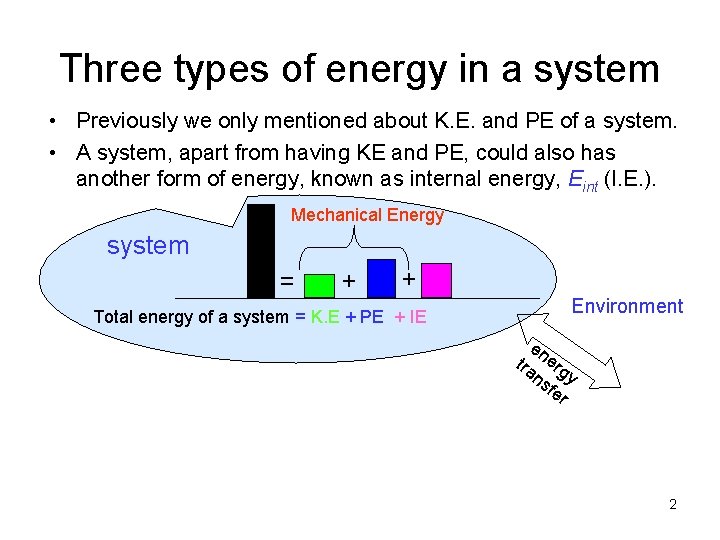
Three types of energy in a system • Previously we only mentioned about K. E. and PE of a system. • A system, apart from having KE and PE, could also has another form of energy, known as internal energy, Eint (I. E. ). Mechanical Energy system = + + Total energy of a system = K. E + PE + IE Environment en t ra e rg ns y fe r 2
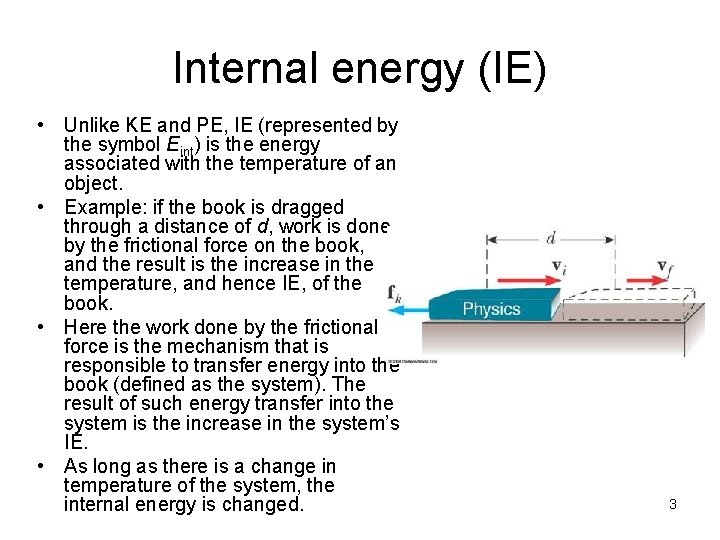
Internal energy (IE) • Unlike KE and PE, IE (represented by the symbol Eint) is the energy associated with the temperature of an object. • Example: if the book is dragged through a distance of d, work is done by the frictional force on the book, and the result is the increase in the temperature, and hence IE, of the book. • Here the work done by the frictional force is the mechanism that is responsible to transfer energy into the book (defined as the system). The result of such energy transfer into the system is the increase in the system’s IE. • As long as there is a change in temperature of the system, the internal energy is changed. 3
Mechanisms to transfer energy across the boundary of a system • The total energy within an system will change if there is energy being transferred across the boundary. • The listed mechanism are the ways energy can be transferred into or out of a system: • Ways (mechanisms) to transfer energy across the boundary and change the total energy of the system: 1. work done by forces (we have seen this in previous chapters) 2. mechanical waves 3. heat 4. mass transfer 5. electrical transmission 6. electromagnetic radiation 4
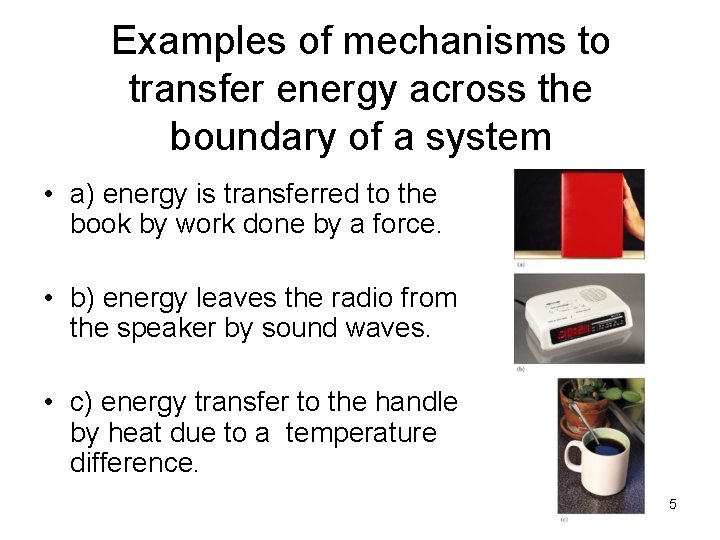
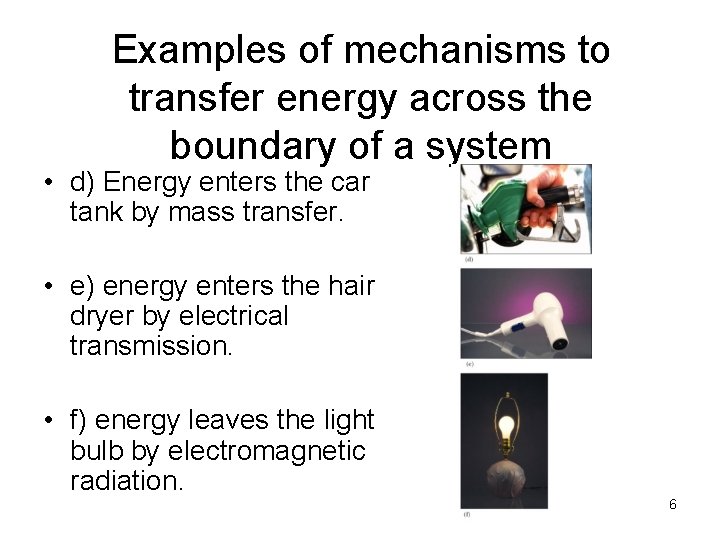
Examples of mechanisms to transfer energy across the boundary of a system • a) energy is transferred to the book by work done by a force. • b) energy leaves the radio from the speaker by sound waves. • c) energy transfer to the handle by heat due to a temperature difference. 5
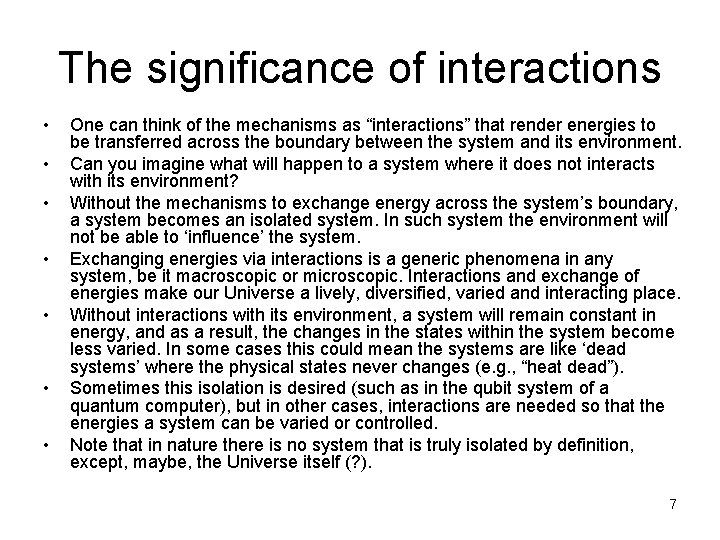
Examples of mechanisms to transfer energy across the boundary of a system • d) Energy enters the car tank by mass transfer. • e) energy enters the hair dryer by electrical transmission. • f) energy leaves the light bulb by electromagnetic radiation. 6
The significance of interactions • • One can think of the mechanisms as “interactions” that render energies to be transferred across the boundary between the system and its environment. Can you imagine what will happen to a system where it does not interacts with its environment? Without the mechanisms to exchange energy across the system’s boundary, a system becomes an isolated system. In such system the environment will not be able to ‘influence’ the system. Exchanging energies via interactions is a generic phenomena in any system, be it macroscopic or microscopic. Interactions and exchange of energies make our Universe a lively, diversified, varied and interacting place. Without interactions with its environment, a system will remain constant in energy, and as a result, the changes in the states within the system become less varied. In some cases this could mean the systems are like ‘dead systems’ where the physical states never changes (e. g. , “heat dead”). Sometimes this isolation is desired (such as in the qubit system of a quantum computer), but in other cases, interactions are needed so that the energies a system can be varied or controlled. Note that in nature there is no system that is truly isolated by definition, except, maybe, the Universe itself (? ). 7
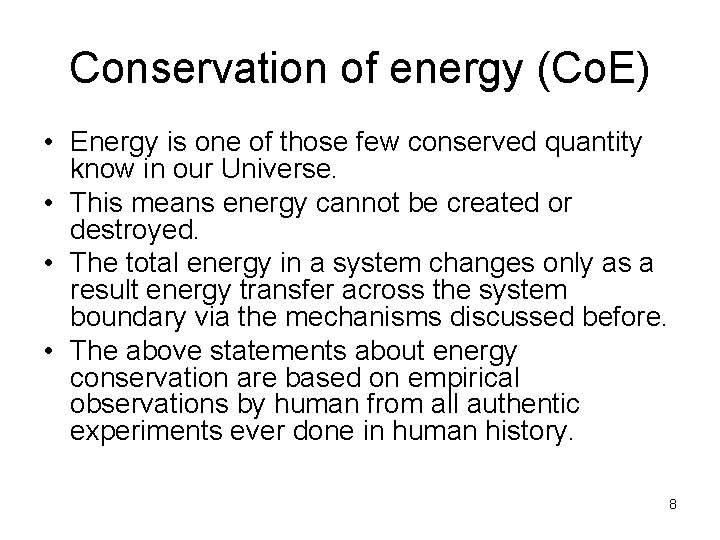
Conservation of energy (Co. E) • Energy is one of those few conserved quantity know in our Universe. • This means energy cannot be created or destroyed. • The total energy in a system changes only as a result energy transfer across the system boundary via the mechanisms discussed before. • The above statements about energy conservation are based on empirical observations by human from all authentic experiments ever done in human history. 8
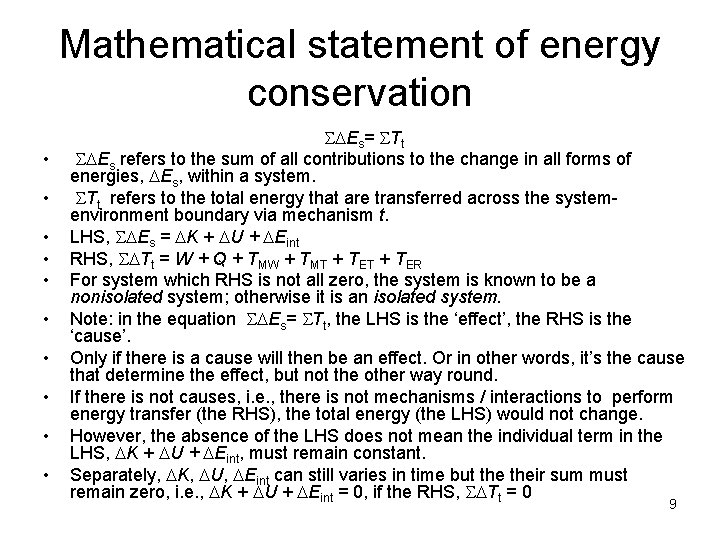
Mathematical statement of energy conservation • • • DEs= Tt DEs refers to the sum of all contributions to the change in all forms of energies, DEs, within a system. Tt refers to the total energy that are transferred across the systemenvironment boundary via mechanism t. LHS, DEs = DK + DU + DEint RHS, DTt = W + Q + TMW + TMT + TER For system which RHS is not all zero, the system is known to be a nonisolated system; otherwise it is an isolated system. Note: in the equation DEs= Tt, the LHS is the ‘effect’, the RHS is the ‘cause’. Only if there is a cause will then be an effect. Or in other words, it’s the cause that determine the effect, but not the other way round. If there is not causes, i. e. , there is not mechanisms / interactions to perform energy transfer (the RHS), the total energy (the LHS) would not change. However, the absence of the LHS does not mean the individual term in the LHS, DK + DU + DEint, must remain constant. Separately, DK, DU, DEint can still varies in time but their sum must remain zero, i. e. , DK + DU + DEint = 0, if the RHS, DTt = 0 9
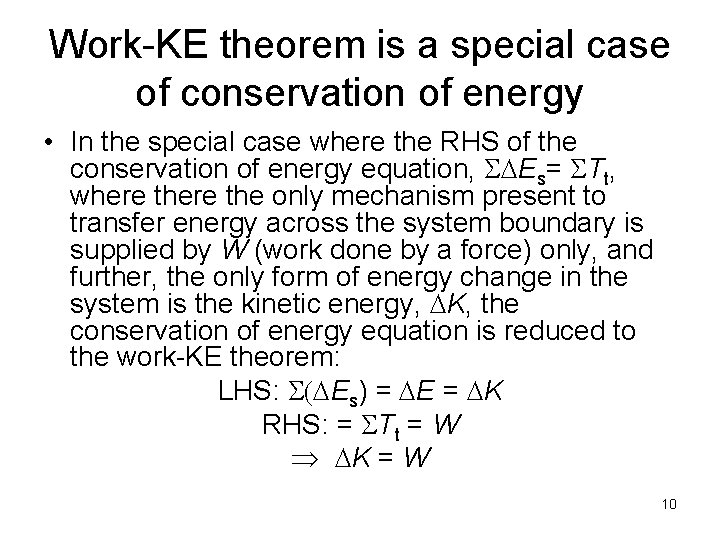
Work-KE theorem is a special case of conservation of energy • In the special case where the RHS of the conservation of energy equation, DEs= Tt, where the only mechanism present to transfer energy across the system boundary is supplied by W (work done by a force) only, and further, the only form of energy change in the system is the kinetic energy, DK, the conservation of energy equation is reduced to the work-KE theorem: LHS: (DEs) = DE = DK RHS: = Tt = W DK = W 10
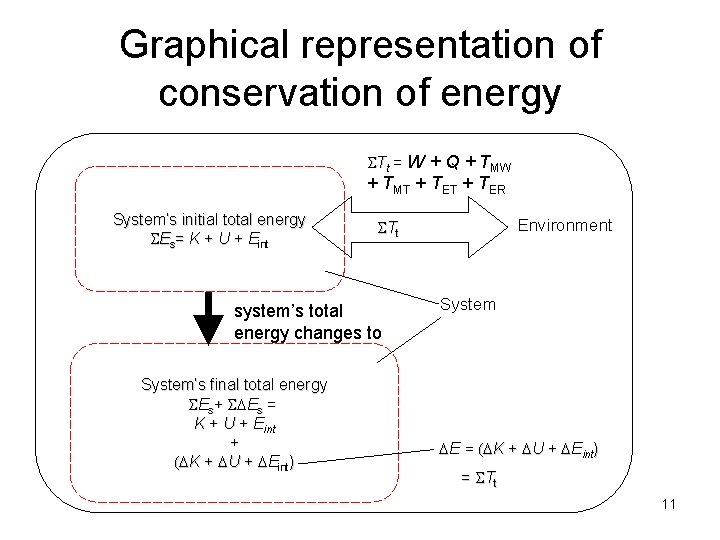
Graphical representation of conservation of energy Tt = W + Q + TMW + TMT + TER System’s initial total energy Es= K + U + Eint system’s total energy changes to System’s final total energy Es+ DEs = K + U + Eint + (DK + DU + DEint) Environment Tt System DE = (DK + DU + DEint) = Tt 11
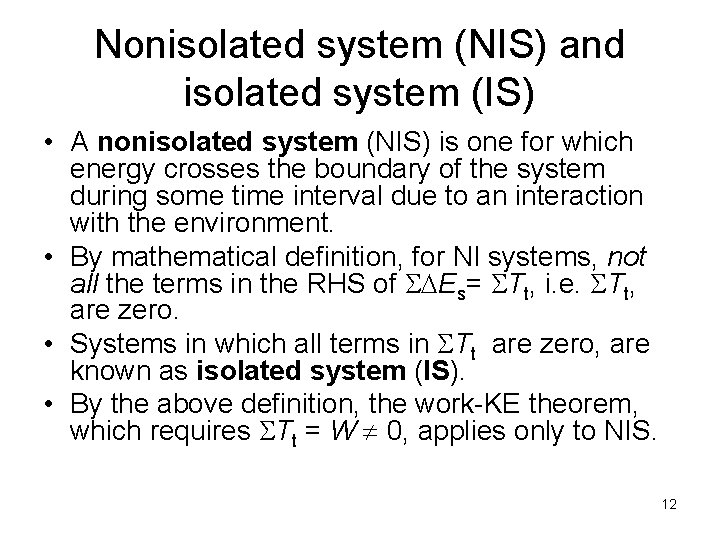
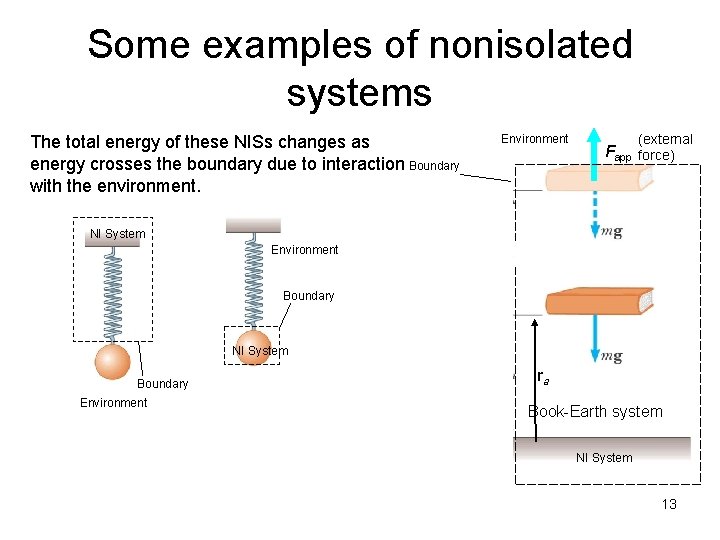
Nonisolated system (NIS) and isolated system (IS) • A nonisolated system (NIS) is one for which energy crosses the boundary of the system during some time interval due to an interaction with the environment. • By mathematical definition, for NI systems, not all the terms in the RHS of DEs= Tt, i. e. Tt, are zero. • Systems in which all terms in Tt are zero, are known as isolated system (IS). • By the above definition, the work-KE theorem, which requires Tt = W 0, applies only to NIS. 12
Some examples of nonisolated systems The total energy of these NISs changes as energy crosses the boundary due to interaction Boundary with the environment. Environment Fapp (external force) NI System Environment Boundary j NI System Boundary Environment ra Book-Earth system NI System 13
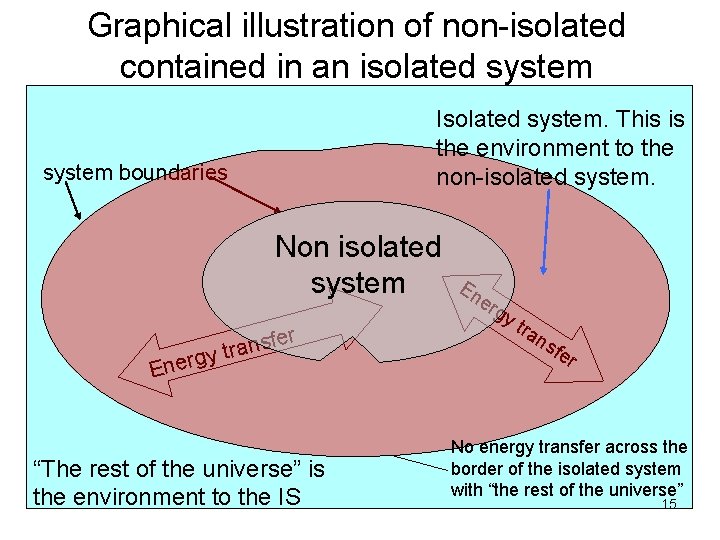
Isolated system • If a system does not interact with its environment, (i. e. , energy does not crosses the border of the system due to the absence of interaction), it’s an isolated system. 14
Graphical illustration of non-isolated contained in an isolated system Isolated system. This is the environment to the non-isolated system boundaries Non isolated system r e f s n a rgy tr Ene “The rest of the universe” is the environment to the IS En erg yt ran sfe r No energy transfer across the border of the isolated system with “the rest of the universe” 15
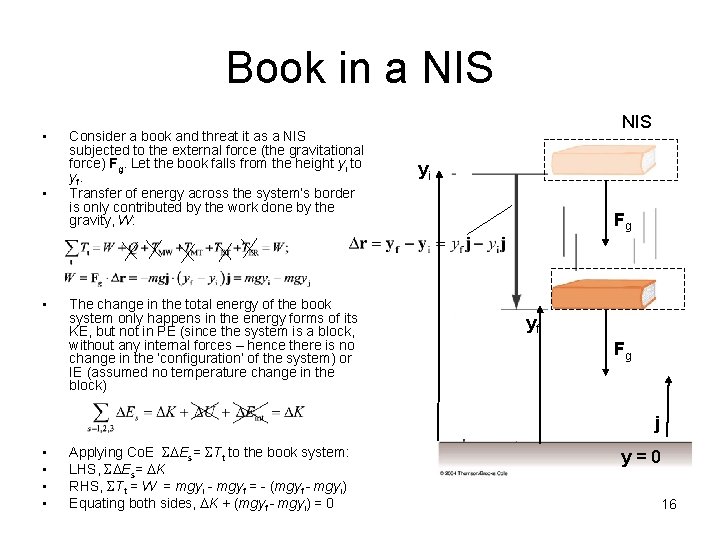
Book in a NIS • • • Consider a book and threat it as a NIS subjected to the external force (the gravitational force) Fg. Let the book falls from the height yi to yf. Transfer of energy across the system’s border is only contributed by the work done by the gravity, W: The change in the total energy of the book system only happens in the energy forms of its KE, but not in PE (since the system is a block, without any internal forces – hence there is no change in the ‘configuration’ of the system) or IE (assumed no temperature change in the block) NIS yi Fg yf Fg j • • Applying Co. E DEs= Tt to the book system: LHS, DEs= DK RHS, Tt = W = mgyi - mgyf = - (mgyf - mgyi) Equating both sides, DK + (mgyf - mgyi) = 0 y=0 16
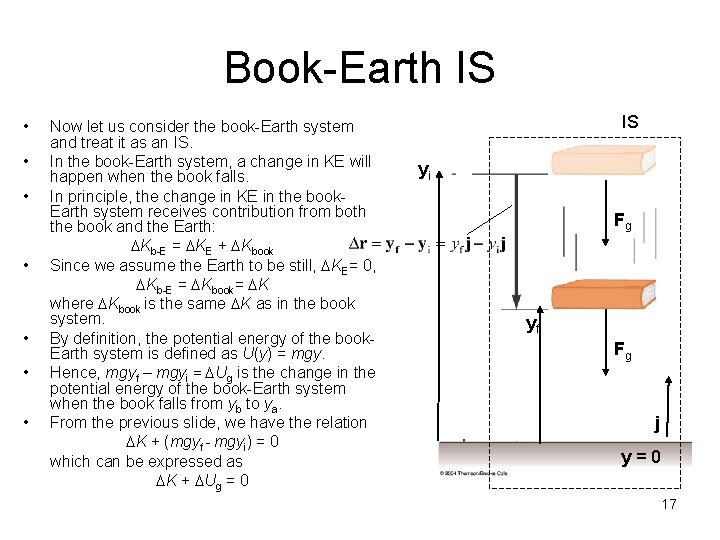
Book-Earth IS • • Now let us consider the book-Earth system and treat it as an IS. In the book-Earth system, a change in KE will happen when the book falls. In principle, the change in KE in the book. Earth system receives contribution from both the book and the Earth: DKb-E = DKE + DKbook Since we assume the Earth to be still, DKE= 0, DKb-E = DKbook= DK where DKbook is the same DK as in the book system. By definition, the potential energy of the book. Earth system is defined as U(y) = mgy. Hence, mgyf – mgyi = DUg is the change in the potential energy of the book-Earth system when the book falls from yb to ya. From the previous slide, we have the relation DK + (mgyf - mgyi) = 0 which can be expressed as DK + DUg = 0 IS yi Fg yf Fg j y=0 17
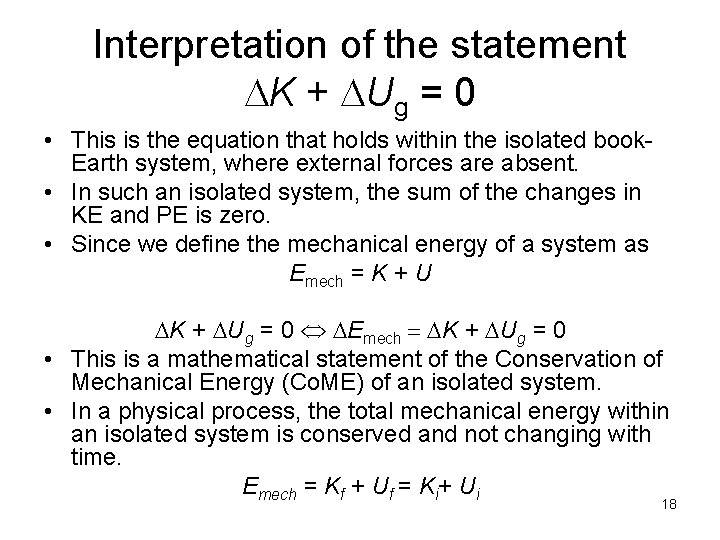
Interpretation of the statement DK + DUg = 0 • This is the equation that holds within the isolated book. Earth system, where external forces are absent. • In such an isolated system, the sum of the changes in KE and PE is zero. • Since we define the mechanical energy of a system as Emech = K + U DK + DUg = 0 DEmech = DK + DUg = 0 • This is a mathematical statement of the Conservation of Mechanical Energy (Co. ME) of an isolated system. • In a physical process, the total mechanical energy within an isolated system is conserved and not changing with time. Emech = Kf + Uf = Ki+ Ui 18
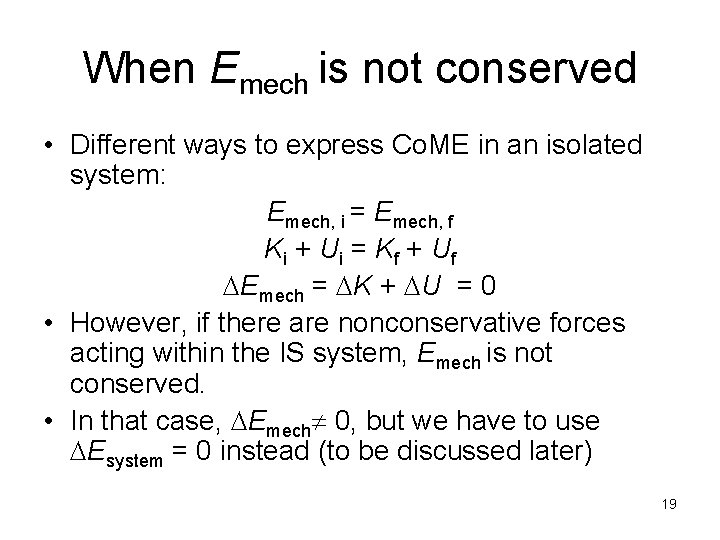
When Emech is not conserved • Different ways to express Co. ME in an isolated system: Emech, i = Emech, f K i + Ui = K f + Uf DEmech = DK + DU = 0 • However, if there are nonconservative forces acting within the IS system, Emech is not conserved. • In that case, DEmech 0, but we have to use DEsystem = 0 instead (to be discussed later) 19
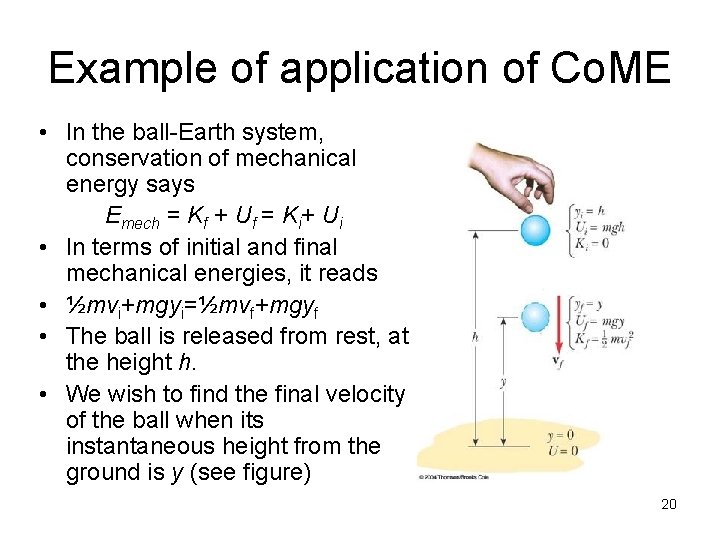
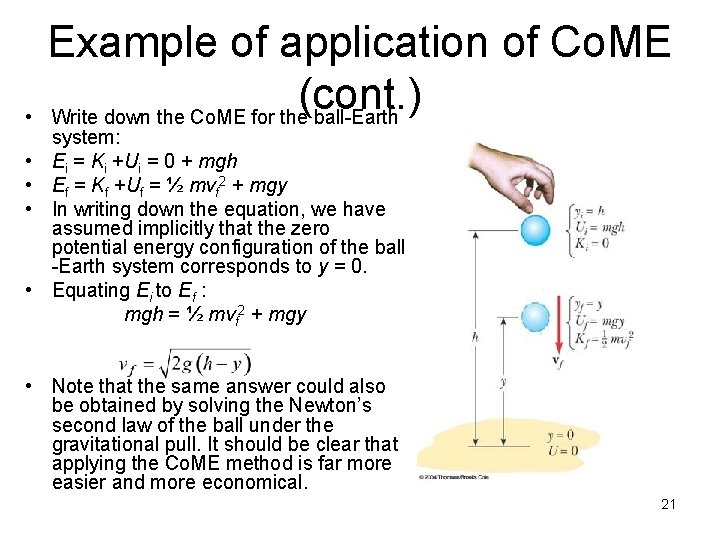
Example of application of Co. ME • In the ball-Earth system, conservation of mechanical energy says Emech = Kf + Uf = Ki+ Ui • In terms of initial and final mechanical energies, it reads • ½mvi+mgyi=½mvf+mgyf • The ball is released from rest, at the height h. • We wish to find the final velocity of the ball when its instantaneous height from the ground is y (see figure) 20
• • • Example of application of Co. ME (cont. ) Write down the Co. ME for the ball-Earth system: Ei = Ki +Ui = 0 + mgh Ef = Kf +Uf = ½ mvf 2 + mgy In writing down the equation, we have assumed implicitly that the zero potential energy configuration of the ball -Earth system corresponds to y = 0. Equating Ei to Ef : mgh = ½ mvf 2 + mgy • Note that the same answer could also be obtained by solving the Newton’s second law of the ball under the gravitational pull. It should be clear that applying the Co. ME method is far more easier and more economical. 21
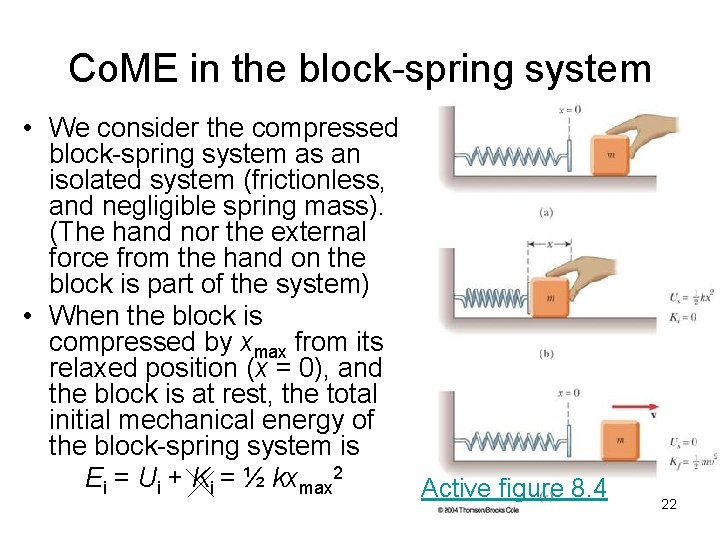
Co. ME in the block-spring system • We consider the compressed block-spring system as an isolated system (frictionless, and negligible spring mass). (The hand nor the external force from the hand on the block is part of the system) • When the block is compressed by xmax from its relaxed position (x = 0), and the block is at rest, the total initial mechanical energy of the block-spring system is Ei = Ui + Ki = ½ kxmax 2 Active figure 8. 4 22
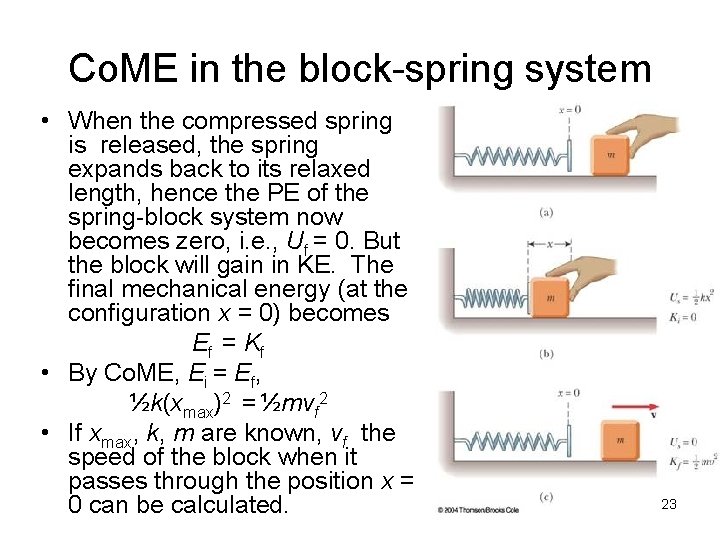
Co. ME in the block-spring system • When the compressed spring is released, the spring expands back to its relaxed length, hence the PE of the spring-block system now becomes zero, i. e. , Uf = 0. But the block will gain in KE. The final mechanical energy (at the configuration x = 0) becomes Ef = Kf • By Co. ME, Ei = Ef, ½k(xmax)2 = ½mvf 2 • If xmax, k, m are known, vf the speed of the block when it passes through the position x = 0 can be calculated. 23
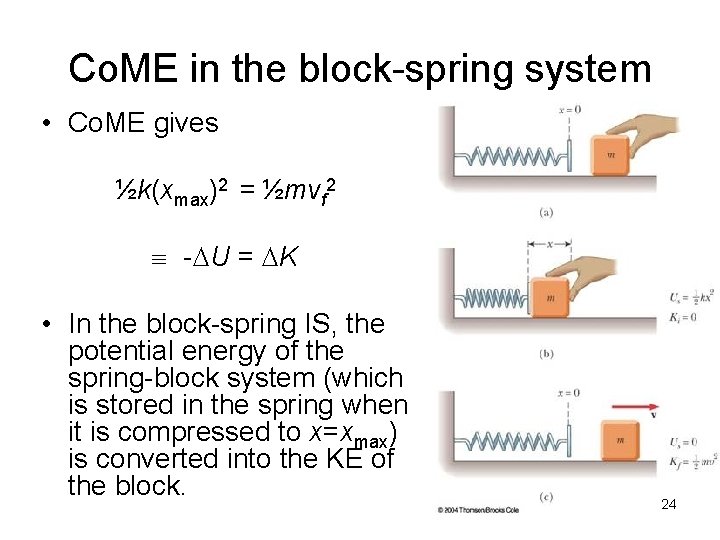
Co. ME in the block-spring system • Co. ME gives ½k(xmax)2 = ½mvf 2 -DU = DK • In the block-spring IS, the potential energy of the spring-block system (which is stored in the spring when it is compressed to x=xmax) is converted into the KE of the block. 24
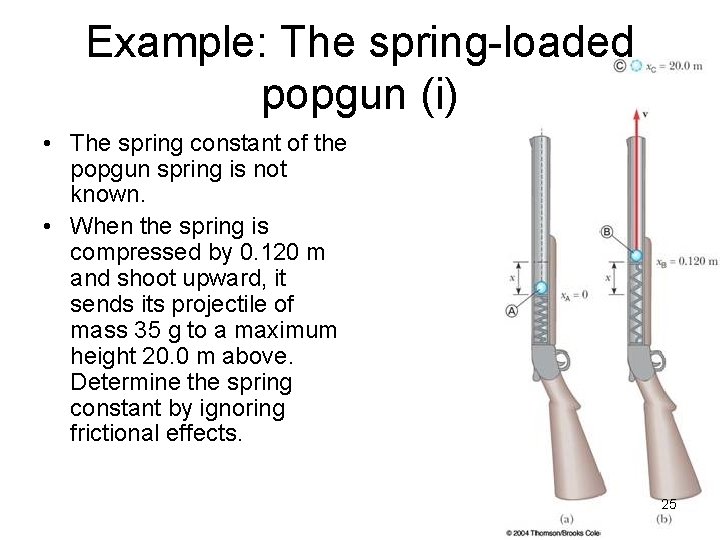
Example: The spring-loaded popgun (i) • The spring constant of the popgun spring is not known. • When the spring is compressed by 0. 120 m and shoot upward, it sends its projectile of mass 35 g to a maximum height 20. 0 m above. Determine the spring constant by ignoring frictional effects. 25
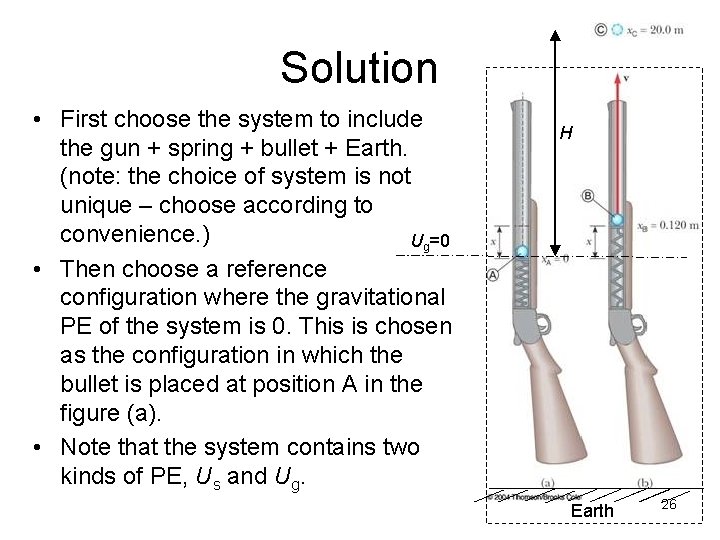
Solution • First choose the system to include the gun + spring + bullet + Earth. (note: the choice of system is not unique – choose according to convenience. ) Ug=0 • Then choose a reference configuration where the gravitational PE of the system is 0. This is chosen as the configuration in which the bullet is placed at position A in the figure (a). • Note that the system contains two kinds of PE, Us and Ug. H Earth 26
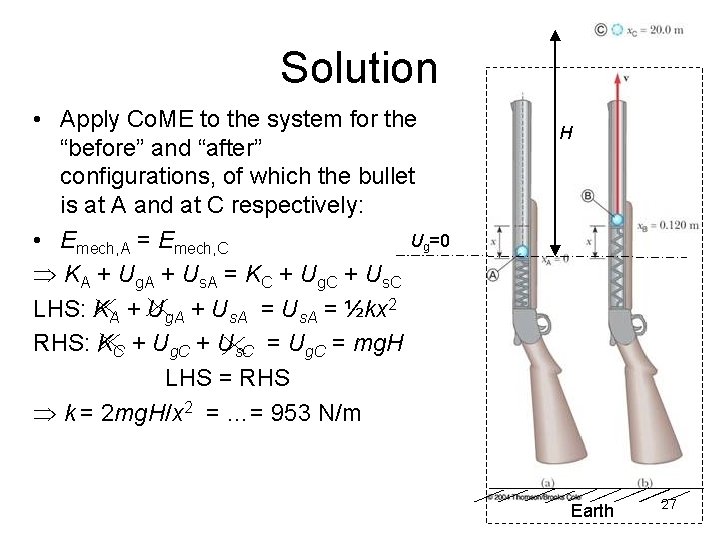
Solution • Apply Co. ME to the system for the “before” and “after” configurations, of which the bullet is at A and at C respectively: Ug=0 • Emech, A = Emech, C KA + Ug. A + Us. A = KC + Ug. C + Us. C LHS: KA + Ug. A + Us. A = ½kx 2 RHS: KC + Ug. C + Us. C = Ug. C = mg. H LHS = RHS k = 2 mg. H/x 2 = …= 953 N/m H Earth 27
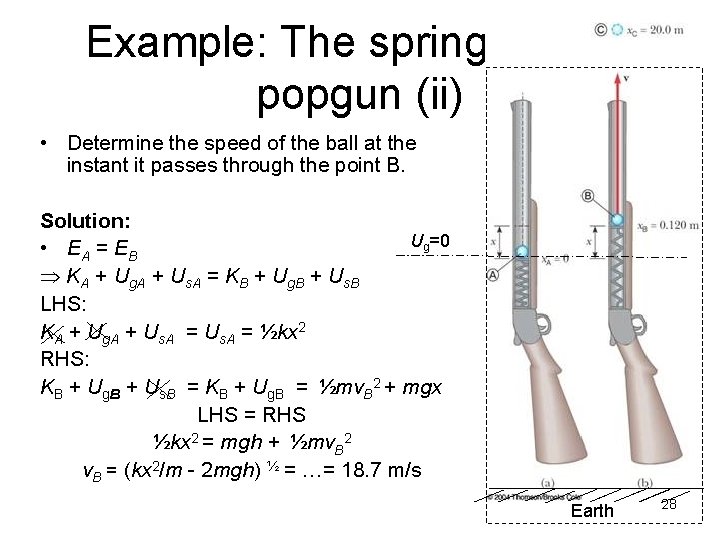
Example: The spring-loaded popgun (ii) • Determine the speed of the ball at the instant it passes through the point B. Solution: Ug=0 • EA = EB KA + Ug. A + Us. A = KB + Ug. B + Us. B LHS: KA + Ug. A + Us. A = ½kx 2 RHS: KB + Ug. B + Us. B = KB + Ug. B = ½mv. B 2 + mgx LHS = RHS ½kx 2 = mgh + ½mv. B 2 v. B = (kx 2/m - 2 mgh) ½ = …= 18. 7 m/s Earth 28
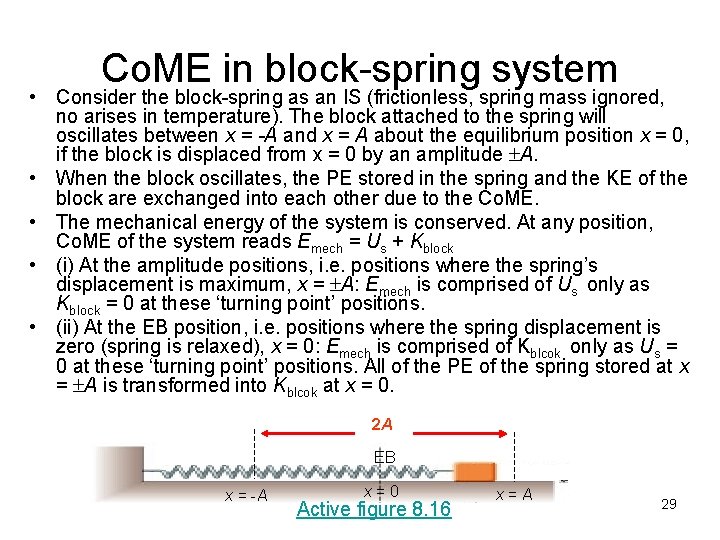
Co. ME in block-spring system • Consider the block-spring as an IS (frictionless, spring mass ignored, no arises in temperature). The block attached to the spring will oscillates between x = -A and x = A about the equilibrium position x = 0, if the block is displaced from x = 0 by an amplitude A. • When the block oscillates, the PE stored in the spring and the KE of the block are exchanged into each other due to the Co. ME. • The mechanical energy of the system is conserved. At any position, Co. ME of the system reads Emech = Us + Kblock • (i) At the amplitude positions, i. e. positions where the spring’s displacement is maximum, x = A: Emech is comprised of Us only as Kblock = 0 at these ‘turning point’ positions. • (ii) At the EB position, i. e. positions where the spring displacement is zero (spring is relaxed), x = 0: Emech is comprised of Kblcok only as Us = 0 at these ‘turning point’ positions. All of the PE of the spring stored at x = A is transformed into Kblcok at x = 0. 2 A EB x = -A x=0 Active figure 8. 16 x=A 29
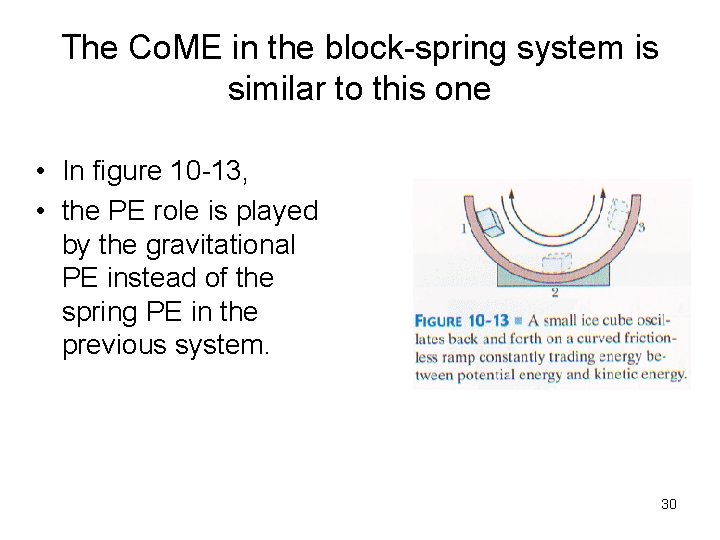
The Co. ME in the block-spring system is similar to this one • In figure 10 -13, • the PE role is played by the gravitational PE instead of the spring PE in the previous system. 30
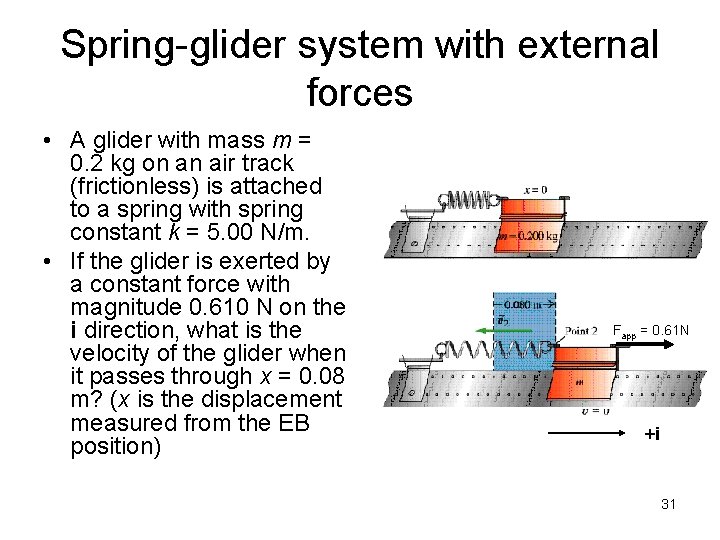
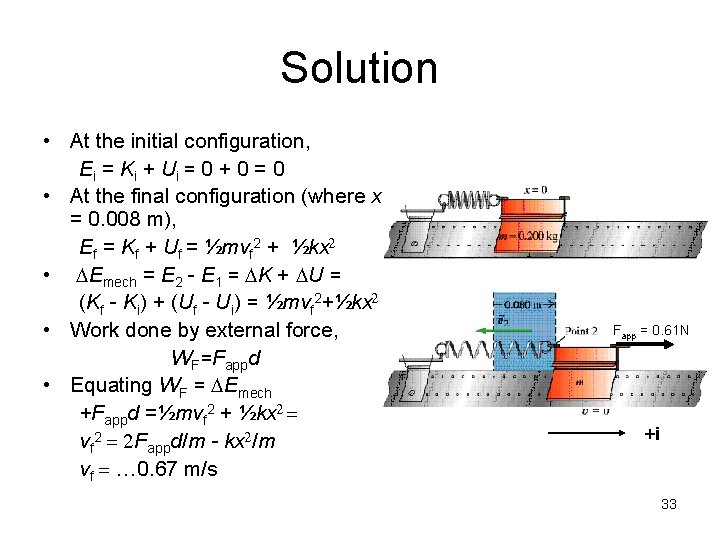
Spring-glider system with external forces • A glider with mass m = 0. 2 kg on an air track (frictionless) is attached to a spring with spring constant k = 5. 00 N/m. • If the glider is exerted by a constant force with magnitude 0. 610 N on the i direction, what is the velocity of the glider when it passes through x = 0. 08 m? (x is the displacement measured from the EB position) Fapp = 0. 61 N +i 31
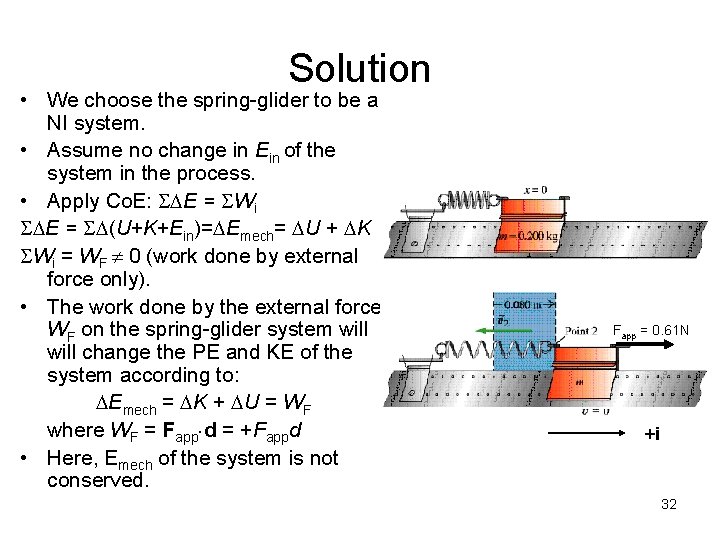
Solution • We choose the spring-glider to be a NI system. • Assume no change in Ein of the system in the process. • Apply Co. E: DE = Wi DE = D(U+K+Ein)=DEmech= DU + DK Wi = WF 0 (work done by external force only). • The work done by the external force WF on the spring-glider system will change the PE and KE of the system according to: DEmech = DK + DU = WF where WF = Fapp d = +Fappd • Here, Emech of the system is not conserved. Fapp = 0. 61 N +i 32
Solution • At the initial configuration, E i = K i + Ui = 0 + 0 = 0 • At the final configuration (where x = 0. 008 m), Ef = Kf + Uf = ½mvf 2 + ½kx 2 • DEmech = E 2 - E 1 = DK + DU = (Kf - Ki) + (Uf - Ui) = ½mvf 2+½kx 2 • Work done by external force, WF=Fappd • Equating WF = DEmech +Fappd =½mvf 2 + ½kx 2 = vf 2 = 2 Fappd/m - kx 2/m vf = … 0. 67 m/s Fapp = 0. 61 N +i 33
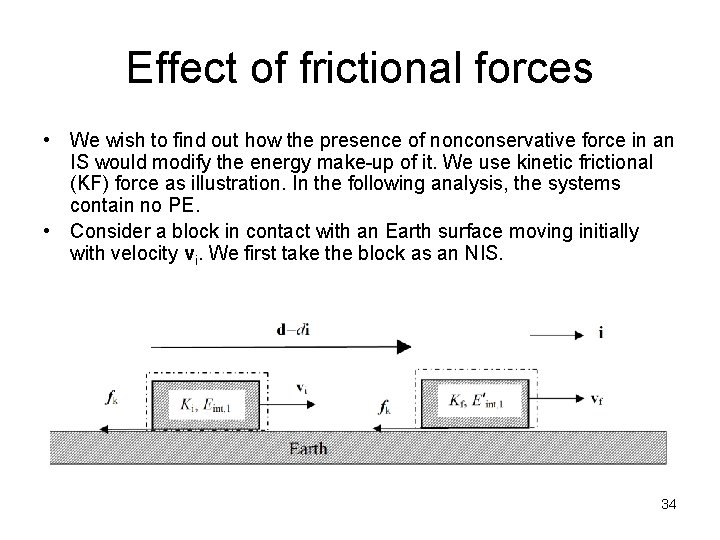
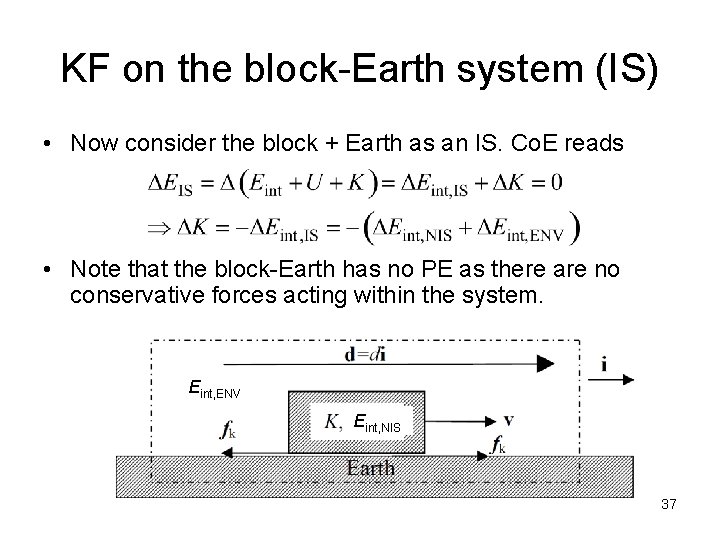
Effect of frictional forces • We wish to find out how the presence of nonconservative force in an IS would modify the energy make-up of it. We use kinetic frictional (KF) force as illustration. In the following analysis, the systems contain no PE. • Consider a block in contact with an Earth surface moving initially with velocity vi. We first take the block as an NIS. 34
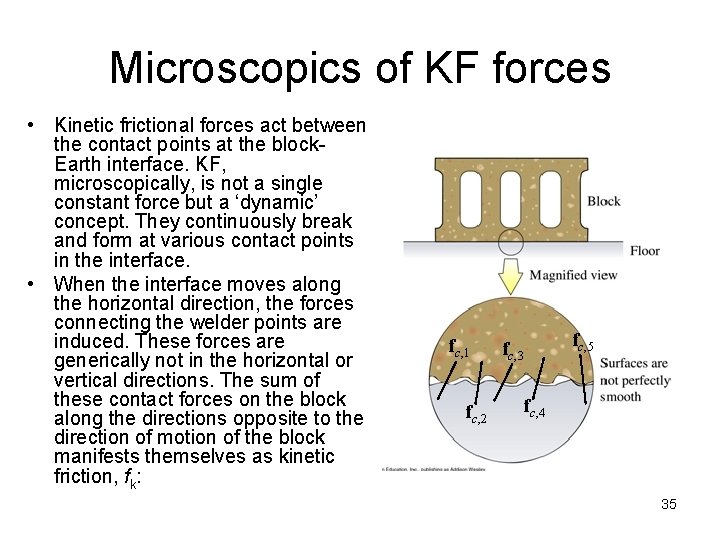
Microscopics of KF forces • Kinetic frictional forces act between the contact points at the block. Earth interface. KF, microscopically, is not a single constant force but a ‘dynamic’ concept. They continuously break and form at various contact points in the interface. • When the interface moves along the horizontal direction, the forces connecting the welder points are induced. These forces are generically not in the horizontal or vertical directions. The sum of these contact forces on the block along the directions opposite to the direction of motion of the block manifests themselves as kinetic friction, fk: fc, 1 fc, 2 fc, 3 fc, 5 fc, 4 35
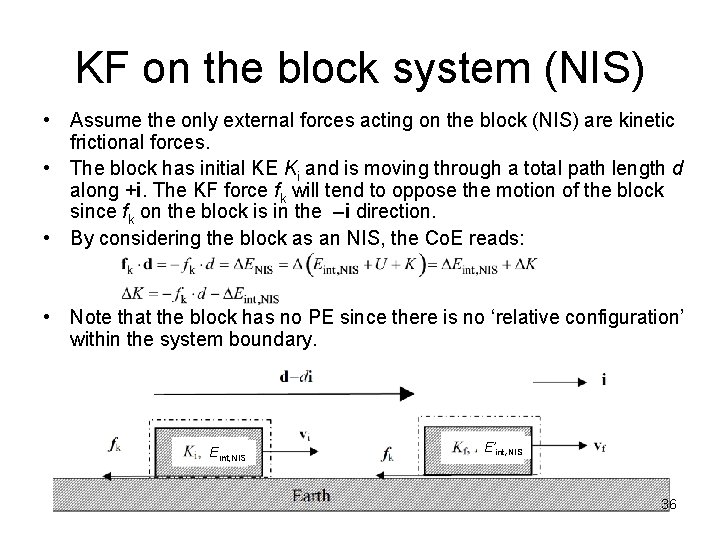
KF on the block system (NIS) • Assume the only external forces acting on the block (NIS) are kinetic frictional forces. • The block has initial KE Ki and is moving through a total path length d along +i. The KF force fk will tend to oppose the motion of the block since fk on the block is in the –i direction. • By considering the block as an NIS, the Co. E reads: • Note that the block has no PE since there is no ‘relative configuration’ within the system boundary. Eint, NIS E’int, NIS 36
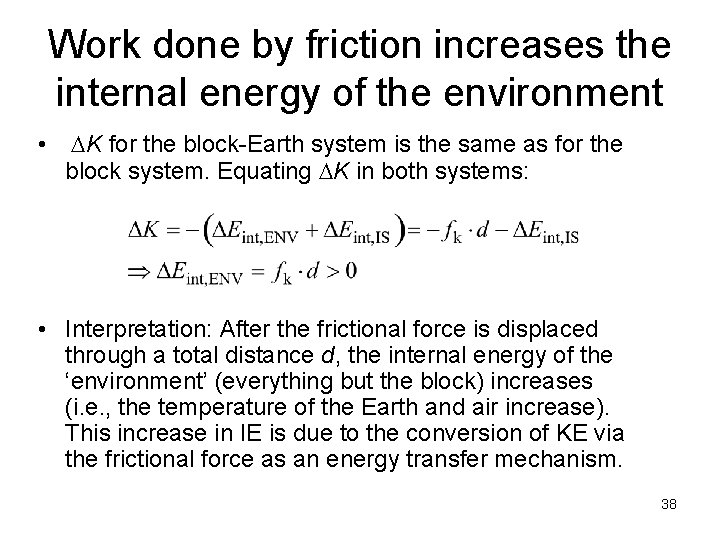
KF on the block-Earth system (IS) • Now consider the block + Earth as an IS. Co. E reads • Note that the block-Earth has no PE as there are no conservative forces acting within the system. Eint, ENV Eint, NIS 37
Work done by friction increases the internal energy of the environment • DK for the block-Earth system is the same as for the block system. Equating DK in both systems: • Interpretation: After the frictional force is displaced through a total distance d, the internal energy of the ‘environment’ (everything but the block) increases (i. e. , the temperature of the Earth and air increase). This increase in IE is due to the conversion of KE via the frictional force as an energy transfer mechanism. 38
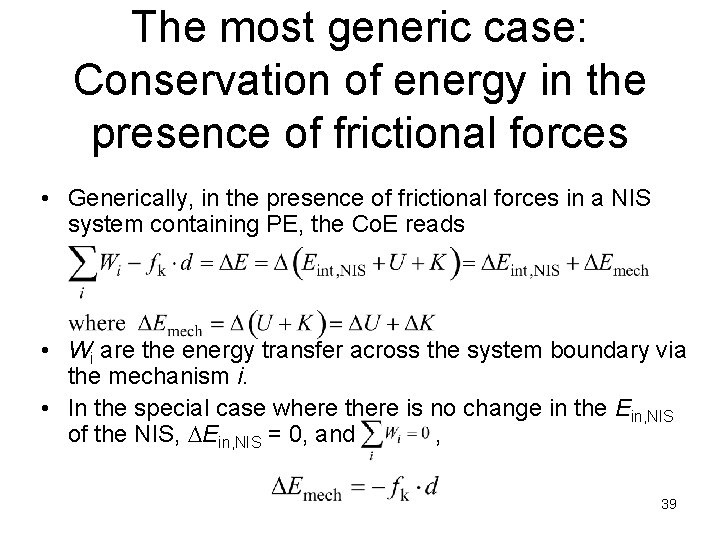
The most generic case: Conservation of energy in the presence of frictional forces • Generically, in the presence of frictional forces in a NIS system containing PE, the Co. E reads • Wi are the energy transfer across the system boundary via the mechanism i. • In the special case where there is no change in the Ein, NIS of the NIS, DEin, NIS = 0, and , 39
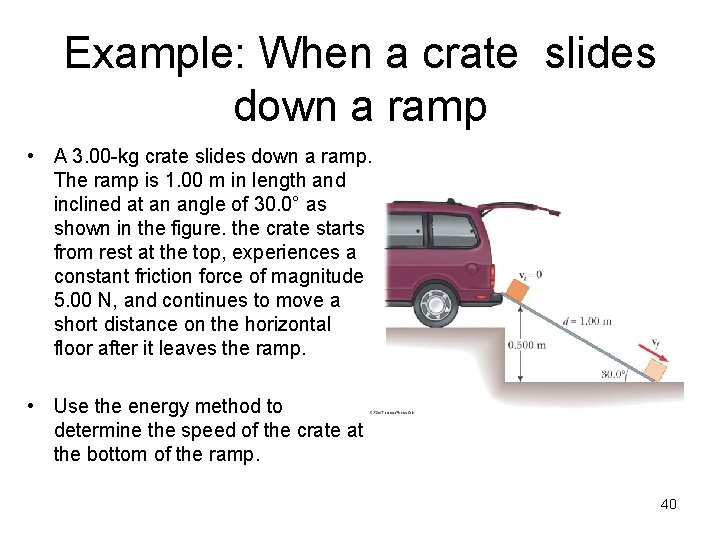
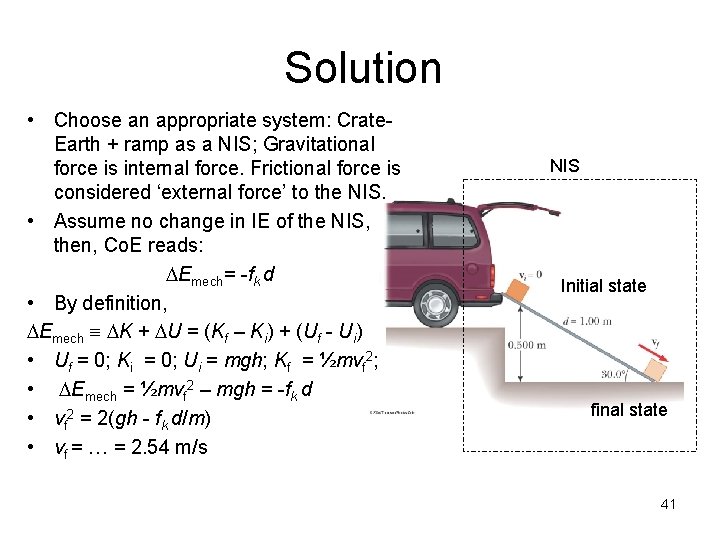
Example: When a crate slides down a ramp • A 3. 00 -kg crate slides down a ramp. The ramp is 1. 00 m in length and inclined at an angle of 30. 0° as shown in the figure. the crate starts from rest at the top, experiences a constant friction force of magnitude 5. 00 N, and continues to move a short distance on the horizontal floor after it leaves the ramp. • Use the energy method to determine the speed of the crate at the bottom of the ramp. 40
Solution • Choose an appropriate system: Crate. Earth + ramp as a NIS; Gravitational force is internal force. Frictional force is considered ‘external force’ to the NIS. • Assume no change in IE of the NIS, then, Co. E reads: DEmech= -fk d • By definition, DEmech DK + DU = (Kf – Ki) + (Uf - Ui) • Uf = 0; Ki = 0; Ui = mgh; Kf = ½mvf 2; • DEmech = ½mvf 2 – mgh = -fk d • vf 2 = 2(gh - fk d/m) • vf = … = 2. 54 m/s NIS Initial state final state 41
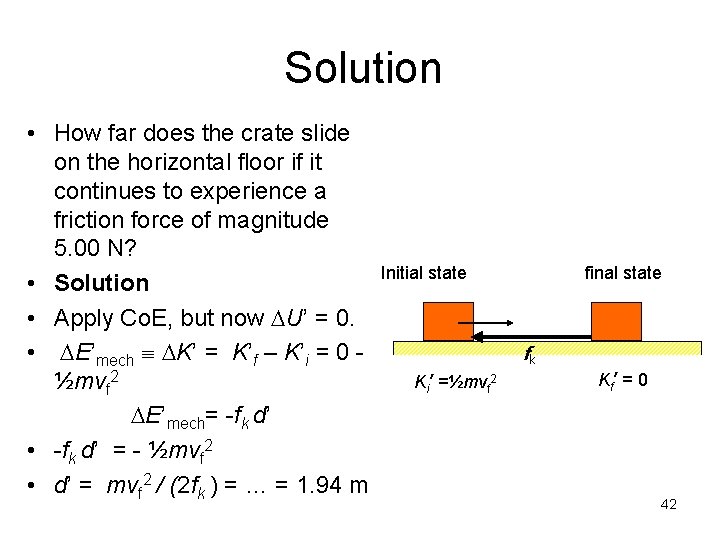
Solution • How far does the crate slide on the horizontal floor if it continues to experience a friction force of magnitude 5. 00 N? • Solution • Apply Co. E, but now DU’ = 0. • DE’mech DK’ = K’f – K’i = 0 ½mvf 2 DE’mech= -fk d’ • -fk d’ = - ½mvf 2 • d’ = mvf 2 / (2 fk ) = … = 1. 94 m Initial state final state fk Ki’ =½mvf 2 Kf’ = 0 42
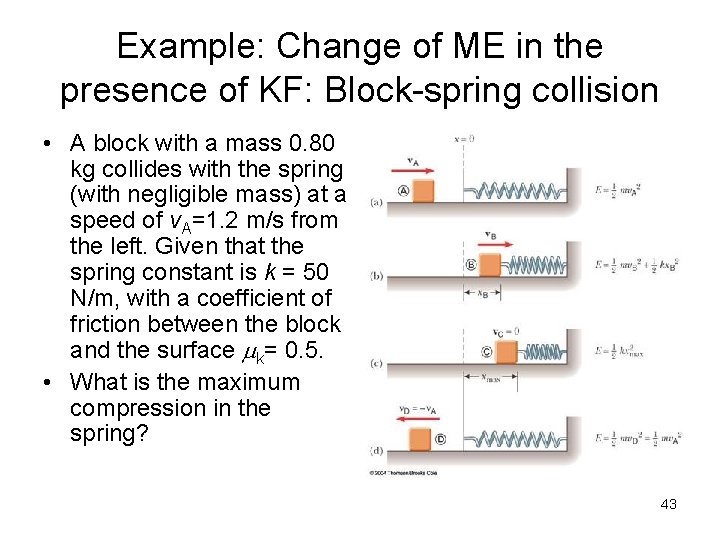
Example: Change of ME in the presence of KF: Block-spring collision • A block with a mass 0. 80 kg collides with the spring (with negligible mass) at a speed of v. A=1. 2 m/s from the left. Given that the spring constant is k = 50 N/m, with a coefficient of friction between the block and the surface mk= 0. 5. • What is the maximum compression in the spring? 43
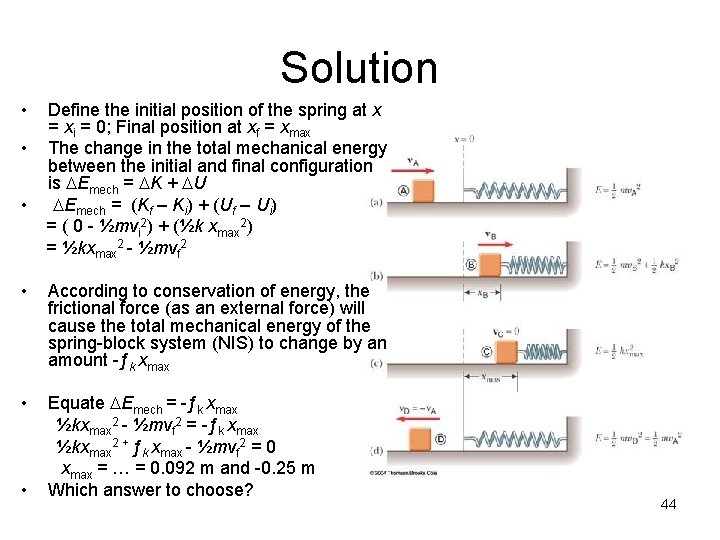
Solution • • • Define the initial position of the spring at x = xi = 0; Final position at xf = xmax The change in the total mechanical energy between the initial and final configuration is DEmech = DK + DU DEmech = (Kf – Ki) + (Uf – Ui) = ( 0 - ½mvi 2) + (½k xmax 2) = ½kxmax 2 - ½mvf 2 • According to conservation of energy, the frictional force (as an external force) will cause the total mechanical energy of the spring-block system (NIS) to change by an amount -ƒk xmax • Equate DEmech = -ƒk xmax ½kxmax 2 - ½mvf 2 = -ƒk xmax ½kxmax 2 + ƒk xmax - ½mvf 2 = 0 xmax = … = 0. 092 m and -0. 25 m Which answer to choose? • 44
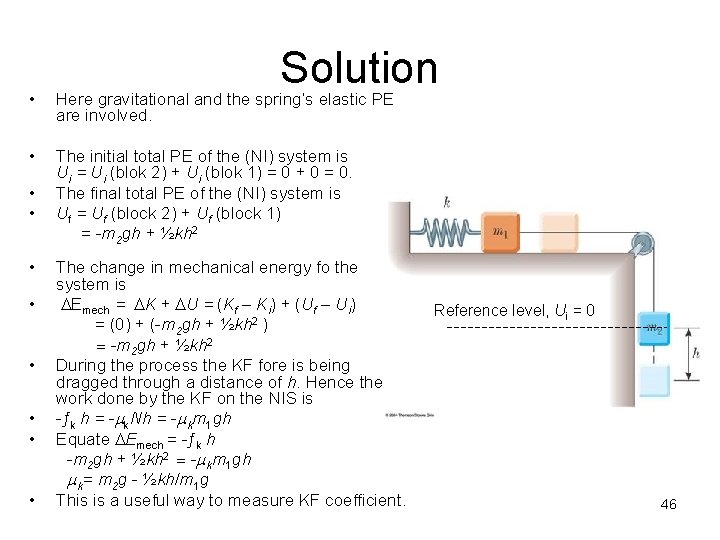
Connected block • The system is chosen to be an NIS consisting of the two blocks + spring + the Earth + the string. • KF force, as an external force, acts on block when it moves along the horizontal surface. • The system starts from the rest and m 2 falls through a vertical distance of h before the blocks come to rest. • Calculate the coefficient of KF. NIS 45
Solution • Here gravitational and the spring’s elastic PE are involved. • The initial total PE of the (NI) system is Ui = Ui (blok 2) + Ui (blok 1) = 0 + 0 = 0. The final total PE of the (NI) system is Uf = Uf (block 2) + Uf (block 1) = -m 2 gh + ½kh 2 • • The change in mechanical energy fo the system is DEmech = DK + DU = (Kf – Ki) + (Uf – Ui) = (0) + (-m 2 gh + ½kh 2 ) = -m 2 gh + ½kh 2 During the process the KF fore is being dragged through a distance of h. Hence the work done by the KF on the NIS is -ƒk h = -mk. Nh = -mkm 1 gh Equate DEmech = -ƒk h -m 2 gh + ½kh 2 = -mkm 1 gh mk= m 2 g - ½kh/m 1 g This is a useful way to measure KF coefficient. Reference level, Ui = 0 46
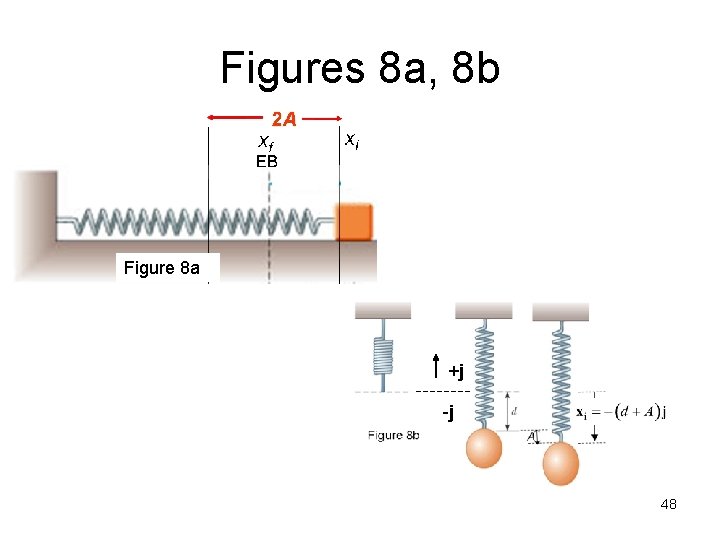
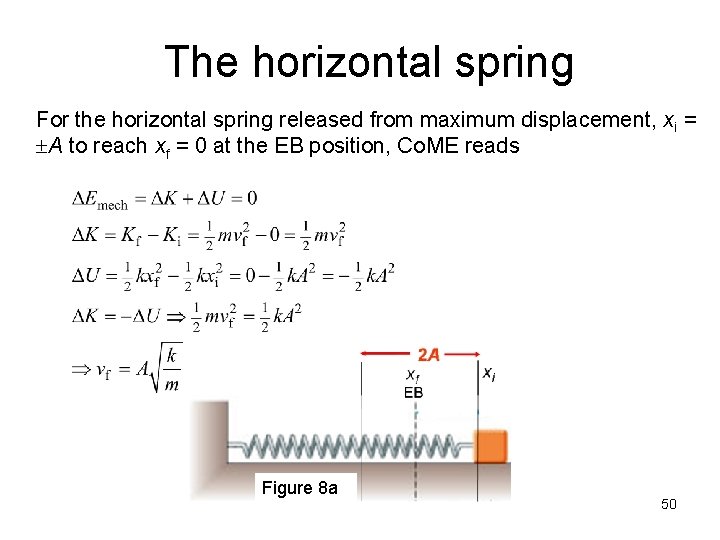
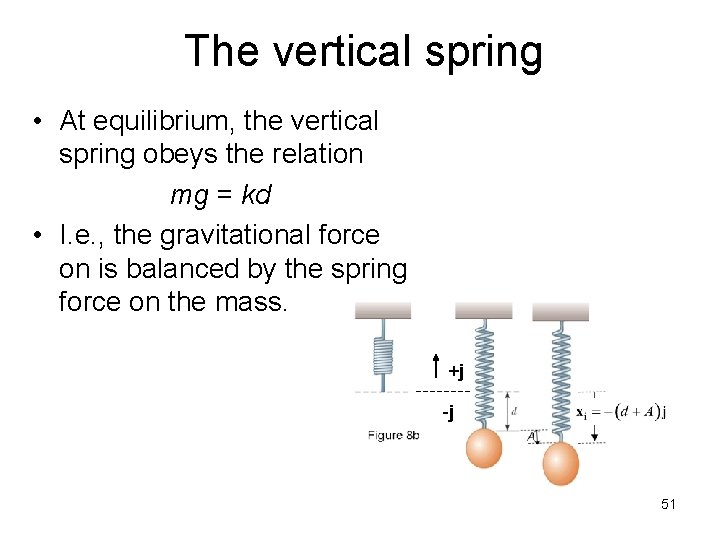
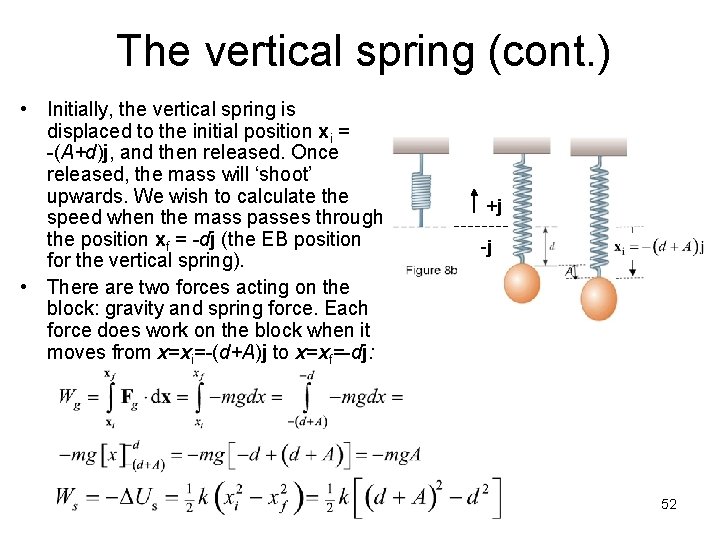
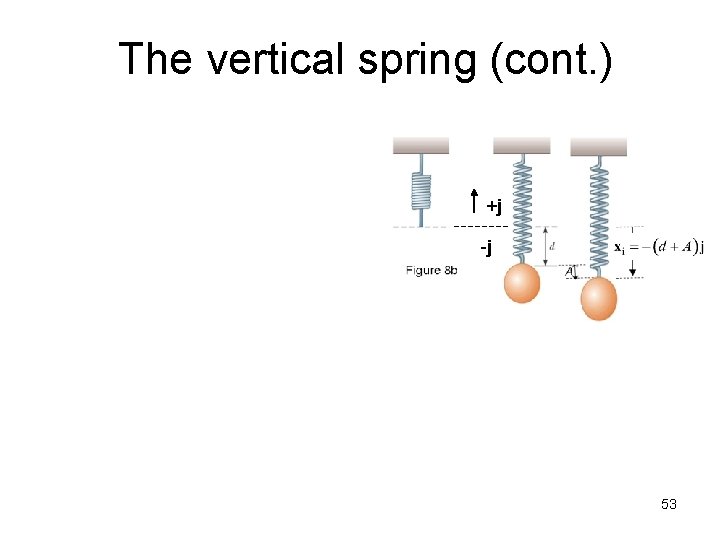
Example • A mass on a horizontal frictionless surface is connected to a spring, as illustrated in Figure 8 a. The mass is displaced a distance A from its equilibrium position and released. The speed of the mass at the moment it crosses the equilibrium position is measured. The same spring and mass are now hung in the vertical position as illustrated in Figure 8 b, and the mass now sits at a new equilibrium position, a distance d from the spring’s equilibrium position, as shown. If the mass is now displaced a distance A from its new equilibrium position and released, what is the speed of the mass when it crosses its new equilibrium position compared to that in the horizontal case? 47
Figures 8 a, 8 b Figure 8 a +j -j 48
Solution • To answer the question, apply work-KE theorem to each case to find out the KE of the block at their respective EB position in the spring systems. 49
The horizontal spring For the horizontal spring released from maximum displacement, xi = A to reach xf = 0 at the EB position, Co. ME reads Figure 8 a 50
The vertical spring • At equilibrium, the vertical spring obeys the relation mg = kd • I. e. , the gravitational force on is balanced by the spring force on the mass. +j -j 51
The vertical spring (cont. ) • Initially, the vertical spring is displaced to the initial position xi = -(A+d)j, and then released. Once released, the mass will ‘shoot’ upwards. We wish to calculate the speed when the mass passes through the position xf = -dj (the EB position for the vertical spring). • There are two forces acting on the block: gravity and spring force. Each force does work on the block when it moves from x=xi=-(d+A)j to x=xf=-dj: +j -j 52
The vertical spring (cont. ) +j -j 53
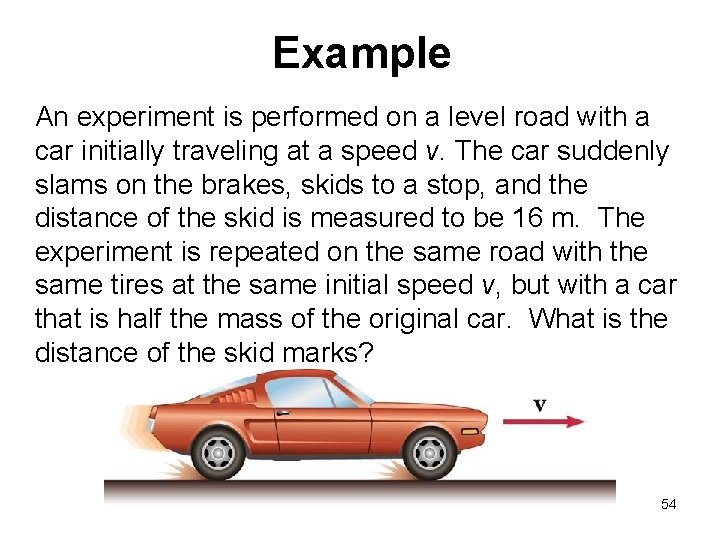
Example An experiment is performed on a level road with a car initially traveling at a speed v. The car suddenly slams on the brakes, skids to a stop, and the distance of the skid is measured to be 16 m. The experiment is repeated on the same road with the same tires at the same initial speed v, but with a car that is half the mass of the original car. What is the distance of the skid marks? 54
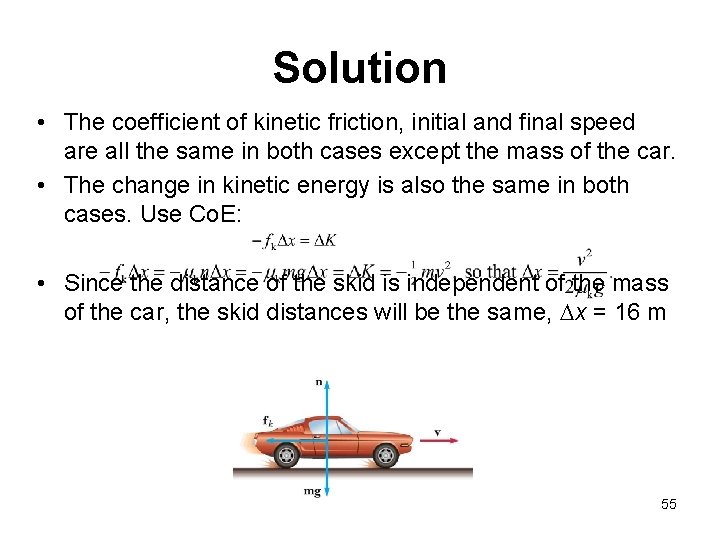
Solution • The coefficient of kinetic friction, initial and final speed are all the same in both cases except the mass of the car. • The change in kinetic energy is also the same in both cases. Use Co. E: • Since the distance of the skid is independent of the mass of the car, the skid distances will be the same, Dx = 16 m 55
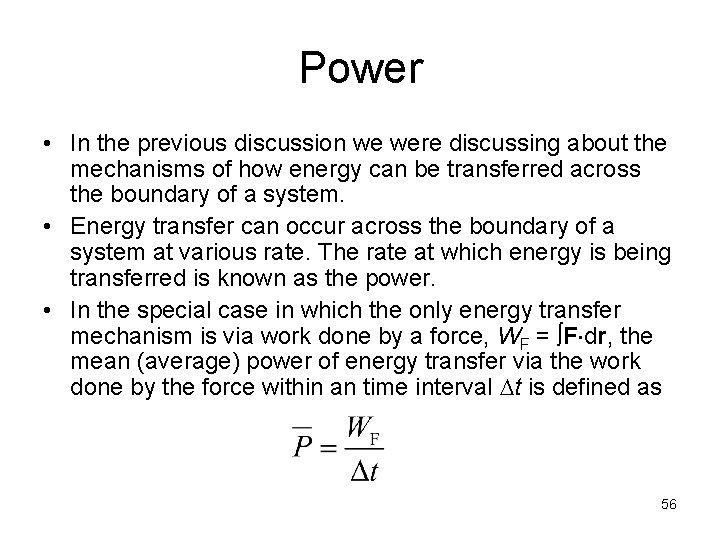
Power • In the previous discussion we were discussing about the mechanisms of how energy can be transferred across the boundary of a system. • Energy transfer can occur across the boundary of a system at various rate. The rate at which energy is being transferred is known as the power. • In the special case in which the only energy transfer mechanism is via work done by a force, WF = F dr, the mean (average) power of energy transfer via the work done by the force within an time interval Dt is defined as 56
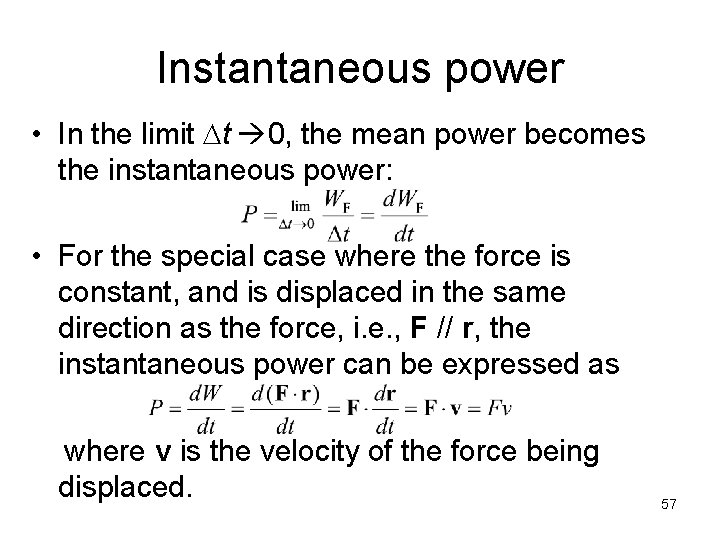
Instantaneous power • In the limit Dt 0, the mean power becomes the instantaneous power: • For the special case where the force is constant, and is displaced in the same direction as the force, i. e. , F // r, the instantaneous power can be expressed as where v is the velocity of the force being displaced. 57
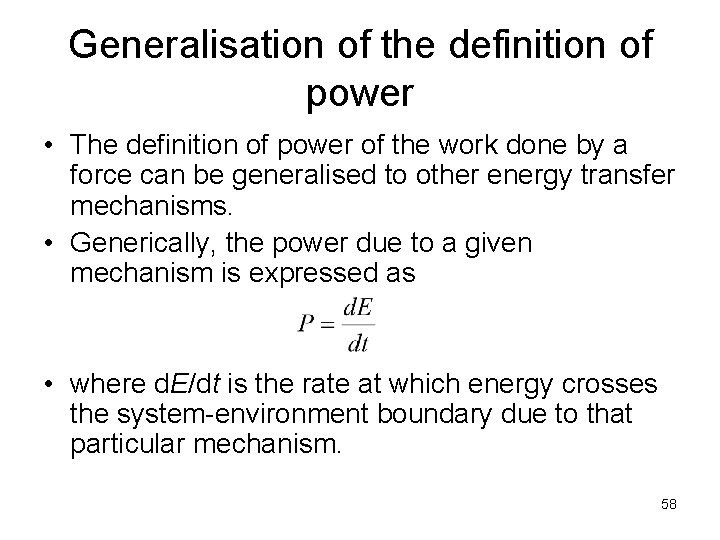
Generalisation of the definition of power • The definition of power of the work done by a force can be generalised to other energy transfer mechanisms. • Generically, the power due to a given mechanism is expressed as • where d. E/dt is the rate at which energy crosses the system-environment boundary due to that particular mechanism. 58
The unit for power • The SI unit for power is watt. • 1 watt = 1 joule / second = 1 kg. m 2/s 2 • It is also common to use the non SI unit “horsepower ” (hp) : 1 hp = 746 W. • Example: a National aircon of 1 hp is sold at the prize RM 950; 1. 5 h. p. at RM 1400 (during sale) • Power can also be used in expressing the amount of energy or work done: • 1 k. Wh = (1000 W)(3600 s) = 3. 6 x 10⁶ J 59
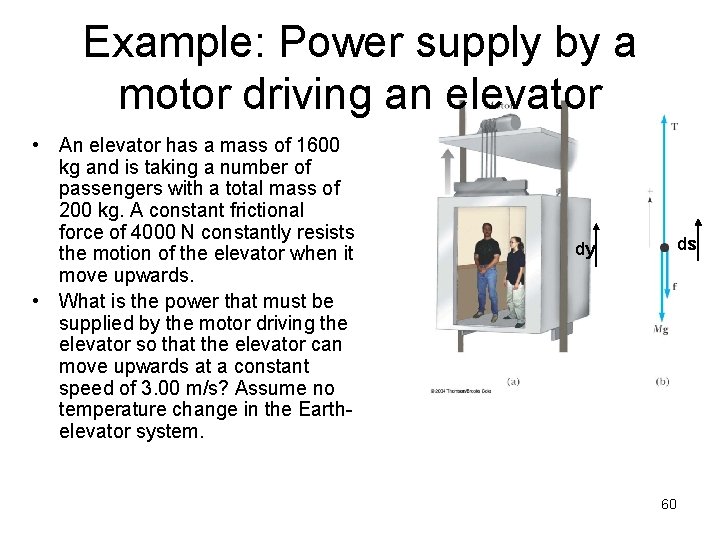
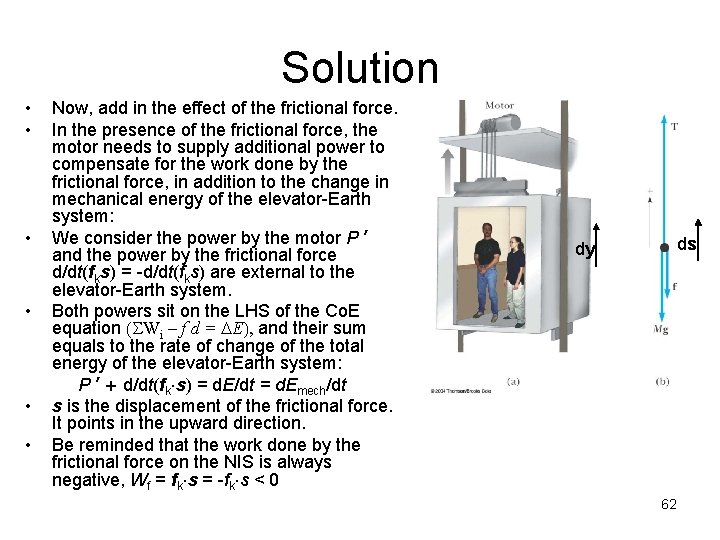
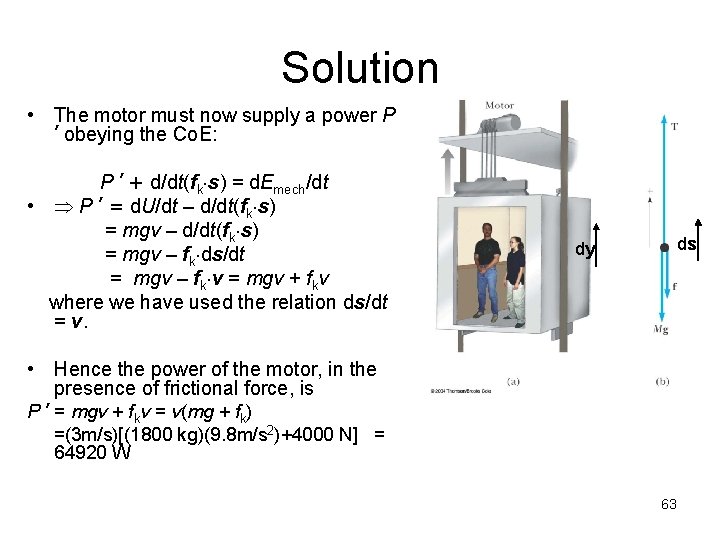
Example: Power supply by a motor driving an elevator • An elevator has a mass of 1600 kg and is taking a number of passengers with a total mass of 200 kg. A constant frictional force of 4000 N constantly resists the motion of the elevator when it move upwards. • What is the power that must be supplied by the motor driving the elevator so that the elevator can move upwards at a constant speed of 3. 00 m/s? Assume no temperature change in the Earthelevator system. ds dy 60
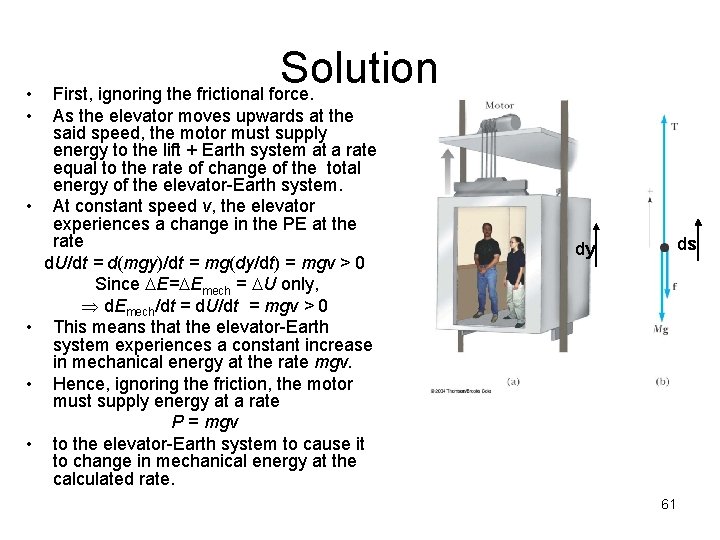
• • • Solution First, ignoring the frictional force. As the elevator moves upwards at the said speed, the motor must supply energy to the lift + Earth system at a rate equal to the rate of change of the total energy of the elevator-Earth system. At constant speed v, the elevator experiences a change in the PE at the rate d. U/dt = d(mgy)/dt = mg(dy/dt) = mgv > 0 Since DE=DEmech = DU only, d. Emech/dt = d. U/dt = mgv > 0 This means that the elevator-Earth system experiences a constant increase in mechanical energy at the rate mgv. Hence, ignoring the friction, the motor must supply energy at a rate P = mgv to the elevator-Earth system to cause it to change in mechanical energy at the calculated rate. ds dy 61
Solution • • • Now, add in the effect of the frictional force. In the presence of the frictional force, the motor needs to supply additional power to compensate for the work done by the frictional force, in addition to the change in mechanical energy of the elevator-Earth system: We consider the power by the motor P ’ and the power by the frictional force d/dt(fks) = -d/dt(fks) are external to the elevator-Earth system. Both powers sit on the LHS of the Co. E equation ( Wi – f d = DE), and their sum equals to the rate of change of the total energy of the elevator-Earth system: P ’ + d/dt(fk s) = d. E/dt = d. Emech/dt s is the displacement of the frictional force. It points in the upward direction. Be reminded that the work done by the frictional force on the NIS is always negative, Wf = fk s = -fk s < 0 ds dy 62
Solution • The motor must now supply a power P ’ obeying the Co. E: P ’ + d/dt(fk s) = d. Emech/dt • P ’ = d. U/dt – d/dt(fk s) = mgv – fk ds/dt = mgv – fk v = mgv + fkv where we have used the relation ds/dt = v. ds dy • Hence the power of the motor, in the presence of frictional force, is P ’ = mgv + fkv = v(mg + fk) =(3 m/s)[(1800 kg)(9. 8 m/s 2)+4000 N] = 64920 W 63
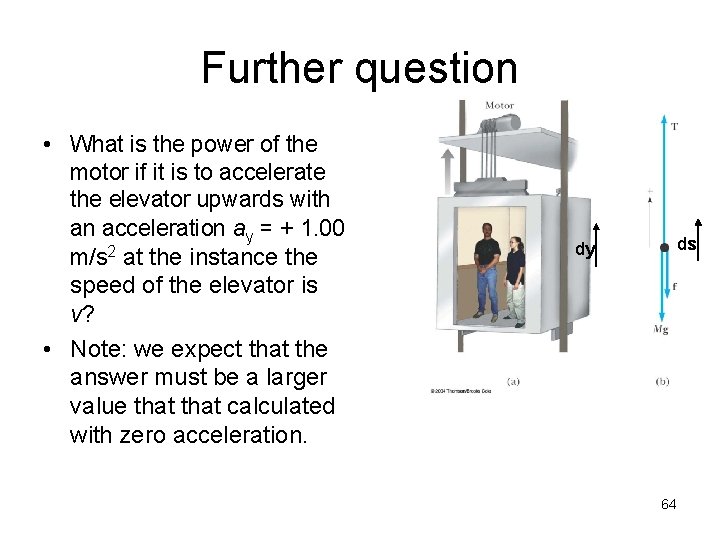
Further question • What is the power of the motor if it is to accelerate the elevator upwards with an acceleration ay = + 1. 00 m/s 2 at the instance the speed of the elevator is v? • Note: we expect that the answer must be a larger value that calculated with zero acceleration. ds dy 64
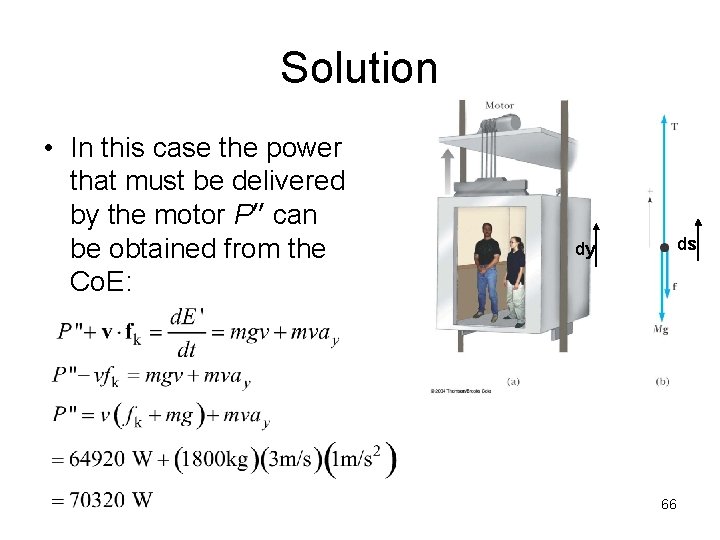
Solution • In this case the rate of the change of the mechanical energy of the elevator. Earth system has to be modified to include the increase in the KE, in addition to the PE: ds dy 65
Solution • In this case the power that must be delivered by the motor P’’ can be obtained from the Co. E: ds dy 66