
Chapter 8 Competition Market Concept of Competition Competitors
- Slides: 18
Chapter 8 - Competition Market Concept of Competition: Competitors are those that satisfy the same customer (p. 153) A customer who buys word processing software really wants “writing ability” – a need that can be satisfied by pencils, pens, or typewriters
Competitor Analysis Each competitor pursues some mix of objectives: current profitability, marketshare growth, cash flow, technological leadership, and service leadership. Company goal: ____________
Market Leader Strategies Market share: % of total industry sales accounted for by one firm. Market leader: largest share of the relevant product market Market-Leader Strategies 1. Expanding the __________ Market leader stands to gain the most when the total market expands
Market Leader Strategies 1. Expanding the Total Market Find new users: – new market segment strategy – – geographical expansion strategy – Find new uses:
Market Leader Strategies 2. Defending Market Share ___________: increase competitive strength; increase value to customers; control costs; charge reasonable prices 3. Expand Market Share Market development, ___________
Market Challenger Strategies Firms that occupy second, third, and lower ranks in an industry (runner-up firms) Attack market leader and other competitors • increase (take away market share) • (p. 163) - offer comparable product at lower price (price discount); offer average or low quality product at much lower price (lower price goods); etc.
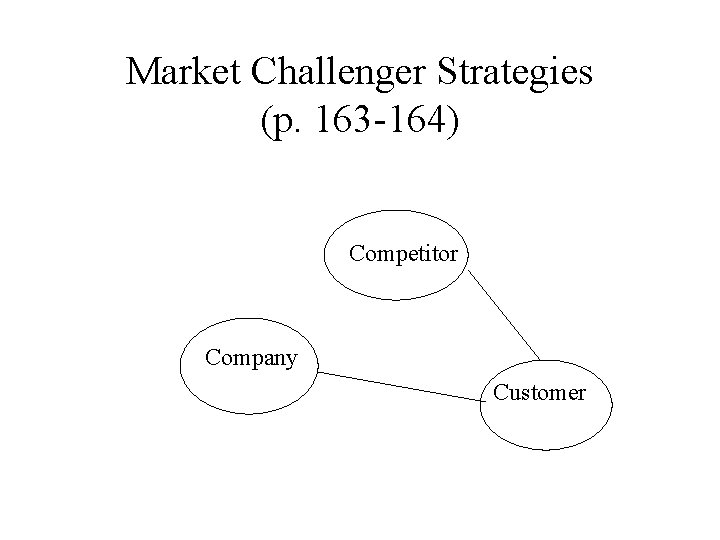
Market Challenger Strategies (p. 163 -164) Competitor Company Customer
Market Follower Strategies Imitate • Avoid risk/cost of introducing new product • adapt or improve leader’s products
Market-Nicher Strategies Specialize • Leader of a small market or niche • Nicher is most knowledgeable about their customers; can best meet their needs
Balancing Customer and Competitive Orientations Competitor centered company: monitor and react to competition Customer-centered company: greater focus on customer developments in formulating strategies; better position to identify new opportunities; long-run profits
Industry Concept of Competition ______: group of firms that offer a product or class of products that are close substitutes for each other
Entry and Exit Barriers Entry barriers: ____________ High capital requirements Economies of Scale Patents and licensing agreements Scarce locations New materials Distributors Reputation requirements
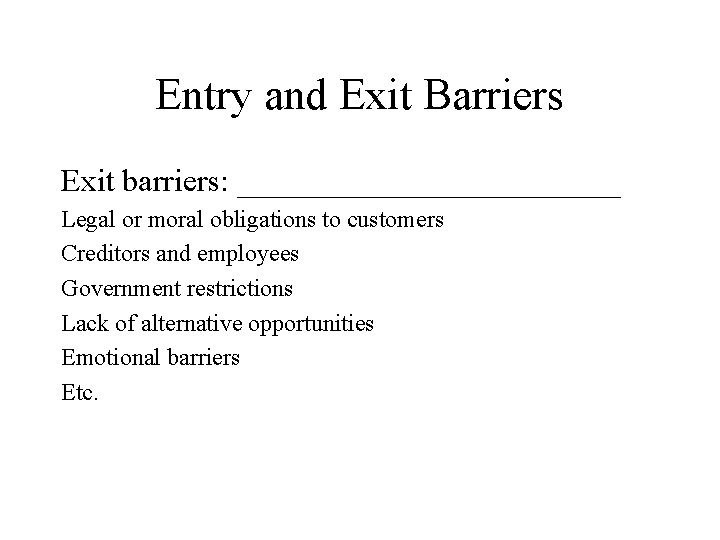
Entry and Exit Barriers Exit barriers: ____________ Legal or moral obligations to customers Creditors and employees Government restrictions Lack of alternative opportunities Emotional barriers Etc.
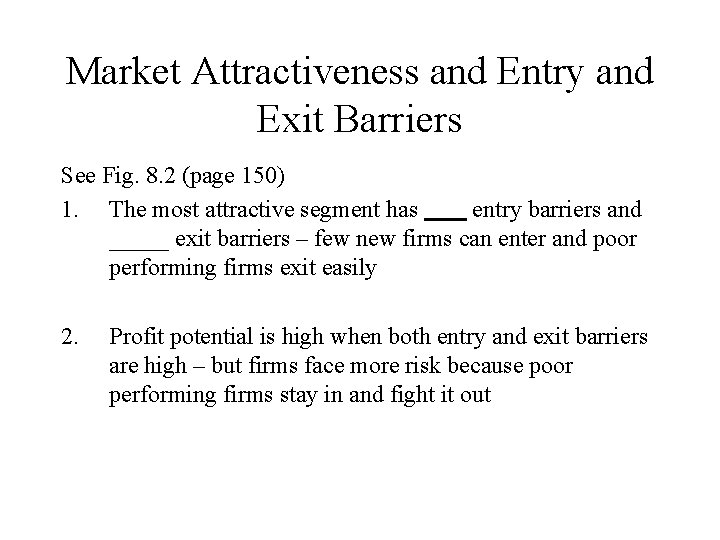
Market Attractiveness and Entry and Exit Barriers See Fig. 8. 2 (page 150) 1. The most attractive segment has entry barriers and _____ exit barriers – few new firms can enter and poor performing firms exit easily 2. Profit potential is high when both entry and exit barriers are high – but firms face more risk because poor performing firms stay in and fight it out
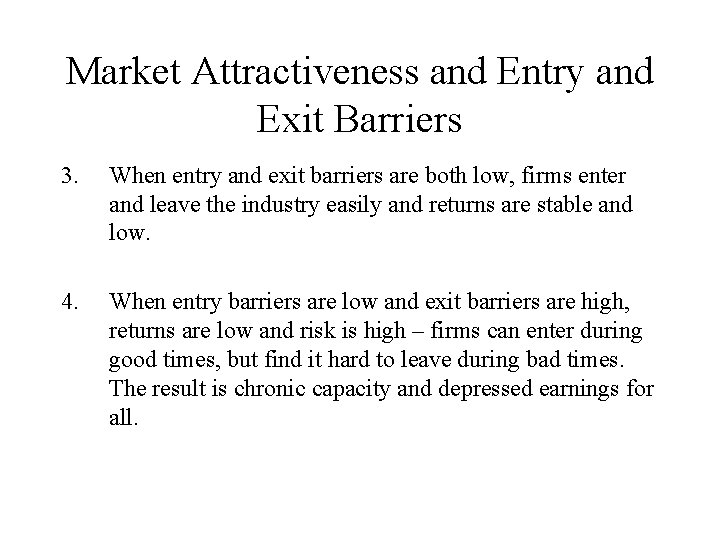
Market Attractiveness and Entry and Exit Barriers 3. When entry and exit barriers are both low, firms enter and leave the industry easily and returns are stable and low. 4. When entry barriers are low and exit barriers are high, returns are low and risk is high – firms can enter during good times, but find it hard to leave during bad times. The result is chronic capacity and depressed earnings for all.
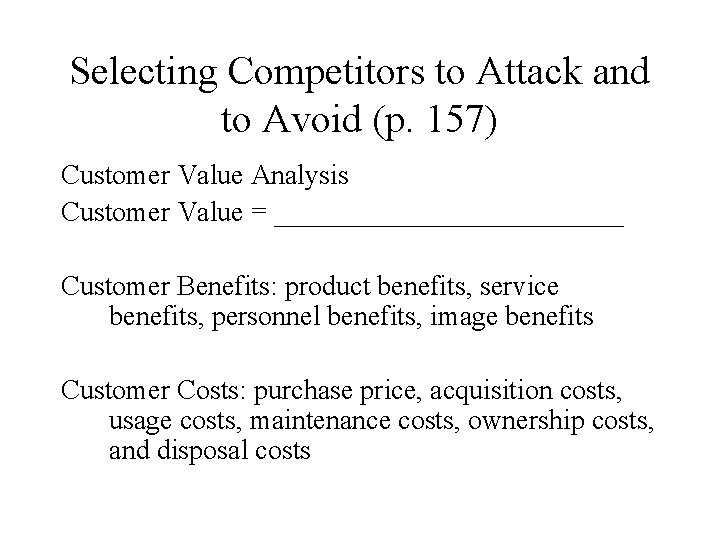
Selecting Competitors to Attack and to Avoid (p. 157) Customer Value Analysis Customer Value = _____________ Customer Benefits: product benefits, service benefits, personnel benefits, image benefits Customer Costs: purchase price, acquisition costs, usage costs, maintenance costs, ownership costs, and disposal costs
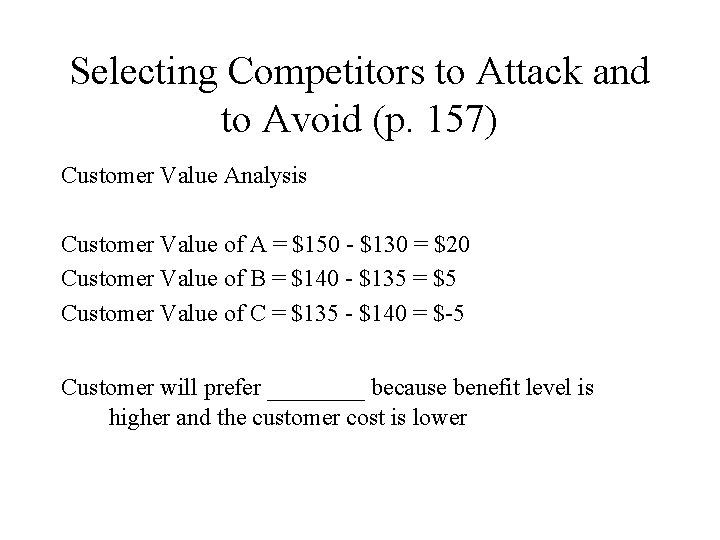
Selecting Competitors to Attack and to Avoid (p. 157) Customer Value Analysis Customer Value of A = $150 - $130 = $20 Customer Value of B = $140 - $135 = $5 Customer Value of C = $135 - $140 = $-5 Customer will prefer _______ because benefit level is higher and the customer cost is lower
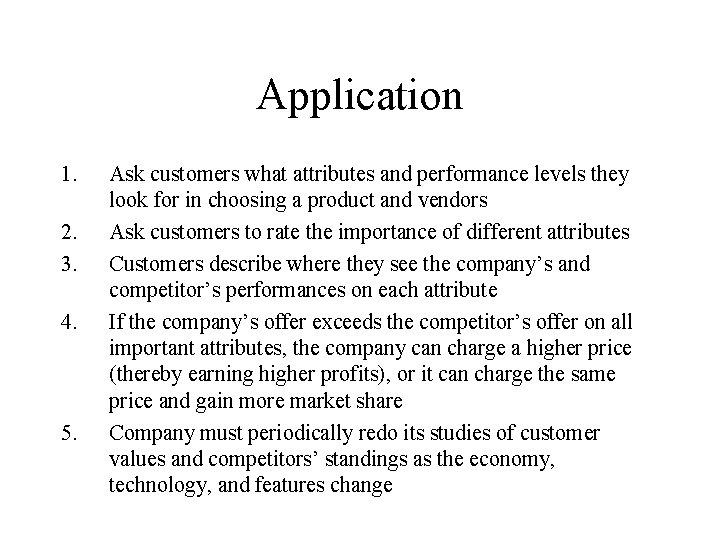
Application 1. 2. 3. 4. 5. Ask customers what attributes and performance levels they look for in choosing a product and vendors Ask customers to rate the importance of different attributes Customers describe where they see the company’s and competitor’s performances on each attribute If the company’s offer exceeds the competitor’s offer on all important attributes, the company can charge a higher price (thereby earning higher profits), or it can charge the same price and gain more market share Company must periodically redo its studies of customer values and competitors’ standings as the economy, technology, and features change