
Chapter 8 Compatibility Testing Objectives Define compatibility testing
Chapter 8 Compatibility Testing
Objectives Define compatibility testing and crossmatching List the procedures included in the routine compatibility test, and explain their purpose Explain the AABB’s Standards for Blood Banks and Transfusion Services as related to compatibility testing Discuss the selection of crossmatch-compatible whole blood, red blood cells (RBCs), plasma, platelets, and cryoprecipitate for transfusion Copyright © 2013, 2009, 2000 by Mosby, Inc. , an affiliate of Elsevier Inc. 2
Objectives (cont’d) Discuss strategies for transfusion when compatible blood cannot be located Discuss limitations of crossmatching Describe how crossmatching is handled in the massive transfusion situation Discuss the advantages and issues related to computer crossmatching Copyright © 2013, 2009, 2000 by Mosby, Inc. , an affiliate of Elsevier Inc. 3
Objectives (cont’d) Explain how immediate-spin (IS) crossmatching and antiglobulin crossmatching are performed and when they would be performed Explain the elements of patient identification and their importance in compatibility testing Explain the use of a typing and screening protocol and a maximum surgical blood order schedule Copyright © 2013, 2009, 2000 by Mosby, Inc. , an affiliate of Elsevier Inc. 4
Objectives (cont’d) Explain how compatibility testing is carried out for an infant younger than 4 months Discuss the principles of autologous blood crossmatching Copyright © 2013, 2009, 2000 by Mosby, Inc. , an affiliate of Elsevier Inc. 5
Compatibility Testing Compatibility testing involves all the steps in the identification and testing of a donor unit and a proposed recipient’s blood Crossmatching is part of compatibility testing • Involves mixing donor RBCs and recipient serum or plasma • No agglutination or hemolysis indicates compatibility • Agglutination or hemolysis indicates incompatibility Copyright © 2013, 2009, 2000 by Mosby, Inc. , an affiliate of Elsevier Inc. 6
Purpose Crossmatching • Serves as a double check of ABO errors • Provides a second means of detecting antibodies According to the AABB Standards, crossmatching “shall use methods that demonstrate ABO incompatibility and clinically significant antibodies to red cell antigens and shall include an antiglobulin phase” Copyright © 2013, 2009, 2000 by Mosby, Inc. , an affiliate of Elsevier Inc. 7
Serologic Crossmatching IS CROSSMATCHING IS crossmatching is performed when the recipient has no evidence of an antibody ANTIGLOBULIN TEST • In the current sample OR • In the historical record All phases (IS, 37° C, antihuman globulin [AHG]) are performed if the patient demonstrates a clinically significant antibody • In the current sample OR Recipient serum and donor RBC suspension are mixed and immediately centrifuged Fulfills AABB standards for detecting ABO incompatibility • In the historical record If the patient has autoantibody, autoadsorbed serum may be used Copyright © 2013, 2009, 2000 by Mosby, Inc. , an affiliate of Elsevier Inc. 8
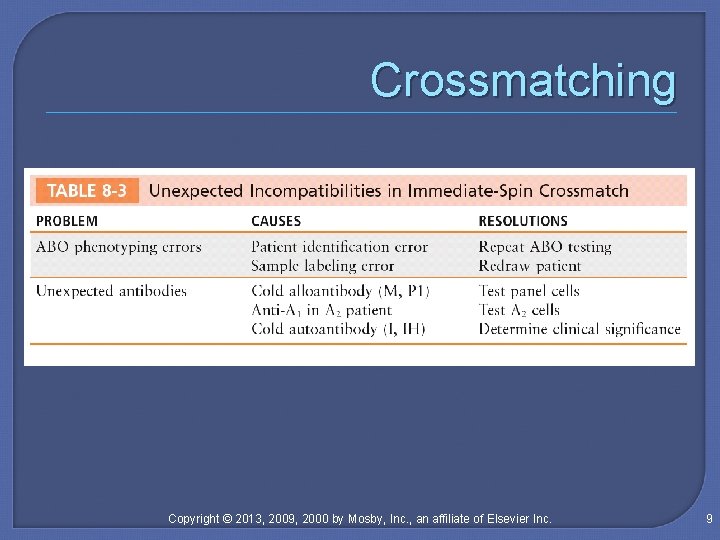
Crossmatching Copyright © 2013, 2009, 2000 by Mosby, Inc. , an affiliate of Elsevier Inc. 9
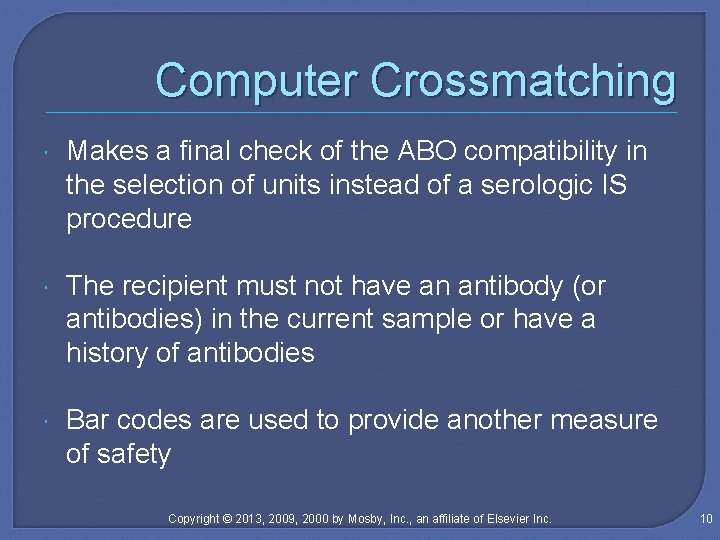
Computer Crossmatching Makes a final check of the ABO compatibility in the selection of units instead of a serologic IS procedure The recipient must not have an antibody (or antibodies) in the current sample or have a history of antibodies Bar codes are used to provide another measure of safety Copyright © 2013, 2009, 2000 by Mosby, Inc. , an affiliate of Elsevier Inc. 10
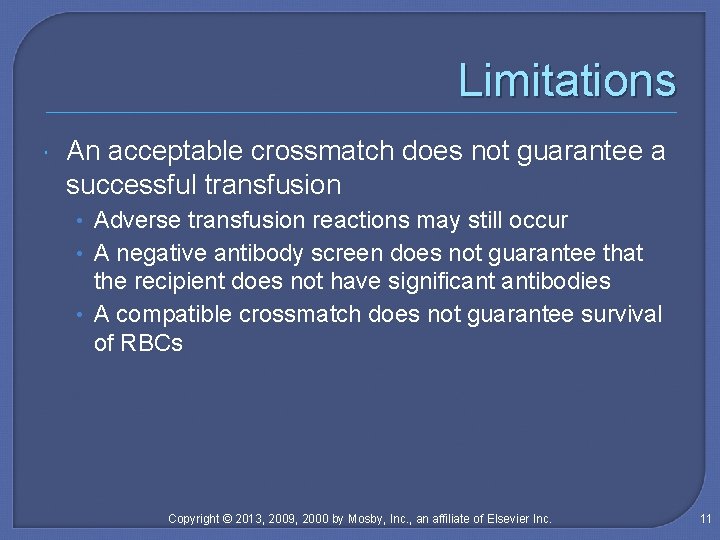
Limitations An acceptable crossmatch does not guarantee a successful transfusion • Adverse transfusion reactions may still occur • A negative antibody screen does not guarantee that the recipient does not have significant antibodies • A compatible crossmatch does not guarantee survival of RBCs Copyright © 2013, 2009, 2000 by Mosby, Inc. , an affiliate of Elsevier Inc. 11
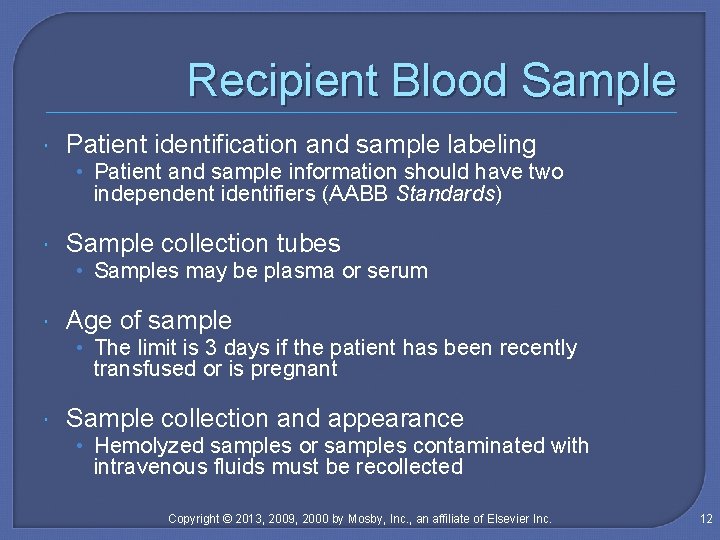
Recipient Blood Sample Patient identification and sample labeling • Patient and sample information should have two independent identifiers (AABB Standards) Sample collection tubes • Samples may be plasma or serum Age of sample • The limit is 3 days if the patient has been recently transfused or is pregnant Sample collection and appearance • Hemolyzed samples or samples contaminated with intravenous fluids must be recollected Copyright © 2013, 2009, 2000 by Mosby, Inc. , an affiliate of Elsevier Inc. 12
Previous Records Current blood ABO and D typing must be compared with results performed over the past 12 months Previous records must also be consulted for any significant event related to testing or transfusion Copyright © 2013, 2009, 2000 by Mosby, Inc. , an affiliate of Elsevier Inc. 13
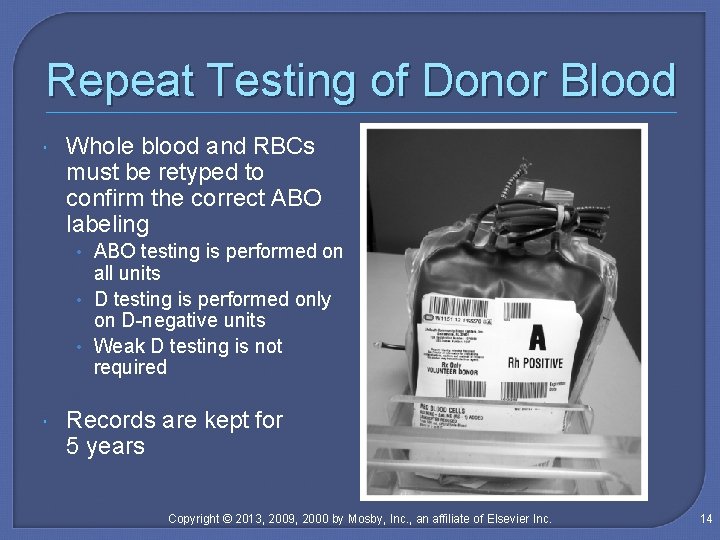
Repeat Testing of Donor Blood Whole blood and RBCs must be retyped to confirm the correct ABO labeling • ABO testing is performed on all units • D testing is performed only on D-negative units • Weak D testing is not required Records are kept for 5 years Copyright © 2013, 2009, 2000 by Mosby, Inc. , an affiliate of Elsevier Inc. 14
Pretransfusion Testing ABO and D typing • Discrepancies should be resolved before transfusion Antibody detection • Unpooled reagent RBCs should be used Crossmatching • Demonstrates ABO incompatibility and clinically significant antibodies to RBC antigens Copyright © 2013, 2009, 2000 by Mosby, Inc. , an affiliate of Elsevier Inc. 15
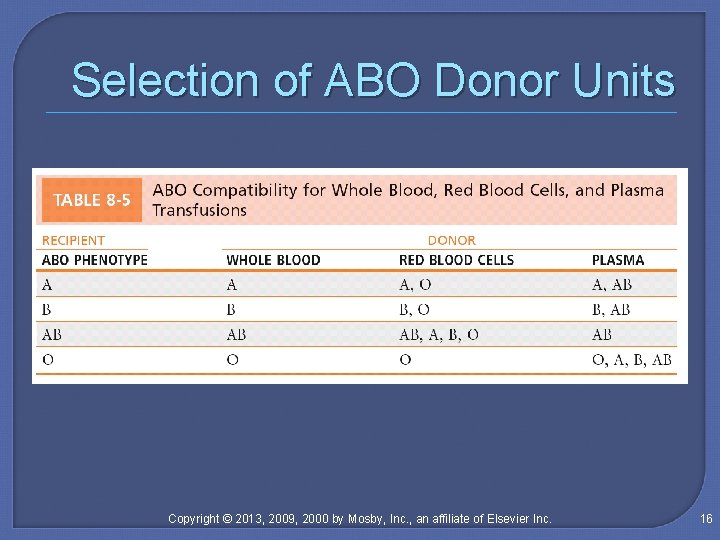
Selection of ABO Donor Units Copyright © 2013, 2009, 2000 by Mosby, Inc. , an affiliate of Elsevier Inc. 16
Selection of Donor Units RECIPIENTS WITH ANTIBODIES D ANTIGEN D-negative units should be given to D-negative recipients, especially women of child-bearing age Antigen-negative blood should be given if anti-D antibody is formed Antigen-negative units are recommended for the following antibodies: • ABO • Rh • Kell • Duffy • Kidd Copyright © 2013, 2009, 2000 by Mosby, Inc. , an affiliate of Elsevier Inc. 17
Tagging Blood Products Requirements for the tag on a crossmatched donor unit • • • Patient’s full name and two independent identifiers Name of blood product Unique donor unit number or pool number Unit’s expiration date and ABO and D typing Interpretation of crossmatching Technologist’s identification Copyright © 2013, 2009, 2000 by Mosby, Inc. , an affiliate of Elsevier Inc. 18
Issuing Blood Products Requirements for the issue of donor units • Physician’s order • Intended recipient’s two independent identifiers, ABO group, and • • D type Requisition form: patient name and blood product Compare requisition form with donor unit tag Compare donor unit tag with blood product label Check blood product’s expiration date Visual check of unit: discoloration? clot? abnormal appearance? Documentation of person issuing and person receiving donor unit Special transfusion requirements Date and time of issue, unit destination Copyright © 2013, 2009, 2000 by Mosby, Inc. , an affiliate of Elsevier Inc. 19
Unused Blood Products Blood products may be reissued if the closure has not been entered and • If the unit has been kept between the upper and lower temperature conditions (1° to 10° C for RBCs) • If the unit was stored at room temperature, it should be returned within 30 minutes or within a time determined by the facility Copyright © 2013, 2009, 2000 by Mosby, Inc. , an affiliate of Elsevier Inc. 20
Emergency Release must be signed by physician Tag on donor unit indicating emergency release: compatibility and/or infectious disease Patient name and identifiers Donor unit number(s), ABO and D typing, expiration date Retain segments from units for crossmatching Name of person issuing units Copyright © 2013, 2009, 2000 by Mosby, Inc. , an affiliate of Elsevier Inc. 21
Massive Transfusion A massive transfusion is a total volume exchange of blood within 24 hours • Group O, D-negative unit is given in an emergency • If a D-negative unit is unavailable, group O, D-positive blood can be given to D-negative individuals who are not of child-bearing age • ABO-identical unit is given once the blood group is established in the recipient Copyright © 2013, 2009, 2000 by Mosby, Inc. , an affiliate of Elsevier Inc. 22
Maximum Surgical Blood Order Schedule Average number of blood units used for surgical procedures is determined in a facility This number is used as the standard blood order for surgical procedures It may also be used as a guide for the number of autologous units that can be donated Copyright © 2013, 2009, 2000 by Mosby, Inc. , an affiliate of Elsevier Inc. 23
Typing and Screening Procedure A typing and screening (T/S) procedure includes ABO, Rh, and antibody screening A T/S is ordered when a surgical procedure uses less than 1 unit of RBCs Crossmatching is performed on the sample if blood is needed The goal of a T/S is to conserve the blood inventory Copyright © 2013, 2009, 2000 by Mosby, Inc. , an affiliate of Elsevier Inc. 24
Crossmatching INFANTS YOUNGER THAN 4 MONTHS OF AGE AUTOLOGOUS BLOOD Procedures must be in place to ensure that units are located and transfused to the recipient The process is monitored manually or through computerized tracking methods ABO and D typing must be performed Serum testing is not necessary Antibody screening is performed on the infant’s or mother’s sample If antibody is present, antigennegative units are given Copyright © 2013, 2009, 2000 by Mosby, Inc. , an affiliate of Elsevier Inc. 25
Non-RBC Products Frozen plasma, platelet concentrates, and cryoprecipitate do not need to be crossmatched • Plasma products should be ABO serum compatible • Cryoprecipitate and platelet concentrates may not need to be ABO compatible Apheresis platelets and granulocyte concentrates may need to be crossmatched if they contain more than 2 m. L of RBCs Copyright © 2013, 2009, 2000 by Mosby, Inc. , an affiliate of Elsevier Inc. 26
- Slides: 26