
Chapter 8 Community Interventions Responsibility Rights or Reconciliation

Chapter 8: Community Interventions Responsibility, Rights or Reconciliation? Roger Smith
Summary • Focus on development of community interventions in youth justice • Complex and changing nature of community sentences • Wide range of aims and content, with diverse and sometimes ‘unintended’ consequences • Community interventions can still play an important part in progressive practice

Community Sentences • Community sentences date back at least to the 1907 Probation of Offenders Act • In 2005, they represented 13% of disposals at magistrates courts • In 2005/06, community disposals were administered to 17% of convicted young offenders aged 10 -17 • Community sentences act as ‘alternatives’ to more conventionally penal options
Muncie (2002) on youth justice: “Youth justice is now an amalgam of: 1. just desserts 2. risk assessment 3. managerialism 4. community responsibilisation 5. authoritarian populism 6. restorative justice” A New Deal for Youth? Early Intervention and Correctionalism in Hughes, G. , Mc. Laughlin, E. and Muncie, J. (eds) Crime Prevention and Community Safety: New Directions. London: Sage: 142 -162

Community sentences have eight purposes: 1. welfare 2. diversion 3. justice 4. control 5. correction 6. (personal) development 7. reparation 8. reintegration
Welfare • A declining influence in youth justice, coming to the fore in the 1970 s • Uneasily accommodated alongside measures of punishment and control • Still incorporated in some disposals, such as Action Plan and Supervision Orders • Also an explicit objective of global policy statements, such as Every Child Matters
Diversion • Very influential in youth justice during the 1980 s • Alternatives to prosecution reduced the flow of young people into court and custody • Diversion remains an objective of youth justice, through pre-court disposals such as reprimands and final warnings, and the Referral Order • Diversion is ‘capped’, to limit the number of ‘chances’ given to repeat offenders
Justice • The ‘default’ position held by sentencers (and many others) • “The punishment should fit the crime” • Sentencing should be based on a progressive tariff of disposals • Community sentences are graded according to the seriousness and persistence of offending, i. e. ISSP
Control • Reflects continuing concerns about community safety and crime reduction • Informed by risk assessment and targeted interventions • Surveillance, tracking and tagging can be incorporated in a range of orders • Specific measures of ‘control’ include drug treatment and testing orders
Correctionalism • Closely associated with ‘control’ • Aims to change behaviour ‘prosocially’ • Programmes included in community sentences such as Action Plan/Supervision Orders • ‘Anger management’, ‘offending behaviour’, cognitive behavioural methods
Developmentalism • Influential in the 1980 s • Reverses ‘correctional’ assumptions, ‘strengths-based’, develops abilities and promotes opportunities for offenders • Educational and aspirational elements in some community orders • Connects with ‘social inclusion’ agenda
Reparation • Increasingly influential, associated with ‘restorative justice’ • Based on simple idea of ‘making amends’ • Victim-focused • Available as a free-standing disposal (Reparation Order); also a possible component of other community sentences
Reintegration • More recent development, extending the notion of ‘making amends’ to ‘making good’ • Based on international models of ‘reconciliation’ (e. g. South Africa, Northern Ireland) • Offence resolution linked to community concerns and ‘re-inclusion’ of offender • Referral Order offers a limited model of reintegrative justice
Key Principles of Community Sentences • • • Individualisation Offender focus Crime prevention Tackling the ‘causes of crime’ Offender ‘engagement’

The Current Position • Different perspectives come to the fore over time • The present agenda: Risk management Control Correctionalism Punishment
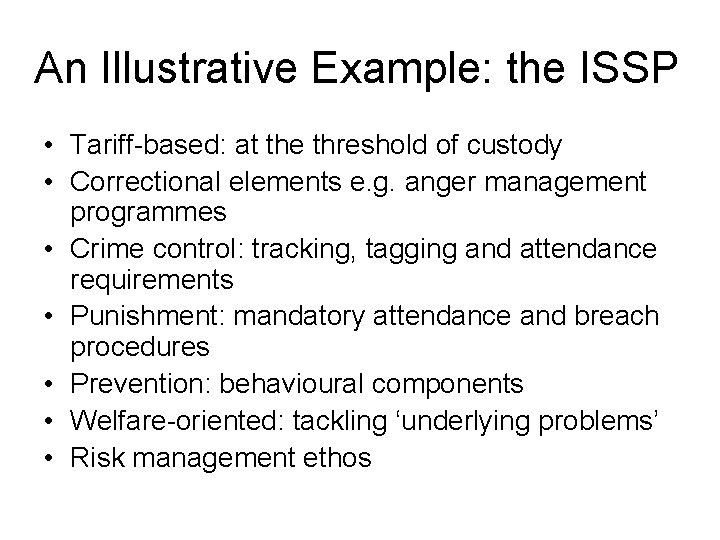
An Illustrative Example: the ISSP • Tariff-based: at the threshold of custody • Correctional elements e. g. anger management programmes • Crime control: tracking, tagging and attendance requirements • Punishment: mandatory attendance and breach procedures • Prevention: behavioural components • Welfare-oriented: tackling ‘underlying problems’ • Risk management ethos
For many young people, ISSP became known simply as ‘the tag’: “The objective is to ensure that the young people themselves are aware that their behaviour is being monitored and to provide reassurance to the community that their whereabouts are being checked. ” Moore, R. et al (2004) ISSP: the Initial Report. London Youth Justice Board: 44
• Is it possible to achieve different goals within the framework of community interventions? • The Referral Order, for instance, is constrained by: Its place in the sentencing tariff The ‘correctional’ nature of interventions The coercive nature of its requirements

An Alternative View? • Positive change requires a more constructive approach • Features of this form of intervention include: Empathy Person-centredness Collaborative practice
Key Arguments • Community intervention is well-established in the justice system • Community sentences tend to incorporate a range of objectives • As a result, their practices and impacts are often complex and contradictory • Certain perspectives tend to dominate, according to place and time • In most parts of the UK and other Western societies, control, punishment and correctionalism currently dominate • Interventions based on these principles often fail to achieve their stated aims, whilst also being damaging to young people and communities in other ways • Alternative strategies based on problem-solving, reconciliation and mutual rights and responsibilities have been developed, and have demonstrated positive outcomes
- Slides: 21