
CHAPTER 8 COMMUNICATIONS AND NETWORKS PREPARED BY LOH

CHAPTER 8 COMMUNICATIONS AND NETWORKS PREPARED BY: LOH YEW CHONG LEE TONG MING MUHAMMAD AZIM MOHAMMAD SAFWAN
CONTENTS 1 3 COMMUNICATION NETWORK 2 WIRELESS TECHNOLOGY 4 NETWORK SECURITY
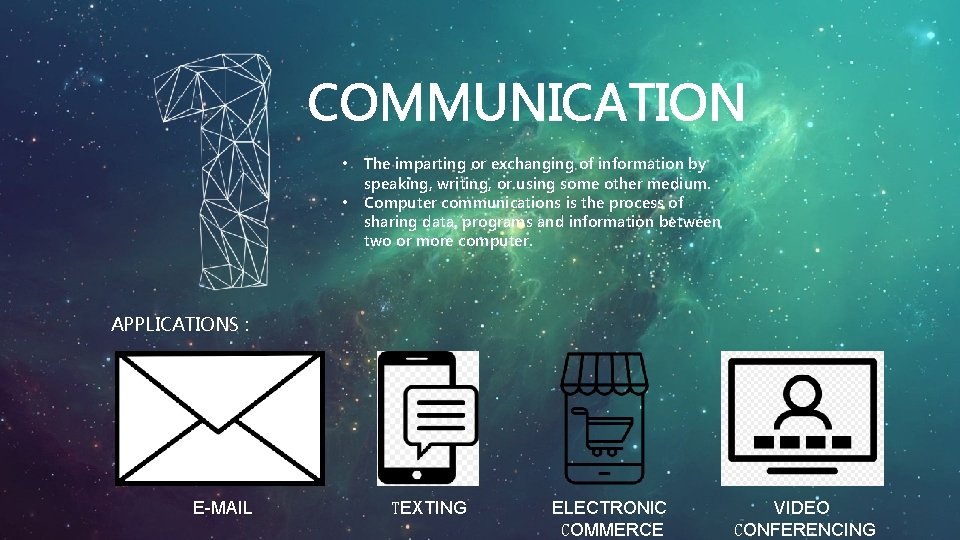
COMMUNICATION • • The imparting or exchanging of information by speaking, writing, or using some other medium. Computer communications is the process of sharing data, programs and information between two or more computer. APPLICATIONS : E-MAIL TEXTING ELECTRONIC COMMERCE VIDEO CONFERENCING
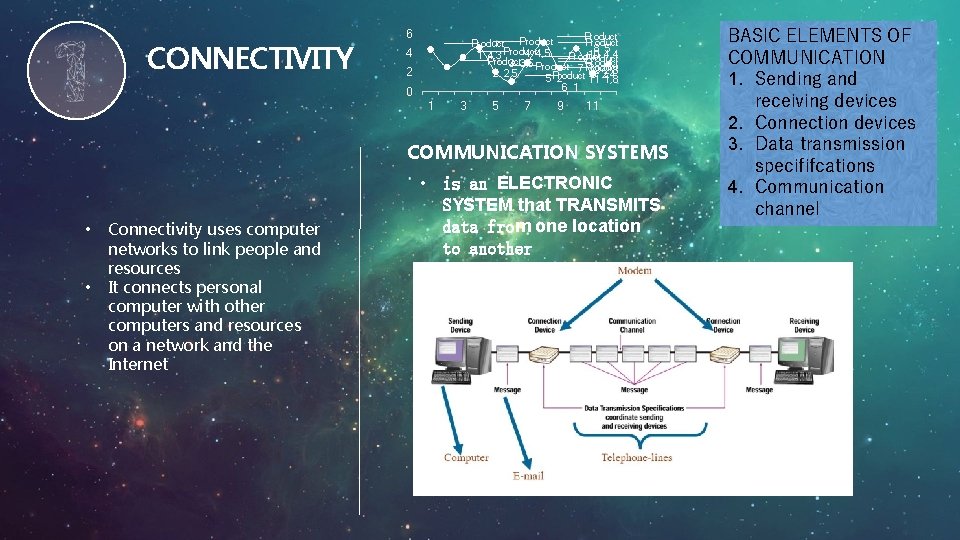
CONNECTIVITY 6 Product 8 5 Product 4 4, 5 10 4, 4 1 4, 3 Product 3 3, 5 Product 7 Product 3 2, 8 12 2 2, 5 9 2, 4 5 Product 2 11 1, 8 6 1 4 2 0 1 3 5 7 9 11 COMMUNICATION SYSTEMS • • Connectivity uses computer networks to link people and resources It connects personal computer with other computers and resources on a network and the Internet • is an ELECTRONIC SYSTEM that TRANSMITS data from one location to another BASIC ELEMENTS OF COMMUNICATION 1. Sending and receiving devices 2. Connection devices 3. Data transmission specififcations 4. Communication channel
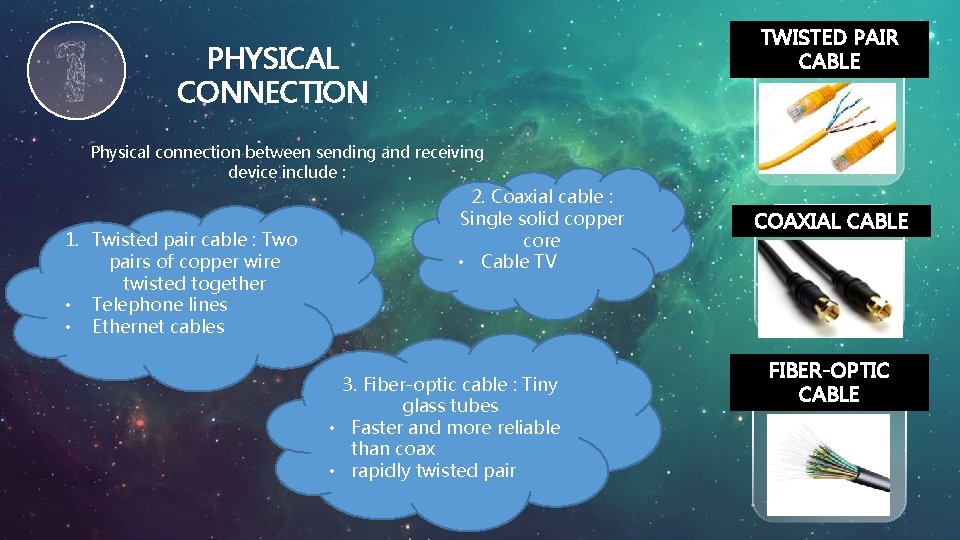
TWISTED PAIR CABLE PHYSICAL CONNECTION Physical connection between sending and receiving device include : 1. Twisted pair cable : Two pairs of copper wire twisted together • Telephone lines • Ethernet cables 2. Coaxial cable : Single solid copper core • Cable TV 3. Fiber-optic cable : Tiny glass tubes • Faster and more reliable than coax • rapidly twisted pair COAXIAL CABLE FIBER-OPTIC CABLE
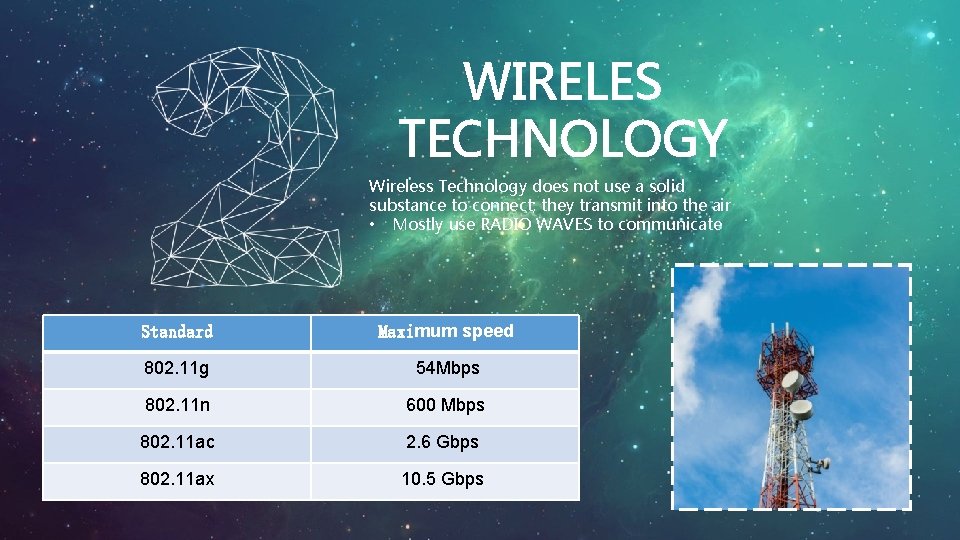
WIRELES TECHNOLOGY Wireless Technology does not use a solid substance to connect; they transmit into the air • Mostly use RADIO WAVES to communicate Standard Maximum speed 802. 11 g 54 Mbps 802. 11 n 600 Mbps 802. 11 ac 2. 6 Gbps 802. 11 ax 10. 5 Gbps
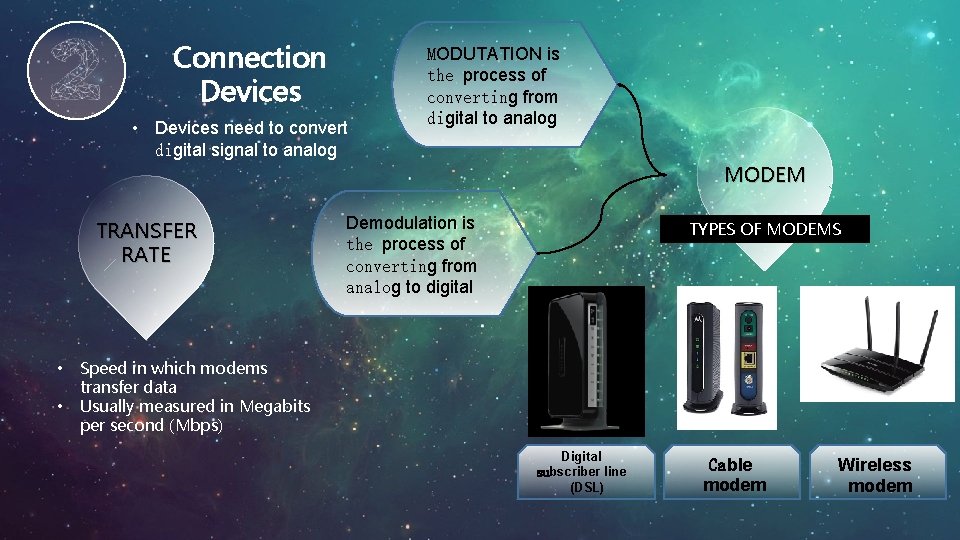
Connection Devices • Devices need to convert digital signal to analog MODUTATION is the process of converting from digital to analog MODEM TRANSFER RATE • • Demodulation is the process of converting from analog to digital TYPES OF MODEMS Speed in which modems transfer data Usually measured in Megabits per second (Mbps) Digital subscriber line (DSL) Cable modem Wireless modem
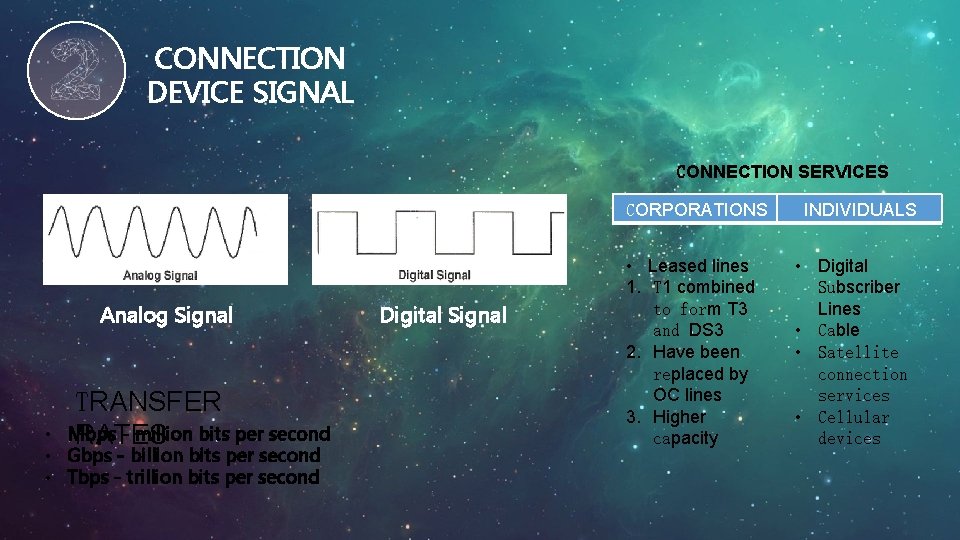
CONNECTION DEVICE SIGNAL CONNECTION SERVICES CORPORATIONS Analog Signal TRANSFER Mbps - million bits per second RATES • • Gbps - billion bits per second • Tbps - trillion bits per second Digital Signal • Leased lines 1. T 1 combined to form T 3 and DS 3 2. Have been replaced by OC lines 3. Higher capacity INDIVIDUALS • Digital Subscriber Lines • Cable • Satellite connection services • Cellular devices
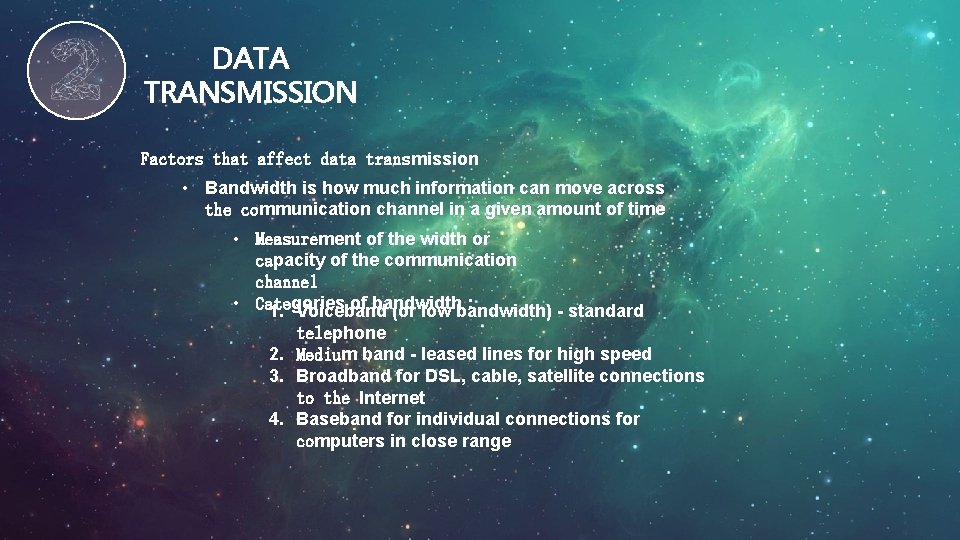
DATA TRANSMISSION Factors that affect data transmission • Bandwidth is how much information can move across the communication channel in a given amount of time • Measurement of the width or capacity of the communication channel • Categories of bandwidth : 1. Voiceband (or low bandwidth) - standard telephone 2. Medium band - leased lines for high speed 3. Broadband for DSL, cable, satellite connections to the Internet 4. Baseband for individual connections for computers in close range
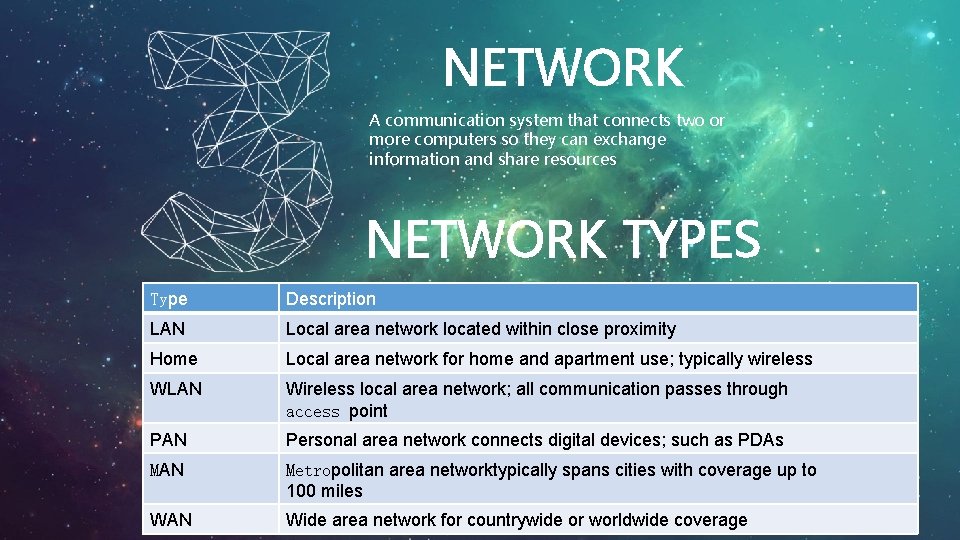
NETWORK A communication system that connects two or more computers so they can exchange information and share resources NETWORK TYPES Type Description LAN Local area network located within close proximity Home Local area network for home and apartment use; typically wireless WLAN Wireless local area network; all communication passes through access point PAN Personal area network connects digital devices; such as PDAs MAN Metropolitan area networktypically spans cities with coverage up to 100 miles WAN Wide area network for countrywide or worldwide coverage
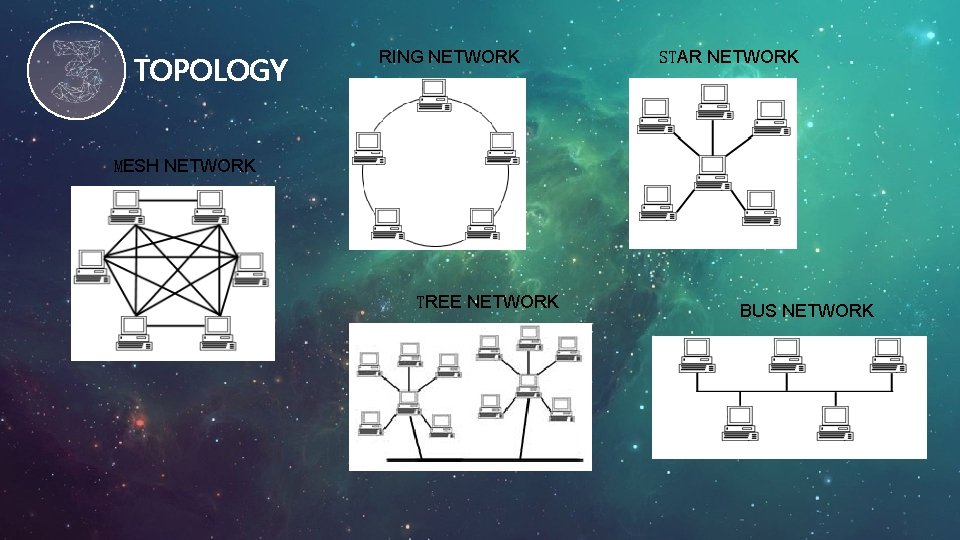
TOPOLOGY RING NETWORK STAR NETWORK MESH NETWORK TREE NETWORK BUS NETWORK
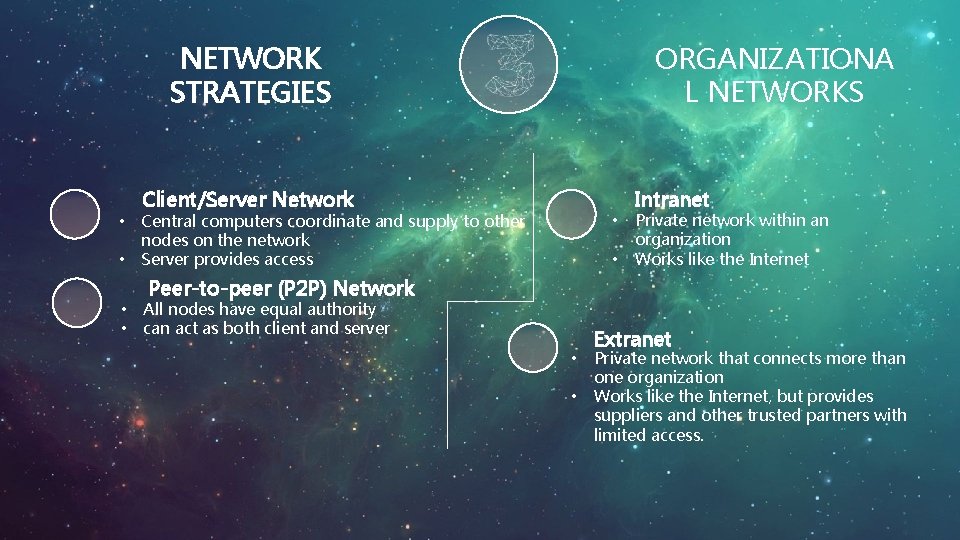
NETWORK STRATEGIES • • ORGANIZATIONA L NETWORKS Client/Server Network Central computers coordinate and supply to other nodes on the network Server provides access • • Intranet Private network within an organization Works like the Internet Peer-to-peer (P 2 P) Network All nodes have equal authority can act as both client and server • • Extranet Private network that connects more than one organization Works like the Internet, but provides suppliers and other trusted partners with limited access.
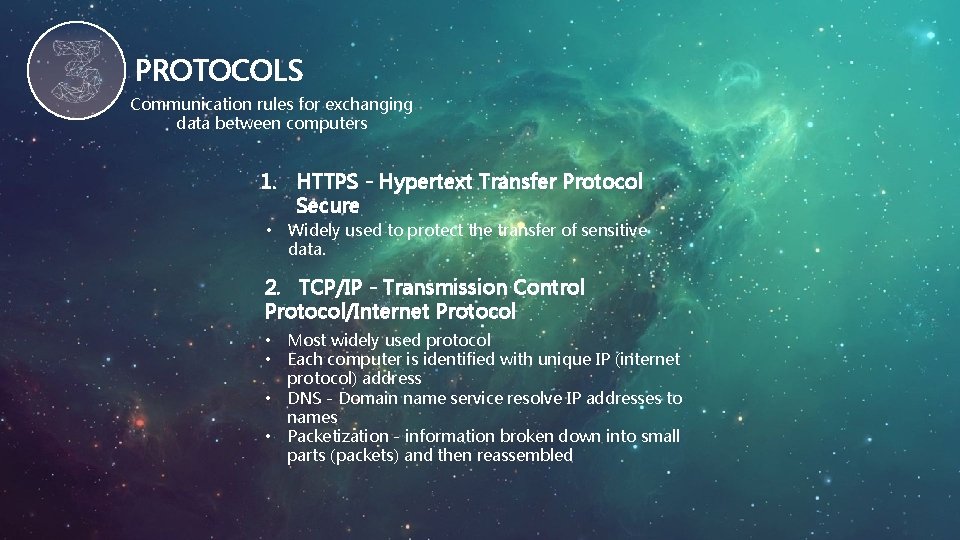
PROTOCOLS Communication rules for exchanging data between computers 1. HTTPS - Hypertext Transfer Protocol Secure • Widely used to protect the transfer of sensitive data. 2. TCP/IP - Transmission Control Protocol/Internet Protocol • • Most widely used protocol Each computer is identified with unique IP (internet protocol) address DNS - Domain name service resolve IP addresses to names Packetization - information broken down into small parts (packets) and then reassembled
NETWORK SECURITY • protection of the access to files and directories in a computer network against hacking, misuse and unauthorized changes to the system. • Example of network security: 1. Firewall 2. Intrusion detection system (IDS) 3. Virtual private network (VPN)
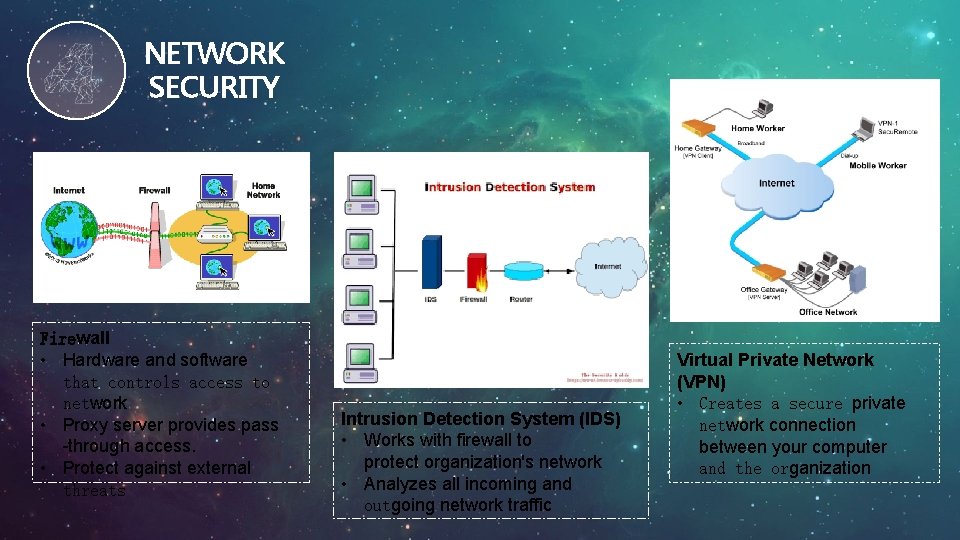
NETWORK SECURITY Firewall • Hardware and software that controls access to network • Proxy server provides pass -through access. • Protect against external threats Intrusion Detection System (IDS) • Works with firewall to protect organization's network • Analyzes all incoming and outgoing network traffic Virtual Private Network (VPN) • Creates a secure private network connection between your computer and the organization

- Slides: 16