
CHAPTER 8 CN 3124 E Particle Technology Measurement


- Slides: 12
CHAPTER 8 CN 3124 E – Particle Technology
Measurement Techniques Used to Study Dynamics of Particulate Systems Electrical Capacitance Tomography (ETC) Particle Image Velocimetry (PIV) Phase Doppler Particle Analyzer (PDPA)
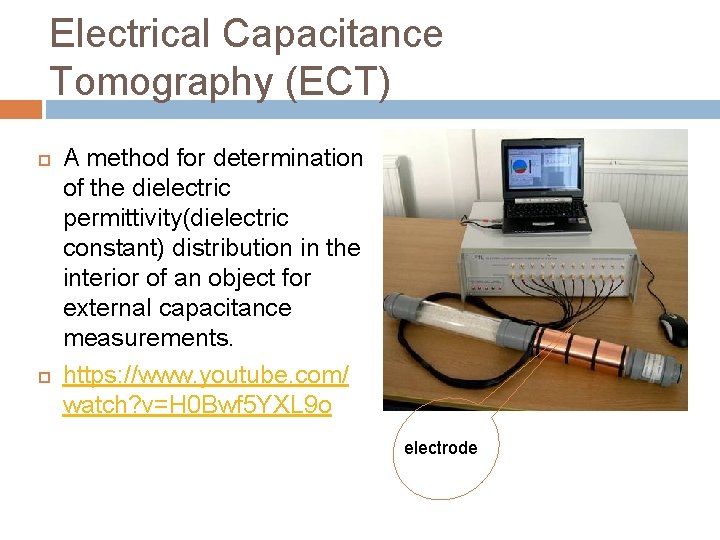
Electrical Capacitance Tomography (ECT) A method for determination of the dielectric permittivity(dielectric constant) distribution in the interior of an object for external capacitance measurements. https: //www. youtube. com/ watch? v=H 0 Bwf 5 YXL 9 o electrode
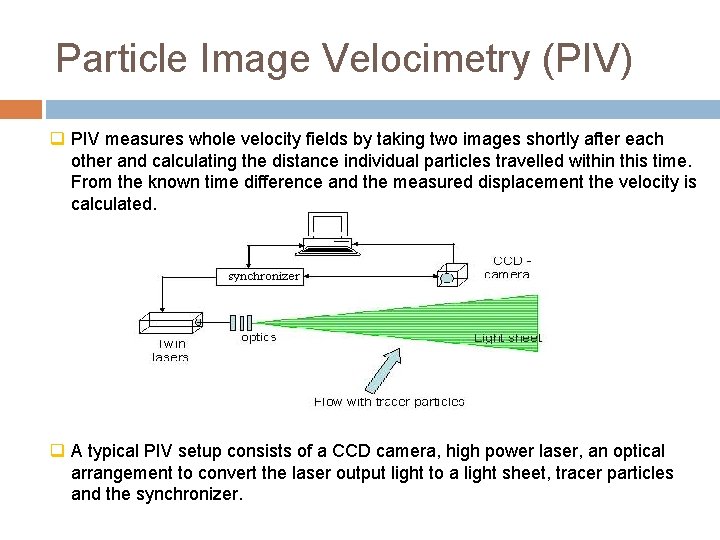
Particle Image Velocimetry (PIV) q PIV measures whole velocity fields by taking two images shortly after each other and calculating the distance individual particles travelled within this time. From the known time difference and the measured displacement the velocity is calculated. q A typical PIV setup consists of a CCD camera, high power laser, an optical arrangement to convert the laser output light to a light sheet, tracer particles and the synchronizer.
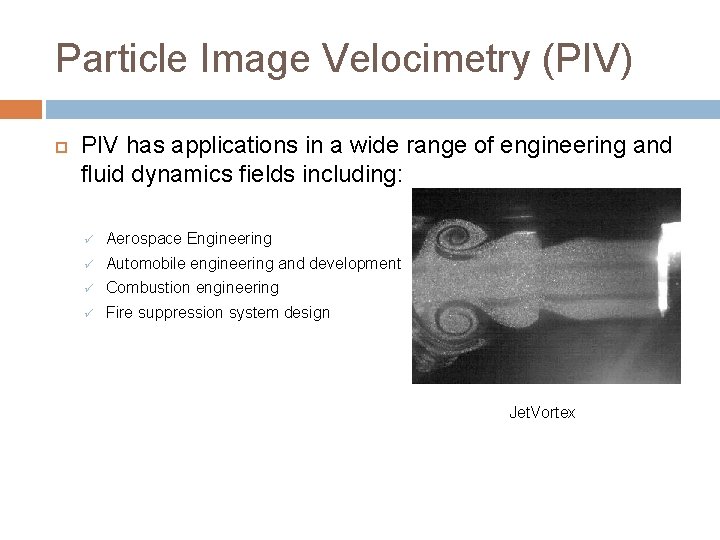
Particle Image Velocimetry (PIV) PIV has applications in a wide range of engineering and fluid dynamics fields including: ü Aerospace Engineering ü Automobile engineering and development ü Combustion engineering ü Fire suppression system design Jet. Vortex
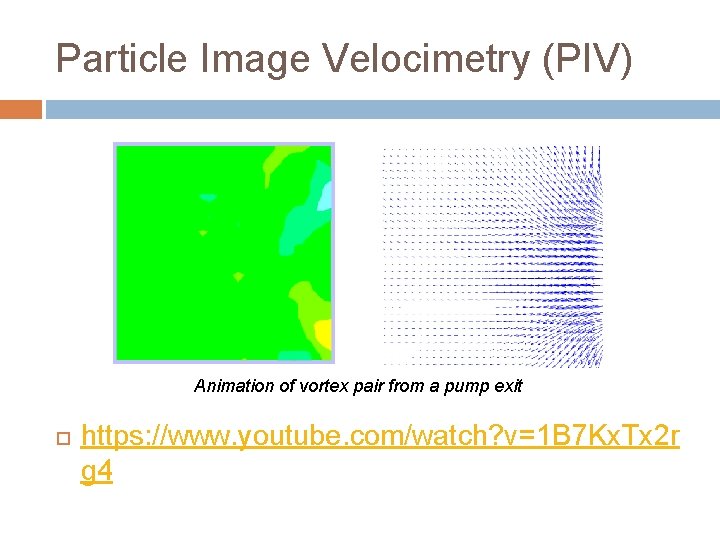
Particle Image Velocimetry (PIV) Animation of vortex pair from a pump exit https: //www. youtube. com/watch? v=1 B 7 Kx. Tx 2 r g 4
Bubble Motion in Taylor Vortex
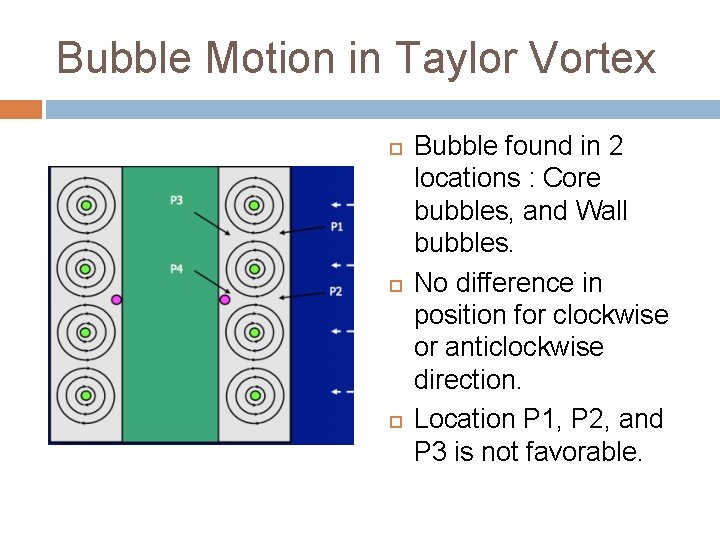
Bubble Motion in Taylor Vortex Bubble found in 2 locations : Core bubbles, and Wall bubbles. No difference in position for clockwise or anticlockwise direction. Location P 1, P 2, and P 3 is not favorable.
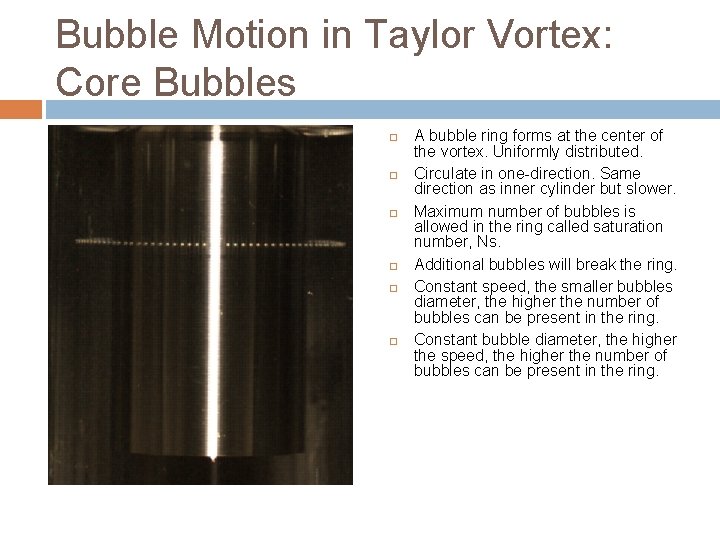
Bubble Motion in Taylor Vortex: Core Bubbles A bubble ring forms at the center of the vortex. Uniformly distributed. Circulate in one-direction. Same direction as inner cylinder but slower. Maximum number of bubbles is allowed in the ring called saturation number, Ns. Additional bubbles will break the ring. Constant speed, the smaller bubbles diameter, the higher the number of bubbles can be present in the ring. Constant bubble diameter, the higher the speed, the higher the number of bubbles can be present in the ring.
Bubble Motion in Taylor Vortex: Wall Bubbles Bubbles are trapped at the outflow regions when it is injected near the wall. Travel faster than core bubbles. Angular speed of the bubble is proportional to but lower than rotational speed. Does not induced ring structure though size is uniform. Instead it inhibits a chain structure. Chains are only stable at low rotation speed. Some of the bubbles tend to combine with each other to form larger bubble and escape from the orbit. Increase in rotation speed increases the chances of the bubbles combining.
Sources http: //www. tomography. com/PTL 300 ESPOffer. htm http: //www. dantecdynamics. com/particleimage-velocimetry R. S. Deng, C. H. Wang, and K. A. Smith, “Bubble behavior in a Taylor vortex”, Physical Review E, 73, 036306 (2006).
Thank You ! By: Phanna Onnicha Kevin Liu Zhaoheng Joycelyn