
Chapter 8 Cellular Respiration AP Biology Mr Freidhoff
Chapter 8: Cellular Respiration AP Biology Mr. Freidhoff
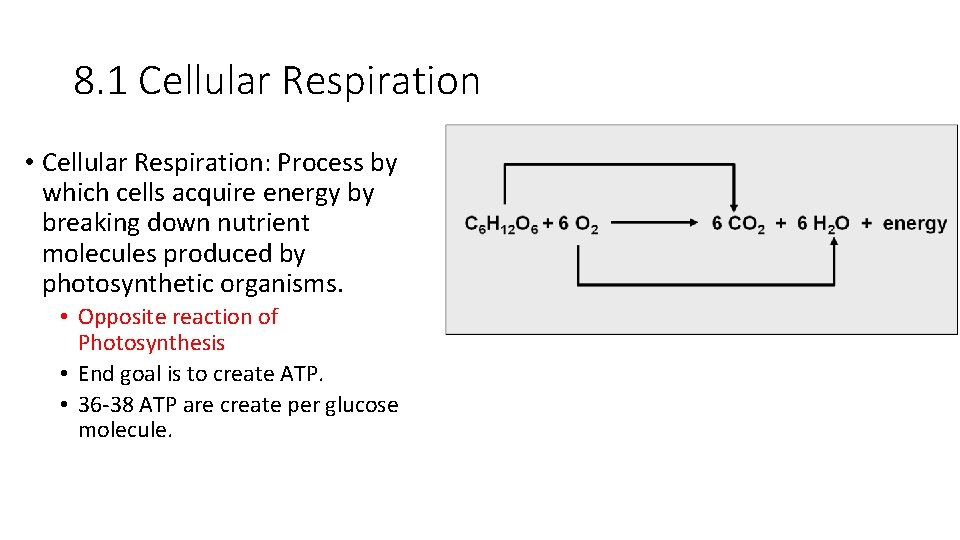
8. 1 Cellular Respiration • Cellular Respiration: Process by which cells acquire energy by breaking down nutrient molecules produced by photosynthetic organisms. • Opposite reaction of Photosynthesis • End goal is to create ATP. • 36 -38 ATP are create per glucose molecule.
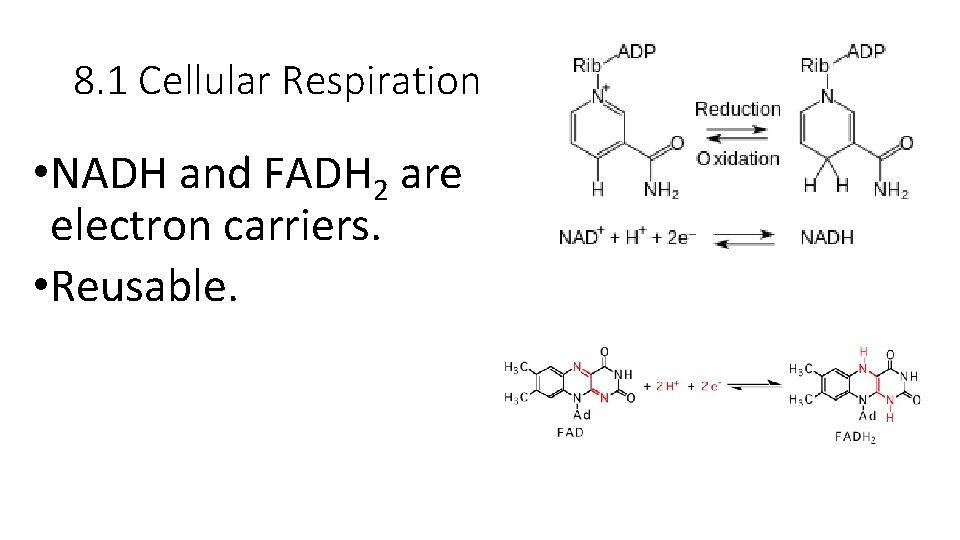
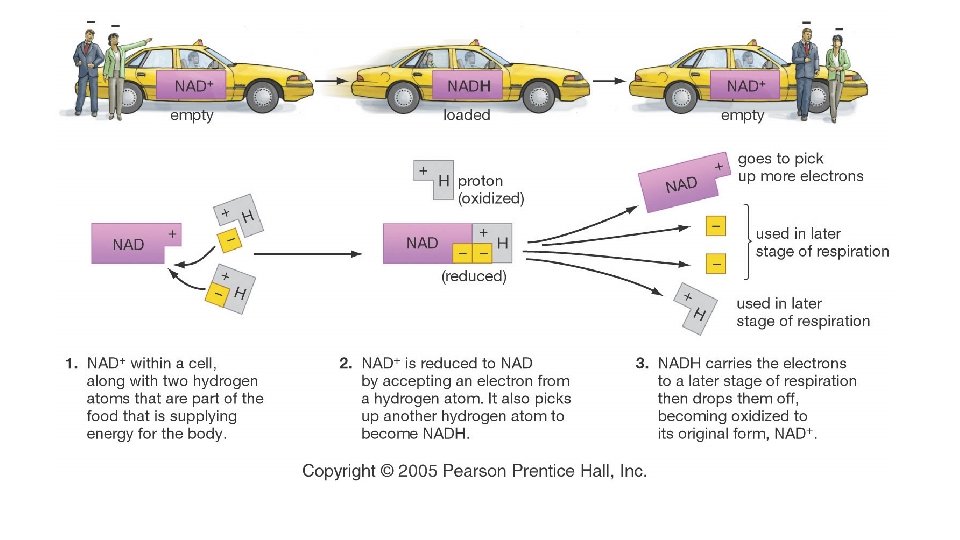
8. 1 Cellular Respiration • NADH and FADH 2 are electron carriers. • Reusable.
8. 1 Cellular Respiration • Aerobic: Requires Oxygen. • Anaerobic: Doesn’t require oxygen. • 4 Main phases of CR: 1. 2. 3. 4. Glycolysis: Anaerobic Preparation Step: Aerobic Krebs Cycle: Aerobic Electron Transport Chain: Aerobic
8. 2 Glycolysis • Occurs in cytoplasm. • Occurs in almost all organisms, evolved before Krebs Cycle and ETC. • Breaks down glucose (6 C) into two pyruvate molecules (3 C).
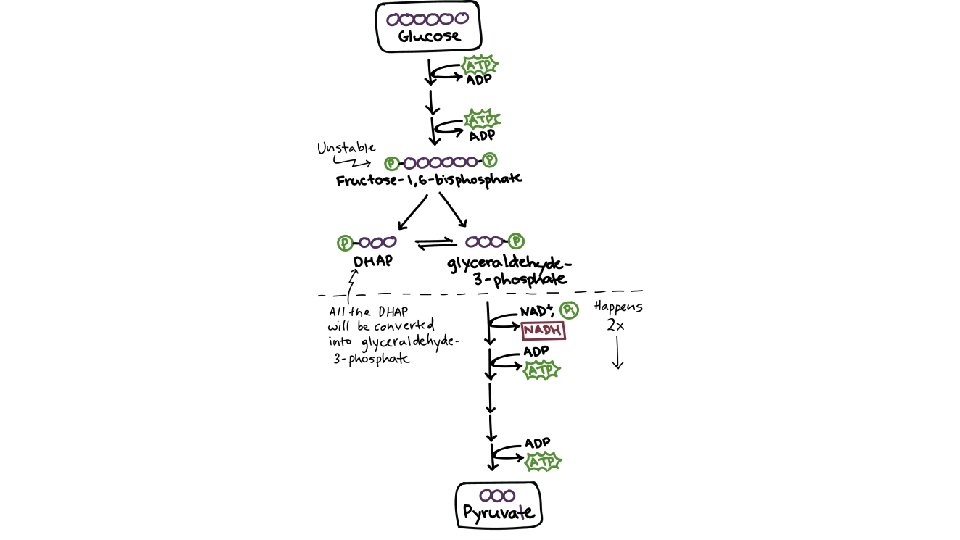
8. 2 Glycolysis • Energy Investment Step • Two ATP are used to add phosphate groups onto Glucose. • Glucose then splits into two G 3 P molecules. • Energy Harvesting Step (per pyruvate) • G 3 P is oxidized by NAD+ which becomes NADH after taking 2 electrons and 1 hydrogen ion. • Creates two ATP molecules per G 3 P.
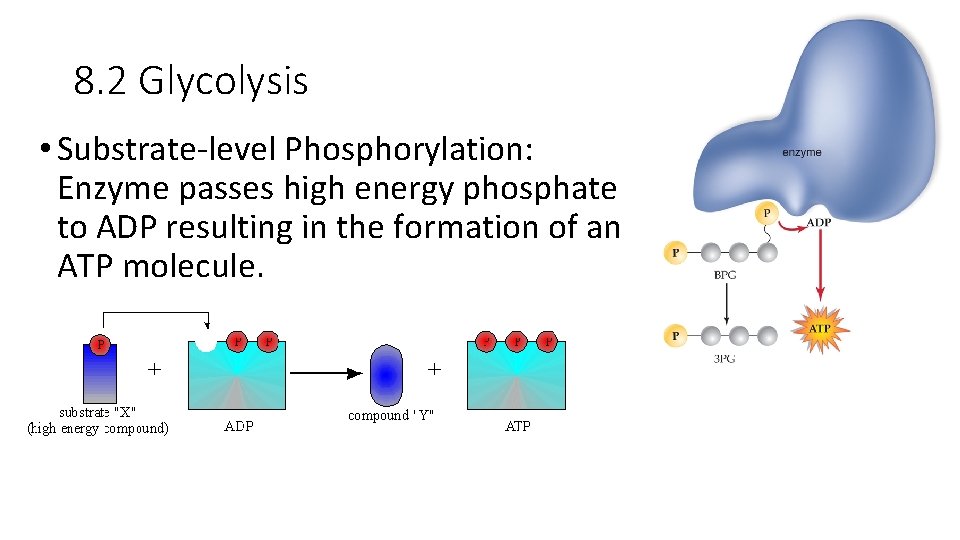
8. 2 Glycolysis • Substrate-level Phosphorylation: Enzyme passes high energy phosphate to ADP resulting in the formation of an ATP molecule.
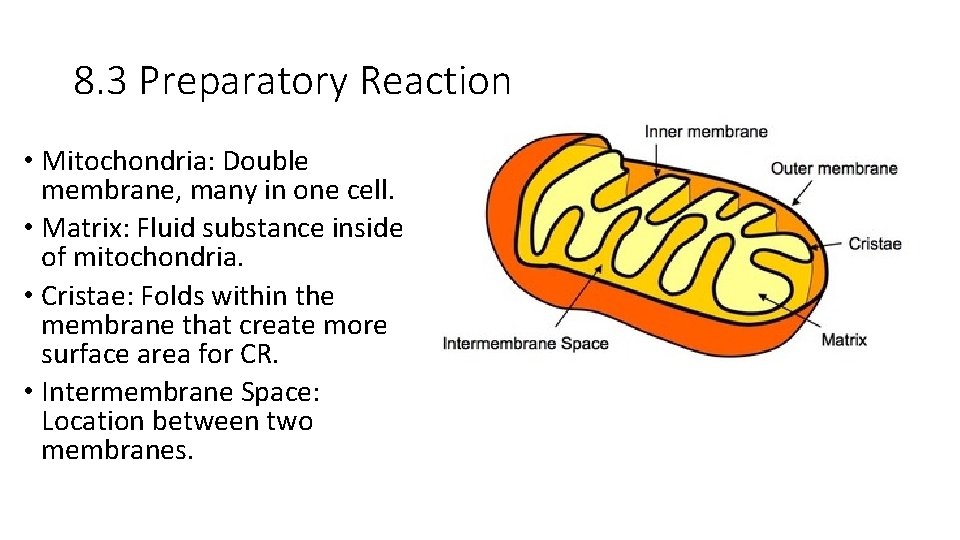
8. 3 Preparatory Reaction • Mitochondria: Double membrane, many in one cell. • Matrix: Fluid substance inside of mitochondria. • Cristae: Folds within the membrane that create more surface area for CR. • Intermembrane Space: Location between two membranes.
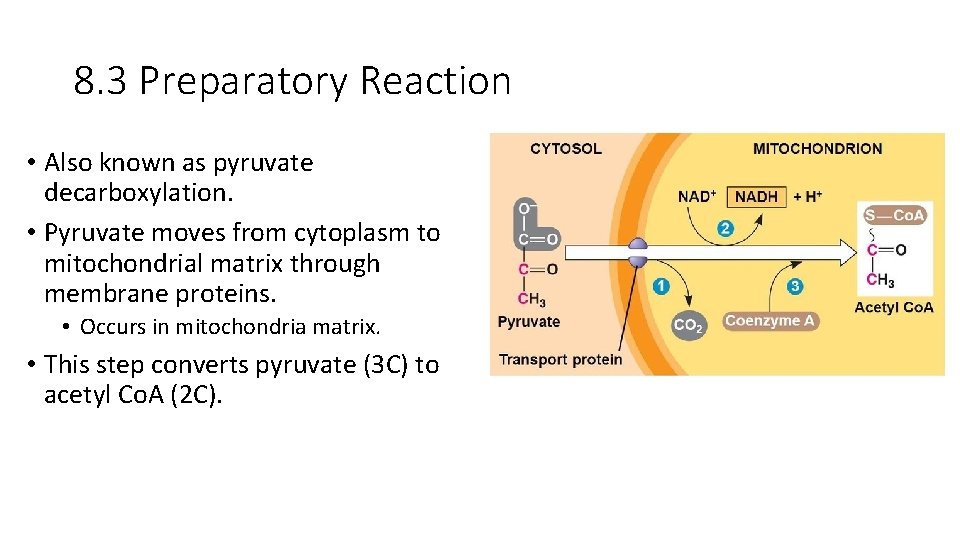
8. 3 Preparatory Reaction • Also known as pyruvate decarboxylation. • Pyruvate moves from cytoplasm to mitochondrial matrix through membrane proteins. • Occurs in mitochondria matrix. • This step converts pyruvate (3 C) to acetyl Co. A (2 C).
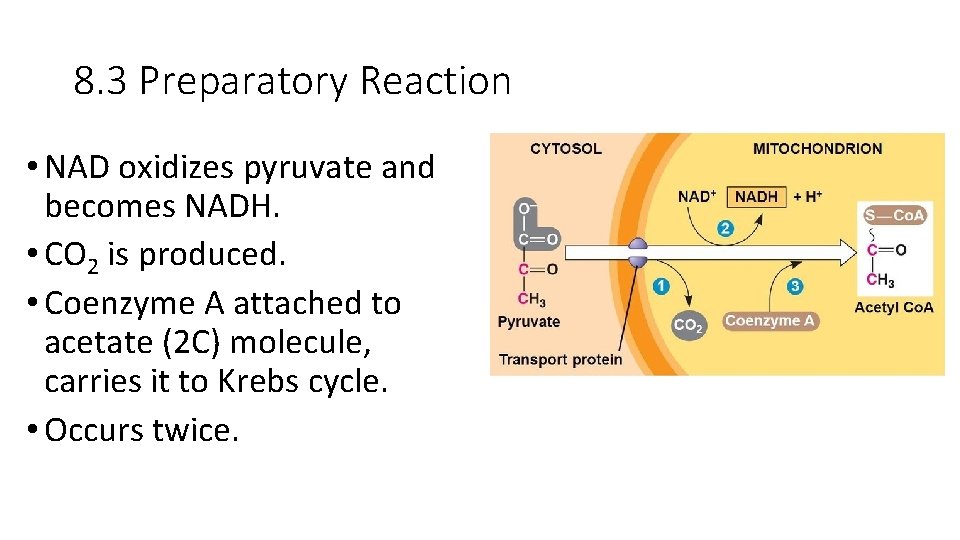
8. 3 Preparatory Reaction • NAD oxidizes pyruvate and becomes NADH. • CO 2 is produced. • Coenzyme A attached to acetate (2 C) molecule, carries it to Krebs cycle. • Occurs twice.
8. 4 The Krebs Cycle • AKA: TCA Cycle • AKA: Citric Acid Cycle • Location: Mitochondria matrix. • ATP is created through substrate level phosphorylation. • Turns twice for every glucose molecule. Discovered by Hans Krebs
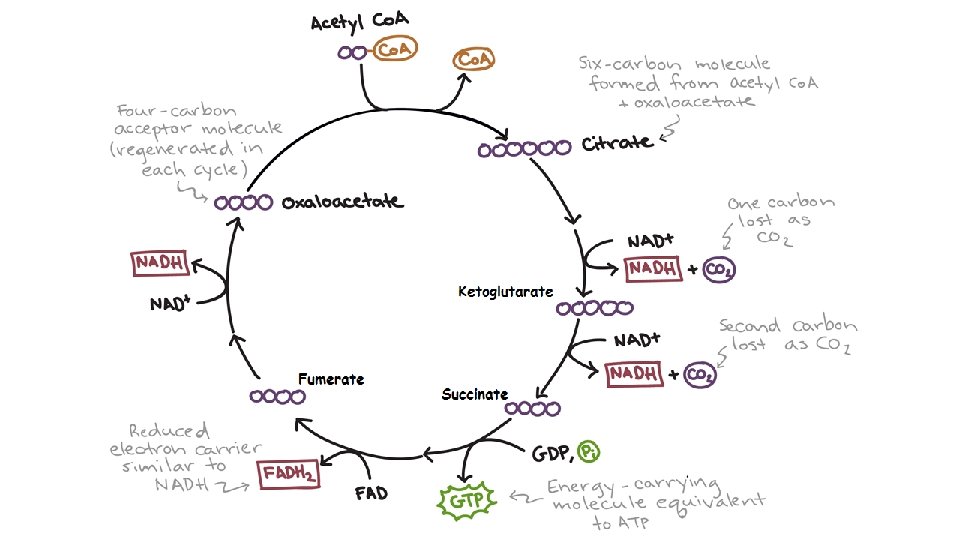
8. 4 The Krebs Cycle • Acetyl Co. A (2 C) joins with oxaloacetate (4 C) to create a 6 -carbon molecule called citrate. • NAD is reduced to NADH. CO 2 is released. 5 carbon molecule called ketoglutarate. • NAD is reduced to NADH. CO 2 is produced. 4 carbon molecule called succinate. • FAD is reduced to FADH 2. ATP is produced. Produces 4 carbon compound called fumarate. • NAD is reduced to NADH. Water is added. Produces 4 carbon compound called oxaloacetate.
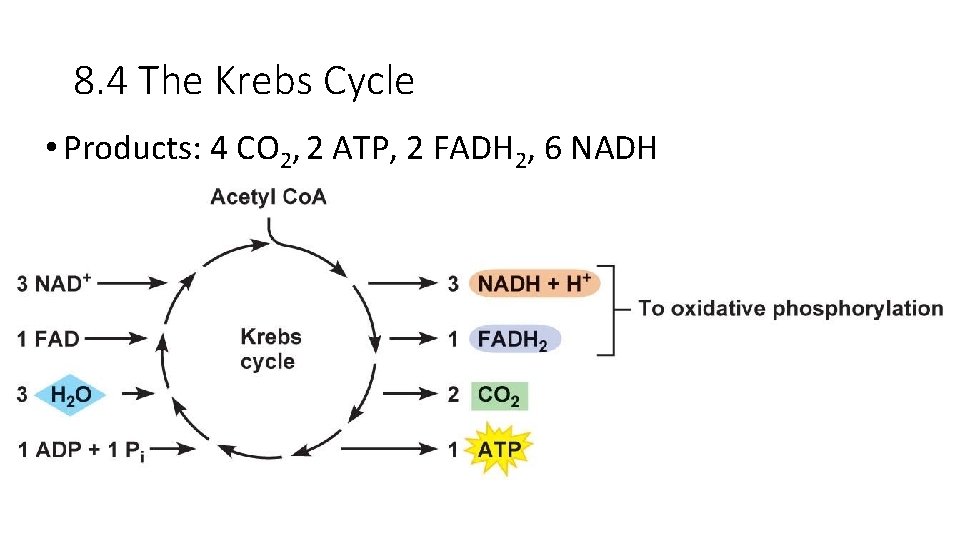
8. 4 The Krebs Cycle • Products: 4 CO 2, 2 ATP, 2 FADH 2, 6 NADH
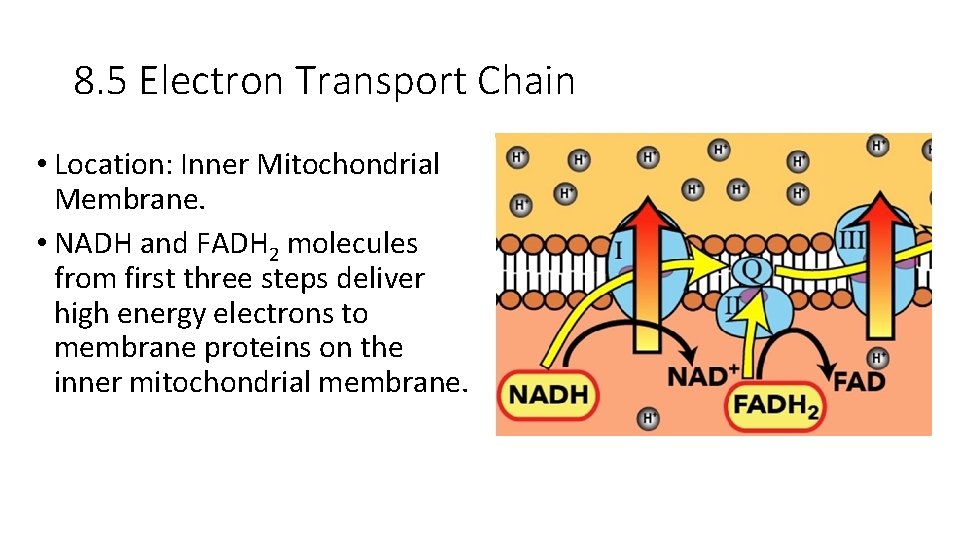
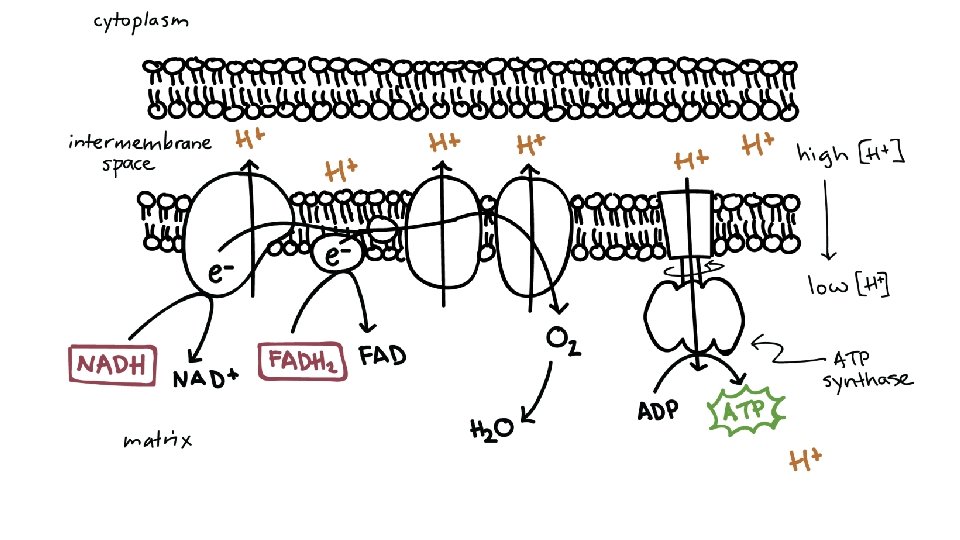
8. 5 Electron Transport Chain • Location: Inner Mitochondrial Membrane. • NADH and FADH 2 molecules from first three steps deliver high energy electrons to membrane proteins on the inner mitochondrial membrane.
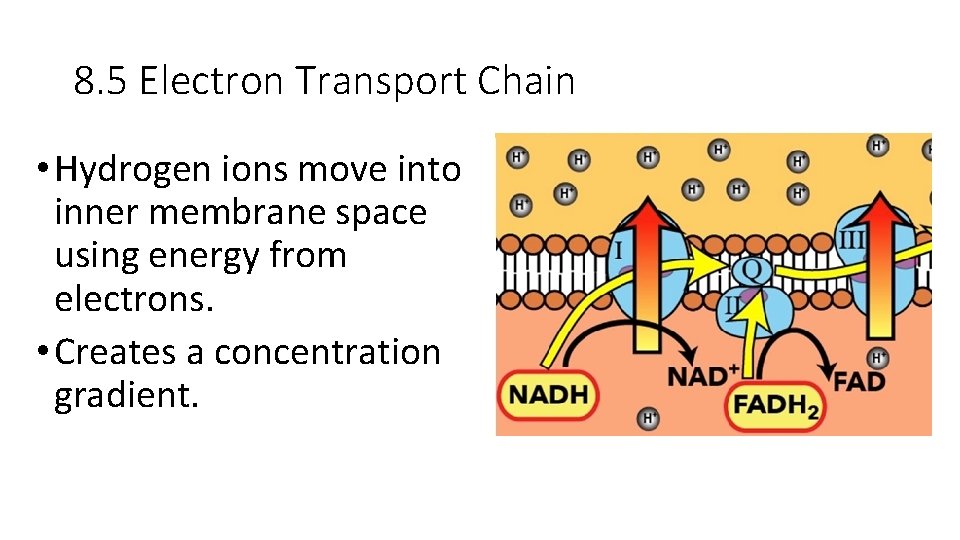
8. 5 Electron Transport Chain • Hydrogen ions move into inner membrane space using energy from electrons. • Creates a concentration gradient.
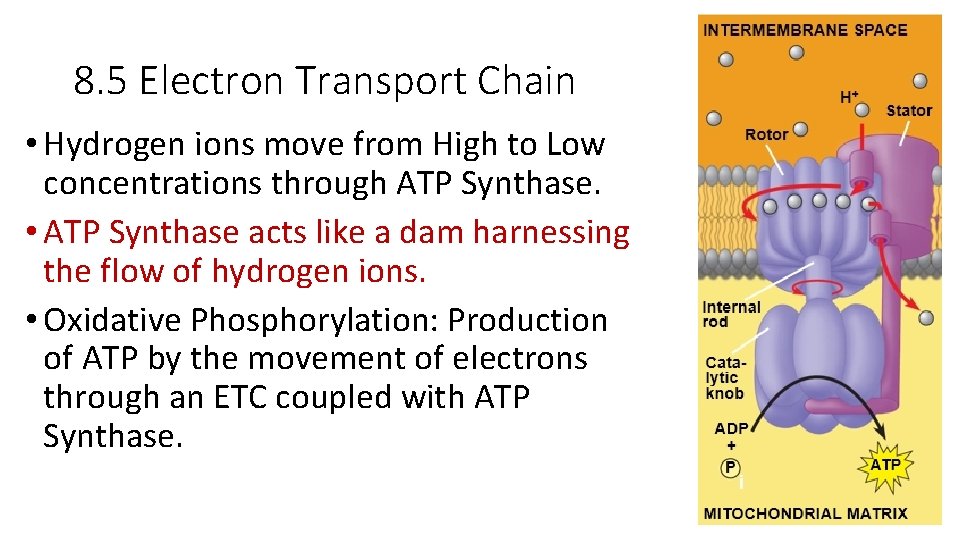
8. 5 Electron Transport Chain • Hydrogen ions move from High to Low concentrations through ATP Synthase. • ATP Synthase acts like a dam harnessing the flow of hydrogen ions. • Oxidative Phosphorylation: Production of ATP by the movement of electrons through an ETC coupled with ATP Synthase.
8. 5 Electron Transport Chain • Oxygen is the final electron accepter. Combines with hydrogen ions to form water. • If there is no oxygen, ATP does not form. • For each NADH, 3 ATP are created. • For each FADH 2, 2 ATP are created.
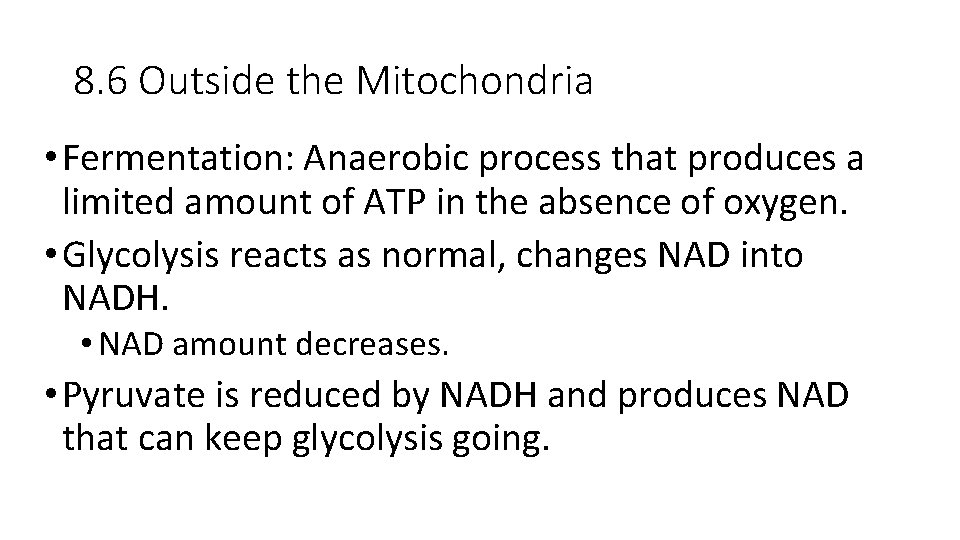
8. 6 Outside the Mitochondria • Fermentation: Anaerobic process that produces a limited amount of ATP in the absence of oxygen. • Glycolysis reacts as normal, changes NAD into NADH. • NAD amount decreases. • Pyruvate is reduced by NADH and produces NAD that can keep glycolysis going.
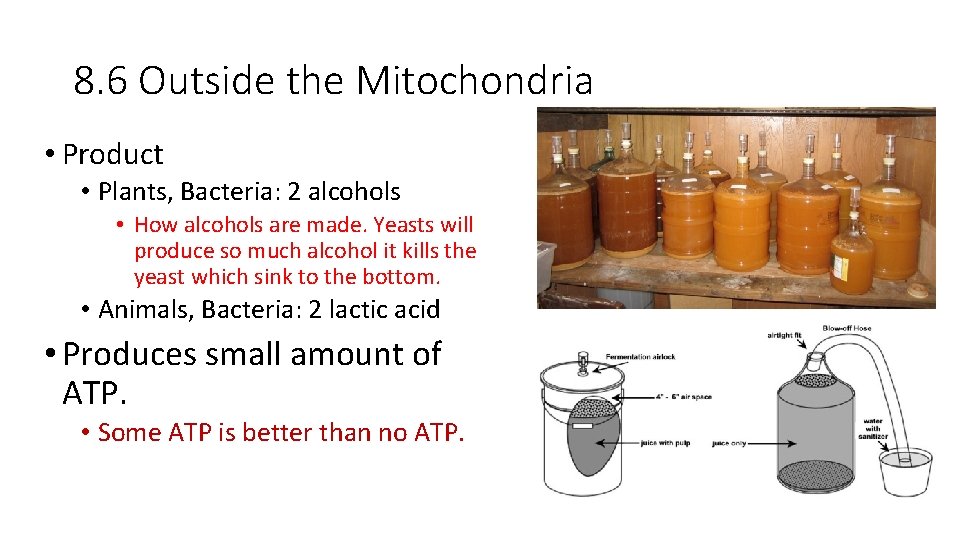
8. 6 Outside the Mitochondria • Product • Plants, Bacteria: 2 alcohols • How alcohols are made. Yeasts will produce so much alcohol it kills the yeast which sink to the bottom. • Animals, Bacteria: 2 lactic acid • Produces small amount of ATP. • Some ATP is better than no ATP.
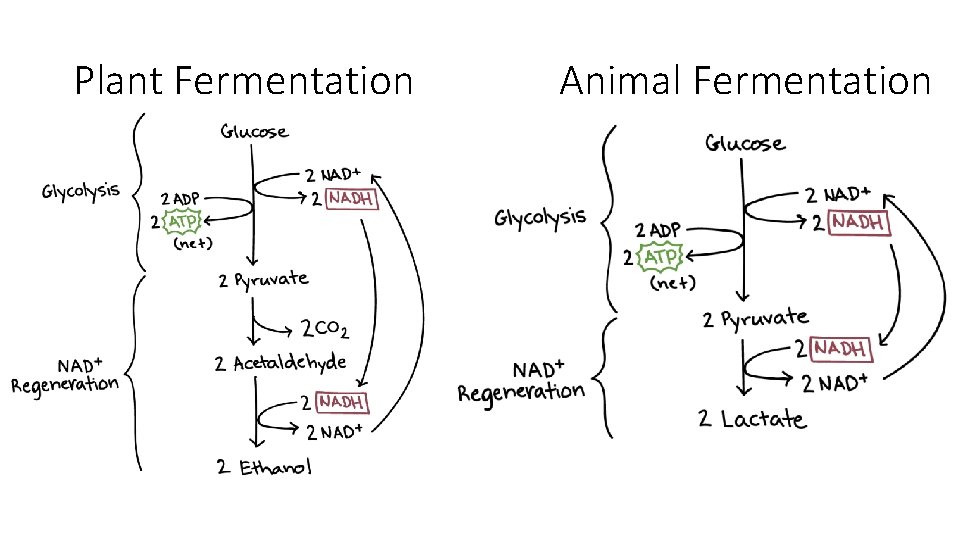
Plant Fermentation Animal Fermentation
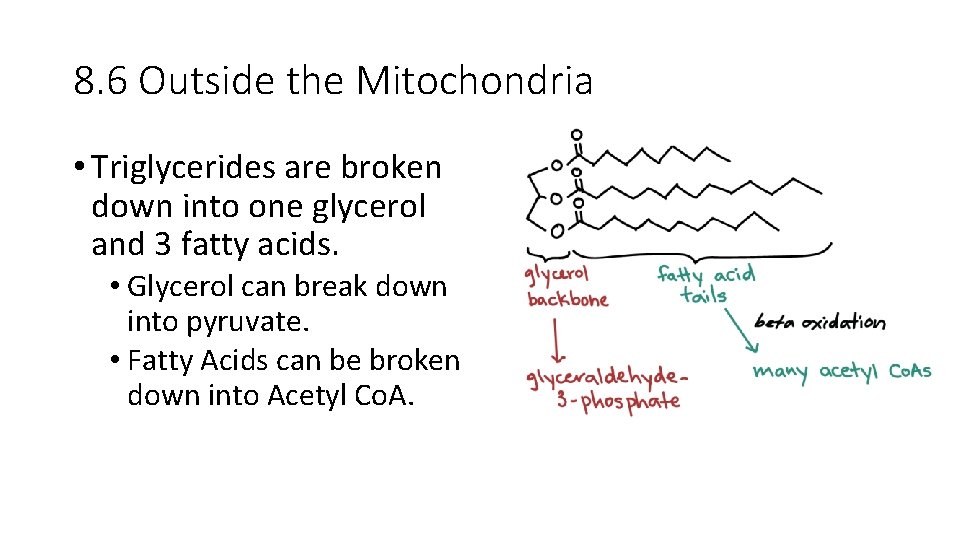
8. 6 Outside the Mitochondria • Triglycerides are broken down into one glycerol and 3 fatty acids. • Glycerol can break down into pyruvate. • Fatty Acids can be broken down into Acetyl Co. A.
8. 6 Outside the Mitochondria • Excessive amounts of carbohydrates can result in the formation of fat. • Extra Acetyl Co. A can form fatty acids. • ”ABCD“ • Anabolism = Building • Catabolism = Degradation
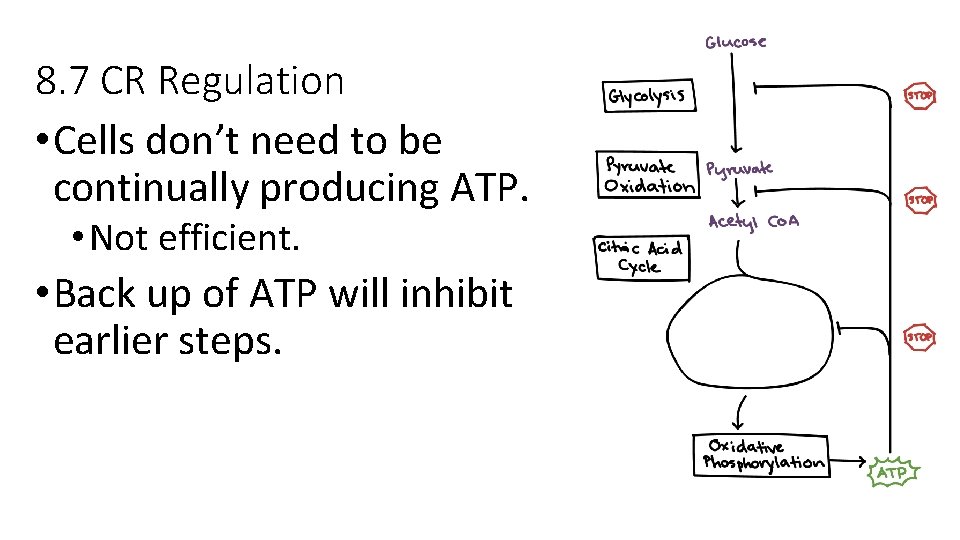
8. 7 CR Regulation • Cells don’t need to be continually producing ATP. • Not efficient. • Back up of ATP will inhibit earlier steps.
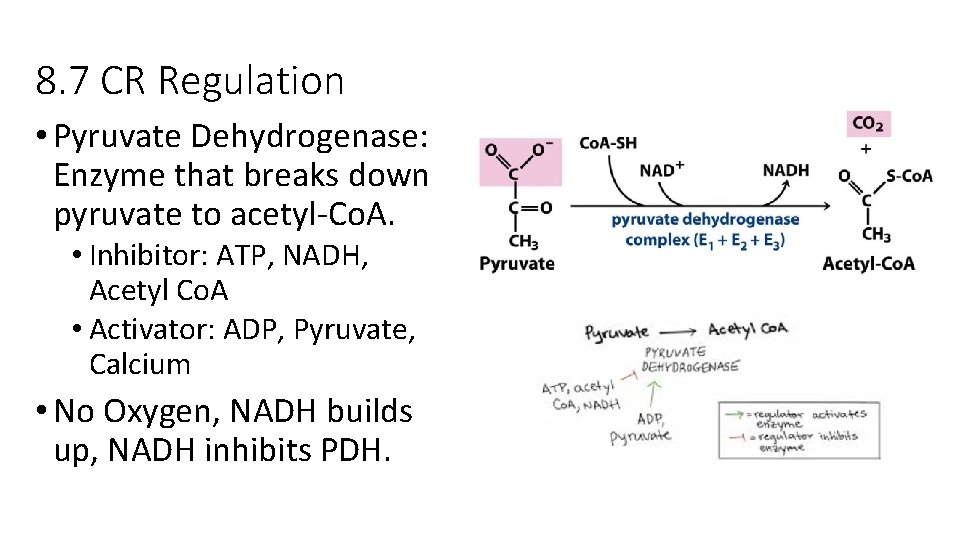
8. 7 CR Regulation • Pyruvate Dehydrogenase: Enzyme that breaks down pyruvate to acetyl-Co. A. • Inhibitor: ATP, NADH, Acetyl Co. A • Activator: ADP, Pyruvate, Calcium • No Oxygen, NADH builds up, NADH inhibits PDH.
- Slides: 28