
Chapter 8 Cell Reproduction Table of Contents Section
Chapter 8 Cell Reproduction Table of Contents Section 1 Chromosomes Section 2 Cell Division Section 3 Meiosis
Chapter 8 Section 1 Chromosomes Objectives • Describe the structure of a chromosome. • Identify the differences in structure between prokaryotic chromosomes and eukaryotic chromosomes. • Compare the numbers of chromosomes in different species. • Explain the differences between sex chromosomes and autosomes. • Distinguish between diploid and haploid cells.
Chapter 8 Section 1 Chromosomes Chromosome Structure • Chromosomes are rod-shaped structures made of DNA and protein. • In eukaryotes, DNA wraps around proteins called histones to help maintain the compact structure of chromosomes.
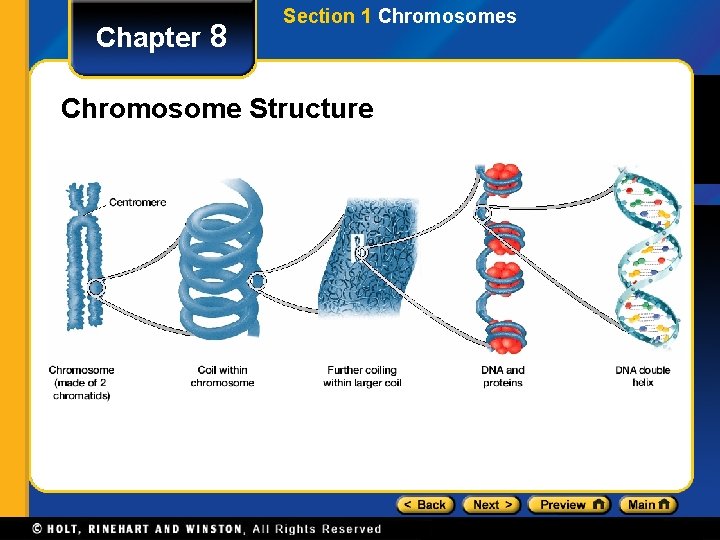
Chapter 8 Section 1 Chromosomes Chromosome Structure
Chapter 8 Section 1 Chromosomes Chromosome Structure, continued • Chromosomes in prokaryotes are simpler in structure than chromosomes in eukaryotes.
Chapter 8 Section 1 Chromosomes Chromosome Numbers • Each species has a characteristic number of chromosomes in each cell.
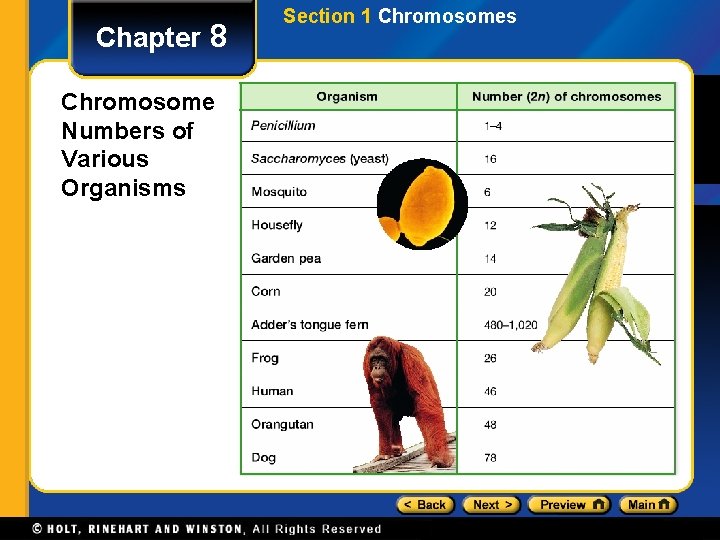
Chapter 8 Chromosome Numbers of Various Organisms Section 1 Chromosomes
Chapter 8 Section 1 Chromosomes Chromosome Numbers, continued • Sex Chromosomes and Autosomes – Sex chromosomes are chromosomes that determine the sex of an organism. – All of the other chromosomes in an organism are autosomes.
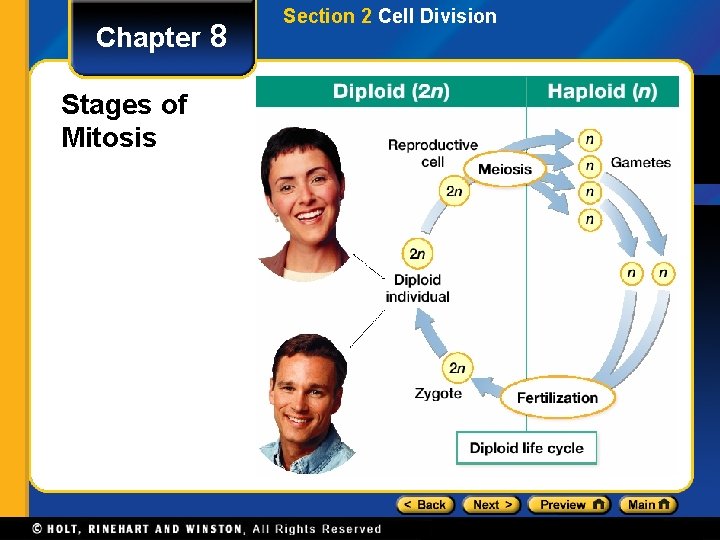
Chapter 8 Section 1 Chromosomes Chromosome Numbers, continued • Diploid and Haploid Cells – Cells having two sets of chromosomes are diploid (2 n). – Haploid cells (1 n) have only one set of chromosomes.
Chapter 8 Section 2 Cell Division Objectives • Describe the events of cell division in prokaryotes. • Name the two parts of the cell that are equally divided during cell division in eukaryotes. • Summarize the events of interphase. • Describe the stages of mitosis. • Compare cytokinesis in animal cells with cytokinesis in plant cells. • Explain how cell division is controlled.
Chapter 8 Section 2 Cell Division in Prokaryotes • Describe the events of cell division in prokaryotes. • Name the two parts of the cell that are equally divided during cell division in eukaryotes. • Summarize the events of interphase. • Describe the stages of mitosis. • Compare cytokinesis in animal cells with cytokinesis in plant cells.
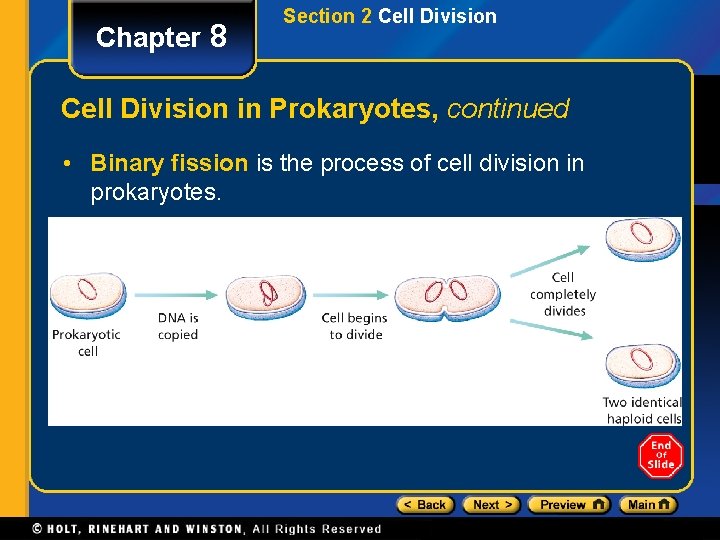
Chapter 8 Section 2 Cell Division in Prokaryotes, continued • Binary fission is the process of cell division in prokaryotes.
Chapter 8 Section 2 Cell Division in Eukaryotes • Cell Cycle – The cell cycle is the repeating set of events in the life of a cell. – The cell cycle consists of cell division and interphase. – Cell division in eukaryotes includes nuclear division, called mitosis, and the division of cytoplasm, called cytokinesis.
Chapter 8 Section 2 Cell Division in Eukaryotes, continued • Interphase – Interphase consists of growth (G 1), DNA replication, and preparation for cell division (G 2).
Chapter 8 Section 2 Cell Division Stages of Mitosis • Mitosis is divided into stages: prophase, metaphase, and telophase. • Mitosis results in two offspring cells that are genetically identical to the original cell.
Chapter 8 Stages of Mitosis Section 2 Cell Division
Chapter 8 Section 2 Cell Division Cytokinesis • During cytokinesis in animal cells, a cleavage furrow pinches in and eventually separates the dividing cell into two cells. • In plant cells, a cell plate separates the dividing cell into two cells.
Chapter 8 Section 2 Cell Division Control of Cell Division • Cell division in eukaryotes is controlled by many proteins. • Control occurs at three main checkpoints.

Chapter 8 Section 2 Cell Division Control of Cell Division, continued • When Control is Lost: Cancer – Cancer may result if cells do not respond to control mechanisms.
Chapter 8 Section 3 Meiosis Objectives • Compare the end products of meiosis with those of mitosis. • Summarize the events of meiosis I. • Explain crossing-over and how it contributes to the production of unique individuals. • Summarize the events of meiosis II. • Compare spermatogenesis and oogenesis. • Define sexual reproduction.
Chapter 8 Section 3 Meiosis Formation of Haploid Cells • Meiosis is a process of nuclear division that reduces the number of chromosomes in new cells to half the number in the original cell. • Meiosis produces haploid gametes.
Chapter 8 Section 3 Meiosis Formation of Haploid Cells, continued • Meiosis is a process of nuclear division that reduces the number of chromosomes in new cells to half the number in the original cell. • Meiosis leads to four haploid cells (gametes) rather than two diploid cells as in mitosis.
Chapter 8 Section 3 Meiosis I • Meiosis I includes prophase I, metaphase I, and telophase I. • Crossing-over, which is when portions of homologous chromosomes exchange genetics material, occurs during prophase I and results in genetic recombination.
Chapter 8 Section 3 Meiosis II • Meiosis II includes prophase II, metaphase II, and telophase II. • Four new haploid cells result.
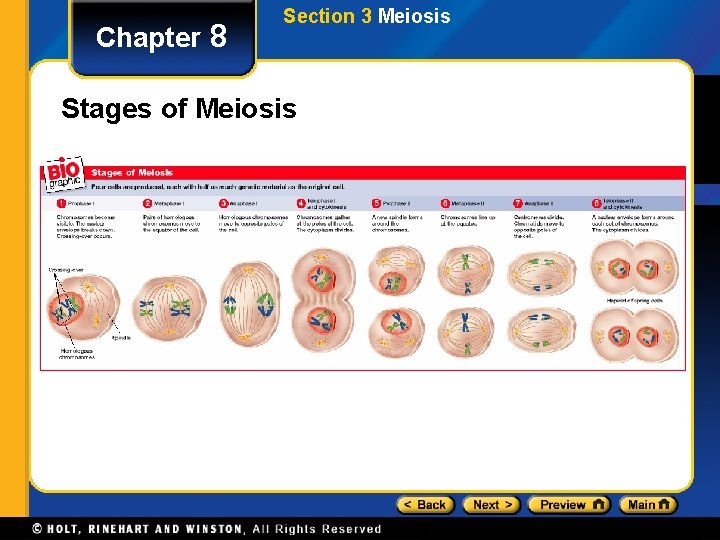
Chapter 8 Section 3 Meiosis Stages of Meiosis
Chapter 8 Section 3 Meiosis Development of Gametes • Spermatogenesis is the process by which sperm cells are produced. • Oogenesis is the process that produces mature egg cells.
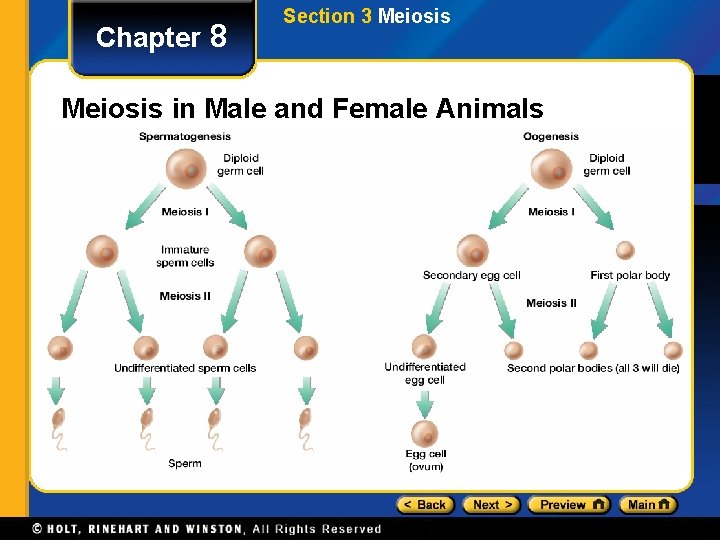
Chapter 8 Section 3 Meiosis in Male and Female Animals
Chapter 8 Section 3 Meiosis Sexual Reproduction • Sexual reproduction is the formation of offspring through meiosis and the union of a sperm and an egg. • Offspring produced by sexual reproduction are genetically different from the parents.
- Slides: 28