
Chapter 8 Cell Reproduction Review Organelles Centrioles Made
- Slides: 25
Chapter 8: Cell Reproduction
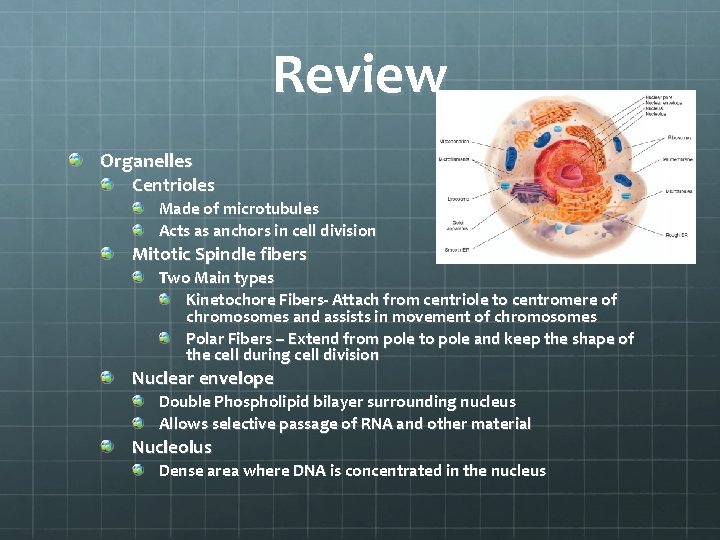
Review Organelles Centrioles Made of microtubules Acts as anchors in cell division Mitotic Spindle fibers Two Main types Kinetochore Fibers- Attach from centriole to centromere of chromosomes and assists in movement of chromosomes Polar Fibers – Extend from pole to pole and keep the shape of the cell during cell division Nuclear envelope Double Phospholipid bilayer surrounding nucleus Allows selective passage of RNA and other material Nucleolus Dense area where DNA is concentrated in the nucleus
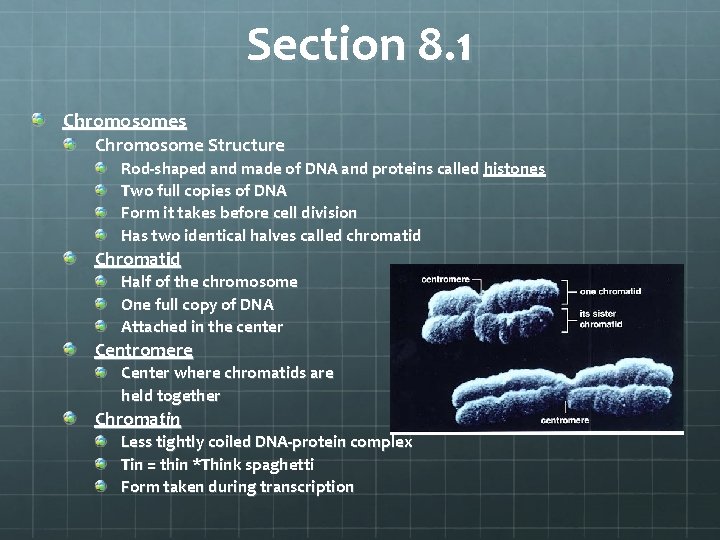
Section 8. 1 Chromosomes Chromosome Structure Rod-shaped and made of DNA and proteins called histones Two full copies of DNA Form it takes before cell division Has two identical halves called chromatid Chromatid Half of the chromosome One full copy of DNA Attached in the center Centromere Center where chromatids are held together Chromatin Less tightly coiled DNA-protein complex Tin = thin *Think spaghetti Form taken during transcription
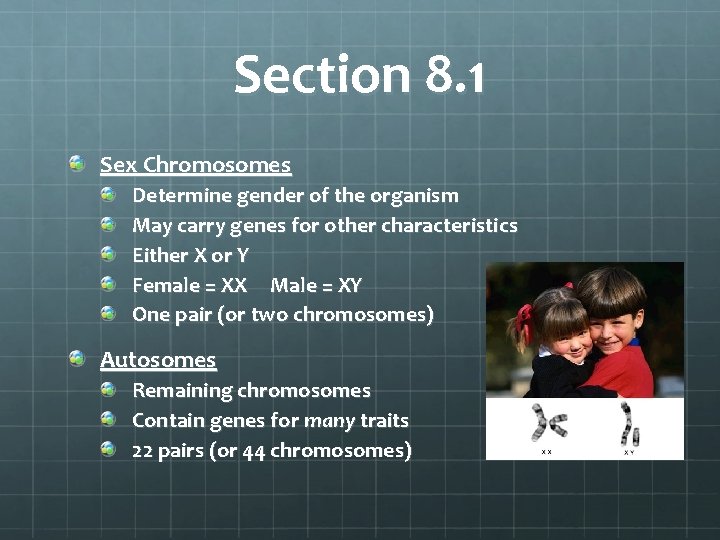
Section 8. 1 Sex Chromosomes Determine gender of the organism May carry genes for other characteristics Either X or Y Female = XX Male = XY One pair (or two chromosomes) Autosomes Remaining chromosomes Contain genes for many traits 22 pairs (or 44 chromosomes)
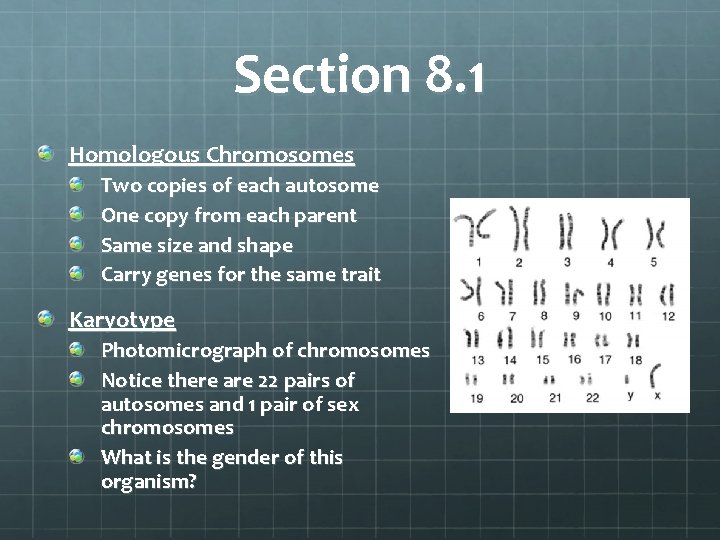
Section 8. 1 Homologous Chromosomes Two copies of each autosome One copy from each parent Same size and shape Carry genes for the same trait Karyotype Photomicrograph of chromosomes Notice there are 22 pairs of autosomes and 1 pair of sex chromosomes What is the gender of this organism?
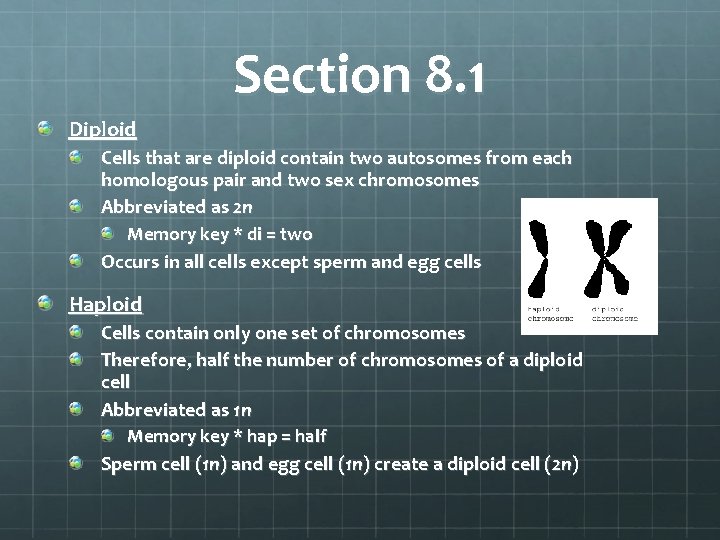
Section 8. 1 Diploid Cells that are diploid contain two autosomes from each homologous pair and two sex chromosomes Abbreviated as 2 n Memory key * di = two Occurs in all cells except sperm and egg cells Haploid Cells contain only one set of chromosomes Therefore, half the number of chromosomes of a diploid cell Abbreviated as 1 n Memory key * hap = half Sperm cell (1 n) and egg cell (1 n) create a diploid cell (2 n)
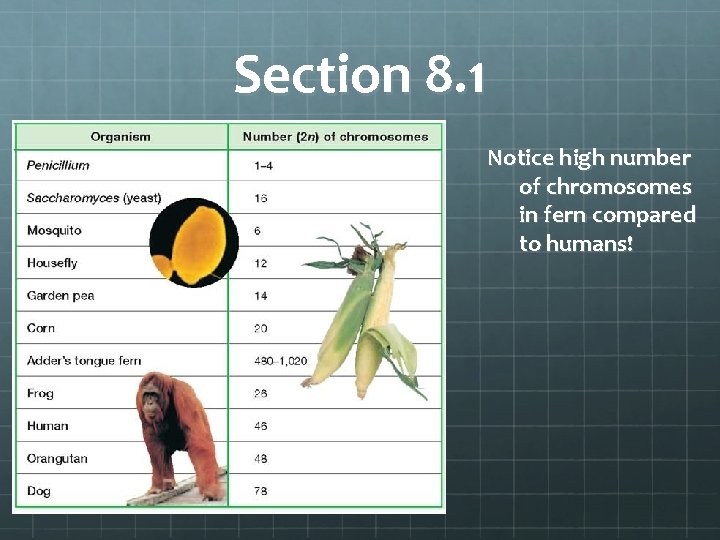
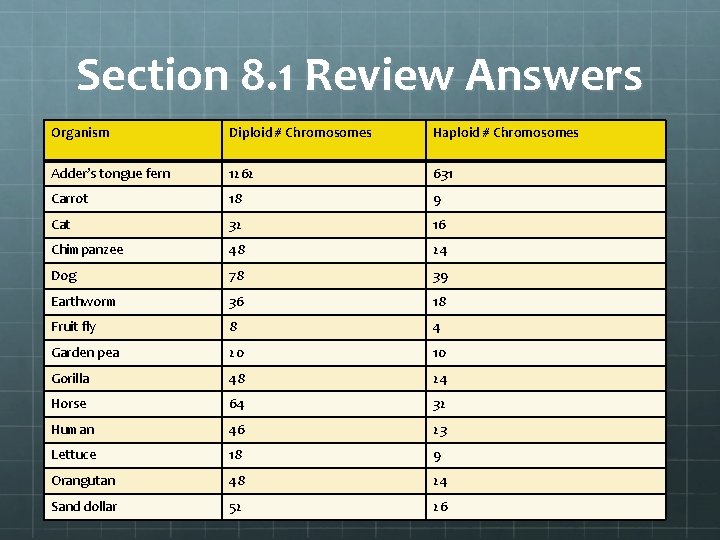
Section 8. 1 Notice high number of chromosomes in fern compared to humans!
Section 8. 1 Homework Review questions on p. 153 #1 -5
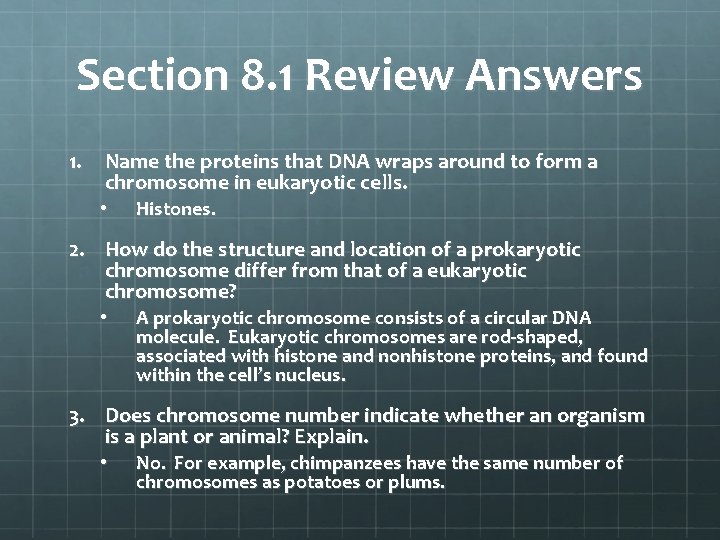
Section 8. 1 Review Answers 1. Name the proteins that DNA wraps around to form a chromosome in eukaryotic cells. • Histones. 2. How do the structure and location of a prokaryotic chromosome differ from that of a eukaryotic chromosome? • A prokaryotic chromosome consists of a circular DNA molecule. Eukaryotic chromosomes are rod-shaped, associated with histone and nonhistone proteins, and found within the cell’s nucleus. 3. Does chromosome number indicate whether an organism is a plant or animal? Explain. • No. For example, chimpanzees have the same number of chromosomes as potatoes or plums.
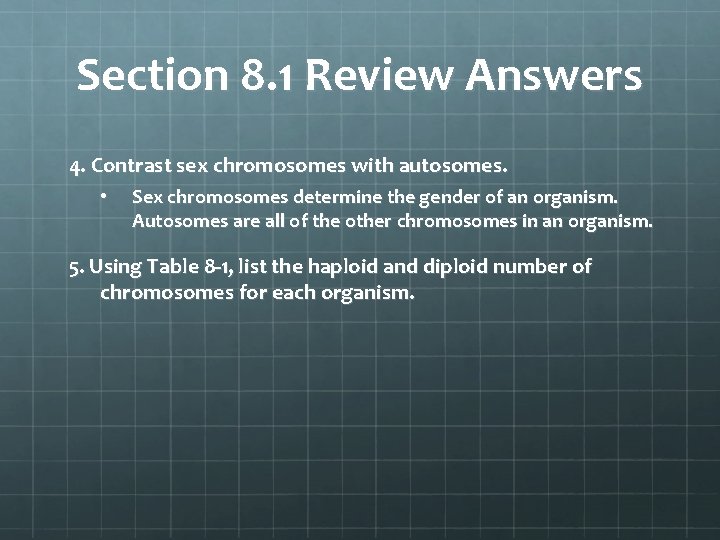
Section 8. 1 Review Answers 4. Contrast sex chromosomes with autosomes. • Sex chromosomes determine the gender of an organism. Autosomes are all of the other chromosomes in an organism. 5. Using Table 8 -1, list the haploid and diploid number of chromosomes for each organism.
Section 8. 1 Review Answers Organism Diploid # Chromosomes Haploid # Chromosomes Adder’s tongue fern 1262 631 Carrot 18 9 Cat 32 16 Chimpanzee 48 24 Dog 78 39 Earthworm 36 18 Fruit fly 8 4 Garden pea 20 10 Gorilla 48 24 Horse 64 32 Human 46 23 Lettuce 18 9 Orangutan 48 24 Sand dollar 52 26
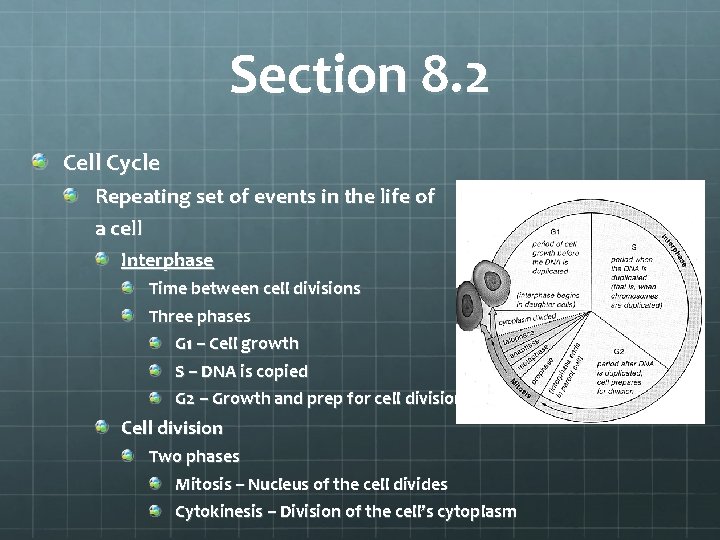
Section 8. 2 Cell Cycle Repeating set of events in the life of a cell Interphase Time between cell divisions Three phases G 1 – Cell growth S – DNA is copied G 2 – Growth and prep for cell division Cell division Two phases Mitosis – Nucleus of the cell divides Cytokinesis – Division of the cell’s cytoplasm
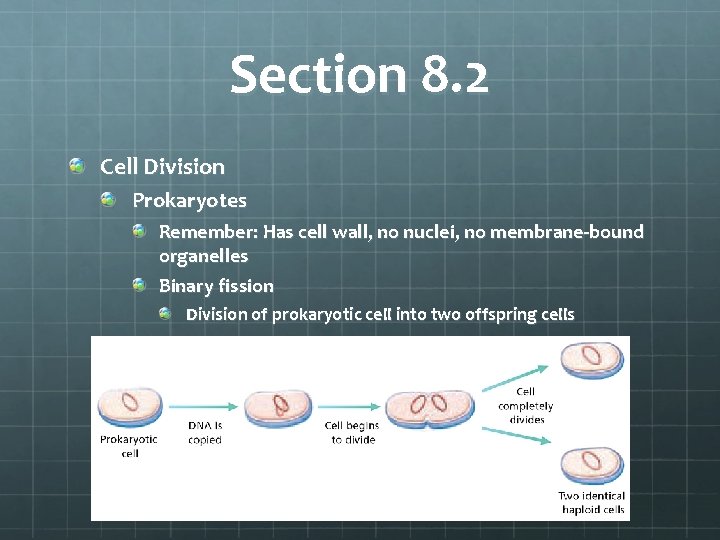
Section 8. 2 Cell Division Prokaryotes Remember: Has cell wall, no nuclei, no membrane-bound organelles Binary fission Division of prokaryotic cell into two offspring cells
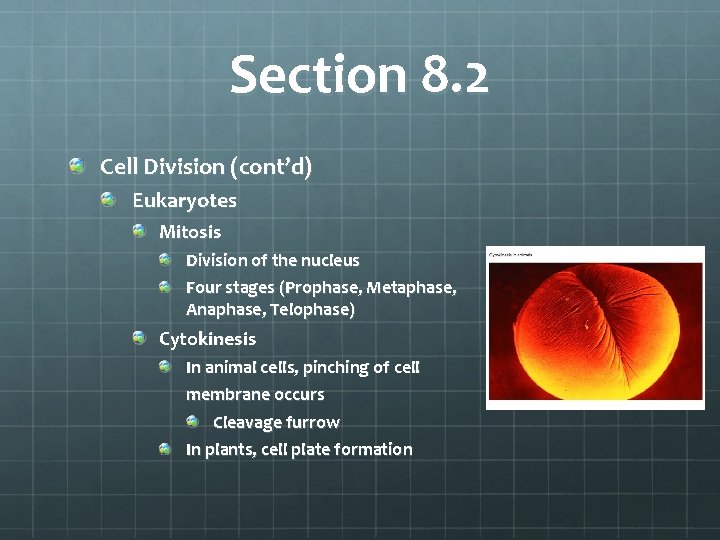
Section 8. 2 Cell Division (cont’d) Eukaryotes Mitosis Division of the nucleus Four stages (Prophase, Metaphase, Anaphase, Telophase) Cytokinesis In animal cells, pinching of cell membrane occurs Cleavage furrow In plants, cell plate formation
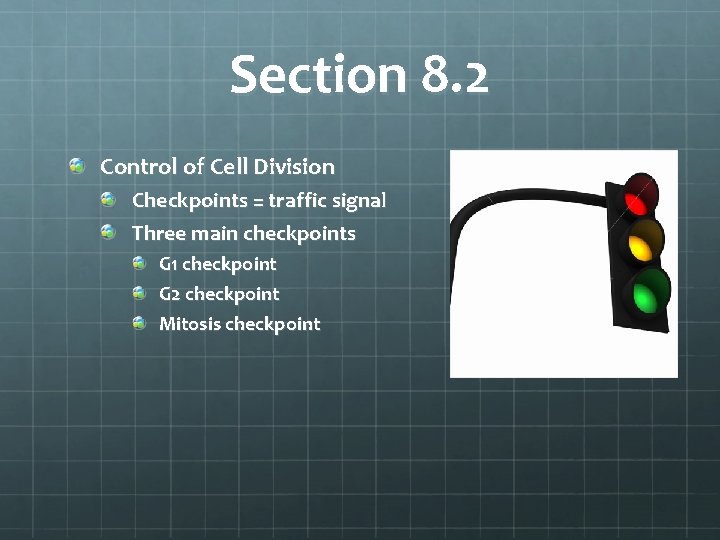
Section 8. 2 Control of Cell Division Checkpoints = traffic signal Three main checkpoints G 1 checkpoint G 2 checkpoint Mitosis checkpoint
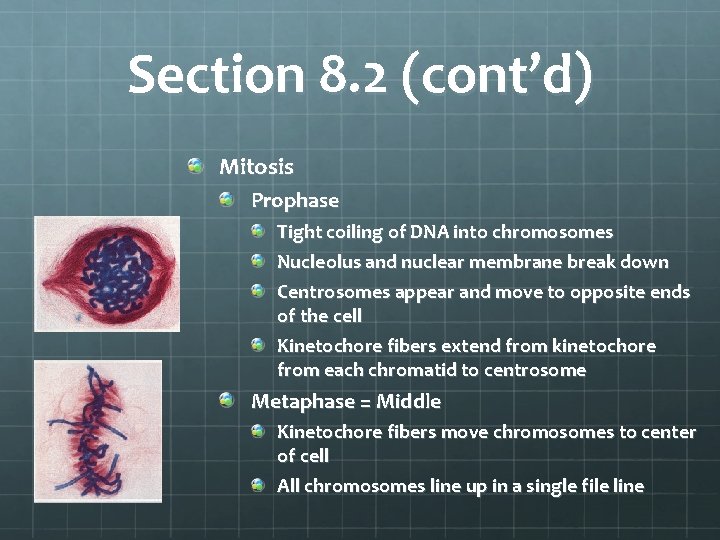
Section 8. 2 (cont’d) Mitosis Prophase Tight coiling of DNA into chromosomes Nucleolus and nuclear membrane break down Centrosomes appear and move to opposite ends of the cell Kinetochore fibers extend from kinetochore from each chromatid to centrosome Metaphase = Middle Kinetochore fibers move chromosomes to center of cell All chromosomes line up in a single file line
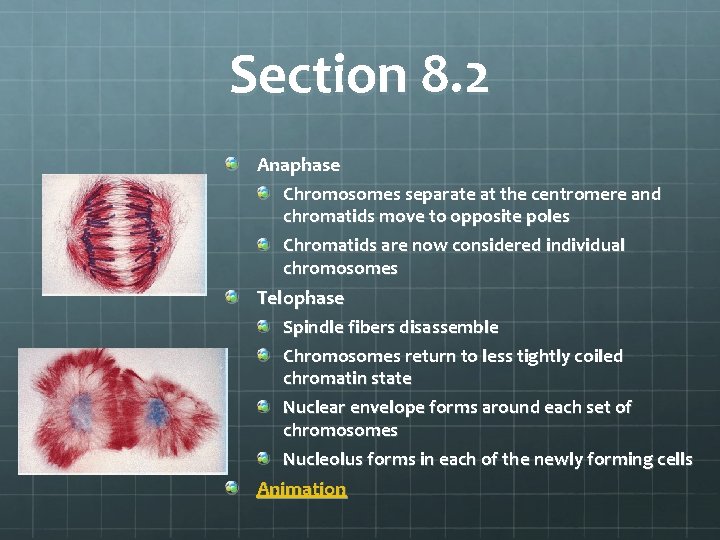
Section 8. 2 Anaphase Chromosomes separate at the centromere and chromatids move to opposite poles Chromatids are now considered individual chromosomes Telophase Spindle fibers disassemble Chromosomes return to less tightly coiled chromatin state Nuclear envelope forms around each set of chromosomes Nucleolus forms in each of the newly forming cells Animation
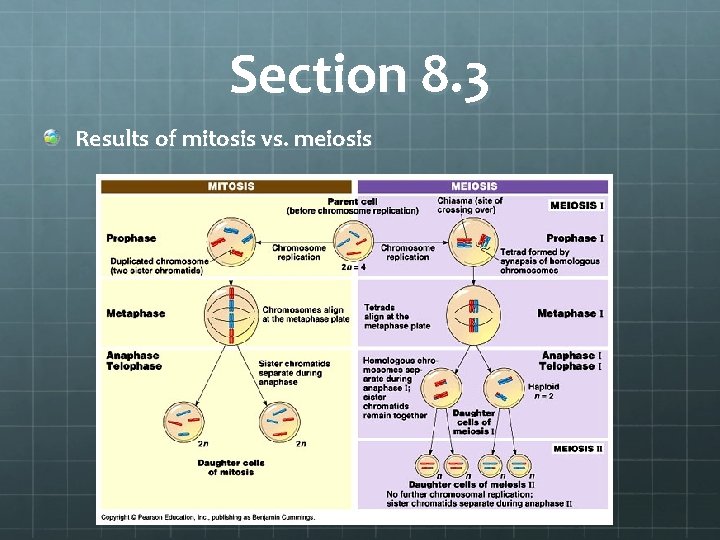
Mitosis vs Meiosis Where do they occur? Mitosis – in the body cells (Somatic Cells) Meiosis – in the germ cells (Sex Cells) Why does it occur? Mitosis Asexual reproduction Growth and development To replace old cells Meiosis Formation of gametes (egg and sperm cells) that will be used in sexual reproduction
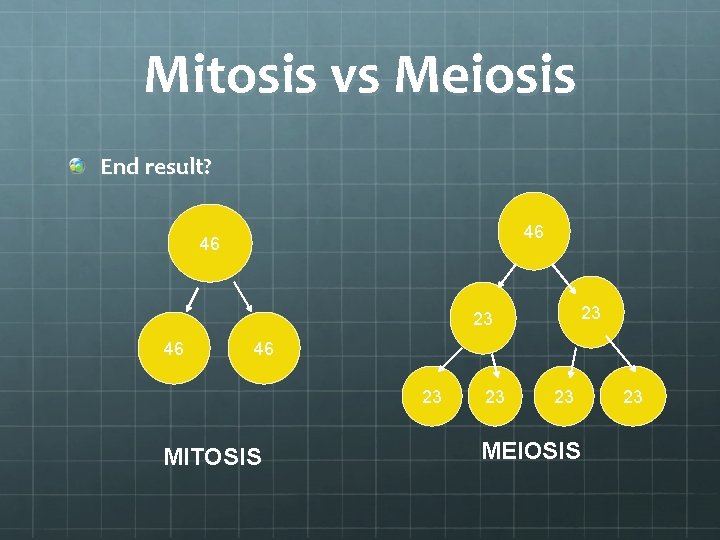
Mitosis vs Meiosis End result? 46 46 23 23 46 46 23 MITOSIS 23 23 MEIOSIS 23
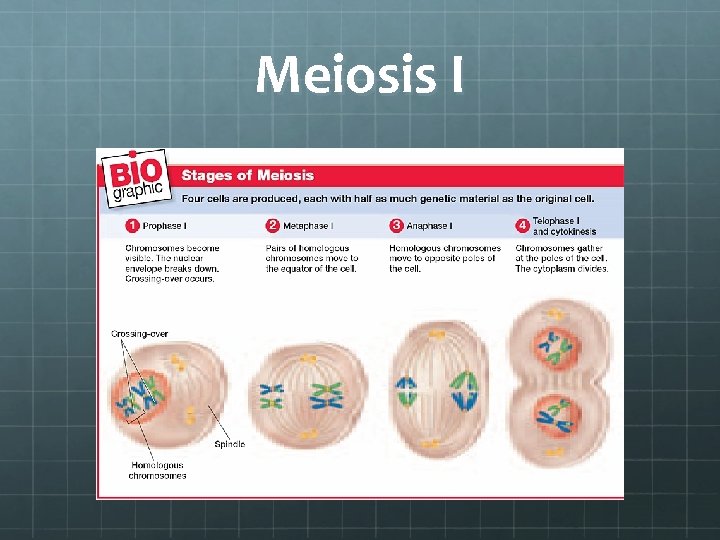
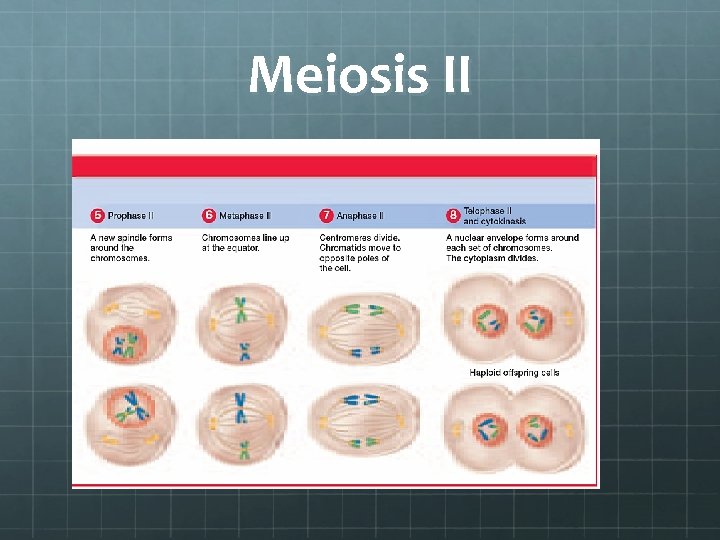
Meiosis Also known as reduction division Occurs in germ cells found in the ovaries and testes Produces sex cells which are haploid Occurs in two phases Meiosis I Reduces the number of chromosomes from diploid to haploid Meiosis II Produces four haploid daughter cells
Meiosis I
Meiosis II
Section 8. 3 Results of mitosis vs. meiosis
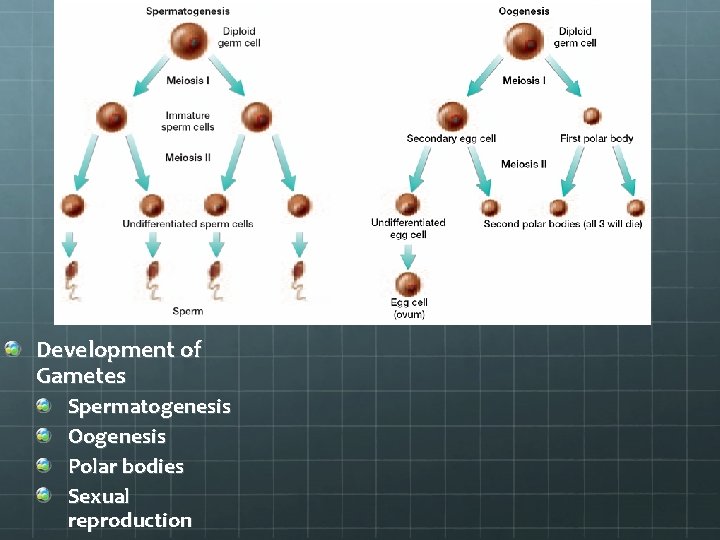
Section 8. 3 Development of Gametes Spermatogenesis Oogenesis Polar bodies Sexual reproduction
Why is meiosis important? Increases genetic diversity in a population of species. This helps to prevent organisms from mass extinction in the event of a plague or other disaster. Allows animals to adapt to a changing environment (natural selection)