
Chapter 8 Case Study FCAPS System Part II

- Slides: 30
Chapter 8: Case Study FCAPS System (Part II)
Iteration 2: Identifying Structures to Support Primary Functionality This section presents the results of the activities that are performed in each of steps of ADD The goal in second iteration is to reason about the units of implementation, which affect team formation, interfaces, and the means by which development tasks may be distributed, outsourced, and implemented in sprints
Step 2: Establish iteration goal by selecting drivers The goal of this iteration is to address the general architecture concern of identifying structures to support primary functionality Identifying these elements is useful not only for understanding how functionality is supported CRN-3 – allocation of work to members of development team In this second iteration, besides CRN-3, the architect considers the system’s primary use cases: q UC-1 q UC-2 q UC-3
Step 3: Choose one or more elements of the system to refine The elements that will refined in this iteration are the modules located in the different layers defined by the two reference architectures from the previous iteration Support of functionality in this system requires the collaboration of components associated with modules that are located in the different layers
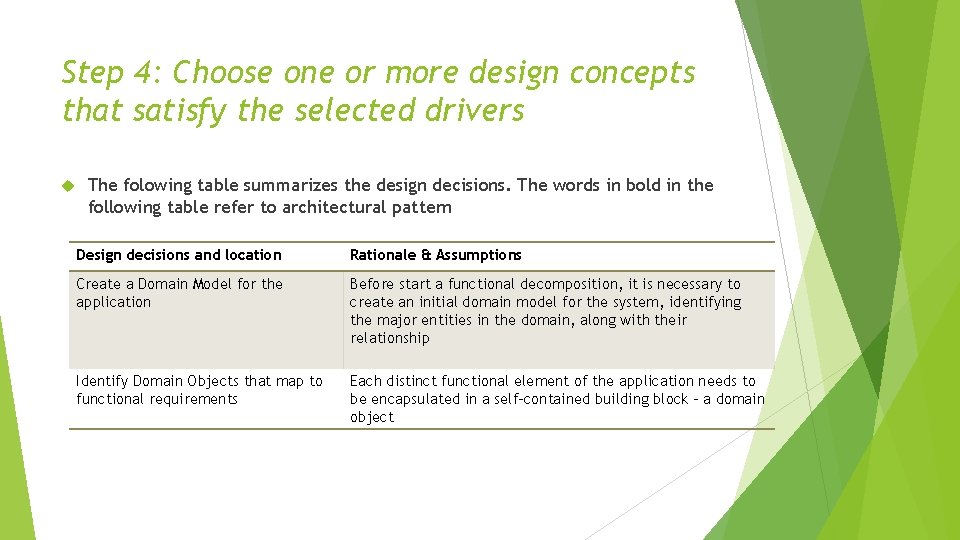
Step 4: Choose one or more design concepts that satisfy the selected drivers The folowing table summarizes the design decisions. The words in bold in the following table refer to architectural pattern Design decisions and location Rationale & Assumptions Create a Domain Model for the application Before start a functional decomposition, it is necessary to create an initial domain model for the system, identifying the major entities in the domain, along with their relationship Identify Domain Objects that map to functional requirements Each distinct functional element of the application needs to be encapsulated in a self-contained building block – a domain object
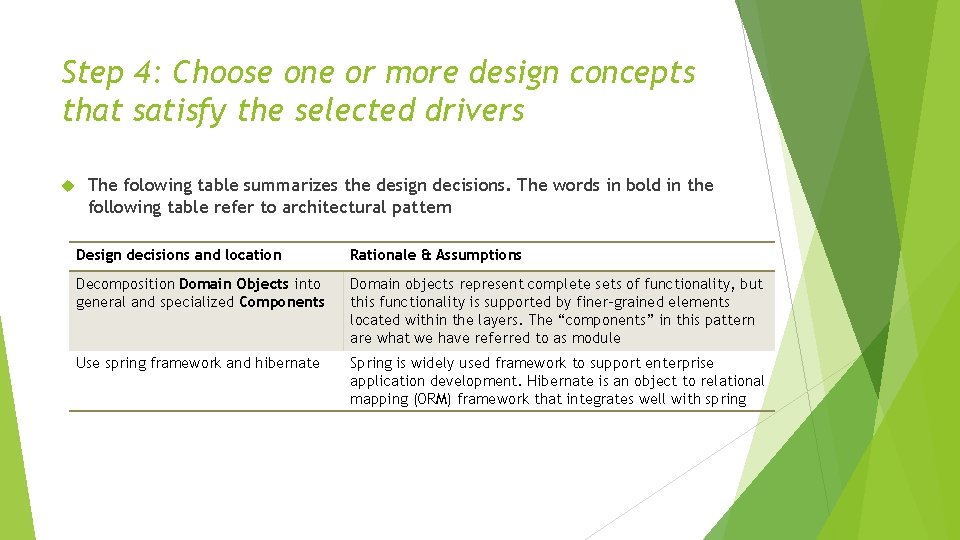
Step 4: Choose one or more design concepts that satisfy the selected drivers The folowing table summarizes the design decisions. The words in bold in the following table refer to architectural pattern Design decisions and location Rationale & Assumptions Decomposition Domain Objects into general and specialized Components Domain objects represent complete sets of functionality, but this functionality is supported by finer-grained elements located within the layers. The “components” in this pattern are what we have referred to as module Use spring framework and hibernate Spring is widely used framework to support enterprise application development. Hibernate is an object to relational mapping (ORM) framework that integrates well with spring
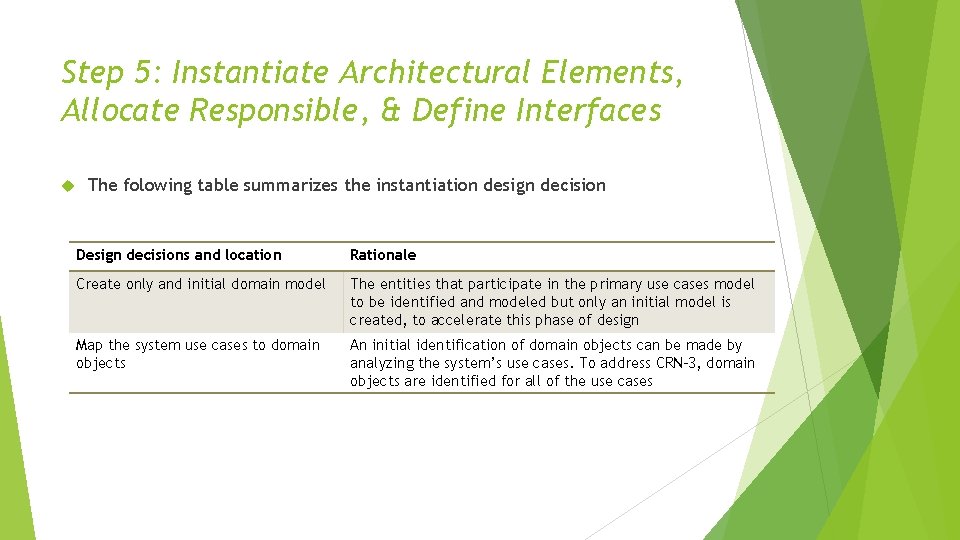
Step 5: Instantiate Architectural Elements, Allocate Responsible, & Define Interfaces The folowing table summarizes the instantiation design decision Design decisions and location Rationale Create only and initial domain model The entities that participate in the primary use cases model to be identified and modeled but only an initial model is created, to accelerate this phase of design Map the system use cases to domain objects An initial identification of domain objects can be made by analyzing the system’s use cases. To address CRN-3, domain objects are identified for all of the use cases
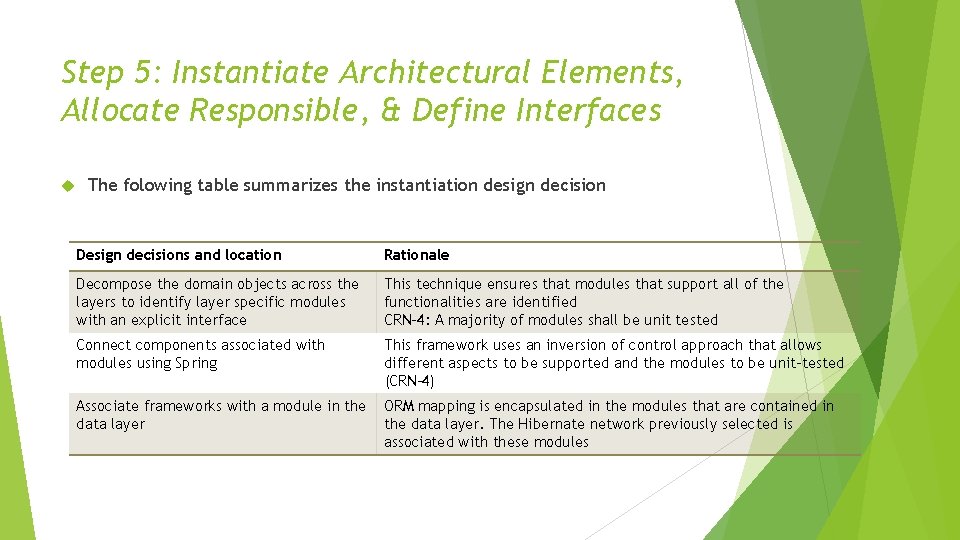
Step 5: Instantiate Architectural Elements, Allocate Responsible, & Define Interfaces The folowing table summarizes the instantiation design decision Design decisions and location Rationale Decompose the domain objects across the layers to identify layer specific modules with an explicit interface This technique ensures that modules that support all of the functionalities are identified CRN-4: A majority of modules shall be unit tested Connect components associated with modules using Spring This framework uses an inversion of control approach that allows different aspects to be supported and the modules to be unit-tested (CRN-4) Associate frameworks with a module in the data layer ORM mapping is encapsulated in the modules that are contained in the data layer. The Hibernate network previously selected is associated with these modules
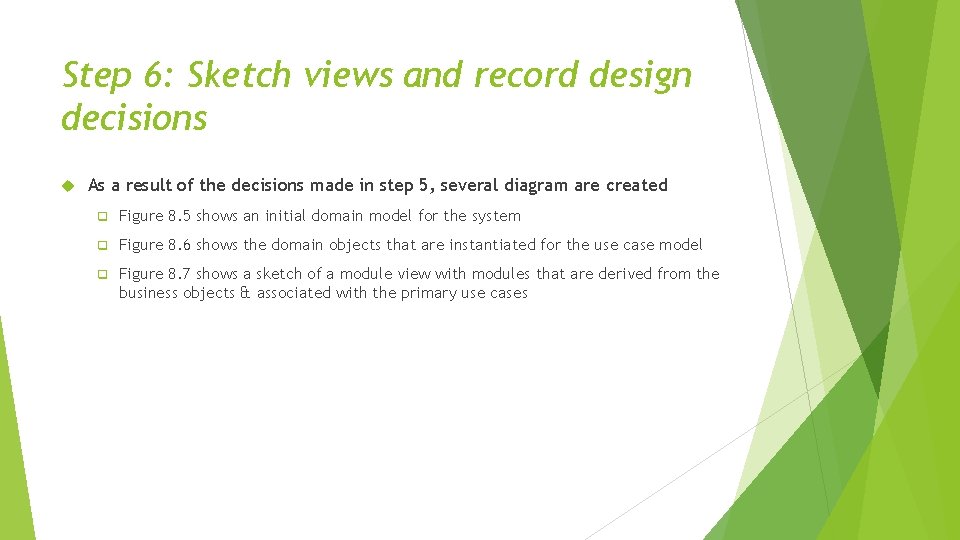
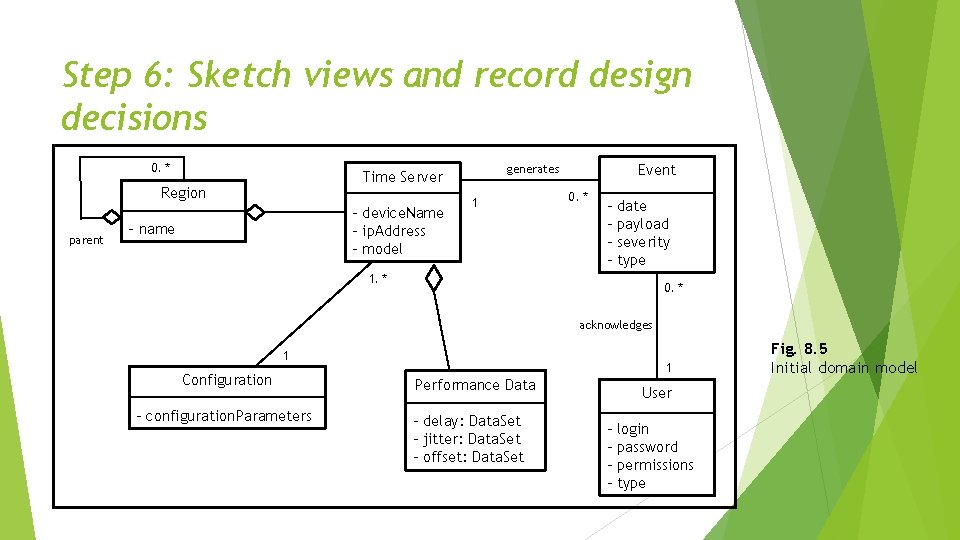
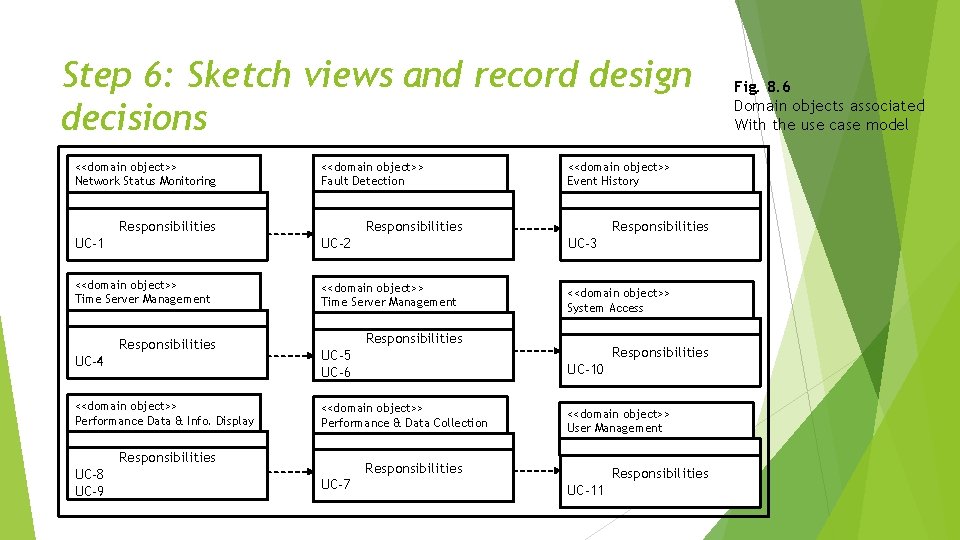
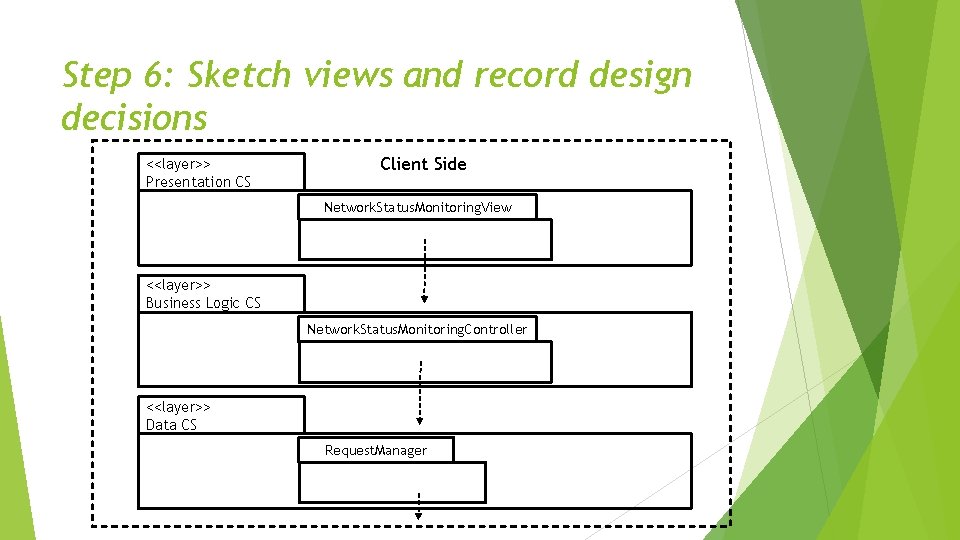
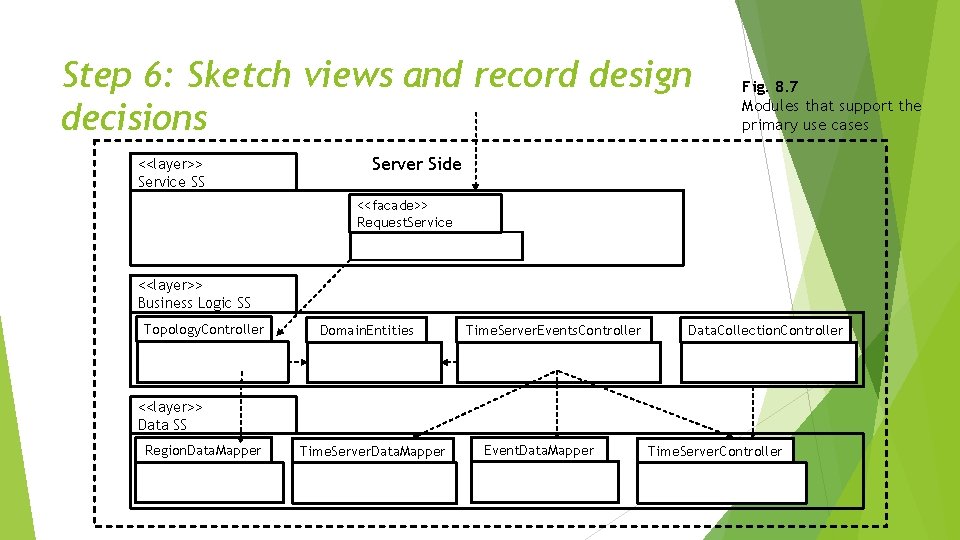
Step 6: Sketch views and record design decisions As a result of the decisions made in step 5, several diagram are created q Figure 8. 5 shows an initial domain model for the system q Figure 8. 6 shows the domain objects that are instantiated for the use case model q Figure 8. 7 shows a sketch of a module view with modules that are derived from the business objects & associated with the primary use cases
Step 6: Sketch views and record design decisions 0. * Region parent - device. Name - ip. Address - model - name Event generates Time Server 1 0. * - date payload severity type 1. * 0. * acknowledges 1 Configuration - configuration. Parameters 1 Performance Data - delay: Data. Set - jitter: Data. Set - offset: Data. Set User - login password permissions type Fig. 8. 5 Initial domain model
Step 6: Sketch views and record design decisions <<domain object>> Network Status Monitoring <<domain object>> Fault Detection <<domain object>> Event History Responsibilities UC-1 UC-2 UC-3 <<domain object>> Time Server Management <<domain object>> System Access Responsibilities UC-4 UC-5 UC-6 UC-10 <<domain object>> Performance Data & Info. Display <<domain object>> Performance & Data Collection <<domain object>> User Management Responsibilities UC-8 UC-9 Responsibilities UC-7 Responsibilities UC-11 Fig. 8. 6 Domain objects associated With the use case model
Step 6: Sketch views and record design decisions <<layer>> Presentation CS Client Side Network. Status. Monitoring. View <<layer>> Business Logic CS Network. Status. Monitoring. Controller <<layer>> Data CS Request. Manager
Step 6: Sketch views and record design decisions <<layer>> Service SS Fig. 8. 7 Modules that support the primary use cases Server Side <<facade>> Request. Service <<layer>> Business Logic SS Topology. Controller Domain. Entities Time. Server. Events. Controller Data. Collection. Controller <<layer>> Data SS Region. Data. Mapper Time. Server. Data. Mapper Event. Data. Mapper Time. Server. Controller
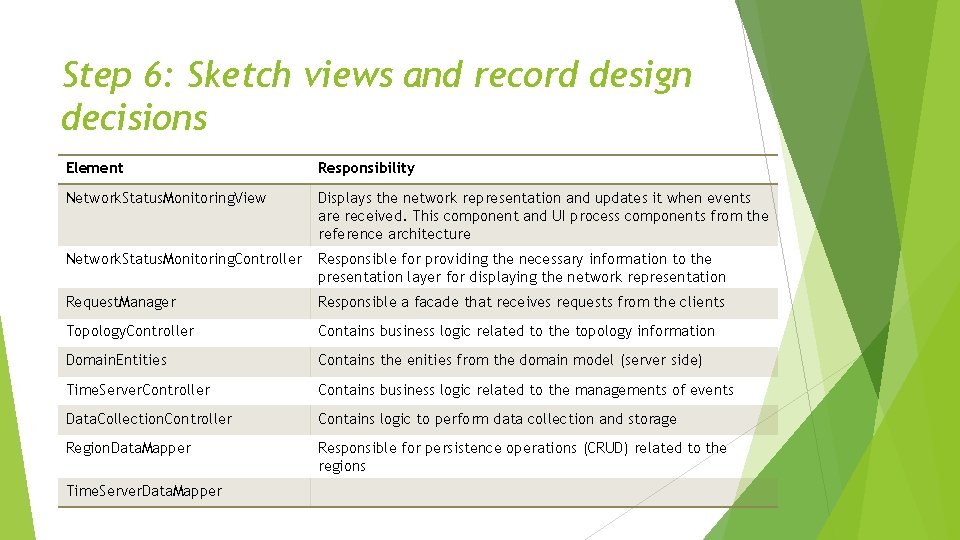
Step 6: Sketch views and record design decisions Element Responsibility Network. Status. Monitoring. View Displays the network representation and updates it when events are received. This component and UI process components from the reference architecture Network. Status. Monitoring. Controller Responsible for providing the necessary information to the presentation layer for displaying the network representation Request. Manager Responsible a facade that receives requests from the clients Topology. Controller Contains business logic related to the topology information Domain. Entities Contains the enities from the domain model (server side) Time. Server. Controller Contains business logic related to the managements of events Data. Collection. Controller Contains logic to perform data collection and storage Region. Data. Mapper Responsible for persistence operations (CRUD) related to the regions Time. Server. Data. Mapper
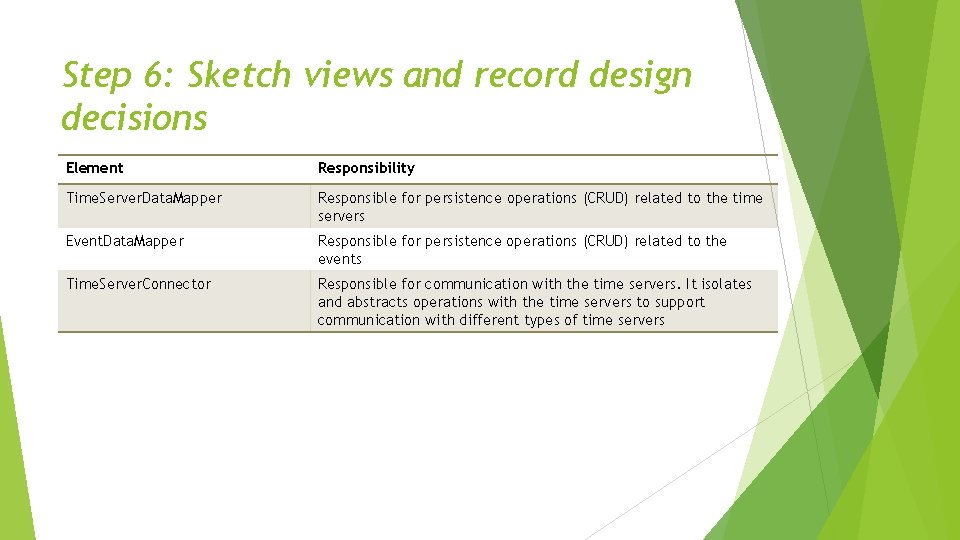
Step 6: Sketch views and record design decisions Element Responsibility Time. Server. Data. Mapper Responsible for persistence operations (CRUD) related to the time servers Event. Data. Mapper Responsible for persistence operations (CRUD) related to the events Time. Server. Connector Responsible for communication with the time servers. It isolates and abstracts operations with the time servers to support communication with different types of time servers
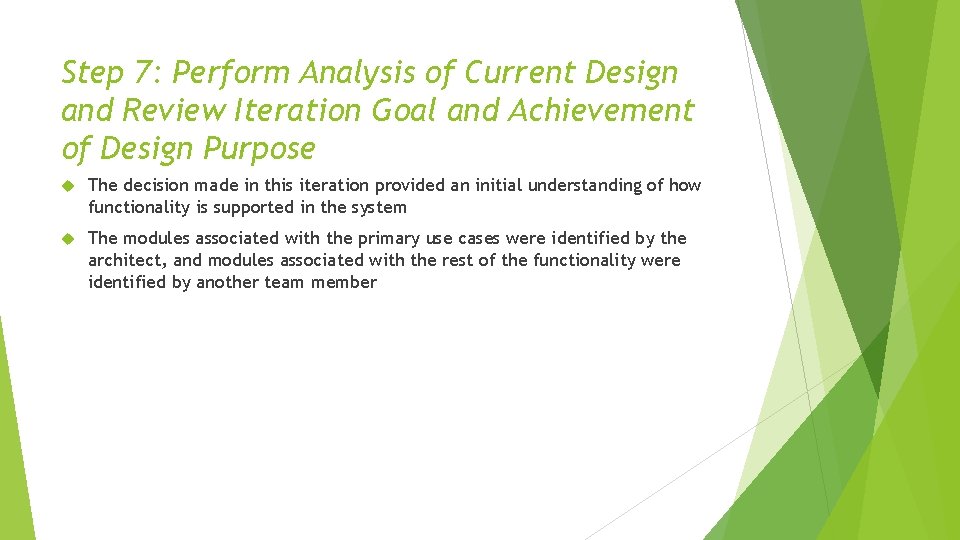
Step 7: Perform Analysis of Current Design and Review Iteration Goal and Achievement of Design Purpose The decision made in this iteration provided an initial understanding of how functionality is supported in the system The modules associated with the primary use cases were identified by the architect, and modules associated with the rest of the functionality were identified by another team member
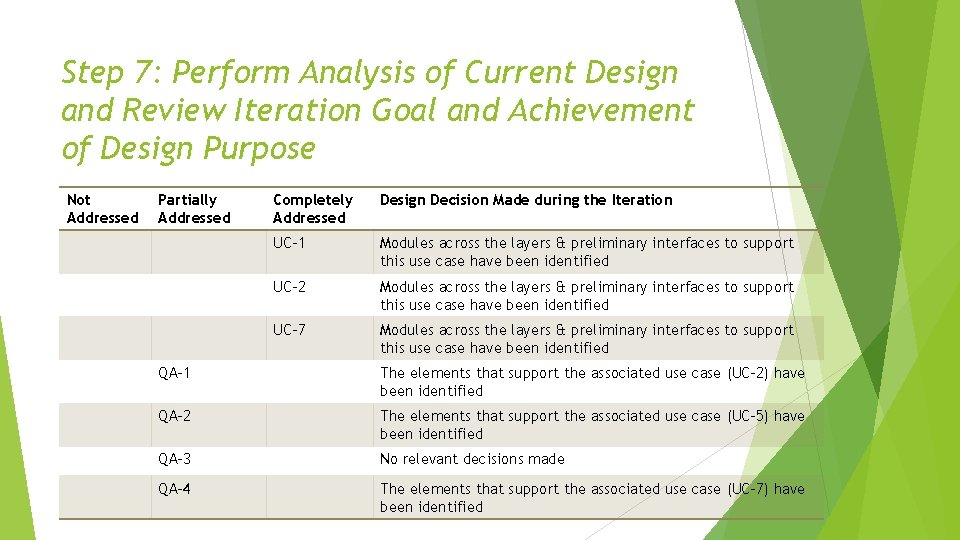
Step 7: Perform Analysis of Current Design and Review Iteration Goal and Achievement of Design Purpose Not Addressed Partially Addressed Completely Addressed Design Decision Made during the Iteration UC-1 Modules across the layers & preliminary interfaces to support this use case have been identified UC-2 Modules across the layers & preliminary interfaces to support this use case have been identified UC-7 Modules across the layers & preliminary interfaces to support this use case have been identified QA-1 The elements that support the associated use case (UC-2) have been identified QA-2 The elements that support the associated use case (UC-5) have been identified QA-3 No relevant decisions made QA-4 The elements that support the associated use case (UC-7) have been identified
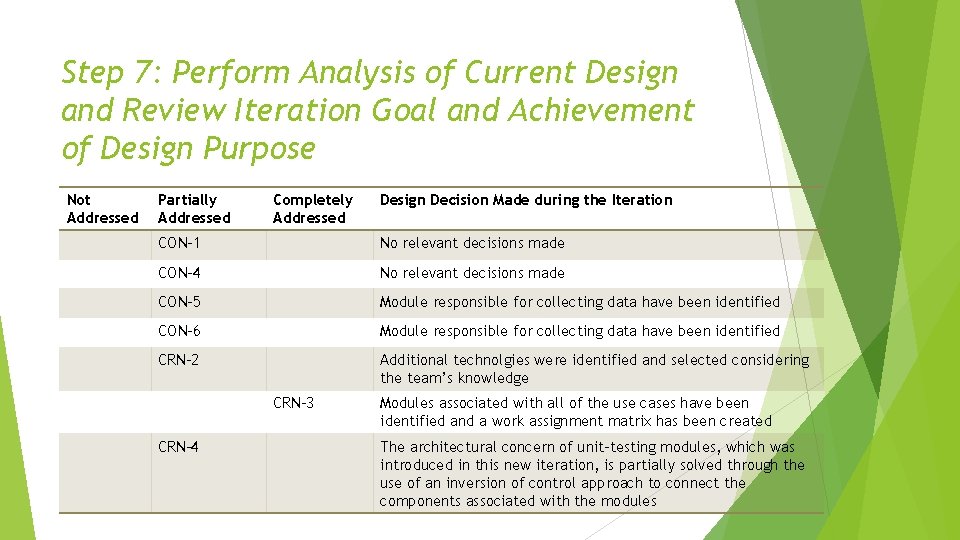
Step 7: Perform Analysis of Current Design and Review Iteration Goal and Achievement of Design Purpose Not Addressed Partially Addressed Completely Addressed Design Decision Made during the Iteration CON-1 No relevant decisions made CON-4 No relevant decisions made CON-5 Module responsible for collecting data have been identified CON-6 Module responsible for collecting data have been identified CRN-2 Additional technolgies were identified and selected considering the team’s knowledge CRN-3 CRN-4 Modules associated with all of the use cases have been identified and a work assignment matrix has been created The architectural concern of unit-testing modules, which was introduced in this new iteration, is partially solved through the use of an inversion of control approach to connect the components associated with the modules
Iteration 3: Addressing Quality Attribute Scenario Driver (QA-3) This section presents the results of the activities that are performed in each of the step of ADD in the third iteration of the design process This iteration focuses on just one of these quality attributes scenarios
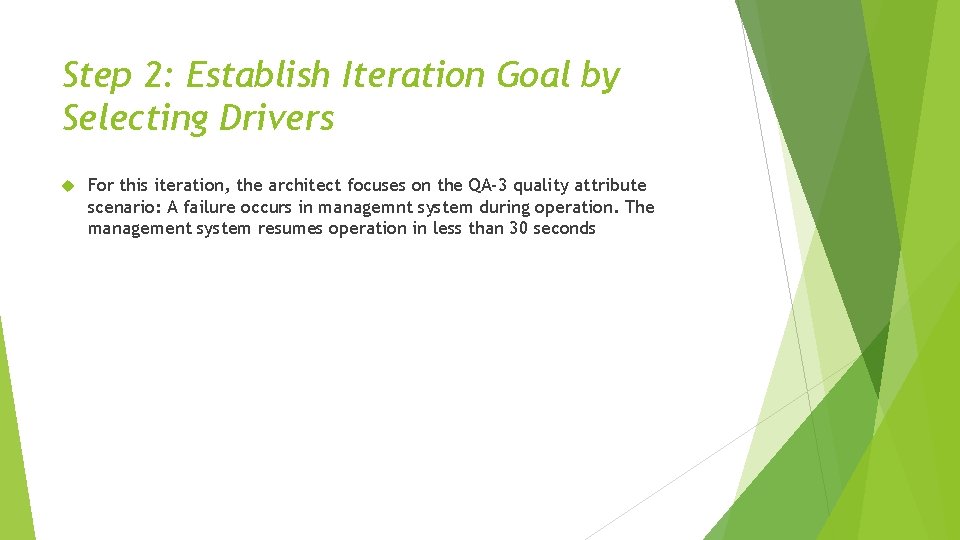
Step 2: Establish Iteration Goal by Selecting Drivers For this iteration, the architect focuses on the QA-3 quality attribute scenario: A failure occurs in managemnt system during operation. The management system resumes operation in less than 30 seconds
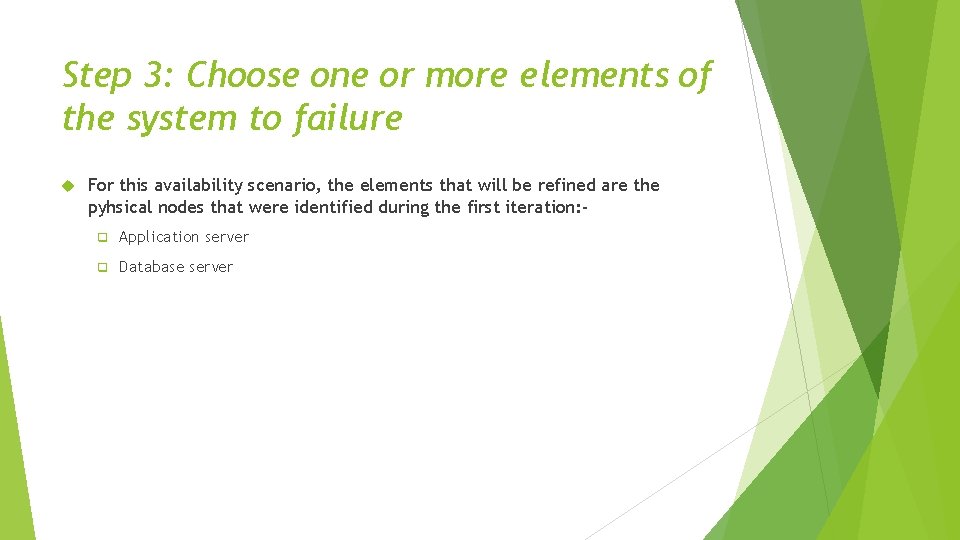
Step 3: Choose one or more elements of the system to failure For this availability scenario, the elements that will be refined are the pyhsical nodes that were identified during the first iteration: q Application server q Database server
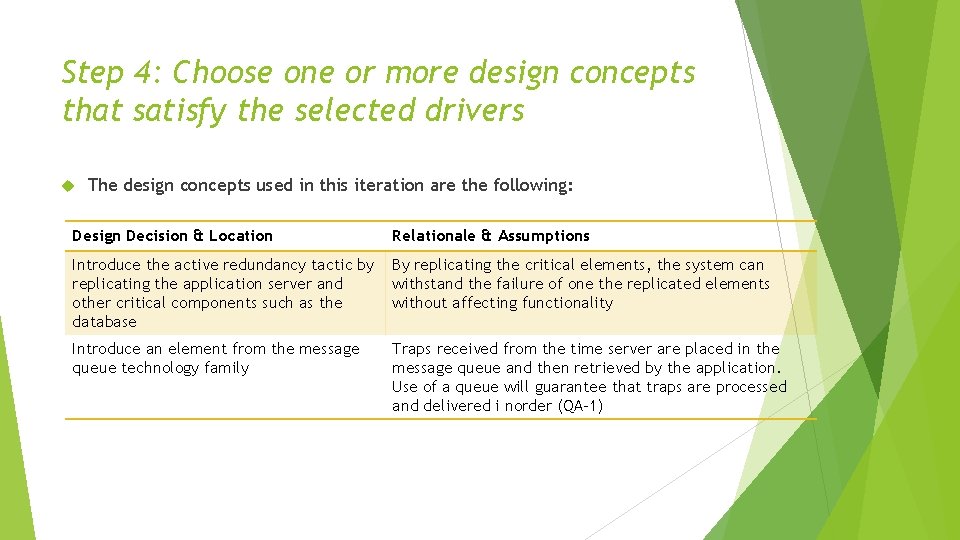
Step 4: Choose one or more design concepts that satisfy the selected drivers The design concepts used in this iteration are the following: Design Decision & Location Relationale & Assumptions Introduce the active redundancy tactic by replicating the application server and other critical components such as the database By replicating the critical elements, the system can withstand the failure of one the replicated elements without affecting functionality Introduce an element from the message queue technology family Traps received from the time server are placed in the message queue and then retrieved by the application. Use of a queue will guarantee that traps are processed and delivered i norder (QA-1)
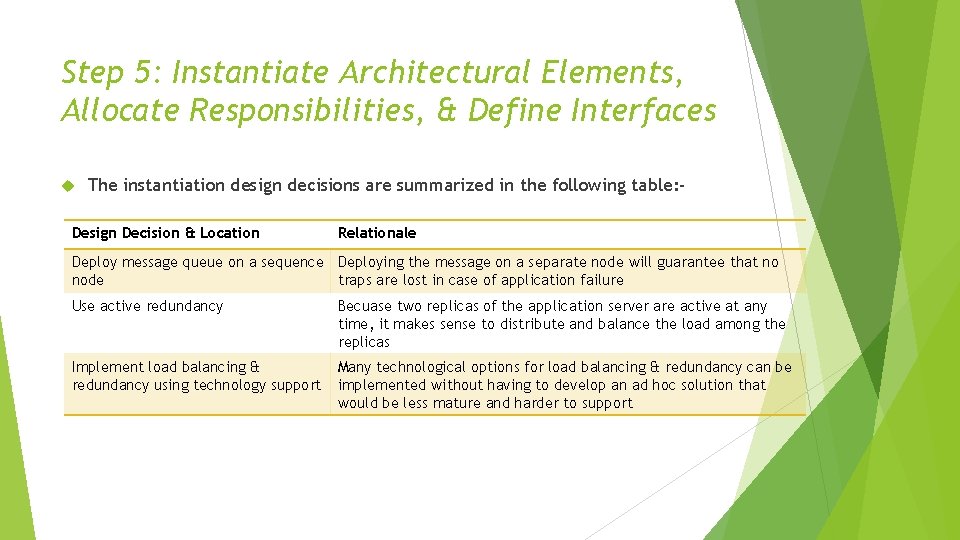
Step 5: Instantiate Architectural Elements, Allocate Responsibilities, & Define Interfaces The instantiation design decisions are summarized in the following table: - Design Decision & Location Relationale Deploy message queue on a sequence Deploying the message on a separate node will guarantee that no node traps are lost in case of application failure Use active redundancy Becuase two replicas of the application server are active at any time, it makes sense to distribute and balance the load among the replicas Implement load balancing & redundancy using technology support Many technological options for load balancing & redundancy can be implemented without having to develop an ad hoc solution that would be less mature and harder to support
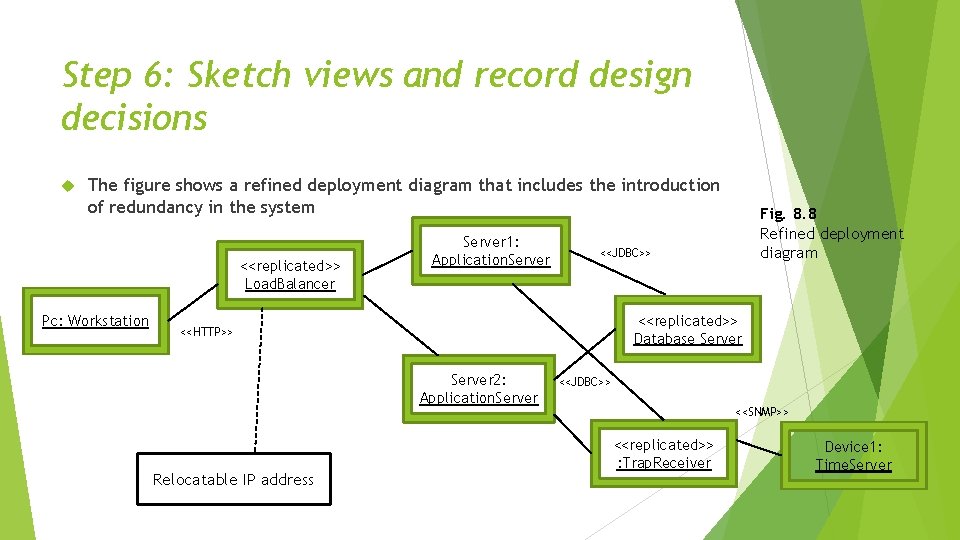
Step 6: Sketch views and record design decisions The figure shows a refined deployment diagram that includes the introduction of redundancy in the system <<replicated>> Load. Balancer Pc: Workstation Server 1: Application. Server <<JDBC>> <<replicated>> Database Server <<HTTP>> Server 2: Application. Server Relocatable IP address Fig. 8. 8 Refined deployment diagram <<JDBC>> <<SNMP>> <<replicated>> : Trap. Receiver Device 1: Time. Server
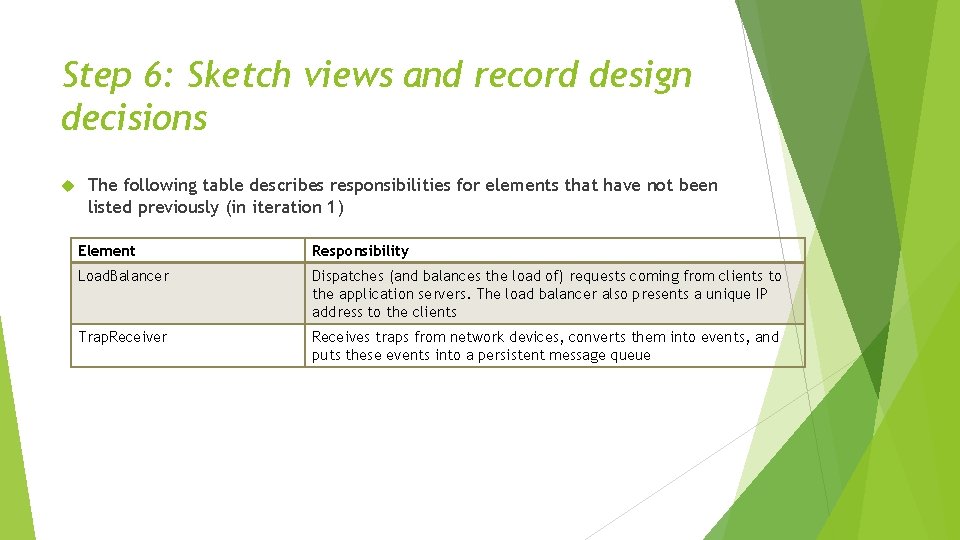
Step 6: Sketch views and record design decisions The following table describes responsibilities for elements that have not been listed previously (in iteration 1) Element Responsibility Load. Balancer Dispatches (and balances the load of) requests coming from clients to the application servers. The load balancer also presents a unique IP address to the clients Trap. Receiver Receives traps from network devices, converts them into events, and puts these events into a persistent message queue
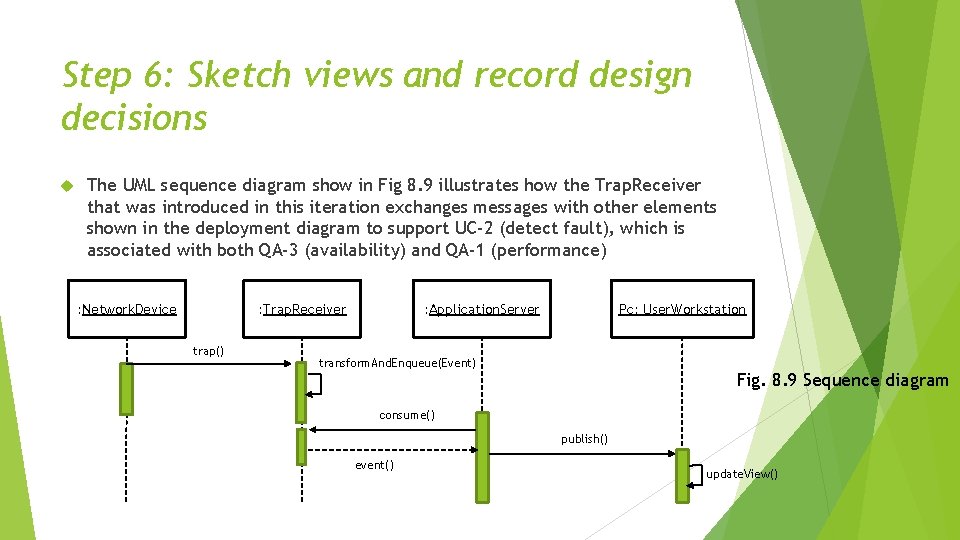
Step 6: Sketch views and record design decisions The UML sequence diagram show in Fig 8. 9 illustrates how the Trap. Receiver that was introduced in this iteration exchanges messages with other elements shown in the deployment diagram to support UC-2 (detect fault), which is associated with both QA-3 (availability) and QA-1 (performance) : Network. Device : Trap. Receiver trap() : Application. Server Pc: User. Workstation transform. And. Enqueue(Event) Fig. 8. 9 Sequence diagram consume() publish() event() update. View()
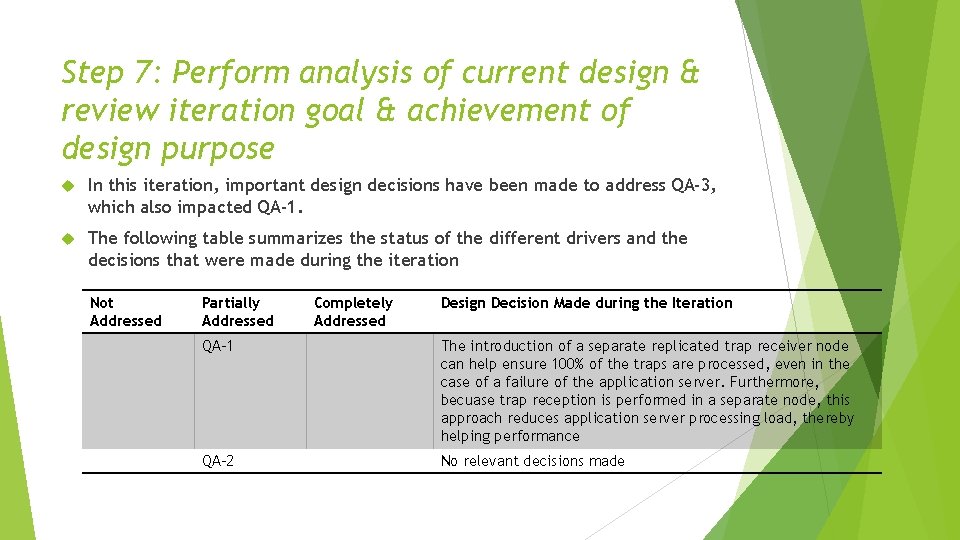
Step 7: Perform analysis of current design & review iteration goal & achievement of design purpose In this iteration, important design decisions have been made to address QA-3, which also impacted QA-1. The following table summarizes the status of the different drivers and the decisions that were made during the iteration Not Addressed Partially Addressed Completely Addressed Design Decision Made during the Iteration QA-1 The introduction of a separate replicated trap receiver node can help ensure 100% of the traps are processed, even in the case of a failure of the application server. Furthermore, becuase trap reception is performed in a separate node, this approach reduces application server processing load, thereby helping performance QA-2 No relevant decisions made
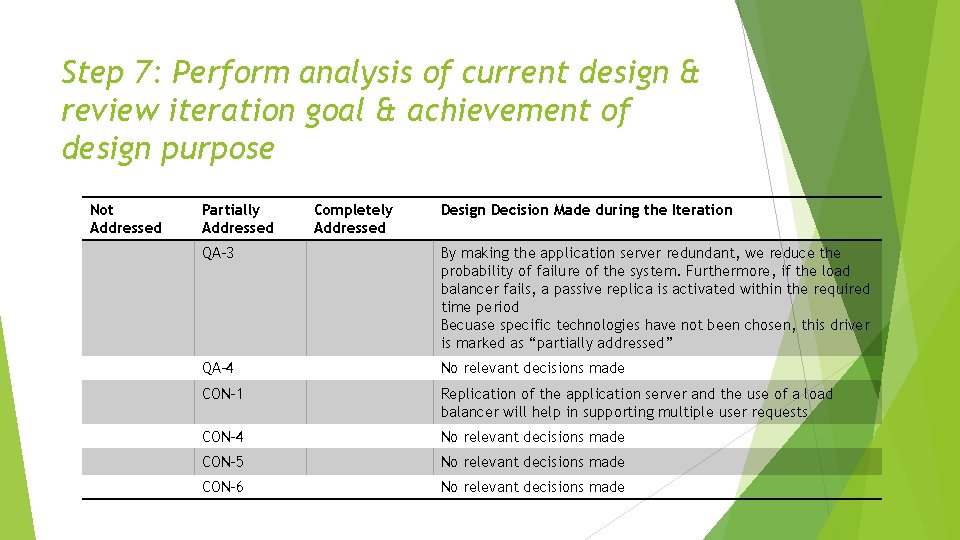
Step 7: Perform analysis of current design & review iteration goal & achievement of design purpose Not Addressed Partially Addressed Completely Addressed Design Decision Made during the Iteration QA-3 By making the application server redundant, we reduce the probability of failure of the system. Furthermore, if the load balancer fails, a passive replica is activated within the required time period Becuase specific technologies have not been chosen, this driver is marked as “partially addressed” QA-4 No relevant decisions made CON-1 Replication of the application server and the use of a load balancer will help in supporting multiple user requests CON-4 No relevant decisions made CON-5 No relevant decisions made CON-6 No relevant decisions made
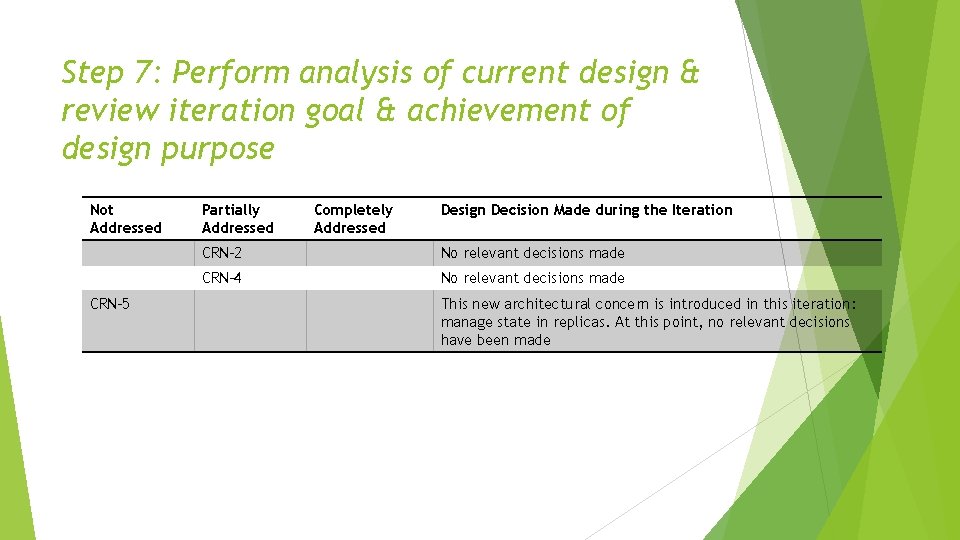
Step 7: Perform analysis of current design & review iteration goal & achievement of design purpose Not Addressed CRN-5 Partially Addressed Completely Addressed Design Decision Made during the Iteration CRN-2 No relevant decisions made CRN-4 No relevant decisions made This new architectural concern is introduced in this iteration: manage state in replicas. At this point, no relevant decisions have been made
Summary In this chapter, we presented an example of using ADD to design a greenfield system in a mature domain We illustrated three iterations with different foci: addressing a general concern, addressing functionality, and addressing one key quality attribute scenario 7 The example also demonstrates how architectural concerns, primary use cases, and quality attributes scenarios can be addressed as part of architectural design In a real system, more iterations would be necessary to create a complete architecture design by addressing other scenarios with high priority