
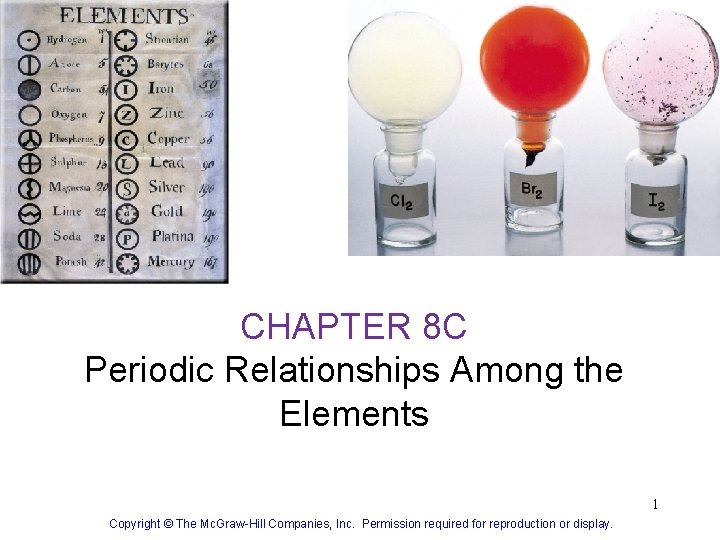
CHAPTER 8 C Periodic Relationships Among the Elements

- Slides: 23
CHAPTER 8 C Periodic Relationships Among the Elements 1 Copyright © The Mc. Graw-Hill Companies, Inc. Permission required for reproduction or display.
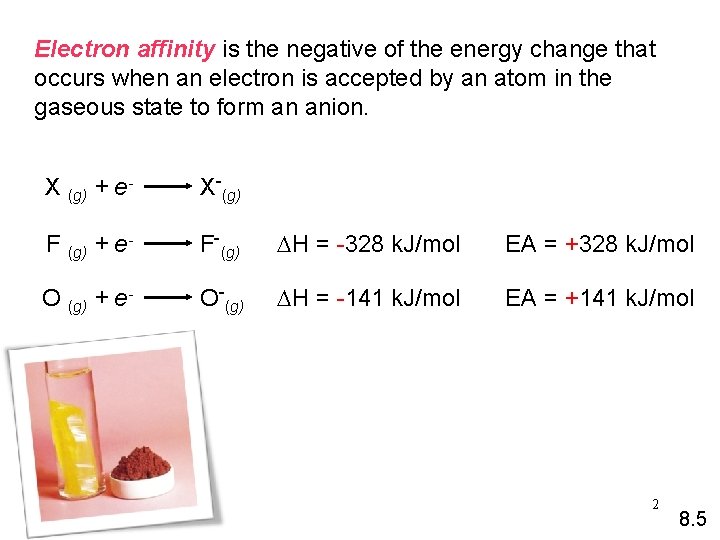
Electron affinity is the negative of the energy change that occurs when an electron is accepted by an atom in the gaseous state to form an anion. X (g) + e- X-(g) F (g) + e- F-(g) DH = -328 k. J/mol EA = +328 k. J/mol O (g) + e- O-(g) DH = -141 k. J/mol EA = +141 k. J/mol 2 8. 5
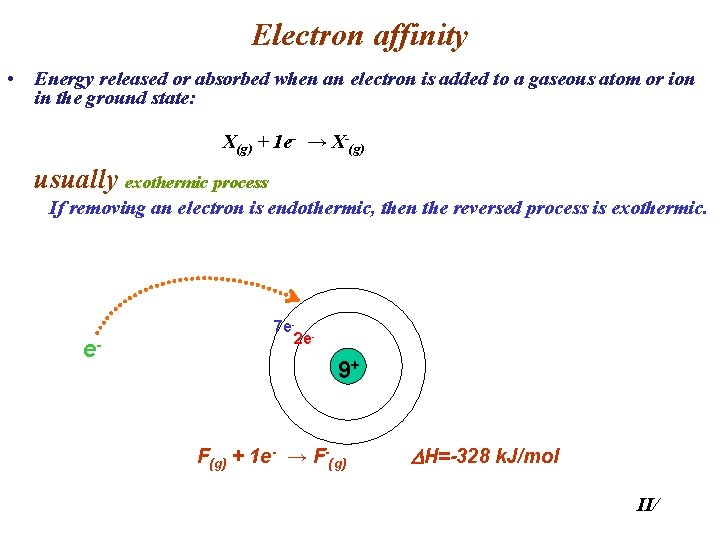
Electron affinity • Energy released or absorbed when an electron is added to a gaseous atom or ion in the ground state: X(g) + 1 e- → X-(g) usually exothermic process If removing an electron is endothermic, then the reversed process is exothermic. e- 7 e- 2 e 9+ F(g) + 1 e- → F-(g) DH=-328 k. J/mol II/
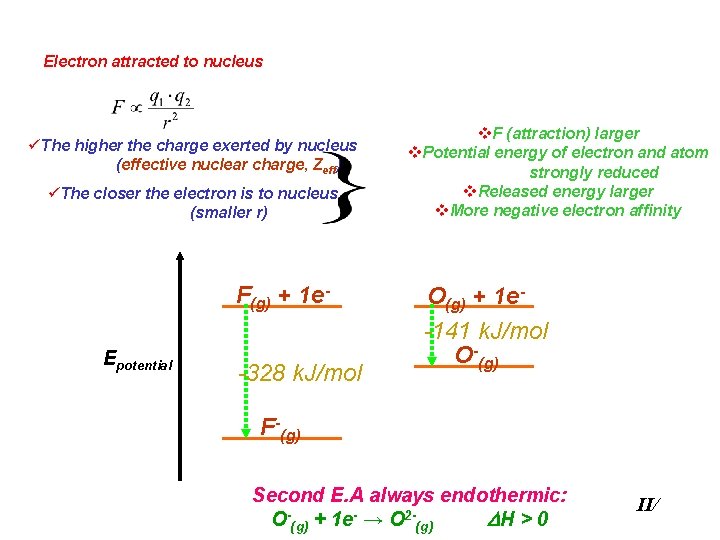
Electron attracted to nucleus üThe higher the charge exerted by nucleus (effective nuclear charge, Zeff) üThe closer the electron is to nucleus (smaller r) F(g) + 1 e. Epotential -328 k. J/mol v. F (attraction) larger v. Potential energy of electron and atom strongly reduced v. Released energy larger v. More negative electron affinity O(g) + 1 e-141 k. J/mol O-(g) F-(g) Second E. A always endothermic: O-(g) + 1 e- → O 2 -(g) DH > 0 II/
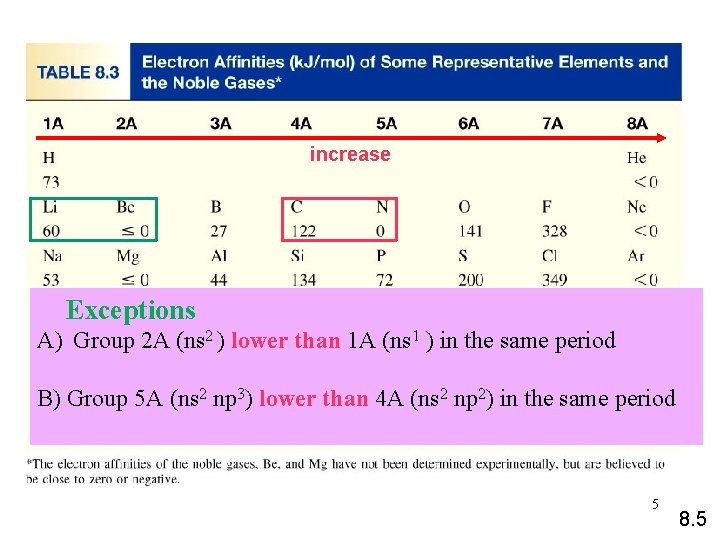
increase Exceptions A) Group 2 A (ns 2 ) lower than 1 A (ns 1 ) in the same period B) Group 5 A (ns 2 np 3) lower than 4 A (ns 2 np 2) in the same period 5 8. 5
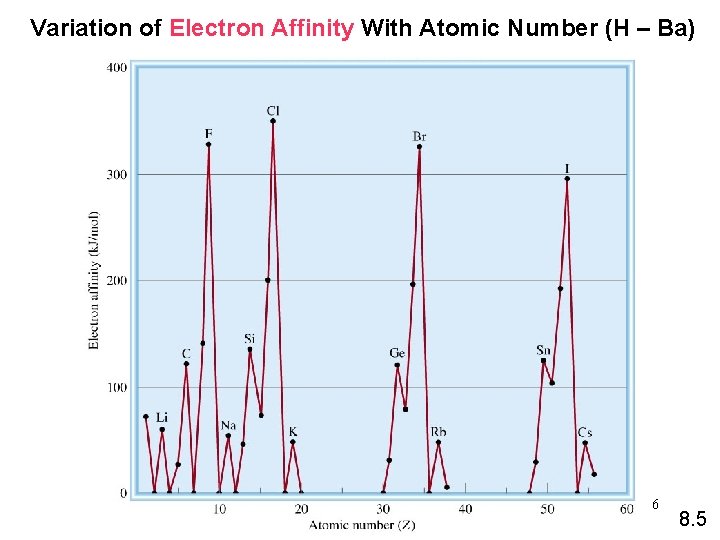
Variation of Electron Affinity With Atomic Number (H – Ba) 6 8. 5
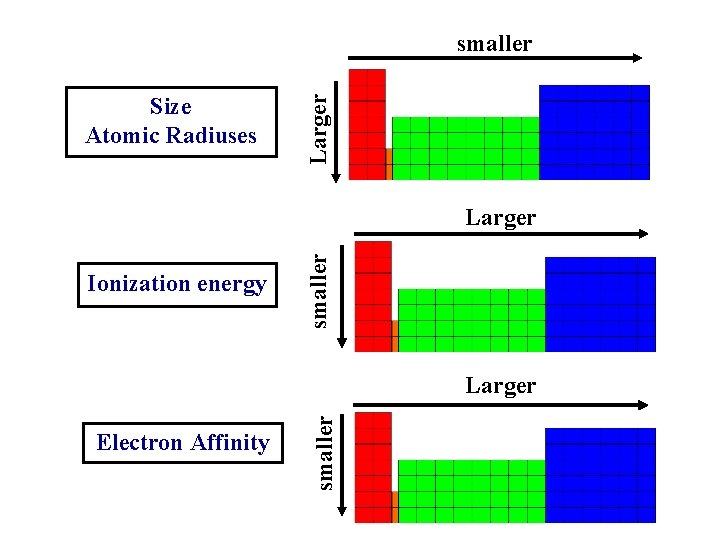
Size Atomic Radiuses Larger smaller Ionization energy smaller Larger Electron Affinity smaller Larger
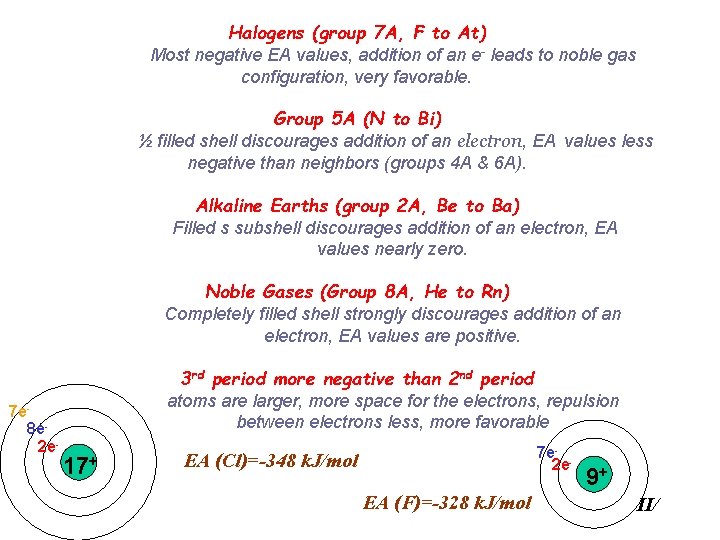
Halogens (group 7 A, F to At) Most negative EA values, addition of an e- leads to noble gas configuration, very favorable. Group 5 A (N to Bi) ½ filled shell discourages addition of an electron, EA values less negative than neighbors (groups 4 A & 6 A). Alkaline Earths (group 2 A, Be to Ba) Filled s subshell discourages addition of an electron, EA values nearly zero. Noble Gases (Group 8 A, He to Rn) Completely filled shell strongly discourages addition of an electron, EA values are positive. 7 e 8 e 2 e- 3 rd period more negative than 2 nd period atoms are larger, more space for the electrons, repulsion between electrons less, more favorable 17+ 7 e- 2 e EA (Cl)=-348 k. J/mol EA (F)=-328 k. J/mol 9+ II/
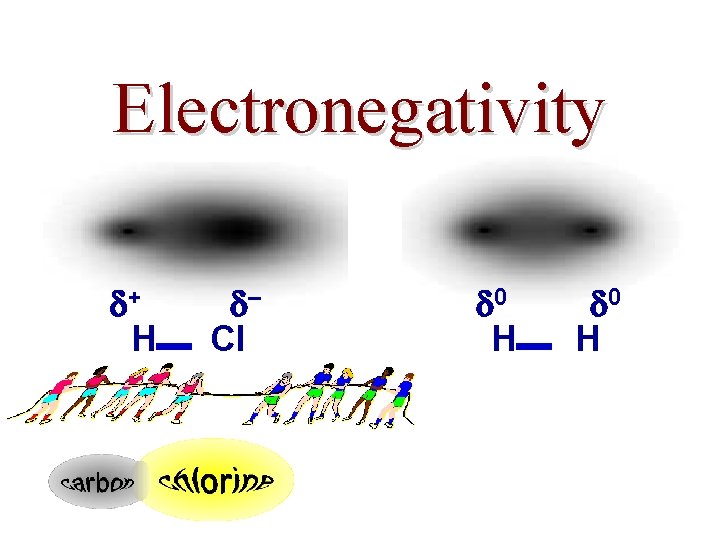
Electronegativity + H – Cl 0 H
Electronegativity • When electrons are shared by two atoms a covalent bond is formed. • When the atoms are the same they pull on the electrons equally. Example, H-H. • When the atoms are different, the atoms pull on the electrons unevenly. Example, HCl
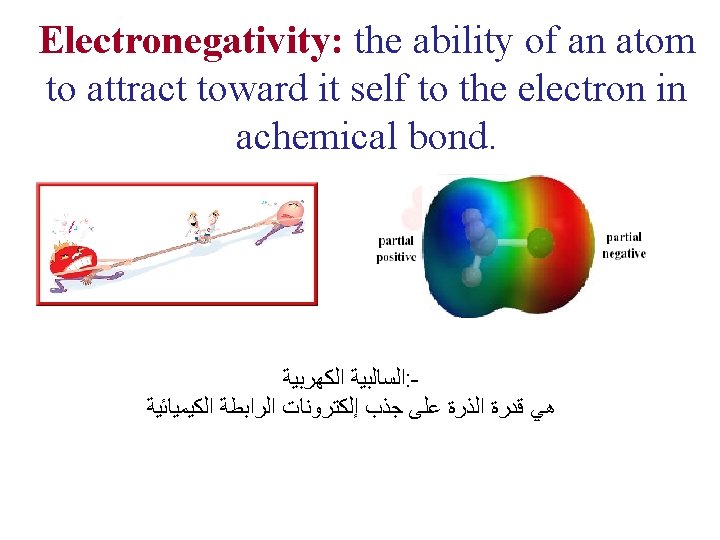
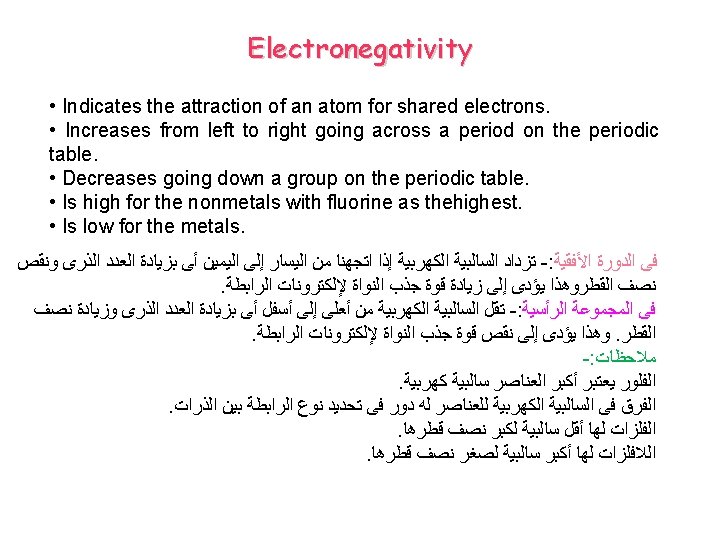
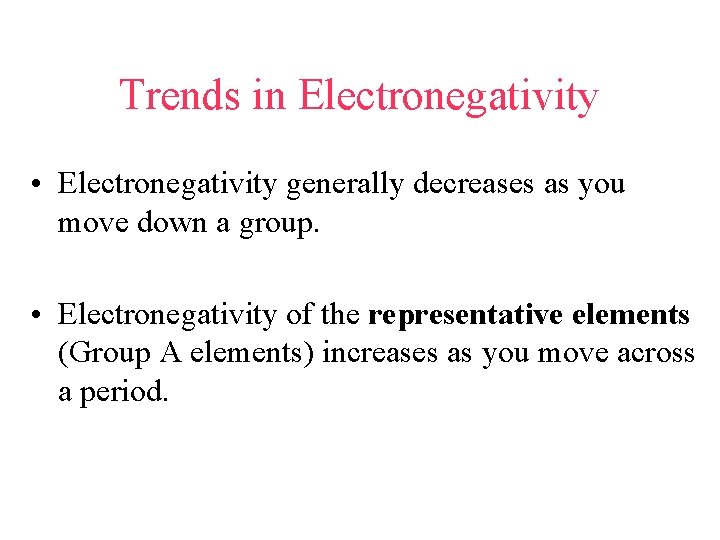
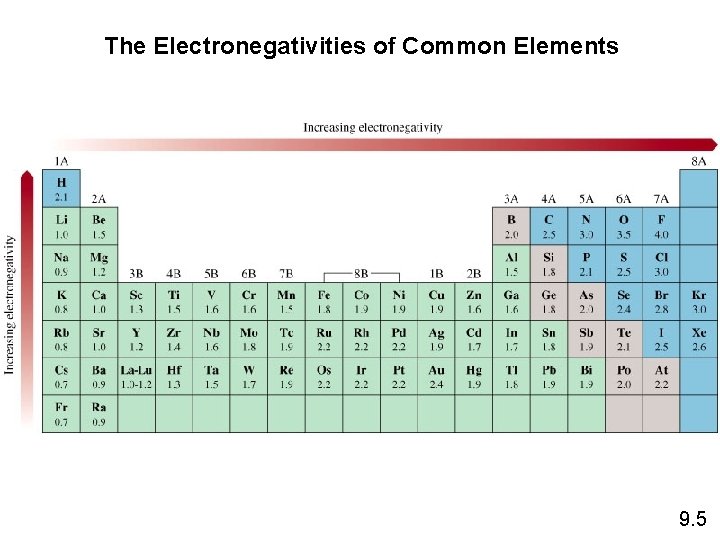
Trends in Electronegativity • Electronegativity generally decreases as you move down a group. • Electronegativity of the representative elements (Group A elements) increases as you move across a period.
Electronegativities of Some Elements Element F Cl O N S C H Na Cs Pauling scale 4. 0 3. 5 3. 0 2. 5 2. 1 0. 9 0. 7
The Electronegativities of Common Elements 9. 5
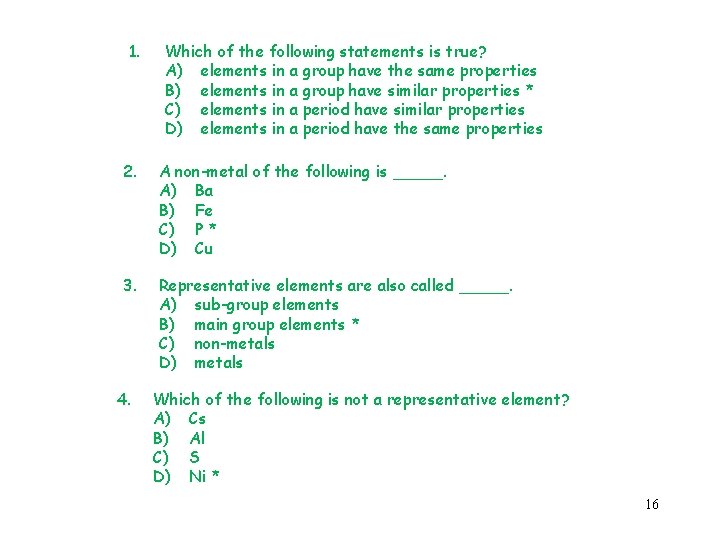
1. Which of the following statements is true? A) elements in a group have the same properties B) elements in a group have similar properties * C) elements in a period have similar properties D) elements in a period have the same properties 2. A non-metal of the following is _____. A) Ba B) Fe C) P * D) Cu 3. Representative elements are also called _____. A) sub-group elements B) main group elements * C) non-metals D) metals 4. Which of the following is not a representative element? A) Cs B) Al C) S D) Ni * 16
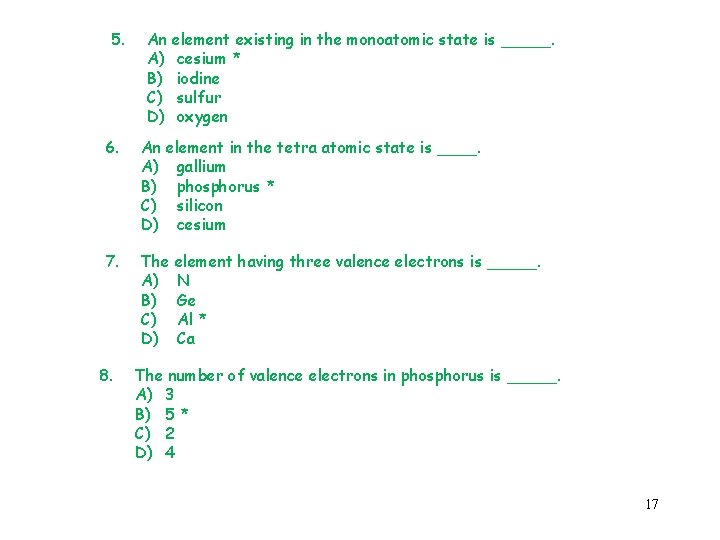
5. An element existing in the monoatomic state is _____. A) cesium * B) iodine C) sulfur D) oxygen 6. An element in the tetra atomic state is ____. A) gallium B) phosphorus * C) silicon D) cesium 7. The element having three valence electrons is _____. A) N B) Ge C) Al * D) Ca 8. The number of valence electrons in phosphorus is _____. A) 3 B) 5 * C) 2 D) 4 17
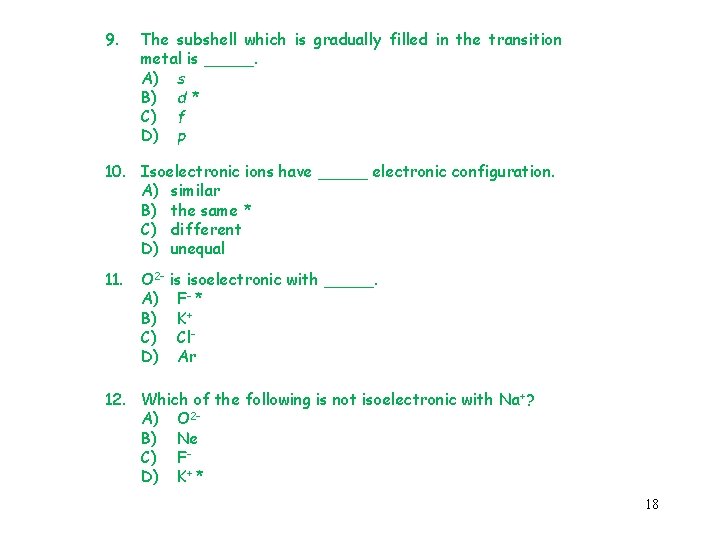
9. The subshell which is gradually filled in the transition metal is _____. A) s B) d * C) f D) p 10. Isoelectronic ions have _____ electronic configuration. A) similar B) the same * C) different D) unequal 11. O 2– is isoelectronic with _____. A) F– * B) K+ C) Cl– D) Ar 12. Which of the following is not isoelectronic with Na +? A) O 2– B) Ne C) F– D) K+ * 18
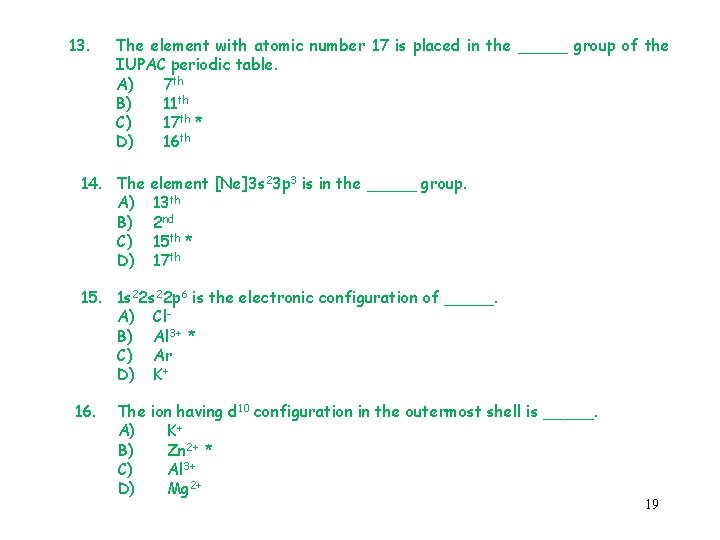
13. The element with atomic number 17 is placed in the _____ group of the IUPAC periodic table. A) 7 th B) 11 th C) 17 th * D) 16 th 14. The element [Ne]3 s 23 p 3 is in the _____ group. A) 13 th B) 2 nd C) 15 th * D) 17 th 15. 1 s 22 p 6 is the electronic configuration of _____. A) Cl– B) Al 3+ * C) Ar D) K+ 16. The ion having d 10 configuration in the outermost shell is _____. A) K+ B) Zn 2+ * C) Al 3+ D) Mg 2+ 19
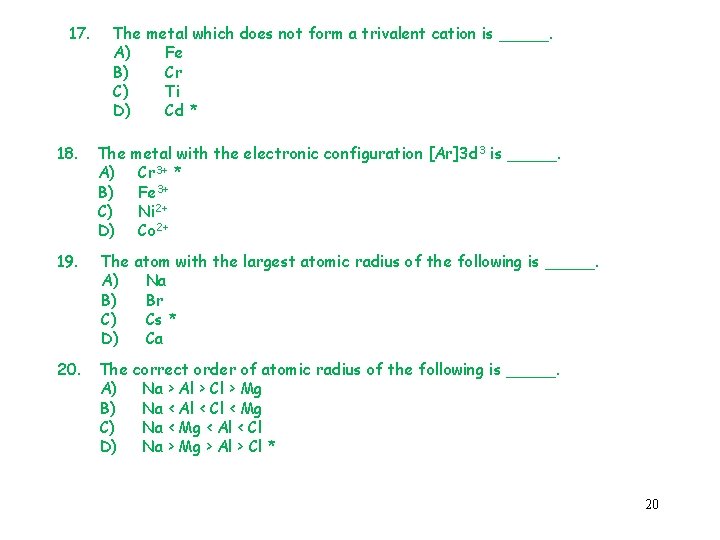
17. The metal which does not form a trivalent cation is _____. A) Fe B) Cr C) Ti D) Cd * 18. The metal with the electronic configuration [Ar]3 d 3 is _____. A) Cr 3+ * B) Fe 3+ C) Ni 2+ D) Co 2+ 19. The atom with the largest atomic radius of the following is _____. A) Na B) Br C) Cs * D) Ca 20. The correct order of atomic radius of the following is _____. A) Na > Al > Cl > Mg B) Na < Al < Cl < Mg C) Na < Mg < Al < Cl D) Na > Mg > Al > Cl * 20
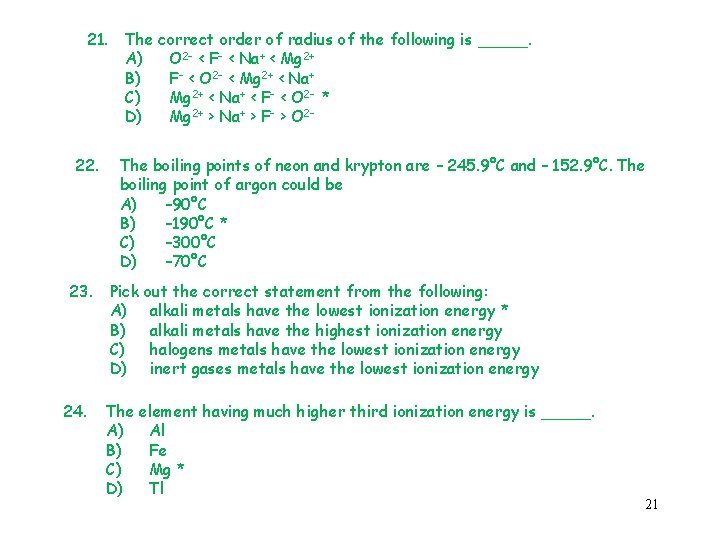
21. 22. 23. 24. The correct order of radius of the following is _____. A) O 2– < F– < Na+ < Mg 2+ B) F– < O 2– < Mg 2+ < Na+ C) Mg 2+ < Na+ < F– < O 2– * D) Mg 2+ > Na+ > F– > O 2– The boiling points of neon and krypton are – 245. 9°C and – 152. 9°C. The boiling point of argon could be A) – 90°C B) – 190°C * C) – 300°C D) – 70°C Pick out the correct statement from the following: A) alkali metals have the lowest ionization energy * B) alkali metals have the highest ionization energy C) halogens metals have the lowest ionization energy D) inert gases metals have the lowest ionization energy The element having much higher third ionization energy is _____. A) Al B) Fe C) Mg * D) Tl 21
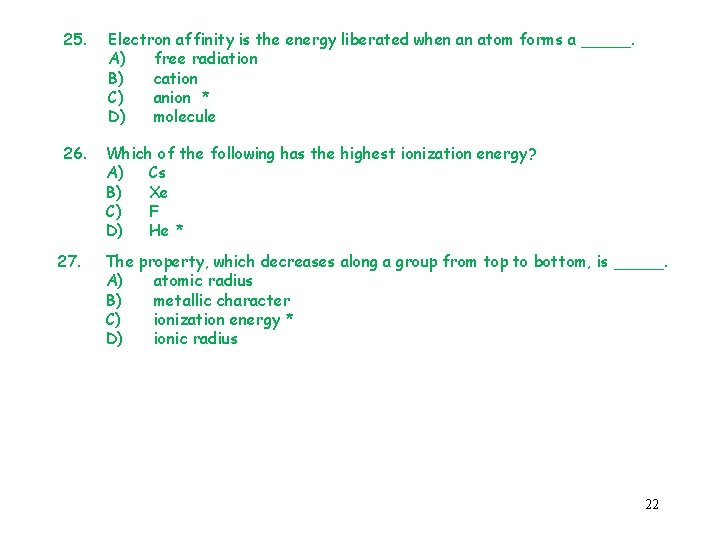
25. Electron affinity is the energy liberated when an atom forms a _____. A) free radiation B) cation C) anion * D) molecule 26. Which of the following has the highest ionization energy? A) Cs B) Xe C) F D) He * 27. The property, which decreases along a group from top to bottom, is _____. A) atomic radius B) metallic character C) ionization energy * D) ionic radius 22
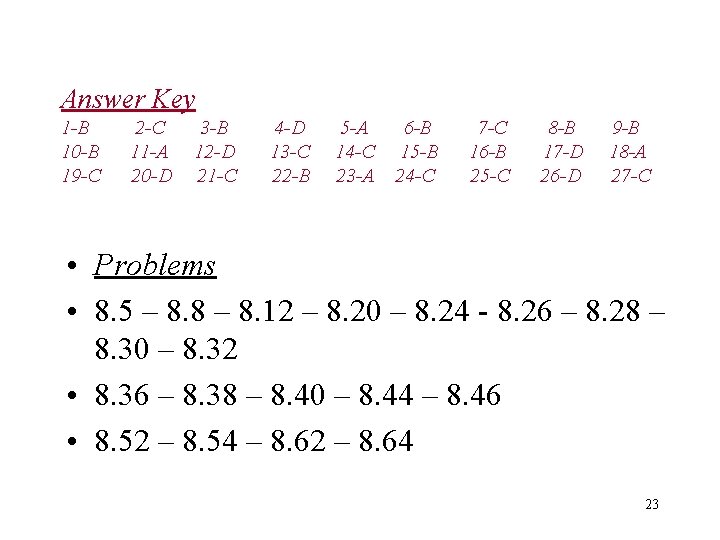
Answer Key 1 -B 10 -B 19 -C 2 -C 11 -A 20 -D 3 -B 12 -D 21 -C 4 -D 13 -C 22 -B 5 -A 14 -C 23 -A 6 -B 15 -B 24 -C 7 -C 16 -B 25 -C 8 -B 17 -D 26 -D 9 -B 18 -A 27 -C • Problems • 8. 5 – 8. 8 – 8. 12 – 8. 20 – 8. 24 - 8. 26 – 8. 28 – 8. 30 – 8. 32 • 8. 36 – 8. 38 – 8. 40 – 8. 44 – 8. 46 • 8. 52 – 8. 54 – 8. 62 – 8. 64 23