
Chapter 8 Breeding Programs Animal Breeding Genomics Centre
Chapter 8 Breeding Programs Animal Breeding & Genomics Centre
Breeding program n What are reasons to start a breeding program? l l n Genetic conservation Genetic selection What information do you need to make a breeding program? l Select best animals for next generation… EBV! Animal Breeding & Genomics Centre
Structure of breeding programs 1. 2. 3. 4. 5. 6. Define the breeding goal Record data on selection candidates Estimate breeding values Mating design with selected individuals Disseminate genetic progress Evaluation breeding scheme Animal Breeding & Genomics Centre
Structure of breeding programs 1. 2. 3. 4. 5. 6. Define the breeding goal Record data on selection candidates Estimate breeding values Mating design with selected individuals Disseminate genetic progress Evaluation breeding scheme Animal Breeding & Genomics Centre

Define the breeding goal n A breeding goal indicates the desired direction of change over generations n Examples: l l l Increased milk yield Increased egg production Reduced leg problems Animal Breeding & Genomics Centre

Breeding goals: n n Include more than 1 trait Inclusion of traits depends on importance, not on heritability! Defining breeding goals is about predicting the future! Breeding goals should be expressed as a single value: ranking of individuals Animal Breeding & Genomics Centre

Breeding goal defined as: n The weighted sum of economic values and breeding values or n Set of desired gains for each trait, based on marketing considerations of breeding companies Animal Breeding & Genomics Centre
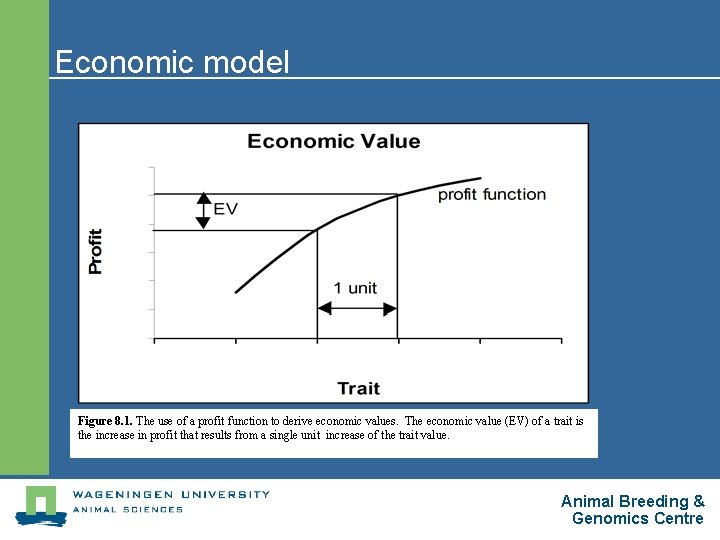
Economic model Figure 8. 1. The use of a profit function to derive economic values. The economic value (EV) of a trait is the increase in profit that results from a single unit increase of the trait value. Animal Breeding & Genomics Centre
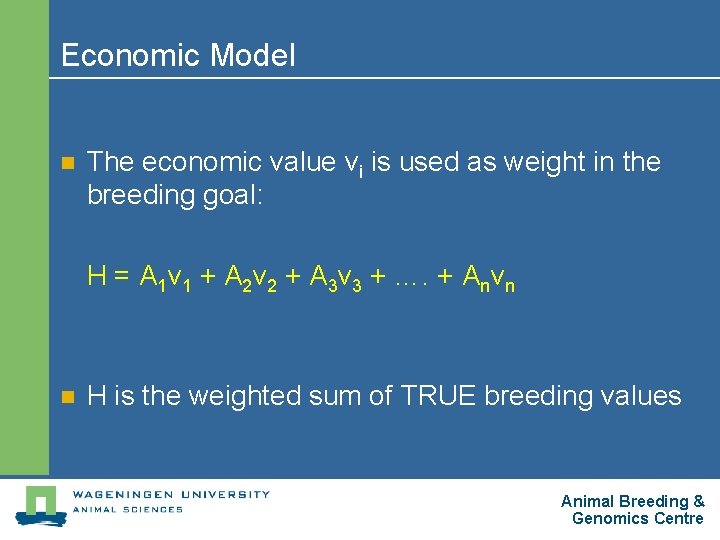
Economic Model n The economic value vi is used as weight in the breeding goal: H = A 1 v 1 + A 2 v 2 + A 3 v 3 + …. + Anvn n H is the weighted sum of TRUE breeding values Animal Breeding & Genomics Centre
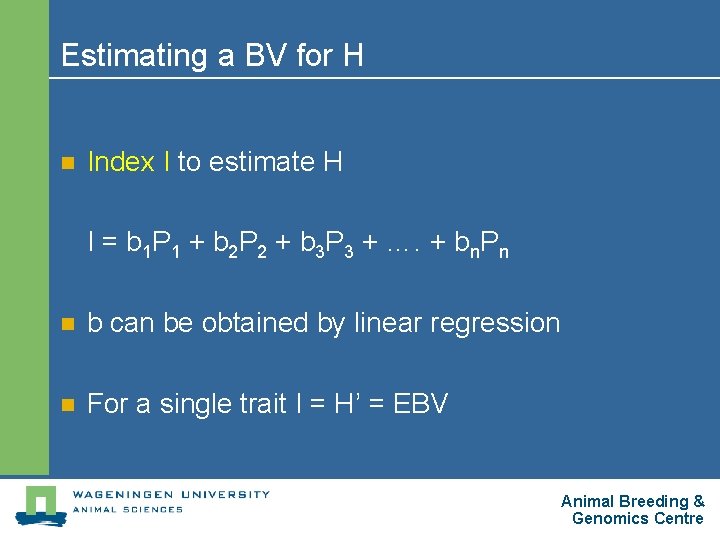
Estimating a BV for H n Index I to estimate H I = b 1 P 1 + b 2 P 2 + b 3 P 3 + …. + bn. Pn n b can be obtained by linear regression n For a single trait I = H’ = EBV Animal Breeding & Genomics Centre

Breeding goals: economic values or desired gains? n Some traits cannot be expressed in economic values: l Competitive position vs. profitability (Breeding company want to predict market in long term) l Consequences of negative correlated responses (fertility, health, or welfare) Animal Breeding & Genomics Centre

Defining breeding goals for the future n n n Economic profit farmer Competitive position breeding company Country/ production system International trade restrictions? Production quota Animal Breeding & Genomics Centre
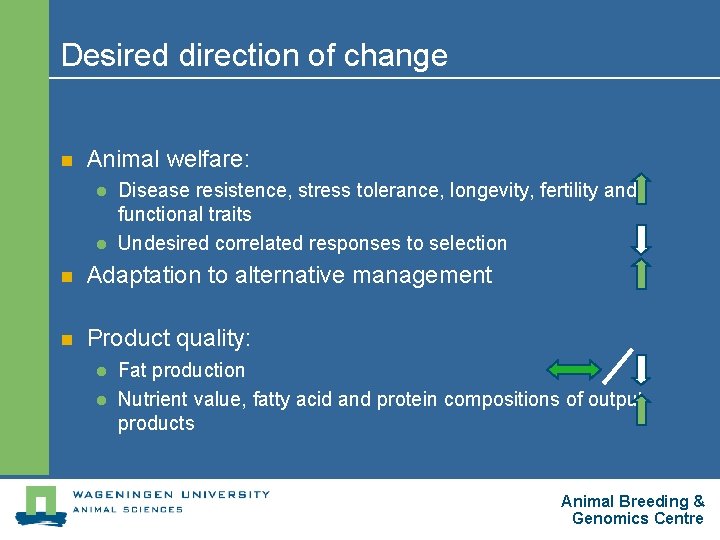
Desired direction of change n Animal welfare: l l Disease resistence, stress tolerance, longevity, fertility and functional traits Undesired correlated responses to selection n Adaptation to alternative management n Product quality: l l Fat production Nutrient value, fatty acid and protein compositions of output products Animal Breeding & Genomics Centre
Structure of breeding programs 1. 2. 3. 4. 5. 6. Define the breeding goal Record data on selection candidates Estimate breeding values Mating design with selected individuals Disseminate genetic progress Evaluation breeding scheme Animal Breeding & Genomics Centre
Data recording systems n Who collects the data? l l l n Farmers Breeding company Test stations Data on selection candidates or on sibs/progeny? l Depends on traits! Animal Breeding & Genomics Centre
Structure of breeding programs 1. 2. 3. 4. 5. 6. Define the breeding goal Record data on selection candidates Estimate breeding values Mating design with selected individuals Disseminate genetic progress Evaluation breeding scheme Animal Breeding & Genomics Centre

Breeding Value estimation n Structure of breeding program depends on species and traits: Dairy Cattle: Progeny Testing few offspring/ female identification at birth sex limited traits Layer Hens: more progeny/ female Line identification at birth reproduction vs production Crossing Animal Breeding & Genomics Centre
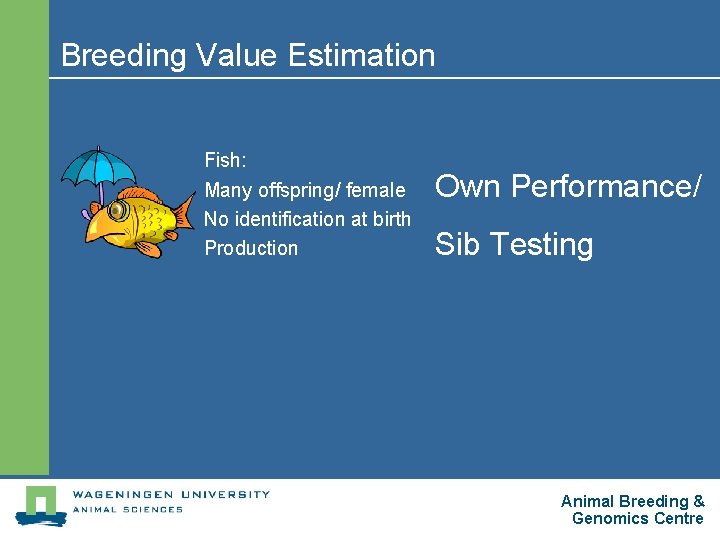
Breeding Value Estimation Fish: Many offspring/ female No identification at birth Production Own Performance/ Sib Testing Animal Breeding & Genomics Centre
Structure of breeding programs 1. 2. 3. 4. 5. 6. Define the breeding goal Record data on selection candidates Estimate breeding values Mating design with selected individuals Disseminate genetic progress Evaluation breeding scheme Animal Breeding & Genomics Centre
Selection and Mating 1. Selecting parents determines genetic improvement over time 2. Mating parents determines combination of maternal and paternal alleles Animal Breeding & Genomics Centre
Structure of breeding programs 1. 2. 3. 4. 5. 6. Define the breeding goal Record data on selection candidates Estimate breeding values Mating design with selected individuals Disseminate genetic progress Evaluation breeding scheme Animal Breeding & Genomics Centre
Dissemination n n Dairy Cattle: straws Pigs: piglet producers and fattening farms Chicken: Only crossbreds Fish: monosex or sterile fry Animal Breeding & Genomics Centre
Structure of breeding programs 1. 2. 3. 4. 5. 6. Define the breeding goal Record data on selection candidates Estimate breeding values Mating design with selected individuals Disseminate genetic progress Evaluation breeding scheme Animal Breeding & Genomics Centre
Evaluation of breeding programs Things that can go wrong: n n Selection response Wrong models, eg no inclusion of systematic environmental effects: common environment! Inbreeding and Genetic diversity Overestimation genetic parameters n Preferential treatments Costs Unexpected correlated responses Animal Breeding & Genomics Centre
Summary Breeding program n 4 steps to a successful program: 1. Define a breeding goal Make a base population and estimate genetic parameters Estimate breeding values Assess quality: genetic progress, rate of inbreeding and costs 2. 3. 4. Animal Breeding & Genomics Centre
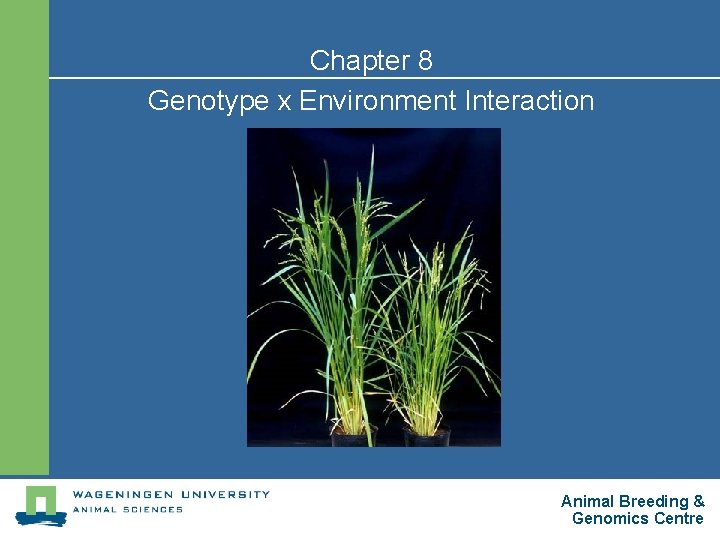
Chapter 8 Genotype x Environment Interaction Animal Breeding & Genomics Centre
Breeding program n Different genotypes show different sensitivity to changes in the environment n Are the animals (or breed) we selected based on their genotype in one environment also the best animals (or breed) in another environment? n no Gx. E interaction: Yes large Gx. E interaction: Maybe n Animal Breeding & Genomics Centre
Gx. E interaction n Do we need different animals (selection directions) for: l l High input conditions vs organic farming systems? Production in temperate environments vs production in tropical environments? Animal Breeding & Genomics Centre
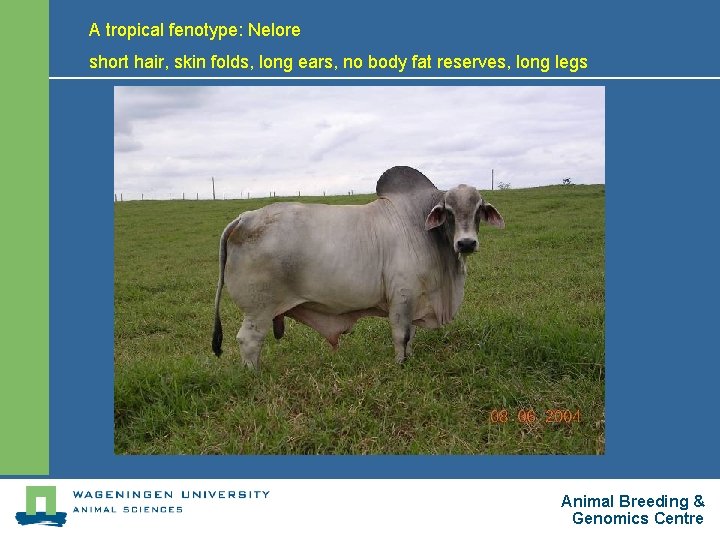
A tropical fenotype: Nelore short hair, skin folds, long ears, no body fat reserves, long legs Animal Breeding & Genomics Centre
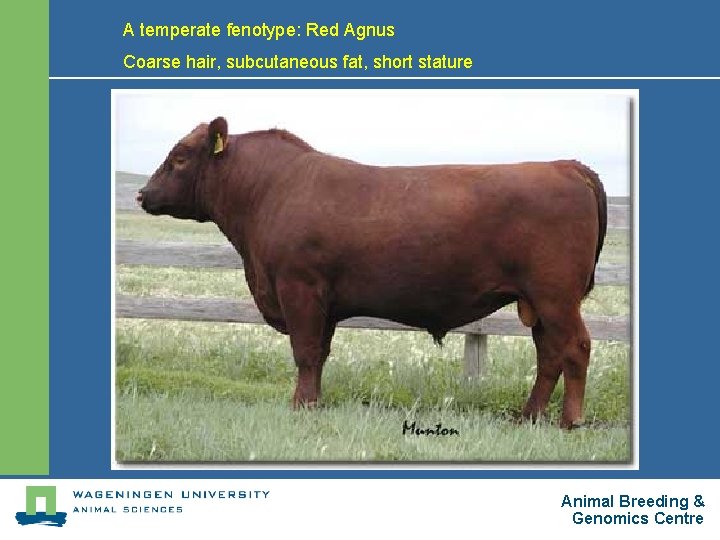
A temperate fenotype: Red Agnus Coarse hair, subcutaneous fat, short stature Animal Breeding & Genomics Centre
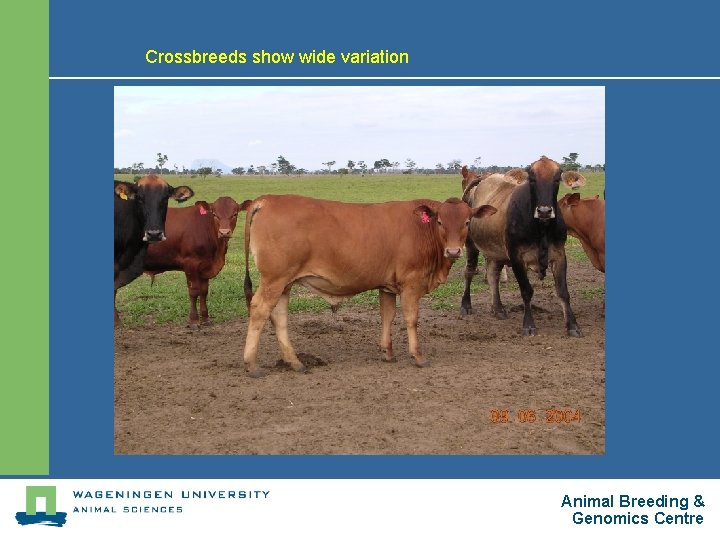
Crossbreeds show wide variation Animal Breeding & Genomics Centre
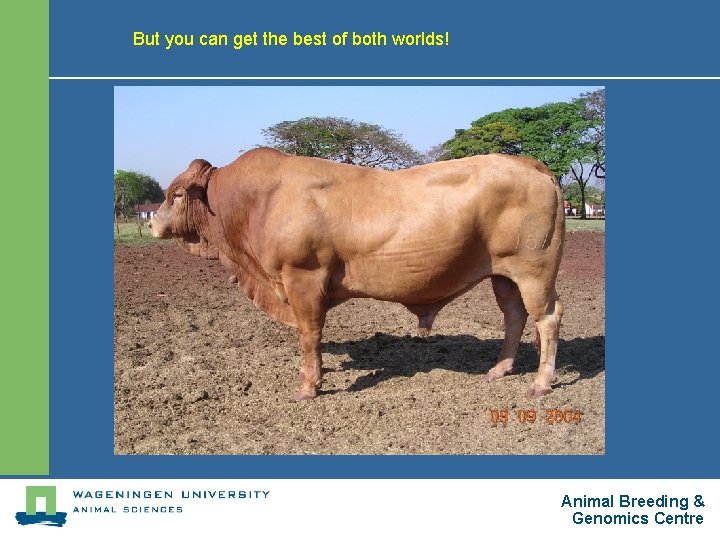
But you can get the best of both worlds! Animal Breeding & Genomics Centre
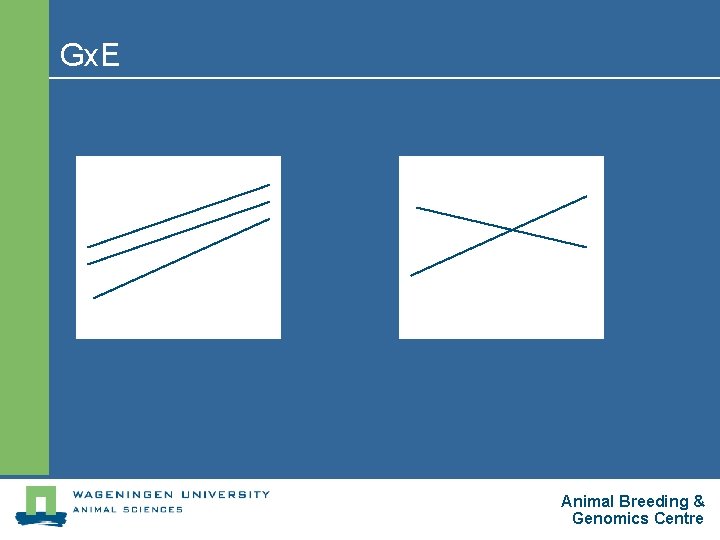
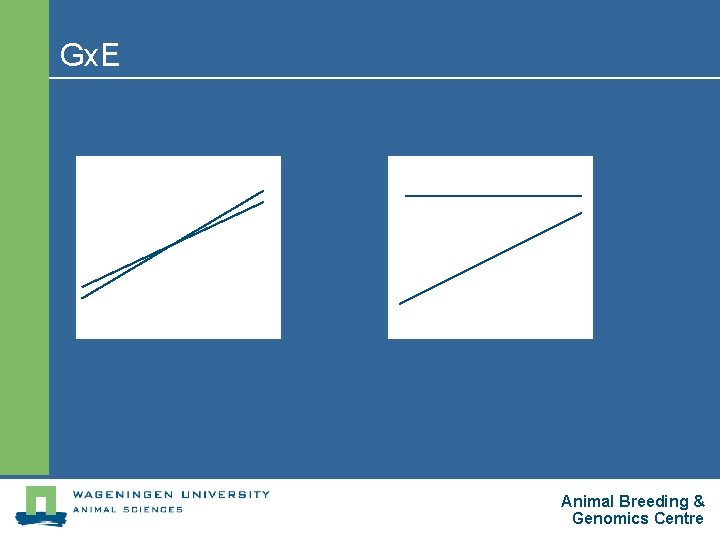
Gx. E interaction n n Ranking of breeding values change with change in environment (re-ranking) Average value of a trait does not change Between breeds: some fit better to certain environments (countries) than others Within breed: some genotypes less (more) sensitive to variation in environment > Within country >Between countries Animal Breeding & Genomics Centre
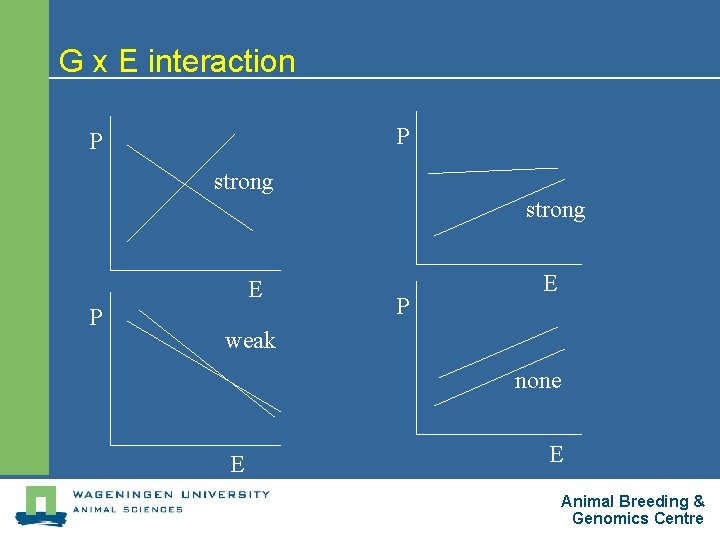
G x E interaction P P strong E P P E weak none E E Animal Breeding & Genomics Centre
How to detect Gx. E n Between breeds: test different breeds in different environments, and rank. n Within breeds: test progeny groups in different (2 or more) environments, and calculate genetic correlations between the two “traits” Animal Breeding & Genomics Centre
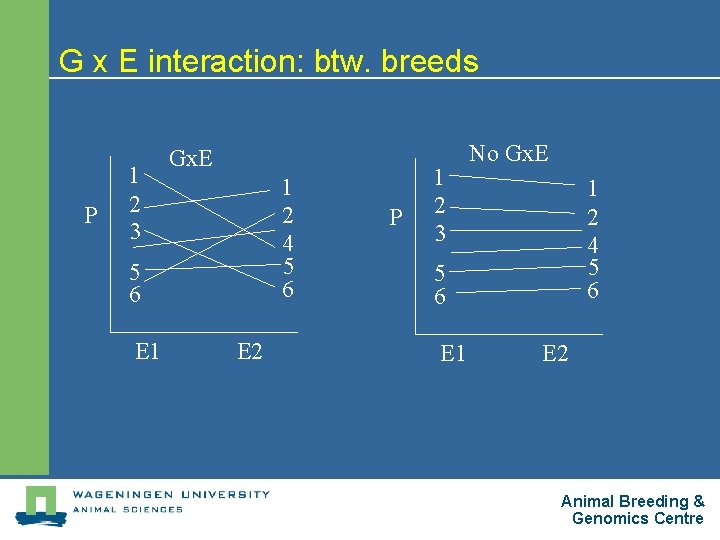
G x E interaction: btw. breeds P 1 2 3 Gx. E 1 2 4 5 6 E 1 E 2 P 1 2 3 No Gx. E 1 2 4 5 6 E 1 E 2 Animal Breeding & Genomics Centre
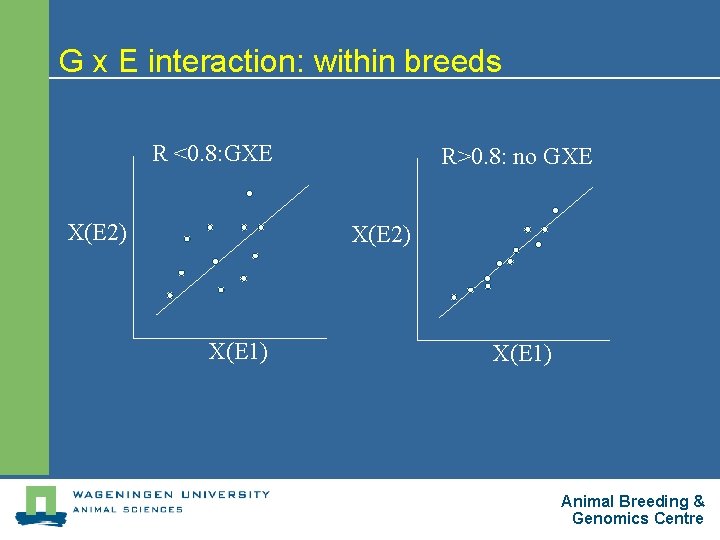
G x E interaction: within breeds R <0. 8: GXE X(E 2) R>0. 8: no GXE X(E 2) X(E 1) Animal Breeding & Genomics Centre
Conclusions Problems: n 1) breeding goals may differ (populations) n 2) breeding values can differ (within breeds) Examples: n Feed intake groups vs individuals n SPF environments vs on-farm conditions n Test station performance vs commercial fattening Animal Breeding & Genomics Centre
Gx. E Animal Breeding & Genomics Centre
Gx. E Animal Breeding & Genomics Centre
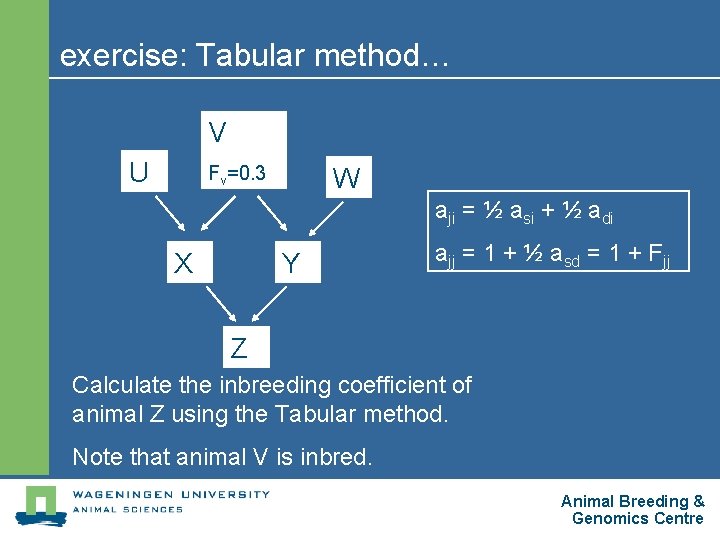
exercise: Tabular method… V U Fv=0. 3 W aji = ½ asi + ½ adi X Y ajj = 1 + ½ asd = 1 + Fjj Z Calculate the inbreeding coefficient of animal Z using the Tabular method. Note that animal V is inbred. Animal Breeding & Genomics Centre
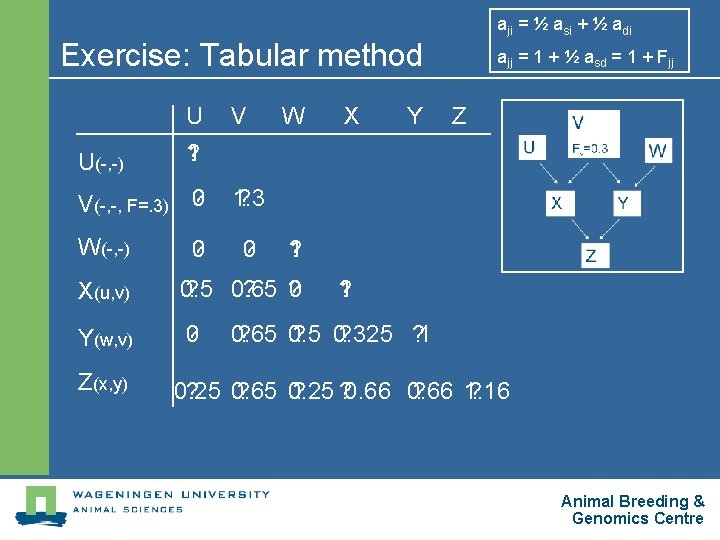
aji = ½ asi + ½ adi Exercise: Tabular method U U(-, -) W Y Z 0 ? 1. 3 ? 0 ? 1 ? X(u, v) 0. 5 ? 0. 65 ? ? 0 Y(w, v) 0 ? Z(x, y) X 1 ? 0 V(-, -, F=. 3) ? W(-, -) V ajj = 1 + ½ asd = 1 + Fjj 1 ? 0. 65 ? 0. 325 ? ? 1 0. 25 ? 0. 65 ? 0. 25 ? ? 0. 66 ? 1. 16 ? Animal Breeding & Genomics Centre
- Slides: 42