
Chapter 8 Branding and Core Business Growth Learning
Chapter 8 Branding and Core Business Growth
Learning objectives • • The role and scope of branding Brand equity Building brand equity Measuring and managing brand equity Devising a branding strategy Customer equity Driving growth 2
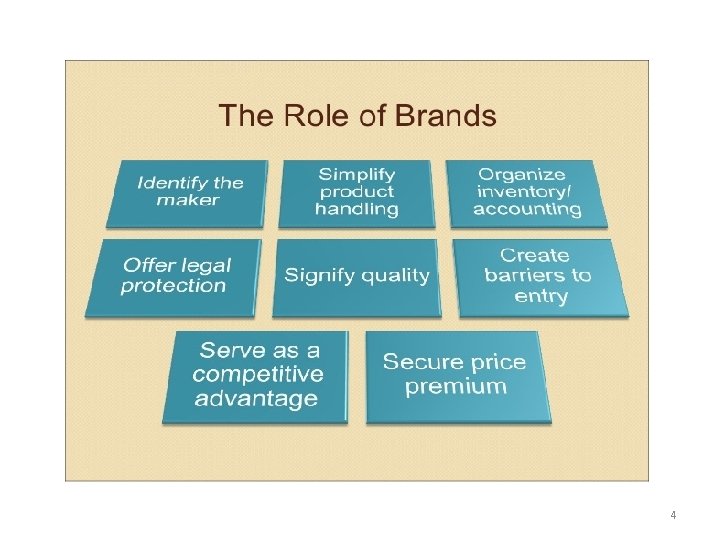
What does branding work A brand is a name, term, sign, symbol or design, or a combination of them, intended to identify the goods or services of one seller or group of sellers and to differentiate them from those of competitors. A brand is thus a product or service that adds dimensions that differentiate it in some way from other products or services designed to satisfy the same need. These differences may be functional, rational, or tangible. They may also be more symbolic, emotional or intangible. 3
4
The scope of branding Branding is endowing products and services with the power of the brand. Branding is all about creating differences. To brand a product, it is necessary to teach customers “who” the product is as well as “what” the product does and “why” consumers should care. For branding strategies to be successful and brand value to be created, consumers must be convinced that there are meaningful differences among brands in the product or service category. 5
Defining brand equity Brand equity is the added value endowed on products and services, which may be reflected in the way consumers, think, feel, and act with respect to the brand. Marketers use various perspectives to study brand equity. Customer-based approaches view brand equity from the perspective of the customer. Customer-based brand equity can be defined as the differential effect that brand knowledge has on consumer response to the marketing of that brand. 6
Brand equity as a bridge From the perspective of brand equity, all the marketing dollars spent each year on products and services should be thought of as investments in consumer brand knowledge. The quality of the investment in brand building is the critical factor. A brand is essentially a marketer’s promise to deliver predictable product or service performance. A brand promise is the marketer’s vision what the brand must be and do for consumers. 7
Brand equity models Brand asset valuator: There are four key components of brand equity: Differentiation measures the degree to which a brand is seen as different from others. Relevance measures the breadth of a brand’s appeal. Esteem measures how well the brand is regarded and respected. Knowledge measures how familiar and intimate consumers are with the brand. Differentiation and relevance combine to determine brand strength. Esteem and knowledge together to create brand stature. 8
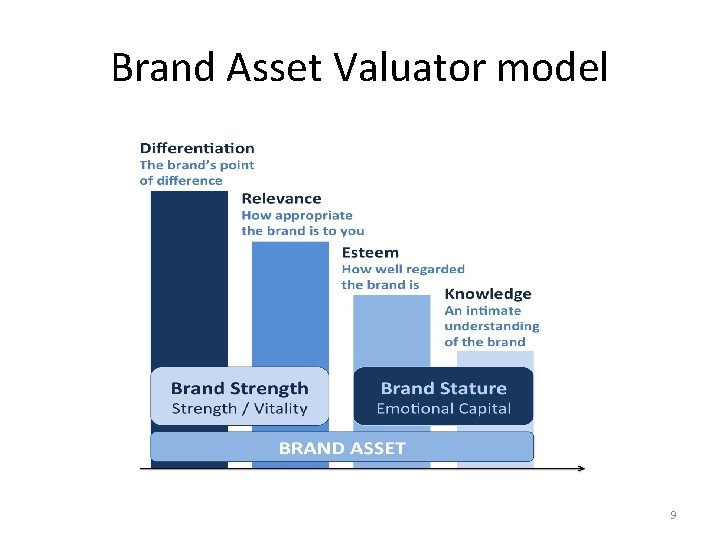
Brand Asset Valuator model 9
Brand equity models Aaker model: This model views brand equity as a set of five categories of brand assets and liabilities linked to a brand that add to or subtract from the value provided by a product or service to a firm and/or to a firms’ customers. These categories of brand assets are: • Brand loyalty • Brand awareness • Perceived quality • Brand associations • Other proprietary assets such as patents, trademarks and channel relationships. 10
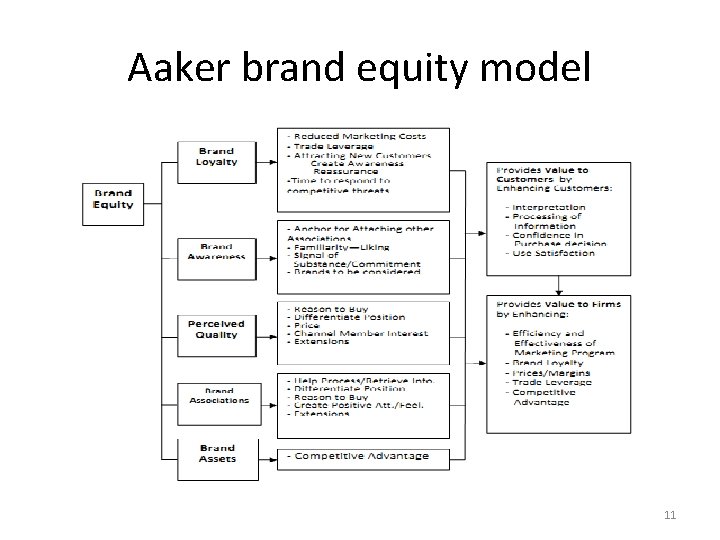
Aaker brand equity model 11
Brand equity models Brandz: According to this model, brand building involves a sequential series of steps, where each step is contingent upon successfully accomplishing the previous step. The objectives at each step are as follows: Presence. Do I know about it? Relevance. Does it offer me something? Performance. Can it deliver? Advantage. Does it offer something better than others Bonding. Nothing else beats it. 12
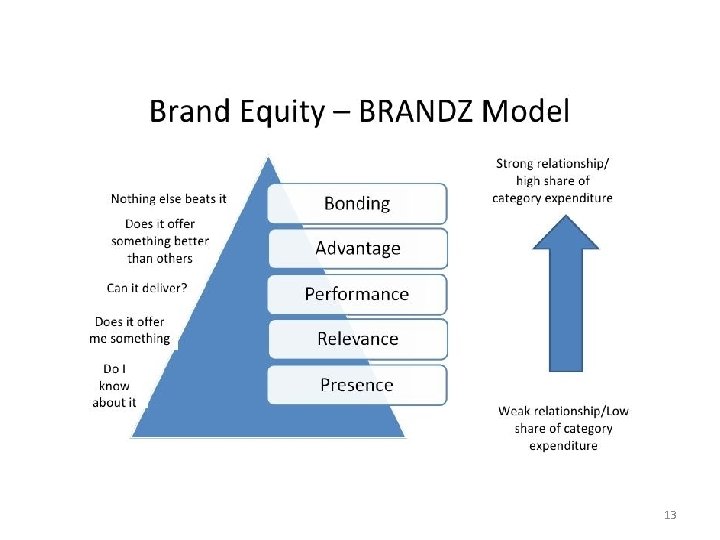
13
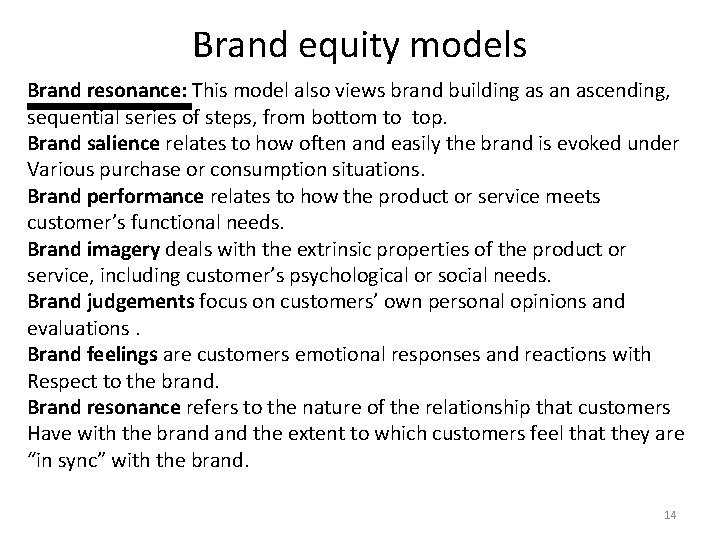
Brand equity models Brand resonance: This model also views brand building as an ascending, sequential series of steps, from bottom to top. Brand salience relates to how often and easily the brand is evoked under Various purchase or consumption situations. Brand performance relates to how the product or service meets customer’s functional needs. Brand imagery deals with the extrinsic properties of the product or service, including customer’s psychological or social needs. Brand judgements focus on customers’ own personal opinions and evaluations. Brand feelings are customers emotional responses and reactions with Respect to the brand. Brand resonance refers to the nature of the relationship that customers Have with the brand the extent to which customers feel that they are “in sync” with the brand. 14
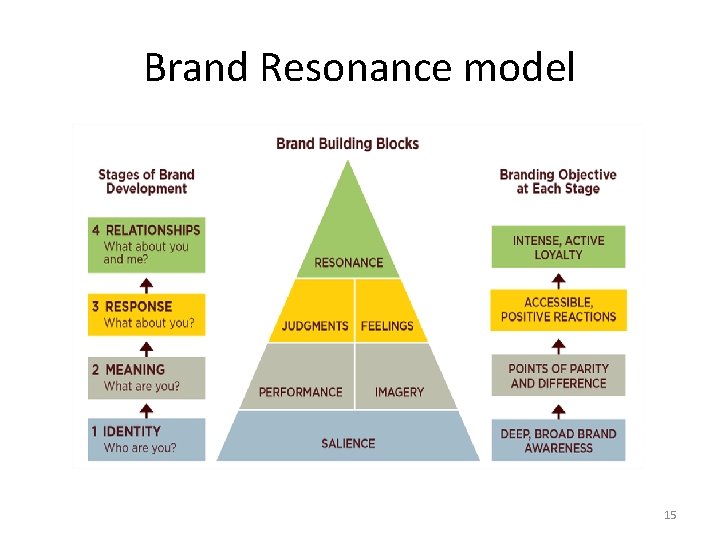
Brand Resonance model 15
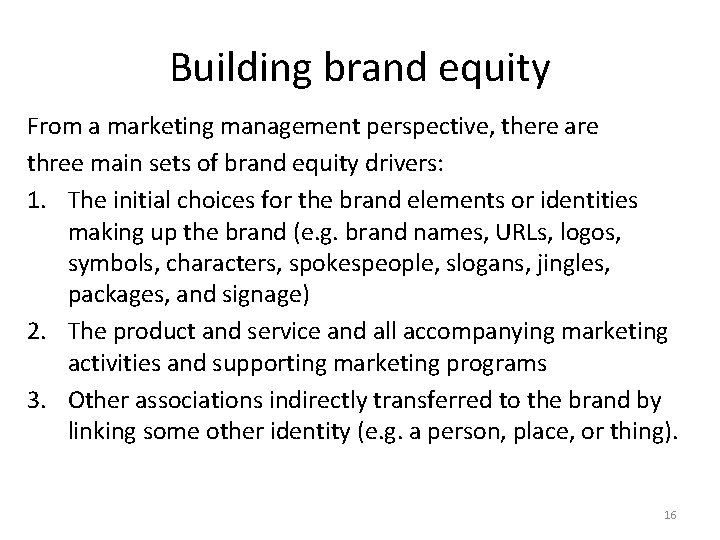
Building brand equity From a marketing management perspective, there are three main sets of brand equity drivers: 1. The initial choices for the brand elements or identities making up the brand (e. g. brand names, URLs, logos, symbols, characters, spokespeople, slogans, jingles, packages, and signage) 2. The product and service and all accompanying marketing activities and supporting marketing programs 3. Other associations indirectly transferred to the brand by linking some other identity (e. g. a person, place, or thing). 16
Choosing brand elements Brand elements are devices, which can trademarked, that identify and differentiate the brand. Most strong brands employ multiple brand elements such as Nike has the distinctive “swoosh” logo, the empowering “just do it” slogan, and the “Nike” name from the Greek winged goddess of victory. 17
Brand elements choice criteria There are six criteria in choosing brand elements. The first three can be characterized as “brand building”, the latter three are more “defensive”. • Memorable • Meaningful • Likeability • Transferable • Adaptable • Protectable 18
Developing brand elements Brand elements can play a number of brand building roles. If consumers do not examine much information in making their product decisions, brand elements should be easily recognized and recalled. They are also be descriptive and persuasive. Brand names are not the only important brand element. Often, the less concrete brand benefits are, the more important it is that brand elements capture the brand’s intangible characteristics. Many insurance firms use symbols of strength, security, or some combination of the two. A powerful brand element is slogans. Like brand names, slogans are an extremely efficient means to build brand equity. Slogans can function as useful “hooks” or “handles” to help consumers to grasp what the brand is and what makes it special. 19
Designing holistic marketing activities Customers come to know a brand through a range of contacts and touch points: personal observation and use, word of mouth, interactions with company personnel, online or telephone experience and payment transactions. A brand contact is any of information- bearing experience whether positive or negative, a customer or prospect has with the brand, its product category, or its market. The company must put as much effort into managing these experiences. Integrated marketing is about mixing and matching marketing activities to maximize their individual and collective effects. Marketers need a variety of different marketing activities that consistently reinforce the brand promise, working singularly or in combination. 20
Leveraging brand associations The third and final way of to build brand equity is to “borrow” it by linking the brand to other information in memory that conveys meaning to consumers. These “secondary” brand associations can link to sources such as the company itself, countries, or other geographical regions, and channels of distribution as well as other brands, characters, spokesperson (through endorsement), sporting or cultural events (through sponsorship), or other third-party sources. Leveraging a secondary associations can be efficient and effective way to strengthen a brand. But linking a brand to someone or something else can be risky because if anything bad that happens to that other entity can also be linked to the brand. 21
Internal branding consists of activities and processes that help inform and inspire employees about brands. Holistic marketers go even further and train and encourage distributors and dealers to serve their customers well. 22
Measuring and managing brand equity How do we measure brand equity? An indirect approach assesses potential sources of brand equity by identifying and consumer brand knowledge structures. A direct approach assesses the actual impact of brand knowledge on consumer response to different aspects of the marketing. For brand equity to guide strategy and decisions, marketers need to fully understand ; • The sources of brand equity and how they affect outcomes of interest • How these sources and outcomes change. 23
Measuring and managing brand equity Brand audits and brand tracking: A brand audit is a focused series of procedures to asses the health of the brand, uncover its sources of brand equity; suggest ways to improve and leverage its equity. Brand tracking studies use the brand audit as input to collect quantitative data from consumers over time, providing consistent, baseline information about how brands and marketing programs are performing. Brand valuation: Marketers should distinguish brand equity from brand valuation, which is the job of estimating the total financial value of the brand. 24
Managing brand equity Brand reinforcement: marketers can reinforce brand equity by consistently conveying the brand’s meaning in terms of (1) what products it represents, what core benefits it supplies, and what needs it satisfies; (2) how the brand makes products superior and which strong, favorable, and unique brand associations exist in consumers’ mind. Brand revitalization: Any new developments in the marketing environment can affect the success of a brand. However, it is possible to make positive changes. The first step is to understand what sources of brand equity were to begin with Then , decide whether to retain the same positioning or create a new one and if so, which new one. 25
Devising a branding strategy A firm’s branding strategy reflects the number and nature of both common and distinctive elements. A firm has three main choices: 1) Develop new brand elements for the new product 2) Apply some existing brand elements, or 3) Use a combination of new and existing brand elements. 26
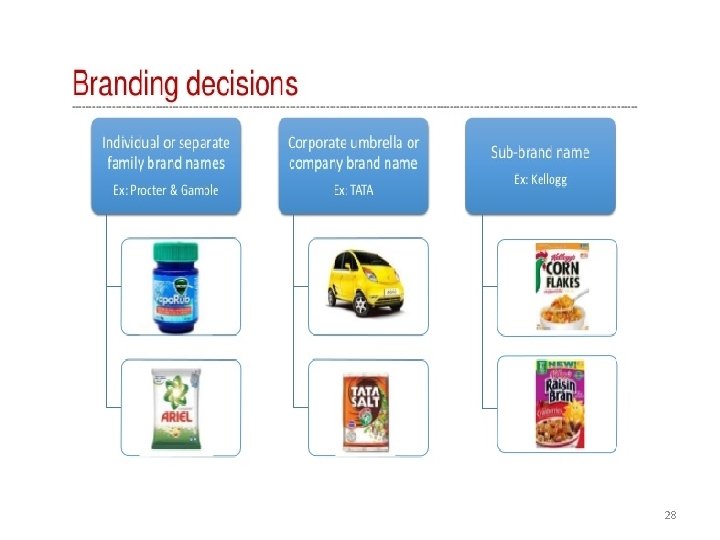
Brand decisions Assuming a firm decides to brand its products or services, it must choose which brand names to use. Three general strategies are popular: Individual or separate family brand names: A major advantage is that if a product fails or appears low quality, the company has not tied its reputation to it. Corporate umbrella or company brand name: Development costs are lower, and sales of the new product are likely to be strong if the manufacturer’s name is good. Corporate-image associations of innovativeness, expertise, and trustworthiness have been shown to directly influence consumer evaluations. Sub-brand name: Sub-brands combine two or more of the corporate brand, family brand, or individual product brand names. For example, Kellogg’s Rice Krispies. 27
28
Brand portfolios The brand portfolio is the set of all brands and brand lines. A particular firm offer for sale in a particular category or market segment. The basic principle is: • to maximize market coverage so no potential customers are being ignored, but minimize brand overlap so brands are not competing for customer approval. • Each brand should be clearly differentiated and appealing to a sizeable enough marketing segment to justify its marketing and production costs. 29
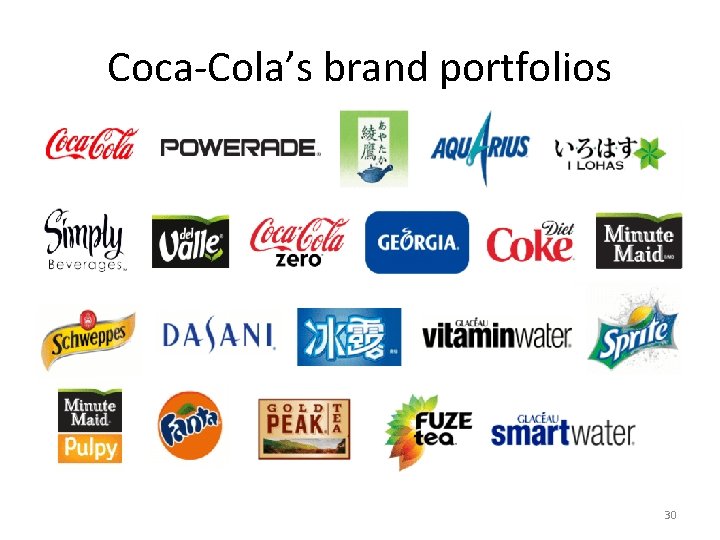
Coca-Cola’s brand portfolios 30
Brand portfolios Brands can also play a number of specific roles as part of a portfolio. Flankers: Flanker or fighter brands are positioned with respect to competitors’ brands so that more important and flagship brands can retain their desired position. Cash cows: Some brands may be kept around despite dwindling sales because they manage to maintain their profitability with virtually no marketing support. Low-end entry level: The role of a relatively low-priced brand in the portfolio often may be to attract customers to the brand franchise. High-end prestige: The role of a relatively high-priced brand often is to add prestige and credibility to the entire portfolio. 31
Brand extensions Many companies leverage their most valuable asset by introducing a host of new products under their strongest brand names. Advantages: • They can facilitate new product acceptance • They provide positive feedback to the parent brand company. Disadvantages: • They may cause the brand name to be less strongly identified with any one product • They may harm the parent brand in the process. 32
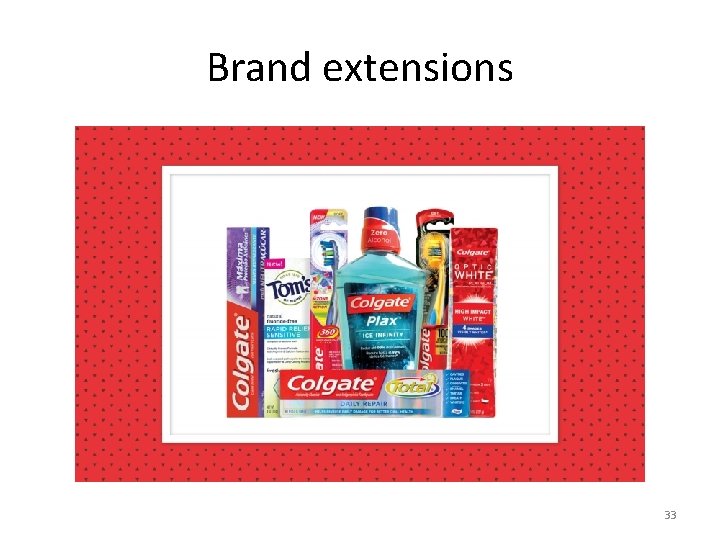
Brand extensions 33
Customer equity The aim of customer relationship management (CRM) is to produce high customer equity. Customer equity is the total of the discounted life time values of all the firm’s customers. Customer lifetime value is affected by revenue and by the costs of customer acquisition, retention, and cross-selling. Clearly, the more loyal the customers, the higher the customer equity. 34
The relationships between customer equity and brand equity The brand equity and customer equity perspectives share many common themes. Both emphasize the importance of customer loyalty. The customer equity perspective focuses on bottom-line financial value. But it offers limited guidance for go-to-market strategies and ignores some of the important advantages of creating strong brands. Brand equity, on the other hand, emphasizes strategic issues in managing brands and creating and leveraging brand awareness and image, providing practical guidance for marketing activities. Managers, however, do not always develop detailed customer analyses in terms of the brand equity they achieve or the resulting long-term profitability they create. 35
- Slides: 35