
Chapter 8 Bonding General Concepts Chapter 8 Table
Chapter 8 Bonding: General Concepts
Chapter 8 Table of Contents 8. 1 8. 3 8. 5 8. 6 8. 7 8. 8 8. 9 8. 10 8. 11 8. 12 8. 13 Types of Chemical Bonds Bond Polarity and Dipole Moments Energy Effects in Binary Ionic Compounds Partial Ionic Character of Covalent Bonds The Covalent Chemical Bond: A Model Covalent Bond Energies and Chemical Reactions The Localized Electron Bonding Model Lewis Structures Exceptions to the Octet Rule Resonance Molecular Structure: The VSEPR Model
Section 8. 1 Types of Chemical Bonds A Chemical Bond • No simple, and yet complete, way to define this. • Forces that hold groups of atoms together and make them function as a unit. • A bond will form if the energy of the aggregate is lower than that of the separated atoms. Return to TOC Copyright © Cengage Learning. All rights reserved 3
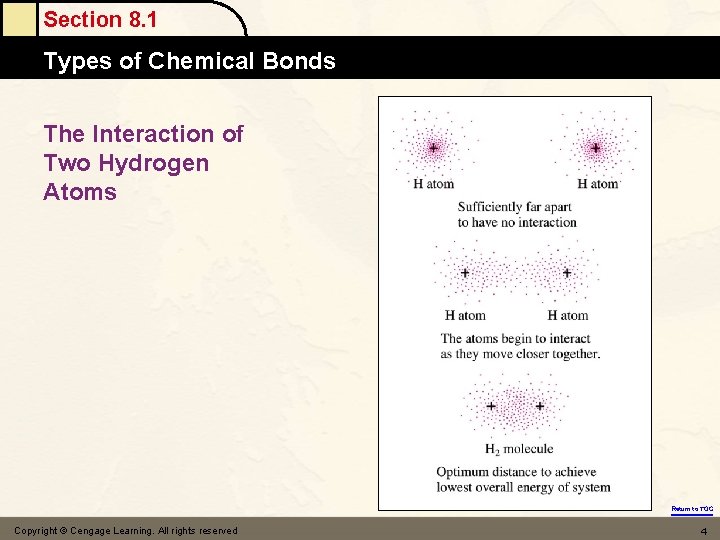
Section 8. 1 Types of Chemical Bonds The Interaction of Two Hydrogen Atoms Return to TOC Copyright © Cengage Learning. All rights reserved 4
Section 8. 1 Types of Chemical Bonds Key Ideas in Bonding • Ionic Bonding – electrons are transferred • Covalent Bonding – electrons are shared equally • What about intermediate cases? Return to TOC Copyright © Cengage Learning. All rights reserved 5
Section 8. 1 Types of Chemical Bonds Polar Covalent Bond • Unequal sharing of electrons between atoms in a molecule. • Results in a charge separation in the bond (partial positive and partial negative charge). Return to TOC Copyright © Cengage Learning. All rights reserved 6
Section 8. 1 Types of Chemical Bonds Polar Molecules Return to TOC Copyright © Cengage Learning. All rights reserved 7
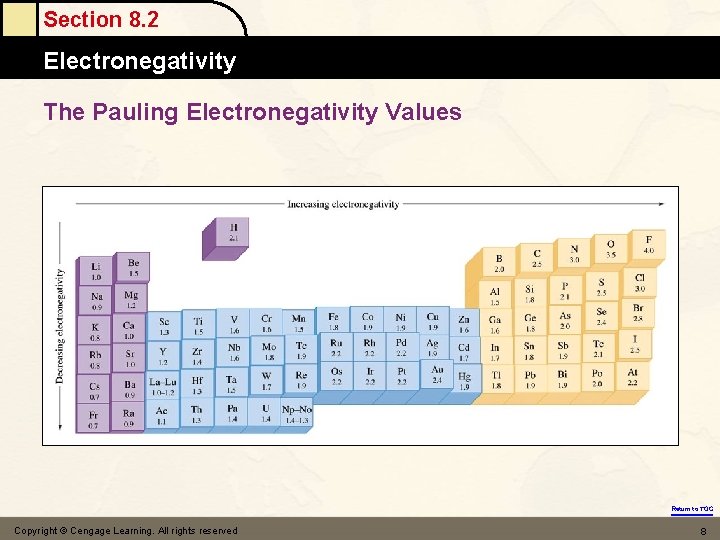
Section 8. 2 Electronegativity The Pauling Electronegativity Values Return to TOC Copyright © Cengage Learning. All rights reserved 8
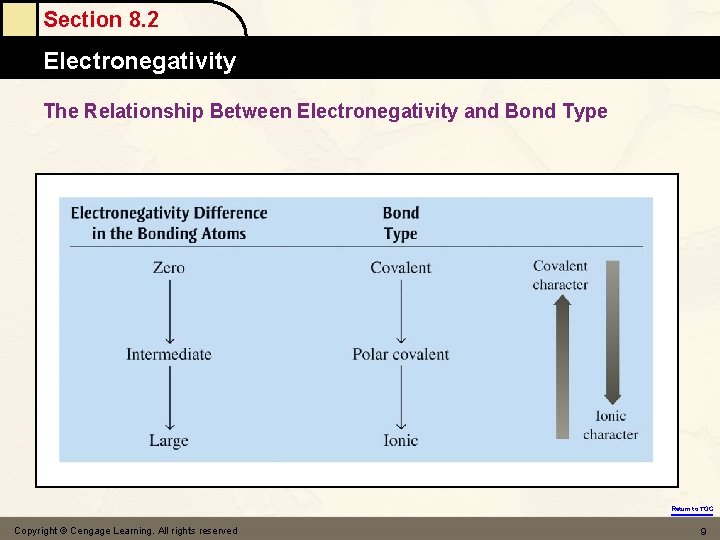
Section 8. 2 Electronegativity The Relationship Between Electronegativity and Bond Type Return to TOC Copyright © Cengage Learning. All rights reserved 9
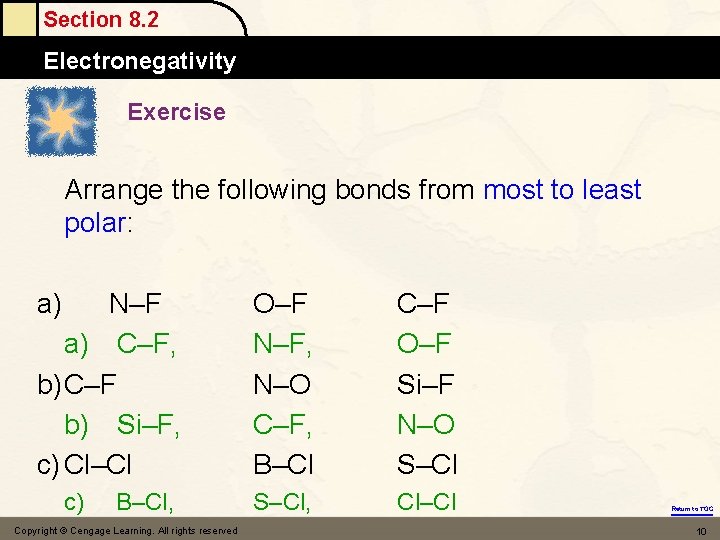
Section 8. 2 Electronegativity Exercise Arrange the following bonds from most to least polar: a) N–F a) C–F, b)C–F b) Si–F, c) Cl–Cl c) B–Cl, Copyright © Cengage Learning. All rights reserved O–F N–F, N–O C–F, B–Cl C–F O–F Si–F N–O S–Cl, Cl–Cl Return to TOC 10
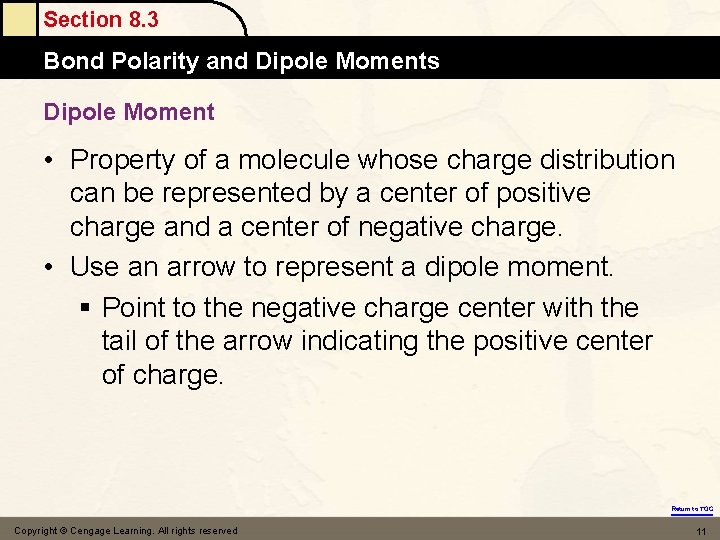
Section 8. 3 Bond Polarity and Dipole Moments Dipole Moment • Property of a molecule whose charge distribution can be represented by a center of positive charge and a center of negative charge. • Use an arrow to represent a dipole moment. § Point to the negative charge center with the tail of the arrow indicating the positive center of charge. Return to TOC Copyright © Cengage Learning. All rights reserved 11
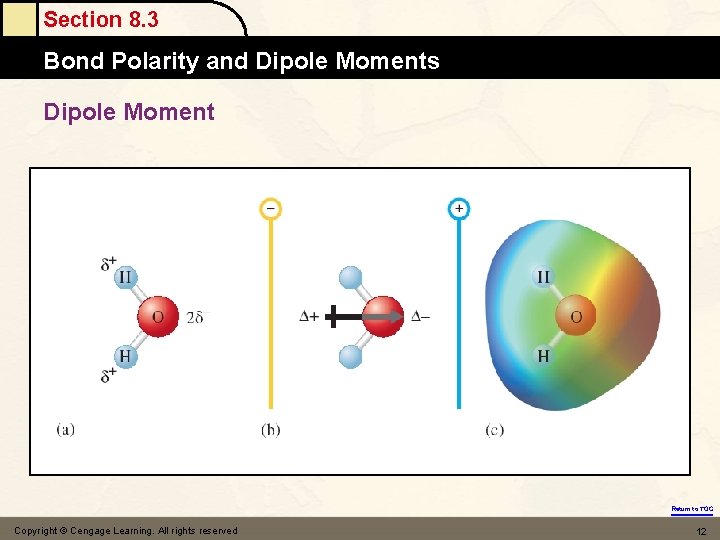
Section 8. 3 Bond Polarity and Dipole Moments Dipole Moment Return to TOC Copyright © Cengage Learning. All rights reserved 12
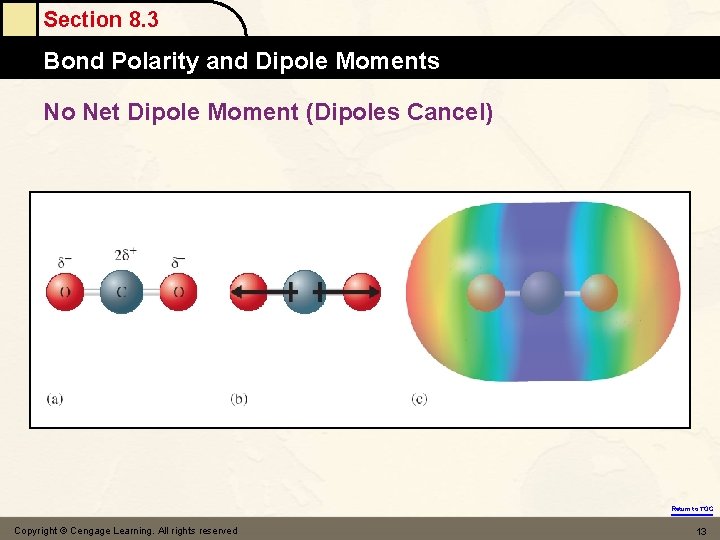
Section 8. 3 Bond Polarity and Dipole Moments No Net Dipole Moment (Dipoles Cancel) Return to TOC Copyright © Cengage Learning. All rights reserved 13
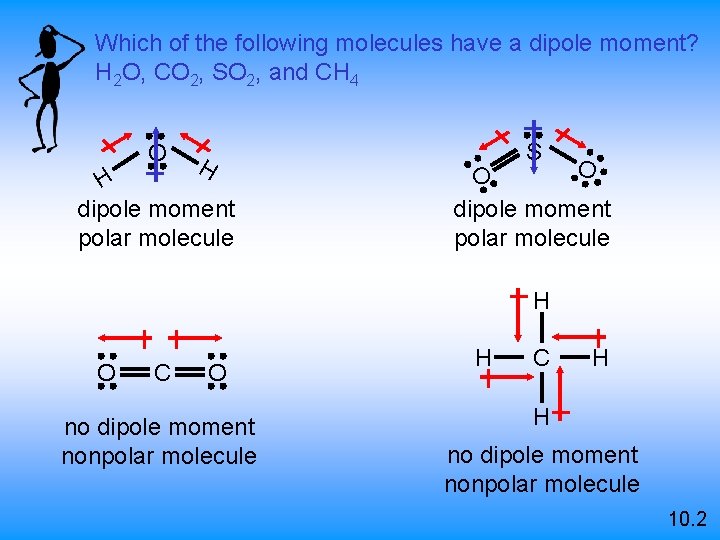
Which of the following molecules have a dipole moment? H 2 O, CO 2, SO 2, and CH 4 O H H dipole moment polar molecule S O O dipole moment polar molecule H O C O no dipole moment nonpolar molecule H C H H no dipole moment nonpolar molecule 10. 2
Section 8. 4 Ions: Electron Configurations and Sizes Electron Configurations in Stable Compounds • Two nonmetals form a covalent bond by sharing electrons to complete the valence electron configurations of both atoms. • A metal and a nonmetal form ions by emptying the valence orbitals of the metal and adding electrons to the nonmetal to gain a noble gas configuration. These ions then form a binary ionic compound. Return to TOC Copyright © Cengage Learning. All rights reserved 15
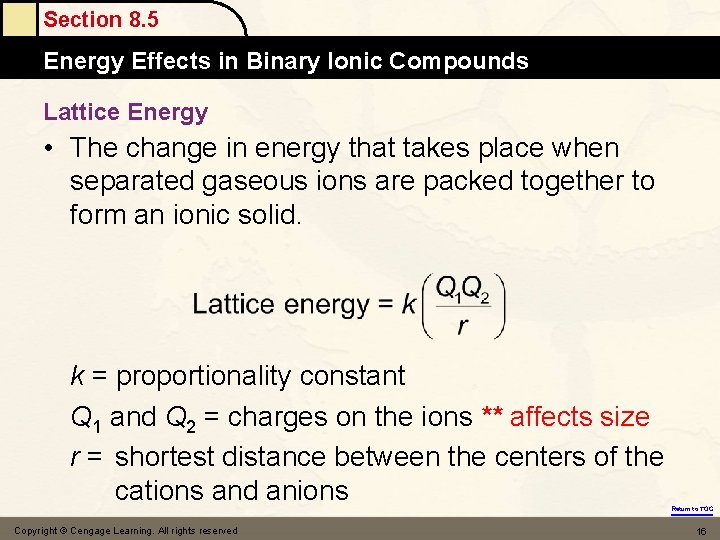
Section 8. 5 Energy Effects in Binary Ionic Compounds Lattice Energy • The change in energy that takes place when separated gaseous ions are packed together to form an ionic solid. k = proportionality constant Q 1 and Q 2 = charges on the ions ** affects size r = shortest distance between the centers of the cations and anions Return to TOC Copyright © Cengage Learning. All rights reserved 16
Section 8. 5 Energy Effects in Binary Ionic Compounds Born-Haber Cycle for Na. Cl Return to TOC Copyright © Cengage Learning. All rights reserved 17
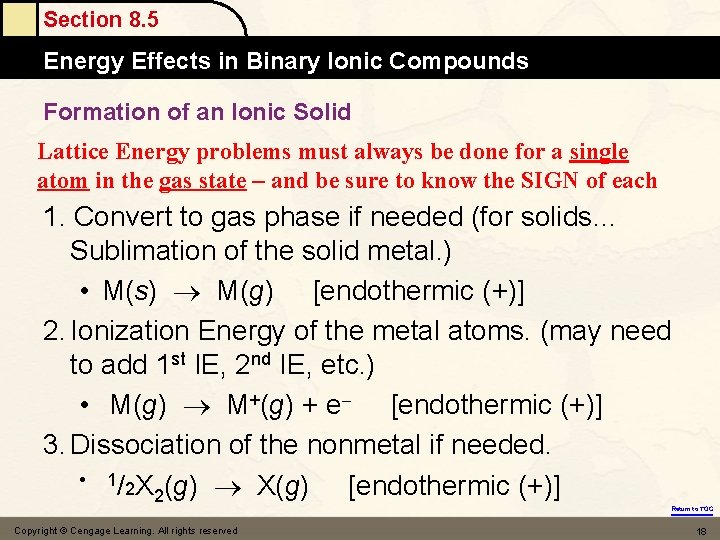
Section 8. 5 Energy Effects in Binary Ionic Compounds Formation of an Ionic Solid Lattice Energy problems must always be done for a single atom in the gas state – and be sure to know the SIGN of each 1. Convert to gas phase if needed (for solids… Sublimation of the solid metal. ) • M(s) M(g) [endothermic (+)] 2. Ionization Energy of the metal atoms. (may need to add 1 st IE, 2 nd IE, etc. ) • M(g) M+(g) + e [endothermic (+)] 3. Dissociation of the nonmetal if needed. • 1/2 X (g) X(g) [endothermic (+)] 2 Return to TOC Copyright © Cengage Learning. All rights reserved 18
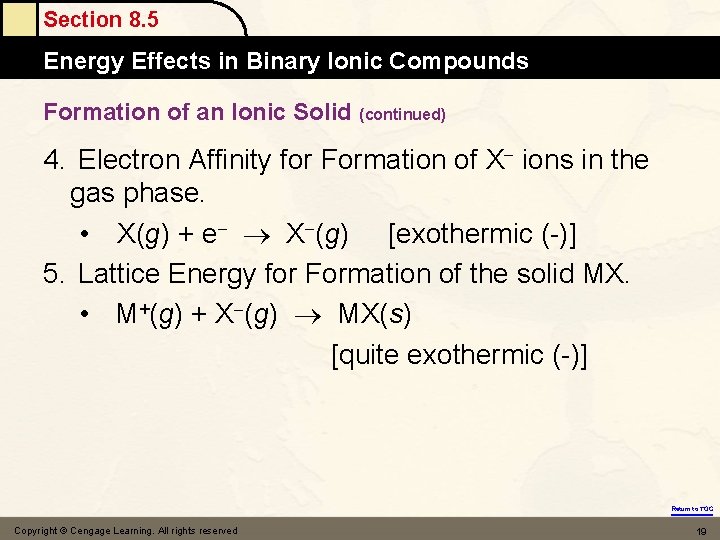
Section 8. 5 Energy Effects in Binary Ionic Compounds Formation of an Ionic Solid (continued) 4. Electron Affinity for Formation of X ions in the gas phase. • X(g) + e X (g) [exothermic (-)] 5. Lattice Energy for Formation of the solid MX. • M+(g) + X (g) MX(s) [quite exothermic (-)] Return to TOC Copyright © Cengage Learning. All rights reserved 19
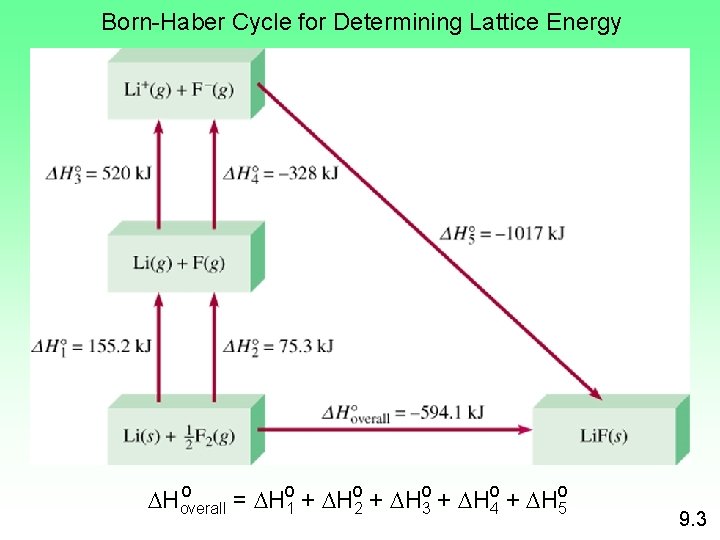
Born-Haber Cycle for Determining Lattice Energy o Hoverall = Ho 1 + Ho 2 + Ho 3 + Ho 4 + Ho 5 9. 3
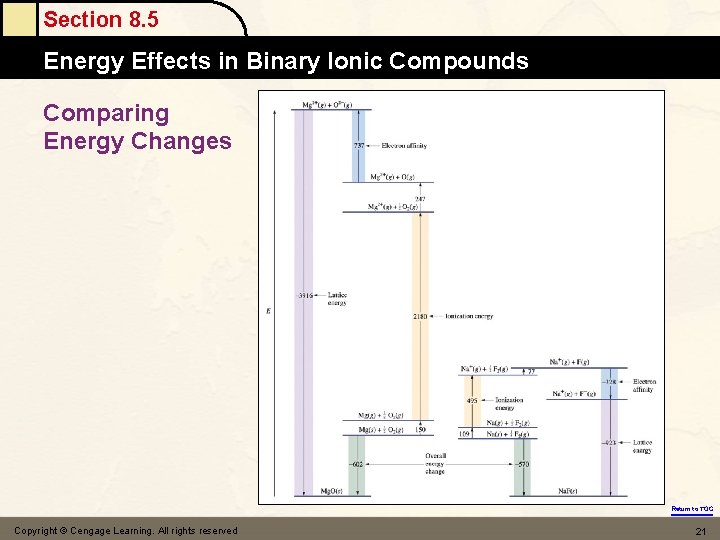
Section 8. 5 Energy Effects in Binary Ionic Compounds Comparing Energy Changes Return to TOC Copyright © Cengage Learning. All rights reserved 21
Section 8. 8 Covalent Bond Energies and Chemical Reactions Bond Energies • To break bonds, energy must be added to the system (endothermic). • To form bonds, energy is released (exothermic). Return to TOC Copyright © Cengage Learning. All rights reserved 22
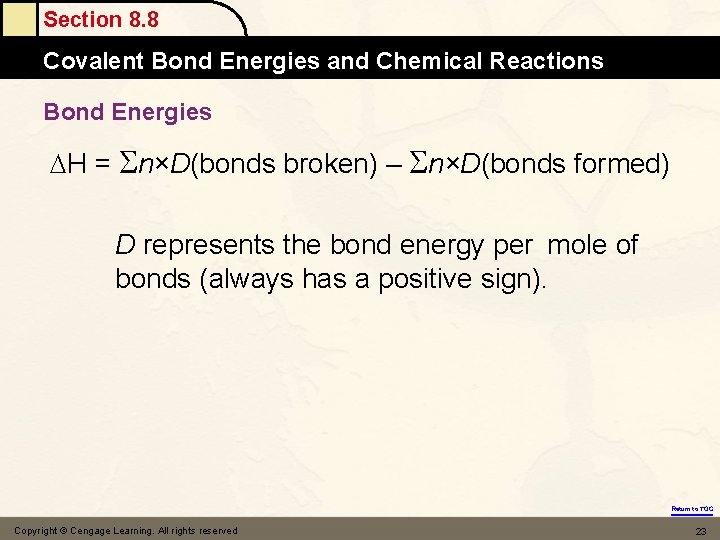
Section 8. 8 Covalent Bond Energies and Chemical Reactions Bond Energies H = n×D(bonds broken) – n×D(bonds formed) D represents the bond energy per mole of bonds (always has a positive sign). Return to TOC Copyright © Cengage Learning. All rights reserved 23
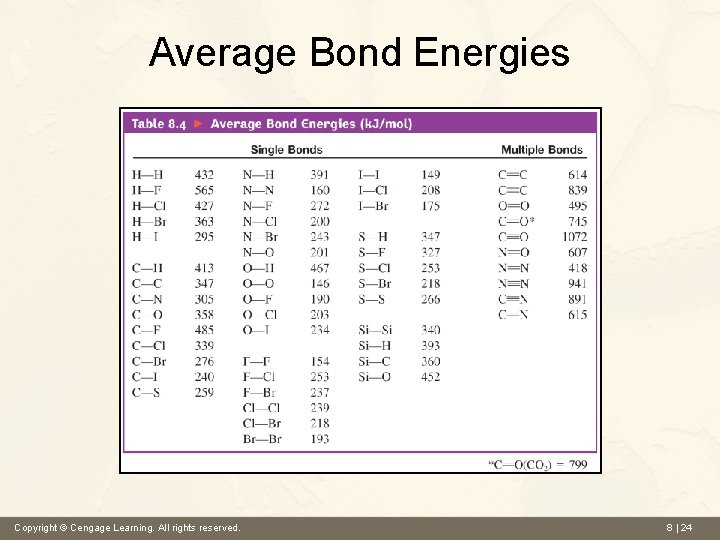
Average Bond Energies Copyright © Cengage Learning. All rights reserved. 8 | 24
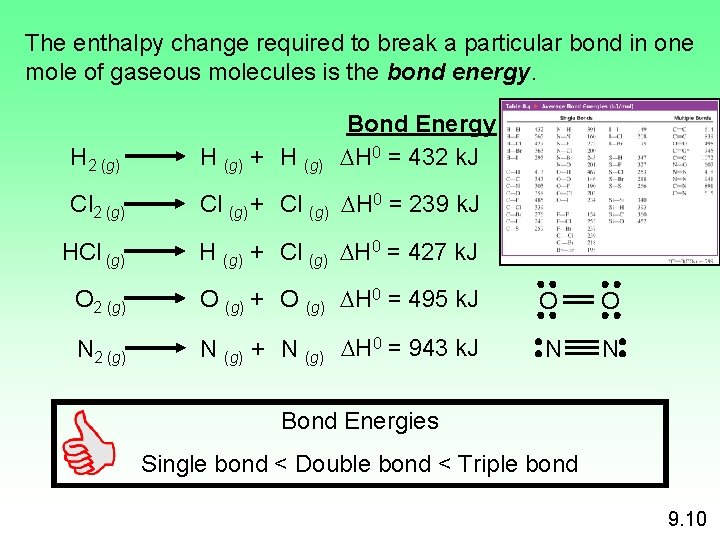
The enthalpy change required to break a particular bond in one mole of gaseous molecules is the bond energy. Bond Energy H 0 = 432 k. J H 2 (g) H (g) + H (g) Cl 2 (g) Cl (g) + Cl (g) H 0 = 239 k. J HCl (g) H (g) + Cl (g) H 0 = 427 k. J O 2 (g) O (g) + O (g) H 0 = 495 k. J O O N 2 (g) N (g) + N (g) H 0 = 943 k. J N N Bond Energies Single bond < Double bond < Triple bond 9. 10
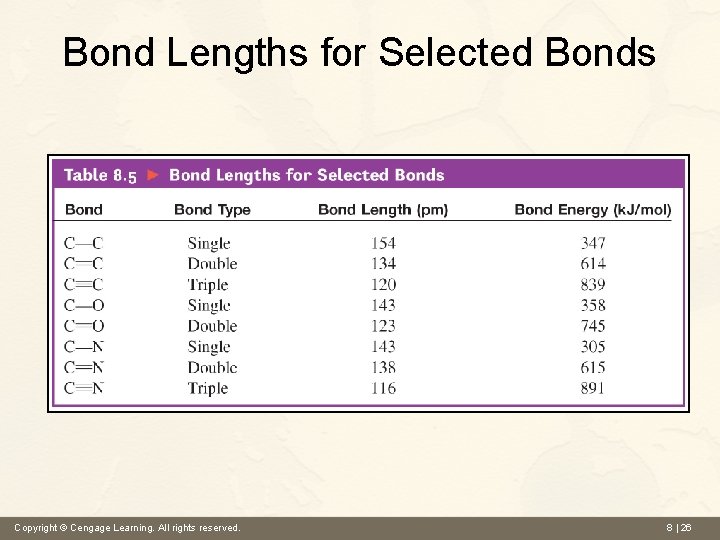
Bond Lengths for Selected Bonds Copyright © Cengage Learning. All rights reserved. 8 | 26
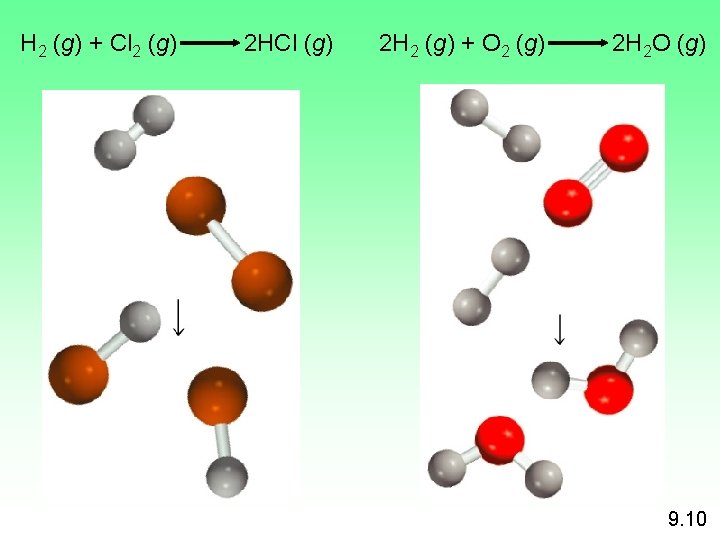
H 2 (g) + Cl 2 (g) 2 HCl (g) 2 H 2 (g) + O 2 (g) 2 H 2 O (g) 9. 10
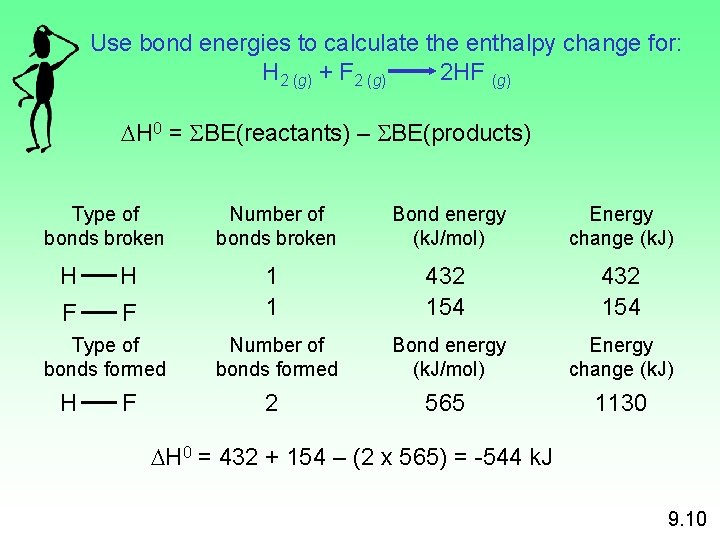
Use bond energies to calculate the enthalpy change for: H 2 (g) + F 2 (g) 2 HF (g) H 0 = BE(reactants) – BE(products) Type of bonds broken H H F F Type of bonds formed H F Number of bonds broken Bond energy (k. J/mol) Energy change (k. J) 1 1 432 154 Number of bonds formed Bond energy (k. J/mol) Energy change (k. J) 2 565 1130 H 0 = 432 + 154 – (2 x 565) = -544 k. J 9. 10
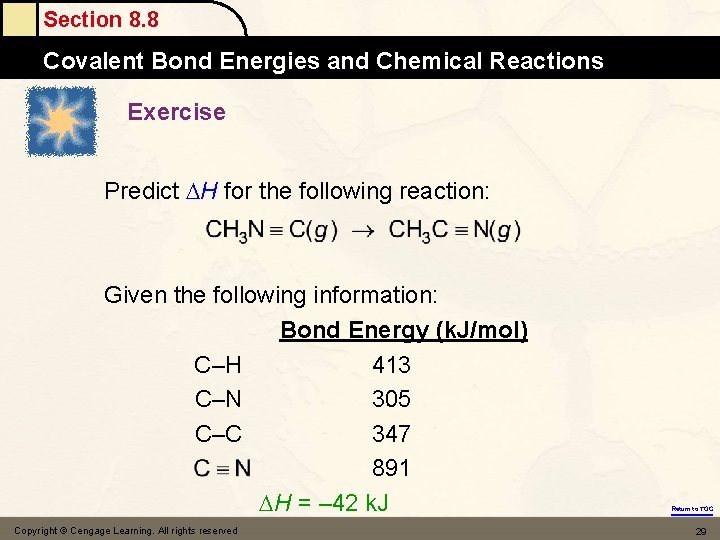
Section 8. 8 Covalent Bond Energies and Chemical Reactions Exercise Predict H for the following reaction: Given the following information: Bond Energy (k. J/mol) C–H 413 C–N 305 C–C 347 891 H = – 42 k. J Copyright © Cengage Learning. All rights reserved Return to TOC 29
Section 8. 7 The Covalent Chemical Bond: A Models • Models are attempts to explain how nature operates on the microscopic level based on experiences in the macroscopic world. Return to TOC Copyright © Cengage Learning. All rights reserved 30
Section 8. 7 The Covalent Chemical Bond: A Model Fundamental Properties of Models 1. A model does not equal reality. 2. Models are oversimplifications, and are therefore often wrong. 3. Models become more complicated and are modified as they age. 4. We must understand the underlying assumptions in a model so that we don’t misuse it. 5. When a model is wrong, we often learn much more than when it is right. Return to TOC Copyright © Cengage Learning. All rights reserved 31
Section 8. 9 The Localized Electron Bonding Model Localized Electron Model • A molecule is composed of atoms that are bound together by sharing pairs of electrons using the atomic orbitals of the bound atoms. Return to TOC Copyright © Cengage Learning. All rights reserved 32
Section 8. 9 The Localized Electron Bonding Model Localized Electron Model • Electron pairs are assumed to be localized on a particular atom or in the space between two atoms: § Lone pairs – pairs of electrons localized on an atom § Bonding pairs – pairs of electrons found in the space between the atoms Return to TOC Copyright © Cengage Learning. All rights reserved 33
Section 8. 9 The Localized Electron Bonding Model Localized Electron Model 1. Description of valence electron arrangement (Lewis structure). 2. Prediction of geometry (VSEPR model). 3. Description of atomic orbital types used to share electrons or hold lone pairs. Return to TOC Copyright © Cengage Learning. All rights reserved 34
Section 8. 10 Lewis Structures Lewis Structure • Shows how valence electrons are arranged among atoms in a molecule. • Reflects central idea that stability of a compound relates to noble gas electron configuration. Return to TOC Copyright © Cengage Learning. All rights reserved 35
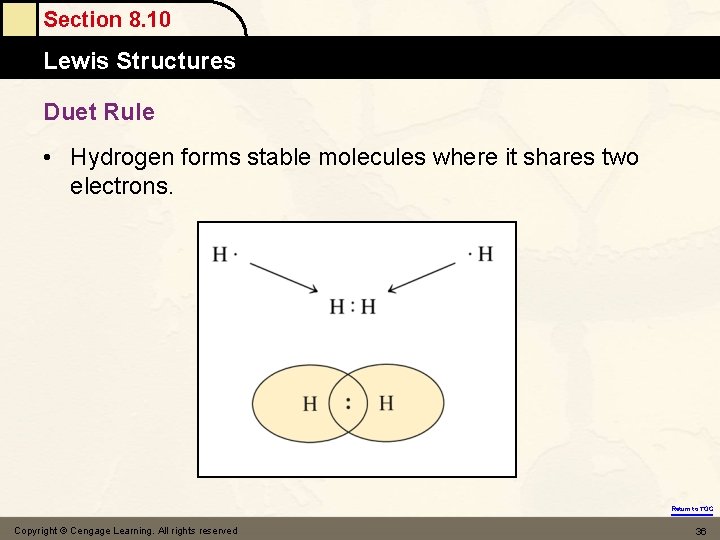
Section 8. 10 Lewis Structures Duet Rule • Hydrogen forms stable molecules where it shares two electrons. Return to TOC Copyright © Cengage Learning. All rights reserved 36
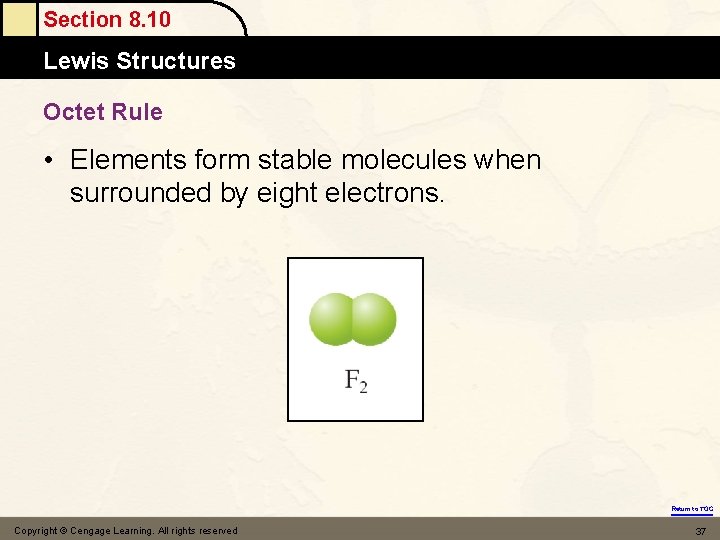
Section 8. 10 Lewis Structures Octet Rule • Elements form stable molecules when surrounded by eight electrons. Return to TOC Copyright © Cengage Learning. All rights reserved 37
Section 8. 10 Lewis Structures Steps for Writing Lewis Structures 1. Sum the valence electrons from all the atoms. 2. Use a pair of electrons to form a bond between each pair of bound atoms. 3. Atoms usually have noble gas configurations. Arrange the remaining electrons to satisfy the octet rule (or duet rule for hydrogen). Return to TOC Copyright © Cengage Learning. All rights reserved 38
Section 8. 10 Lewis Structures Steps for Writing Lewis Structures 1. Sum the valence electrons from all the atoms. (Use the periodic table. ) Example: H 2 O 2 (1 e–) + 6 e– = 8 e– total Return to TOC Copyright © Cengage Learning. All rights reserved 39
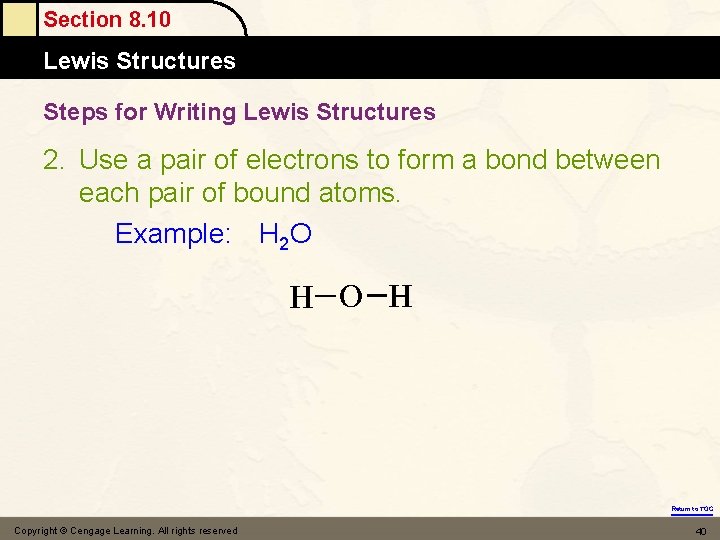
Section 8. 10 Lewis Structures Steps for Writing Lewis Structures 2. Use a pair of electrons to form a bond between each pair of bound atoms. Example: H 2 O Return to TOC Copyright © Cengage Learning. All rights reserved 40
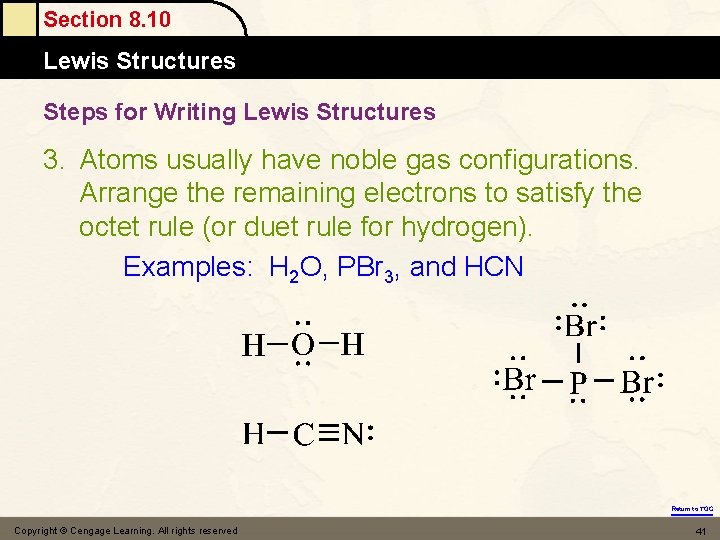
Section 8. 10 Lewis Structures Steps for Writing Lewis Structures 3. Atoms usually have noble gas configurations. Arrange the remaining electrons to satisfy the octet rule (or duet rule for hydrogen). Examples: H 2 O, PBr 3, and HCN Return to TOC Copyright © Cengage Learning. All rights reserved 41
Section 8. 10 Lewis Structures Concept Check Draw a Lewis structure for each of the following molecules: NH 3 CO 2 CCl 4 Return to TOC Copyright © Cengage Learning. All rights reserved 42
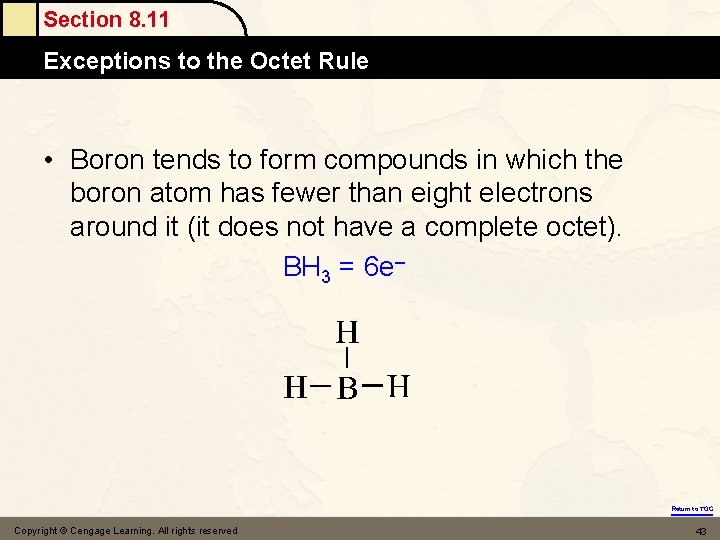
Section 8. 11 Exceptions to the Octet Rule • Boron tends to form compounds in which the boron atom has fewer than eight electrons around it (it does not have a complete octet). BH 3 = 6 e– Return to TOC Copyright © Cengage Learning. All rights reserved 43
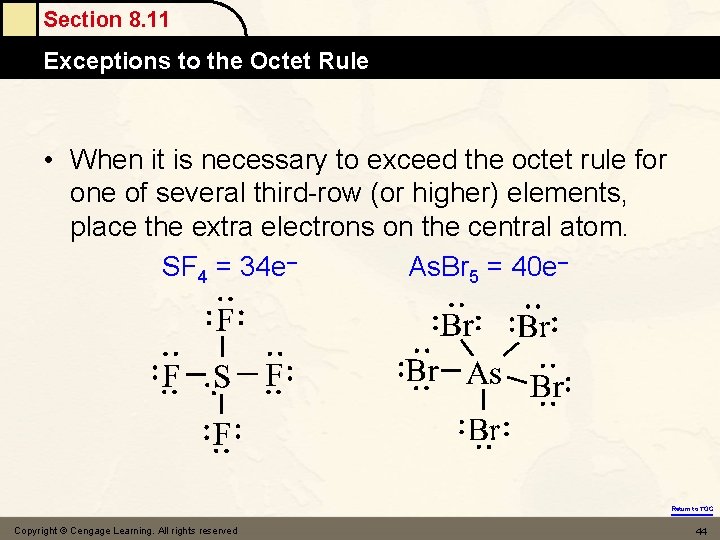
Section 8. 11 Exceptions to the Octet Rule • When it is necessary to exceed the octet rule for one of several third-row (or higher) elements, place the extra electrons on the central atom. SF 4 = 34 e– As. Br 5 = 40 e– Return to TOC Copyright © Cengage Learning. All rights reserved 44
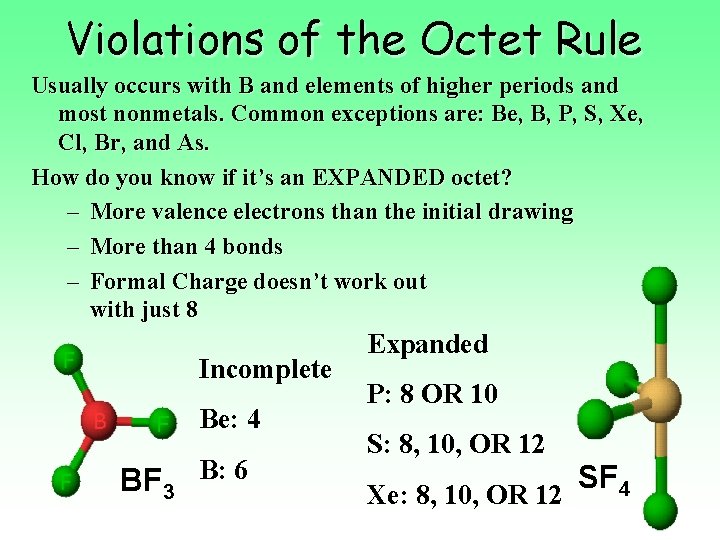
Violations of the Octet Rule Usually occurs with B and elements of higher periods and most nonmetals. Common exceptions are: Be, B, P, S, Xe, Cl, Br, and As. How do you know if it’s an EXPANDED octet? – More valence electrons than the initial drawing – More than 4 bonds – Formal Charge doesn’t work out with just 8 Incomplete Be: 4 BF 3 B: 6 Expanded P: 8 OR 10 S: 8, 10, OR 12 Xe: 8, 10, OR 12 SF 4
Section 8. 11 Exceptions to the Octet Rule Concept Check Draw a Lewis structure for each of the following molecules: BF 3 PCl 5 SF 6 Return to TOC Copyright © Cengage Learning. All rights reserved 46
Section 8. 11 Exceptions to the Octet Rule Let’s Review • C, N, O, and F should always be assumed to obey the octet rule. • B and Be often have fewer than 8 electrons around them in their compounds. • Second-row elements never exceed the octet rule. • Third-row and heavier elements often satisfy the octet rule but can exceed the octet rule by using their empty valence d orbitals. Return to TOC Copyright © Cengage Learning. All rights reserved 47
Section 8. 11 Exceptions to the Octet Rule Let’s Review • When writing the Lewis structure for a molecule, satisfy the octet rule for the atoms first. If electrons remain after the octet rule has been satisfied, then place them on the elements having available d orbitals (elements in Period 3 or beyond). Return to TOC Copyright © Cengage Learning. All rights reserved 48
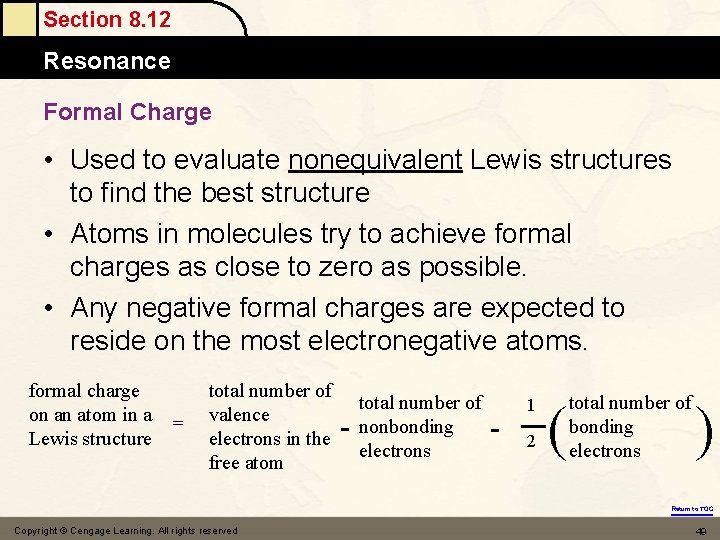
Section 8. 12 Resonance Formal Charge • Used to evaluate nonequivalent Lewis structures to find the best structure • Atoms in molecules try to achieve formal charges as close to zero as possible. • Any negative formal charges are expected to reside on the most electronegative atoms. formal charge on an atom in a Lewis structure = total number of valence electrons in the free atom - total number of nonbonding electrons - 1 2 ( total number of bonding electrons ) Return to TOC Copyright © Cengage Learning. All rights reserved 49
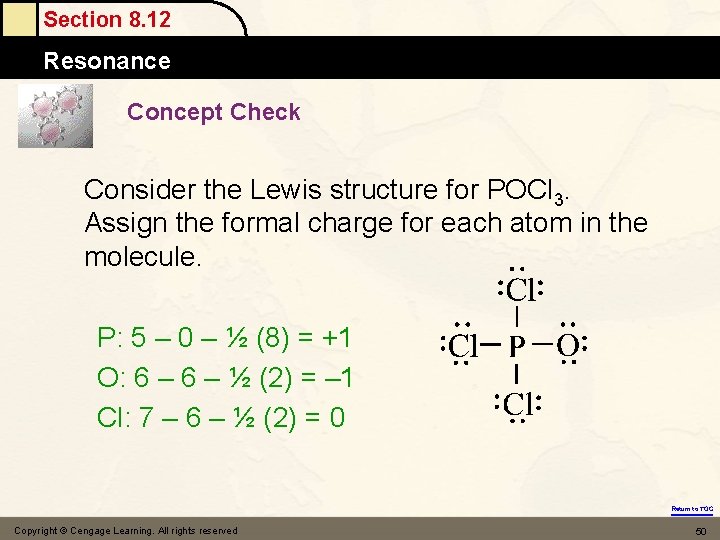
Section 8. 12 Resonance Concept Check Consider the Lewis structure for POCl 3. Assign the formal charge for each atom in the molecule. P: 5 – 0 – ½ (8) = +1 O: 6 – ½ (2) = – 1 Cl: 7 – 6 – ½ (2) = 0 Return to TOC Copyright © Cengage Learning. All rights reserved 50
Section 8. 12 Resonance Rules Governing Formal Charge • The sum of the formal charges of all atoms in a given molecule or ion must equal the overall charge on that species. Return to TOC Copyright © Cengage Learning. All rights reserved 51
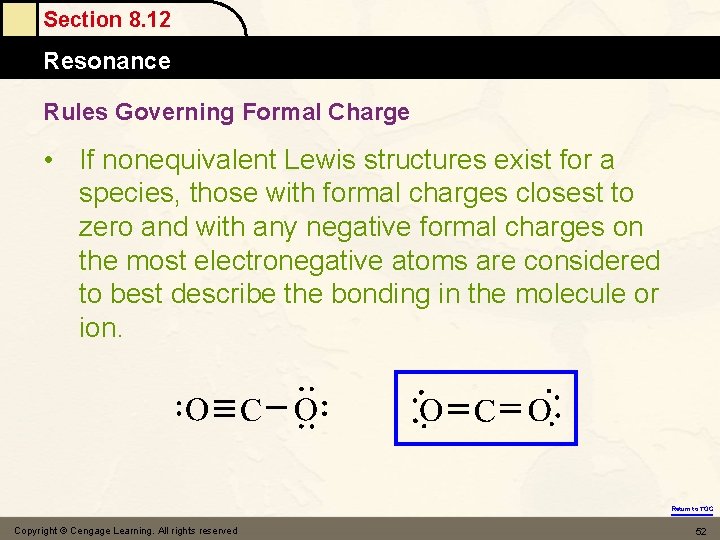
Section 8. 12 Resonance Rules Governing Formal Charge • If nonequivalent Lewis structures exist for a species, those with formal charges closest to zero and with any negative formal charges on the most electronegative atoms are considered to best describe the bonding in the molecule or ion. Return to TOC Copyright © Cengage Learning. All rights reserved 52
Section 8. 12 Resonance Concept Check • Draw the best structure for the anion: thiocyanate. Return to TOC Copyright © Cengage Learning. All rights reserved 53
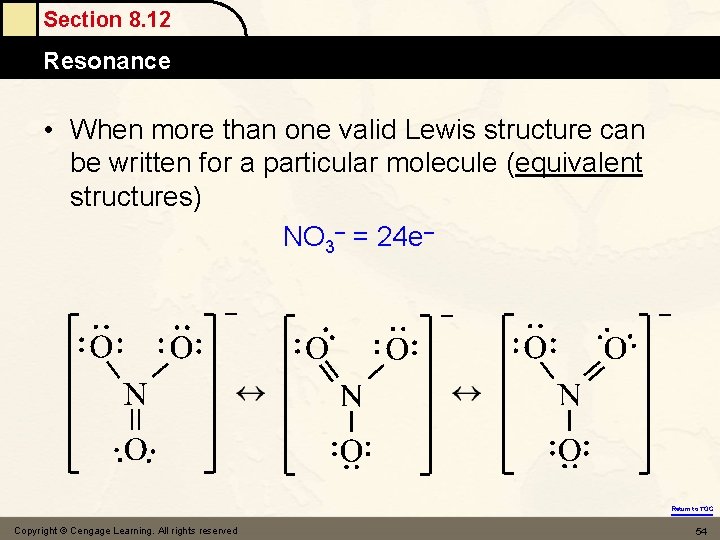
Section 8. 12 Resonance • When more than one valid Lewis structure can be written for a particular molecule (equivalent structures) NO 3– = 24 e– Return to TOC Copyright © Cengage Learning. All rights reserved 54
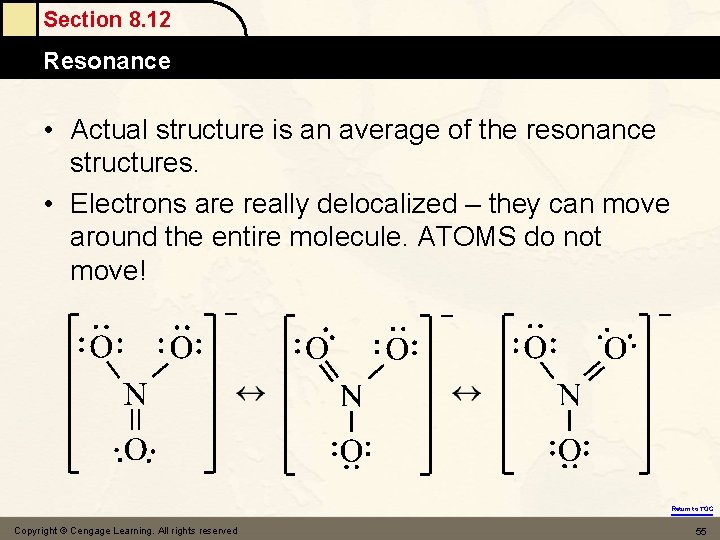
Section 8. 12 Resonance • Actual structure is an average of the resonance structures. • Electrons are really delocalized – they can move around the entire molecule. ATOMS do not move! Return to TOC Copyright © Cengage Learning. All rights reserved 55
Section 8. 12 Resonance Concept Check Draw a Lewis structure for each of the following molecules: CO CH 3 OH CO 2 OCN– Return to TOC Copyright © Cengage Learning. All rights reserved 56
Section 8. 13 Molecular Structure: The VSEPR Model • VSEPR: Valence Shell Electron-Pair Repulsion. • The structure around a given atom is determined principally by minimizing electron pair repulsions. Return to TOC Copyright © Cengage Learning. All rights reserved 57
Section 8. 13 Molecular Structure: The VSEPR Model Steps to Apply the VSEPR Model 1. Draw the Lewis structure for the molecule. 2. Count the electron pairs and arrange them in the way that minimizes repulsion (put the pairs as far apart as possible. 3. Determine the positions of the atoms from the way electron pairs are shared (how electrons are shared between the central atom and surrounding atoms). 4. Determine the name of the molecular structure from positions of the atoms. Return to TOC Copyright © Cengage Learning. All rights reserved 58
Section 8. 13 Molecular Structure: The VSEPR Model VSEPR Return to TOC Copyright © Cengage Learning. All rights reserved 59
Section 8. 13 Molecular Structure: The VSEPR Model VSEPR: Two Electron Pairs Return to TOC Copyright © Cengage Learning. All rights reserved 60
Section 8. 13 Molecular Structure: The VSEPR Model VSEPR: Three Electron Pairs Return to TOC Copyright © Cengage Learning. All rights reserved 61
Section 8. 13 Molecular Structure: The VSEPR Model VSEPR: Four Electron Pairs Return to TOC Copyright © Cengage Learning. All rights reserved 62
Section 8. 13 Molecular Structure: The VSEPR Model VSEPR: Iodine Pentafluoride Return to TOC Copyright © Cengage Learning. All rights reserved 63
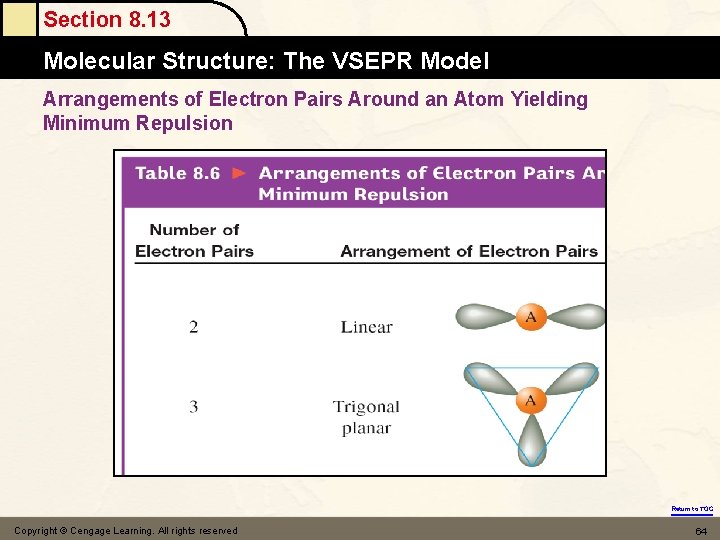
Section 8. 13 Molecular Structure: The VSEPR Model Arrangements of Electron Pairs Around an Atom Yielding Minimum Repulsion Return to TOC Copyright © Cengage Learning. All rights reserved 64
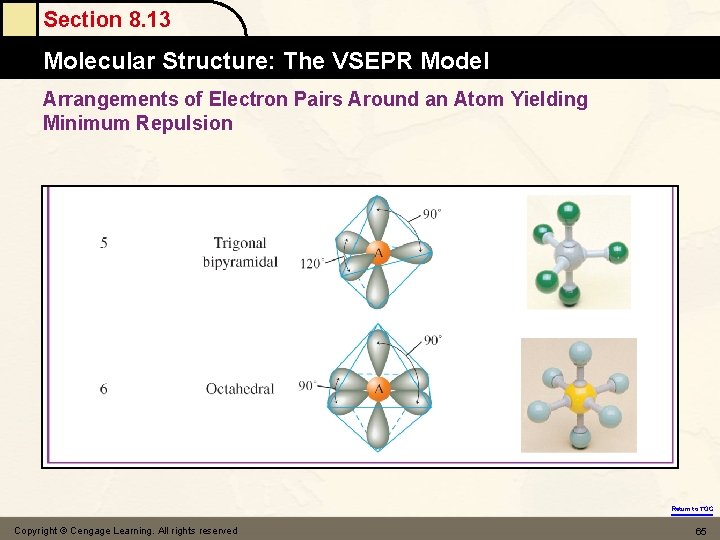
Section 8. 13 Molecular Structure: The VSEPR Model Arrangements of Electron Pairs Around an Atom Yielding Minimum Repulsion Return to TOC Copyright © Cengage Learning. All rights reserved 65
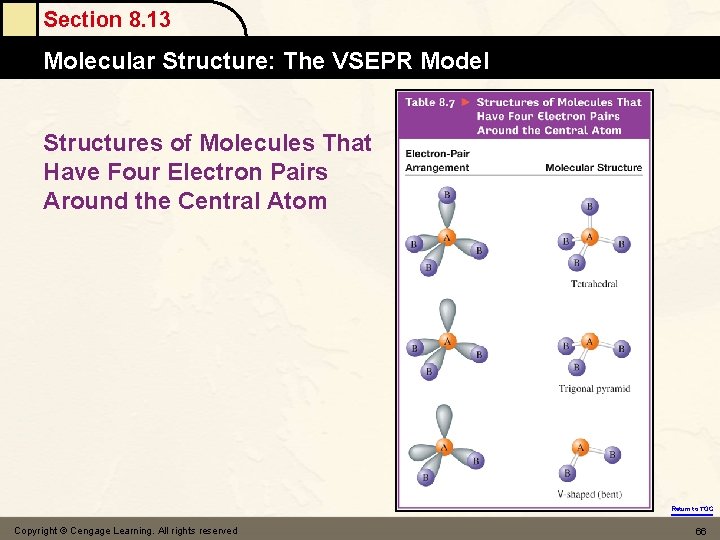
Section 8. 13 Molecular Structure: The VSEPR Model Structures of Molecules That Have Four Electron Pairs Around the Central Atom Return to TOC Copyright © Cengage Learning. All rights reserved 66
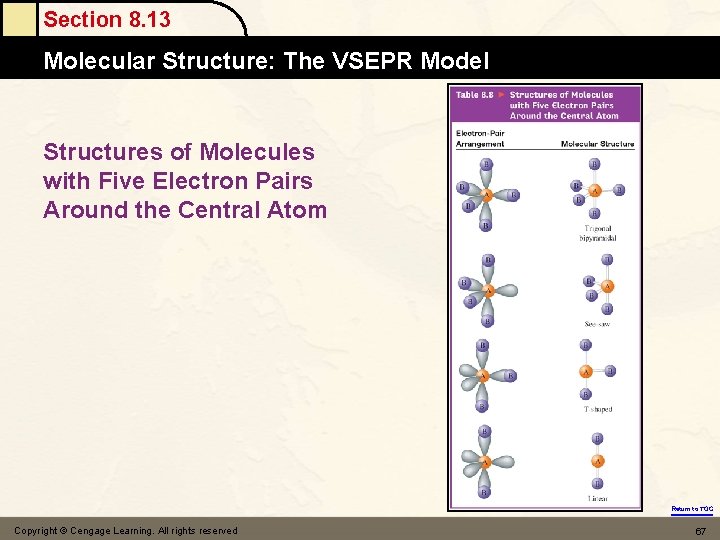
Section 8. 13 Molecular Structure: The VSEPR Model Structures of Molecules with Five Electron Pairs Around the Central Atom Return to TOC Copyright © Cengage Learning. All rights reserved 67
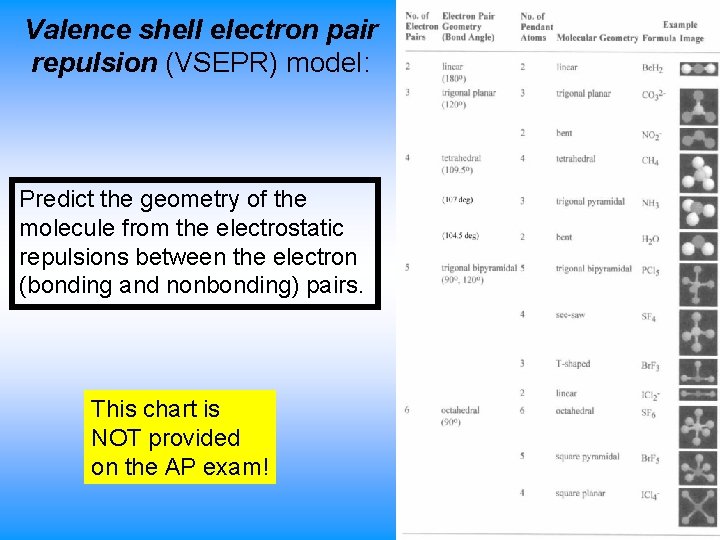
Valence shell electron pair repulsion (VSEPR) model: Predict the geometry of the molecule from the electrostatic repulsions between the electron (bonding and nonbonding) pairs. This chart is NOT provided on the AP exam!
Section 8. 13 Molecular Structure: The VSEPR Model Concept Check Determine the shape for each of the following molecules, and include bond angles: HCN PH 3 SF 4 HCN – linear, 180 o PH 3 – trigonal pyramid, 109. 5 o (107 o) SF 4 – see saw, 90 o, 120 o Copyright © Cengage Learning. All rights reserved Return to TOC 69
Section 8. 13 Molecular Structure: The VSEPR Model Concept Check Determine the shape for each of the following molecules, and include bond angles: O 3 Kr. F 4 O 3 – bent, 120 o Kr. F 4 – square planar, 90 o, 180 o Return to TOC Copyright © Cengage Learning. All rights reserved 70
- Slides: 70