
Chapter 8 BNomenclature Nomenclature Nomenclature The system of
Chapter 8 BNomenclature
Nomenclature • Nomenclature– The system of naming compounds – Standardizes rules • Names are information – Water vs dihydrogen monoxide – Soda ash vs sodium carbonate
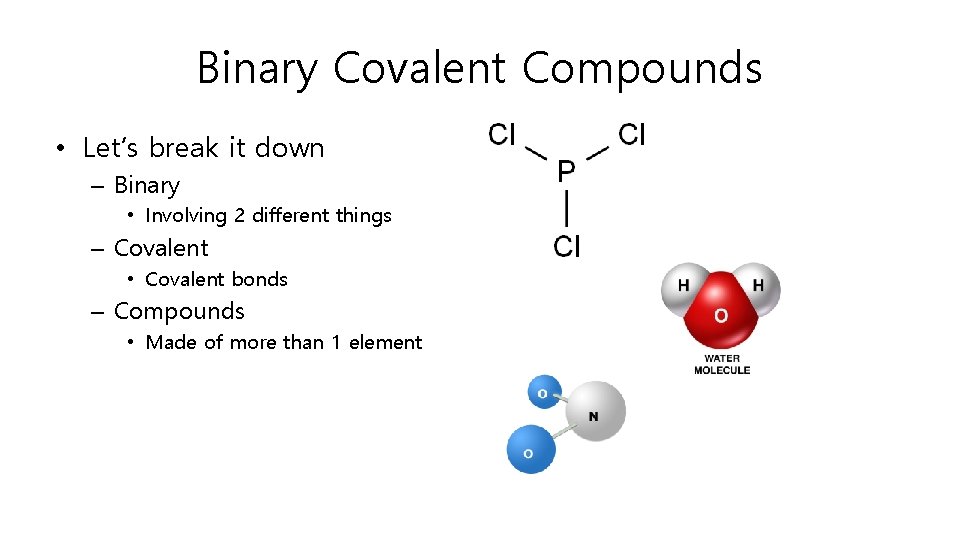
Binary Covalent Compounds • Let’s break it down – Binary • Involving 2 different things – Covalent • Covalent bonds – Compounds • Made of more than 1 element
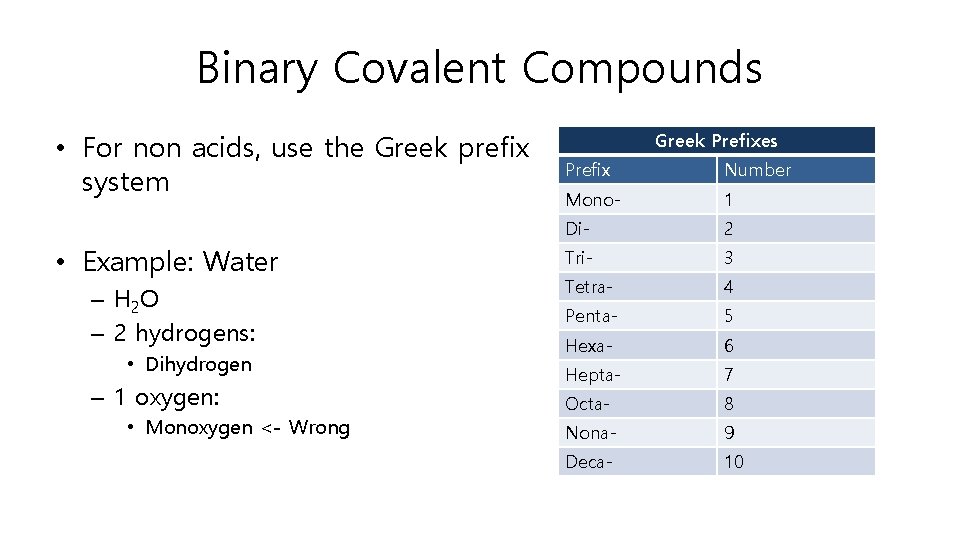
Binary Covalent Compounds • For non acids, use the Greek prefix system • Example: Water – H 2 O – 2 hydrogens: • Dihydrogen – 1 oxygen: • Monoxygen <- Wrong Greek Prefixes Prefix Number Mono- 1 Di- 2 Tri- 3 Tetra- 4 Penta- 5 Hexa- 6 Hepta- 7 Octa- 8 Nona- 9 Deca- 10
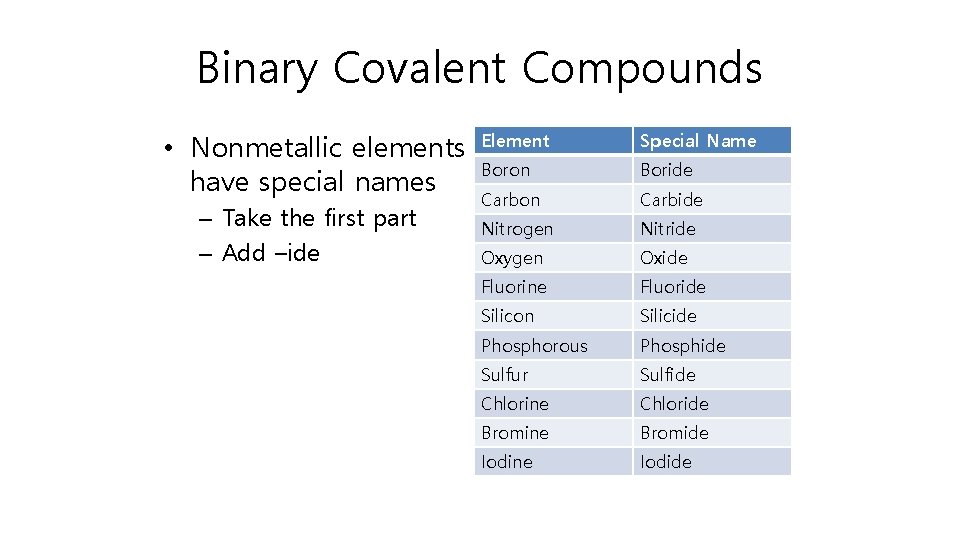
Binary Covalent Compounds • Nonmetallic elements have special names – Take the first part – Add –ide Element Special Name Boron Boride Carbon Carbide Nitrogen Nitride Oxygen Oxide Fluorine Fluoride Silicon Silicide Phosphorous Phosphide Sulfur Sulfide Chlorine Chloride Bromine Bromide Iodine Iodide
Binary Ionic Compounds • Ionic compounds don’t use Greek prefix • Positive Ion: – Normal • Negative Ion: – -ide • Ca. I 2 – Calcium is the positive – Iodine is the negative – So name is: • Calcium Iodide
Polyatomic Ionic Compounds • What does poly- mean? – Many • Polyatomic? – Many atoms • Polyatomic Ionic Compounds? – Not an ion – Has ionic parts • Example: – H 2 O 2 • Hydrogen Peroxide • Covalent compound – Fe(NO 3)2 • This contains 2 nitrates • Iron (II) nitrate • Note: if an anion contains oxygen, it is an oxyanion
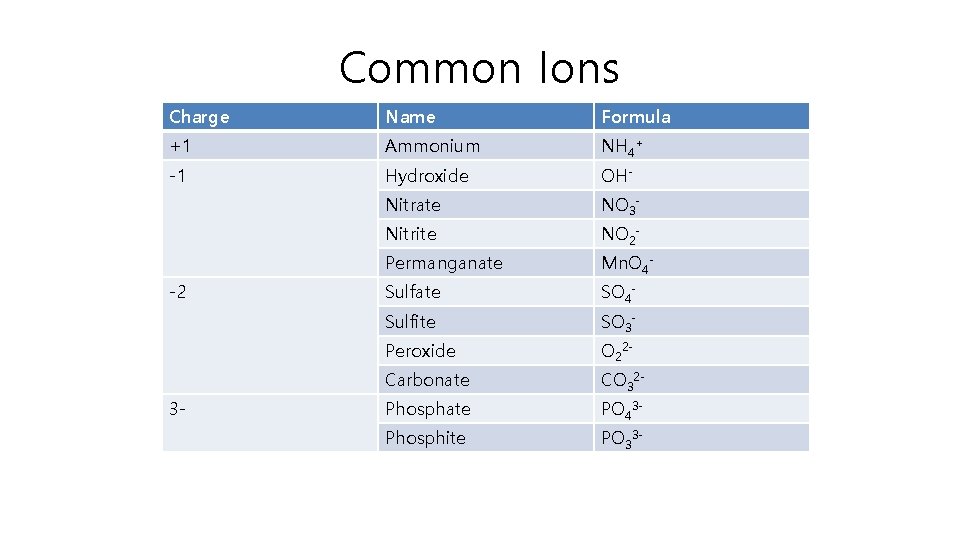
Common Ions Charge Name Formula +1 Ammonium NH 4+ -1 Hydroxide OH- Nitrate NO 3 - Nitrite NO 2 - Permanganate Mn. O 4 - Sulfate SO 4 - Sulfite SO 3 - Peroxide O 22 - Carbonate CO 32 - Phosphate PO 43 - Phosphite PO 33 - -2 3 -
Polyatomic Ionic Compounds • How do we name? – Start with nitrogen & oxygen • What if it has one less oxygen, but still -1 charge? – Change Nitrate to Nitrite – Take the first part of cation and add “-ate” – Call this Nitrate
Polyatomic Ionic Compounds • Practice with Sulfur and Oxygen • What if it has one less oxygen, but still -1 charge?
Polyatomic Ionic Compounds • What if it has 2 less oxygen, but still -1 charge? – Add hypo- to the beginning • What if it has one extra oxygen, but still -1 charge? – Add per- to the beginning
Multiple Oxidation States • Some (many) elements have multiple oxidation numbers (especially metals). • We use the Stock System (Roman Numerals) to show ON • Example: Mercury (Hg) and Iodide – Hg can be +1 or +2 – Hg 2 I 2 • Mercury (I) iodide – Hg. I 2 • Mercury (II) iodide • Iron: – Fe. Cl 2 – Fe. Cl 3
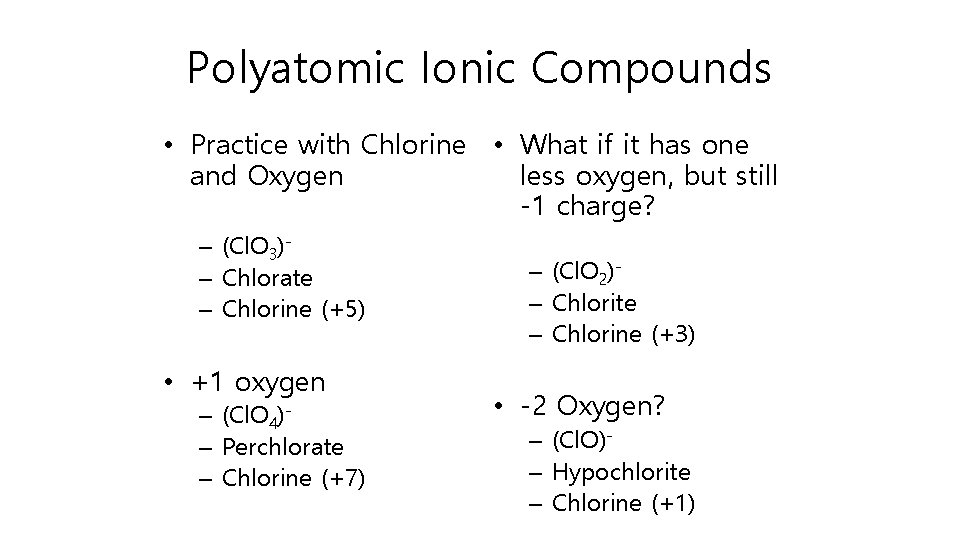
Polyatomic Ionic Compounds • Practice with Chlorine • What if it has one and Oxygen less oxygen, but still -1 charge? – (Cl. O 3)– Chlorate – Chlorine (+5) • +1 oxygen – (Cl. O 4)– Perchlorate – Chlorine (+7) – (Cl. O 2)– Chlorite – Chlorine (+3) • -2 Oxygen? – (Cl. O)– Hypochlorite – Chlorine (+1)
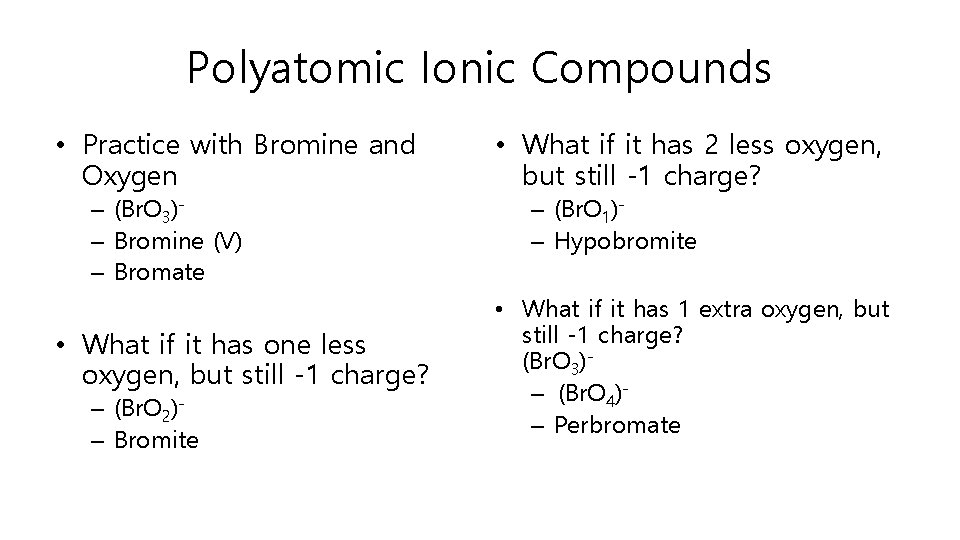
Polyatomic Ionic Compounds • Practice with Bromine and Oxygen • What if it has 2 less oxygen, but still -1 charge? • What if it has one less oxygen, but still -1 charge? • What if it has 1 extra oxygen, but still -1 charge? (Br. O 3)– (Br. O 4)– Perbromate – (Br. O 3)– Bromine (V) – Bromate – (Br. O 2)– Bromite – (Br. O 1)– Hypobromite
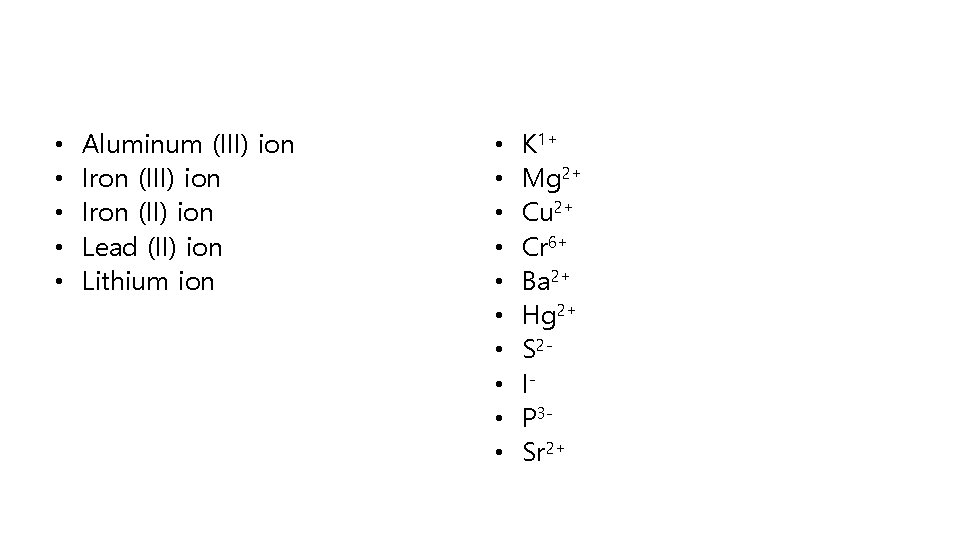
• • • Aluminum (III) ion Iron (II) ion Lead (II) ion Lithium ion • • • K 1+ Mg 2+ Cu 2+ Cr 6+ Ba 2+ Hg 2+ S 2 IP 3 Sr 2+
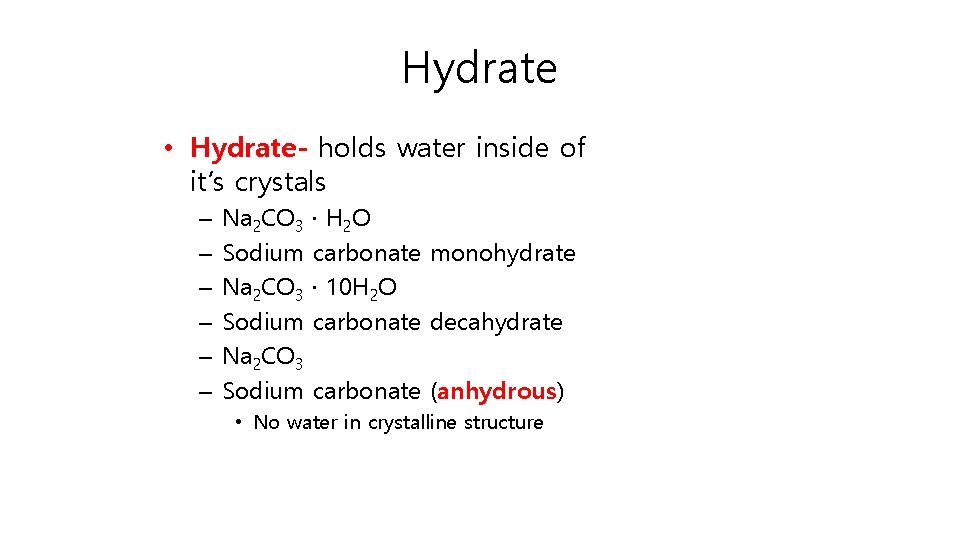
Hydrate • Hydrate- holds water inside of it’s crystals – – – Na 2 CO 3 Sodium · H 2 O carbonate monohydrate · 10 H 2 O carbonate decahydrate carbonate (anhydrous) • No water in crystalline structure
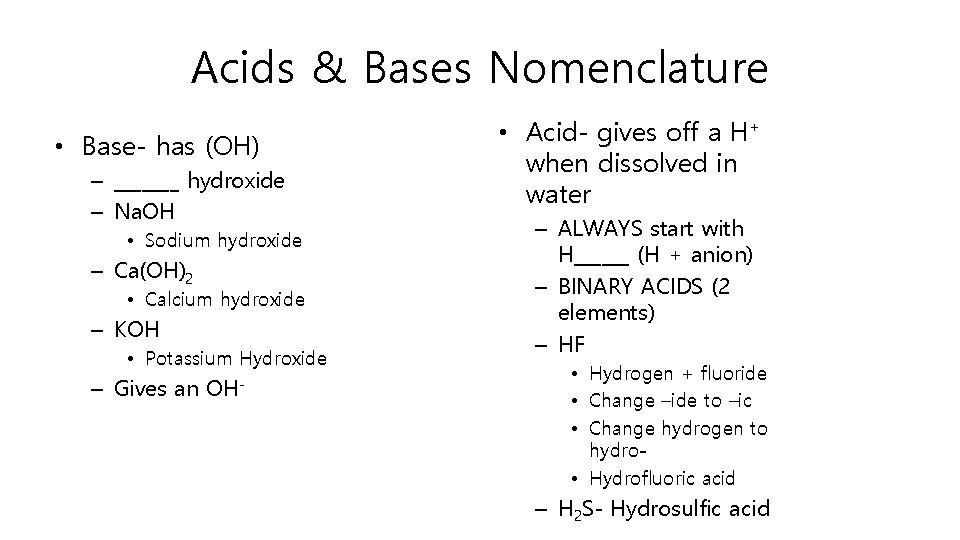
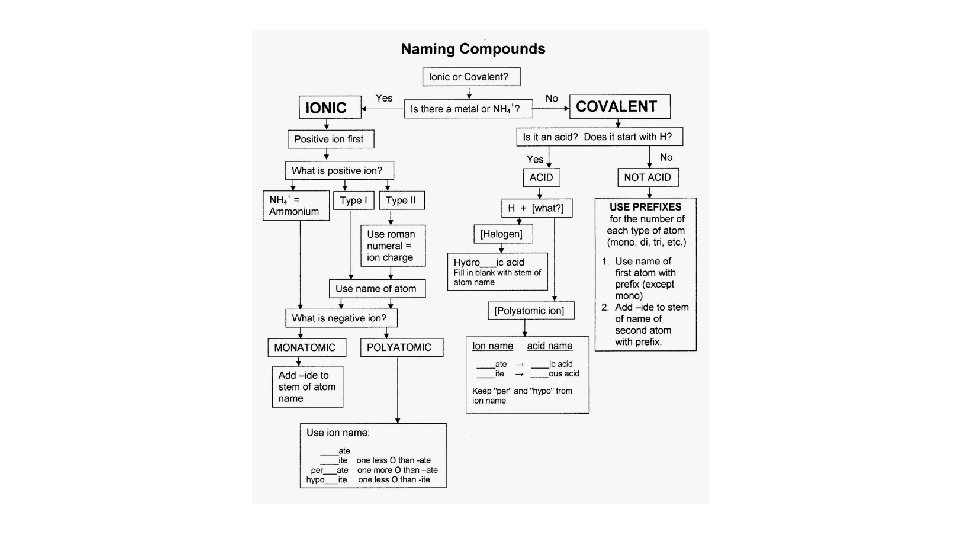
Acids & Bases Nomenclature • Base- has (OH) – _______ hydroxide – Na. OH • Sodium hydroxide – Ca(OH)2 • Calcium hydroxide – KOH • Potassium Hydroxide – Gives an OH- • Acid- gives off a H+ when dissolved in water – ALWAYS start with H______ (H + anion) – BINARY ACIDS (2 elements) – HF • Hydrogen + fluoride • Change –ide to –ic • Change hydrogen to hydro • Hydrofluoric acid – H 2 S- Hydrosulfic acid
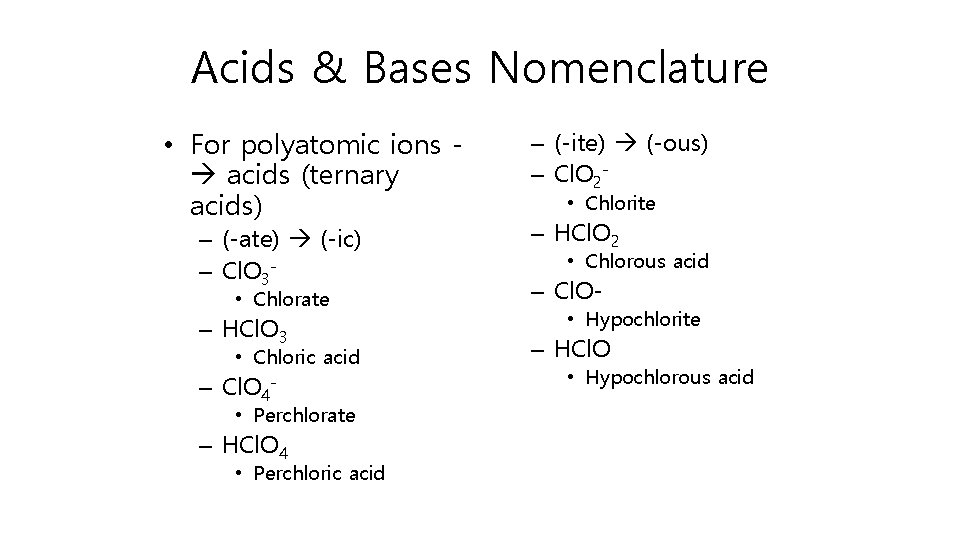
Acids & Bases Nomenclature • For polyatomic ions acids (ternary acids) – (-ate) (-ic) – Cl. O 3 - – (-ite) (-ous) – Cl. O 2 • Chlorite – HCl. O 2 • Chlorous acid • Chlorate – Cl. O- • Chloric acid – HCl. O 3 – Cl. O 4 - • Perchlorate – HCl. O 4 • Perchloric acid • Hypochlorite • Hypochlorous acid
- Slides: 19