
Chapter 8 BJT SmallSignal Analysis Slide 1 BJT
Chapter 8: BJT Small-Signal Analysis

Slide 1 BJT Small Signal Analysis The re and hybrid models will be used to analyze AC small-signal transistor circuits.
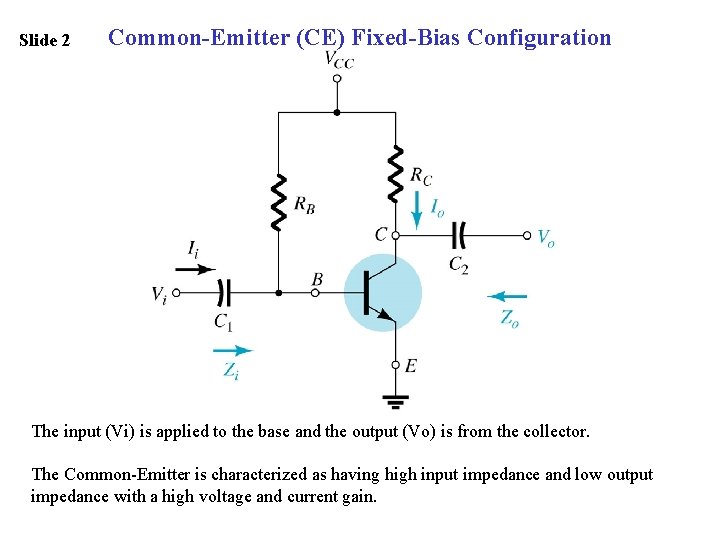
Slide 2 Common-Emitter (CE) Fixed-Bias Configuration The input (Vi) is applied to the base and the output (Vo) is from the collector. The Common-Emitter is characterized as having high input impedance and low output impedance with a high voltage and current gain.
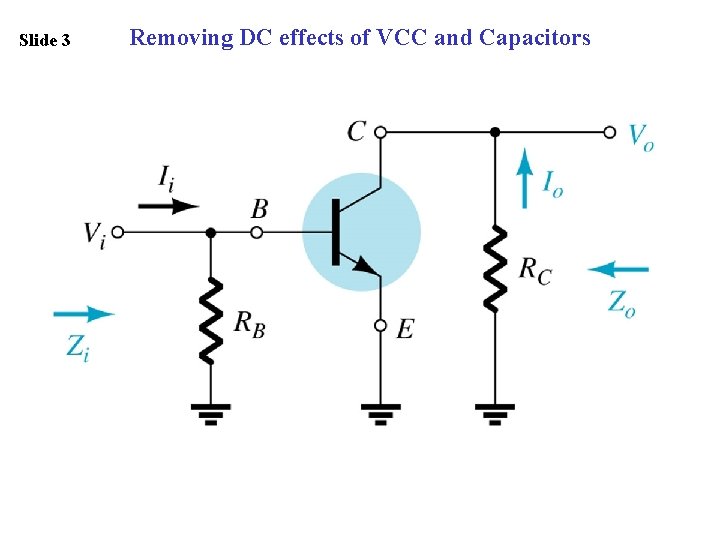
Slide 3 Removing DC effects of VCC and Capacitors
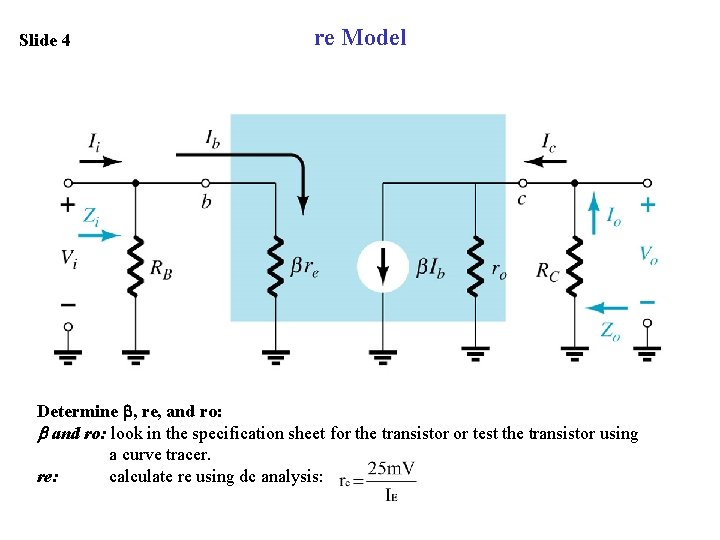
Slide 4 re Model Determine , re, and ro: look in the specification sheet for the transistor or test the transistor using a curve tracer. re: calculate re using dc analysis:
![Slide 5 Impedance Calculations Input Impedance: [Formula 8. 1] [Formula 8. 2] Output Impedance:](http://slidetodoc.com/presentation_image_h2/66e58a5cf20a236f1374e9b13c730ea3/image-6.jpg "Slide 5 Impedance Calculations Input Impedance: [Formula 8. 1] [Formula 8. 2] Output Impedance:")
Slide 5 Impedance Calculations Input Impedance: [Formula 8. 1] [Formula 8. 2] Output Impedance: [Formula 8. 3] [Formula 8. 4]
![Slide 6 Gain Calculations Voltage Gain (Av): [Formula 8. 5] [Formula 8. 6] Current](http://slidetodoc.com/presentation_image_h2/66e58a5cf20a236f1374e9b13c730ea3/image-7.jpg "Slide 6 Gain Calculations Voltage Gain (Av): [Formula 8. 5] [Formula 8. 6] Current")
Slide 6 Gain Calculations Voltage Gain (Av): [Formula 8. 5] [Formula 8. 6] Current Gain (Ai): [Formula 8. 7] [Formula 8. 8] Current Gain from Voltage Gain: [Formula 8. 9]
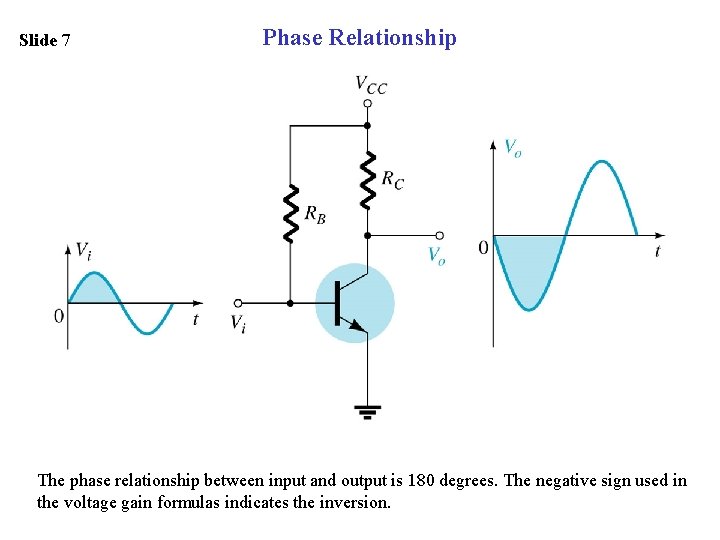
Slide 7 Phase Relationship The phase relationship between input and output is 180 degrees. The negative sign used in the voltage gain formulas indicates the inversion.
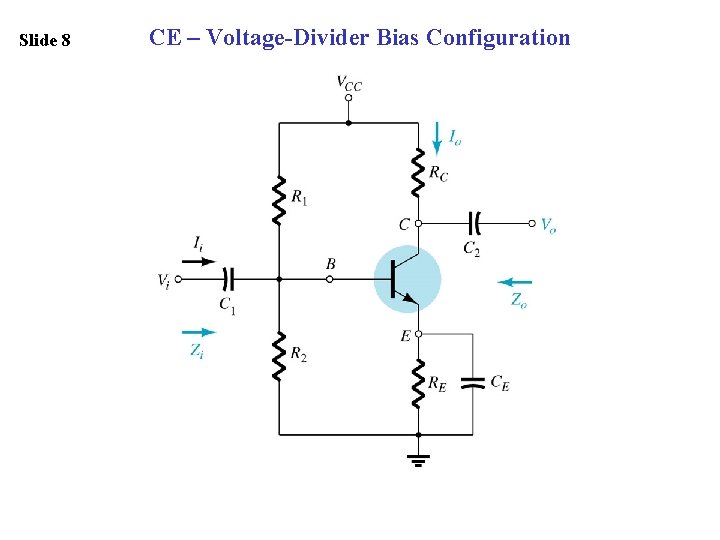
Slide 8 CE – Voltage-Divider Bias Configuration
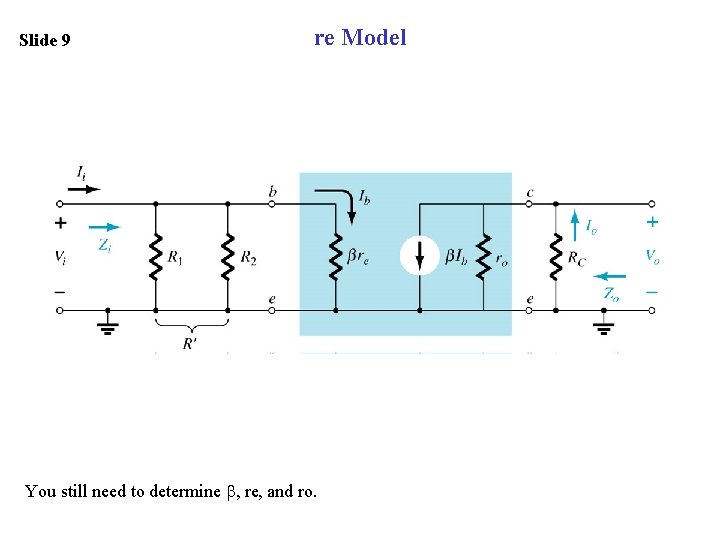
Slide 9 re Model You still need to determine , re, and ro.
![Slide 10 Impedance Calculations Input Impedance: [Formula 8. 10] [Formula 8. 11] Output Impedance:](http://slidetodoc.com/presentation_image_h2/66e58a5cf20a236f1374e9b13c730ea3/image-11.jpg "Slide 10 Impedance Calculations Input Impedance: [Formula 8. 10] [Formula 8. 11] Output Impedance:")
Slide 10 Impedance Calculations Input Impedance: [Formula 8. 10] [Formula 8. 11] Output Impedance: [Formula 8. 12] [Formula 8. 13]
![Slide 11 Gain Calculations Voltage Gain (Av): [Formula 8. 14] [Formula 8. 15] Current](http://slidetodoc.com/presentation_image_h2/66e58a5cf20a236f1374e9b13c730ea3/image-12.jpg "Slide 11 Gain Calculations Voltage Gain (Av): [Formula 8. 14] [Formula 8. 15] Current")
Slide 11 Gain Calculations Voltage Gain (Av): [Formula 8. 14] [Formula 8. 15] Current Gain (Ai): [Formula 8. 16] [Formula 8. 17] [Formula 8. 18] Current Gain from Voltage Gain: [Formula 8. 19]
Slide 12 Phase Relationship A CE amplifier configuration will always have a phase relationship between input and output is 180 degrees. This is independent of the DC bias.
- Slides: 13