
Chapter 8 B Solution Concentrations 1 CHAPTER OUTLINE
Chapter 8 B Solution Concentrations 1
CHAPTER OUTLINE § § § § Concentration Units Mass Percent Using Percent Concentration Molarity Using Molarity Dilution Osmolarity Tonicity of Solutions 2
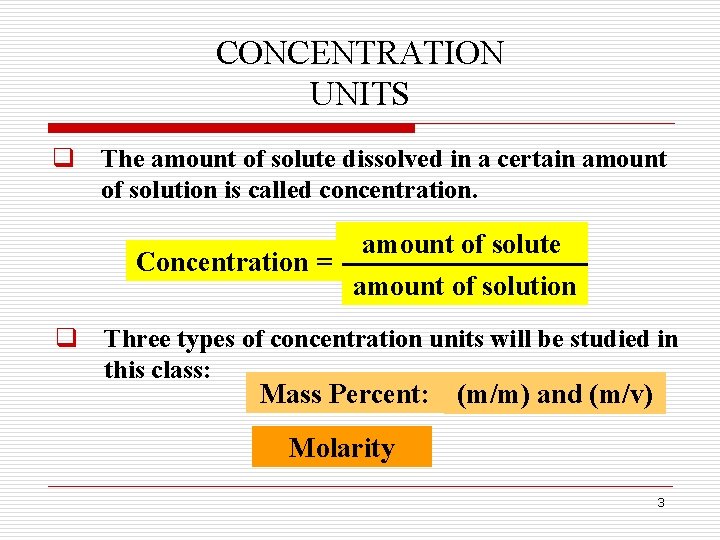
CONCENTRATION UNITS q The amount of solute dissolved in a certain amount of solution is called concentration. Concentration = amount of solute amount of solution q Three types of concentration units will be studied in this class: Mass Percent: (m/m) and (m/v) Molarity 3
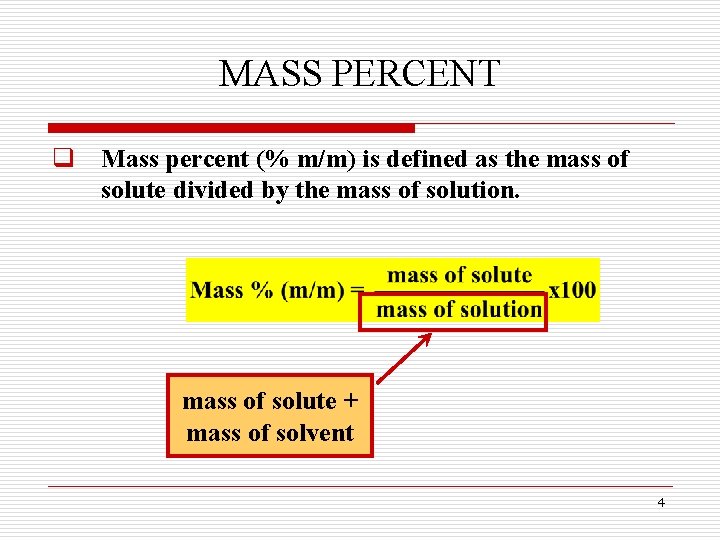
MASS PERCENT q Mass percent (% m/m) is defined as the mass of solute divided by the mass of solution. mass of solute + mass of solvent 4
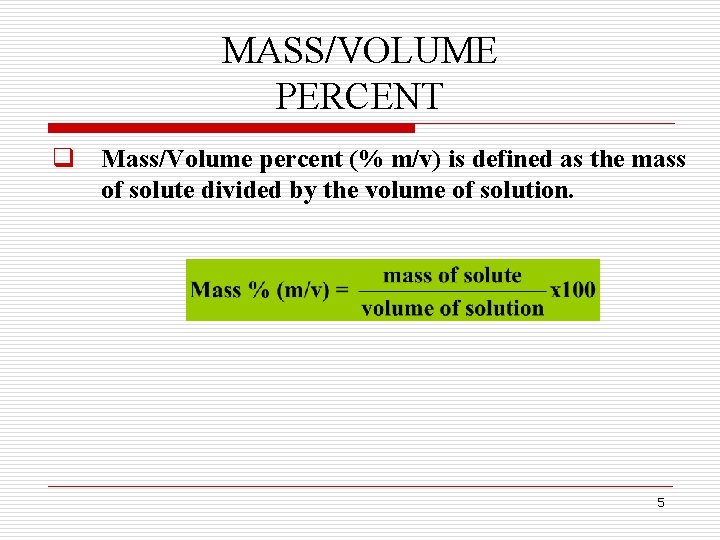
MASS/VOLUME PERCENT q Mass/Volume percent (% m/v) is defined as the mass of solute divided by the volume of solution. 5
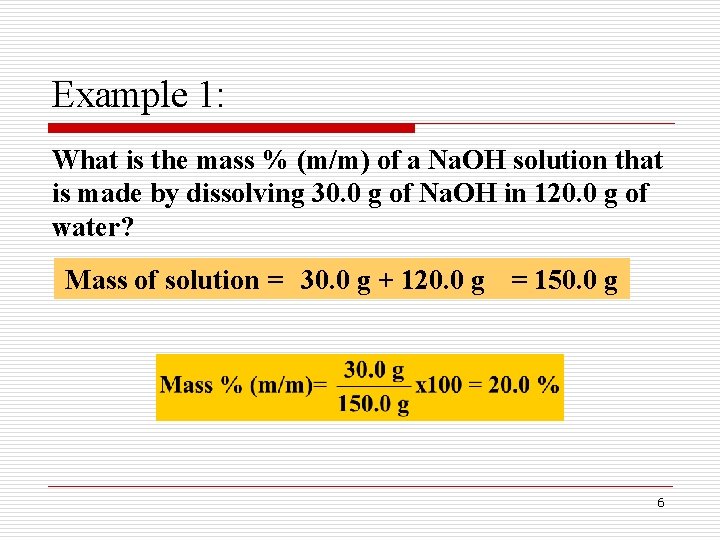
Example 1: What is the mass % (m/m) of a Na. OH solution that is made by dissolving 30. 0 g of Na. OH in 120. 0 g of water? Mass of solution = 30. 0 g + 120. 0 g = 150. 0 g 6
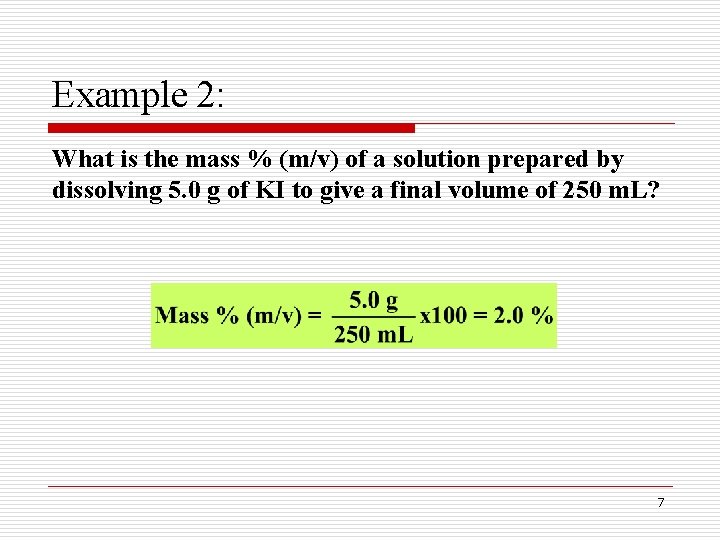
Example 2: What is the mass % (m/v) of a solution prepared by dissolving 5. 0 g of KI to give a final volume of 250 m. L? 7
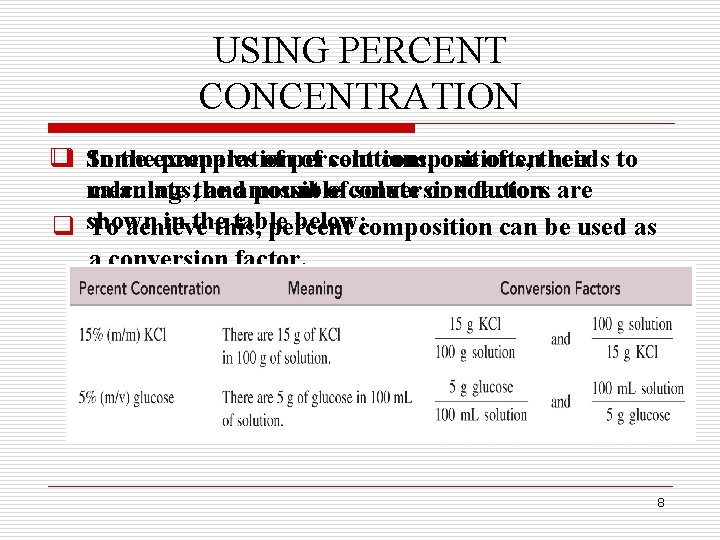
USING PERCENT CONCENTRATION q Some In theexamples preparation of percent of solutions, compositions, one oftentheir needs to meanings, calculate the andamount possible ofconversion solute or solution. factors are in thethis, table below: composition can be used as q shown To achieve percent a conversion factor. 8
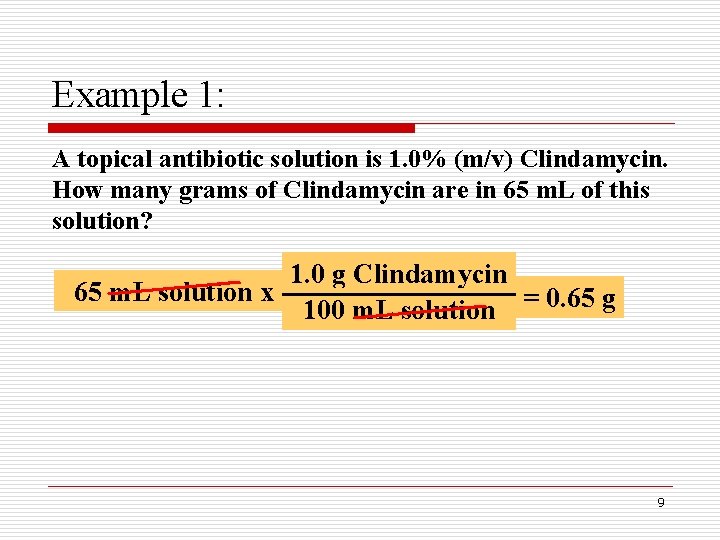
Example 1: A topical antibiotic solution is 1. 0% (m/v) Clindamycin. How many grams of Clindamycin are in 65 m. L of this solution? 1. 0 g Clindamycin 65 m. L solution x 100 m. L solution = 0. 65 g 9
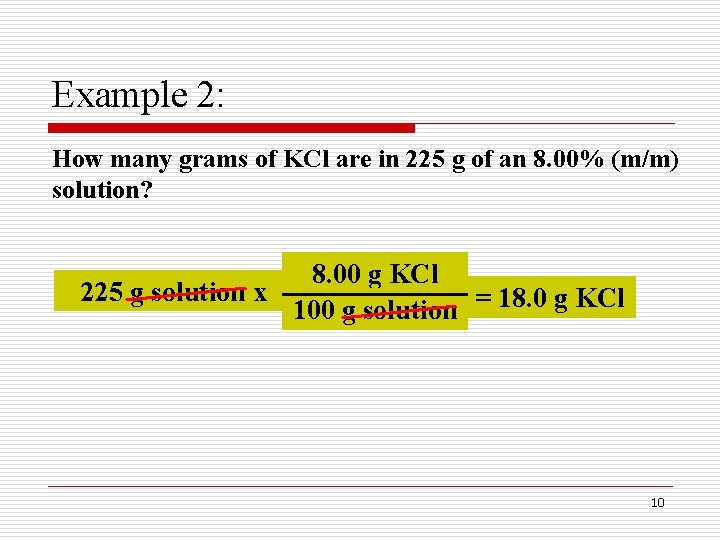
Example 2: How many grams of KCl are in 225 g of an 8. 00% (m/m) solution? 8. 00 g KCl 225 g solution x 100 g solution = 18. 0 g KCl 10
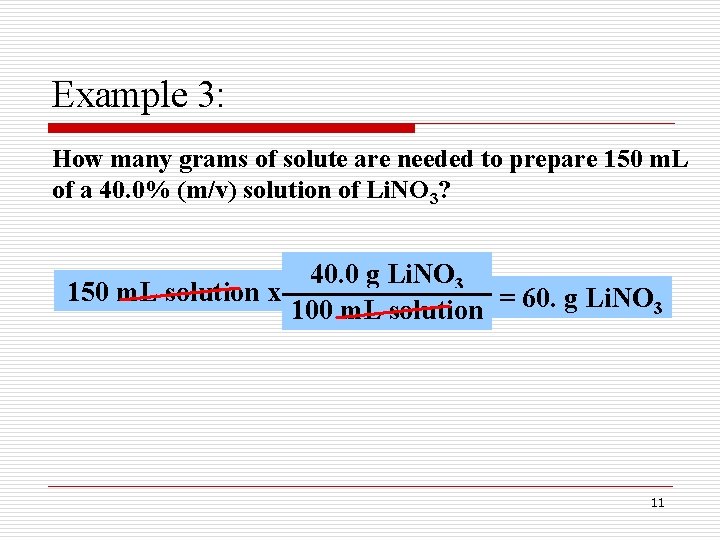
Example 3: How many grams of solute are needed to prepare 150 m. L of a 40. 0% (m/v) solution of Li. NO 3? 40. 0 g Li. NO 3 150 m. L solution x 100 m. L solution = 60. g Li. NO 3 11
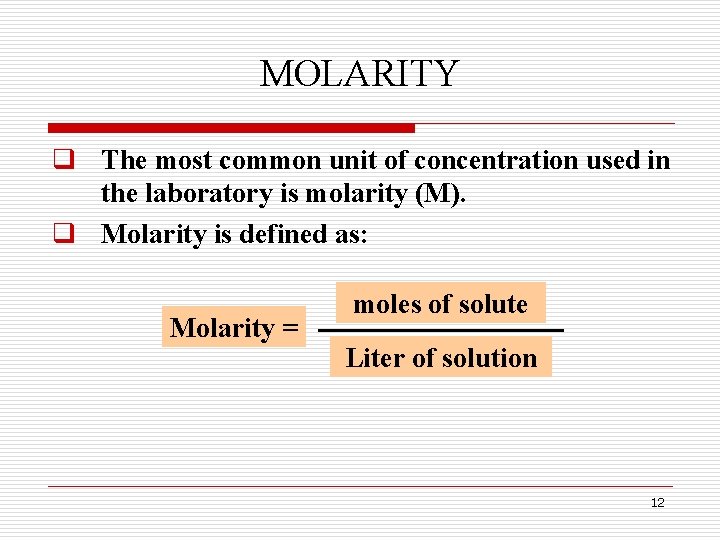
MOLARITY q The most common unit of concentration used in the laboratory is molarity (M). q Molarity is defined as: Molarity = moles of solute Liter of solution 12
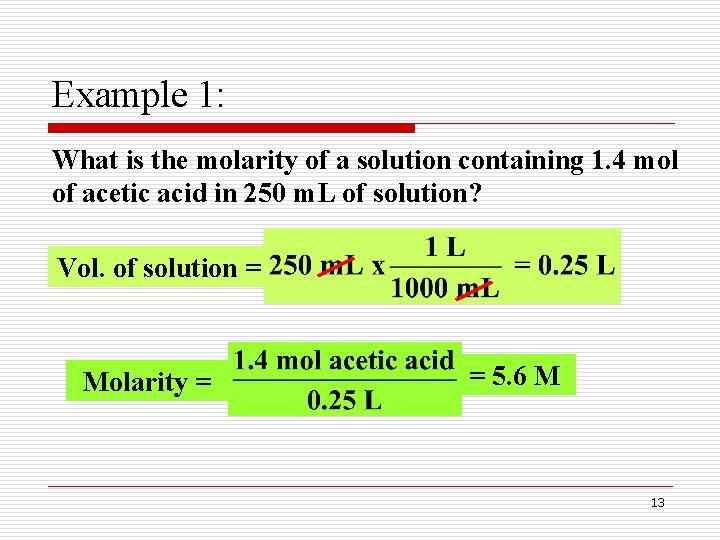
Example 1: What is the molarity of a solution containing 1. 4 mol of acetic acid in 250 m. L of solution? Vol. of solution = Molarity = = 5. 6 M 13
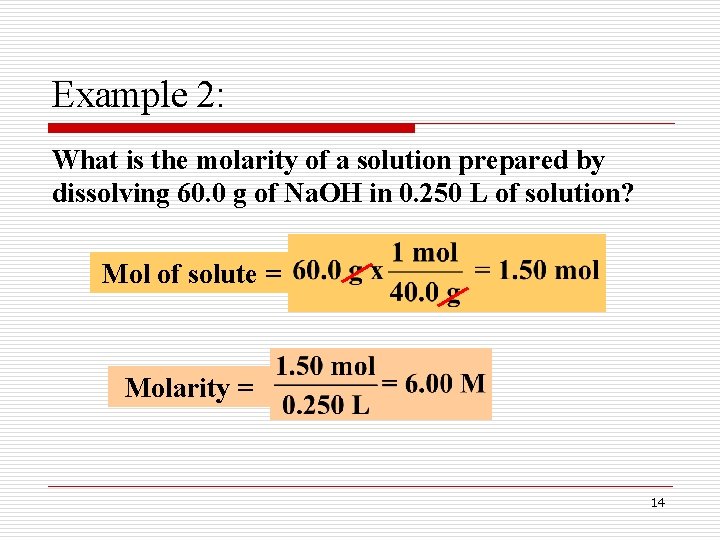
Example 2: What is the molarity of a solution prepared by dissolving 60. 0 g of Na. OH in 0. 250 L of solution? Mol of solute = Molarity = 14
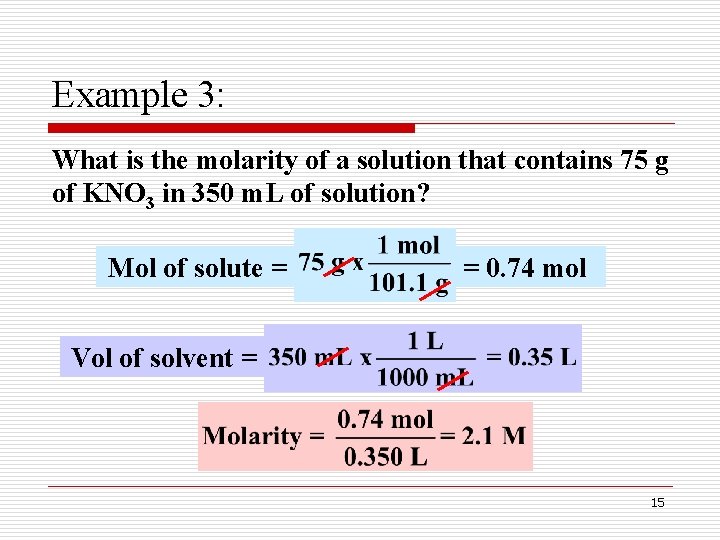
Example 3: What is the molarity of a solution that contains 75 g of KNO 3 in 350 m. L of solution? Mol of solute = = 0. 74 mol Vol of solvent = 15
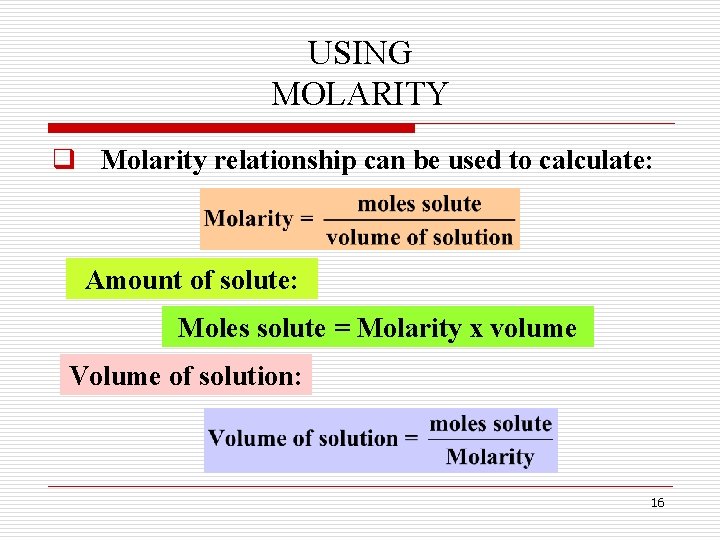
USING MOLARITY q Molarity relationship can be used to calculate: Amount of solute: Moles solute = Molarity x volume Volume of solution: 16
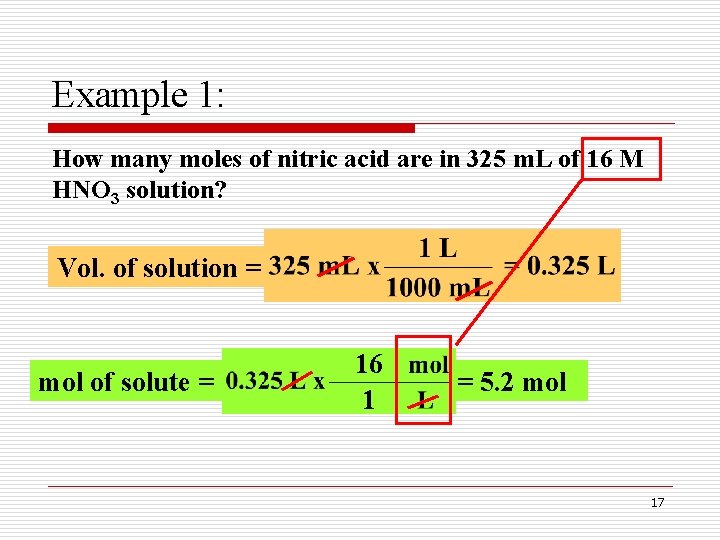
Example 1: How many moles of nitric acid are in 325 m. L of 16 M HNO 3 solution? Vol. of solution = mol of solute = 16 1 = 5. 2 mol 17
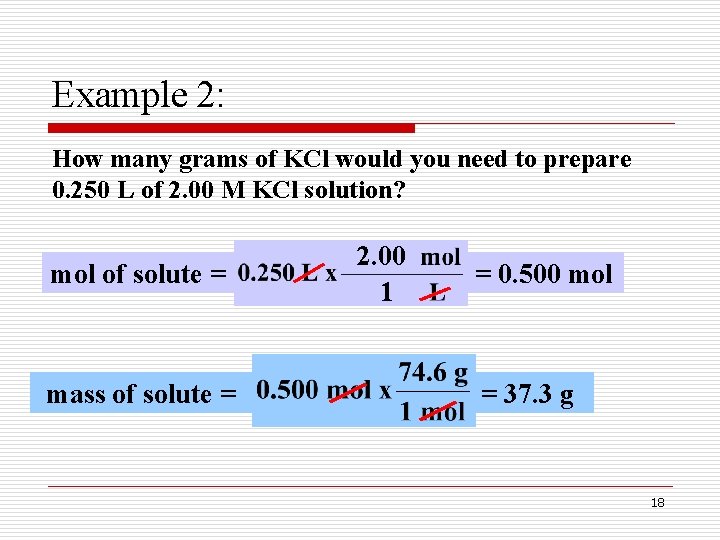
Example 2: How many grams of KCl would you need to prepare 0. 250 L of 2. 00 M KCl solution? mol of solute = mass of solute = 2. 00 1 = 0. 500 mol = 37. 3 g 18
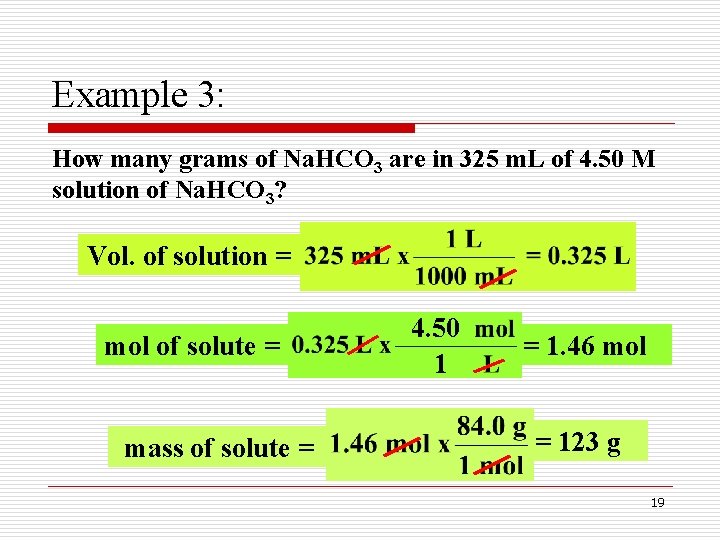
Example 3: How many grams of Na. HCO 3 are in 325 m. L of 4. 50 M solution of Na. HCO 3? Vol. of solution = mol of solute = mass of solute = 4. 50 1 = 1. 46 mol = 123 g 19
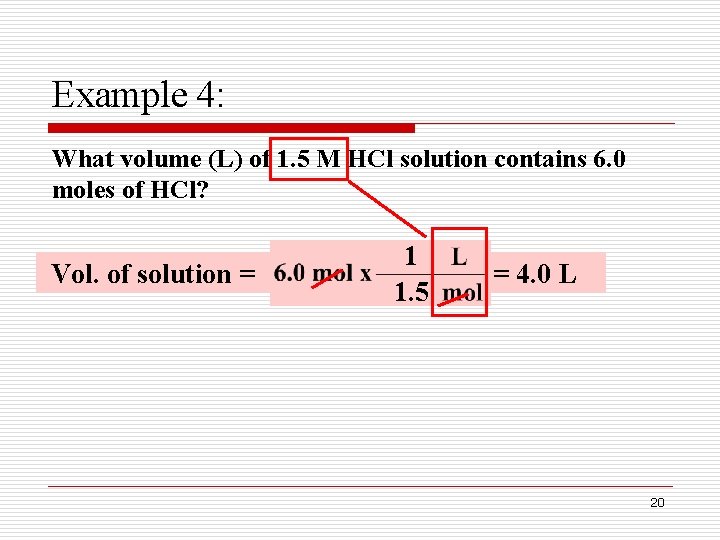
Example 4: What volume (L) of 1. 5 M HCl solution contains 6. 0 moles of HCl? Vol. of solution = 1 1. 5 = 4. 0 L 20
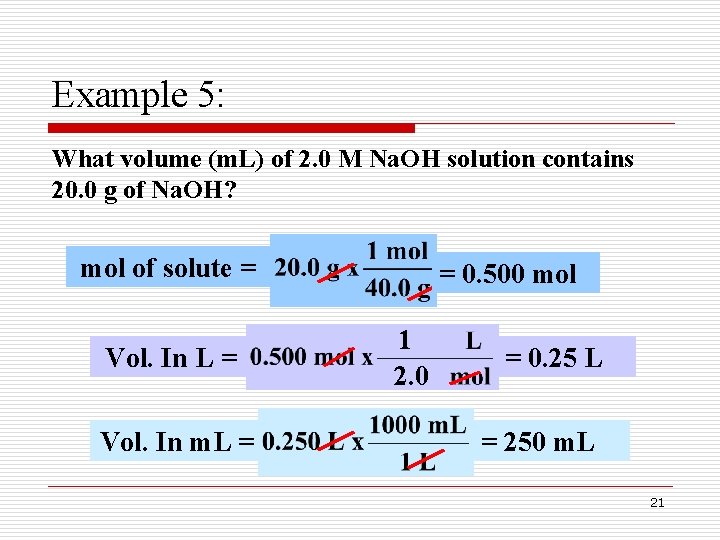
Example 5: What volume (m. L) of 2. 0 M Na. OH solution contains 20. 0 g of Na. OH? mol of solute = Vol. In L = Vol. In m. L = = 0. 500 mol 1 2. 0 = 0. 25 L = 250 m. L 21
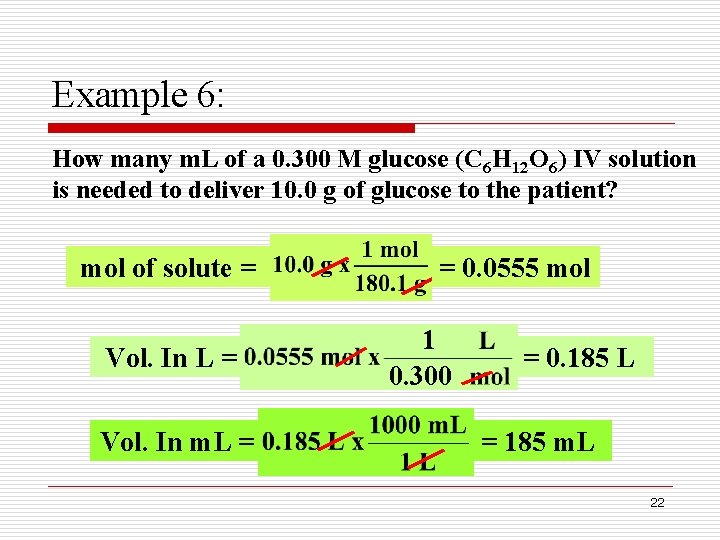
Example 6: How many m. L of a 0. 300 M glucose (C 6 H 12 O 6) IV solution is needed to deliver 10. 0 g of glucose to the patient? mol of solute = Vol. In L = Vol. In m. L = = 0. 0555 mol 1 0. 300 = 0. 185 L = 185 m. L 22
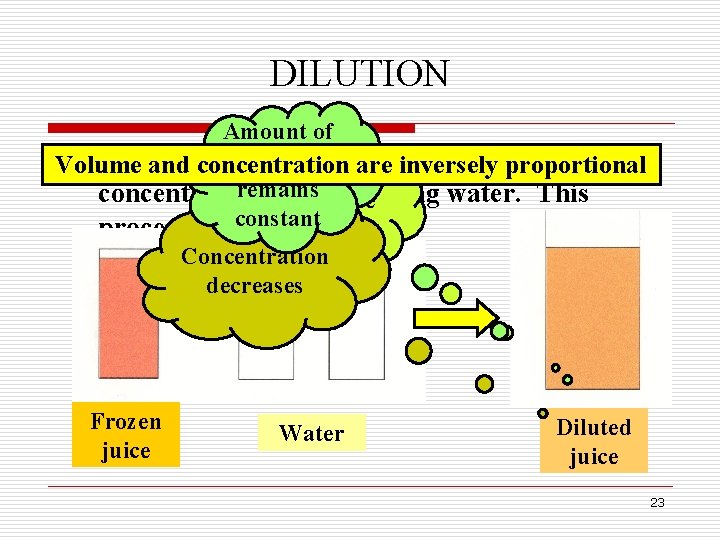
DILUTION Amount of solute q Solutions When more arewater oftenisprepared added tofrom a solution, more Volume and concentration are inversely proportional remains concentrated ones by adding water. This Volume constant process is called dilution. increases Concentration decreases Frozen juice Water Diluted juice 23
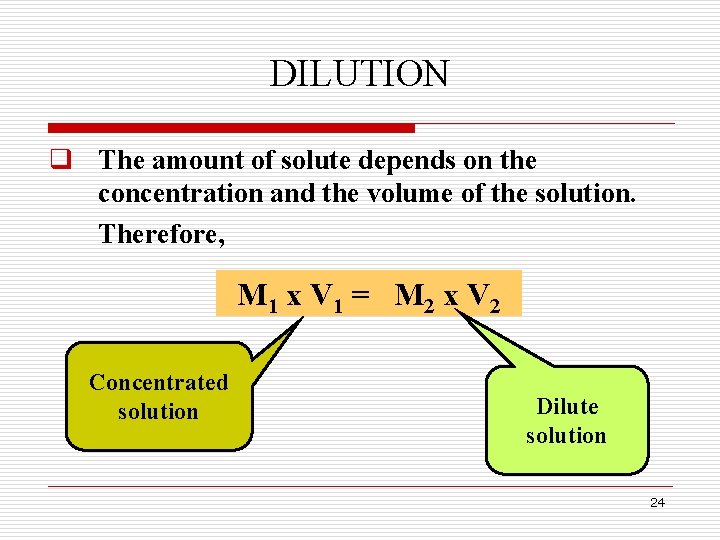
DILUTION q The amount of solute depends on the concentration and the volume of the solution. Therefore, M 1 x V 1 = M 2 x V 2 Concentrated solution Dilute solution 24
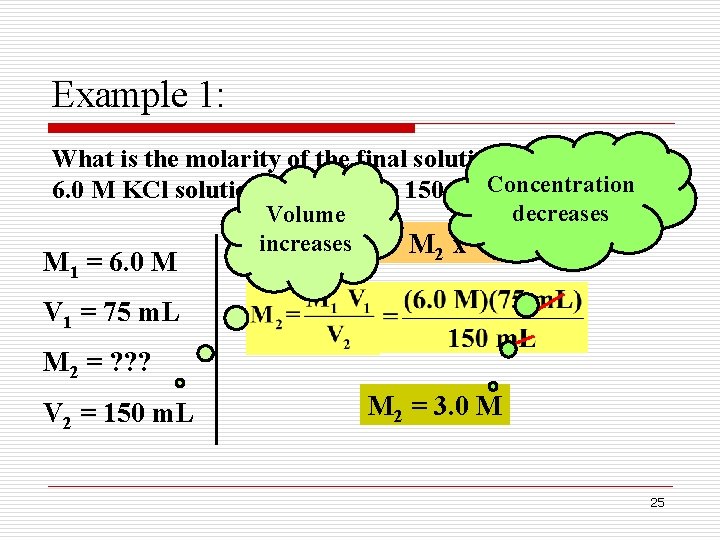
Example 1: What is the molarity of the final solution when 75 m. L of Concentration 6. 0 M KCl solution is diluted to 150 m. L? M 1 = 6. 0 M decreases Volume increases M 1 x V 1 = M 2 x V 2 V 1 = 75 m. L M 2 = ? ? ? V 2 = 150 m. L M 2 = 3. 0 M 25
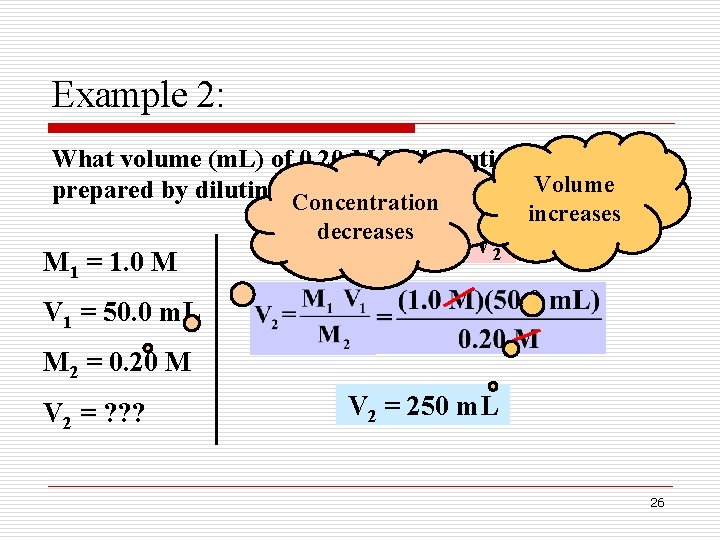
Example 2: What volume (m. L) of 0. 20 M HCl solution can be Volume prepared by diluting 50. 0 m. L of 1. 0 M HCl? Concentration decreases M 1 = 1. 0 M increases M 1 x V 1 = M 2 x V 2 V 1 = 50. 0 m. L M 2 = 0. 20 M V 2 = ? ? ? V 2 = 250 m. L 26
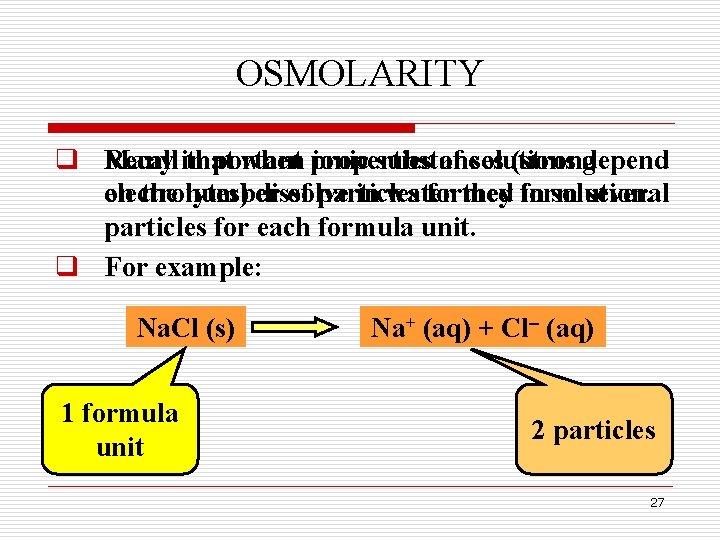
OSMOLARITY q Many Recall important that when properties ionic substances of solutions (strongdepend on the number electrolytes) dissolve of particles in water formed they form in solution. several particles for each formula unit. q For example: Na. Cl (s) 1 formula unit Na+ (aq) + Cl (aq) 2 particles 27
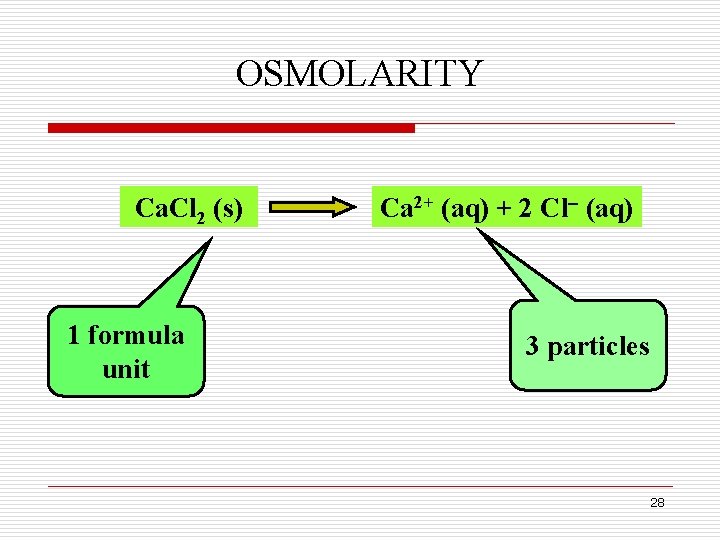
OSMOLARITY Ca. Cl 2 (s) 1 formula unit Ca 2+ (aq) + 2 Cl (aq) 3 particles 28
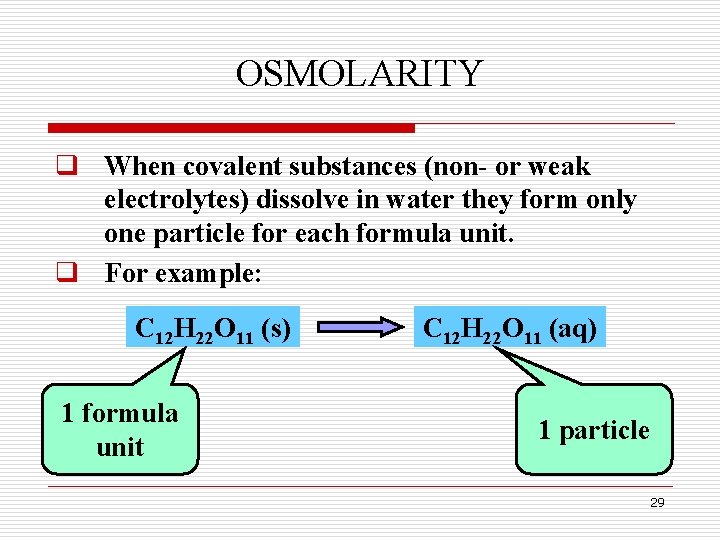
OSMOLARITY q When covalent substances (non- or weak electrolytes) dissolve in water they form only one particle for each formula unit. q For example: C 12 H 22 O 11 (s) 1 formula unit C 12 H 22 O 11 (aq) 1 particle 29
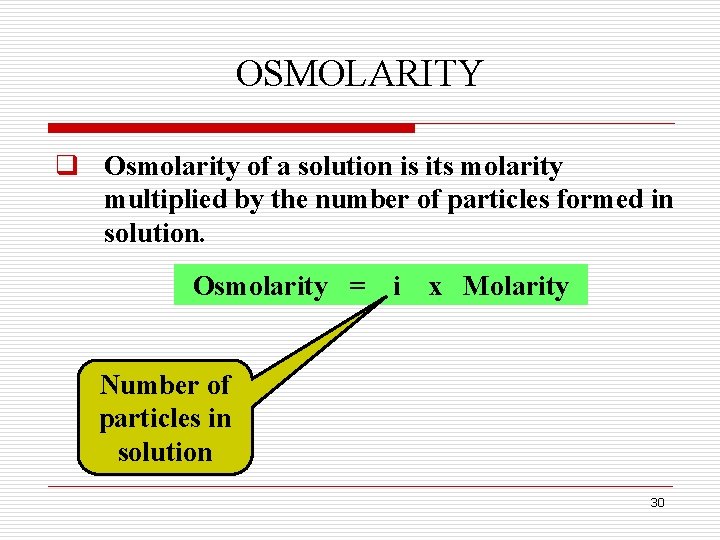
OSMOLARITY q Osmolarity of a solution is its molarity multiplied by the number of particles formed in solution. Osmolarity = i x Molarity Number of particles in solution 30
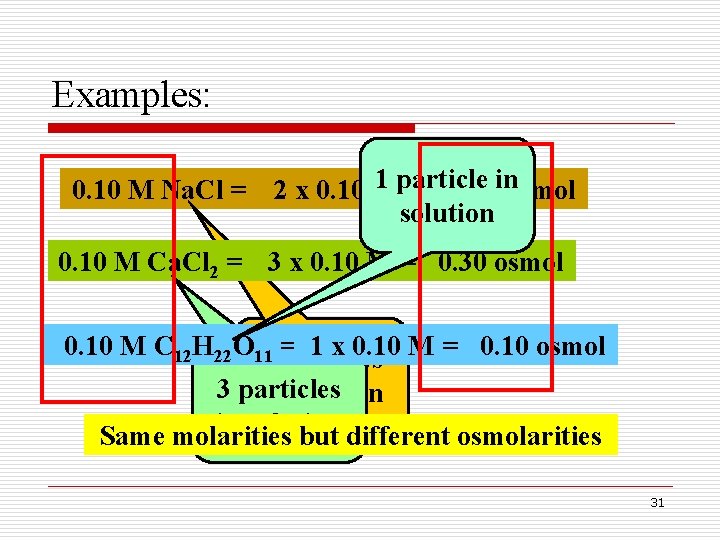
Examples: 0. 10 M Na. Cl = 1 particle 2 x 0. 10 M = 0. 20 inosmol solution 0. 10 M Ca. Cl 2 = 3 x 0. 10 M = 0. 30 osmol 0. 10 M C 12 H 22 O 112 = 1 x 0. 10 M = 0. 10 osmol particles 3 particles in solution Same molarities but different osmolarities 31
TONICITY OF SOLUTIONS q Because the cell membranes in biological systems are semipermeable, particles of solute in solutions can travel in and out of the membranes. This process is called osmosis. q The direction of the flow of solutions in or out of the cell membranes is determined by the relative osmolarity of the cell and the solution. q The comparison of osmolarity of a solution with those in body fluids determines the tonicity of a solution. 32
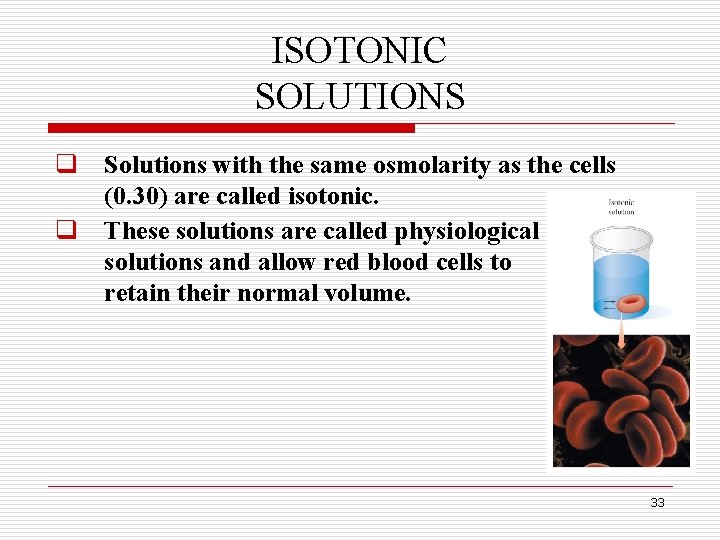
ISOTONIC SOLUTIONS q Solutions with the same osmolarity as the cells (0. 30) are called isotonic. q These solutions are called physiological solutions and allow red blood cells to retain their normal volume. 33
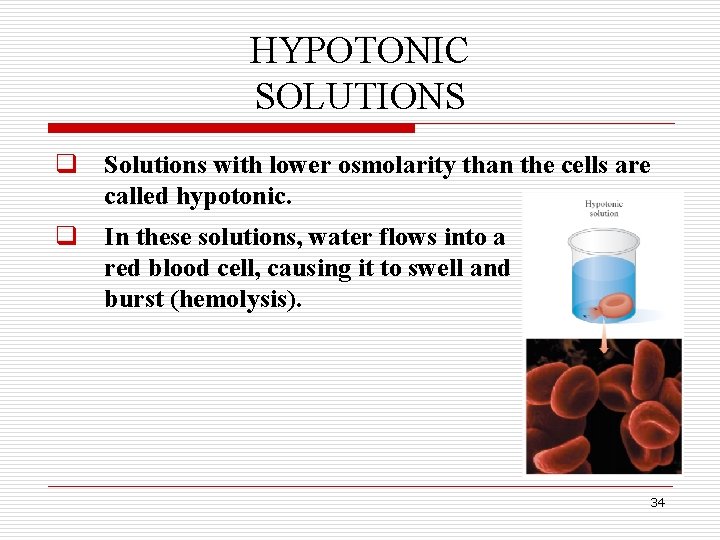
HYPOTONIC SOLUTIONS q Solutions with lower osmolarity than the cells are called hypotonic. q In these solutions, water flows into a red blood cell, causing it to swell and burst (hemolysis). 34
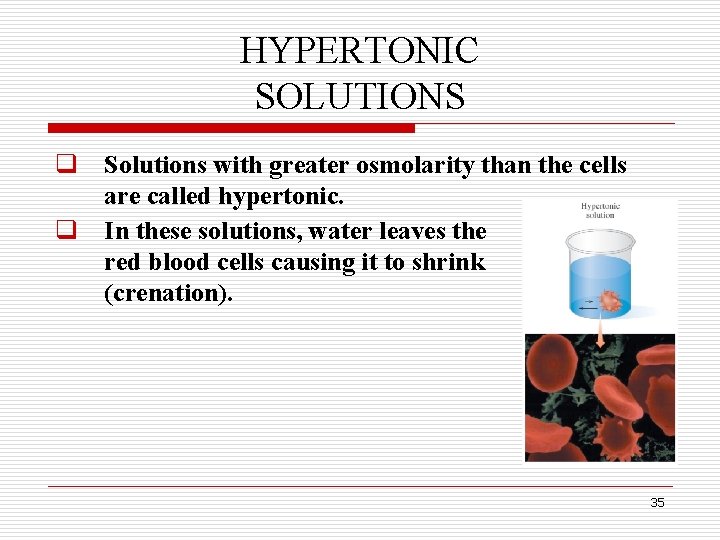
HYPERTONIC SOLUTIONS q Solutions with greater osmolarity than the cells are called hypertonic. q In these solutions, water leaves the red blood cells causing it to shrink (crenation). 35
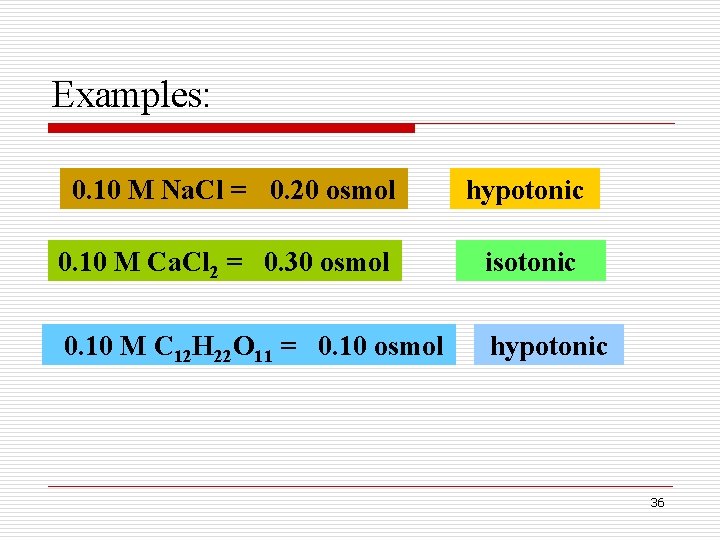
Examples: 0. 10 M Na. Cl = 0. 20 osmol hypotonic 0. 10 M Ca. Cl 2 = 0. 30 osmol isotonic 0. 10 M C 12 H 22 O 11 = 0. 10 osmol hypotonic 36

THE END 37
- Slides: 37