
Chapter 8 b Neurons Cellular and Network Properties
Chapter 8 b Neurons: Cellular and Network Properties
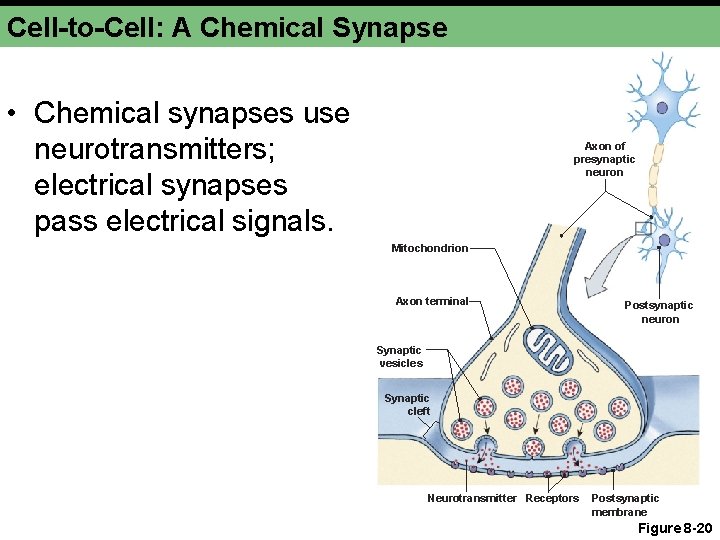
Cell-to-Cell: A Chemical Synapse • Chemical synapses use neurotransmitters; electrical synapses pass electrical signals. Axon of presynaptic neuron Mitochondrion Axon terminal Postsynaptic neuron Synaptic vesicles Synaptic cleft Neurotransmitter Receptors Postsynaptic membrane Figure 8 -20
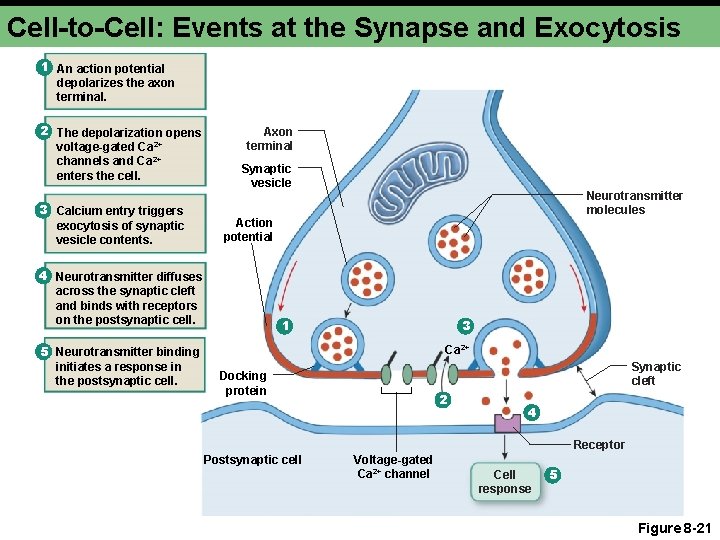
Cell-to-Cell: Events at the Synapse and Exocytosis 1 An action potential depolarizes the axon terminal. 2 The depolarization opens voltage-gated Ca 2+ channels and Ca 2+ enters the cell. 3 Calcium entry triggers exocytosis of synaptic vesicle contents. Axon terminal Synaptic vesicle Action potential 4 Neurotransmitter diffuses across the synaptic cleft and binds with receptors on the postsynaptic cell. 5 Neurotransmitter binding initiates a response in the postsynaptic cell. Neurotransmitter molecules 1 3 Ca 2+ Synaptic cleft Docking protein 2 4 Receptor Postsynaptic cell Voltage-gated Ca 2+ channel Cell response 5 Figure 8 -21
Cell-to-Cell: Neurocrines • Seven classes by structure • • Acetylcholine Amines Amino acids Purines Gases Peptides Lipids
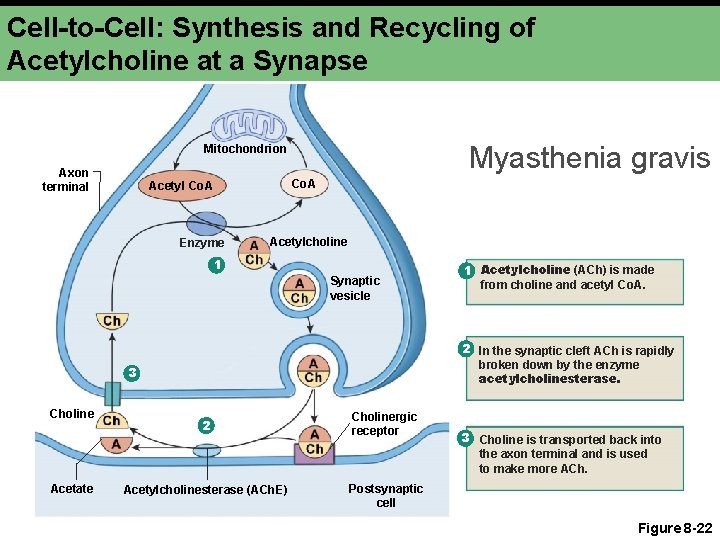
Cell-to-Cell: Synthesis and Recycling of Acetylcholine at a Synapse Myasthenia gravis Mitochondrion Axon terminal Co. A Acetyl Co. A Enzyme Acetylcholine 1 Synaptic vesicle 2 In the synaptic cleft ACh is rapidly broken down by the enzyme acetylcholinesterase. 3 Choline Acetate 1 Acetylcholine (ACh) is made from choline and acetyl Co. A. 2 Acetylcholinesterase (ACh. E) Cholinergic receptor 3 Choline is transported back into the axon terminal and is used to make more ACh. Postsynaptic cell Figure 8 -22
Amines • Derived from single amino acid • Tyrosine • Dopamine • Norepinephrine is secreted by noradrenergic neurons • Epinephrine • Others • Serotonin is made from tryptophan • Histamine is made from histadine
Amino Acids • • Glutamate: Excitatory CNS Aspartate: Excitatory brain GABA: Inhibitory brain Glycine • Inhibitory spinal cord • May also be excitatory
Other Neurotransmitters • Purines • AMP and ATP • Gases • NO and CO • Peptides • Substance P and opioid peptides • Lipids • Eicosanoids
Receptors • Cholinergic receptors • Nicotinic on skeletal muscle, in PNS and CNS • Monovalent cation channels Na+ and K+ • Muscarinic in CNS and Parsympathetic NS • Linked to G proteins to 2 nd messengers • Adrenergic Receptors • and • Linked to G proteins and 2 nd messengers • Glutaminergic • Excitatory in CNS • Metabotropic and Ionotropic
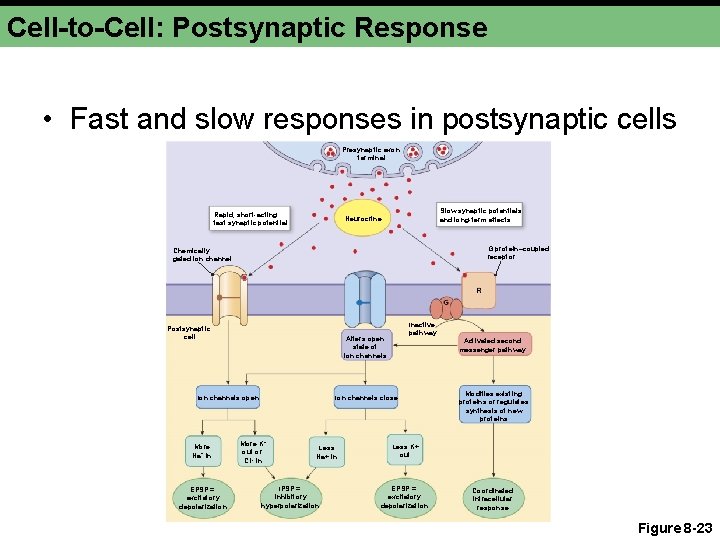
Cell-to-Cell: Postsynaptic Response • Fast and slow responses in postsynaptic cells Presynaptic axon terminal Rapid, short-acting fast synaptic potential Slow synaptic potentials and long-term effects Neurocrine G protein–coupled receptor Chemically gated ion channel Postsynaptic cell Alters open state of ion channels Ion channels open More Na+ in EPSP = excitatory depolarization Inactive pathway Activated second messenger pathway Ion channels close More K+ out or Cl– in Less Na+ in IPSP = inhibitory hyperpolarization Modifies existing proteins or regulates synthesis of new proteins Less K+ out EPSP = excitatory depolarization Coordinated intracellular response Figure 8 -23
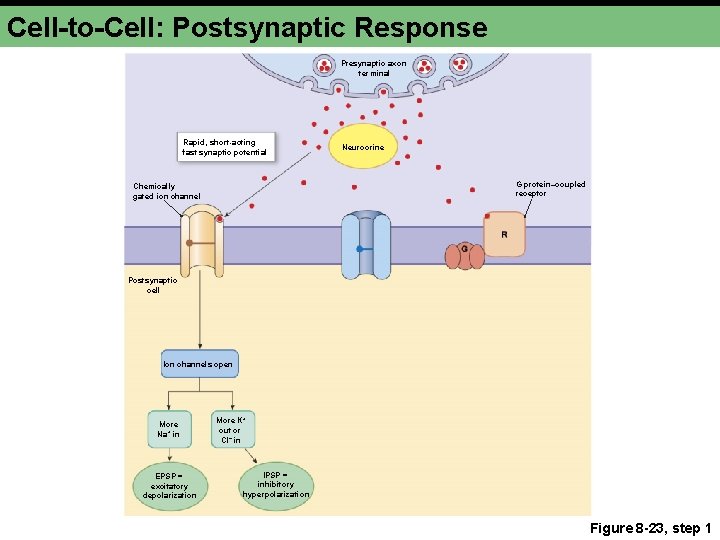
Cell-to-Cell: Postsynaptic Response Presynaptic axon terminal Rapid, short-acting fast synaptic potential Neurocrine G protein–coupled receptor Chemically gated ion channel Postsynaptic cell Ion channels open More Na+ in EPSP = excitatory depolarization More K+ out or Cl– in IPSP = inhibitory hyperpolarization Figure 8 -23, step 1
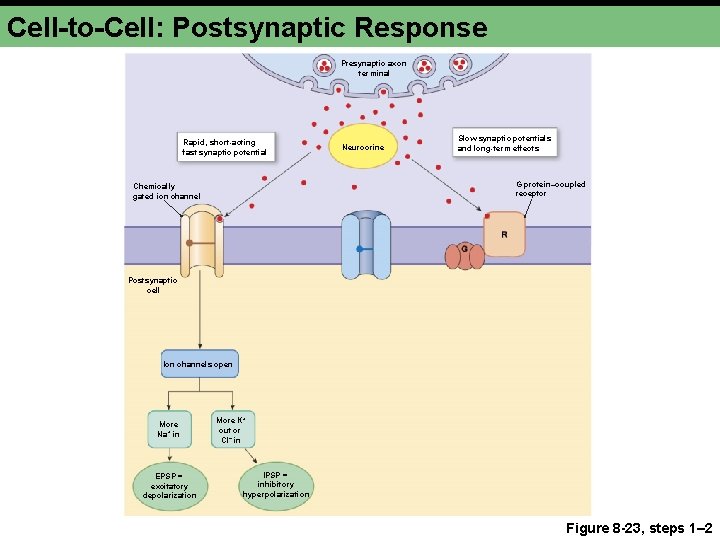
Cell-to-Cell: Postsynaptic Response Presynaptic axon terminal Rapid, short-acting fast synaptic potential Neurocrine Slow synaptic potentials and long-term effects G protein–coupled receptor Chemically gated ion channel Postsynaptic cell Ion channels open More Na+ in EPSP = excitatory depolarization More K+ out or Cl– in IPSP = inhibitory hyperpolarization Figure 8 -23, steps 1– 2
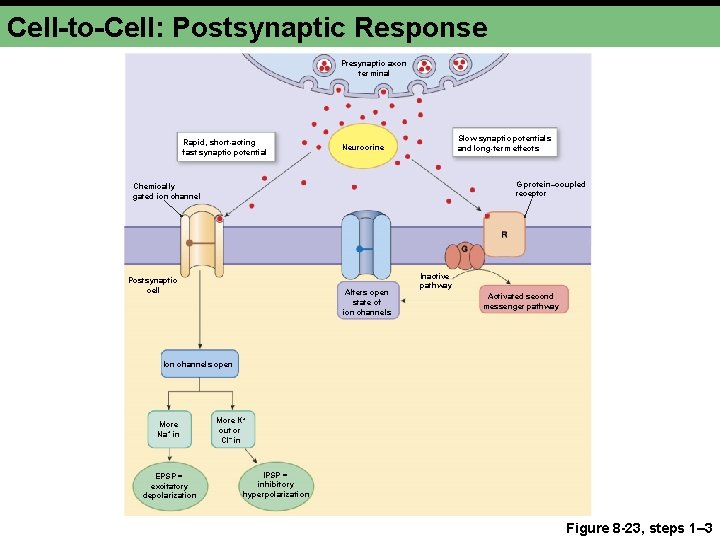
Cell-to-Cell: Postsynaptic Response Presynaptic axon terminal Rapid, short-acting fast synaptic potential Slow synaptic potentials and long-term effects Neurocrine G protein–coupled receptor Chemically gated ion channel Postsynaptic cell Alters open state of ion channels Inactive pathway Activated second messenger pathway Ion channels open More Na+ in EPSP = excitatory depolarization More K+ out or Cl– in IPSP = inhibitory hyperpolarization Figure 8 -23, steps 1– 3
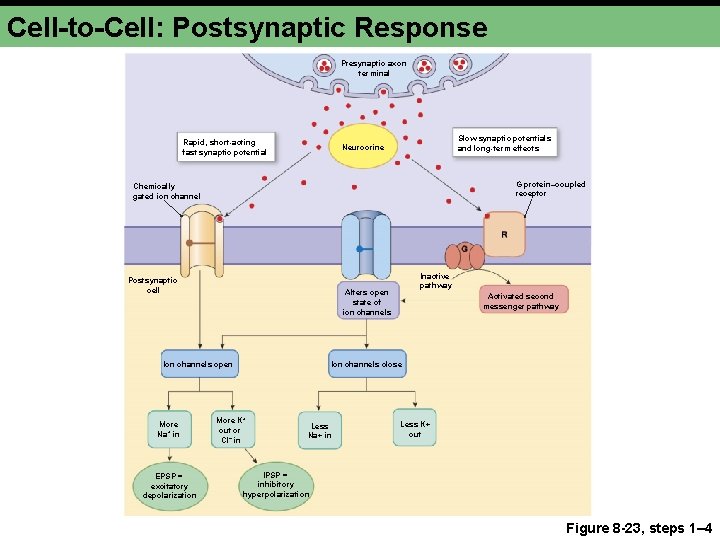
Cell-to-Cell: Postsynaptic Response Presynaptic axon terminal Rapid, short-acting fast synaptic potential Slow synaptic potentials and long-term effects Neurocrine G protein–coupled receptor Chemically gated ion channel Postsynaptic cell Alters open state of ion channels Ion channels open More Na+ in EPSP = excitatory depolarization Inactive pathway Activated second messenger pathway Ion channels close More K+ out or Cl– in Less Na+ in Less K+ out IPSP = inhibitory hyperpolarization Figure 8 -23, steps 1– 4
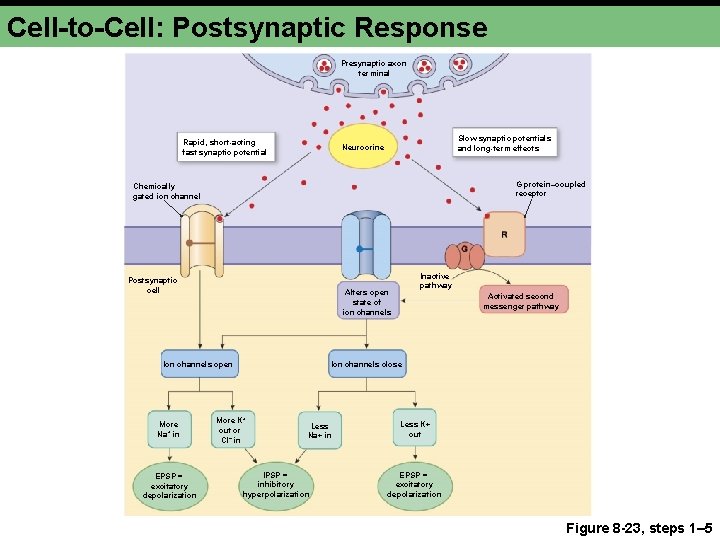
Cell-to-Cell: Postsynaptic Response Presynaptic axon terminal Rapid, short-acting fast synaptic potential Slow synaptic potentials and long-term effects Neurocrine G protein–coupled receptor Chemically gated ion channel Postsynaptic cell Alters open state of ion channels Ion channels open More Na+ in EPSP = excitatory depolarization Inactive pathway Activated second messenger pathway Ion channels close More K+ out or Cl– in Less Na+ in IPSP = inhibitory hyperpolarization Less K+ out EPSP = excitatory depolarization Figure 8 -23, steps 1– 5
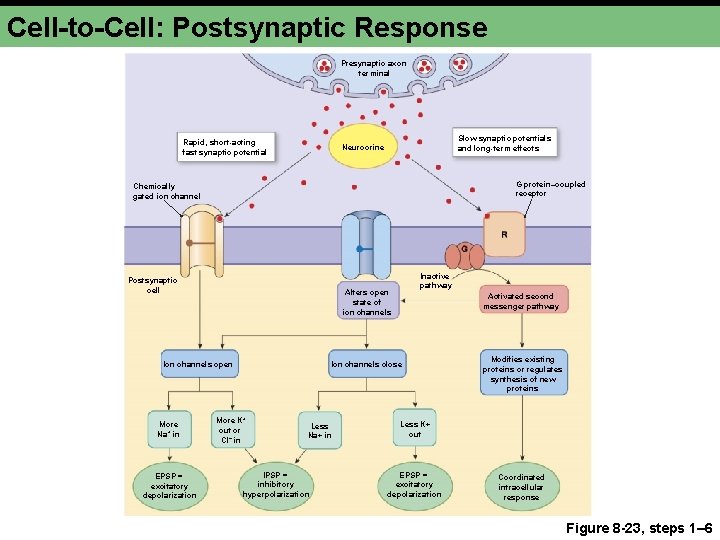
Cell-to-Cell: Postsynaptic Response Presynaptic axon terminal Rapid, short-acting fast synaptic potential Slow synaptic potentials and long-term effects Neurocrine G protein–coupled receptor Chemically gated ion channel Postsynaptic cell Alters open state of ion channels Ion channels open More Na+ in EPSP = excitatory depolarization Inactive pathway Activated second messenger pathway Ion channels close More K+ out or Cl– in Less Na+ in IPSP = inhibitory hyperpolarization Modifies existing proteins or regulates synthesis of new proteins Less K+ out EPSP = excitatory depolarization Coordinated intracellular response Figure 8 -23, steps 1– 6
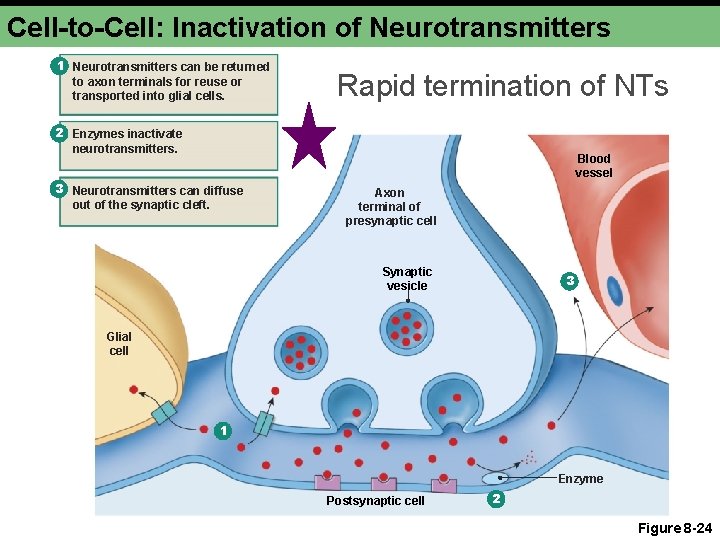
Cell-to-Cell: Inactivation of Neurotransmitters 1 Neurotransmitters can be returned to axon terminals for reuse or transported into glial cells. Rapid termination of NTs 2 Enzymes inactivate neurotransmitters. 3 Neurotransmitters can diffuse out of the synaptic cleft. Blood vessel Axon terminal of presynaptic cell Synaptic vesicle 3 Glial cell 1 Enzyme Postsynaptic cell 2 Figure 8 -24
- Slides: 17