
Chapter 8 Alkenes and Alkynes II Addition Reactions

- Slides: 18
Chapter 8 Alkenes and Alkynes II: Addition Reactions
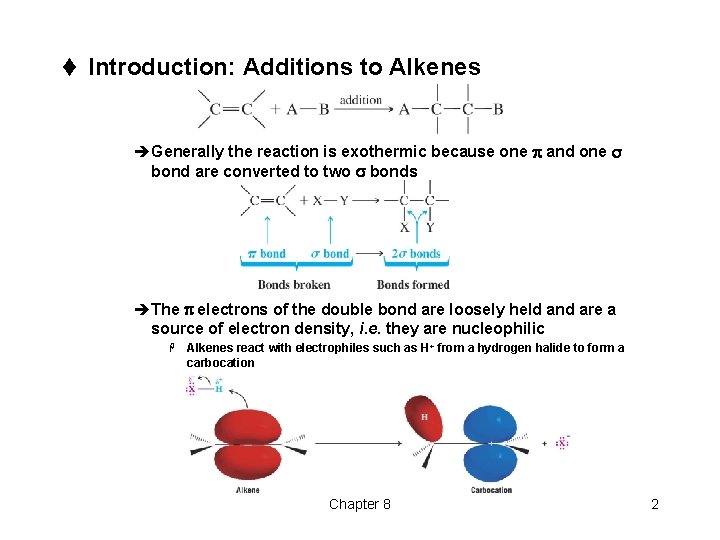
t Introduction: Additions to Alkenes èGenerally the reaction is exothermic because one p and one s bond are converted to two s bonds èThe p electrons of the double bond are loosely held and are a source of electron density, i. e. they are nucleophilic H Alkenes react with electrophiles such as H+ from a hydrogen halide to form a carbocation Chapter 8 2
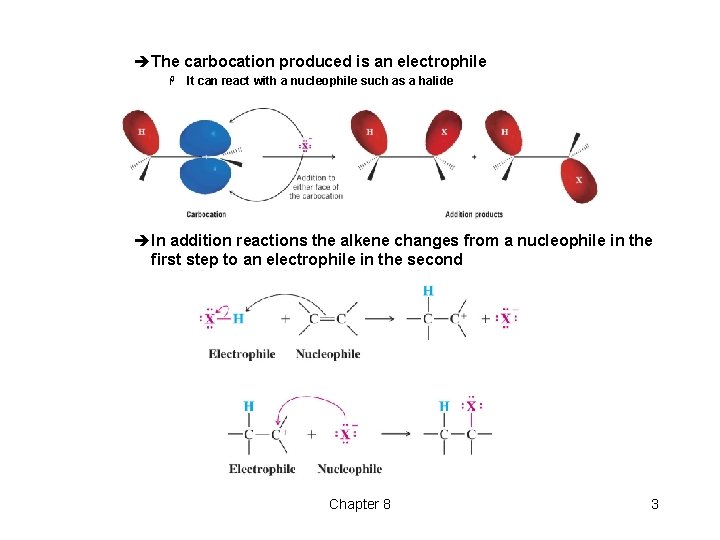
èThe carbocation produced is an electrophile H It can react with a nucleophile such as a halide » Insert top scheme pg 331 èIn addition reactions the alkene changes from a nucleophile in the first step to an electrophile in the second Chapter 8 3
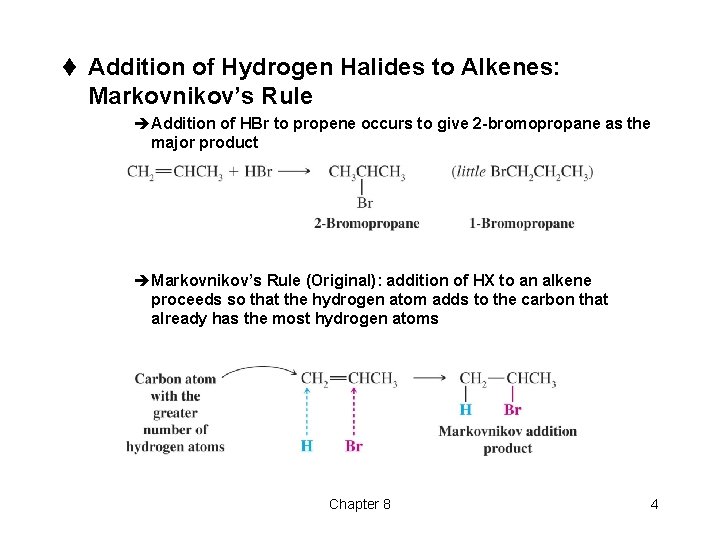
t Addition of Hydrogen Halides to Alkenes: Markovnikov’s Rule èAddition of HBr to propene occurs to give 2 -bromopropane as the major product èMarkovnikov’s Rule (Original): addition of HX to an alkene proceeds so that the hydrogen atom adds to the carbon that already has the most hydrogen atoms Chapter 8 4
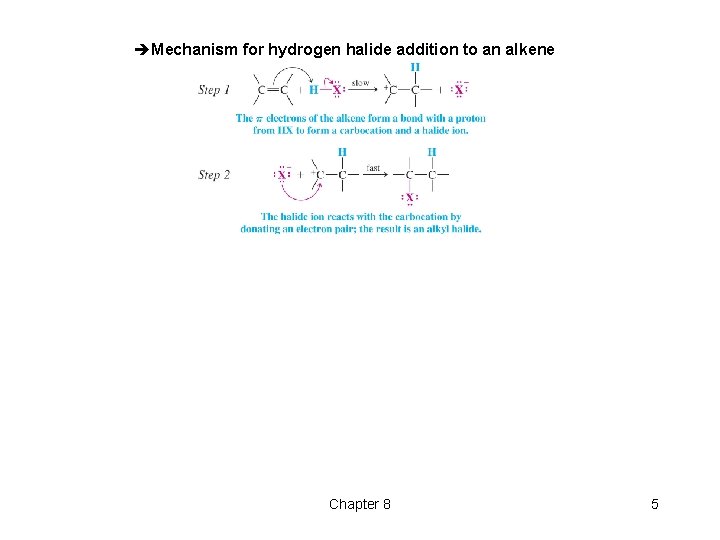
èMechanism for hydrogen halide addition to an alkene Chapter 8 5
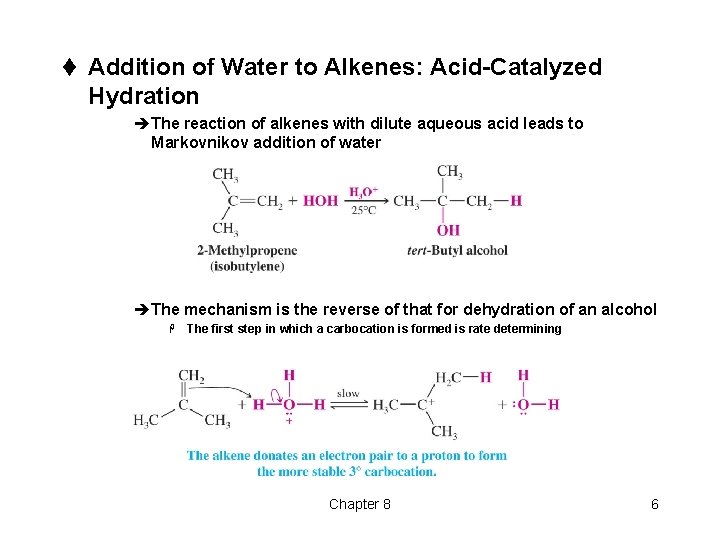
t Addition of Water to Alkenes: Acid-Catalyzed Hydration èThe reaction of alkenes with dilute aqueous acid leads to Markovnikov addition of water èThe mechanism is the reverse of that for dehydration of an alcohol H The first step in which a carbocation is formed is rate determining Chapter 8 6
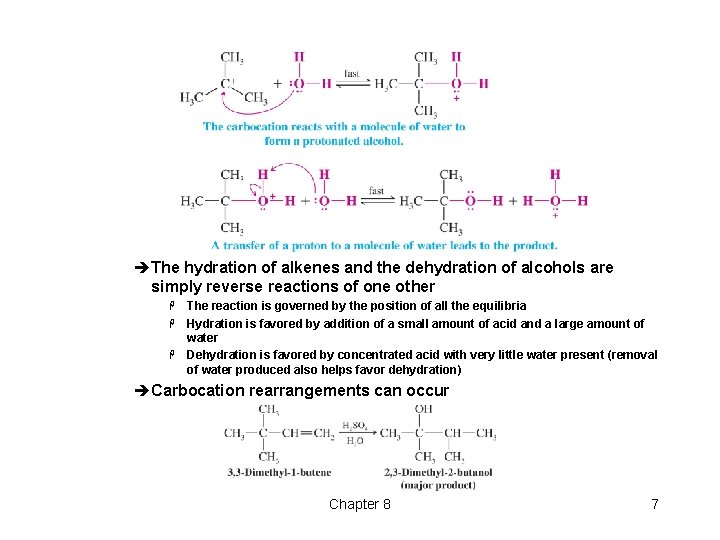
èThe hydration of alkenes and the dehydration of alcohols are simply reverse reactions of one other The reaction is governed by the position of all the equilibria H Hydration is favored by addition of a small amount of acid and a large amount of water H Dehydration is favored by concentrated acid with very little water present (removal of water produced also helps favor dehydration) H èCarbocation rearrangements can occur Chapter 8 7
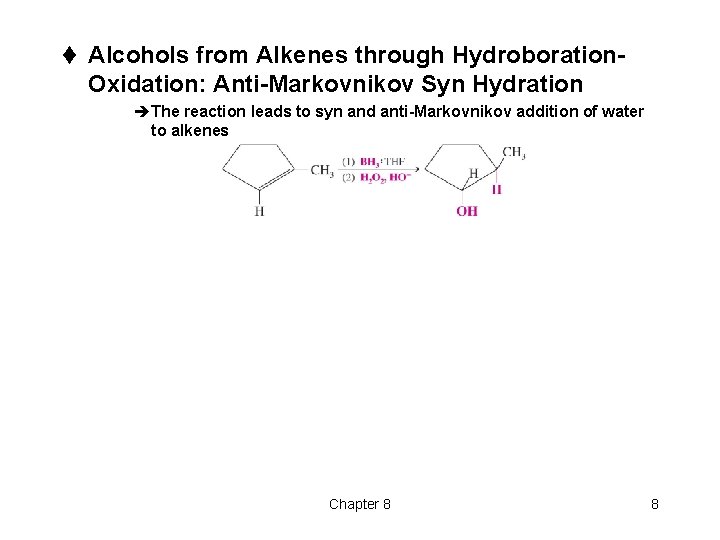
t Alcohols from Alkenes through Hydroboration- Oxidation: Anti-Markovnikov Syn Hydration èThe reaction leads to syn and anti-Markovnikov addition of water to alkenes Chapter 8 8
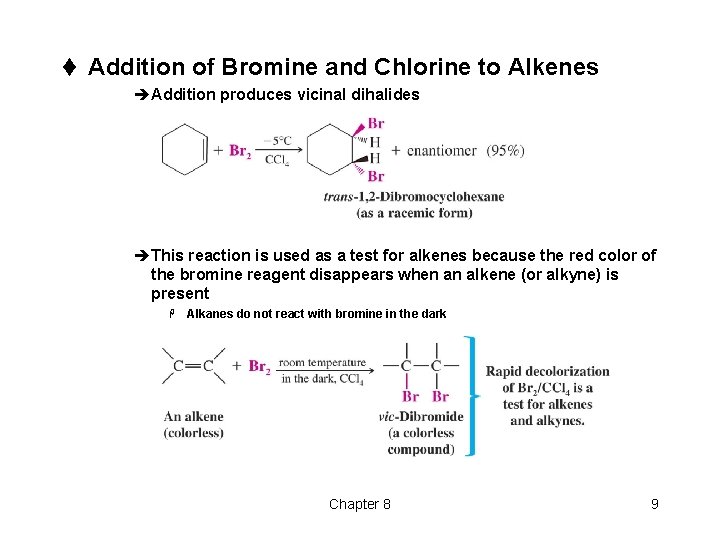
t Addition of Bromine and Chlorine to Alkenes èAddition produces vicinal dihalides èThis reaction is used as a test for alkenes because the red color of the bromine reagent disappears when an alkene (or alkyne) is present H Alkanes do not react with bromine in the dark Chapter 8 9
l Mechanism of Halogen Addition èA bromonium ion intermediate results instead of the carbocation seen in other addition reactions Chapter 8 10
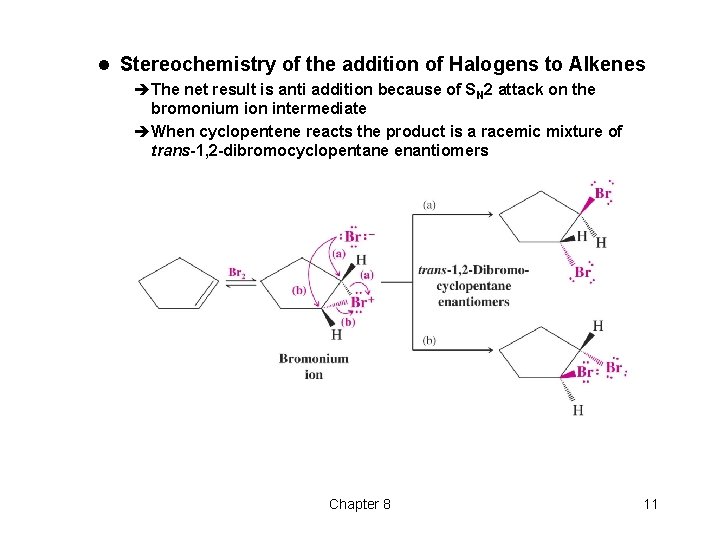
l Stereochemistry of the addition of Halogens to Alkenes èThe net result is anti addition because of SN 2 attack on the bromonium ion intermediate èWhen cyclopentene reacts the product is a racemic mixture of trans-1, 2 -dibromocyclopentane enantiomers Chapter 8 11
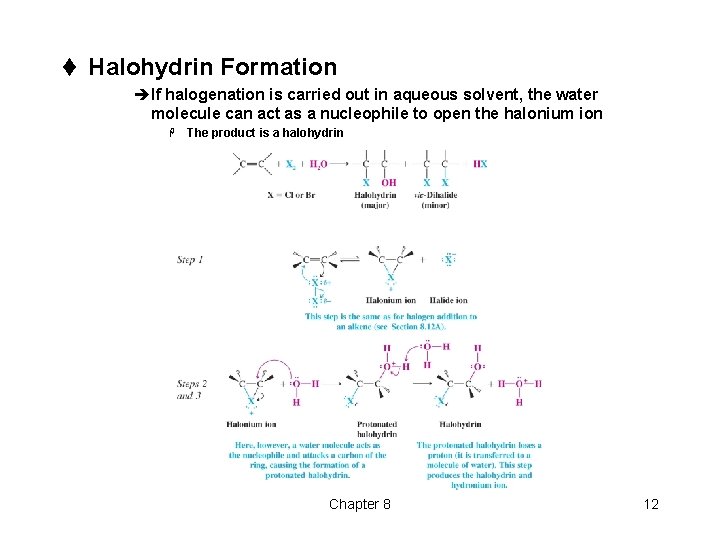
t Halohydrin Formation èIf halogenation is carried out in aqueous solvent, the water molecule can act as a nucleophile to open the halonium ion H The product is a halohydrin Chapter 8 12
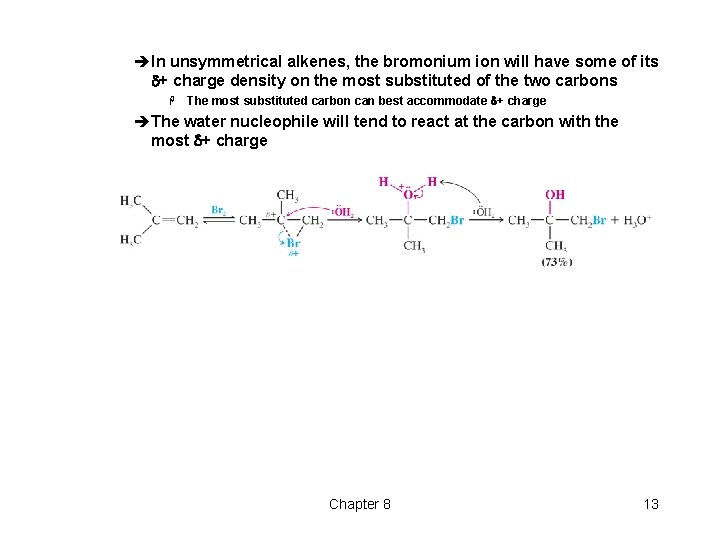
èIn unsymmetrical alkenes, the bromonium ion will have some of its d+ charge density on the most substituted of the two carbons H The most substituted carbon can best accommodate d+ charge èThe water nucleophile will tend to react at the carbon with the most d+ charge Chapter 8 13
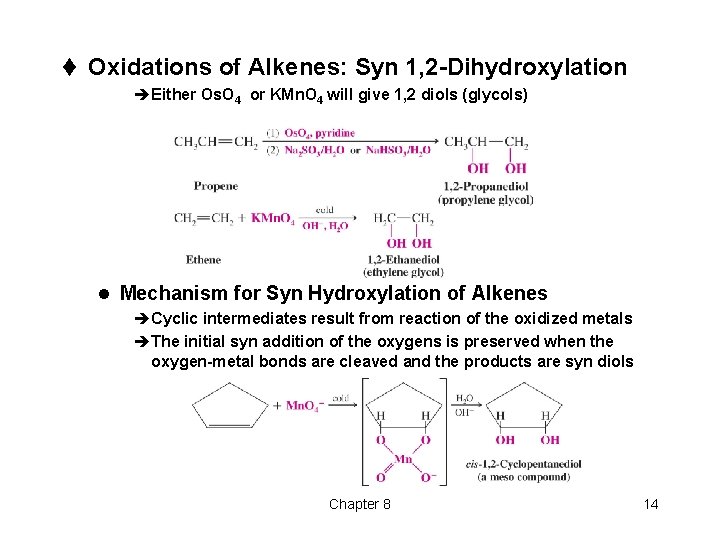
t Oxidations of Alkenes: Syn 1, 2 -Dihydroxylation èEither Os. O 4 or KMn. O 4 will give 1, 2 diols (glycols) l Mechanism for Syn Hydroxylation of Alkenes èCyclic intermediates result from reaction of the oxidized metals èThe initial syn addition of the oxygens is preserved when the oxygen-metal bonds are cleaved and the products are syn diols Chapter 8 14
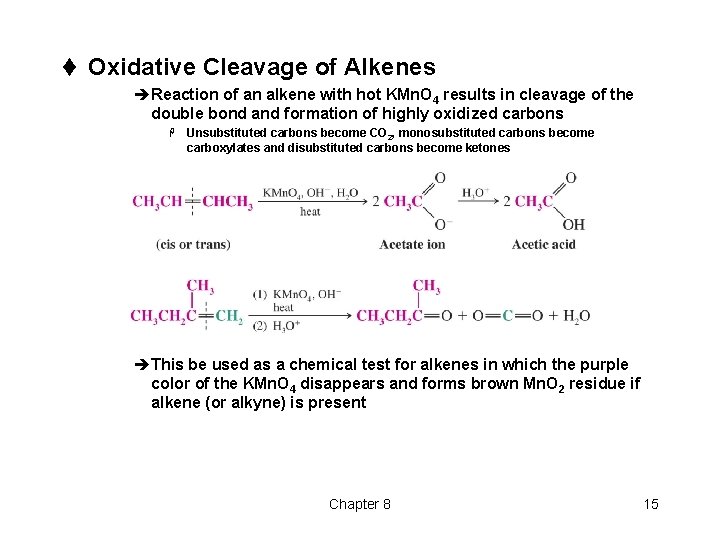
t Oxidative Cleavage of Alkenes èReaction of an alkene with hot KMn. O 4 results in cleavage of the double bond and formation of highly oxidized carbons H Unsubstituted carbons become CO 2, monosubstituted carbons become carboxylates and disubstituted carbons become ketones èThis be used as a chemical test for alkenes in which the purple color of the KMn. O 4 disappears and forms brown Mn. O 2 residue if alkene (or alkyne) is present Chapter 8 15
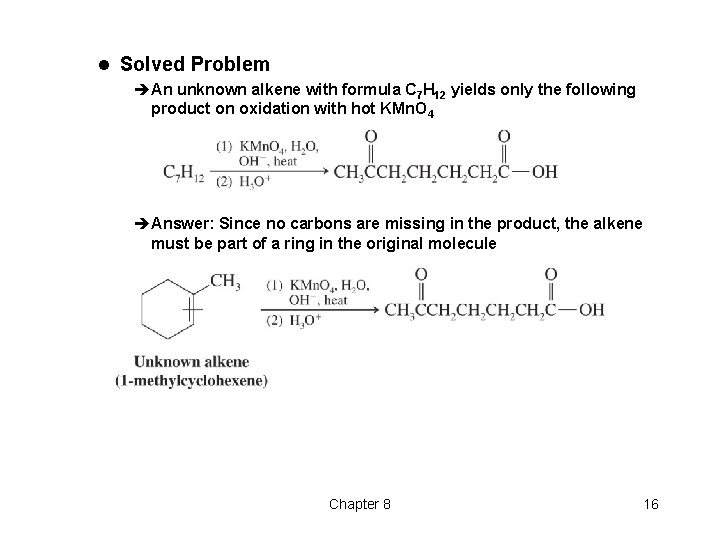
l Solved Problem èAn unknown alkene with formula C 7 H 12 yields only the following product on oxidation with hot KMn. O 4 èAnswer: Since no carbons are missing in the product, the alkene must be part of a ring in the original molecule Chapter 8 16
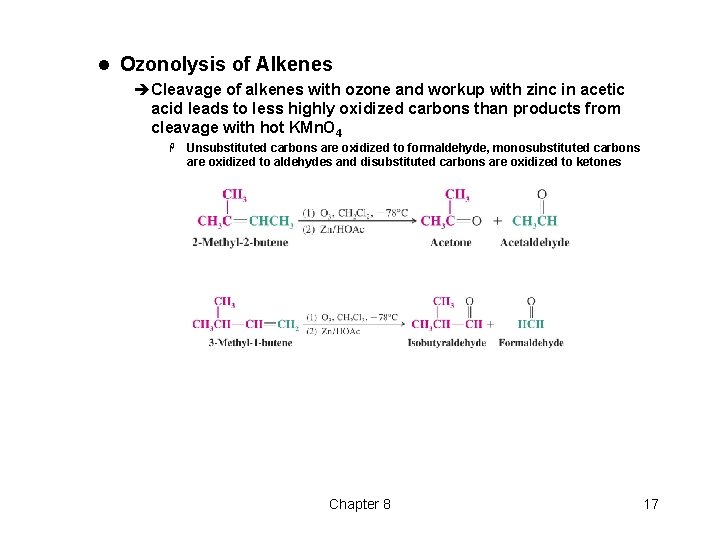
l Ozonolysis of Alkenes èCleavage of alkenes with ozone and workup with zinc in acetic acid leads to less highly oxidized carbons than products from cleavage with hot KMn. O 4 H Unsubstituted carbons are oxidized to formaldehyde, monosubstituted carbons are oxidized to aldehydes and disubstituted carbons are oxidized to ketones Chapter 8 17
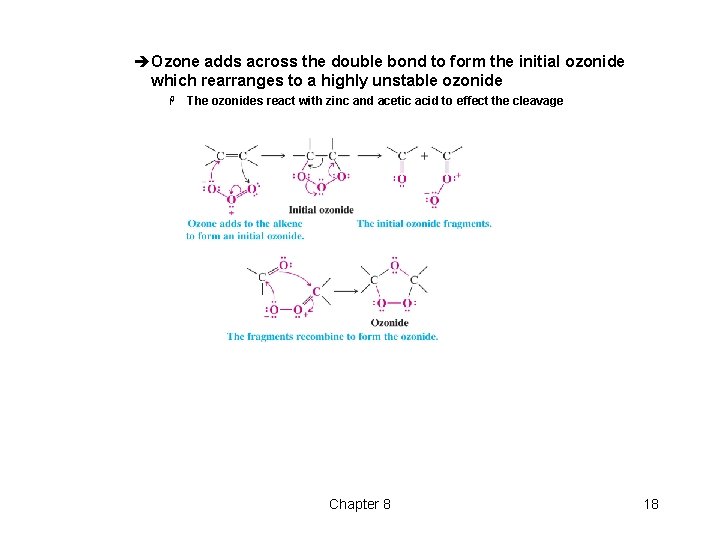
èOzone adds across the double bond to form the initial ozonide which rearranges to a highly unstable ozonide H The ozonides react with zinc and acetic acid to effect the cleavage Chapter 8 18