
Chapter 8 Acids Bases and Buffers in the
Chapter 8 Acids, Bases, and Buffers in the Body 1
Chapter 8 Objectives for Today q q q Review Test #2 Definitions of acids and bases Comparison of strong and weak acids and bases 2

Chapter 8 CHAPTER OVERVIEW 3
Chapter 8 4 8. 1 Acids and Bases—Definitions 8. 2 Strong Acids and Bases 8. 3 Chemical Equilibrium 8. 4 Weak Acids and Bases 8. 5 p. H and the p. H Scale 8. 6 p. Ka 8. 7 Amino Acids: Common Biological Weak Acids 8. 8 Buffers: An Important Property of Weak Acids and Bases
Chapter 8 5 • Citrus fruits taste sour because they contain acid. • Our stomach produces acid to aid in digestion, and our muscles produce lactic acid when we exercise. • An acid can be neutralized by a base. Soaps are mild bases, and, like other bases, feel slippery to the touch. Bases, like caffeine and quinine, taste bitter.
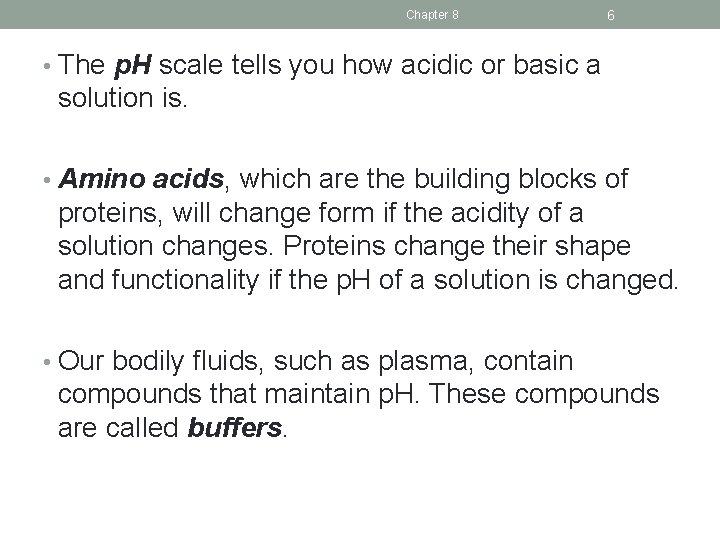
Chapter 8 6 • The p. H scale tells you how acidic or basic a solution is. • Amino acids, which are the building blocks of proteins, will change form if the acidity of a solution changes. Proteins change their shape and functionality if the p. H of a solution is changed. • Our bodily fluids, such as plasma, contain compounds that maintain p. H. These compounds are called buffers.
Chapter 8 ACIDS AND BASES 7

Chapter 8 8 Acids • The Swedish chemist, Svante Arrhenius, first described acids as substances that dissociate, producing hydrogen ions (H+) when dissolved in water. • The hydrogen ions give acids their sour taste and allow acids to corrode some metals.
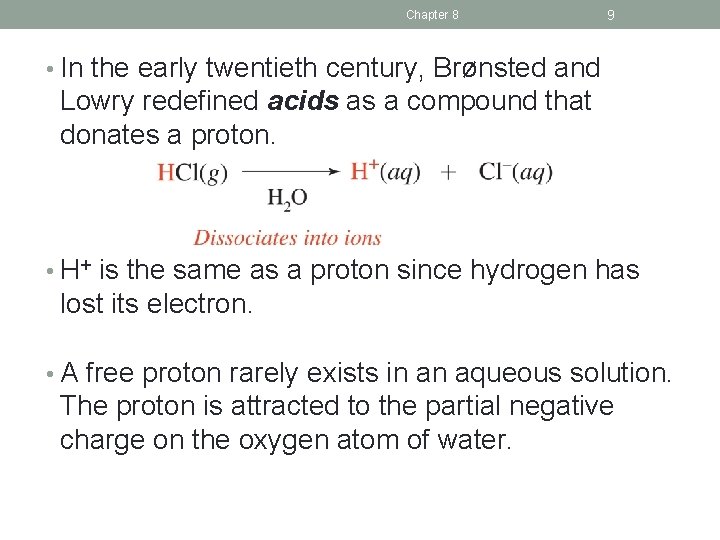
Chapter 8 9 • In the early twentieth century, Brønsted and Lowry redefined acids as a compound that donates a proton. • H+ is the same as a proton since hydrogen has lost its electron. • A free proton rarely exists in an aqueous solution. The proton is attracted to the partial negative charge on the oxygen atom of water.
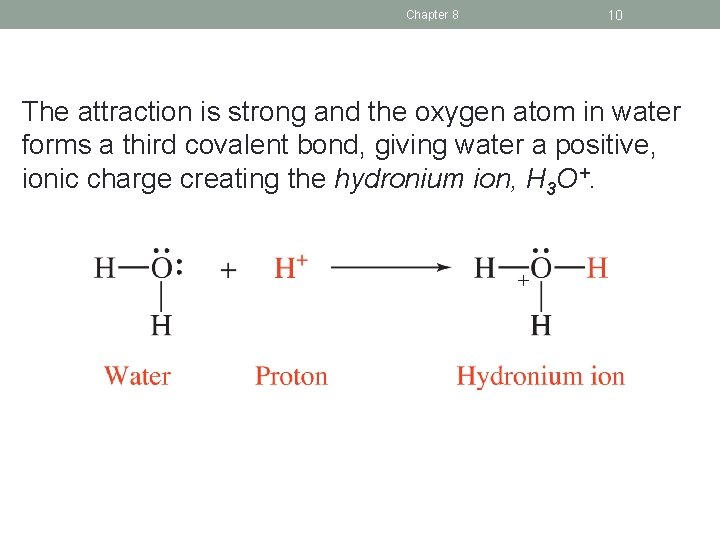
Chapter 8 10 The attraction is strong and the oxygen atom in water forms a third covalent bond, giving water a positive, ionic charge creating the hydronium ion, H 3 O+.
Chapter 8 11 Bases • Arrhenius described bases as compounds that dissociate to form a metal ion and a hydroxide ion (OH-) when dissolved in water. Arrhenius bases are formed from Group 1 A and 2 A metals. Hydroxide bases are characterized by a bitter taste and a slippery feel. • The Brønsted–Lowry definition of a base is a compound that accepts a proton.
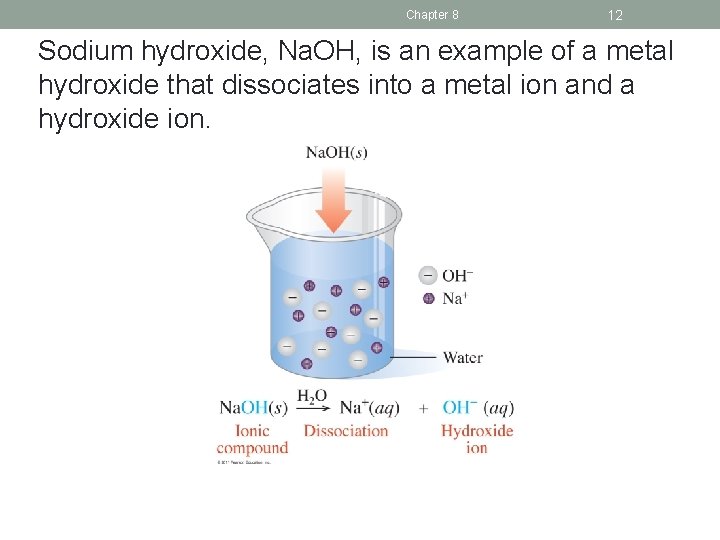
Chapter 8 12 Sodium hydroxide, Na. OH, is an example of a metal hydroxide that dissociates into a metal ion and a hydroxide ion.
Chapter 8 13 Acids and Bases Are Both Present in Aqueous Solution • The Brønsted–Lowry definitions of acids and bases imply that a proton is transferred in an acidic or basic solution.
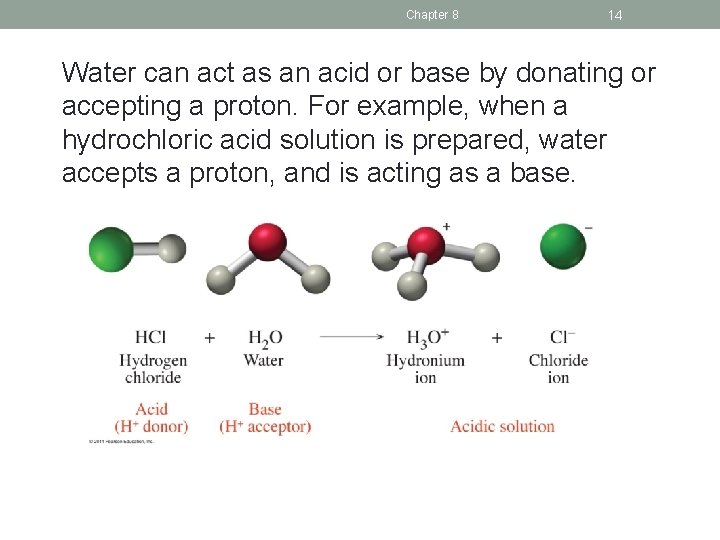
Chapter 8 14 Water can act as an acid or base by donating or accepting a proton. For example, when a hydrochloric acid solution is prepared, water accepts a proton, and is acting as a base.
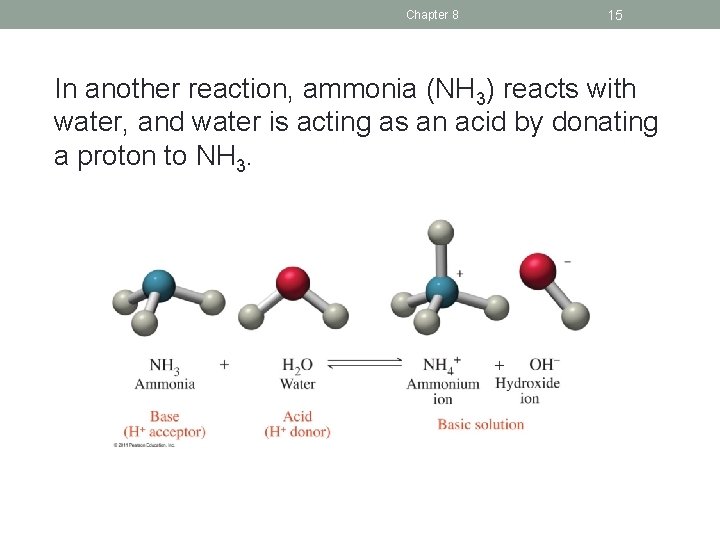
Chapter 8 15 In another reaction, ammonia (NH 3) reacts with water, and water is acting as an acid by donating a proton to NH 3.
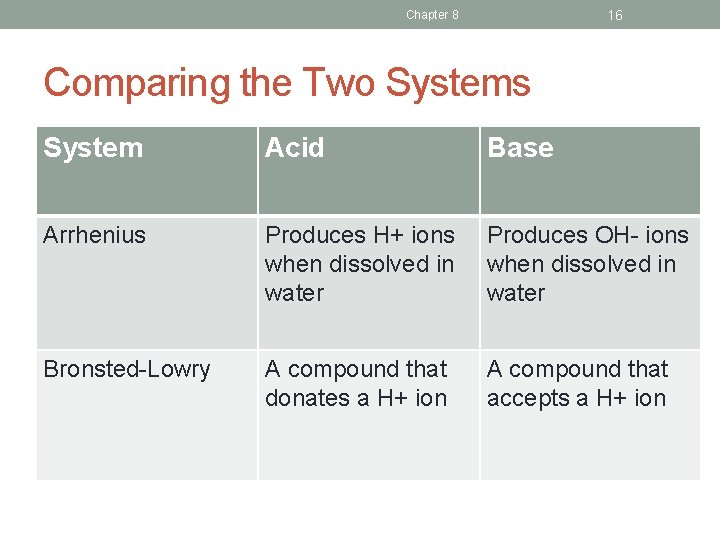
16 Chapter 8 Comparing the Two Systems System Acid Base Arrhenius Produces H+ ions when dissolved in water Produces OH- ions when dissolved in water Bronsted-Lowry A compound that donates a H+ ion A compound that accepts a H+ ion
Chapter 8 STRONG ACIDS AND STRONG BASES 17
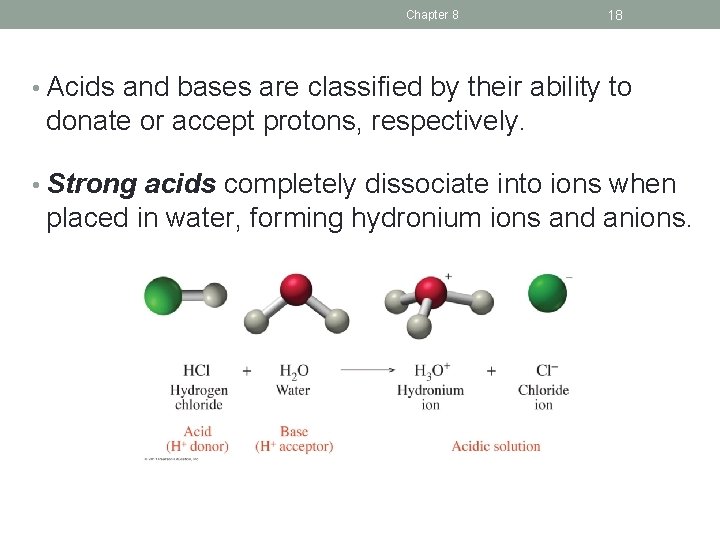
Chapter 8 18 • Acids and bases are classified by their ability to donate or accept protons, respectively. • Strong acids completely dissociate into ions when placed in water, forming hydronium ions and anions.
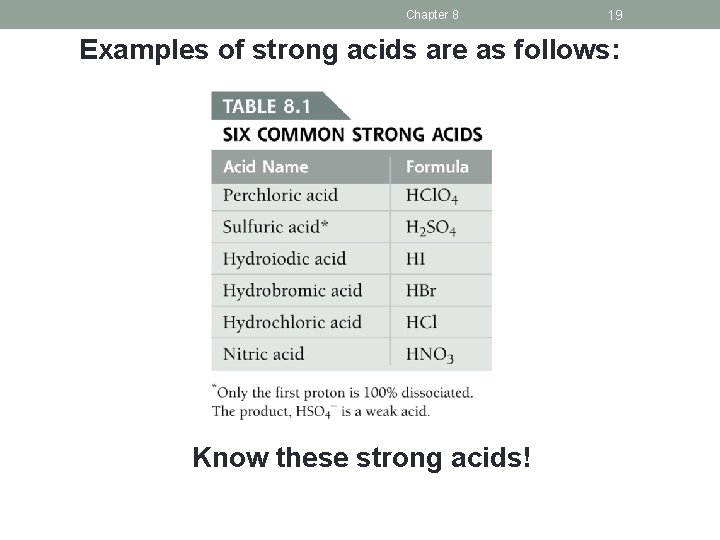
Chapter 8 19 Examples of strong acids are as follows: Know these strong acids!
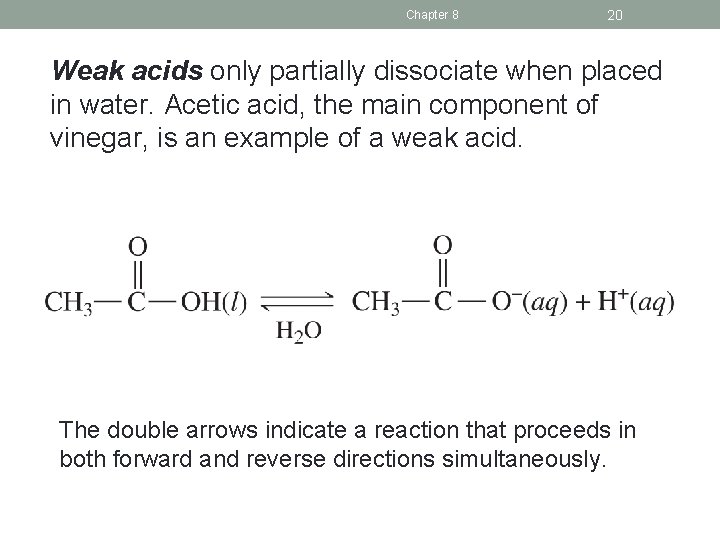
Chapter 8 20 Weak acids only partially dissociate when placed in water. Acetic acid, the main component of vinegar, is an example of a weak acid. The double arrows indicate a reaction that proceeds in both forward and reverse directions simultaneously.
Chapter 8 21 • Sodium hydroxide, Na. OH, is a strong base. It is used in household products such as oven cleaners and drain openers. • Na. OH and other bases like Li. OH, KOH, and Ca(OH)2 are strong bases that completely dissociate in water. They dissociate to give a metal ion and a hydroxide ion. • Weak bases, like weak acids, only partially dissociate in water.
Chapter 8 22 Neutralization • When a strong acid and strong base are mixed, both completely dissociate to form ions in water. • For example, when HCl and Na. OH are mixed, sodium ions and chloride ions are formed, as well as hydroxide ions and hydronium ions. • The protons in the hydronium ion are attracted to the hydroxide ion to form water molecules.
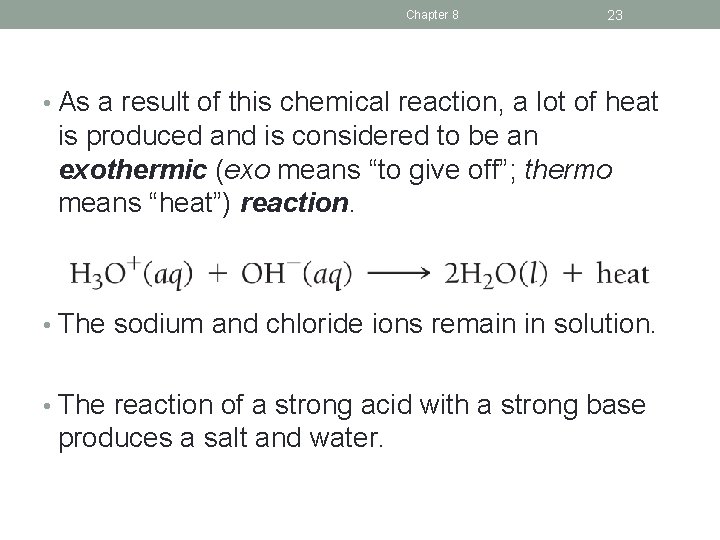
Chapter 8 23 • As a result of this chemical reaction, a lot of heat is produced and is considered to be an exothermic (exo means “to give off”; thermo means “heat”) reaction. • The sodium and chloride ions remain in solution. • The reaction of a strong acid with a strong base produces a salt and water.
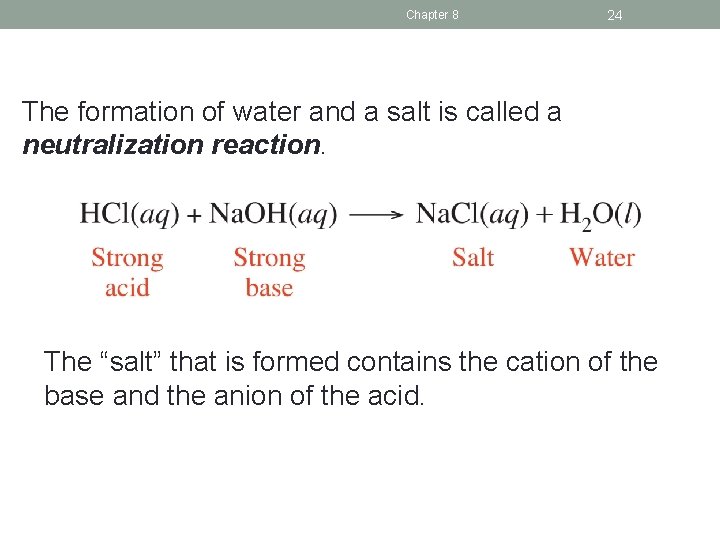
Chapter 8 24 The formation of water and a salt is called a neutralization reaction. The “salt” that is formed contains the cation of the base and the anion of the acid.
Chapter 8 25 • Antacids are substances that neutralize excess stomach acid. Some antacids are bases that are not very soluble in water. • Aluminum hydroxide and magnesium hydroxide are examples of antacids that are not very soluble in water. They are used in combination to prevent unpleasant side effects.
Chapter 8 26 • Calcium carbonate is an antacid that will cause an increase in serum calcium. It is not recommended for people with peptic ulcers or for those that have a tendency to form kidney stones. • Sodium bicarbonate is an antacid that will affect the acidity level of blood and will elevate sodium levels in bodily fluids.
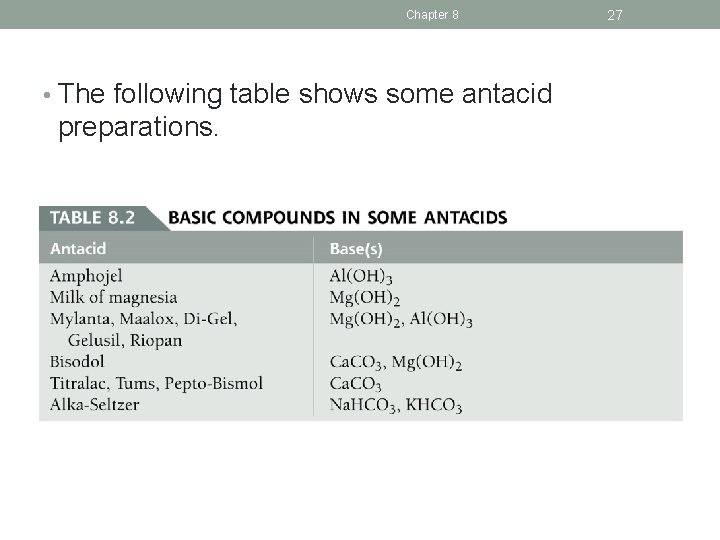
Chapter 8 • The following table shows some antacid preparations. 27
Chapter 8 Objectives for Today üReview Test #2 üDefinitions of acids and bases üComparison of strong and weak acids and bases 28
Chapter 8 Objectives for Today q q Equilbrium concepts Weak acids and weak bases 29
Chapter 8 EQUILIBRIUM 30
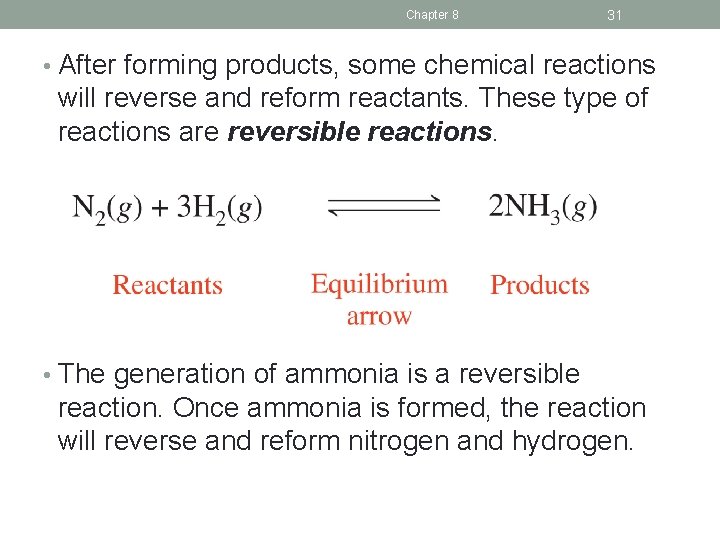
Chapter 8 31 • After forming products, some chemical reactions will reverse and reform reactants. These type of reactions are reversible reactions. • The generation of ammonia is a reversible reaction. Once ammonia is formed, the reaction will reverse and reform nitrogen and hydrogen.
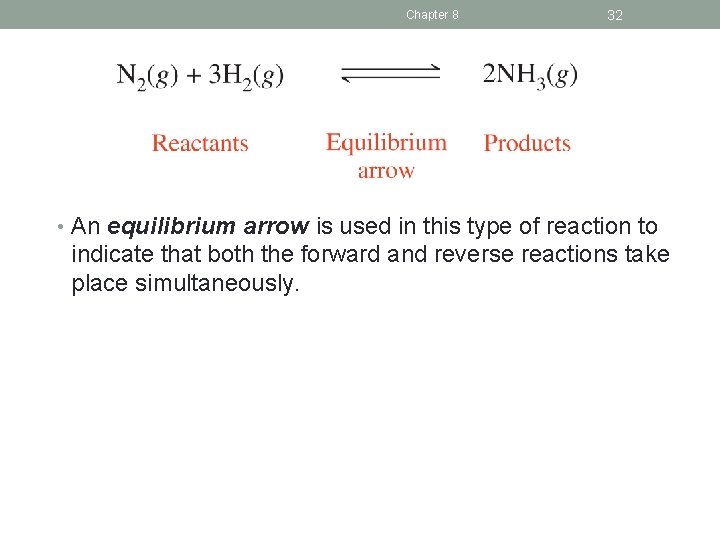
Chapter 8 32 • An equilibrium arrow is used in this type of reaction to indicate that both the forward and reverse reactions take place simultaneously.
Chapter 8 33 • According to Le Châtelier’s principle, if stress is applied to the equilibrium, the rates of the forward and reverse reaction will change to relieve the stress, and equilibrium will be regained.

Chapter 8 34 • http: //www. learnerstv. com/animation. php? ani=1 20&cat=chemistry
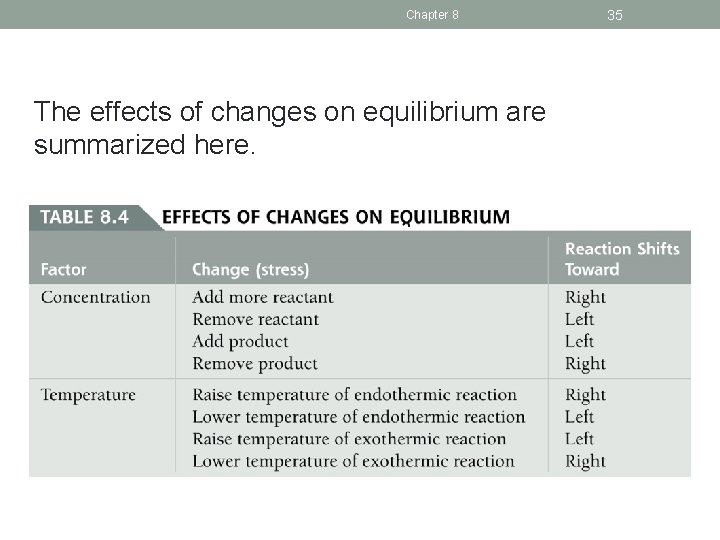
Chapter 8 The effects of changes on equilibrium are summarized here. 35
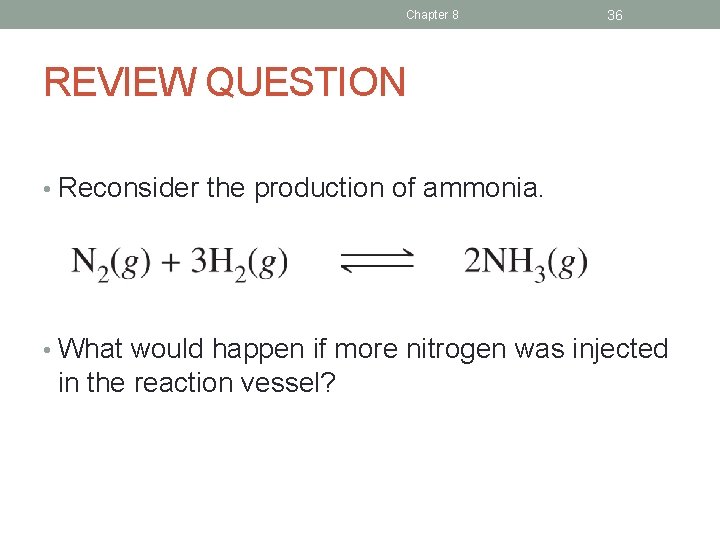
Chapter 8 36 REVIEW QUESTION • Reconsider the production of ammonia. • What would happen if more nitrogen was injected in the reaction vessel?
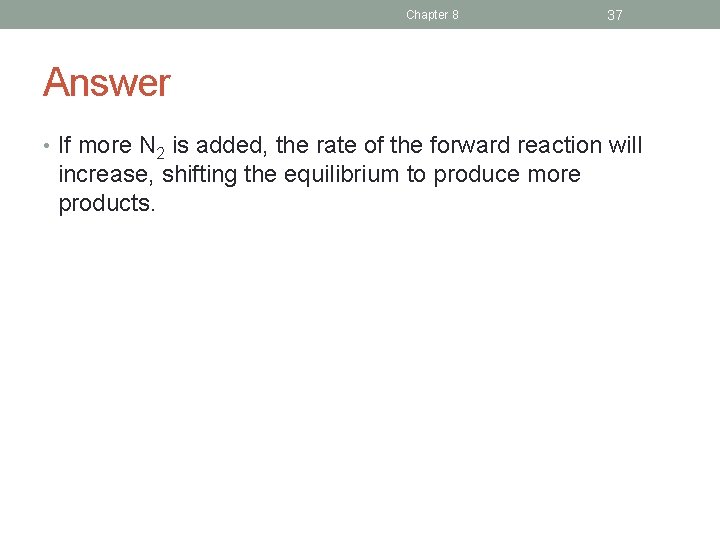
Chapter 8 37 Answer • If more N 2 is added, the rate of the forward reaction will increase, shifting the equilibrium to produce more products.
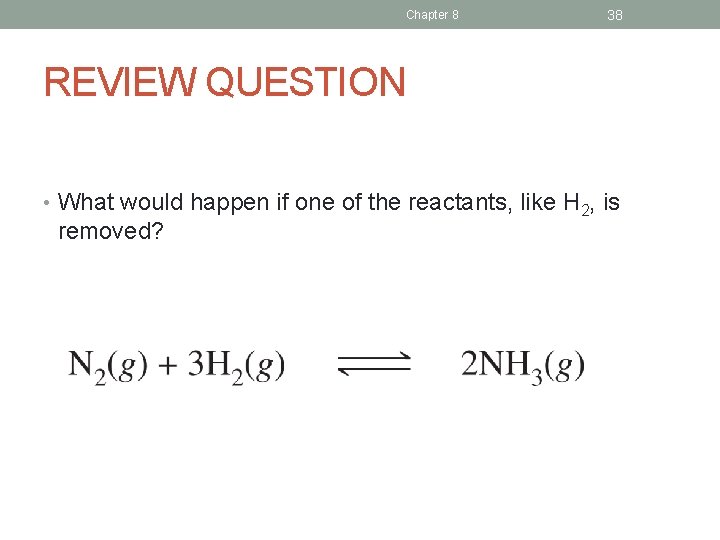
Chapter 8 38 REVIEW QUESTION • What would happen if one of the reactants, like H 2, is removed?
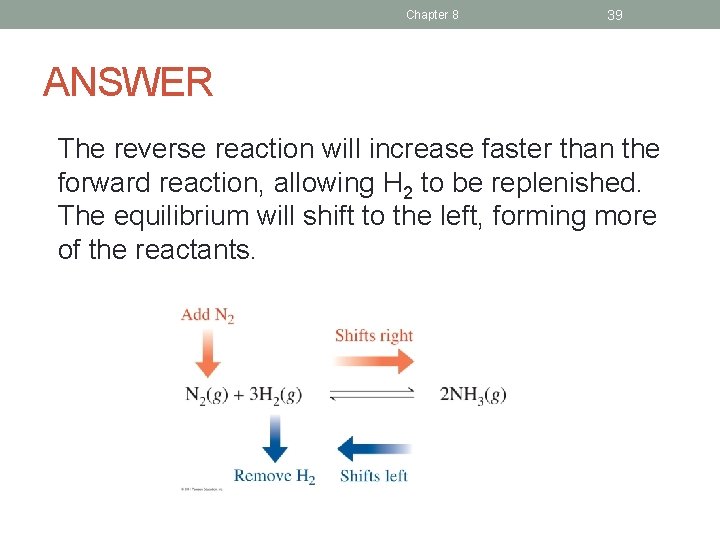
Chapter 8 39 ANSWER The reverse reaction will increase faster than the forward reaction, allowing H 2 to be replenished. The equilibrium will shift to the left, forming more of the reactants.
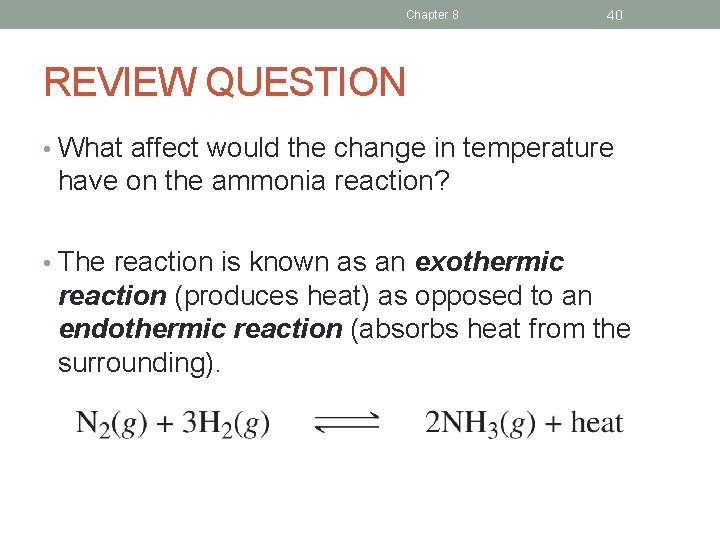
Chapter 8 40 REVIEW QUESTION • What affect would the change in temperature have on the ammonia reaction? • The reaction is known as an exothermic reaction (produces heat) as opposed to an endothermic reaction (absorbs heat from the surrounding).
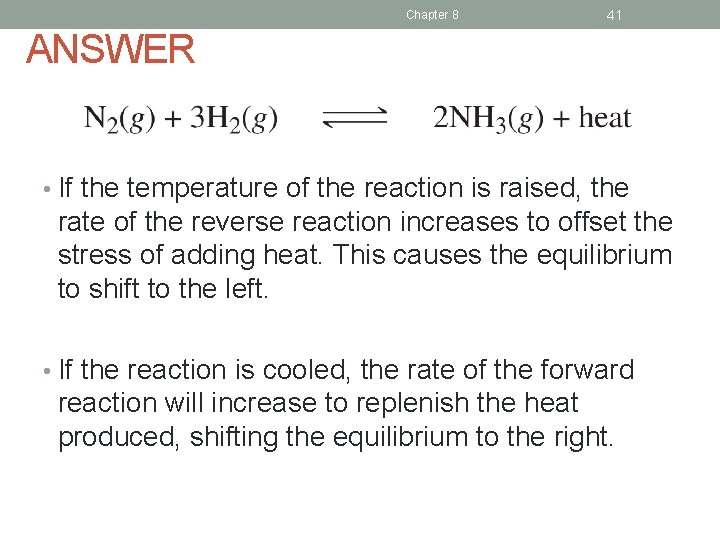
Chapter 8 41 ANSWER • If the temperature of the reaction is raised, the rate of the reverse reaction increases to offset the stress of adding heat. This causes the equilibrium to shift to the left. • If the reaction is cooled, the rate of the forward reaction will increase to replenish the heat produced, shifting the equilibrium to the right.
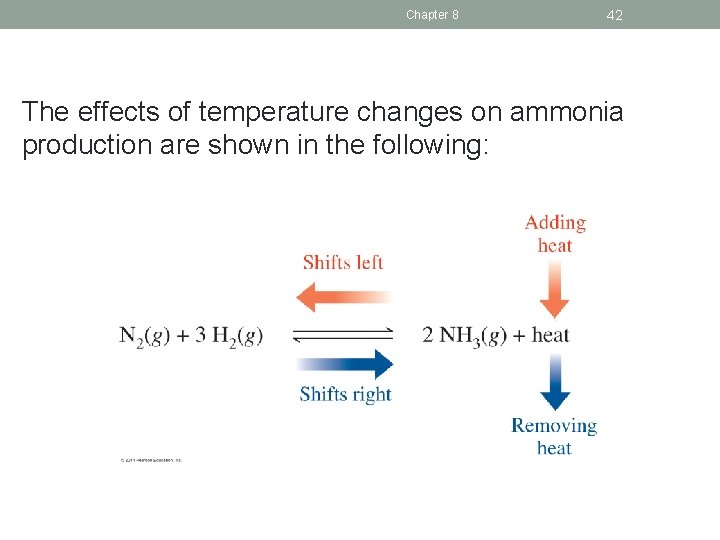
Chapter 8 42 The effects of temperature changes on ammonia production are shown in the following:
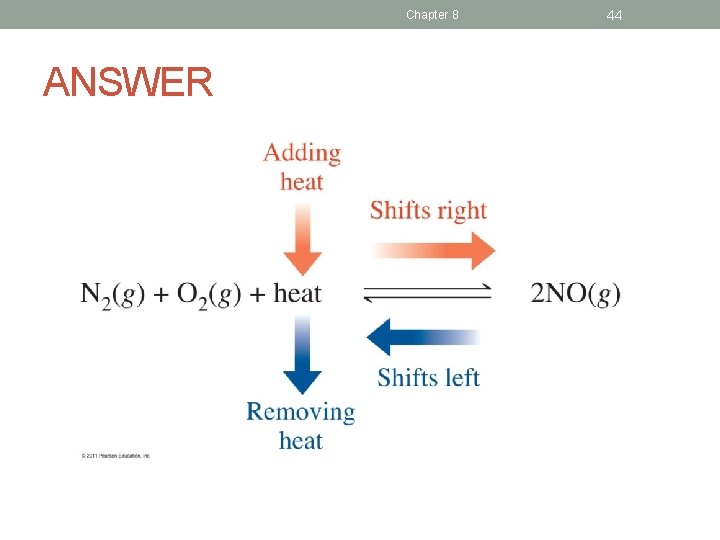
Chapter 8 ANSWER 44
Chapter 8 45 APPLYING EQUILIBRIUM TO WEAK ACIDS AND WEAK BASES
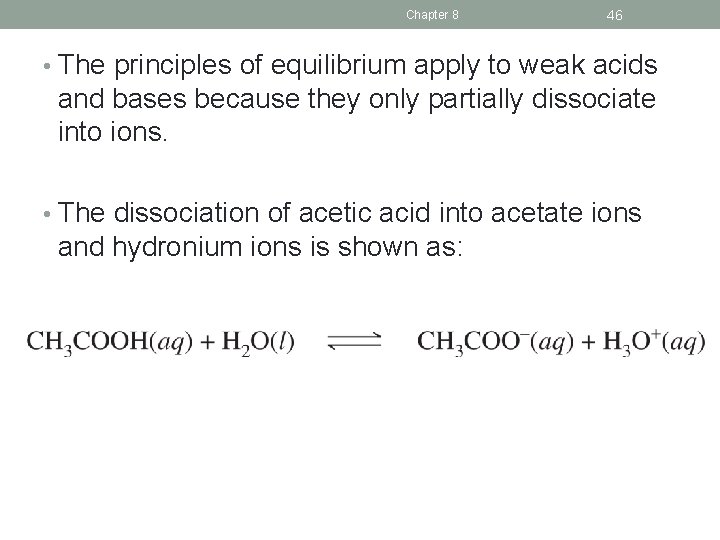
Chapter 8 46 • The principles of equilibrium apply to weak acids and bases because they only partially dissociate into ions. • The dissociation of acetic acid into acetate ions and hydronium ions is shown as:
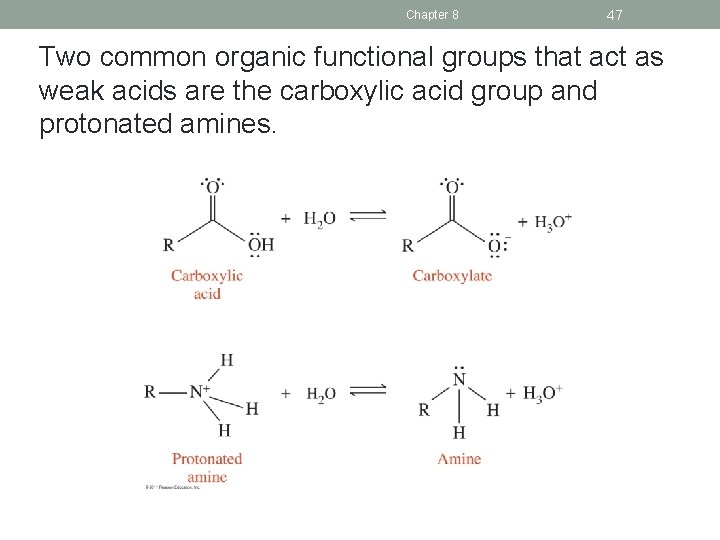
Chapter 8 47 Two common organic functional groups that act as weak acids are the carboxylic acid group and protonated amines.
Chapter 8 48 Conjugate Acids and Bases • The Brønsted–Lowry theory states that the reaction between an acid and base involves a proton transfer. • If a weak acid is mixed with water, water will act as a base and accept a proton from the weak acid.
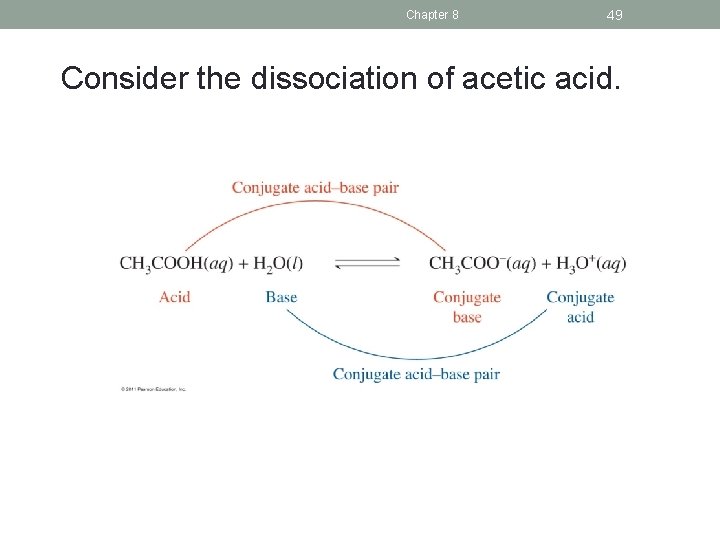
Chapter 8 49 Consider the dissociation of acetic acid.
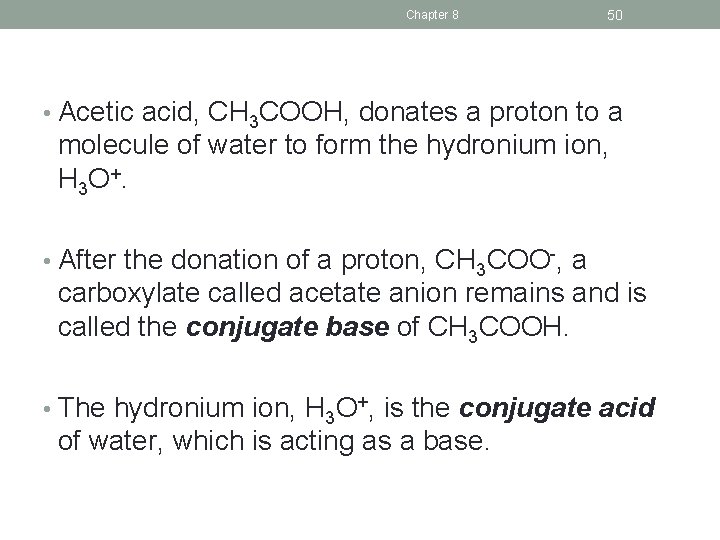
Chapter 8 50 • Acetic acid, CH 3 COOH, donates a proton to a molecule of water to form the hydronium ion, H 3 O +. • After the donation of a proton, CH 3 COO-, a carboxylate called acetate anion remains and is called the conjugate base of CH 3 COOH. • The hydronium ion, H 3 O+, is the conjugate acid of water, which is acting as a base.
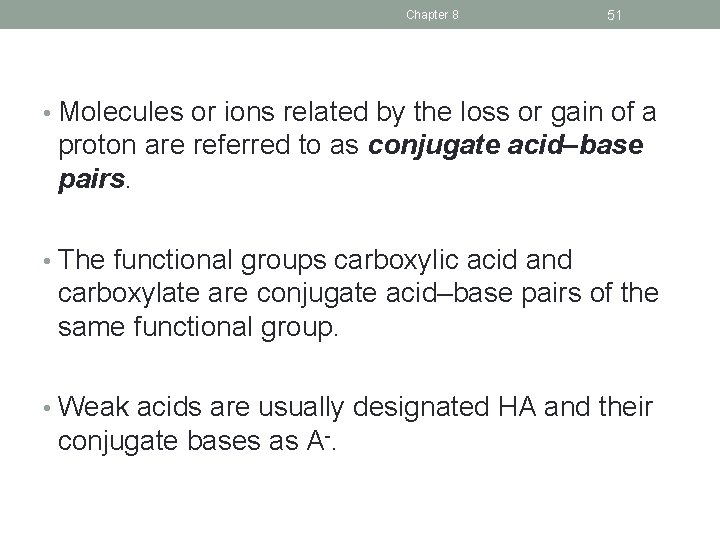
Chapter 8 51 • Molecules or ions related by the loss or gain of a proton are referred to as conjugate acid–base pairs. • The functional groups carboxylic acid and carboxylate are conjugate acid–base pairs of the same functional group. • Weak acids are usually designated HA and their conjugate bases as A-.
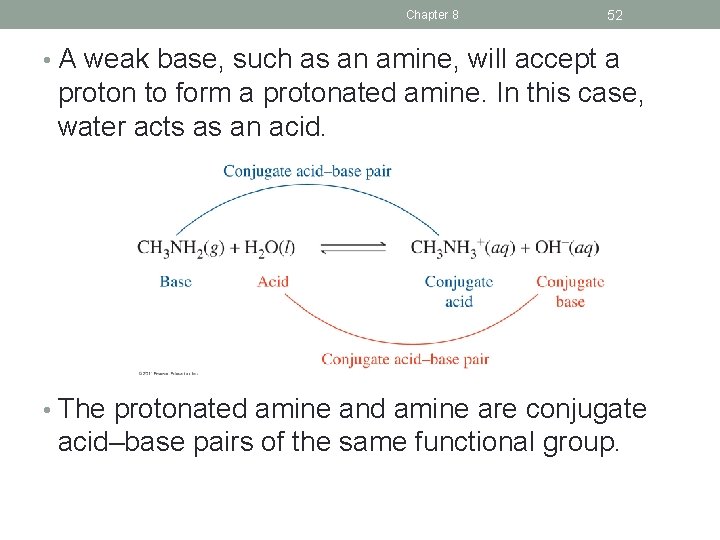
Chapter 8 52 • A weak base, such as an amine, will accept a proton to form a protonated amine. In this case, water acts as an acid. • The protonated amine and amine are conjugate acid–base pairs of the same functional group.
Chapter 8 Objectives for Today ü ü Equilbrium concepts Weak acids and weak bases 53
Chapter 8 OBJECTIVES FOR TODAY q q q Hydronium Ion Concentration and p. H Amino Acids and p. I Buffers in the Body 54
Chapter 8 PH AND THE PH SCALE 55
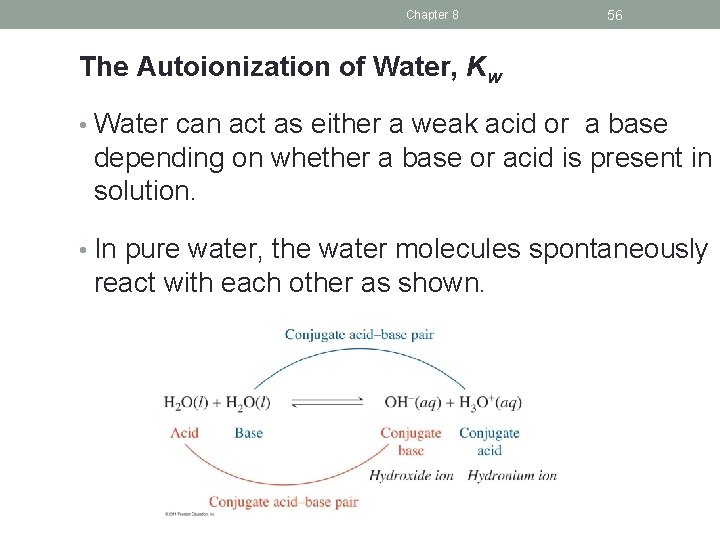
Chapter 8 56 The Autoionization of Water, Kw • Water can act as either a weak acid or a base depending on whether a base or acid is present in solution. • In pure water, the water molecules spontaneously react with each other as shown.
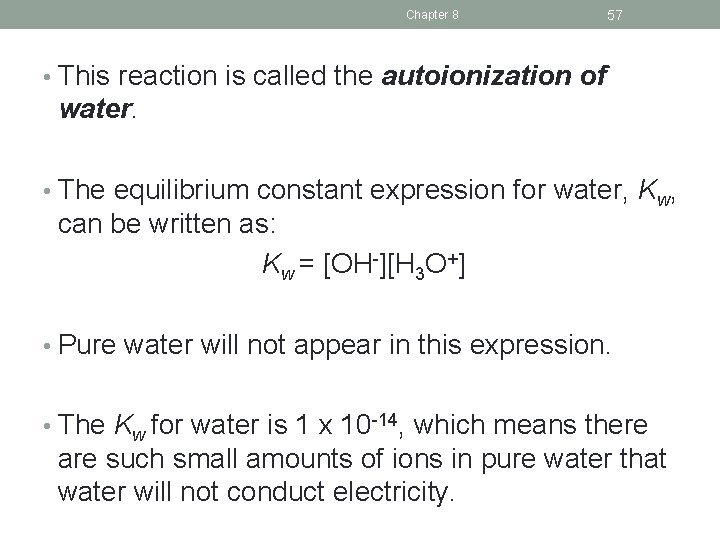
Chapter 8 57 • This reaction is called the autoionization of water. • The equilibrium constant expression for water, Kw, can be written as: Kw = [OH-][H 3 O+] • Pure water will not appear in this expression. • The Kw for water is 1 x 10 -14, which means there are such small amounts of ions in pure water that water will not conduct electricity.
![Chapter 8 58 [H 3 O+], [OH-], and p. H • Pure water has](http://slidetodoc.com/presentation_image_h2/8708eef2199b3c36f49373eaed56f098/image-57.jpg "Chapter 8 58 [H 3 O+], [OH-], and p. H • Pure water has")
Chapter 8 58 [H 3 O+], [OH-], and p. H • Pure water has an equal number of hydroxide and hydronium ions, so [H 3 O+] = [OH-]. At 25 o. C both these values are 1 x 10 -7 M. • When these concentrations are equal, the solution is said to be neutral. • If acid is added to water, there is an increase in [H 3 O+] and a decrease in [OH-], which makes the solution acidic.
![Chapter 8 If a base is added, [OH-] increases and [H 3 O+] decreases,](http://slidetodoc.com/presentation_image_h2/8708eef2199b3c36f49373eaed56f098/image-58.jpg "Chapter 8 If a base is added, [OH-] increases and [H 3 O+] decreases,")
Chapter 8 If a base is added, [OH-] increases and [H 3 O+] decreases, which makes the solution basic. 59
Chapter 8 60 • Most aqueous solutions are not neutral, meaning they have unequal concentrations of H 3 O+ and OH-. • The range of hydronium ion in an aqueous solution can range from 18 M to 1 x 10 -14 M. • Because of this large range, it is more useful to compare [H 3 O+] by a log scale because it gives values that fall between 0 and 14.
Chapter 8 61 Math Matters: Logarithms • The exponent of 10 is the logarithm, or log, of these numbers. For example, the log of 102 = 2; log of 103 = 3, etc. • The purpose of the log function is to show the number of tens places included in a really large or a really small number. • Negative numbers do not have a log value. The log function is described as the log of base 10 because the logs of integers come from numbers that are whole number multiples of 10.
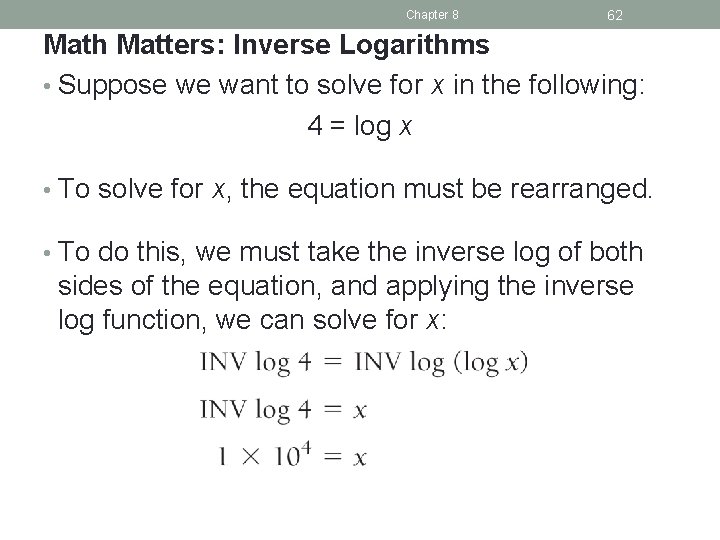
Chapter 8 62 Math Matters: Inverse Logarithms • Suppose we want to solve for x in the following: 4 = log x • To solve for x, the equation must be rearranged. • To do this, we must take the inverse log of both sides of the equation, and applying the inverse log function, we can solve for x:
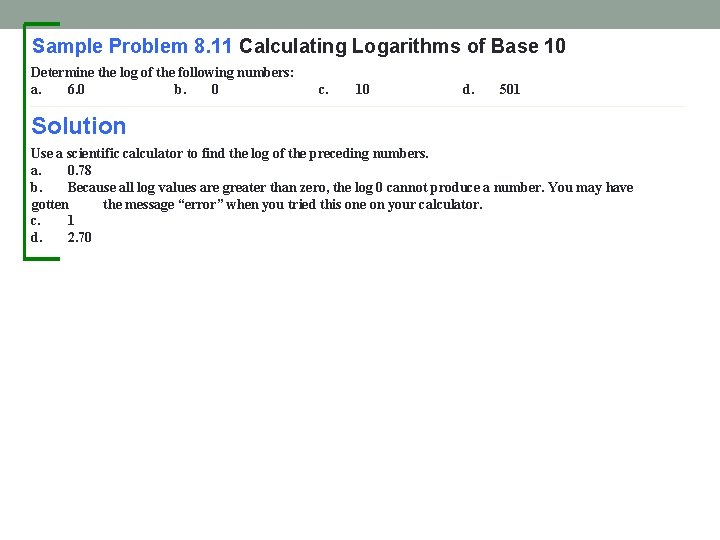
Sample Problem 8. 11 Calculating Logarithms of Base 10 Determine the log of the following numbers: a. 6. 0 b. 0 c. 10 d. 501 Solution Use a scientific calculator to find the log of the preceding numbers. a. 0. 78 b. Because all log values are greater than zero, the log 0 cannot produce a number. You may have gotten the message “error” when you tried this one on your calculator. c. 1 d. 2. 70
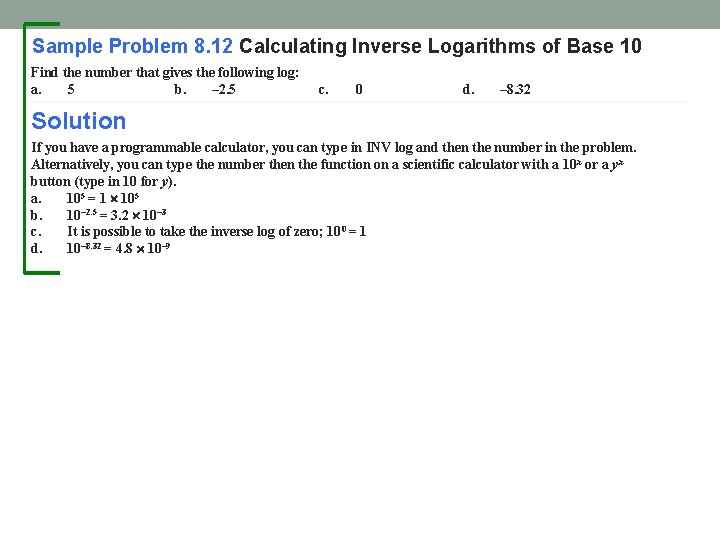
Sample Problem 8. 12 Calculating Inverse Logarithms of Base 10 Find the number that gives the following log: a. 5 b. – 2. 5 c. 0 d. – 8. 32 Solution If you have a programmable calculator, you can type in INV log and then the number in the problem. Alternatively, you can type the number then the function on a scientific calculator with a 10 x or a yx button (type in 10 for y). a. 105 = 1 105 b. 10– 2. 5 = 3. 2 10– 3 c. It is possible to take the inverse log of zero; 100 = 1 d. 10– 8. 32 = 4. 8 10– 9
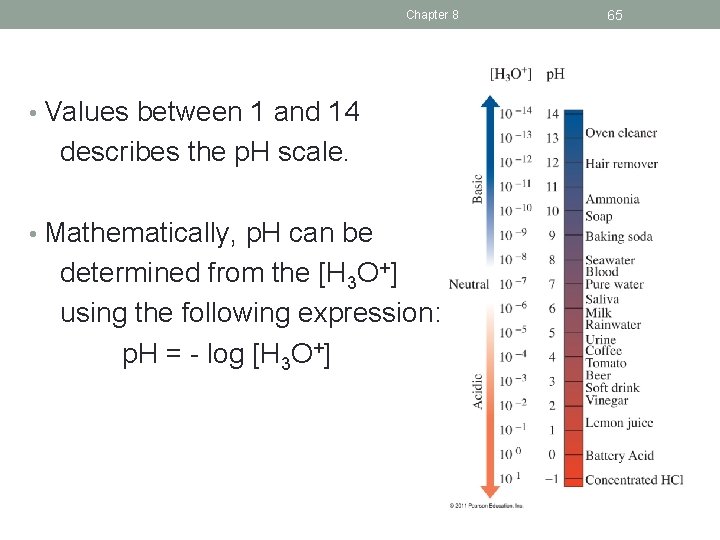
Chapter 8 • Values between 1 and 14 describes the p. H scale. • Mathematically, p. H can be determined from the [H 3 O+] using the following expression: p. H = - log [H 3 O+] 65
![Chapter 8 66 The relationship between p. H and [H 3 O+] are shown](http://slidetodoc.com/presentation_image_h2/8708eef2199b3c36f49373eaed56f098/image-65.jpg "Chapter 8 66 The relationship between p. H and [H 3 O+] are shown")
Chapter 8 66 The relationship between p. H and [H 3 O+] are shown below.
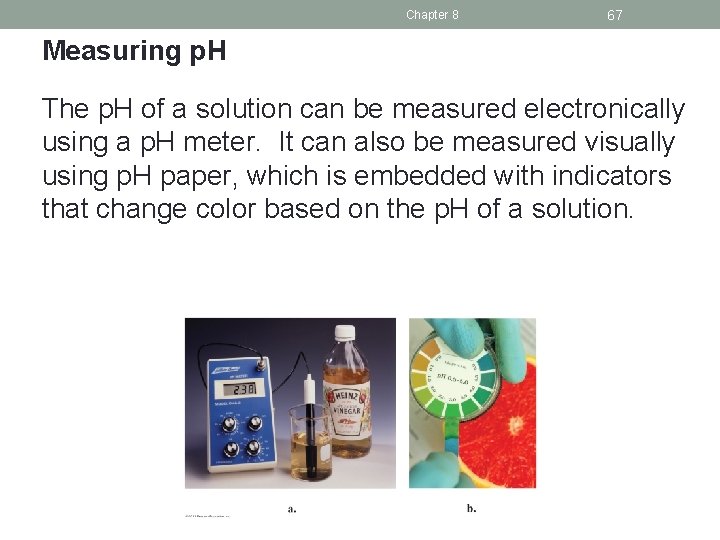
Chapter 8 67 Measuring p. H The p. H of a solution can be measured electronically using a p. H meter. It can also be measured visually using p. H paper, which is embedded with indicators that change color based on the p. H of a solution.
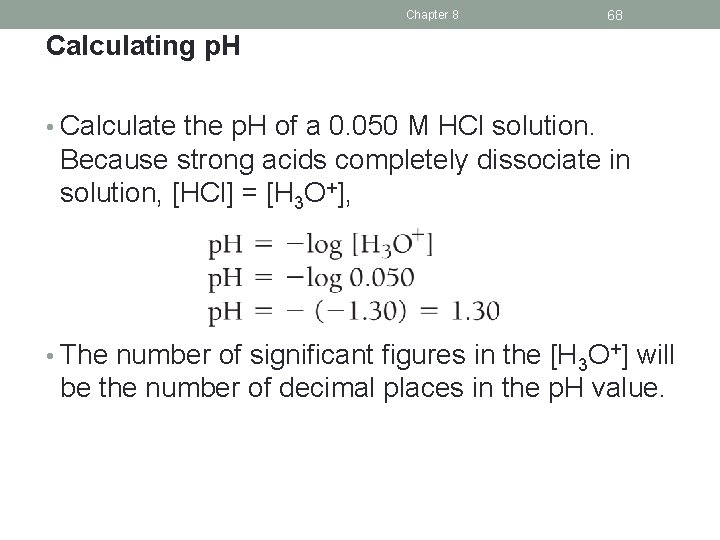
Chapter 8 68 Calculating p. H • Calculate the p. H of a 0. 050 M HCl solution. Because strong acids completely dissociate in solution, [HCl] = [H 3 O+], • The number of significant figures in the [H 3 O+] will be the number of decimal places in the p. H value.
![Chapter 8 69 Calculating [H 3 O+] • If we measure the p. H](http://slidetodoc.com/presentation_image_h2/8708eef2199b3c36f49373eaed56f098/image-68.jpg "Chapter 8 69 Calculating [H 3 O+] • If we measure the p. H")
Chapter 8 69 Calculating [H 3 O+] • If we measure the p. H of a solution to be 3. 00, how do we find the corresponding [H 3 O+] if we know that p. H = - log [H 3 O+]? • Multiply both sides of the equation by negative 1 and the inverse log function, INV log. The inverse log function is 10 x.
![Chapter 8 70 • Solving the equation for [H 3 O+], we have: INV](http://slidetodoc.com/presentation_image_h2/8708eef2199b3c36f49373eaed56f098/image-69.jpg "Chapter 8 70 • Solving the equation for [H 3 O+], we have: INV")
Chapter 8 70 • Solving the equation for [H 3 O+], we have: INV log (-) p. H = [H 3 O+] or alternatively, 10 -p. H = [H 3 O+] • The solution for the [H 3 O+] of a p. H 3. 00 solution is: INV log (-) 3. 00 or 10 -3. 00 = [H 3 O+] 1. 0 x 10 -3 M = [H 3 O+] • The number of significant figures in the [H 3 O+] is:
![Sample Problem 8. 10 The Relationship Between Acidity, p. H, and [H 3 O+]](http://slidetodoc.com/presentation_image_h2/8708eef2199b3c36f49373eaed56f098/image-70.jpg "Sample Problem 8. 10 The Relationship Between Acidity, p. H, and [H 3 O+]")
Sample Problem 8. 10 The Relationship Between Acidity, p. H, and [H 3 O+] State whether solutions with the following conditions would be considered acidic, neutral, or basic. a. p. H = 5. 0 b. [H 3 O+] = 2. 3 10– 9 M c. p. H = 12. 0 + – 4 + – 7 d. [H 3 O ] = 4. 3 10 M e. [H 3 O ] = 1 10 M Solution Refer to Table 8. 6 or Figure 8. 4. a. acidic b. basic c. basic d. acidic e. neutral FIGURE 8. 4 The relationship between [H 3 O+] and p. H of some common substances. Notice that the higher the p. H, the smaller the [H 3 O+] and vice-versa.
![Sample Problem 8. 13 Calculating p. H from [H 3 O+] Determine the p.](http://slidetodoc.com/presentation_image_h2/8708eef2199b3c36f49373eaed56f098/image-71.jpg "Sample Problem 8. 13 Calculating p. H from [H 3 O+] Determine the p.")
Sample Problem 8. 13 Calculating p. H from [H 3 O+] Determine the p. H for the following solutions: a. [H 3 O+] = 1. 0 10– 5 M b. [H 3 O+] = 5 10– 8 M Solution To do these problems, you will be using the log function, log, on your calculator. Depending on the type of scientific calculator that you have, you will be inputting the numbers differently. Check with your instructor if you are having difficulty producing the correct answers using your calculator. a. p. H = –log [H 3 O+] = –log (1. 0 10– 5) = – (– 5. 00) = 5. 00 b. p. H = –log [H 3 O+] = –log (5 10– 8) = – (– 7. 3) = 7. 3
![Sample Problem 8. 14 Calculating [H 3 O+] from a Measured p. H Determine](http://slidetodoc.com/presentation_image_h2/8708eef2199b3c36f49373eaed56f098/image-72.jpg "Sample Problem 8. 14 Calculating [H 3 O+] from a Measured p. H Determine")
Sample Problem 8. 14 Calculating [H 3 O+] from a Measured p. H Determine the [H 3 O+] for solutions having the following measured p. H values: a. p. H = 7. 35 b. p. H = 11. 0 Solution To do these problems, you will be using the inverse log function, either INV log or 10 x, on your calculator. Depending on the type of scientific calculator that you have, you will be inputting the numbers differently. Check with your instructor if you are having difficulty producing the correct answers using your calculator. a. [H 3 O+] = INV log (–p. H) or 10–p. H = INV log (– 7. 35) or 10– 7. 35 = 4. 5 10– 8 M b. [H 3 O+] = INV log (–p. H) or 10–p. H = INV log (– 11. 0) or 10– 11. 0 = 1 10– 11 M
Chapter 8 74 • To determine which acids are strongest, the Ka values can be compared. • As seen with the p. H scale, it is easier to compare whole numbers than those in scientific notation. The p. Ka values are used to measure acid strength. • The lower the p. Ka value, the stronger the acid.
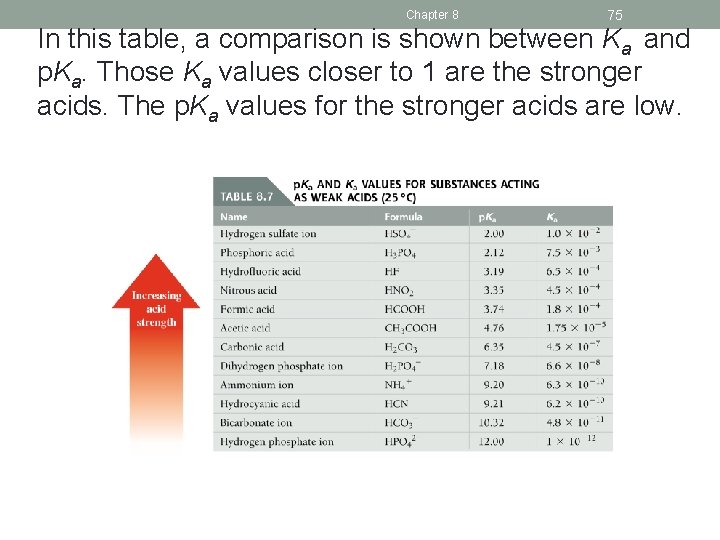
Chapter 8 75 In this table, a comparison is shown between Ka and p. Ka. Those Ka values closer to 1 are the stronger acids. The p. Ka values for the stronger acids are low.
Chapter 8 76 The Relationship between p. H and p. Ka • p. H and p. Ka are two numbers associated with weak acid solutions. • p. Ka gives us the fraction of acid molecules that will dissociate, that is, p. Ka gives the ratio of conjugate base and hydronium ion to weak acid. • p. H tells how much hydronium ion is present in solution.
Chapter 8 77 • At constant temperature, p. Ka does not change if an acid or a base is added to a weak acid solution, however the p. H does change if an acid or a base is added to a weak acid solution. • Consider an acetic acid solution at three different p. H’s: 1. A p. H below the p. Ka 2. A p. H equal to p. Ka 3. A p. H above the p. Ka
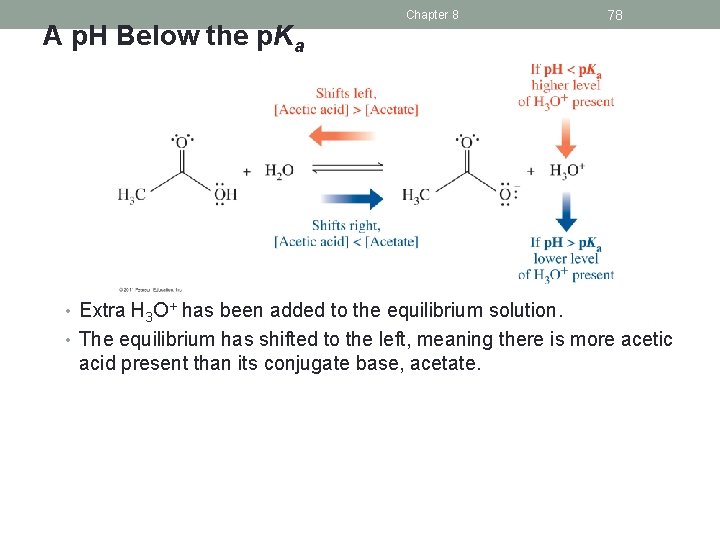
A p. H Below the p. Ka Chapter 8 78 • Extra H 3 O+ has been added to the equilibrium solution. • The equilibrium has shifted to the left, meaning there is more acetic acid present than its conjugate base, acetate.
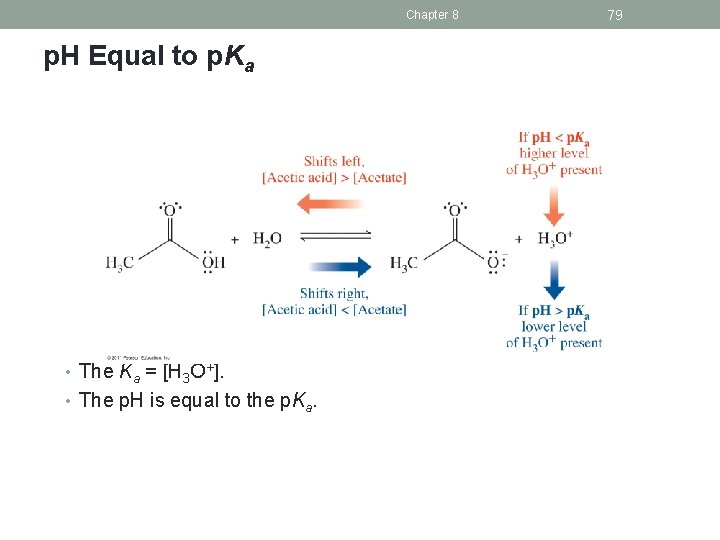
Chapter 8 p. H Equal to p. Ka • The Ka = [H 3 O+]. • The p. H is equal to the p. Ka. 79
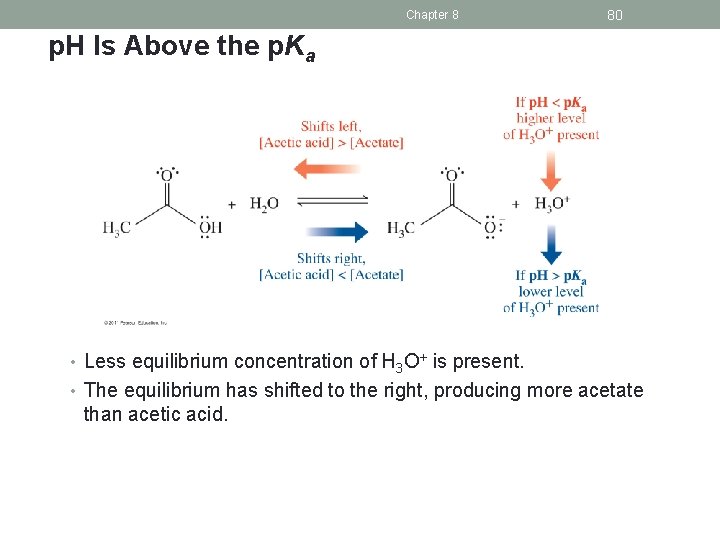
Chapter 8 80 p. H Is Above the p. Ka • Less equilibrium concentration of H 3 O+ is present. • The equilibrium has shifted to the right, producing more acetate than acetic acid.
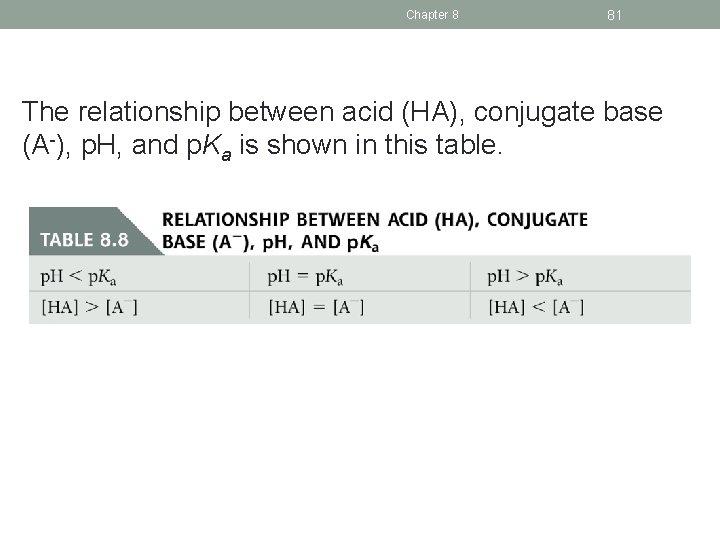
Chapter 8 81 The relationship between acid (HA), conjugate base (A-), p. H, and p. Ka is shown in this table.
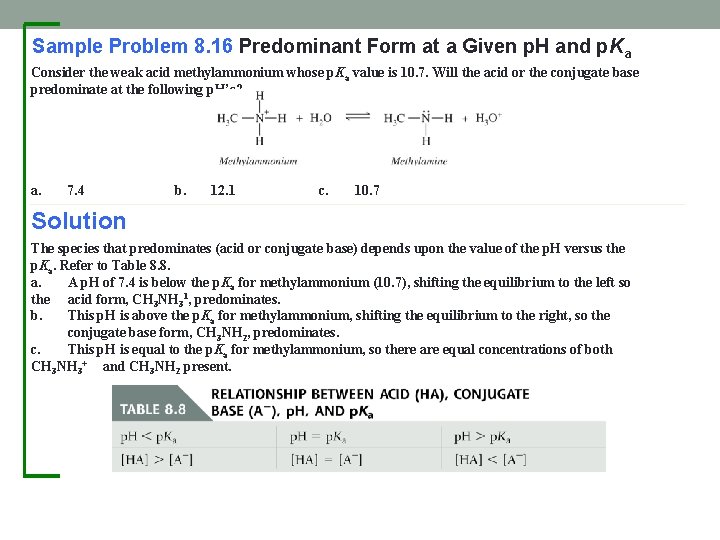
Sample Problem 8. 16 Predominant Form at a Given p. H and p. Ka Consider the weak acid methylammonium whose p. Ka value is 10. 7. Will the acid or the conjugate base predominate at the following p. H’s? a. 7. 4 b. 12. 1 c. 10. 7 Solution The species that predominates (acid or conjugate base) depends upon the value of the p. H versus the p. Ka. Refer to Table 8. 8. a. A p. H of 7. 4 is below the p. Ka for methylammonium (10. 7), shifting the equilibrium to the left so the acid form, CH 3 NH 31, predominates. b. This p. H is above the p. Ka for methylammonium, shifting the equilibrium to the right, so the conjugate base form, CH 3 NH 2, predominates. c. This p. H is equal to the p. Ka for methylammonium, so there are equal concentrations of both CH 3 NH 3+ and CH 3 NH 2 present.
Chapter 8 AMINO ACIDS AND PI 83
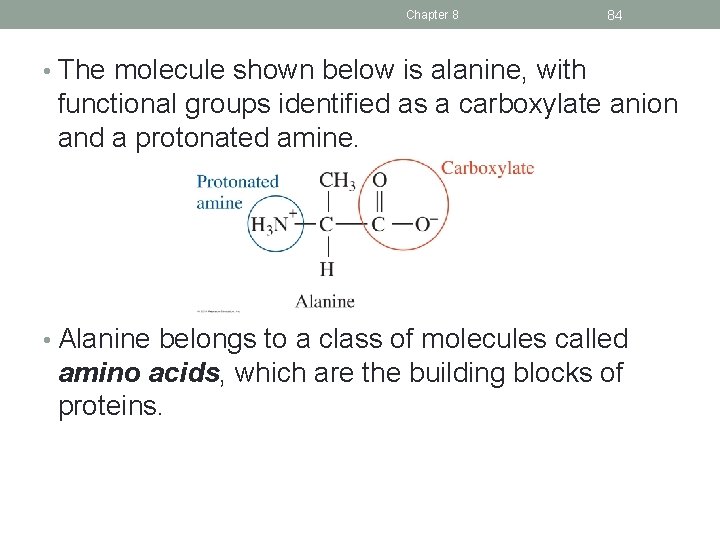
Chapter 8 84 • The molecule shown below is alanine, with functional groups identified as a carboxylate anion and a protonated amine. • Alanine belongs to a class of molecules called amino acids, which are the building blocks of proteins.
Chapter 8 85 • Why is alanine shown with a carboxylate group and a protonated amine rather than a carboxylic acid group and amine group, respectively? • The p. Ka value for the carboxylic acid is 2. 3, below physiological p. H, so the conjugate base form predominates. The p. Ka value for the amine group is 9. 7, above physiological p. H, so the conjugate acid predominates. • This ionic form with no net ionic charge is called a zwitterion.
Chapter 8 86 • Amino acids and other biological molecules contain more than one weak acid group and have more than one p. Ka value. • With more than one p. Ka value, these molecules exist in different acid/conjugate base forms depending on the p. H of the solution. • These molecules have a unique p. H at which the zwitterion is the predominate form. This point is called the isoelectric point (p. I).
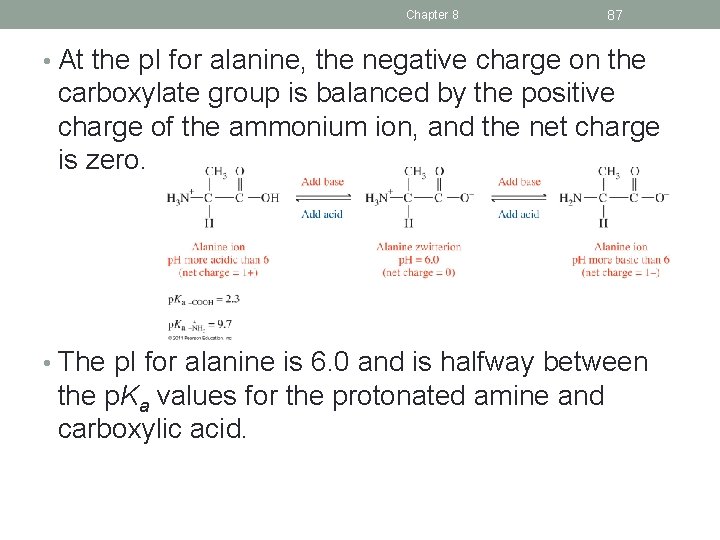
Chapter 8 87 • At the p. I for alanine, the negative charge on the carboxylate group is balanced by the positive charge of the ammonium ion, and the net charge is zero. • The p. I for alanine is 6. 0 and is halfway between the p. Ka values for the protonated amine and carboxylic acid.
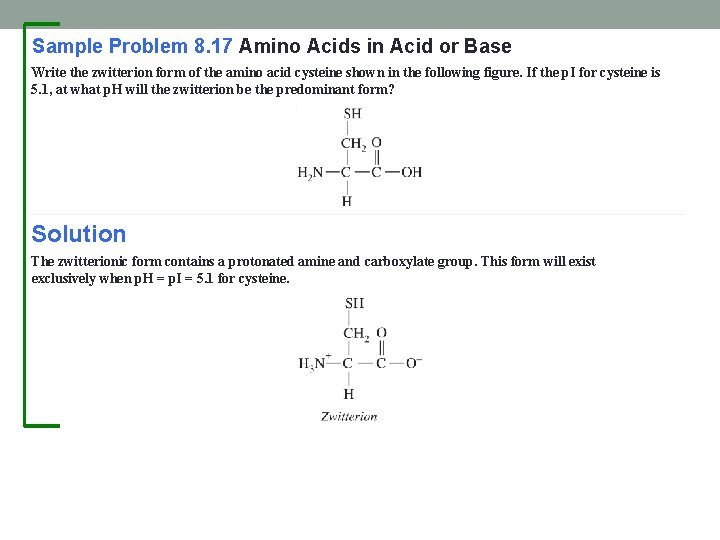
Sample Problem 8. 17 Amino Acids in Acid or Base Write the zwitterion form of the amino acid cysteine shown in the following figure. If the p. I for cysteine is 5. 1, at what p. H will the zwitterion be the predominant form? Solution The zwitterionic form contains a protonated amine and carboxylate group. This form will exist exclusively when p. H = p. I = 5. 1 for cysteine.

Chapter 8 BUFFERS 89
Chapter 8 90 • Our bodies operate under strict conditions of temperature, concentration, and p. H. • How do our bodies maintain p. H in our bloodstream when we consume a variety of foods at different p. H’s? • Our bodies contain solutions of weak acids, containing both acids and conjugate bases, to help neutralize incoming acids and bases.
Chapter 8 91 • A buffer is a solution that contains both a weak acid and its conjugate base, or a base and its conjugate acid. • A buffer will resist a change in p. H if small amounts of an acid or a base are added. • Buffers are what helps our body maintain the proper p. H in our bloodstream when we consume a variety foods at different p. H’s.
Chapter 8 92 • The bicarbonate buffer system is the main buffer system in our blood. • Dissolved CO 2, produced during cellular respiration, is equilibrated through carbonic acid into bicarbonate ions prior to exhalation at the lungs. • The intermediates, carbonic acid and water, are often omitted since they are short lived in the reaction.
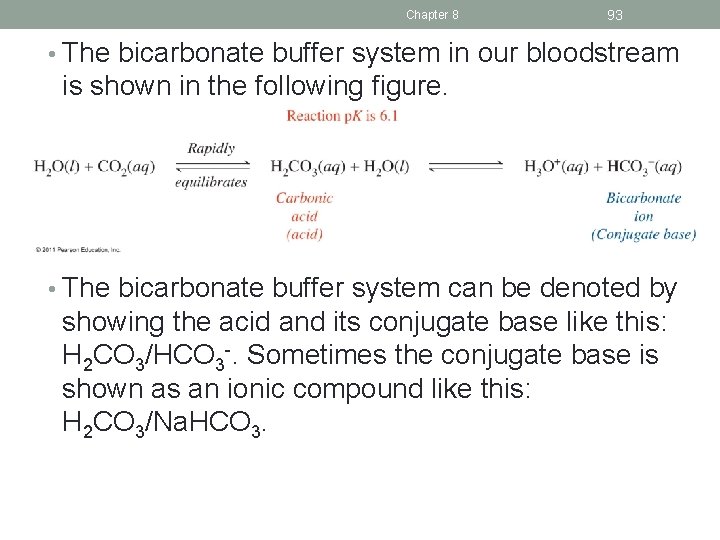
Chapter 8 93 • The bicarbonate buffer system in our bloodstream is shown in the following figure. • The bicarbonate buffer system can be denoted by showing the acid and its conjugate base like this: H 2 CO 3/HCO 3 -. Sometimes the conjugate base is shown as an ionic compound like this: H 2 CO 3/Na. HCO 3.
Chapter 8 94 Maintaining Physiological p. H with Bicarbonate Buffer: Homeostasis • The bicarbonate system helps our bodies maintain its optimal physiological p. H. • The ability of an organism to maintain its internal environment by adjusting such factors as p. H, temperature, and solute concentration is called homeostasis.

Chapter 8 CHANGES IN VENTILATION RATE 95
Chapter 8 96 Respiratory Acidosis • In normal breathing, carbon dioxide is removed from the bloodstream and blood p. H is maintained. • A person who hypoventilates may fail to remove enough carbon dioxide due to shallow breathing causing carbon dioxide to build up in the bloodstream. • A buildup of carbon dioxide in the bloodstream makes the blood more acidic, a condition that is known as respiratory acidosis.
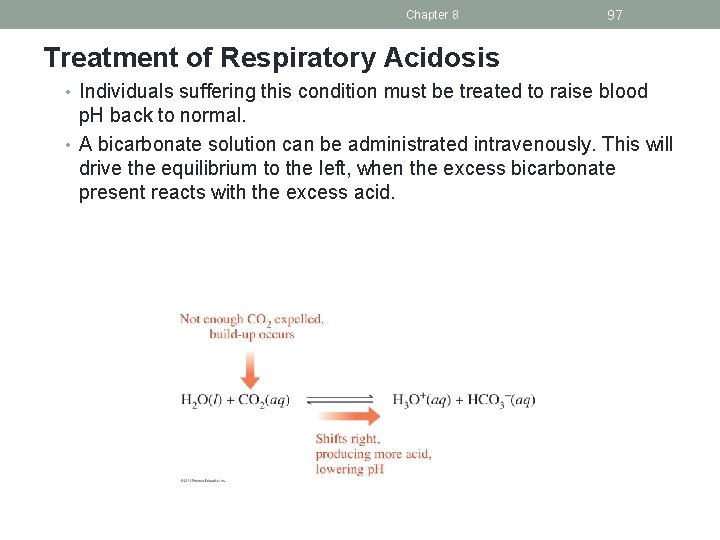
Chapter 8 97 Treatment of Respiratory Acidosis • Individuals suffering this condition must be treated to raise blood p. H back to normal. • A bicarbonate solution can be administrated intravenously. This will drive the equilibrium to the left, when the excess bicarbonate present reacts with the excess acid.
Chapter 8 98 Respiratory Alkalosis • A person who hyperventilates will exhale too much carbon dioxide from the lungs. • This will draw H 3 O+ from the bloodstream, making the blood more basic. This condition is known as respiratory alkalosis. • This condition necessitates getting more carbon dioxide back into the bloodstream, which can be done by having the person breathe into a paper bag.
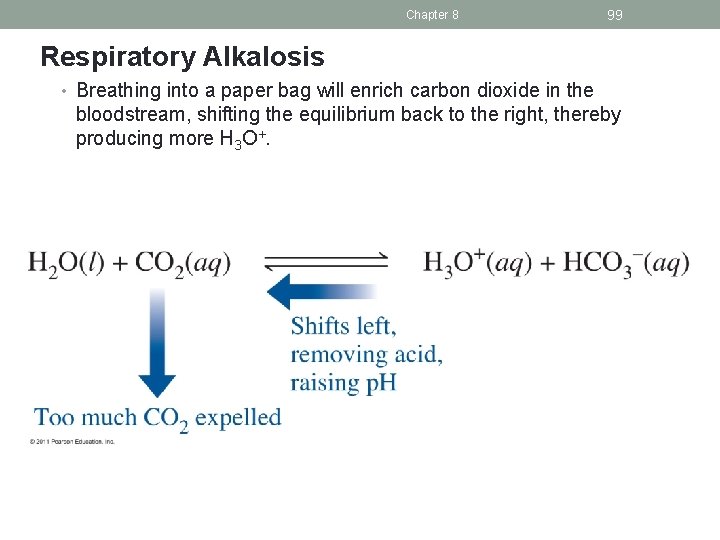
Chapter 8 99 Respiratory Alkalosis • Breathing into a paper bag will enrich carbon dioxide in the bloodstream, shifting the equilibrium back to the right, thereby producing more H 3 O+.

Chapter 8 100 CHANGES IN METABOLIC ACID PRODUCTION
Chapter 8 • Chemical reactions in the body change the p. H of blood by producing too much or too little H 3 O+. • An imbalance by chemical reactions in the body is termed metabolic acidosis or metabolic alkalosis. 101
Chapter 8 102 Metabolic Acidosis • Example: since diabetics use less glucose for energy production, they rely on fatty acids as an energy source. A by-product of fatty acid breakdown is acid production. • This imbalance caused by chemical reactions in the body is termed metabolic acidosis.
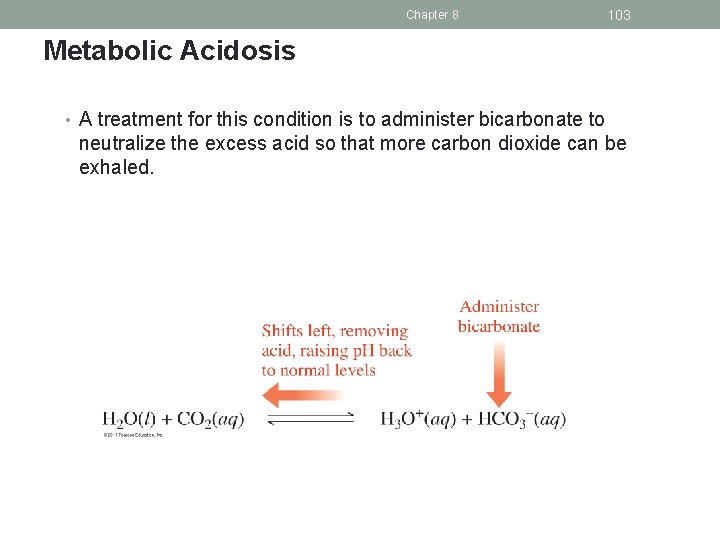
Chapter 8 103 Metabolic Acidosis • A treatment for this condition is to administer bicarbonate to neutralize the excess acid so that more carbon dioxide can be exhaled.
Chapter 8 104 Metabolic Alkalosis • If the blood is basic, the body is losing too much acid, a condition known as metabolic alkalosis. • Metabolic alkalosis occurs under conditions of excess vomiting. • • To lower the p. H back to normal, ammonium chloride (a weak acid) can be administrated.
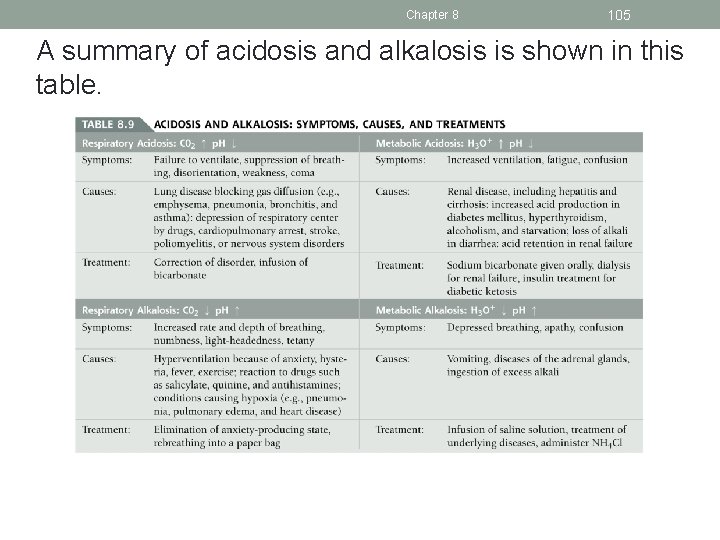
Chapter 8 105 A summary of acidosis and alkalosis is shown in this table.
Chapter 8 OBJECTIVES FOR TODAY ü ü ü Hydronium Ion Concentration and p. H Amino Acids and p. I Buffers in the Body 106
Chapter Summary Chapter 8 107 8. 1 Acids and Bases—Definitions • Arrhenius defines acids as producing H+ and defines bases as producing OH-. • Brønsted–Lowry defines acids as H+ donors and bases as H+ acceptors. • H+, a proton, forms a hydronium ion with a water molecule.
Chapter Summary, Continued Chapter 8 108 8. 2 Strong Acids and Bases • Strong acids and bases completely dissociate in solution. • Water can act as either an acid or base. • Neutralization reactions occur when a strong acid combines with a strong base. Products are a salt and water. • Antacids are basic and neutralize stomach acid.
Chapter Summary, Continued Chapter 8 109 8. 3 Chemical Equilibrium • When forward and reverse reactions occur at the same rate, a chemical equilibrium is established. • K, equilibrium constant, defines the extent of a chemical reaction. • If a chemical reaction at equilibrium is stressed, the reaction regains equilibrium according to Le Châtelier’s principle.
Chapter Summary, Continued Chapter 8 110 8. 3 Chemical Equilibrium, Continued • Endothermic reactions require heat in order to occur. • Exothermic reactions give off heat when they occur.
Chapter Summary, Continued Chapter 8 111 8. 4 Weak Acids and Bases • Weak acids partially ionize in solution and have an equilibrium constant called the acid dissociation constant, Ka. • Weak acids produce a conjugate base when they dissociate, and weak bases produce a conjugate acid when they dissociate. These are referred to as conjugate acid–base pairs. • Strong acids have high Ka values.
Chapter Summary, Continued Chapter 8 112 8. 5 p. H and the p. H Scale • When water ionizes it produces hydronium ions and hydroxide ions. • When these ions are of equal concentration, a neutral solution exists. • An excess of hydronium ions produces an acidic solution and an excess of hydroxide ions produces a basic solution.
Chapter Summary, Continued Chapter 8 113 8. 5 p. H and the p. H Scale, Continued • The p. H scale is a measure of acidity with values between 0– 14. Neutral solutions have a p. H of 7, acidic solutions have values less than 7, and basic solutions have values greater than 7. • p. H can be measured with a p. H meter or using p. H paper. • Mathematically written, p. H = -log [H 3 O+].
Chapter Summary, Continued Chapter 8 114 8. 6 p. Ka • p. Ka is a constant for a specific weak acid at a certain temperature. • If the p. H of a solution is the same as the p. Ka value of a weak acid, then the acid and conjugate base forms are present in equal amounts. • If p. H is higher than p. Ka, the conjugate base predominates in solution.
Chapter Summary, Continued Chapter 8 115 8. 6 p. Ka, Continued If p. H is lower than p. Ka, the acid form predominates in solution.
Chapter Summary, Continued Chapter 8 116 8. 7 Amino Acids: Common Biological Weak Acids • Amino acids contain an acid and base functional group. • Amino acids are building blocks of proteins. • Since amino acids contain both carboxylate and protonated amine functional groups at physiological p. H, they have a net charge of zero and are called a zwitterion. • The isoelectric point is the p. H where the zwitterion exists.
Chapter Summary, Continued Chapter 8 117 8. 8 Buffers: An Important Property of Weak Acids and Bases • Buffers resist changes in p. H when an acid or a base is added to a solution. • Buffer solutions consist of weak acids and their conjugate base. Strong acids cannot be buffers. • If p. H of blood drops below the normal range of 7. 35– 7. 45 a condition called acidosis occurs.
Chapter Summary, Continued Chapter 8 118 8. 8 Buffers: An Important Property of Weak Acids and Bases, Continued • If blood p. H becomes elevated, a condition called alkalosis exists. • Acidosis can be caused by changes in breathing or by changes in metabolism, causing acid to build up in the bloodstream. Alkalosis is caused by acid being removed from the bloodstream.
- Slides: 117