
Chapter 8 Acids and Bases 1 8 6
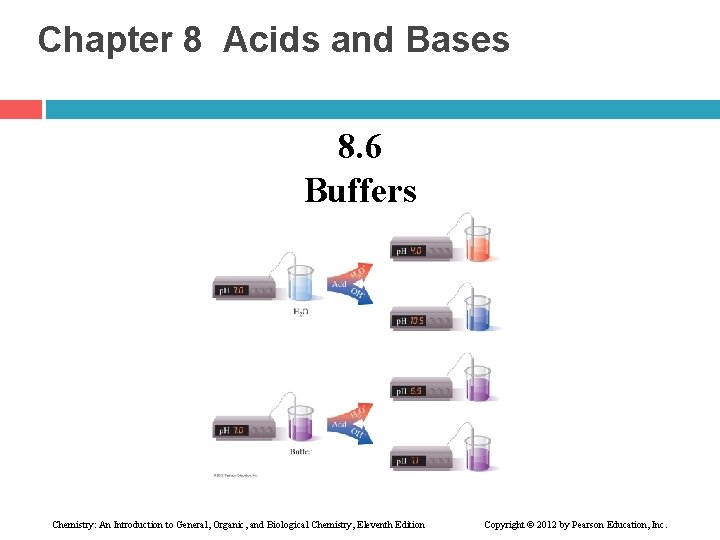
Chapter 8 Acids and Bases 1 8. 6 Buffers Chemistry: An Introduction to General, Organic, and Biological Chemistry, Eleventh Edition Copyright © 2012 by Pearson Education, Inc.
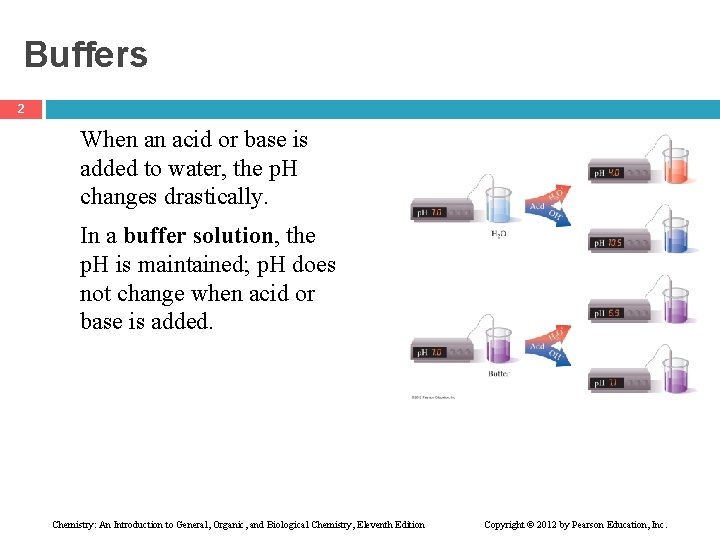
Buffers 2 When an acid or base is added to water, the p. H changes drastically. In a buffer solution, the p. H is maintained; p. H does not change when acid or base is added. Chemistry: An Introduction to General, Organic, and Biological Chemistry, Eleventh Edition Copyright © 2012 by Pearson Education, Inc.
How Buffers Work 3 Buffers work because they • resist changes in p. H from the addition of acid or base • in the body, absorb H 3 O+ or OH from foods and cellular processes to maintain p. H • are important in the proper functioning of cells and blood • maintain a p. H close to 7. 4 in blood. A change in the p. H of the blood affects the uptake of oxygen and cellular processes Chemistry: An Introduction to General, Organic, and Biological Chemistry, Eleventh Edition Copyright © 2012 by Pearson Education, Inc.
Components of a Buffer 4 A buffer solution • contains a combination of acid–base conjugate pairs For example: HA and Na. A • may contain a weak acid and a salt of its conjugate base • typically has equal concentrations of a weak acid and its salt • may also contain a weak base and a salt of the conjugate acid Chemistry: An Introduction to General, Organic, and Biological Chemistry, Eleventh Edition Copyright © 2012 by Pearson Education, Inc.
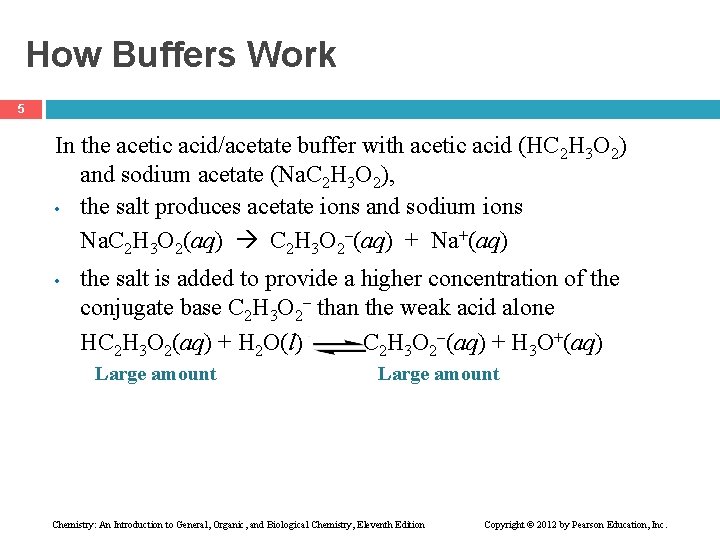
How Buffers Work 5 In the acetic acid/acetate buffer with acetic acid (HC 2 H 3 O 2) and sodium acetate (Na. C 2 H 3 O 2), • the salt produces acetate ions and sodium ions Na. C 2 H 3 O 2(aq) C 2 H 3 O 2 (aq) + Na+(aq) • the salt is added to provide a higher concentration of the conjugate base C 2 H 3 O 2 than the weak acid alone HC 2 H 3 O 2(aq) + H 2 O(l) C 2 H 3 O 2 (aq) + H 3 O+(aq) Large amount Chemistry: An Introduction to General, Organic, and Biological Chemistry, Eleventh Edition Copyright © 2012 by Pearson Education, Inc.
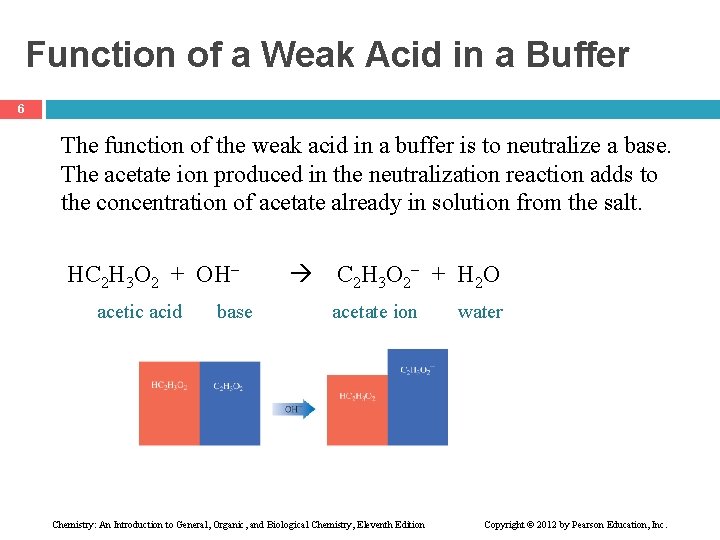
Function of a Weak Acid in a Buffer 6 The function of the weak acid in a buffer is to neutralize a base. The acetate ion produced in the neutralization reaction adds to the concentration of acetate already in solution from the salt. HC 2 H 3 O 2 + OH acetic acid base C 2 H 3 O 2 + H 2 O acetate ion Chemistry: An Introduction to General, Organic, and Biological Chemistry, Eleventh Edition water Copyright © 2012 by Pearson Education, Inc.
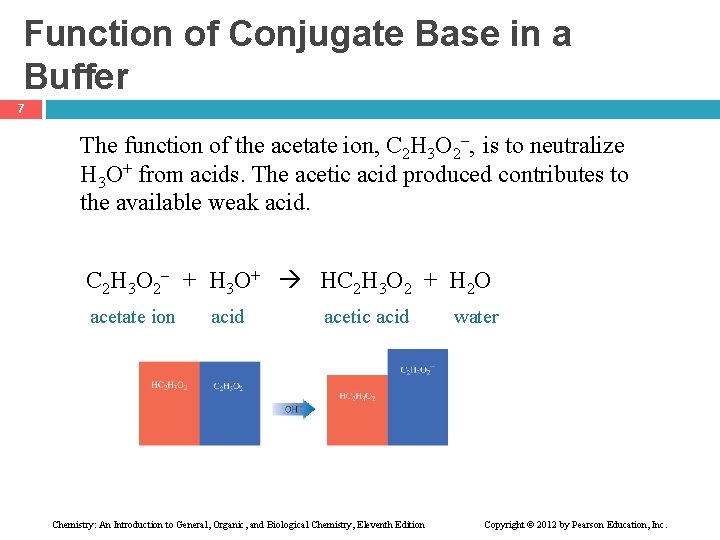
Function of Conjugate Base in a Buffer 7 The function of the acetate ion, C 2 H 3 O 2 , is to neutralize H 3 O+ from acids. The acetic acid produced contributes to the available weak acid. C 2 H 3 O 2 + H 3 O+ HC 2 H 3 O 2 + H 2 O acetate ion acid acetic acid Chemistry: An Introduction to General, Organic, and Biological Chemistry, Eleventh Edition water Copyright © 2012 by Pearson Education, Inc.
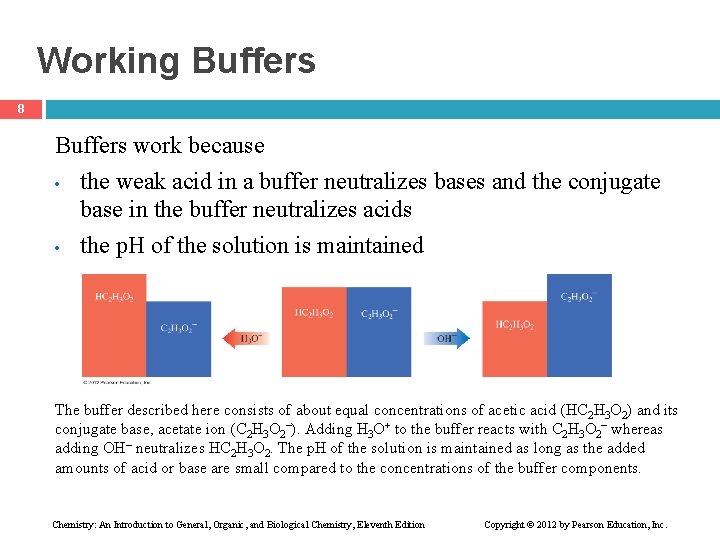
Working Buffers 8 Buffers work because • the weak acid in a buffer neutralizes bases and the conjugate base in the buffer neutralizes acids • the p. H of the solution is maintained The buffer described here consists of about equal concentrations of acetic acid (HC 2 H 3 O 2) and its conjugate base, acetate ion (C 2 H 3 O 2 ). Adding H 3 O+ to the buffer reacts with C 2 H 3 O 2 whereas adding OH neutralizes HC 2 H 3 O 2. The p. H of the solution is maintained as long as the added amounts of acid or base are small compared to the concentrations of the buffer components. Chemistry: An Introduction to General, Organic, and Biological Chemistry, Eleventh Edition Copyright © 2012 by Pearson Education, Inc.
Learning Check 9 Which of the following combinations make a buffer solution? A. HCl and KCl B. H 2 CO 3 and Na. HCO 3 C. H 3 PO 4 and Na. Cl D. HC 2 H 3 O 2 and KC 2 H 3 O 2 Chemistry: An Introduction to General, Organic, and Biological Chemistry, Eleventh Edition Copyright © 2012 by Pearson Education, Inc.
Solution 10 Which of the following combinations make a buffer solution? A buffer consists of a weak acid and salt of its conjugate base. A. B. C. D. HCl and KCl H 2 CO 3 and Na. HCO 3 H 3 PO 4 and Na. Cl HC 2 H 3 O 2 and KC 2 H 3 O 2 Not a buffer. Buffer, a weak acid and its salt. Chemistry: An Introduction to General, Organic, and Biological Chemistry, Eleventh Edition Copyright © 2012 by Pearson Education, Inc.
- Slides: 10