
Chapter 8 Achieving Operational Excellence and Customer Intimacy


- Slides: 29
Chapter 8 Achieving Operational Excellence and Customer Intimacy: Enterprise Applications 6. 1 Copyright © 2014 Pearson Education publishing as Prentice Hall
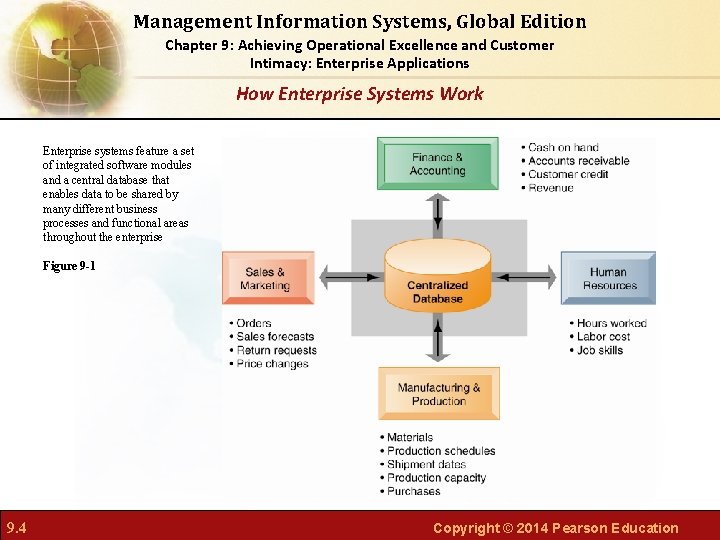
Management Information Systems, Global Edition Chapter 9: Achieving Operational Excellence and Customer Intimacy: Enterprise Applications Enterprise Systems • Enterprise Systems – Enterprise resource planning (ERP) systems – Suite of integrated software modules and a common central database – Collects data from many divisions of firm for use in nearly all of firm’s internal business activities – Information entered in one process is immediately available for other processes – (c. f. Triangle diagram + 4 functions) – manufacturing view of sales data enables planning of resources for future production. Sales view of manufacturing allows visibility of stock levels. 9. 2 Copyright © 2014 Pearson Education
Management Information Systems, Global Edition Chapter 9: Achieving Operational Excellence and Customer Intimacy: Enterprise Applications Enterprise Systems • Enterprise Software – Built around thousands of predefined business processes that reflect best practices • Finance and accounting • Human resources • Manufacturing and production • Sales and marketing – Can help standardize a global company onto standard business processes (big savings come with centralized IT processes) – To implement, firms: • Select functions of system they wish to use. • Map business processes to software processes. – Use software’s configuration tables for customizing. – Main suppliers are Oracle (e-Business Suite, SAP, Microsoft Dynamics) + lots of others with smaller market share – some specialization for particular industries 9. 3 Copyright © 2014 Pearson Education
Management Information Systems, Global Edition Chapter 9: Achieving Operational Excellence and Customer Intimacy: Enterprise Applications How Enterprise Systems Work Enterprise systems feature a set of integrated software modules and a central database that enables data to be shared by many different business processes and functional areas throughout the enterprise Figure 9 -1 9. 4 Copyright © 2014 Pearson Education
Management Information Systems, Global Edition Chapter 9: Achieving Operational Excellence and Customer Intimacy: Enterprise Applications Enterprise Systems • Business value of enterprise systems – Increase operational efficiency • • MP->Sales ; what have we sold? Sales -> MP; what have we got in stock Finance -> sales; what have we sold, sales projections HR -> sales+MP; how many staff needed; what training? – Provide firm-wide information to support decision making – Enable rapid responses to customer requests for information or products – Include analytical tools to evaluate overall organizational performance 9. 5 Copyright © 2014 Pearson Education
Management Information Systems, Global Edition Chapter 9: Achieving Operational Excellence and Customer Intimacy: Enterprise Applications Supply Chain Management Systems • Supply Chain Management – Supply chains can be very large and complex for many companies • Over 50% of operating costs can occur in the supply chain – Can extend to many thousands of organizations and many countries – Getting this right can create big competitive advantage – Network of organizations and processes for: • Procuring materials, transforming them into products, and distributing the products – Upstream supply chain: • Firm’s suppliers, suppliers’ suppliers, processes for managing relationships with them – Downstream supply chain: • Organizations and processes responsible for delivering products to customers – Internal supply chain 9. 6 Copyright © 2014 Pearson Education
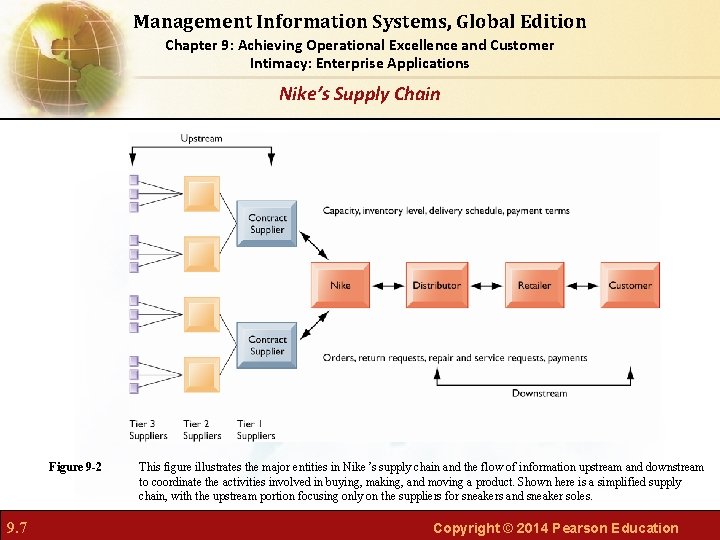
Management Information Systems, Global Edition Chapter 9: Achieving Operational Excellence and Customer Intimacy: Enterprise Applications Nike’s Supply Chain Figure 9 -2 9. 7 This figure illustrates the major entities in Nike’s supply chain and the flow of information upstream and downstream to coordinate the activities involved in buying, making, and moving a product. Shown here is a simplified supply chain, with the upstream portion focusing only on the suppliers for sneakers and sneaker soles. Copyright © 2014 Pearson Education
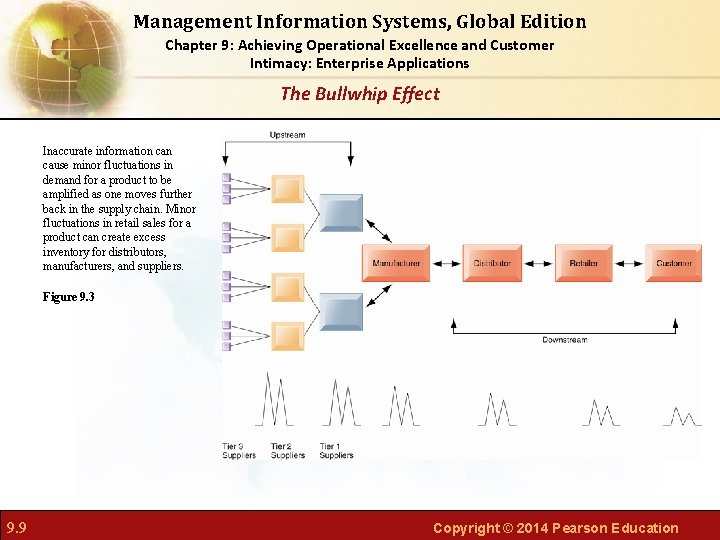
Management Information Systems, Global Edition Chapter 9: Achieving Operational Excellence and Customer Intimacy: Enterprise Applications Supply Chain Management Systems • Supply Chain Management – Inefficiencies cut into a company’s operating costs • Can waste up to 25% of operating expenses – Just-in-time strategy: • Components arrive as they are needed • Finished goods shipped after leaving assembly line – Safety stock: Buffer for lack of flexibility in supply chain – Bullwhip effect • Information about product demand gets distorted as it passes from one entity to next across supply chain 9. 8 Copyright © 2014 Pearson Education
Management Information Systems, Global Edition Chapter 9: Achieving Operational Excellence and Customer Intimacy: Enterprise Applications The Bullwhip Effect Inaccurate information cause minor fluctuations in demand for a product to be amplified as one moves further back in the supply chain. Minor fluctuations in retail sales for a product can create excess inventory for distributors, manufacturers, and suppliers. Figure 9. 3 9. 9 Copyright © 2014 Pearson Education
Management Information Systems, Global Edition Chapter 9: Achieving Operational Excellence and Customer Intimacy: Enterprise Applications Supply Chain Management Systems • Supply Chain Management Software – Supply chain planning systems • Model existing supply chain • Enable demand planning • Optimize sourcing, manufacturing plans • Establish inventory levels • Identify transportation modes – Supply chain execution systems • Manage flow of products through distribution centers and warehouses 9. 10 Copyright © 2014 Pearson Education
Management Information Systems, Global Edition Chapter 9: Achieving Operational Excellence and Customer Intimacy: Enterprise Applications Supply Chain Management Systems • Global supply chain issues – Greater geographical distances – Greater time differences – Participants from different countries • Different performance standards • Different legal requirements • Internet helps manage global complexities – – 9. 11 Warehouse management Transportation management Logistics Outsourcing Copyright © 2014 Pearson Education
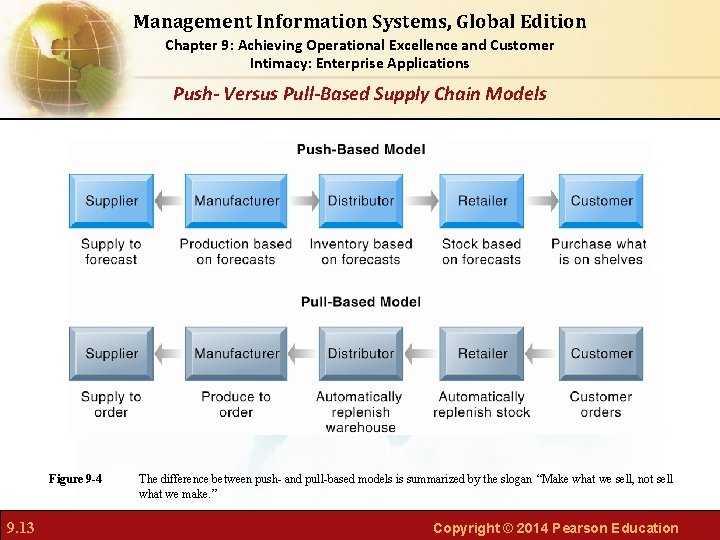
Management Information Systems, Global Edition Chapter 9: Achieving Operational Excellence and Customer Intimacy: Enterprise Applications Supply Chain Management Systems • Supply chain management – Push-based model (build-to-stock) • Earlier SCM systems • Schedules based on best guesses of demand – Pull-based model (demand-driven) • Web-based • Customer orders trigger events in supply chain – Internet enables move from sequential supply chains to concurrent supply chains • Complex networks of suppliers can adjust immediately 9. 12 Copyright © 2014 Pearson Education
Management Information Systems, Global Edition Chapter 9: Achieving Operational Excellence and Customer Intimacy: Enterprise Applications Push- Versus Pull-Based Supply Chain Models Figure 9 -4 9. 13 The difference between push- and pull-based models is summarized by the slogan “Make what we sell, not sell what we make. ” Copyright © 2014 Pearson Education
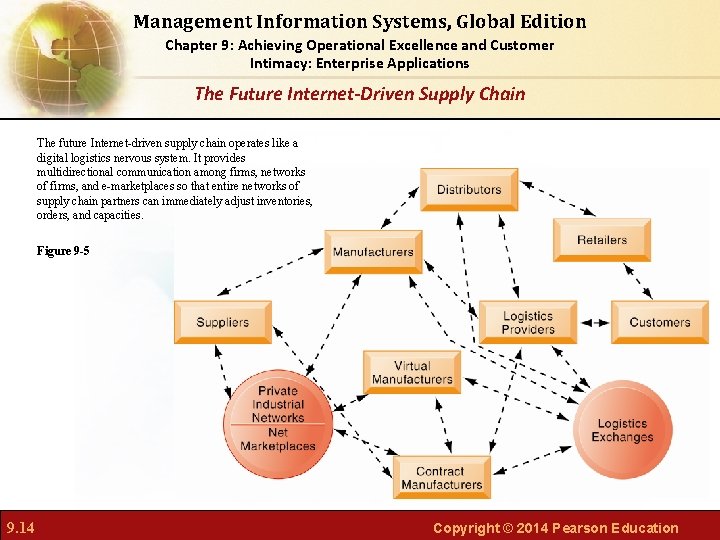
Management Information Systems, Global Edition Chapter 9: Achieving Operational Excellence and Customer Intimacy: Enterprise Applications The Future Internet-Driven Supply Chain The future Internet-driven supply chain operates like a digital logistics nervous system. It provides multidirectional communication among firms, networks of firms, and e-marketplaces so that entire networks of supply chain partners can immediately adjust inventories, orders, and capacities. Figure 9 -5 9. 14 Copyright © 2014 Pearson Education
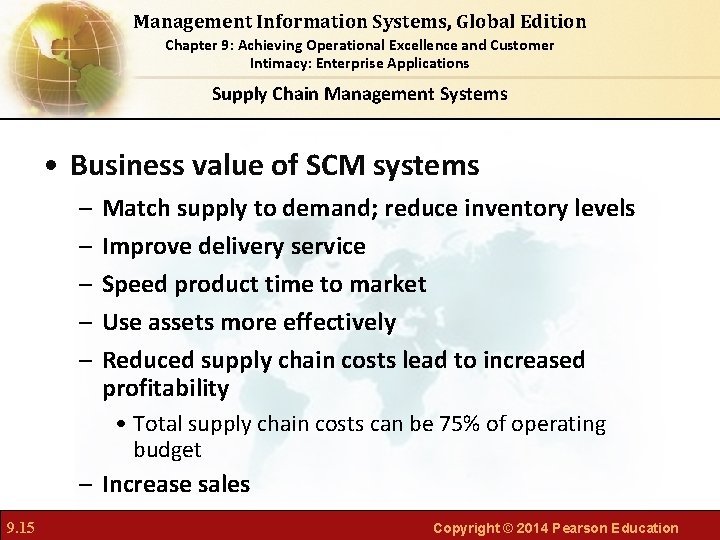
Management Information Systems, Global Edition Chapter 9: Achieving Operational Excellence and Customer Intimacy: Enterprise Applications Supply Chain Management Systems • Business value of SCM systems – – – Match supply to demand; reduce inventory levels Improve delivery service Speed product time to market Use assets more effectively Reduced supply chain costs lead to increased profitability • Total supply chain costs can be 75% of operating budget – Increase sales 9. 15 Copyright © 2014 Pearson Education
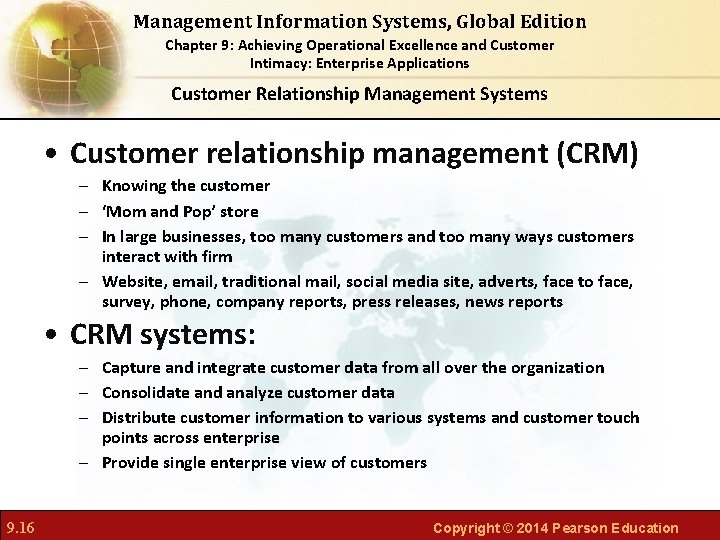
Management Information Systems, Global Edition Chapter 9: Achieving Operational Excellence and Customer Intimacy: Enterprise Applications Customer Relationship Management Systems • Customer relationship management (CRM) – Knowing the customer – ‘Mom and Pop’ store – In large businesses, too many customers and too many ways customers interact with firm – Website, email, traditional mail, social media site, adverts, face to face, survey, phone, company reports, press releases, news reports • CRM systems: – Capture and integrate customer data from all over the organization – Consolidate and analyze customer data – Distribute customer information to various systems and customer touch points across enterprise – Provide single enterprise view of customers 9. 16 Copyright © 2014 Pearson Education
Management Information Systems, Global Edition Chapter 9: Achieving Operational Excellence and Customer Intimacy: Enterprise Applications Customer Relationship Management (CRM) CRM systems examine customers from a multifaceted perspective. These systems use a set of integrated applications to address all aspects of the customer relationship, including customer service, sales, and marketing. Figure 9 -6 9. 17 Copyright © 2014 Pearson Education
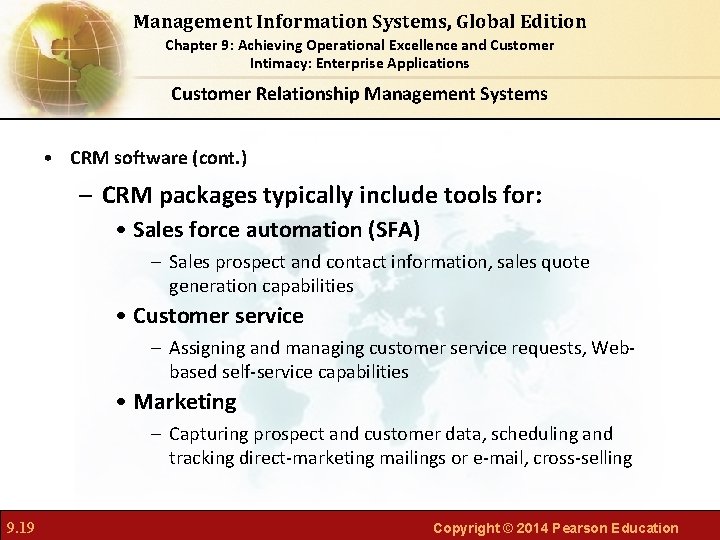
Management Information Systems, Global Edition Chapter 9: Achieving Operational Excellence and Customer Intimacy: Enterprise Applications Customer Relationship Management Systems • CRM Software – Packages range from niche tools to large-scale enterprise applications. – More comprehensive have modules for: • Partner relationship management (PRM) – Integrating lead generation, pricing, promotions, order configurations, and availability – Tools to assess partners’ performances • Employee relationship management (ERM) – Setting objectives, employee performance management, performance-based compensation, employee training 9. 18 Copyright © 2014 Pearson Education
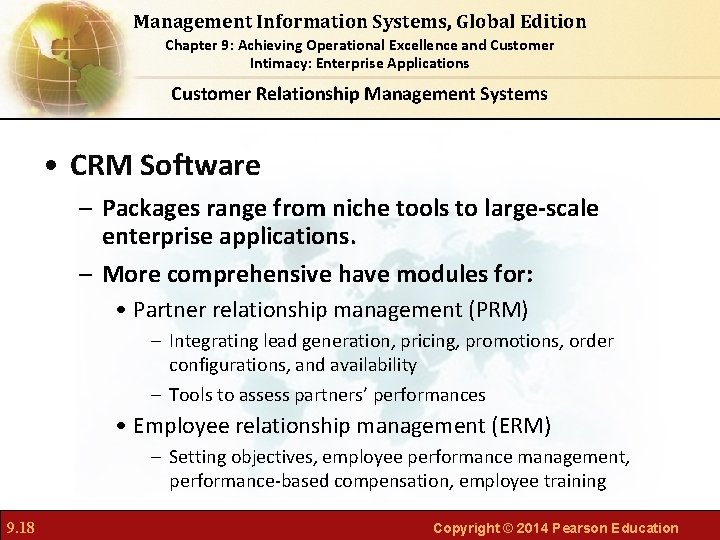
Management Information Systems, Global Edition Chapter 9: Achieving Operational Excellence and Customer Intimacy: Enterprise Applications Customer Relationship Management Systems • CRM software (cont. ) – CRM packages typically include tools for: • Sales force automation (SFA) – Sales prospect and contact information, sales quote generation capabilities • Customer service – Assigning and managing customer service requests, Webbased self-service capabilities • Marketing – Capturing prospect and customer data, scheduling and tracking direct-marketing mailings or e-mail, cross-selling 9. 19 Copyright © 2014 Pearson Education
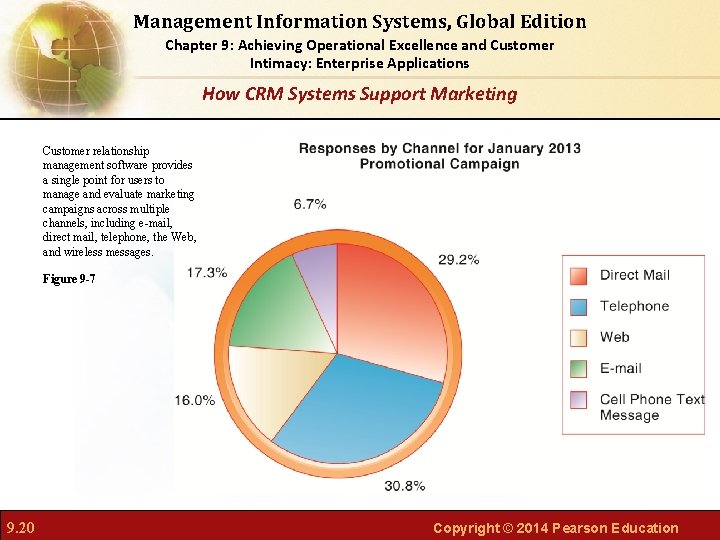
Management Information Systems, Global Edition Chapter 9: Achieving Operational Excellence and Customer Intimacy: Enterprise Applications How CRM Systems Support Marketing Customer relationship management software provides a single point for users to manage and evaluate marketing campaigns across multiple channels, including e-mail, direct mail, telephone, the Web, and wireless messages. Figure 9 -7 9. 20 Copyright © 2014 Pearson Education
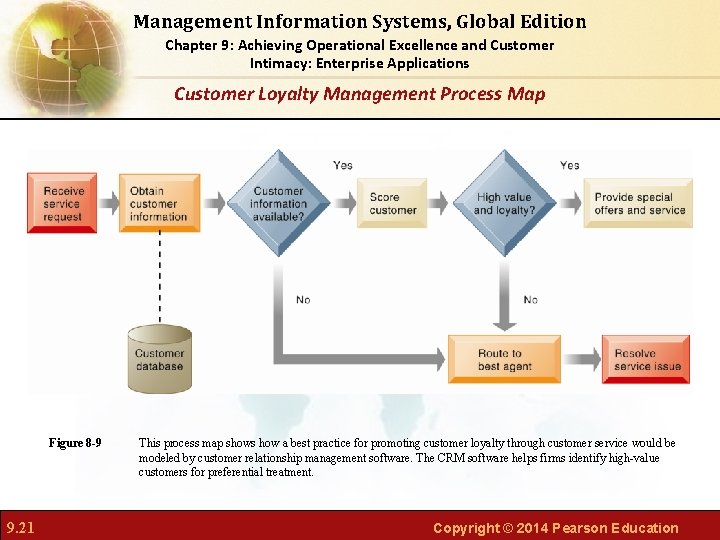
Management Information Systems, Global Edition Chapter 9: Achieving Operational Excellence and Customer Intimacy: Enterprise Applications Customer Loyalty Management Process Map Figure 8 -9 9. 21 This process map shows how a best practice for promoting customer loyalty through customer service would be modeled by customer relationship management software. The CRM software helps firms identify high-value customers for preferential treatment. Copyright © 2014 Pearson Education
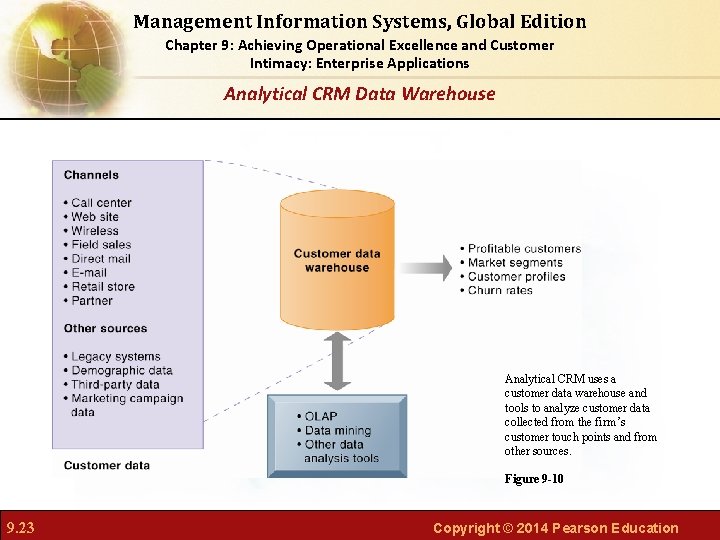
Management Information Systems, Global Edition Chapter 9: Achieving Operational Excellence and Customer Intimacy: Enterprise Applications Customer Relationship Management Systems • Operational CRM: – Customer-facing applications such as sales force automation, call center and customer service support, and marketing automation • Analytical CRM: – Based on data warehouses populated by operational CRM systems and customer touch points – Analyzes customer data (OLAP, data mining, etc. ) • Customer lifetime value (CLTV) 9. 22 Copyright © 2014 Pearson Education
Management Information Systems, Global Edition Chapter 9: Achieving Operational Excellence and Customer Intimacy: Enterprise Applications Analytical CRM Data Warehouse Analytical CRM uses a customer data warehouse and tools to analyze customer data collected from the firm’s customer touch points and from other sources. Figure 9 -10 9. 23 Copyright © 2014 Pearson Education
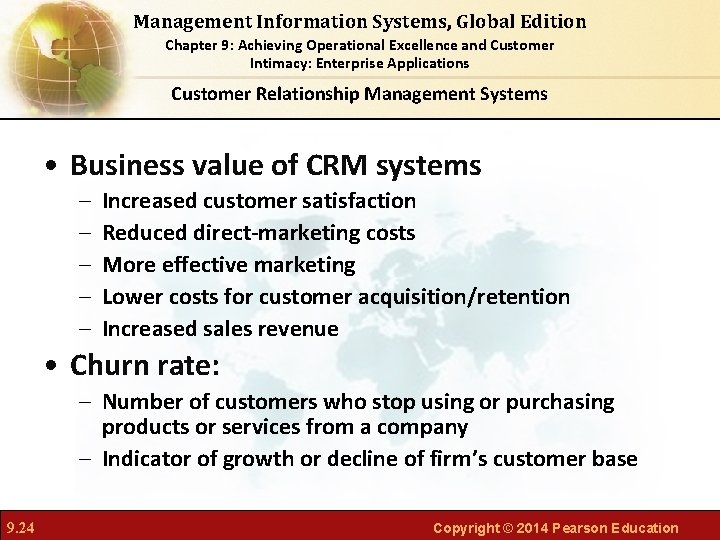
Management Information Systems, Global Edition Chapter 9: Achieving Operational Excellence and Customer Intimacy: Enterprise Applications Customer Relationship Management Systems • Business value of CRM systems – – – Increased customer satisfaction Reduced direct-marketing costs More effective marketing Lower costs for customer acquisition/retention Increased sales revenue • Churn rate: – Number of customers who stop using or purchasing products or services from a company – Indicator of growth or decline of firm’s customer base 9. 24 Copyright © 2014 Pearson Education
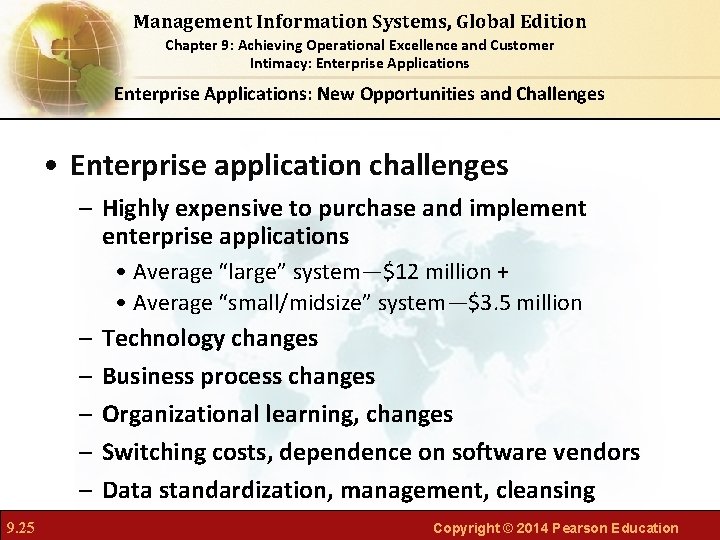
Management Information Systems, Global Edition Chapter 9: Achieving Operational Excellence and Customer Intimacy: Enterprise Applications: New Opportunities and Challenges • Enterprise application challenges – Highly expensive to purchase and implement enterprise applications • Average “large” system—$12 million + • Average “small/midsize” system—$3. 5 million – – – 9. 25 Technology changes Business process changes Organizational learning, changes Switching costs, dependence on software vendors Data standardization, management, cleansing Copyright © 2014 Pearson Education
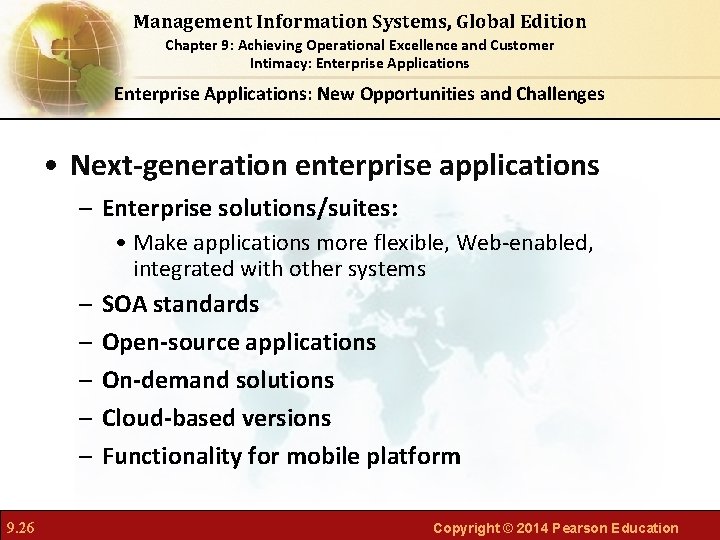
Management Information Systems, Global Edition Chapter 9: Achieving Operational Excellence and Customer Intimacy: Enterprise Applications: New Opportunities and Challenges • Next-generation enterprise applications – Enterprise solutions/suites: • Make applications more flexible, Web-enabled, integrated with other systems – – – 9. 26 SOA standards Open-source applications On-demand solutions Cloud-based versions Functionality for mobile platform Copyright © 2014 Pearson Education
Management Information Systems, Global Edition Chapter 9: Achieving Operational Excellence and Customer Intimacy: Enterprise Applications Interactive Session: Technology Customer Relationship Management Heads to the Cloud Read the Interactive Session and discuss the following questions – What types of companies are most likely to adopt cloud -based CRM software services? What companies might not be suited for this type of software? – What are the advantages and disadvantages of using cloud-based enterprise applications? – What management, organization, and technology issues should be addressed in deciding whether to use a conventional CRM system versus a cloud-based version? 9. 27 Copyright © 2014 Pearson Education
Management Information Systems, Global Edition Chapter 9: Achieving Operational Excellence and Customer Intimacy: Enterprise Applications: New Opportunities and Challenges • Next-generation enterprise applications (cont. ) – Social CRM • Incorporating social networking technologies • Company social networks • Customer interaction via Facebook • For example: Buzzient platform integrates social media with enterprise applications – Business intelligence • Inclusion of BI with enterprise applications • Flexible reporting, ad hoc analysis, “what-if” scenarios, digital dashboards, data visualization 9. 28 Copyright © 2014 Pearson Education
Management Information Systems, Global Edition Chapter 9: Achieving Operational Excellence and Customer Intimacy: Enterprise Applications 9. 29 Copyright © 2014 Pearson Education