
CHAPTER 8 ACCOUNTING FOR RECEIVABLES Agenda Learning goals
CHAPTER 8 ACCOUNTING FOR RECEIVABLES
Agenda • • Learning goals Vocabulary Types of accounts receivable Accounts receivable Valuing accounts receivable Recognize notes receivable Disposing of notes receivable Statement presentation and management of receivables

Learning goals • Record accounts receivable transactions • Calculate the net realizable value of accounts receivable and account for bad debt • Account for notes receivable • Demonstrate the presentation, analysis, and management of receivables
Vocabulary • • Accounts receivable Notes receivable Trade receivables Net realizable value Bad debt expense Allowance method Percentage of sales approach • Income statement • • • approach Percentage of receivables approach Aging schedule Balance sheet approach Promissory note Dishonoured note Turnover ratio

Types of Receivables • Amounts due from individuals and other companies • Accounts receivable: – Amounts owed by customers on account – Expected to be collected within 30 days • Notes receivable (trade receivables): – Supported by formal instruments of credit – For periods of 30 days or longer – Interest bearing
ACCOUNTS RECEIVABLE The three primary accounting problems associated with accounts receivable are: 1. Recognizing accounts receivable. 2. Valuing accounts receivable. 3. Disposing of accounts receivable.
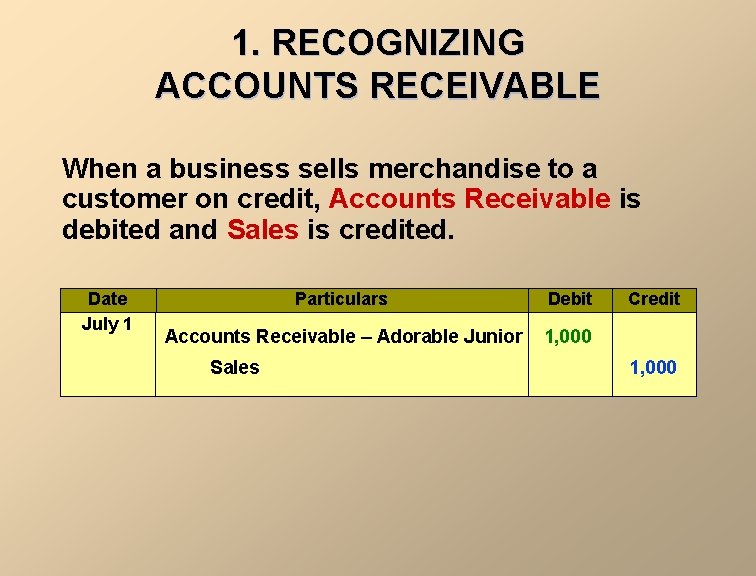
1. RECOGNIZING ACCOUNTS RECEIVABLE When a business sells merchandise to a customer on credit, Accounts Receivable is debited and Sales is credited. Date July 1 Particulars Debit Accounts Receivable – Adorable Junior 1, 000 Sales Credit 1, 000
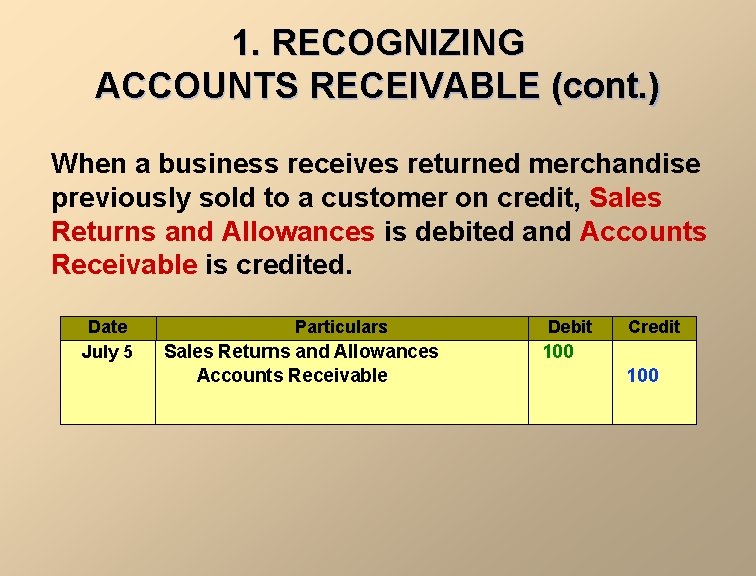
1. RECOGNIZING ACCOUNTS RECEIVABLE (cont. ) When a business receives returned merchandise previously sold to a customer on credit, Sales Returns and Allowances is debited and Accounts Receivable is credited. Date July 5 Particulars Sales Returns and Allowances Accounts Receivable Debit Credit 100
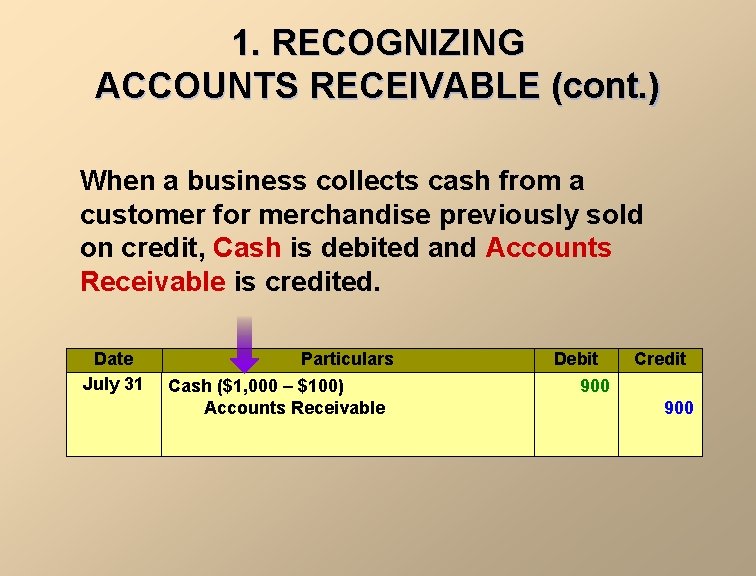
1. RECOGNIZING ACCOUNTS RECEIVABLE (cont. ) When a business collects cash from a customer for merchandise previously sold on credit, Cash is debited and Accounts Receivable is credited. Date July 31 Particulars Cash ($1, 000 – $100) Accounts Receivable Debit 900 Credit 900
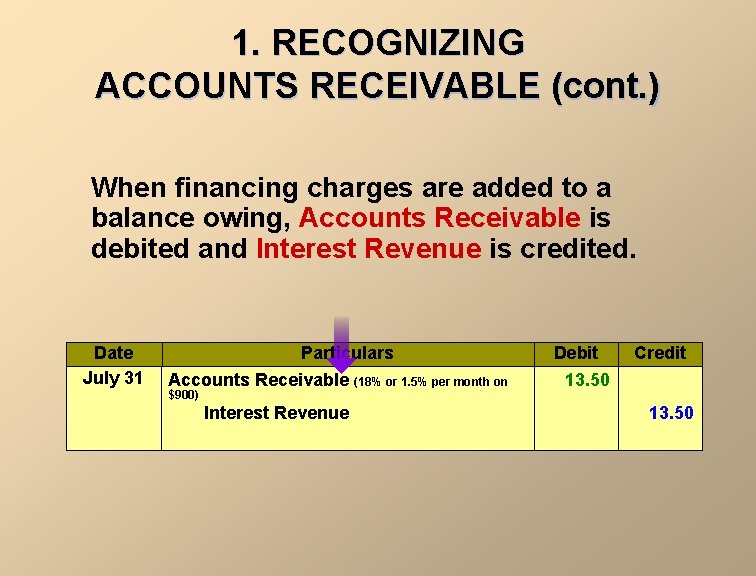
1. RECOGNIZING ACCOUNTS RECEIVABLE (cont. ) When financing charges are added to a balance owing, Accounts Receivable is debited and Interest Revenue is credited. Date July 31 Particulars Accounts Receivable (18% or 1. 5% per month on $900) Interest Revenue Debit 13. 50 Credit 13. 50
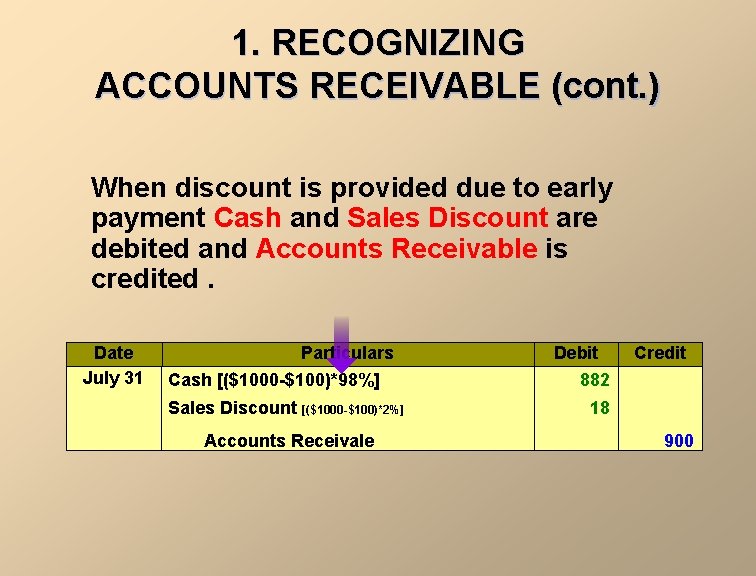
1. RECOGNIZING ACCOUNTS RECEIVABLE (cont. ) When discount is provided due to early payment Cash and Sales Discount are debited and Accounts Receivable is credited. Date July 31 Particulars Cash [($1000 -$100)*98%] Sales Discount [($1000 -$100)*2%] Accounts Receivale Debit 882 Credit 18 900
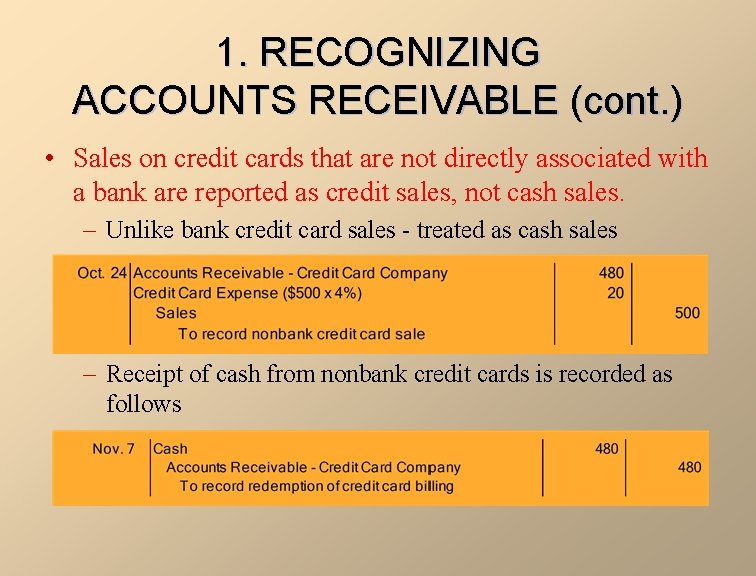
1. RECOGNIZING ACCOUNTS RECEIVABLE (cont. ) • Sales on credit cards that are not directly associated with a bank are reported as credit sales, not cash sales. – Unlike bank credit card sales - treated as cash sales – Receipt of cash from nonbank credit cards is recorded as follows
Practice • Do the practice question on page 412
2. VALUING ACCOUNTS RECEIVABLE • To ensure that receivables are not overstated, they are stated at their net realizable value. • Net realizable value is the net amount expected to be received in cash and excludes amounts that the company estimates it will not be able to collect.
2. VALUING ACCOUNTS RECEIVABLE • When receivables are written down to their net realizable value due to credit losses, owner’s equity must also be reduced. – Done by recording bad debt expense
2. VALUING ACCOUNTS RECEIVABLE (cont. ) • Two methods of accounting for uncollectible accounts are: 1. Allowance method 2. Direct write-off method
DIRECT WRITE-OFF METHOD • Under the direct write-off method, no entries are made for bad debts until an account is determined to be uncollectible at which time the loss is charged to Bad Debts Expense. • No attempt is made to match bad debts to sales revenues or to show the net realizable value of accounts receivable on the balance sheet.
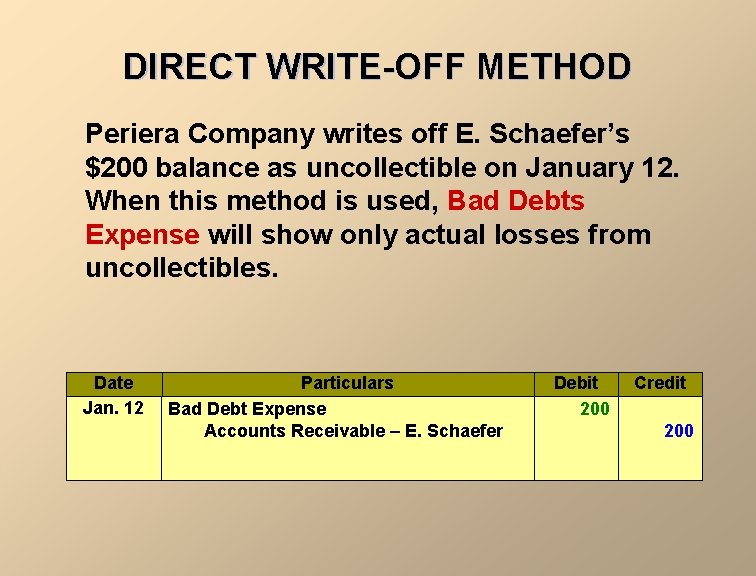
DIRECT WRITE-OFF METHOD Periera Company writes off E. Schaefer’s $200 balance as uncollectible on January 12. When this method is used, Bad Debts Expense will show only actual losses from uncollectibles. Date Jan. 12 Particulars Bad Debt Expense Accounts Receivable – E. Schaefer Debit 200 Credit 200
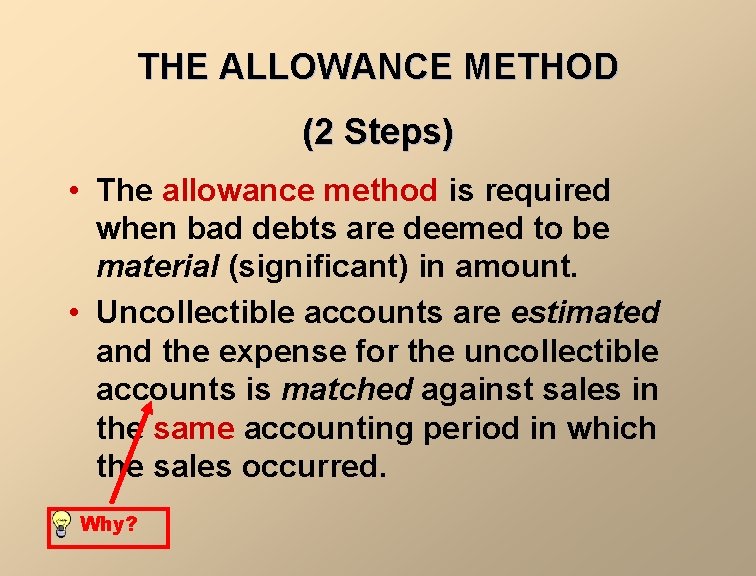
THE ALLOWANCE METHOD (2 Steps) • The allowance method is required when bad debts are deemed to be material (significant) in amount. • Uncollectible accounts are estimated and the expense for the uncollectible accounts is matched against sales in the same accounting period in which the sales occurred. Why?
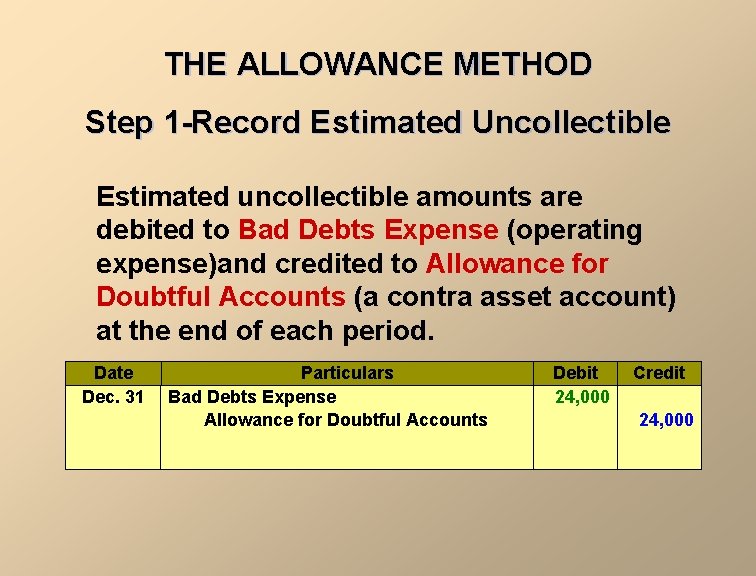
THE ALLOWANCE METHOD Step 1 -Record Estimated Uncollectible Estimated uncollectible amounts are debited to Bad Debts Expense (operating expense)and credited to Allowance for Doubtful Accounts (a contra asset account) at the end of each period. Date Dec. 31 Particulars Bad Debts Expense Allowance for Doubtful Accounts Debit 24, 000 Credit 24, 000
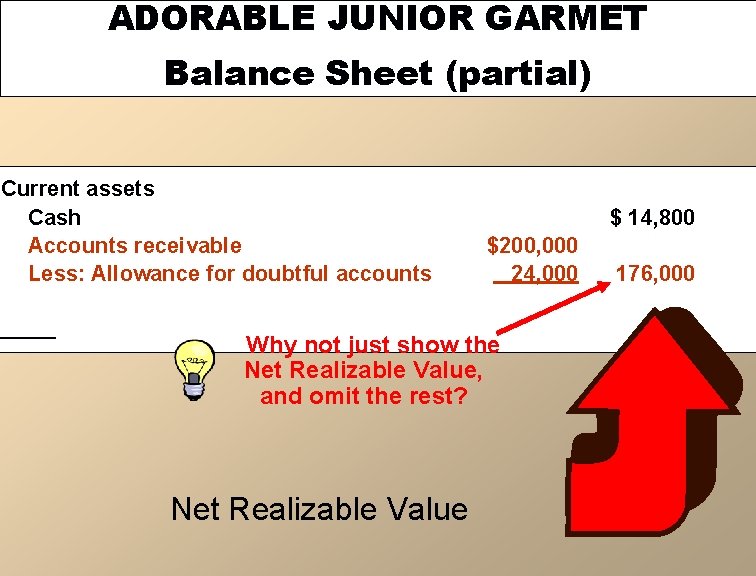
ADORABLE JUNIOR GARMET Balance Sheet (partial) Current assets Cash Accounts receivable Less: Allowance for doubtful accounts $ 14, 800 $200, 000 24, 000 Why not just show the Net Realizable Value, and omit the rest? Net Realizable Value 176, 000
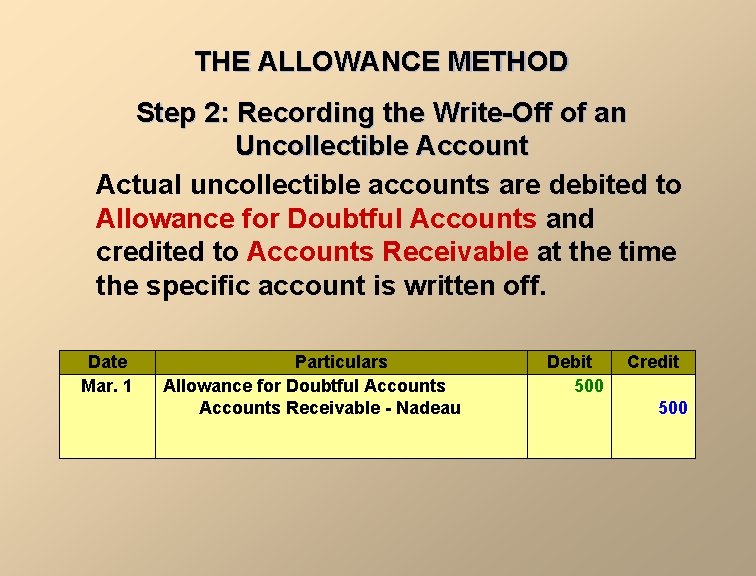
THE ALLOWANCE METHOD Step 2: Recording the Write-Off of an Uncollectible Account Actual uncollectible accounts are debited to Allowance for Doubtful Accounts and credited to Accounts Receivable at the time the specific account is written off. Date Mar. 1 Particulars Allowance for Doubtful Accounts Receivable - Nadeau Debit 500 Credit 500
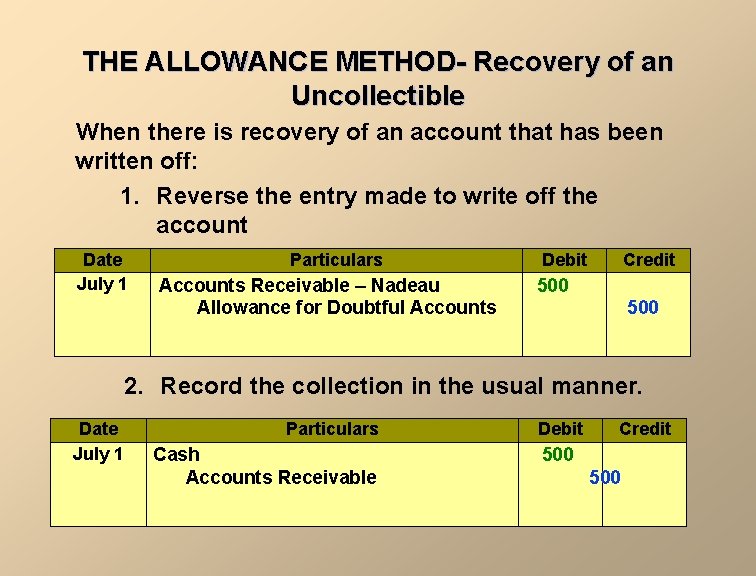
THE ALLOWANCE METHOD- Recovery of an Uncollectible When there is recovery of an account that has been written off: 1. Reverse the entry made to write off the account Date July 1 Particulars Accounts Receivable – Nadeau Allowance for Doubtful Accounts Debit Credit 500 2. Record the collection in the usual manner. Date July 1 Particulars Cash Accounts Receivable Debit Credit 500
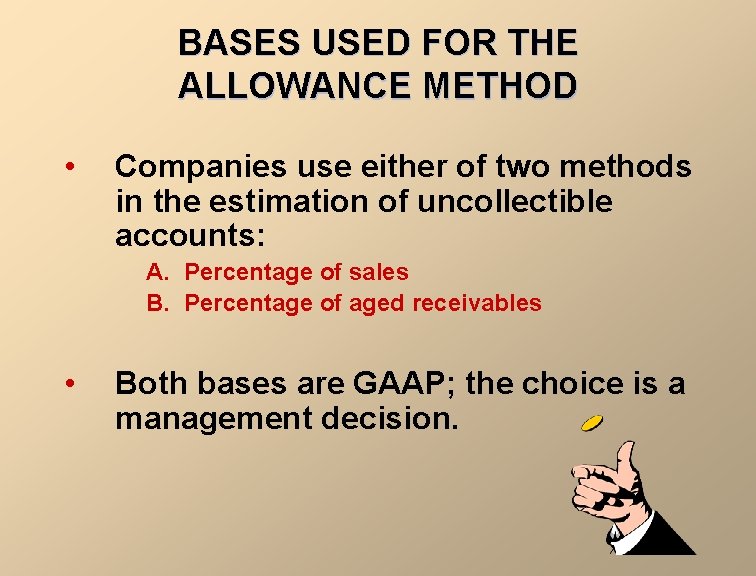
BASES USED FOR THE ALLOWANCE METHOD • Companies use either of two methods in the estimation of uncollectible accounts: A. Percentage of sales B. Percentage of aged receivables • Both bases are GAAP; the choice is a management decision.
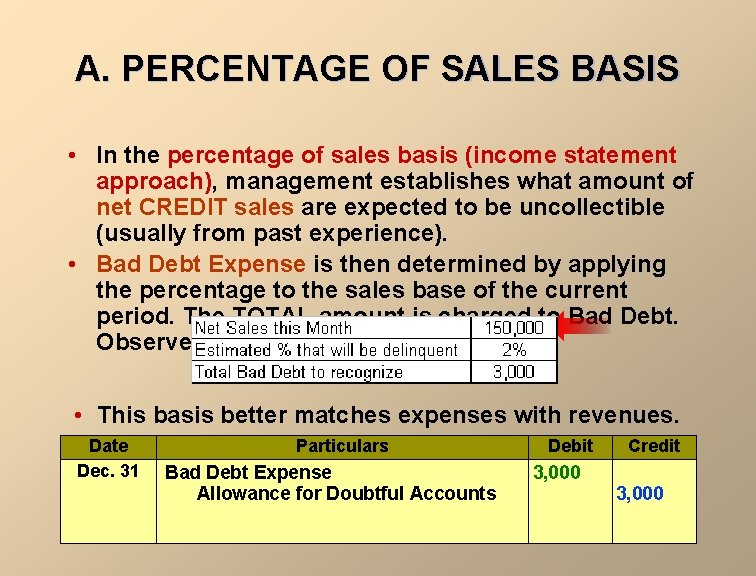
A. PERCENTAGE OF SALES BASIS • In the percentage of sales basis (income statement approach), management establishes what amount of net CREDIT sales are expected to be uncollectible (usually from past experience). • Bad Debt Expense is then determined by applying the percentage to the sales base of the current period. The TOTAL amount is charged to Bad Debt. Observe… • This basis better matches expenses with revenues. Date Dec. 31 Particulars Bad Debt Expense Allowance for Doubtful Accounts Debit Credit 3, 000
B. PERCENTAGE OF AGED RECEIVABLES BASIS • • • Under this method, management estimates what the TOTAL value of bad debt currently is by applying a percentage to the actual, existing accounts receivable balances at the end of the period. Also known as the balance sheet approach This percentage can be applied to 1. The total receivable balance, or 2. To accounts receivable balances grouped by age. (see pg 416)
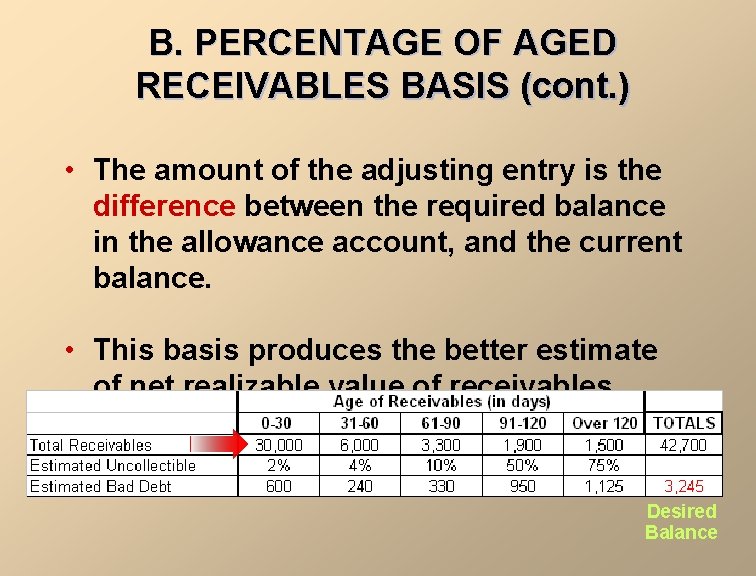
B. PERCENTAGE OF AGED RECEIVABLES BASIS (cont. ) • The amount of the adjusting entry is the difference between the required balance in the allowance account, and the current balance. • This basis produces the better estimate of net realizable value of receivables. Observe… Desired Balance
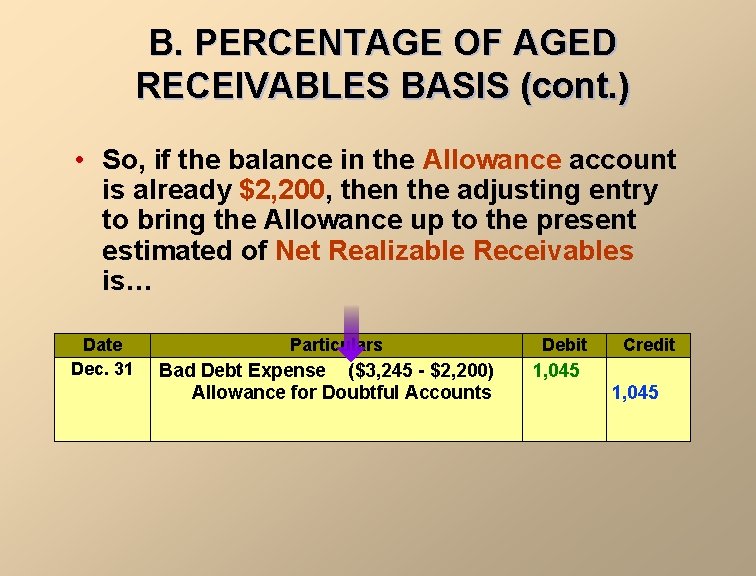
B. PERCENTAGE OF AGED RECEIVABLES BASIS (cont. ) • So, if the balance in the Allowance account is already $2, 200, then the adjusting entry to bring the Allowance up to the present estimated of Net Realizable Receivables is… Date Dec. 31 Particulars Bad Debt Expense ($3, 245 - $2, 200) Allowance for Doubtful Accounts Debit Credit 1, 045
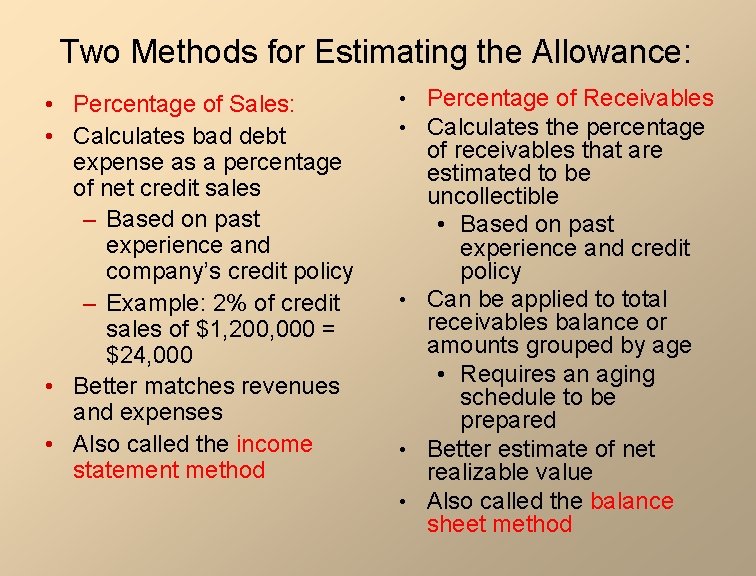
Two Methods for Estimating the Allowance: • Percentage of Sales: • Calculates bad debt expense as a percentage of net credit sales – Based on past experience and company’s credit policy – Example: 2% of credit sales of $1, 200, 000 = $24, 000 • Better matches revenues and expenses • Also called the income statement method Percentage of Receivables Calculates the percentage of receivables that are estimated to be uncollectible • Based on past experience and credit policy • Can be applied to total receivables balance or amounts grouped by age • Requires an aging schedule to be prepared • Better estimate of net realizable value • Also called the balance sheet method • •
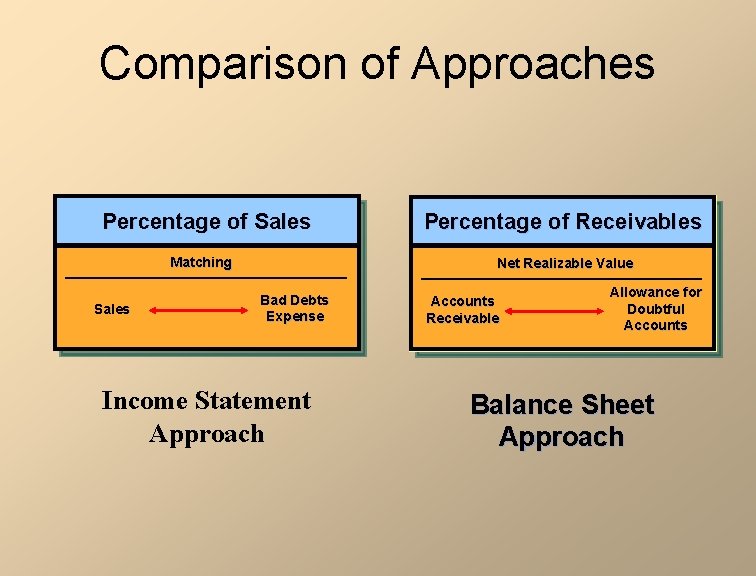
Comparison of Approaches Percentage of Sales Matching Sales Percentage of Receivables Net Realizable Value Bad Debts Expense Income Statement Approach Accounts Receivable Allowance for Doubtful Accounts Balance Sheet Approach

Do the following starting on page 434: BE 8 -6, 7, 8 E 8 -3, E 8 -4 P 8 -5 A
3. DISPOSING OF ACCOUNTS RECEIVABLE To accelerate the receipt of cash from receivables, owners frequently: 1. sell to a factor, such as a finance company or a bank, and 2. make credit card sales.
3. DISPOSING OF ACCOUNTS RECEIVABLE (cont. ) • A factor buys receivables from businesses for a fee and collects the payments directly from customers. • Credit cards are frequently used by retailers who wish to avoid the paperwork of issuing credit. • Retailers can receive cash more quickly from the credit card issuer.
CREDIT CARD SALES • Three parties are involved when credit cards are used in making retail sales: 1. the credit card issuer, 2. the retailer, and 3. the customer. • The retailer pays the credit card issuer a percentage fee of the invoice price for its services.
BANK CARD SALES • Sales resulting from the use of VISA and Master. Card are considered cash sales by the retailer. • These cards are issued by banks. • Upon receipt of credit card sales slips from a retailer, the bank immediately adds the amount to the seller’s bank balance.

BANK CARD SALES • We purchase a CDs for our restaurant from Karen Kerr Music Co. for $1, 000 using our Royal Bank VISA card. • The service fee that the Royal charges is 3. 5 percent. Date July 31 Particulars Cash Credit Card Expense ($1, 000 x 3. 5%) Sales Debit Credit 965 35 1, 000
NOTES RECEIVABLE • A promissory note is a written promise to pay a specified amount of money on demand or at a definite time. • The party making the promise is the maker. • The party to whom payment is made is called the payee.
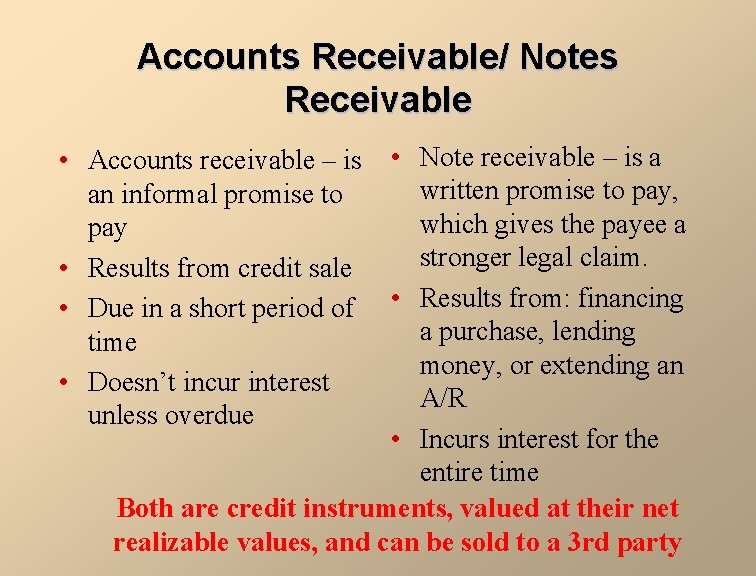
Accounts Receivable/ Notes Receivable • Note receivable – is a written promise to pay, which gives the payee a stronger legal claim. • Results from: financing a purchase, lending money, or extending an A/R • Incurs interest for the entire time Both are credit instruments, valued at their net realizable values, and can be sold to a 3 rd party • Accounts receivable – is an informal promise to pay • Results from credit sale • Due in a short period of time • Doesn’t incur interest unless overdue
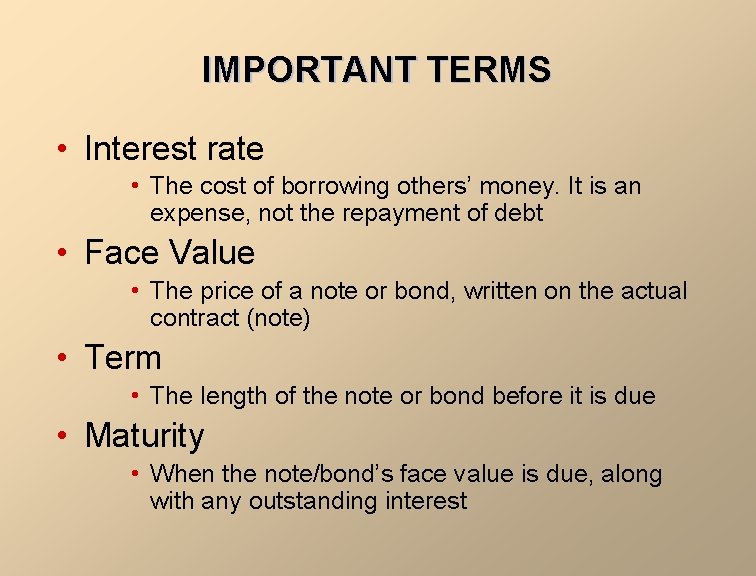
IMPORTANT TERMS • Interest rate • The cost of borrowing others’ money. It is an expense, not the repayment of debt • Face Value • The price of a note or bond, written on the actual contract (note) • Term • The length of the note or bond before it is due • Maturity • When the note/bond’s face value is due, along with any outstanding interest
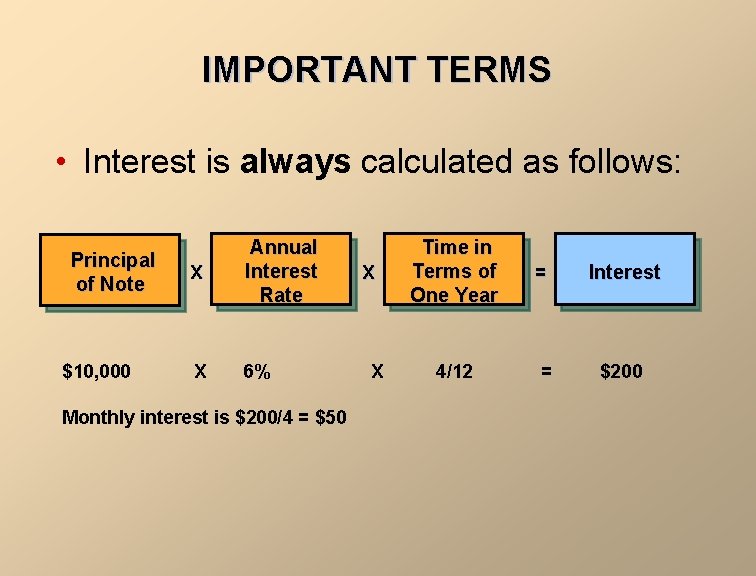
IMPORTANT TERMS • Interest is always calculated as follows: Principal of Note $10, 000 X Annual Interest Rate X 6% Monthly interest is $200/4 = $50 X X Time in Terms of One Year 4/12 = = Interest $200
NOTES RECEIVABLE • We now will look at the following three procedures for dealing with notes: – Acquisition – Adjustment/valuation – Disposal/termination • Note: these three steps are similar to many things we will look at this semester. Best to look for trends and processes.
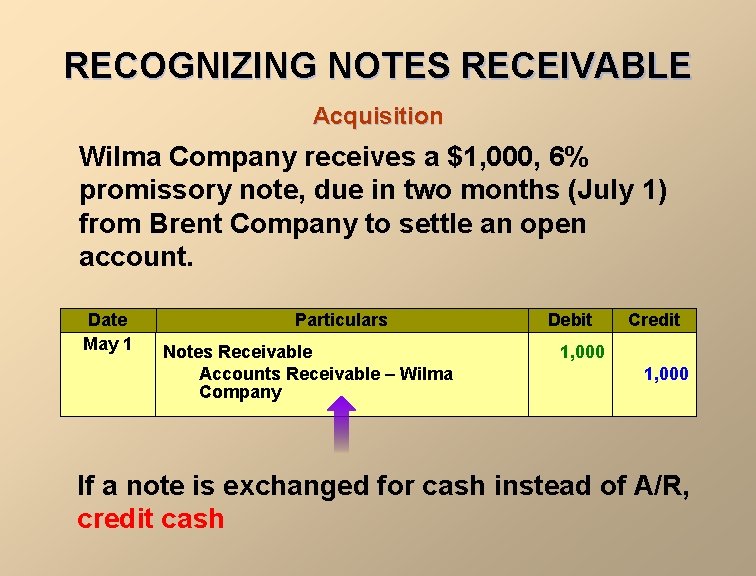
RECOGNIZING NOTES RECEIVABLE Acquisition Wilma Company receives a $1, 000, 6% promissory note, due in two months (July 1) from Brent Company to settle an open account. Date May 1 Particulars Notes Receivable Accounts Receivable – Wilma Company Debit Credit 1, 000 If a note is exchanged for cash instead of A/R, credit cash
VALUING NOTES RECEIVABLE • Like accounts receivable, short-term notes receivable are reported at their net realizable value. • The notes receivable allowance account is Allowance for Doubtful Notes.
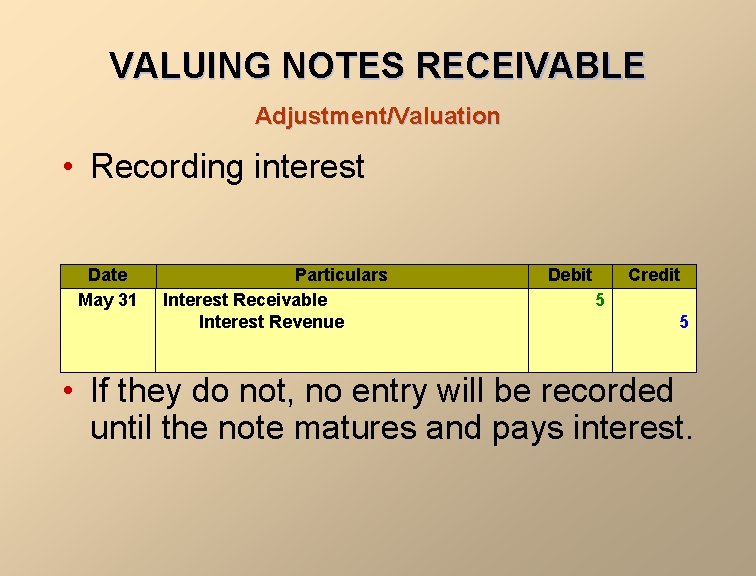
VALUING NOTES RECEIVABLE Adjustment/Valuation • Recording interest Date May 31 Particulars Interest Receivable Interest Revenue Debit Credit 5 5 • If they do not, no entry will be recorded until the note matures and pays interest.
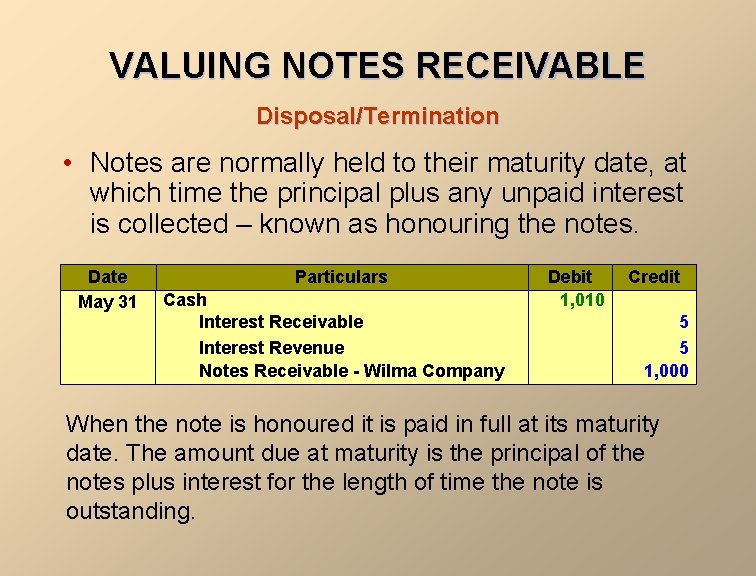
VALUING NOTES RECEIVABLE Disposal/Termination • Notes are normally held to their maturity date, at which time the principal plus any unpaid interest is collected – known as honouring the notes. Date May 31 Particulars Cash Interest Receivable Interest Revenue Notes Receivable - Wilma Company Debit 1, 010 Credit 5 5 1, 000 When the note is honoured it is paid in full at its maturity date. The amount due at maturity is the principal of the notes plus interest for the length of time the note is outstanding.
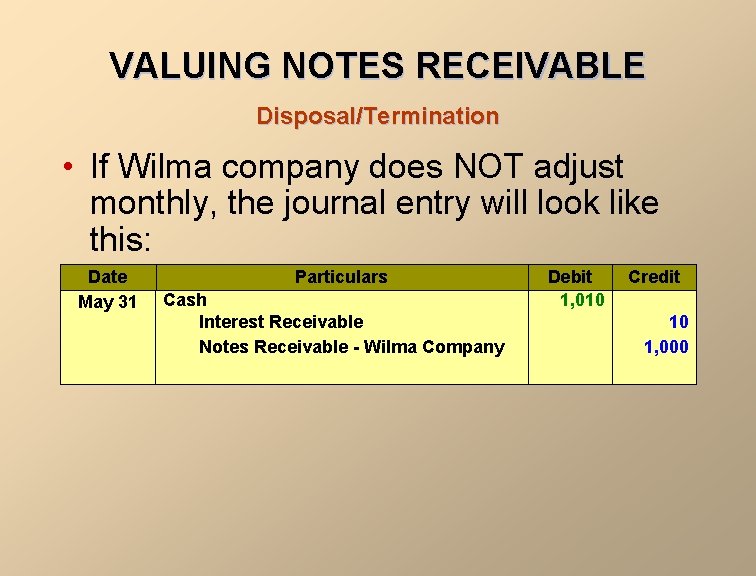
VALUING NOTES RECEIVABLE Disposal/Termination • If Wilma company does NOT adjust monthly, the journal entry will look like this: Date May 31 Particulars Cash Interest Receivable Notes Receivable - Wilma Company Debit 1, 010 Credit 10 1, 000
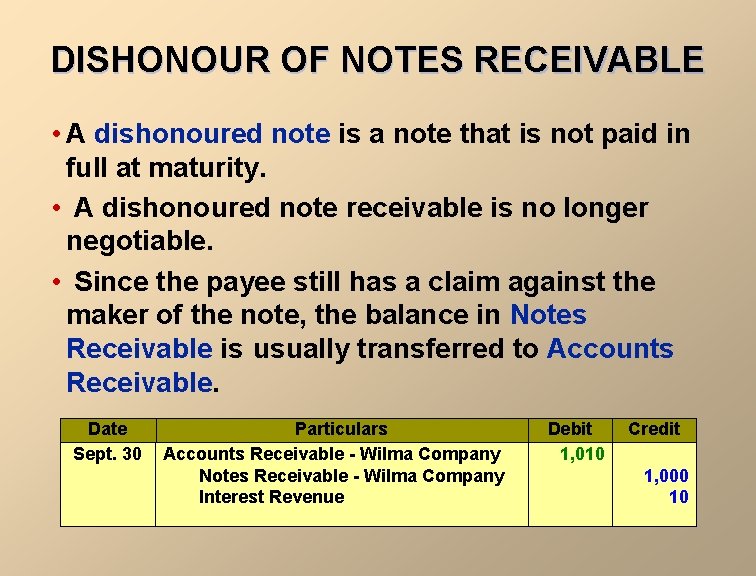
DISHONOUR OF NOTES RECEIVABLE • A dishonoured note is a note that is not paid in full at maturity. • A dishonoured note receivable is no longer negotiable. • Since the payee still has a claim against the maker of the note, the balance in Notes Receivable is usually transferred to Accounts Receivable. Date Sept. 30 Particulars Accounts Receivable - Wilma Company Notes Receivable - Wilma Company Interest Revenue Debit 1, 010 Credit 1, 000 10
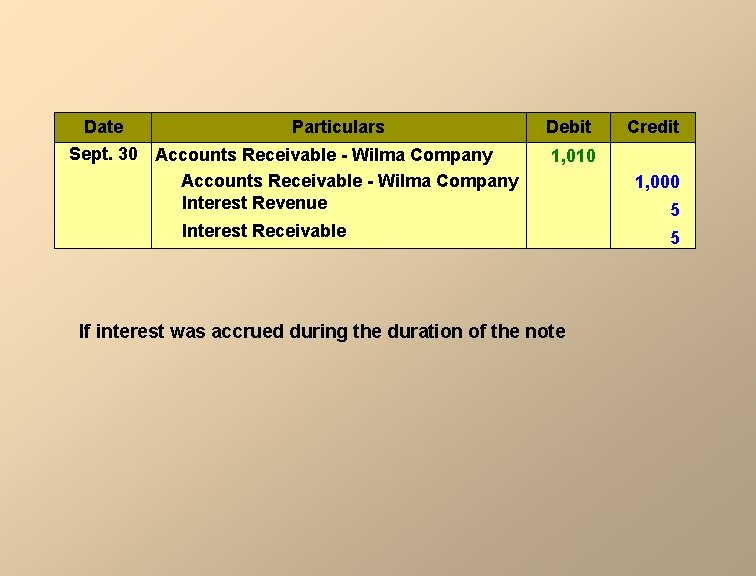
Date Particulars Sept. 30 Accounts Receivable - Wilma Company Interest Revenue Debit Credit 1, 010 Interest Receivable If interest was accrued during the duration of the note 1, 000 5 5
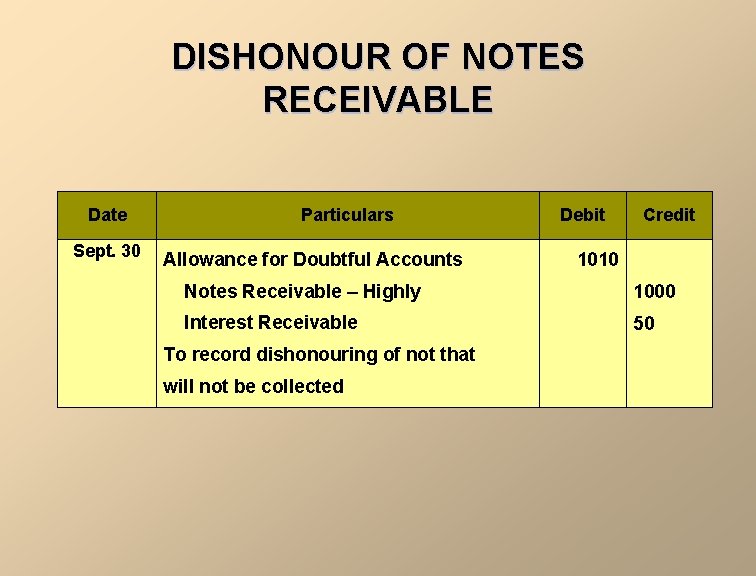
DISHONOUR OF NOTES RECEIVABLE Date Sept. 30 Particulars Allowance for Doubtful Accounts Debit Credit 1010 Notes Receivable – Highly 1000 Interest Receivable 50 To record dishonouring of not that will not be collected
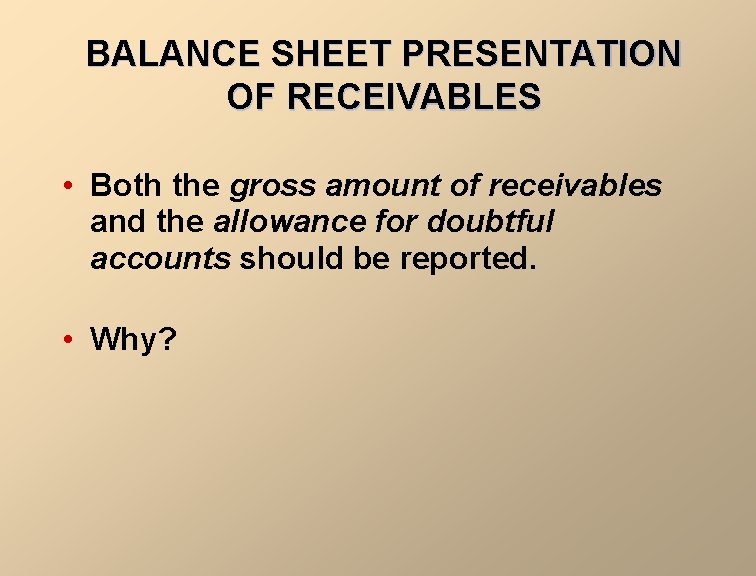
BALANCE SHEET PRESENTATION OF RECEIVABLES • Both the gross amount of receivables and the allowance for doubtful accounts should be reported. • Why?
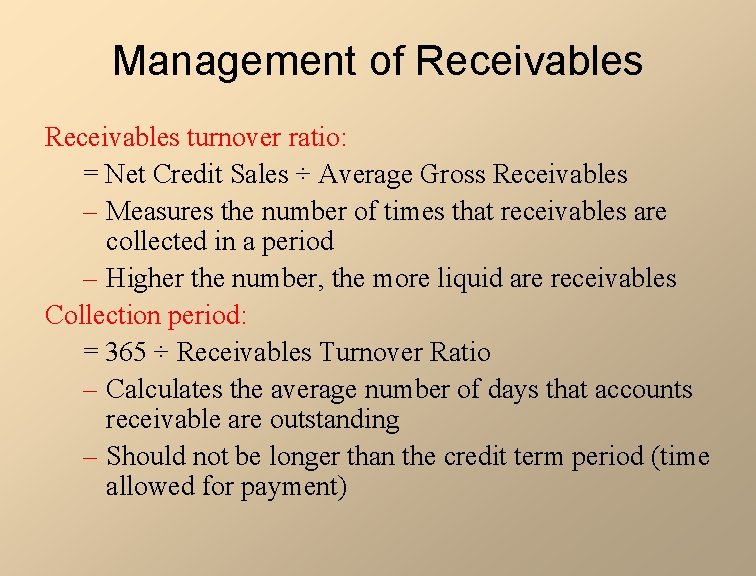
Management of Receivables turnover ratio: = Net Credit Sales ÷ Average Gross Receivables – Measures the number of times that receivables are collected in a period – Higher the number, the more liquid are receivables Collection period: = 365 ÷ Receivables Turnover Ratio – Calculates the average number of days that accounts receivable are outstanding – Should not be longer than the credit term period (time allowed for payment)
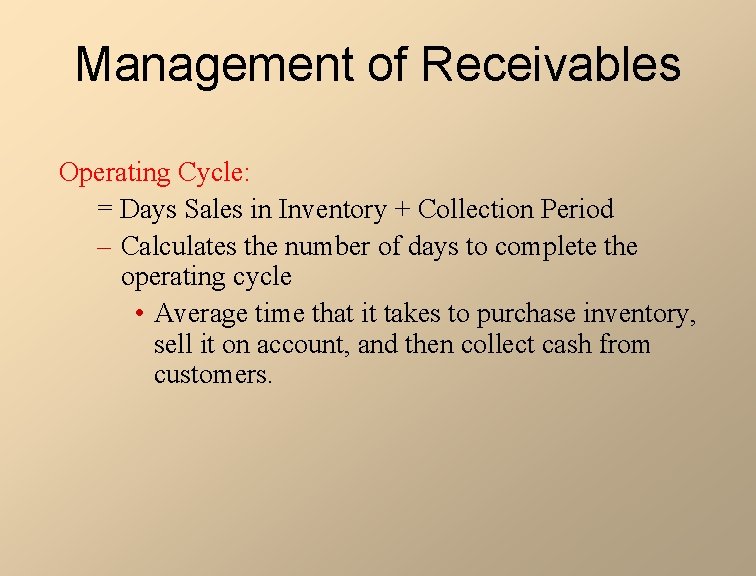
Management of Receivables Operating Cycle: = Days Sales in Inventory + Collection Period – Calculates the number of days to complete the operating cycle • Average time that it takes to purchase inventory, sell it on account, and then collect cash from customers.
USING THE INFORMATION IN THE FINANCIAL STATEMENTS • Financial ratios are calculated to evaluate the short-term liquidity of a company. • Recall these ratios: 1. current ratio, 2. acid test (quick) ratio, 3. receivables turnover, and the 4. A/R collection period (in days).
Do the following starting on page 435: BE 8 -9 to 12 P 8 -8 A P 8 -10 A
- Slides: 54