
Chapter 8 8 1 Introduction to Quadratic Equations

- Slides: 63
Chapter 8 8 -1 Introduction to Quadratic Equations
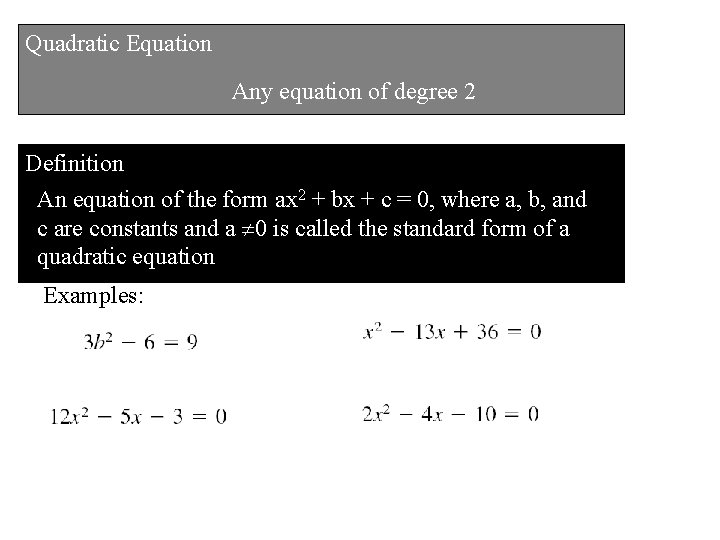
Quadratic Equation Any equation of degree 2 Definition An equation of the form ax 2 + bx + c = 0, where a, b, and c are constants and a 0 is called the standard form of a quadratic equation Examples:
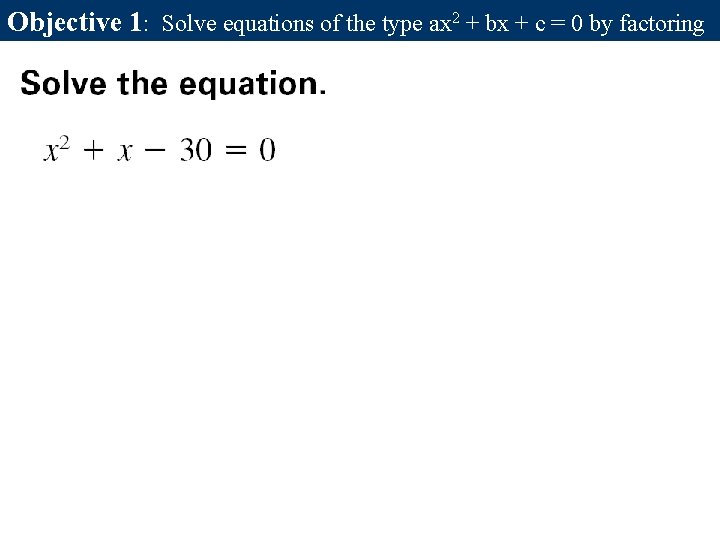
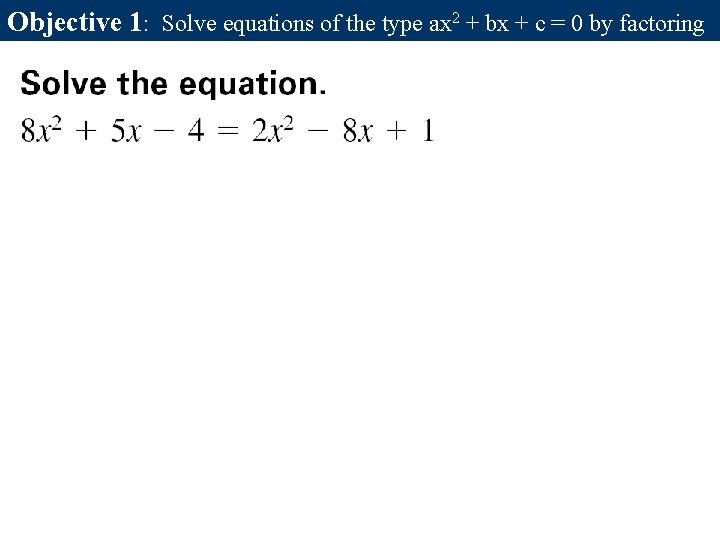
Objective 1: Solve equations of the type ax 2 + bx + c = 0 by factoring
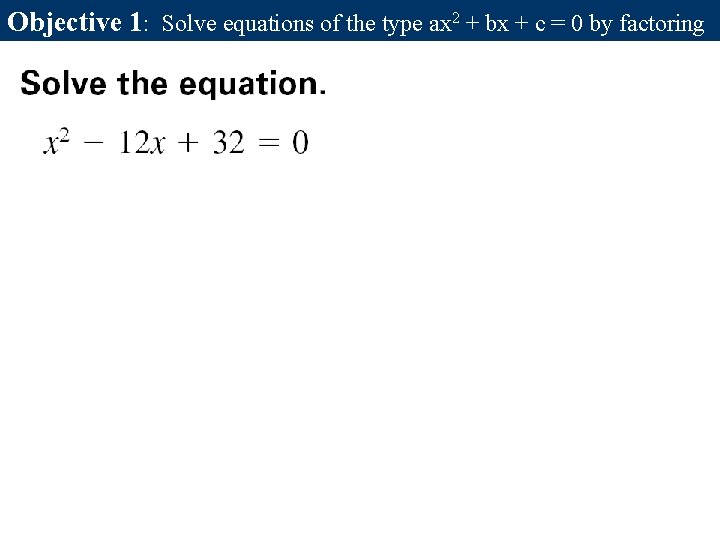
Objective 1: Solve equations of the type ax 2 + bx + c = 0 by factoring
Objective 1: Solve equations of the type ax 2 + bx + c = 0 by factoring
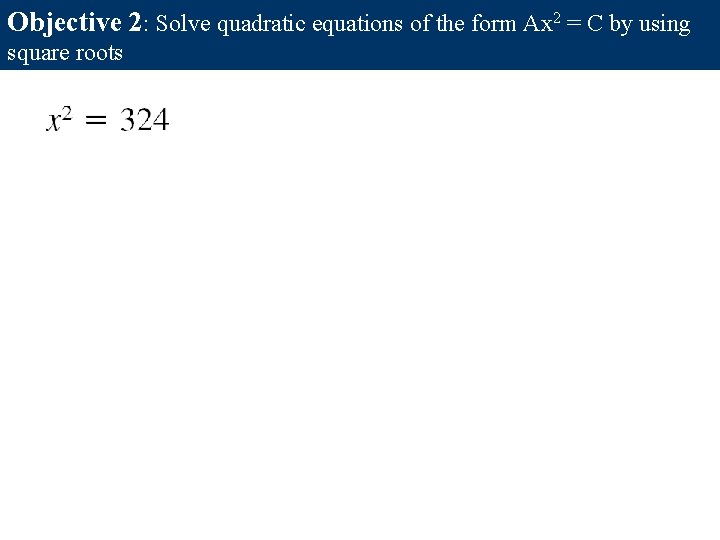
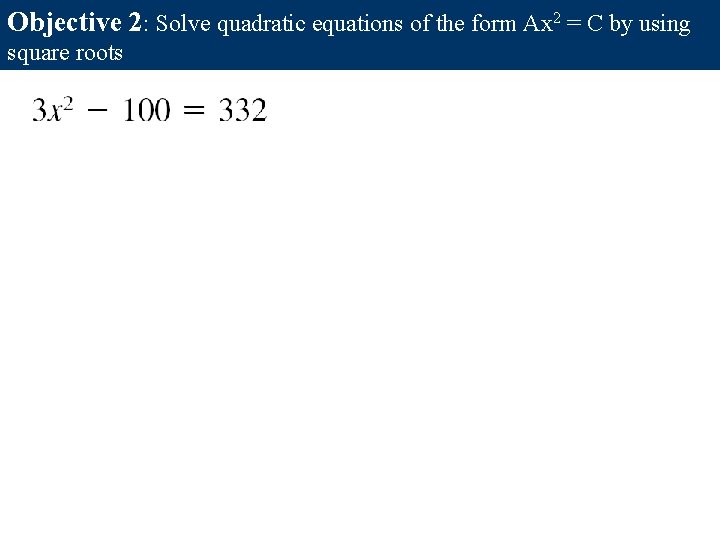
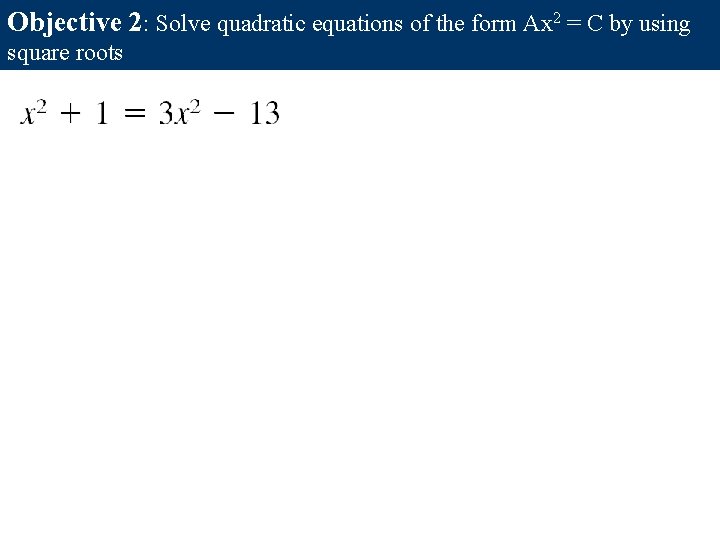
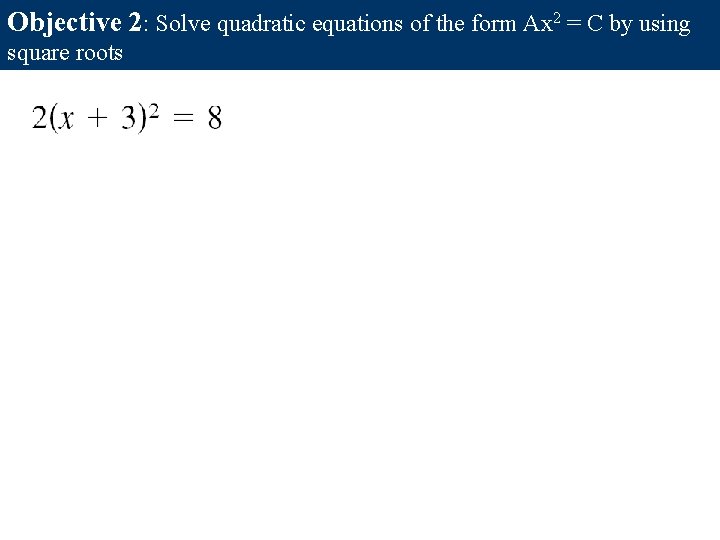
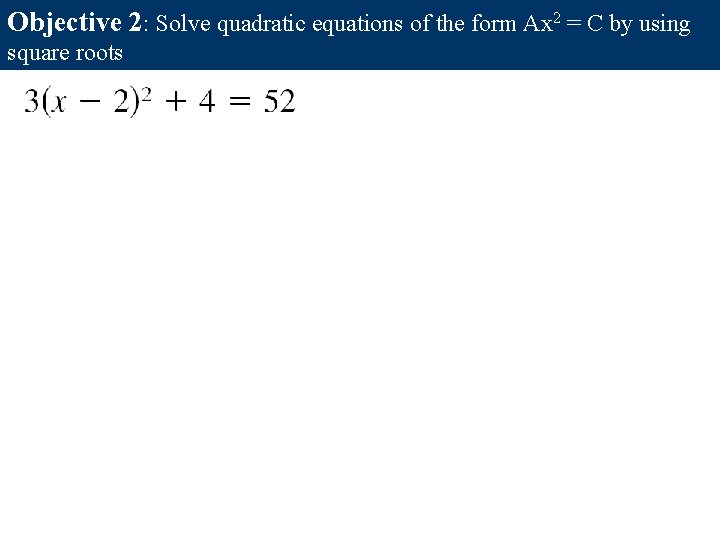
Objective 2: Solve quadratic equations of the form Ax 2 = C by using square roots
Objective 2: Solve quadratic equations of the form Ax 2 = C by using square roots
Objective 2: Solve quadratic equations of the form Ax 2 = C by using square roots
Objective 2: Solve quadratic equations of the form Ax 2 = C by using square roots
Objective 2: Solve quadratic equations of the form Ax 2 = C by using square roots
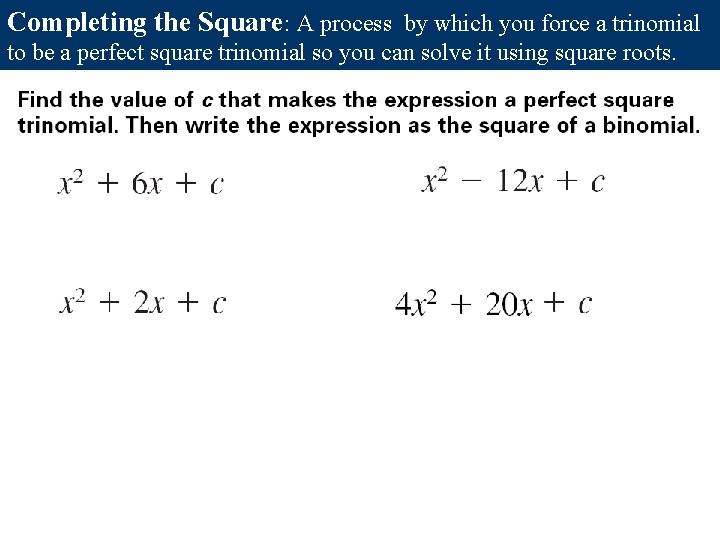
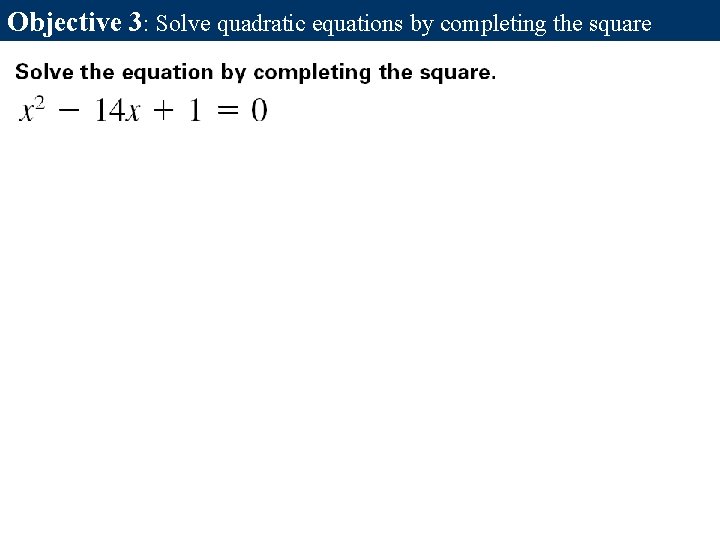
Completing the Square: A process by which you force a trinomial to be a perfect square trinomial so you can solve it using square roots.
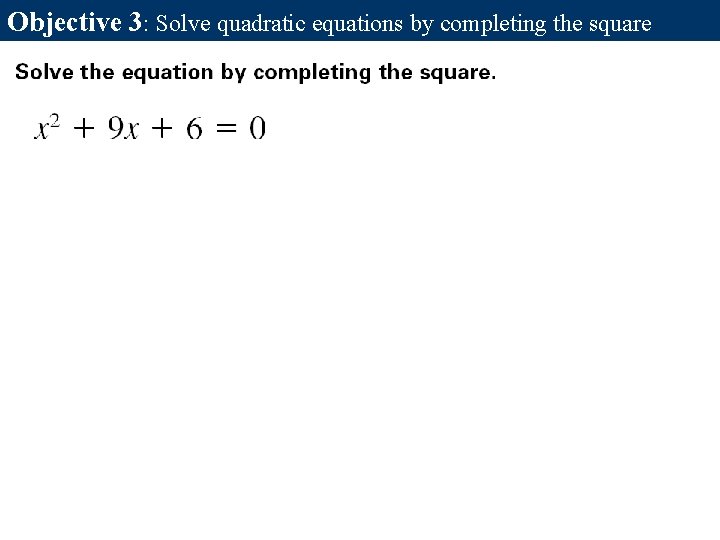
Objective 3: Solve quadratic equations by completing the square
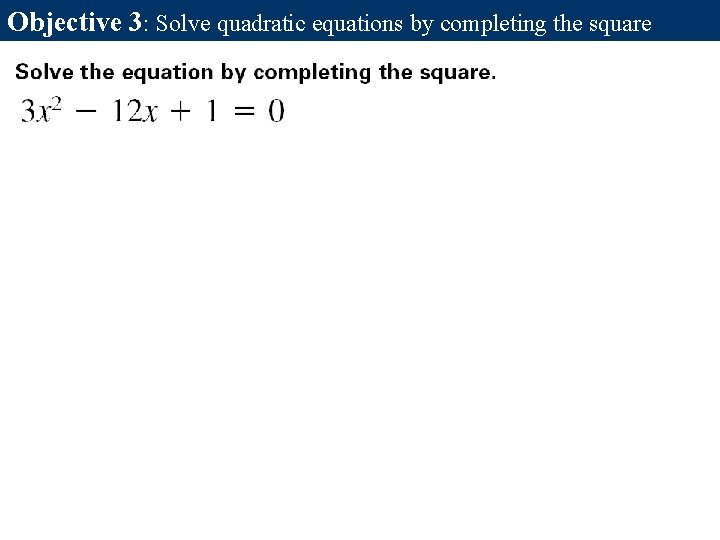
Objective 3: Solve quadratic equations by completing the square
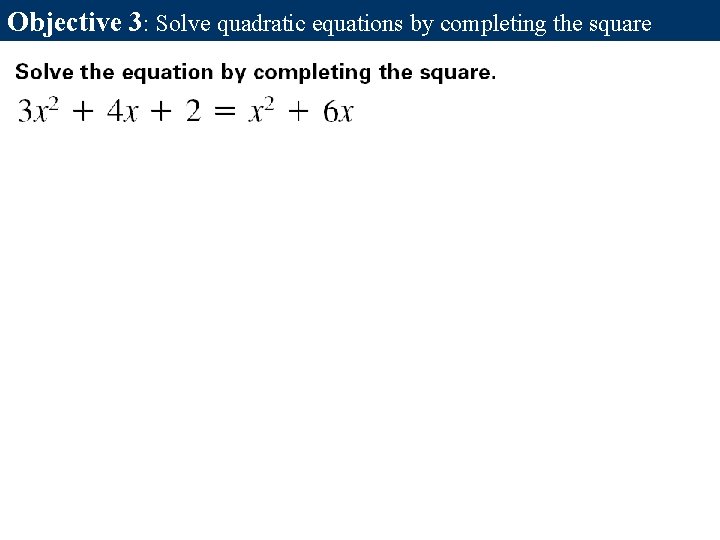
Objective 3: Solve quadratic equations by completing the square
Objective 3: Solve quadratic equations by completing the square
HW #8. 1 Pg 345 -346 3 -54 every third problem, 57 -62
Chapter 8 8 -2 Using Quadratic Equations
Two cyclists A and B leave the same point one traveling north and the other traveling west. B travels 7 km/h faster than A. After 3 hours they are 39 km apart. Find the speed of each cyclist.
Two cyclists A and B leave the same point one traveling north and the other traveling west. B travels 7 km/h faster than A. After 3 hours they are 39 km apart. Find the speed of each cyclist.
Scott wants to swim across a river that is 400 meters wide. He begins swimming perpendicular to the shore he started from but ends up 100 meters down river from where he started because of the current. How far did he actually swim from his starting point?
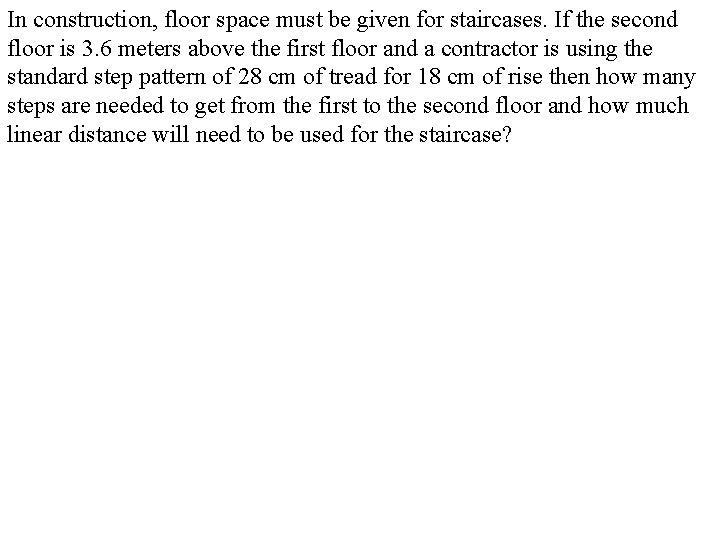
In construction, floor space must be given for staircases. If the second floor is 3. 6 meters above the first floor and a contractor is using the standard step pattern of 28 cm of tread for 18 cm of rise then how many steps are needed to get from the first to the second floor and how much linear distance will need to be used for the staircase?
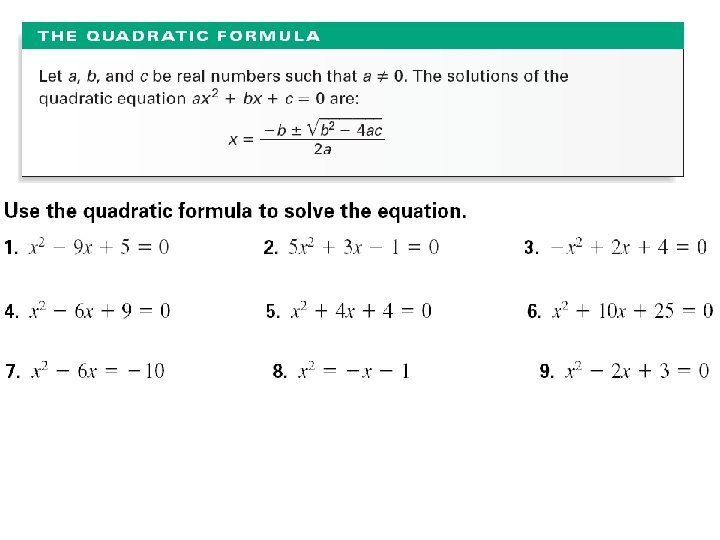
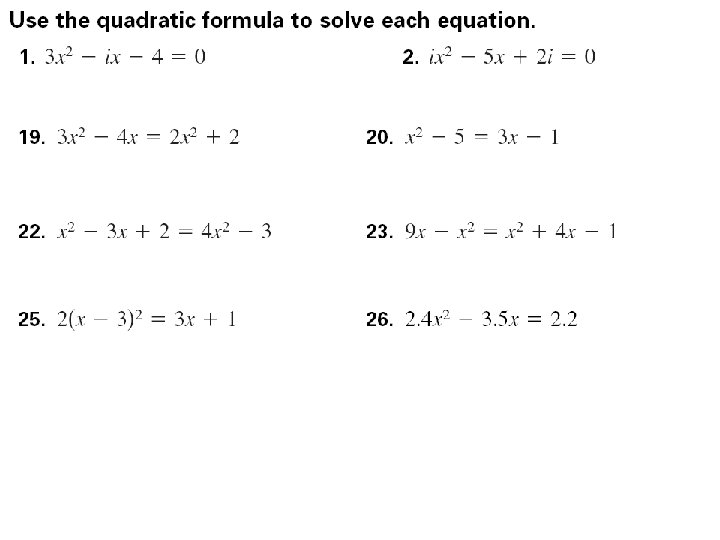
Chapter 8 8 -3 Quadratic Formula
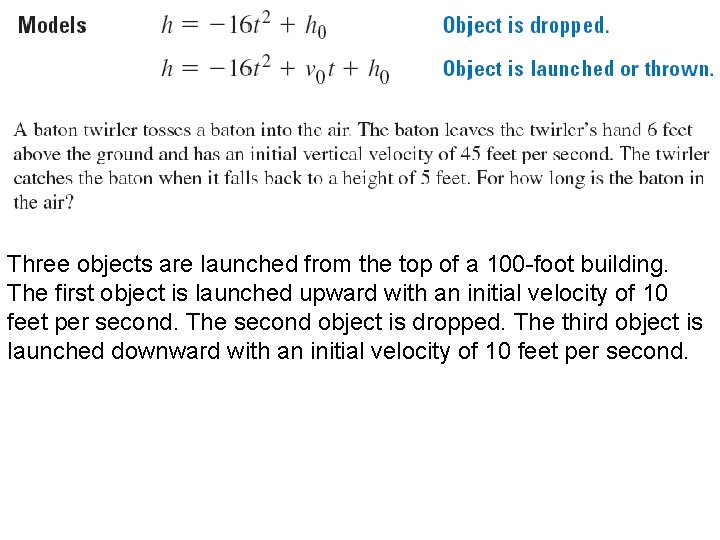
Three objects are launched from the top of a 100 -foot building. The first object is launched upward with an initial velocity of 10 feet per second. The second object is dropped. The third object is launched downward with an initial velocity of 10 feet per second.
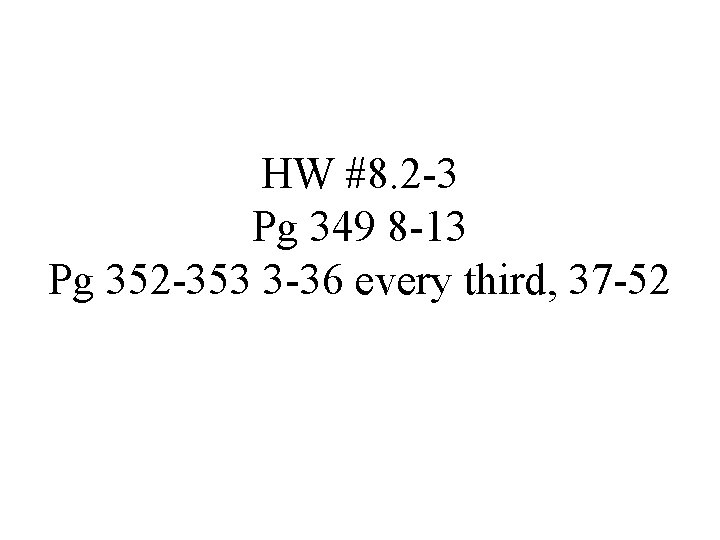
HW #8. 2 -3 Pg 349 8 -13 Pg 352 -353 3 -36 every third, 37 -52
Chapter 8 8 -4 Solutions of quadratic Equations
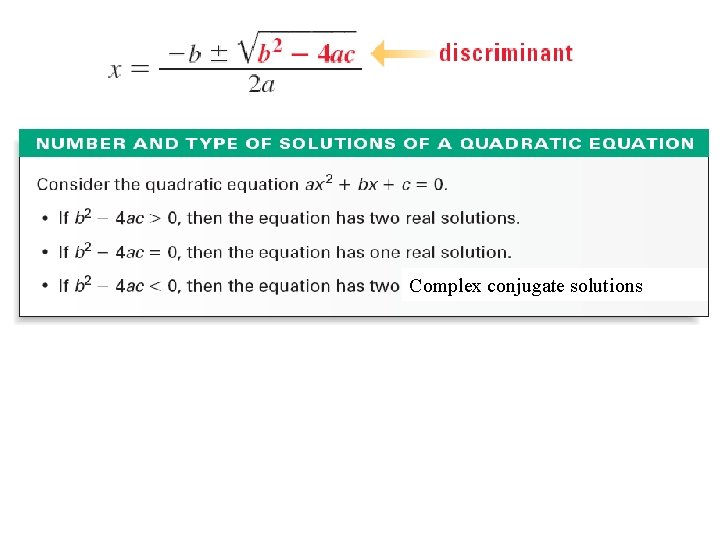
Complex conjugate solutions
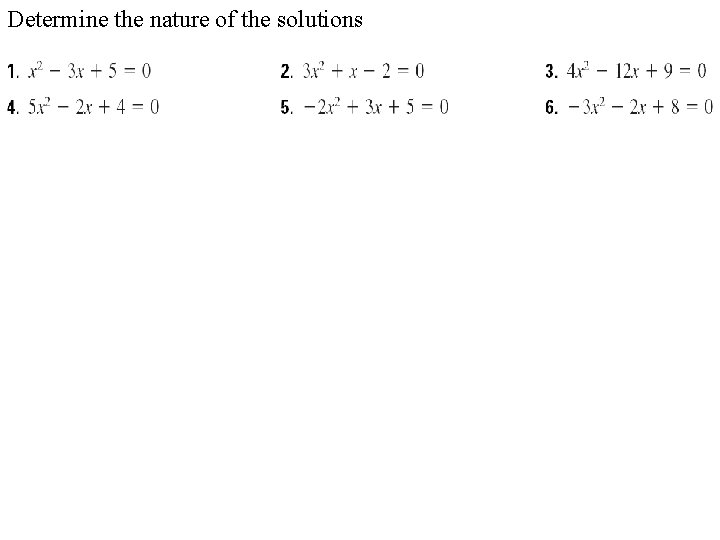
Determine the nature of the solutions
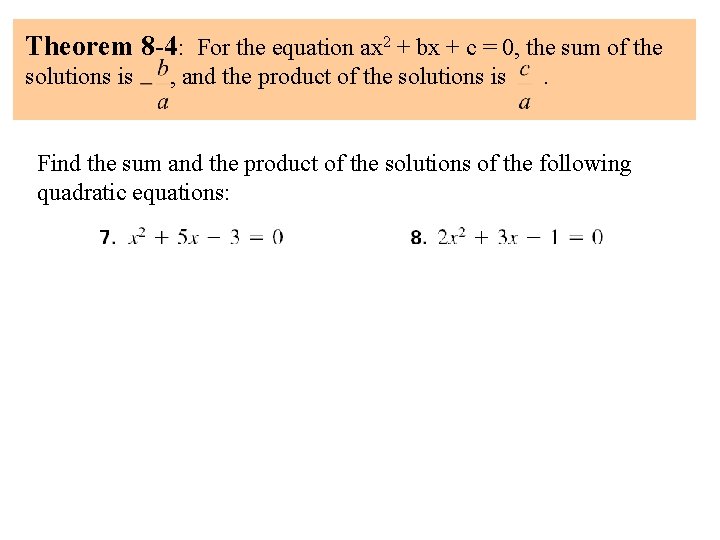
Theorem 8 -4: For the equation ax 2 + bx + c = 0, the sum of the solutions is , and the product of the solutions is . Find the sum and the product of the solutions of the following quadratic equations:
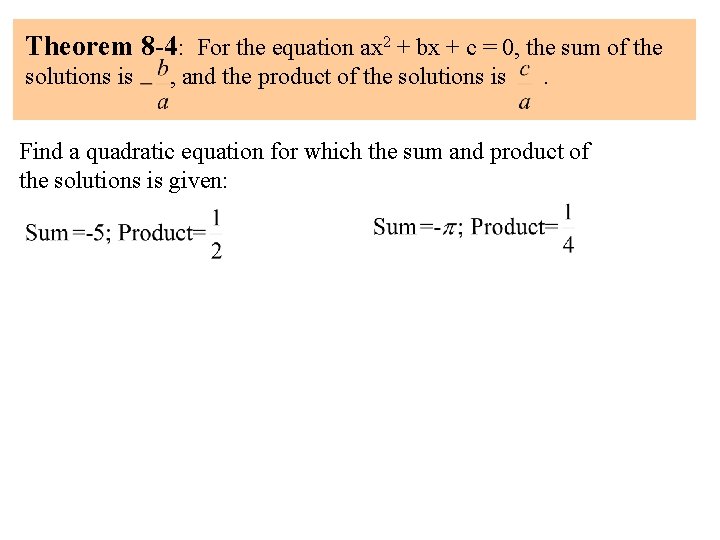
Theorem 8 -4: For the equation ax 2 + bx + c = 0, the sum of the solutions is , and the product of the solutions is . Find a quadratic equation for which the sum and product of the solutions is given:
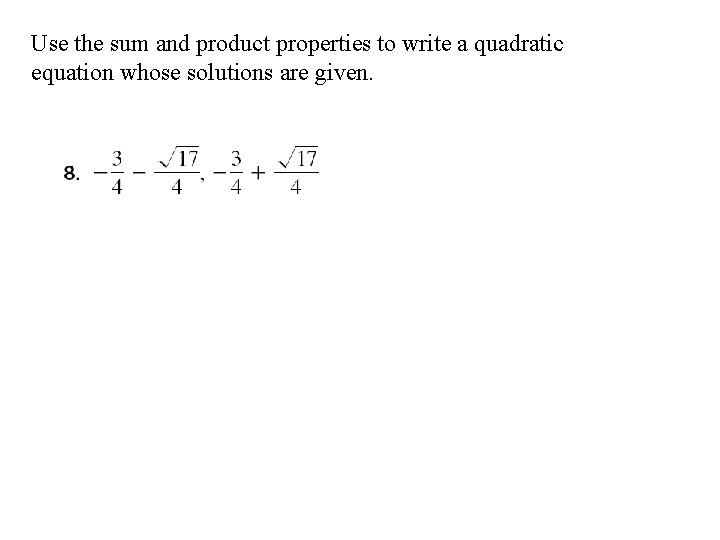
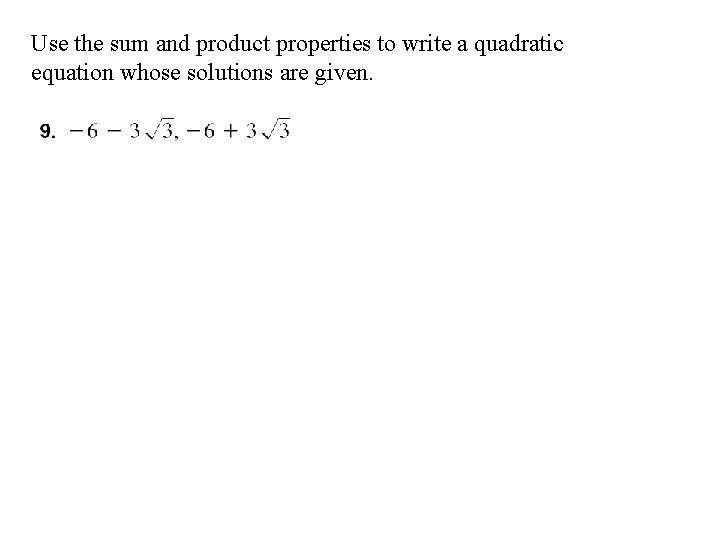
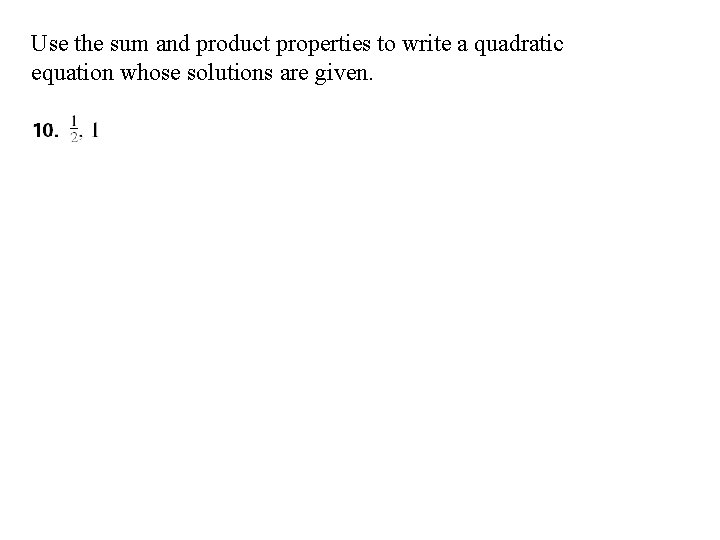
Use the sum and product properties to write a quadratic equation whose solutions are given.
Use the sum and product properties to write a quadratic equation whose solutions are given.
Use the sum and product properties to write a quadratic equation whose solutions are given.
HW #8. 4 Pg 357 Left Column, 56 -65, 67 -72
Chapter 8 8. 5 Equations Reducible to Quadratic Form
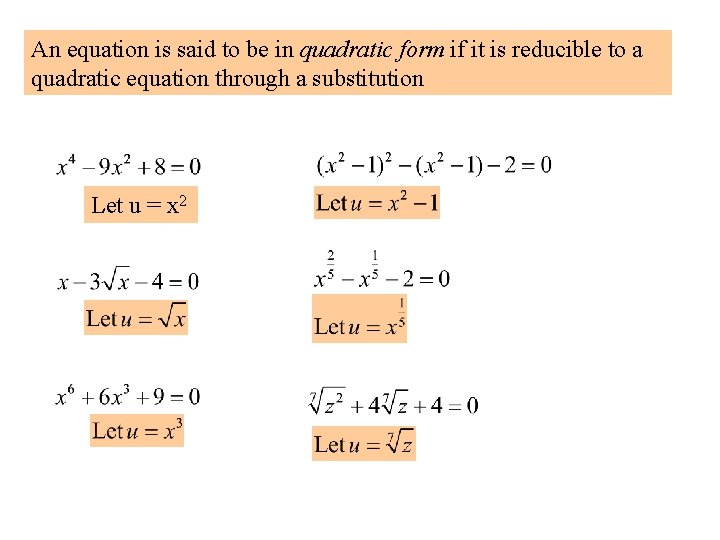
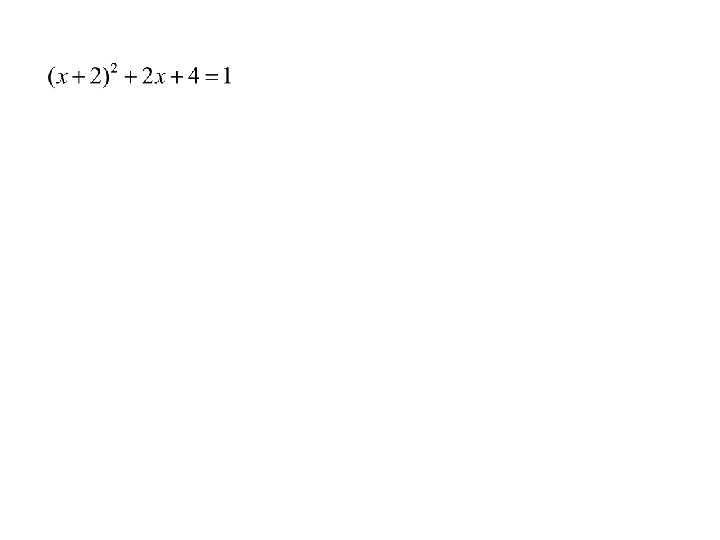
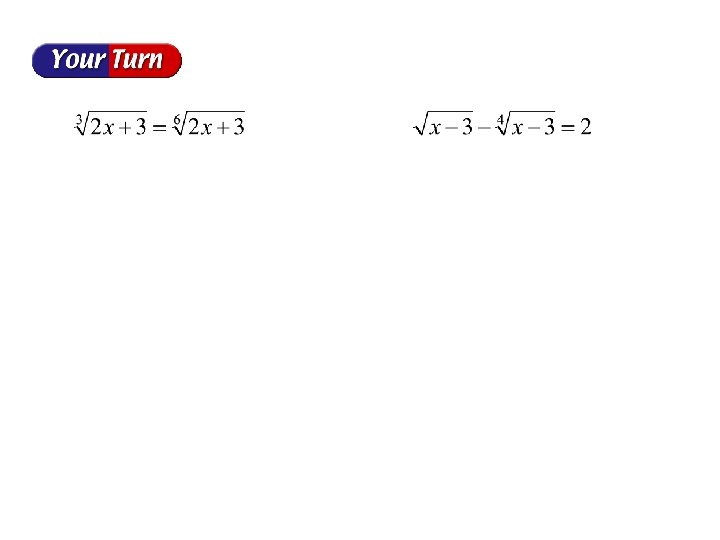
An equation is said to be in quadratic form if it is reducible to a quadratic equation through a substitution Let u = x 2
HW #8. 5 Pg 361 1 -19 Odd, 20 -26
Chapter 8 8. 6 Formulas and Problem Solving
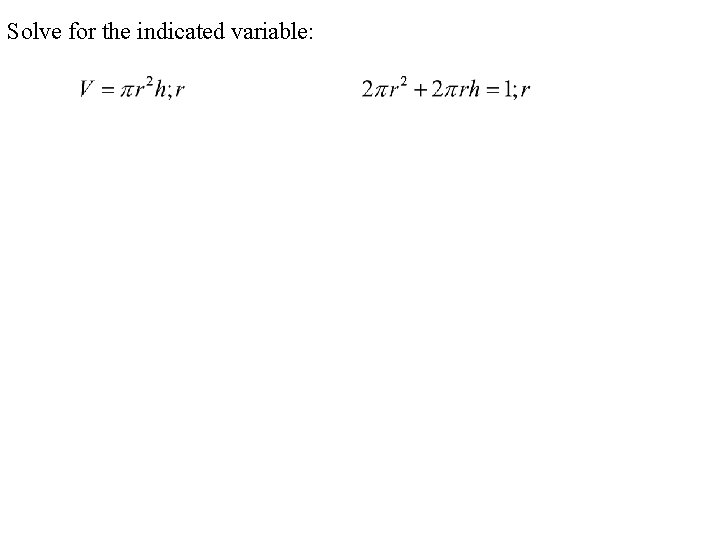
Solve for the indicated variable:
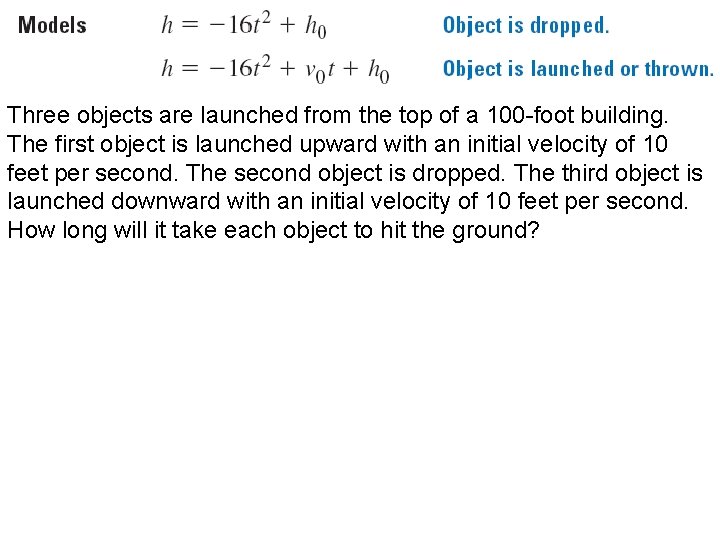
Three objects are launched from the top of a 100 -foot building. The first object is launched upward with an initial velocity of 10 feet per second. The second object is dropped. The third object is launched downward with an initial velocity of 10 feet per second. How long will it take each object to hit the ground?
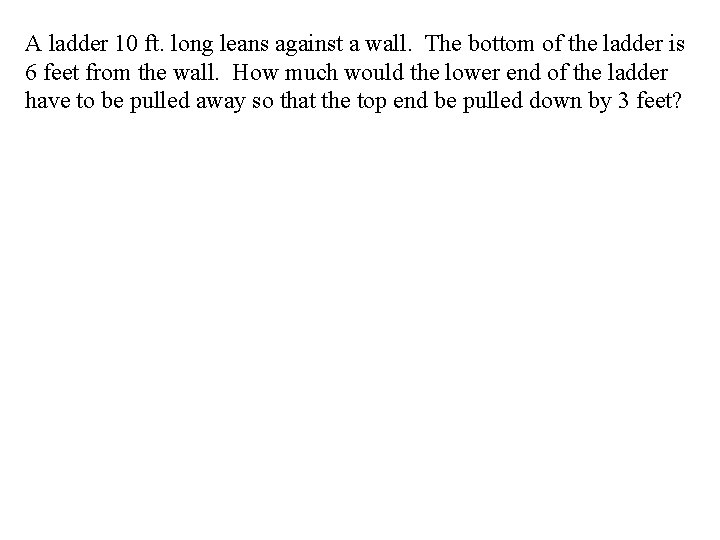
A ladder 10 ft. long leans against a wall. The bottom of the ladder is 6 feet from the wall. How much would the lower end of the ladder have to be pulled away so that the top end be pulled down by 3 feet?
HW #8. 6 Pg 364 -365 1 -29 Odd, 30
Chapter 8 8. 7 Quadratic Variations and Applications
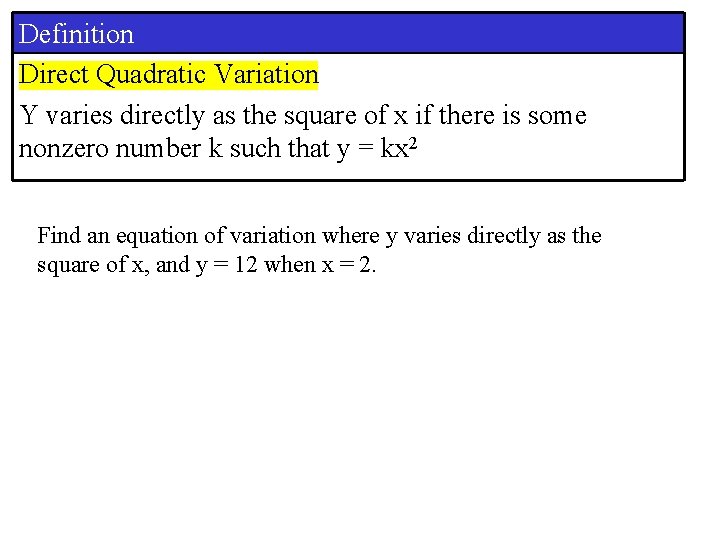
Definition Direct Quadratic Variation Y varies directly as the square of x if there is some nonzero number k such that y = kx 2 Find an equation of variation where y varies directly as the square of x, and y = 12 when x = 2.
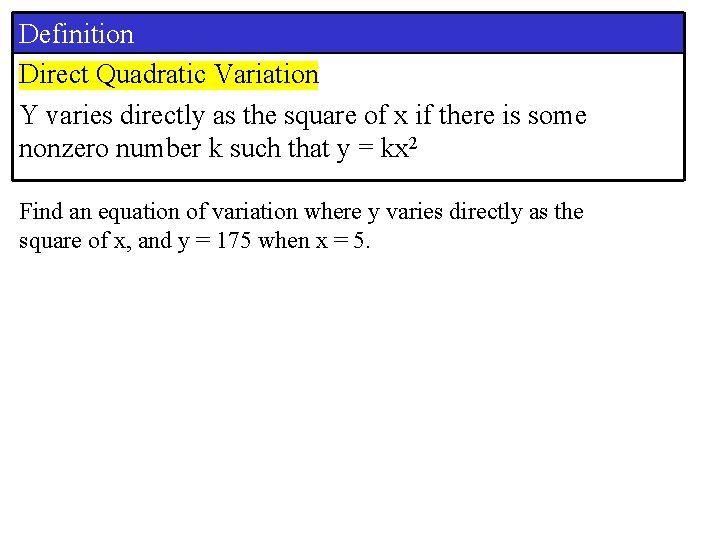
Definition Direct Quadratic Variation Y varies directly as the square of x if there is some nonzero number k such that y = kx 2 Find an equation of variation where y varies directly as the square of x, and y = 175 when x = 5.
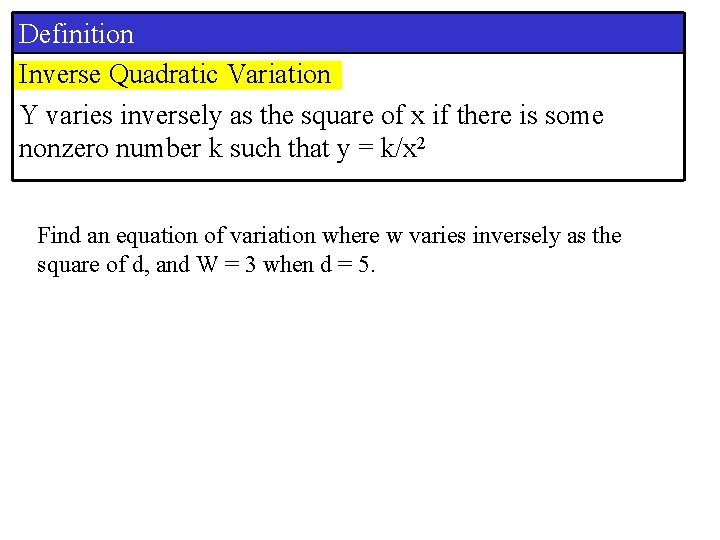
Definition Inverse Quadratic Variation Y varies inversely as the square of x if there is some nonzero number k such that y = k/x 2 Find an equation of variation where w varies inversely as the square of d, and W = 3 when d = 5.
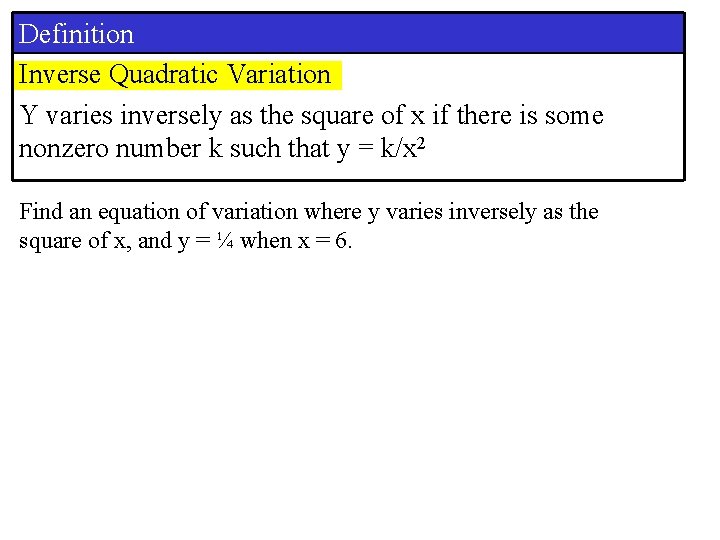
Definition Inverse Quadratic Variation Y varies inversely as the square of x if there is some nonzero number k such that y = k/x 2 Find an equation of variation where y varies inversely as the square of x, and y = ¼ when x = 6.
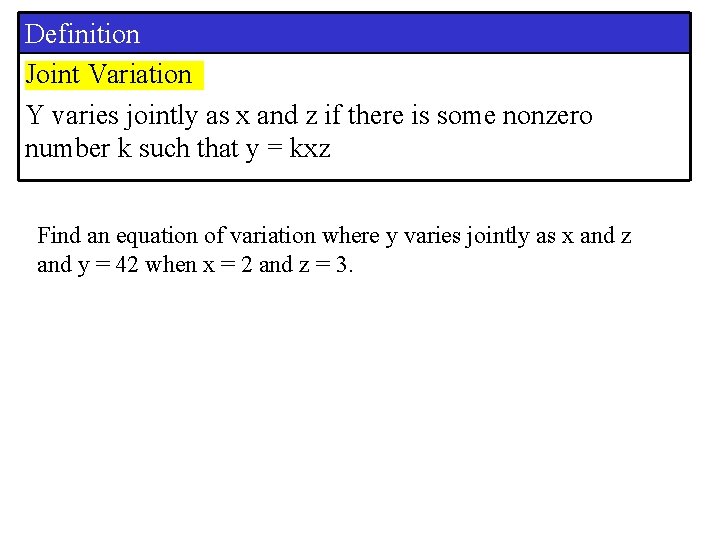
Definition Joint Variation Y varies jointly as x and z if there is some nonzero number k such that y = kxz Find an equation of variation where y varies jointly as x and z and y = 42 when x = 2 and z = 3.
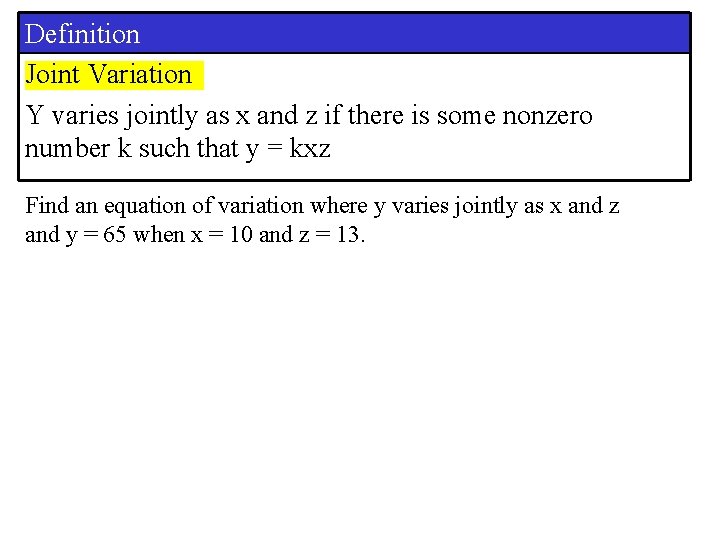
Definition Joint Variation Y varies jointly as x and z if there is some nonzero number k such that y = kxz Find an equation of variation where y varies jointly as x and z and y = 65 when x = 10 and z = 13.
HW #8. 7 Pg 370 -371 1 -23 Odd
Test Review
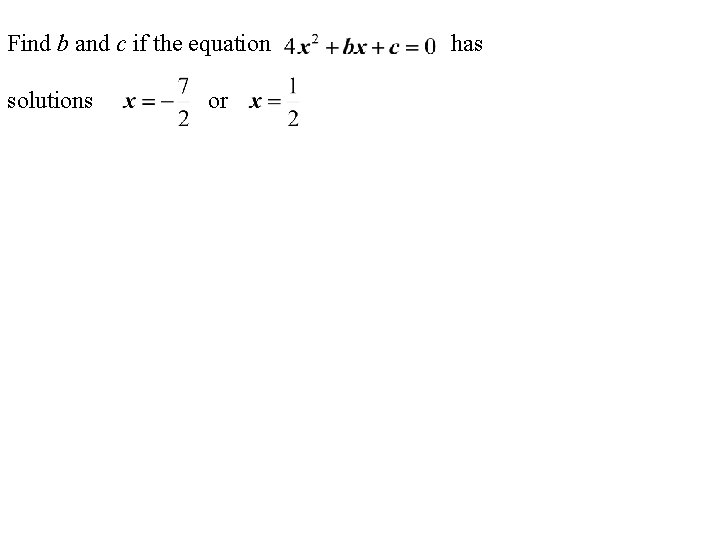
Find b and c if the equation solutions or has
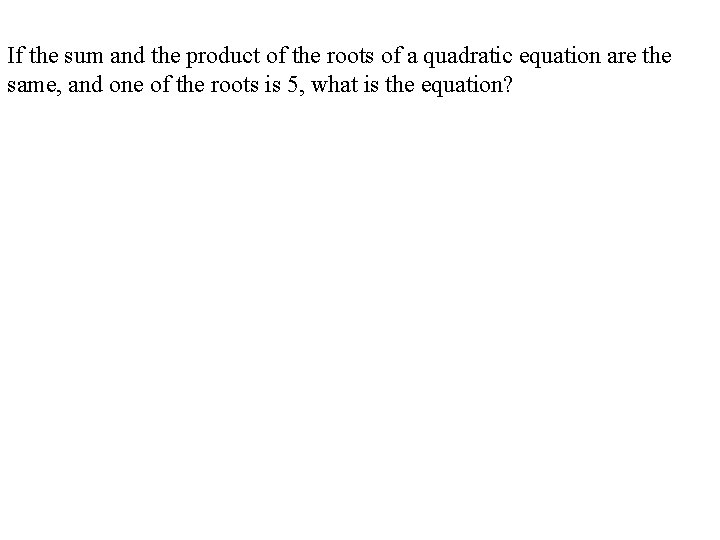
If the sum and the product of the roots of a quadratic equation are the same, and one of the roots is 5, what is the equation?
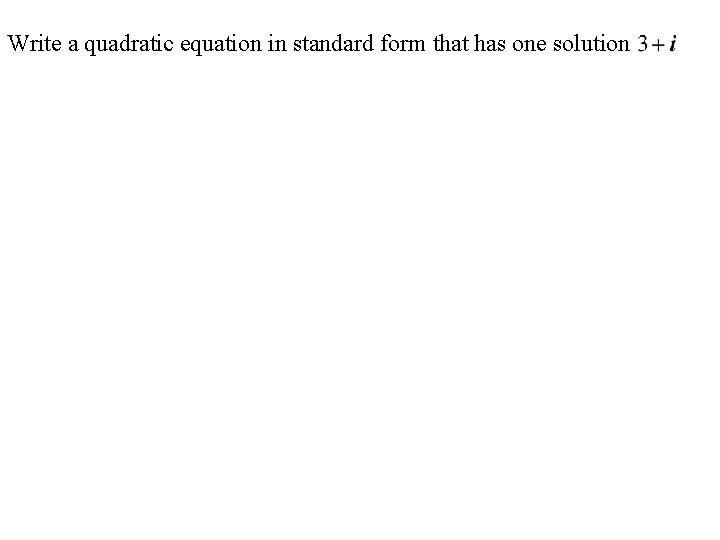
Write a quadratic equation in standard form that has one solution
HW #R-8 Pg 376 1 -30