
CHAPTER 76 Skin Soft Tissue and Wound Infections



- Slides: 16
CHAPTER 76 Skin, Soft Tissue, and Wound Infections Copyright © 2014, by Mosby, an imprint of Elsevier Inc.
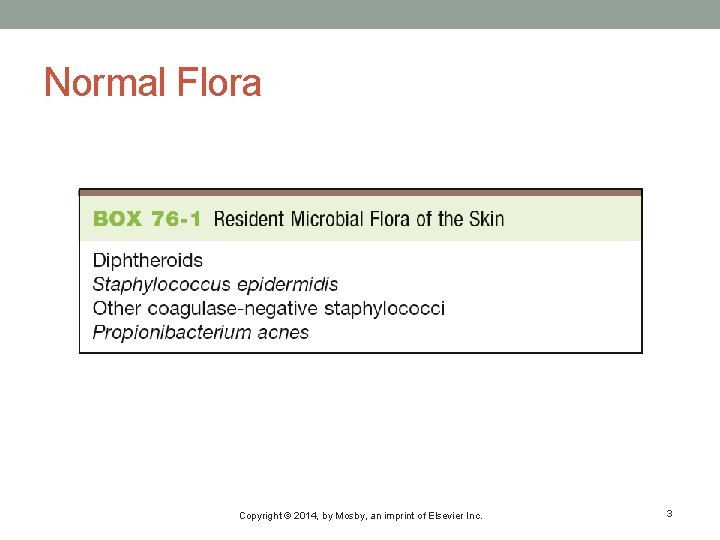
Skin • Skin forms a protective boundary between the body’s internal environment and the external environment. • Skin helps prevent colonization of many pathogens. • Normal microbial flora • p. H • Chemical defense Copyright © 2014, by Mosby, an imprint of Elsevier Inc. 2
Normal Flora Copyright © 2014, by Mosby, an imprint of Elsevier Inc. 3
Manifestations of Skin Infections • Macule • Flat discoloration of the skin • Agents: Dermatophytes, Treponema pallidum, and enteroviruses • Papule • Elevated, solid lesions (less than 5 mm in diameter) • Agents: Human papillomavirus (HPV), pox virus, scabies, Staphylococcus aureus, and Pseudomonas aeruginosa • Nodule • Raised, solid lesion (greater than 5 mm in diameter) • Agents: Corynebacterium diphtheriae, Sporothrix schenckii, fungi, Mycobacterium marinum, and Nocardia spp. • Pustule • Raised, pus-filled lesion containing leukocytes and fluid • Agents: Candida spp. , dermatophytes, herpes simplex virus (HSV), Neisseria gonorrhoeae, S. aureus, Group A streptococci, and varicella-zoster virus. Copyright © 2014, by Mosby, an imprint of Elsevier Inc. 4
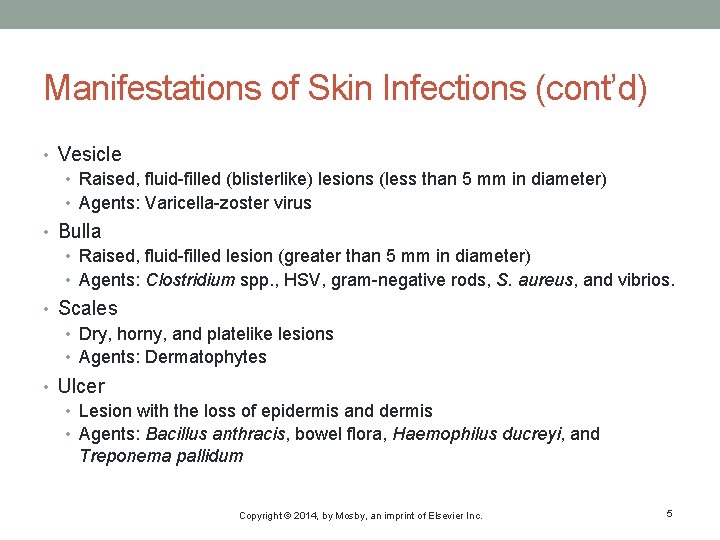
Manifestations of Skin Infections (cont’d) • Vesicle • Raised, fluid-filled (blisterlike) lesions (less than 5 mm in diameter) • Agents: Varicella-zoster virus • Bulla • Raised, fluid-filled lesion (greater than 5 mm in diameter) • Agents: Clostridium spp. , HSV, gram-negative rods, S. aureus, and vibrios. • Scales • Dry, horny, and platelike lesions • Agents: Dermatophytes • Ulcer • Lesion with the loss of epidermis and dermis • Agents: Bacillus anthracis, bowel flora, Haemophilus ducreyi, and Treponema pallidum Copyright © 2014, by Mosby, an imprint of Elsevier Inc. 5
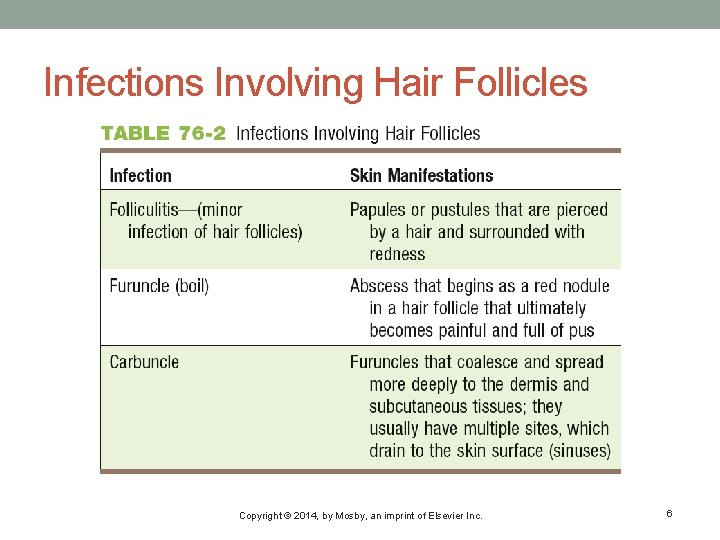
Infections Involving Hair Follicles Copyright © 2014, by Mosby, an imprint of Elsevier Inc. 6
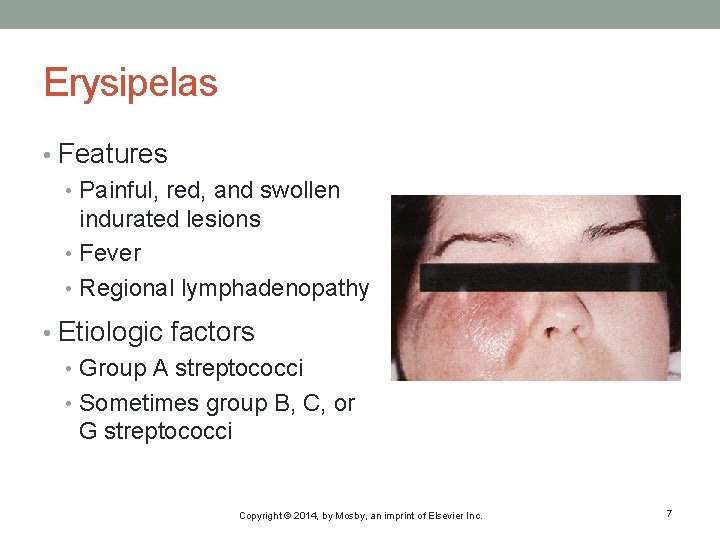
Erysipelas • Features • Painful, red, and swollen indurated lesions • Fever • Regional lymphadenopathy • Etiologic factors • Group A streptococci • Sometimes group B, C, or G streptococci Copyright © 2014, by Mosby, an imprint of Elsevier Inc. 7
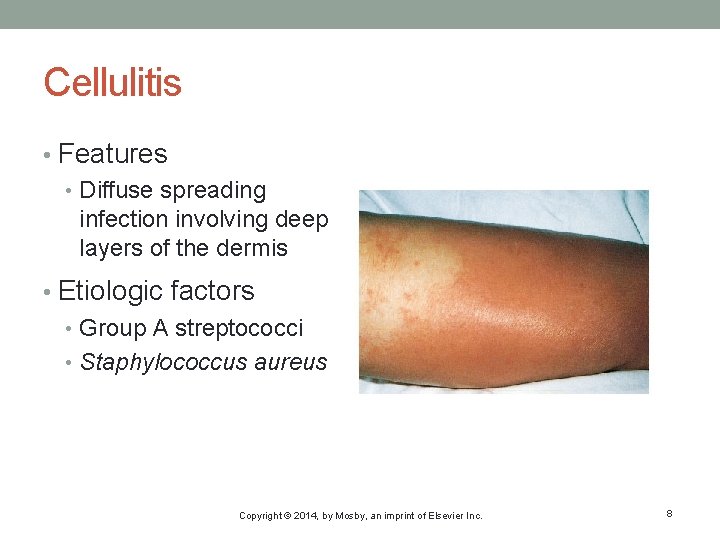
Cellulitis • Features • Diffuse spreading infection involving deep layers of the dermis • Etiologic factors • Group A streptococci • Staphylococcus aureus Copyright © 2014, by Mosby, an imprint of Elsevier Inc. 8
Other Epidermal and Dermal Infections • Erythrasma • Chronic infection of the keratinized layer of the epidermis • Agent: Corynebacterium minutissimum • Erysipeloid • Purplish, nonvesiculated skin lesion with an irregular, raised border • Agent: Erysipelothrix rhusiopathiae • Impetigo • Erythematous lesion that may be bullous or nonbullous • Agents: Group A streptococci (nonbullous) and Staphylococcus aureus (bullous) • Dermatophytosis—Fungal infection of the skin Copyright © 2014, by Mosby, an imprint of Elsevier Inc. 9
Muscle Fascia and Muscle Infections • Necrotizing fasciitis • Muscle fascia and soft tissues become infected. • Large areas of the body may become infected in a short amount of time. • Typically involves group A streptococci or Staphylococcus aureus. • Progressive bacterial synergistic gangrene • Chronic necrotic condition of the skin is a result of surgery. • Is usually polymicrobic with microaerophilic streptococci and S. aureus. • Myositis • Is inflammation of the muscle. • Most common cause of hematogenous spread is S. aureus. Copyright © 2014, by Mosby, an imprint of Elsevier Inc. 10
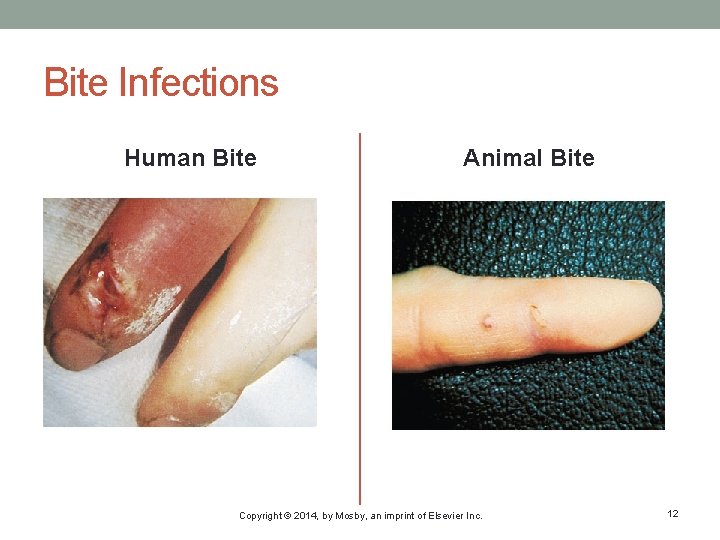
Wound Infections • Postoperative infections • Typically include the patient’s normal flora or nosocomial organisms. • Agents: Staphylococcus aureus (most common), gram-negative bacteria, anaerobes, and enterococci. • Bites • Human bites or closed-fist injuries involve normal oral flora. • Animal bites are most often from domestic cats and dogs. • Agents of animal bites include Pasteurella and Fusobacterium. • Burns • Infected burn wounds may be associated with bacteremia. • Four types are identified: impetigo, surgical, cellulitis, and invasive. • Common agents: S. aureus, Pseudomonas aeruginosa, enterococci, Enterobacter spp. , and Escherichia coli. Copyright © 2014, by Mosby, an imprint of Elsevier Inc. 11
Bite Infections Human Bite Animal Bite Copyright © 2014, by Mosby, an imprint of Elsevier Inc. 12
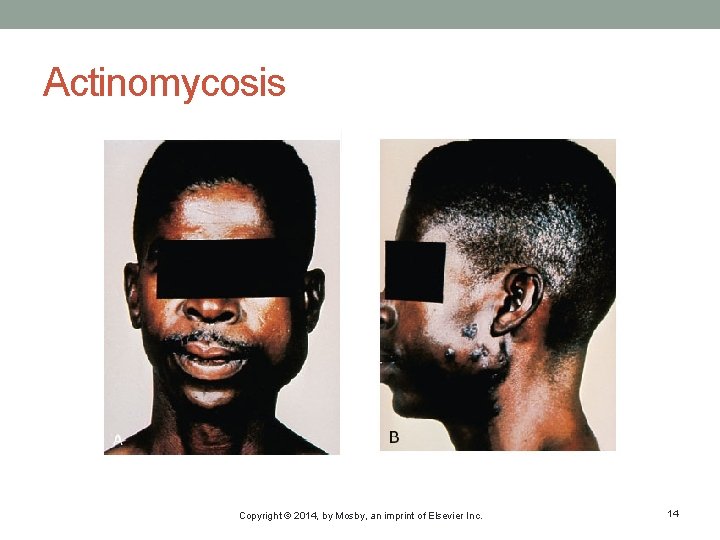
Sinus Tract and Fistulas • A sinus tract infection is a deep-seated inflammation that develops a channel to the skin surface. • Infections are usually chronic and may include osteomyelitis. • Commonly encountered organisms include: • Staphylococcus aureus • Anaerobic gram-negative bacilli • Enteric pathogens • Anaerobic gram-positive cocci • Pseudomonas aeruginosa • Organisms involved with actinomycosis include: • Actinomyces spp. • Actinobacillus actinomycetemcomitans • Propionibacterium propionicum • Prevotella spp. • Porphyromonas spp. Copyright © 2014, by Mosby, an imprint of Elsevier Inc. 13
Actinomycosis Copyright © 2014, by Mosby, an imprint of Elsevier Inc. 14
Infections in Patients with Diabetes • Anaerobic cellulitis is often identified in the extremities. • Vascular or neurologic problems include: • Excess glucose can result in impaired circulation and peripheral motor neuropathy. • Approximately 25% of those with diabetes will develop a foot infection. • Common causes of diabetic foot infections: • Staphylococcus aureus • Group B streptococci • Enteric pathogens • Anaerobes Copyright © 2014, by Mosby, an imprint of Elsevier Inc. 15
Laboratory Diagnosis • Erysipelas and cellulitis • Clinical observation is sufficient. • Swabs of lesions can be cultures. • Vesicles and bullae • Vesicles can be swabbed and cultured. • Blood culture should be performed on bullous lesions. • Wound infections • Postoperative infections usually involve anaerobes; therefore transport in an anaerobic condition is essential. • A swab specimen in anaerobic transport media is appropriate for bite wound infections. • Diagnosis of burn infections is based on clinical symptoms, signs, and examination using quantitative or semiquantitative culture. Copyright © 2014, by Mosby, an imprint of Elsevier Inc. 16