
Chapter 7 Writing the Programs 1 Daunting Task
- Slides: 29
Chapter 7 Writing the Programs 1 Daunting Task: (令人气馁的任务) design is not always straightforward to coding should be understandable considering reuse check design (聪明的程序员借此检查设计的诸多原则,同时也达 到学习设计的目的) Purpose(of the chapter): this chapter does not teach you how to program this chapter explains some of the software engineering practices ( guidelines or experience for implementation )
Chapter 7 Writing the Programs 7. 1 Programming Standards and Procedures (编程标准 (和步骤) ) focus on: A: team work , many people involved B: understand each other is important C: organization’s standards and procedures is important (about coding and for coder) 1. Standards for You(编程标准对自身的用处) 2 organizing your thoughts and avoid mistakes keep tracking what we had been doing by documentation
Chapter 7 Writing the Programs standards and procedure is helpful in translating designs to code ------it is easy to find that which or where the codes should be modified when we change the designs 2. Standards for Others(编程标准对他人的用处) 3 easy to maintenance (example: change requirements) easy to testing(independent test team know how/what) easy to reuse(by other separate team) example: opening section (P 375) ------explain the functions and interfaces invocations,
Chapter 7 Writing the Programs 3. Matching Design with Implementation (设计与编程实现相匹配) (如何做到?) ------direct correspondence between the program design components and the standardized program code components is essential standard (or critical standard ) ------design characteristics , such as low coupling, high cohesion, and well-defined interfaces, should also be program characteristics 4
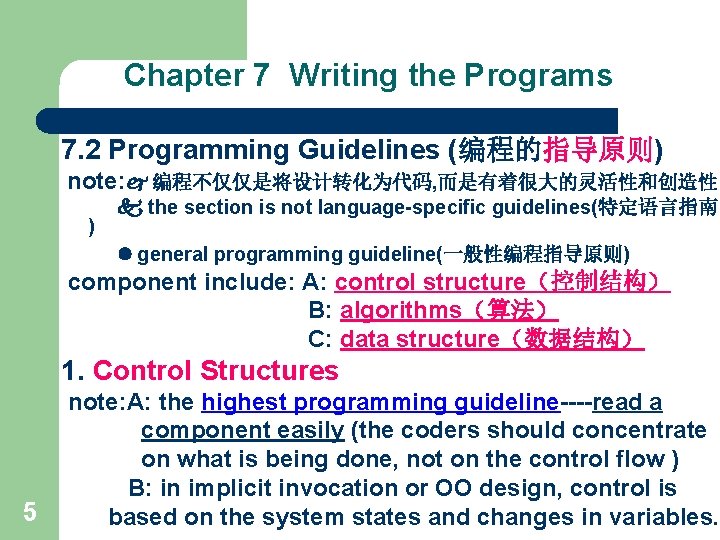
Chapter 7 Writing the Programs 7. 2 Programming Guidelines (编程的指导原则) note: 编程不仅仅是将设计转化为代码, 而是有着很大的灵活性和创造性 ) the section is not language-specific guidelines(特定语言指南 general programming guideline(一般性编程指导原则) component include: A: control structure(控制结构) B: algorithms(算法) C: data structure(数据结构) 1. Control Structures 5 note: A: the highest programming guideline----read a component easily (the coders should concentrate on what is being done, not on the control flow ) B: in implicit invocation or OO design, control is based on the system states and changes in variables.
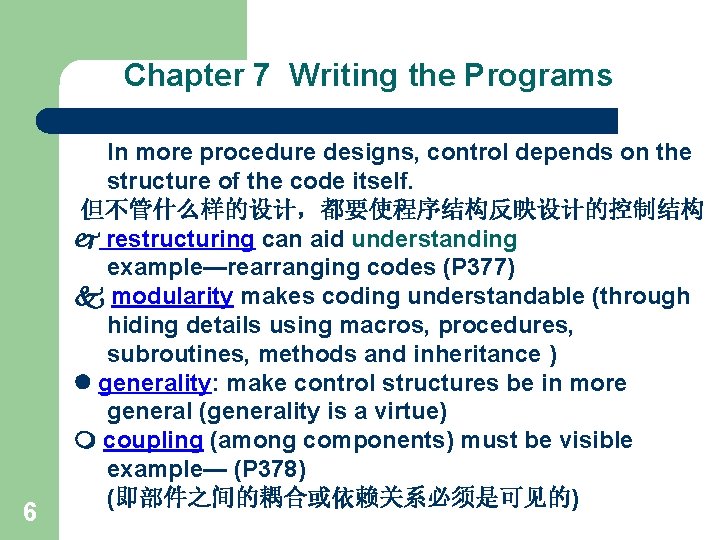
Chapter 7 Writing the Programs 6 In more procedure designs, control depends on the structure of the code itself. 但不管什么样的设计,都要使程序结构反映设计的控制结构 restructuring can aid understanding example—rearranging codes (P 377) modularity makes coding understandable (through hiding details using macros, procedures, subroutines, methods and inheritance ) generality: make control structures be in more general (generality is a virtue) coupling (among components) must be visible example— (P 378) (即部件之间的耦合或依赖关系必须是可见的)
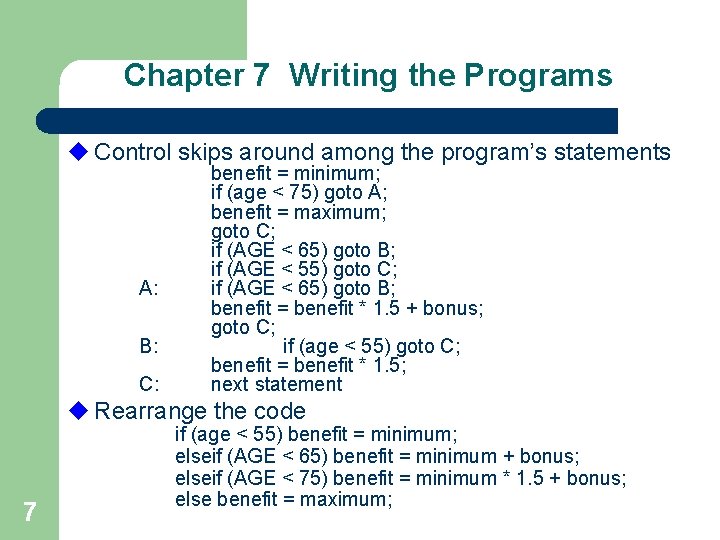
Chapter 7 Writing the Programs u Control skips around among the program’s statements A: B: C: benefit = minimum; if (age < 75) goto A; benefit = maximum; goto C; if (AGE < 65) goto B; if (AGE < 55) goto C; if (AGE < 65) goto B; benefit = benefit * 1. 5 + bonus; goto C; if (age < 55) goto C; benefit = benefit * 1. 5; next statement u Rearrange the code 7 if (age < 55) benefit = minimum; elseif (AGE < 65) benefit = minimum + bonus; elseif (AGE < 75) benefit = minimum * 1. 5 + bonus; else benefit = maximum;
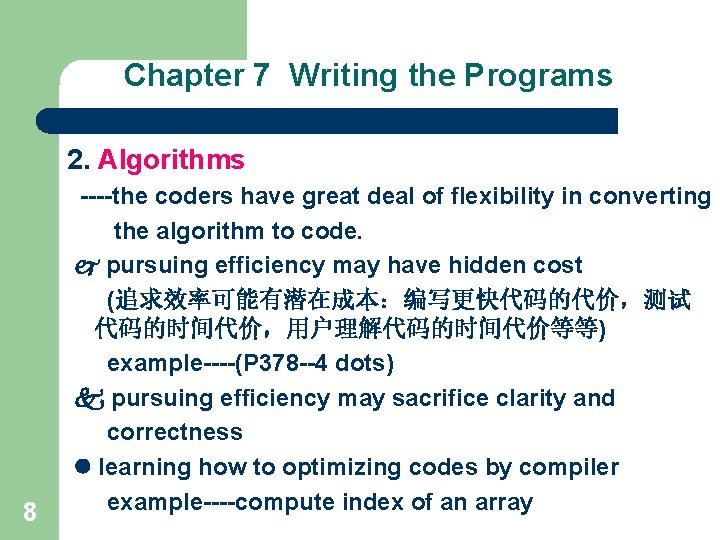
Chapter 7 Writing the Programs 2. Algorithms 8 ----the coders have great deal of flexibility in converting the algorithm to code. pursuing efficiency may have hidden cost (追求效率可能有潜在成本:编写更快代码的代价,测试 代码的时间代价,用户理解代码的时间代价等等) example----(P 378 --4 dots) pursuing efficiency may sacrifice clarity and correctness learning how to optimizing codes by compiler example----compute index of an array
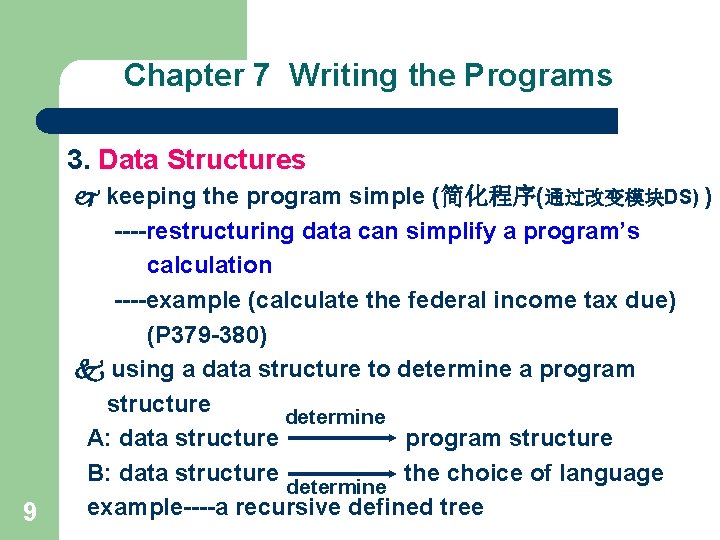
Chapter 7 Writing the Programs 3. Data Structures 9 keeping the program simple (简化程序(通过改变模块DS) ) ----restructuring data can simplify a program’s calculation ----example (calculate the federal income tax due) (P 379 -380) using a data structure to determine a program structure determine A: data structure program structure B: data structure the choice of language determine example----a recursive defined tree
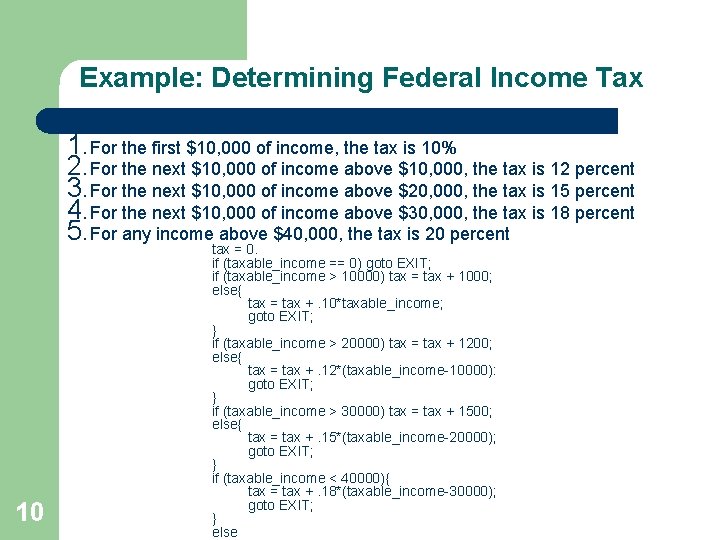
Example: Determining Federal Income Tax 1. For the first $10, 000 of income, the tax is 10% 2. For the next $10, 000 of income above $10, 000, the tax is 12 percent 3. For the next $10, 000 of income above $20, 000, the tax is 15 percent 4. For the next $10, 000 of income above $30, 000, the tax is 18 percent 5. For any income above $40, 000, the tax is 20 percent 10 tax = 0. if (taxable_income == 0) goto EXIT; if (taxable_income > 10000) tax = tax + 1000; else{ tax = tax +. 10*taxable_income; goto EXIT; } if (taxable_income > 20000) tax = tax + 1200; else{ tax = tax +. 12*(taxable_income-10000): goto EXIT; } if (taxable_income > 30000) tax = tax + 1500; else{ tax = tax +. 15*(taxable_income-20000); goto EXIT; } if (taxable_income < 40000){ tax = tax +. 18*(taxable_income-30000); goto EXIT; } else
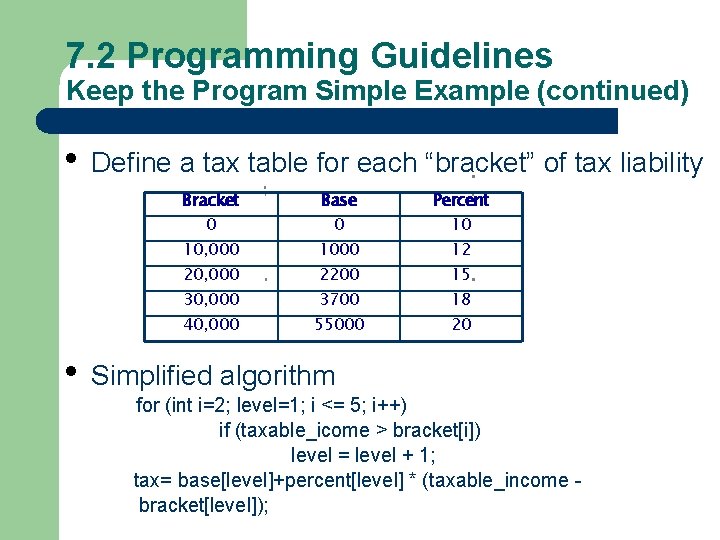
7. 2 Programming Guidelines Keep the Program Simple Example (continued) • Define a tax table for each “bracket” of tax liability Bracket 0 Base 0 Percent 10 10, 000 12 20, 000 2200 15 30, 000 3700 18 40, 000 55000 20 • Simplified algorithm for (int i=2; level=1; i <= 5; i++) if (taxable_icome > bracket[i]) level = level + 1; tax= base[level]+percent[level] * (taxable_income bracket[level]);
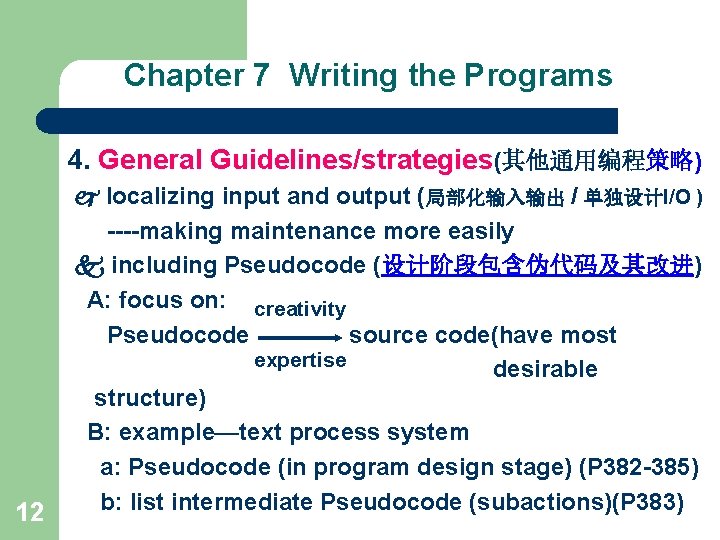
Chapter 7 Writing the Programs 4. General Guidelines/strategies(其他通用编程策略) 12 localizing input and output (局部化输入输出 / 单独设计I/O ) ----making maintenance more easily including Pseudocode (设计阶段包含伪代码及其改进) A: focus on: creativity Pseudocode source code(have most expertise desirable structure) B: example—text process system a: Pseudocode (in program design stage) (P 382 -385) b: list intermediate Pseudocode (subactions)(P 383)
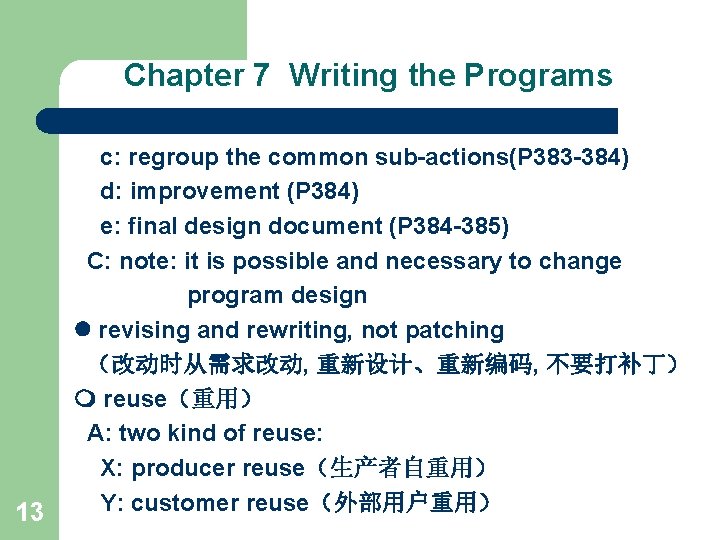
Chapter 7 Writing the Programs 13 c: regroup the common sub-actions(P 383 -384) d: improvement (P 384) e: final design document (P 384 -385) C: note: it is possible and necessary to change program design revising and rewriting, not patching (改动时从需求改动, 重新设计、重新编码, 不要打补丁) reuse(重用) A: two kind of reuse: X: producer reuse(生产者自重用) Y: customer reuse(外部用户重用)
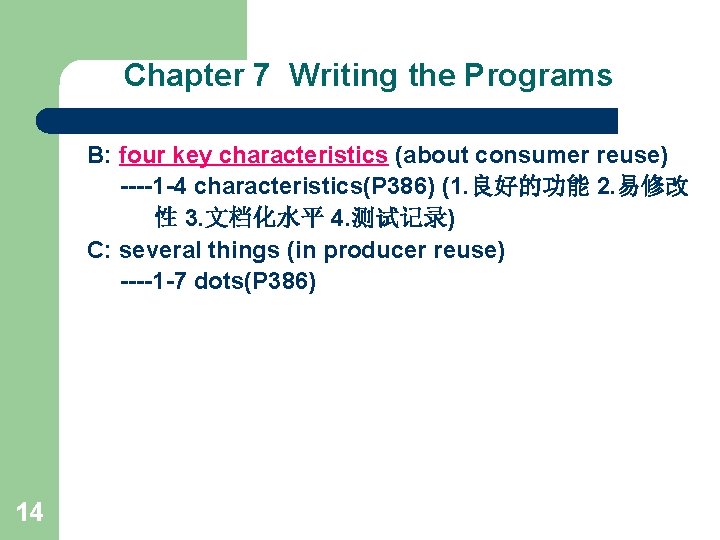
Chapter 7 Writing the Programs B: four key characteristics (about consumer reuse) ----1 -4 characteristics(P 386) (1. 良好的功能 2. 易修改 性 3. 文档化水平 4. 测试记录) C: several things (in producer reuse) ----1 -7 dots(P 386) 14
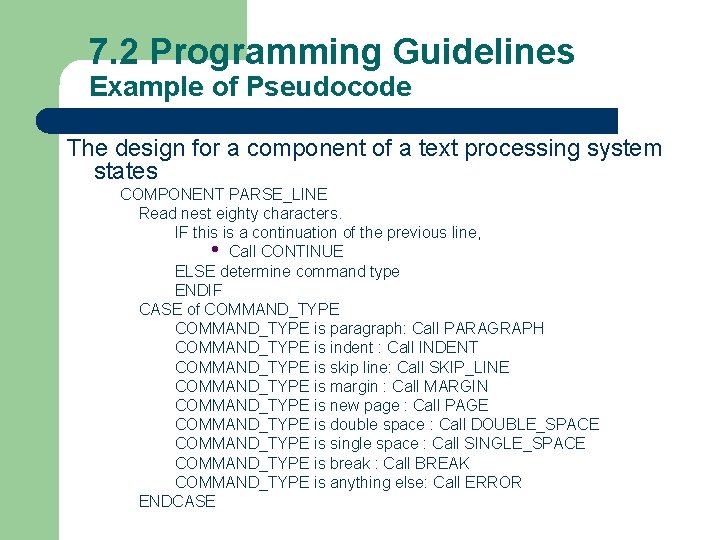
7. 2 Programming Guidelines Example of Pseudocode The design for a component of a text processing system states COMPONENT PARSE_LINE Read nest eighty characters. IF this is a continuation of the previous line, • Call CONTINUE ELSE determine command type ENDIF CASE of COMMAND_TYPE is paragraph: Call PARAGRAPH COMMAND_TYPE is indent : Call INDENT COMMAND_TYPE is skip line: Call SKIP_LINE COMMAND_TYPE is margin : Call MARGIN COMMAND_TYPE is new page : Call PAGE COMMAND_TYPE is double space : Call DOUBLE_SPACE COMMAND_TYPE is single space : Call SINGLE_SPACE COMMAND_TYPE is break : Call BREAK COMMAND_TYPE is anything else: Call ERROR ENDCASE
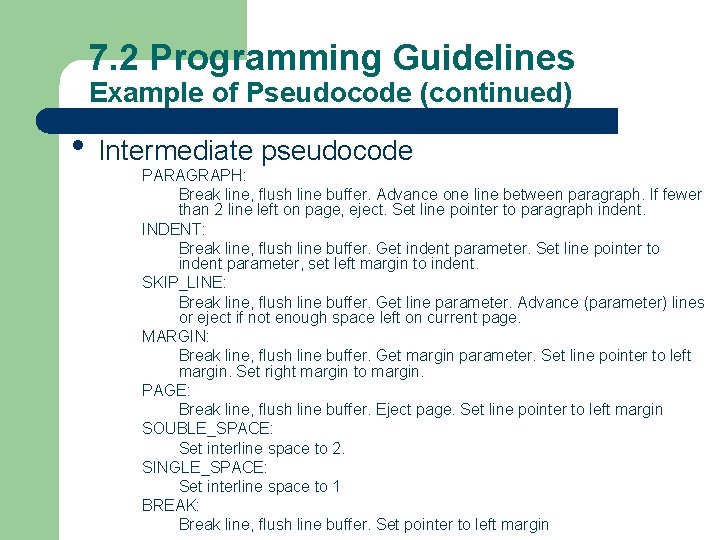
7. 2 Programming Guidelines Example of Pseudocode (continued) • Intermediate pseudocode PARAGRAPH: Break line, flush line buffer. Advance one line between paragraph. If fewer than 2 line left on page, eject. Set line pointer to paragraph indent. INDENT: Break line, flush line buffer. Get indent parameter. Set line pointer to indent parameter, set left margin to indent. SKIP_LINE: Break line, flush line buffer. Get line parameter. Advance (parameter) lines or eject if not enough space left on current page. MARGIN: Break line, flush line buffer. Get margin parameter. Set line pointer to left margin. Set right margin to margin. PAGE: Break line, flush line buffer. Eject page. Set line pointer to left margin SOUBLE_SPACE: Set interline space to 2. SINGLE_SPACE: Set interline space to 1 BREAK: Break line, flush line buffer. Set pointer to left margin
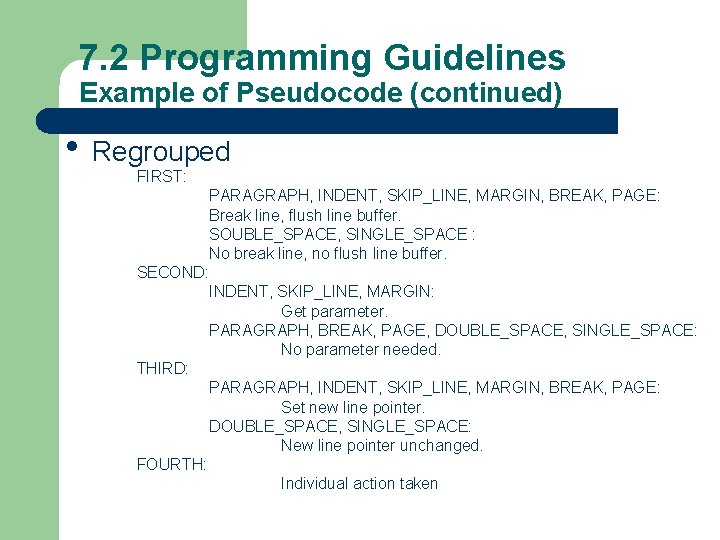
7. 2 Programming Guidelines Example of Pseudocode (continued) • Regrouped FIRST: PARAGRAPH, INDENT, SKIP_LINE, MARGIN, BREAK, PAGE: Break line, flush line buffer. SOUBLE_SPACE, SINGLE_SPACE : No break line, no flush line buffer. SECOND: INDENT, SKIP_LINE, MARGIN: Get parameter. PARAGRAPH, BREAK, PAGE, DOUBLE_SPACE, SINGLE_SPACE: No parameter needed. THIRD: PARAGRAPH, INDENT, SKIP_LINE, MARGIN, BREAK, PAGE: Set new line pointer. DOUBLE_SPACE, SINGLE_SPACE: New line pointer unchanged. FOURTH: Individual action taken
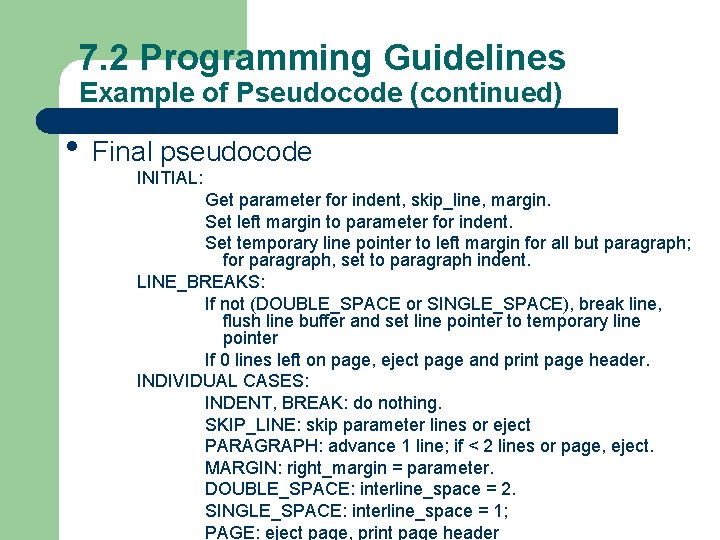
7. 2 Programming Guidelines Example of Pseudocode (continued) • Final pseudocode INITIAL: Get parameter for indent, skip_line, margin. Set left margin to parameter for indent. Set temporary line pointer to left margin for all but paragraph; for paragraph, set to paragraph indent. LINE_BREAKS: If not (DOUBLE_SPACE or SINGLE_SPACE), break line, flush line buffer and set line pointer to temporary line pointer If 0 lines left on page, eject page and print page header. INDIVIDUAL CASES: INDENT, BREAK: do nothing. SKIP_LINE: skip parameter lines or eject PARAGRAPH: advance 1 line; if < 2 lines or page, eject. MARGIN: right_margin = parameter. DOUBLE_SPACE: interline_space = 2. SINGLE_SPACE: interline_space = 1; PAGE: eject page, print page header
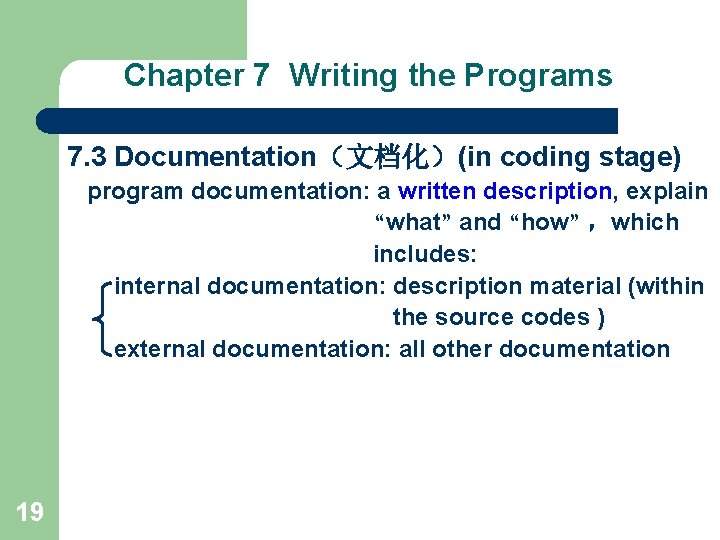
Chapter 7 Writing the Programs 7. 3 Documentation(文档化)(in coding stage) program documentation: a written description, explain “what” and “how” ,which includes: internal documentation: description material (within the source codes ) external documentation: all other documentation 19
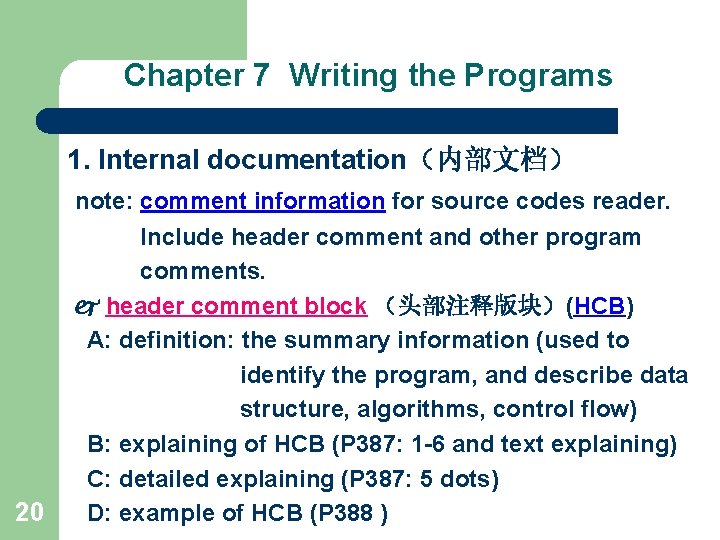
Chapter 7 Writing the Programs 1. Internal documentation(内部文档) 20 note: comment information for source codes reader. Include header comment and other program comments. header comment block (头部注释版块)(HCB) A: definition: the summary information (used to identify the program, and describe data structure, algorithms, control flow) B: explaining of HCB (P 387: 1 -6 and text explaining) C: detailed explaining (P 387: 5 dots) D: example of HCB (P 388 )
Chapter 7 Writing the Programs 21 other program comments(其他程序注释) A: explaining: other explaining (exclude HCB) to help readers understand all intentions about source codes. B: simple guidelines note: additional comments are useful although structured code u: phased comments (exclude lined comments) v: code change accompanying comment update w: comments should have new information example—(P 388 ) x: writing comments as writing code: not afterward
Chapter 7 Writing the Programs 22 meaningful variable names and statement labels A: express specific meaning or useness B: it is better alphabetic statement labels formatting to enhance understanding (P 389 -390) A: indentation and spacing ----clarity and formatting (of the source code) B: right comments documenting data(数据文档化/记录数据) A: internal document should include description for DS and its useness B: information hiding in OO make it even more difficult to understand how a data value is changed
Chapter 7 Writing the Programs 2. External Documentation(外部文档) Note: A: internal document is for programmer external document is for those who never read codes (for example: designer will taking modification or enhancement); it answers questions in a system view. B: content: X: overview Y: data sharing and using Z: explain object classes and inheritance hierarchy 23
Chapter 7 Writing the Programs C: different with the design documentation: design document----skeleton external document----flesh / muscle describing the problem A: why a particular solution was chosen B: discussing the background of the problem describing the algorithms focus: where, formula, boundary condition ----supplement explaining about algorithm in design or other document. 24
Chapter 7 Writing the Programs describing the data A: data flow description in model level B: explaining the interaction among objects in OO components. (interdependency, dealing sequence, constraints, etc) 25
Chapter 7 Writing the Programs 7. 4 The Programming Process(编程过程) Note: guidelines(指导原则) of programming process 1. Programming as Problem Solving (将编程作为问题求解过程) four stages : 26 (1) Understanding the problem(nature about a problem) (2) Devising a plan (solution) (3) Carrying out the plan (finish the solution and implementation) (4) Looking back (回顾----check, modify the implementation )
Chapter 9 Testing the System Note A: unit and integration testing----by yourself or a small part of the development team B: system testing----by the entire develop team • 9. 1 Principles of system testing Focus A: objective of unit and integration ------ensure the code implemented the design properly ⑦ ⑧⑨⑩ 29