
Chapter 7 Working with Databases and My SQL
Chapter 7 Working with Databases and My. SQL PHP Programming with My. SQL 2 nd Edition
Objectives In this chapter, you will: • Study the basics of databases and My. SQL • Work with My. SQL databases • Define database tables • Modify user privileges • Work with database records • Work with php. My. Admin PHP Programming with My. SQL, 2 nd Edition 2
Introduction to Databases • A database is an ordered collection of information from which a computer program can quickly access information • Each row in a database table is called a record • A record in a database is a single complete set of related information • Each column in a database table is called a field • Fields are the individual categories of information stored in a record PHP Programming with My. SQL, 2 nd Edition 3
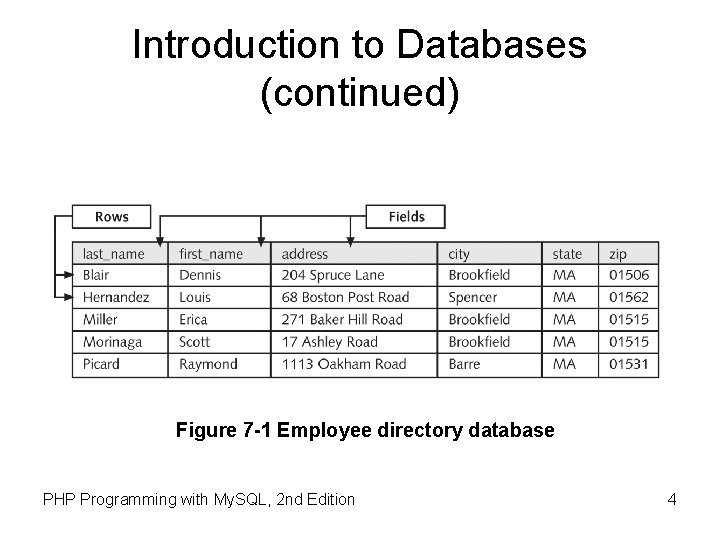
Introduction to Databases (continued) Figure 7 -1 Employee directory database PHP Programming with My. SQL, 2 nd Edition 4
Introduction to Databases (continued) • A flat-file database stores information in a single table • A relational database stores information across multiple related tables PHP Programming with My. SQL, 2 nd Edition 5
Understanding Relational Databases • Relational databases consist of one or more related tables • A primary table is the main table in a relationship that is referenced by another table • A related table (or “child table”) references a primary table in a relational database • A primary key is a field that contains a unique identifier for each record in a primary table PHP Programming with My. SQL, 2 nd Edition 6
Understanding Relational Databases (continued) • A primary key is a type of index, which identifies records in a database to make retrievals and sorting faster • A foreign key is a field in a related table that refers to the primary key in a primary table • Primary and foreign keys link records across multiple tables in a relational database PHP Programming with My. SQL, 2 nd Edition 7
One-to-One Relationships • A one-to-one relationship exists between two tables when a related table contains exactly one record for each record in the primary table • Create one-to-one relationships to break information into multiple, logical sets • Information in the tables in a one-to-one relationship can be placed within a single table • Make the information in one of the tables confidential and accessible only by certain individuals PHP Programming with My. SQL, 2 nd Edition 8
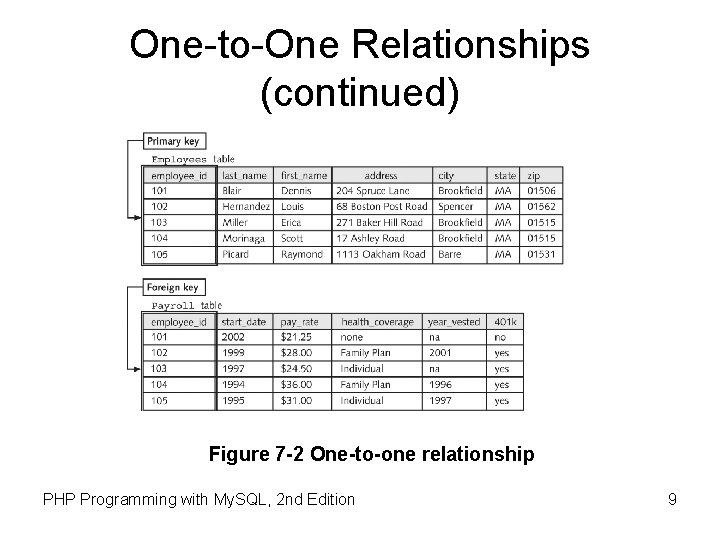
One-to-One Relationships (continued) Figure 7 -2 One-to-one relationship PHP Programming with My. SQL, 2 nd Edition 9
One-to-Many Relationship • A one-to-many relationship exists in a relational database when one record in a primary table has many related records in a related table • Breaking tables into multiple related tables to reduce redundant and duplicate information is called normalization • Provides a more efficient and less redundant method of storing this information in a database PHP Programming with My. SQL, 2 nd Edition 10
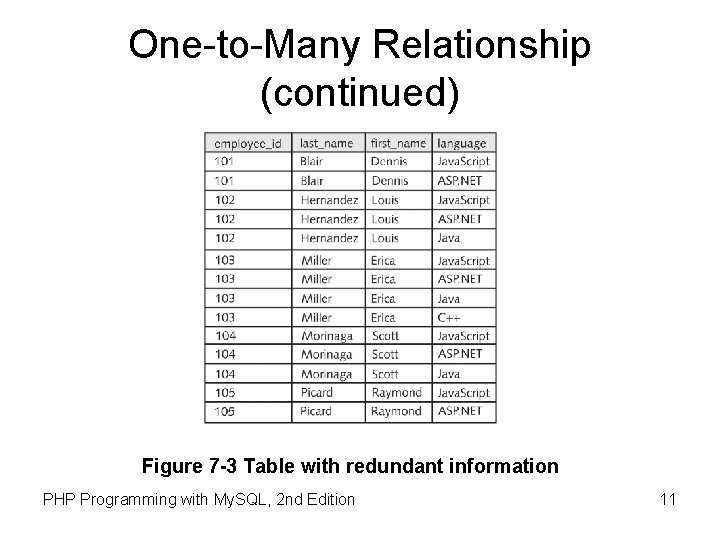
One-to-Many Relationship (continued) Figure 7 -3 Table with redundant information PHP Programming with My. SQL, 2 nd Edition 11
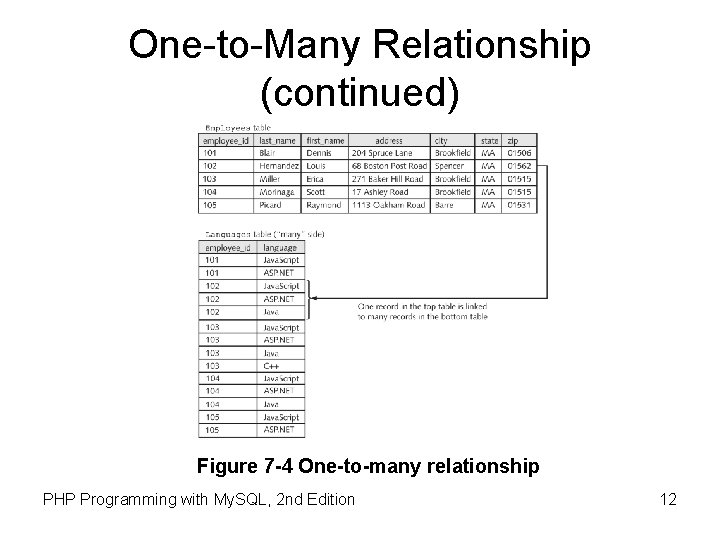
One-to-Many Relationship (continued) Figure 7 -4 One-to-many relationship PHP Programming with My. SQL, 2 nd Edition 12
Many-to-Many Relationship • A many-to-many relationship exists in a relational database when many records in one table are related to many records in another table • A junction table creates a one-to-many relationship for each of the two tables in a many-to-many relationship • A junction table contains foreign keys from the two tables PHP Programming with My. SQL, 2 nd Edition 13
Working with Database Management Systems • A database management system (or DBMS) is an application or collection of applications used to access and manage a database • A schema is the structure of a database including its tables, fields, and relationships • A flat-file database management system is a system that stores data in a flat-file format • A relational database management system (or RDBMS) is a system that stores data in a relational format PHP Programming with My. SQL, 2 nd Edition 14
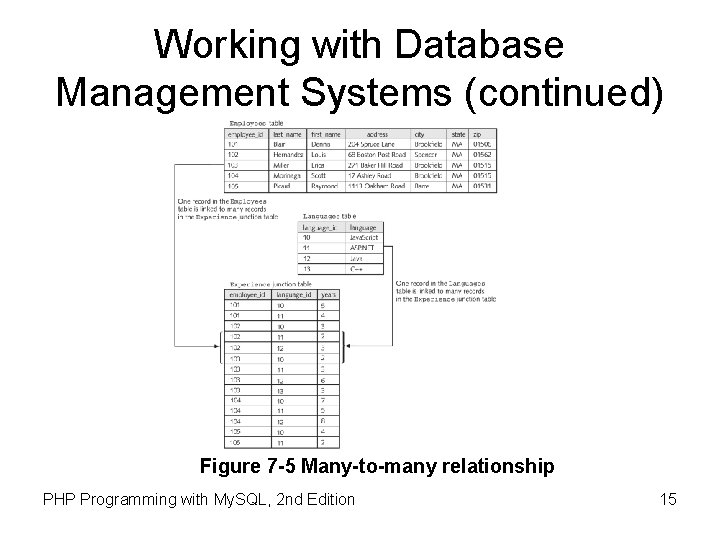
Working with Database Management Systems (continued) Figure 7 -5 Many-to-many relationship PHP Programming with My. SQL, 2 nd Edition 15
Working with Database Management Systems (continued) • Important aspects of database management systems: – The structuring and preservation of the database file – Ensuring that data is stored correctly in a database’s tables, regardless of the database format – Querying capability PHP Programming with My. SQL, 2 nd Edition 16
Working with Database Management Systems (continued) • A query is a structured set of instructions and criteria for retrieving, adding, modifying, and deleting database information • Structured query language (or SQL) is a standard data manipulation language used among many database management systems • Open database connectivity (or ODBC) allows ODBC-compliant applications to access any data source for which there is an ODBC driver PHP Programming with My. SQL, 2 nd Edition 17
Getting Started with My. SQL • The My. SQL Monitor is a command-line program for manipulating My. SQL databases • Connect to the My. SQL server using a commandline connect • Commands are entered at the mysql-> command prompt in the console window PHP Programming with My. SQL, 2 nd Edition 18
Logging in to My. SQL • Enter the following command: mysql –h host –u user –p • Two accounts are created: – Anonymous user account allows login without specifying a username or password – root account (the primary administrative account for My. SQL) is created without a password mysql –u root • Log out with the exit or quit commands PHP Programming with My. SQL, 2 nd Edition 19
![Logging in to My. SQL (continued) $ mysql –h php_db -u dongosselin -p[ENTER ]](http://slidetodoc.com/presentation_image_h2/f50aaaa24cd8c5a90f9ca59faf74a0cc/image-20.jpg "Logging in to My. SQL (continued) $ mysql –h php_db -u dongosselin -p[ENTER ]")
Logging in to My. SQL (continued) $ mysql –h php_db -u dongosselin -p[ENTER ] Enter password: *****[ENTER ] Welcome to the My. SQL monitor. Commands end with ; or g. Your My. SQL connection id is 6611 to server version: 4. 1. 9 nt Type 'help; ' or 'h' for help. Type 'c' to clear the buffer. mysql> • Use the up and down arrow keys on the keyboard to scroll through previously entered commands PHP Programming with My. SQL, 2 nd Edition 20
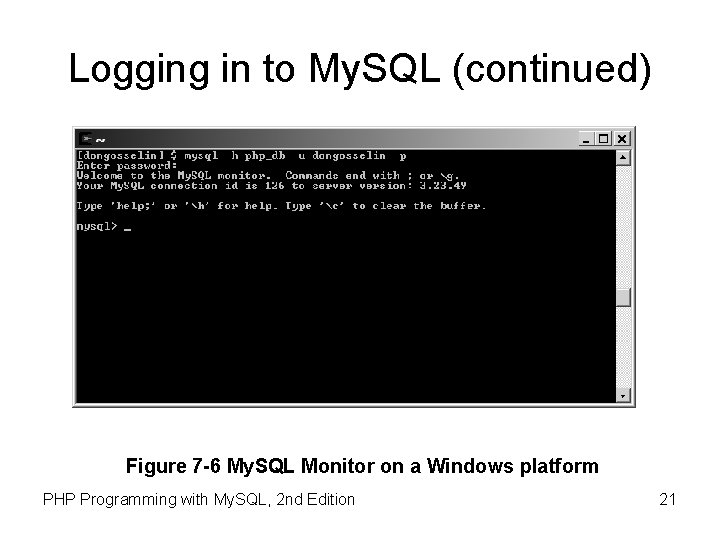
Logging in to My. SQL (continued) Figure 7 -6 My. SQL Monitor on a Windows platform PHP Programming with My. SQL, 2 nd Edition 21
Understanding My. SQL Identifiers • An alias is an alternate name used to refer to a table or field in SQL statements • The case sensitivity of database and table identifiers depends on the operating system – Not case sensitive on Windows platforms – Case sensitive on UNIX/Linux systems • My. SQL stores each database in a directory of the same name as the database identifier • Field and index identifiers are case insensitive on all platforms PHP Programming with My. SQL, 2 nd Edition 23
Understanding My. SQL Identifiers (continued) • Identifiers that must be quoted using the backtick, or single quote, character (`)are – An identifier that includes any character except standard alphanumeric characters, underscores (_) or dollar signs ($) – Any identifier that contains one or more space characters – An identifier that is a reserved word in My. SQL – An identifier made entirely of numeric digits – An identifier that contains a backtick character PHP Programming with My. SQL, 2 nd Edition 24
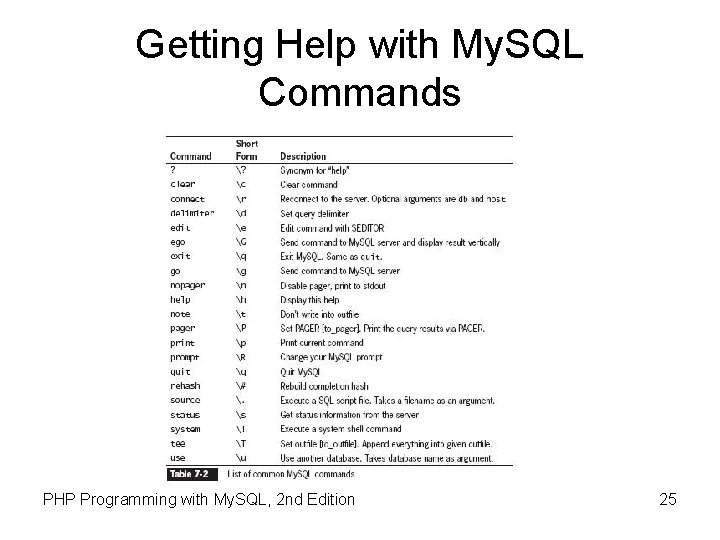
Getting Help with My. SQL Commands PHP Programming with My. SQL, 2 nd Edition 25
Creating Databases • Use the CREATE DATABASE statement to create a new database: mysql> CREATE DATABASE vehicle_fleet; [ENTER ] • To use a new database, select it by executing the USE DATABASE statement PHP Programming with My. SQL, 2 nd Edition 26
Selecting a Database • Use the DATABASE() function to return the name of the currently active database mysql> SELECT DATABASE(); [ENTER ] • View the available databases using the SHOW DATABASES statement mysql> SHOW databases; [ENTER ] • Use the DROP DATABASE statement to remove all tables and delete a database mysql> DROP DATABASE database; PHP Programming with My. SQL, 2 nd Edition 27
Defining Database Tables • Data types that are assigned to fields determine how much storage space the computer allocates for the data in the database • Choose the smallest data type possible for each field PHP Programming with My. SQL, 2 nd Edition 28
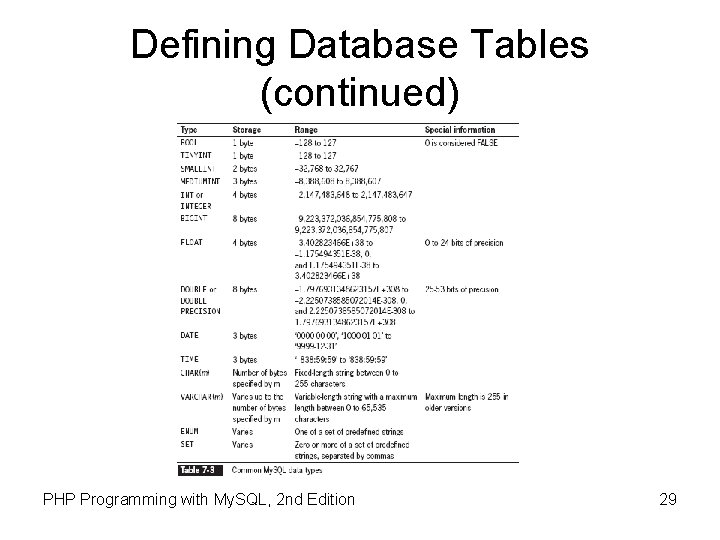
Defining Database Tables (continued) PHP Programming with My. SQL, 2 nd Edition 29
Creating Tables • Use the CREATE TABLE statement to create a new table and define the column names and data types for each column mysql> CREATE TABLE vehicles (license VARCHAR(10), make VARCHAR(25), model VARCHAR(50), miles FLOAT, assigned_to VARCHAR(40)); [ENTER ] PHP Programming with My. SQL, 2 nd Edition 30

Viewing Table Structure • Use the DESCRIBE table_name statement to view the structure of the table PHP Programming with My. SQL, 2 nd Edition 31
Changing Table Field Names • Use the ALTER TABLE to change the name of an existing field in a table using the following syntax ALTER TABLE table_name ADD [COLUMN] (column_name column_type [, column_name column_type. . . ]); • In My. SQL Monitor, enter the following: mysql> ALTER TABLE vehicles ADD COLUMN (model_year INT); [ENTER ] PHP Programming with My. SQL, 2 nd Edition 32
Modifying Column Types • Use the ALTER TABLE to rename columns of an existing field in a table using the following syntax ALTER TABLE table_name CHANGE [COLUMN] column_name new_name column_type; • In My. SQL Monitor, enter the following: mysql> ALTER TABLE vehicles CHANGE COLUMN miles mileage FLOAT; [ENTER ] PHP Programming with My. SQL, 2 nd Edition 33
Renaming Columns • Use the ALTER TABLE to rename columns using the following syntax ALTER TABLE table_name MODIFY [COLUMN] column_name column_type; In My. SQL Monitor, enter the following: mysql> ALTER TABLE vehicles MODIFY COLUMN model_year SMALLINT; [ENTER ] PHP Programming with My. SQL, 2 nd Edition 34
Renaming Tables • Use the ALTER TABLE to change the name of an existing table using the following syntax ALTER TABLE table_name RENAME [TO] new_name; mysql> ALTER TABLE vehicles RENAME TO company_cars; [ENTER ] PHP Programming with My. SQL, 2 nd Edition 35
Removing Columns • Use the ALTER TABLE to remove an existing field from a table using the following syntax ALTER TABLE table_name DROP [COLUMN] column_name; mysql> ALTER TABLE company_cars DROP COLUMN assigned_to; [ENTER ] PHP Programming with My. SQL, 2 nd Edition 36
Deleting Tables • Execute the DROP TABLE statement to remove all data and the table definition from a database DROP TABLE table; • In My. SQL Monitor, enter the following at the mysql> prompt: mysql> DROP TABLE company_cars; [ENTER ] • You must be logged in as the root user or have DROP privileges to delete a table. PHP Programming with My. SQL, 2 nd Edition 37
Modifying User Privileges • Privileges are actions and operations a user can perform with a table or a database • For security purposes, user accounts should only be assigned the minimum necessary privileges to perform given tasks PHP Programming with My. SQL, 2 nd Edition 38
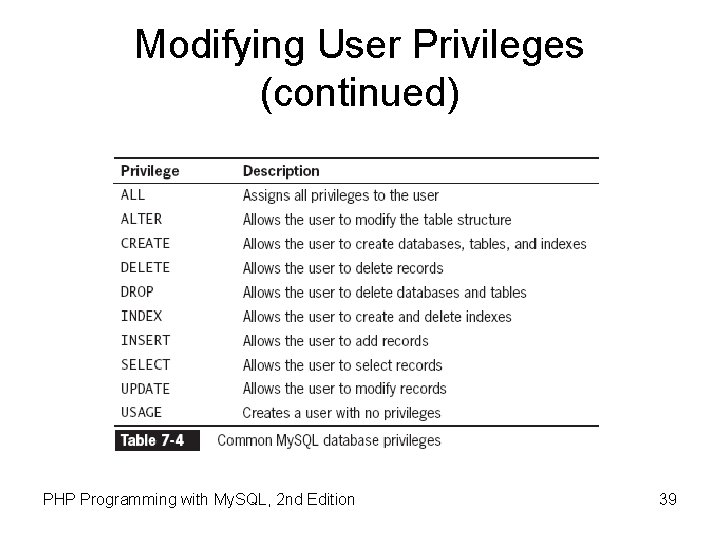
Modifying User Privileges (continued) PHP Programming with My. SQL, 2 nd Edition 39
![Granting Privileges • The syntax for the GRANT statement is: GRANT privilege [(column)] [,](http://slidetodoc.com/presentation_image_h2/f50aaaa24cd8c5a90f9ca59faf74a0cc/image-39.jpg "Granting Privileges • The syntax for the GRANT statement is: GRANT privilege [(column)] [,")
Granting Privileges • The syntax for the GRANT statement is: GRANT privilege [(column)] [, privilege [(columns)]]. . . ON {table | *. * | database. *} TO user [IDENTIFIED BY 'password']; • The GRANT statement creates the user account if it does not exist and assigns the specified privileges • If the user account already exists, the GRANT statement just updates the privileges PHP Programming with My. SQL, 2 nd Edition 40
![Revoking Privileges • The syntax for the REVOKE statement is: REVOKE privilege [(column)] [,](http://slidetodoc.com/presentation_image_h2/f50aaaa24cd8c5a90f9ca59faf74a0cc/image-40.jpg "Revoking Privileges • The syntax for the REVOKE statement is: REVOKE privilege [(column)] [,")
Revoking Privileges • The syntax for the REVOKE statement is: REVOKE privilege [(column)] [, privilege [(columns)]]. . . ON {table | *. * | database. *} FROM user; • The REVOKE ALL PRIVILEGES statement removes all privileges from a user account for a specified table or database • You must be logged in with the root account or have sufficient privileges to revoke privileges from another user account PHP Programming with My. SQL, 2 nd Edition 41
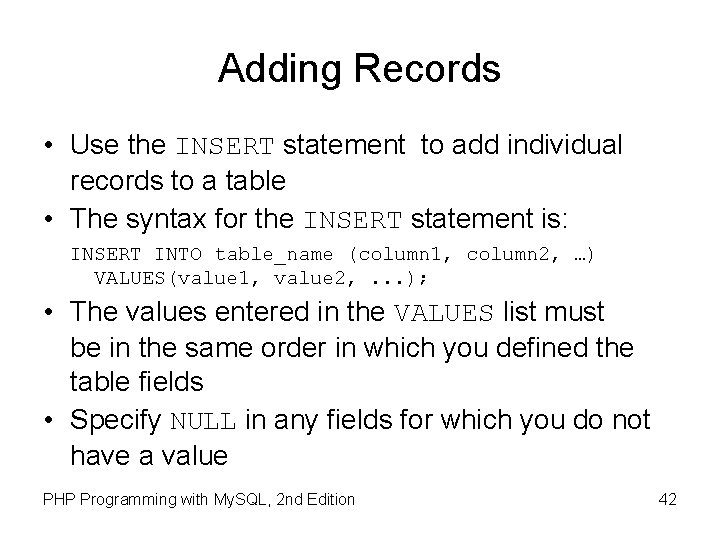
Adding Records • Use the INSERT statement to add individual records to a table • The syntax for the INSERT statement is: INSERT INTO table_name (column 1, column 2, …) VALUES(value 1, value 2, . . . ); • The values entered in the VALUES list must be in the same order in which you defined the table fields • Specify NULL in any fields for which you do not have a value PHP Programming with My. SQL, 2 nd Edition 42
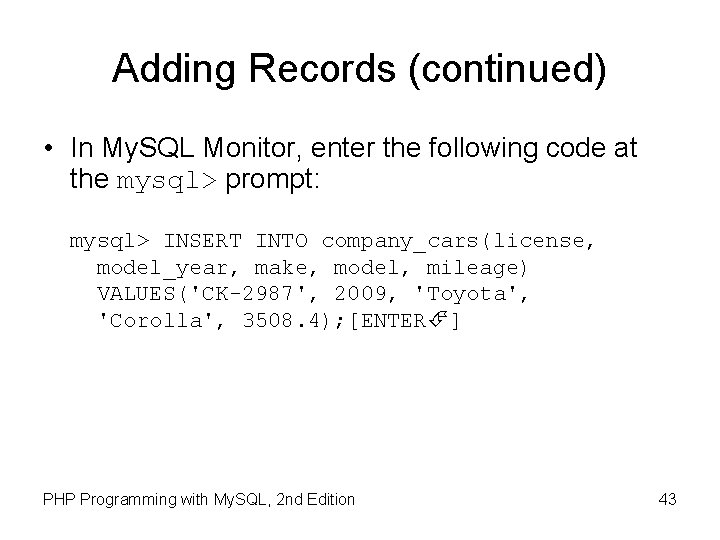
Adding Records (continued) • In My. SQL Monitor, enter the following code at the mysql> prompt: mysql> INSERT INTO company_cars(license, model_year, make, model, mileage) VALUES('CK-2987', 2009, 'Toyota', 'Corolla', 3508. 4); [ENTER ] PHP Programming with My. SQL, 2 nd Edition 43
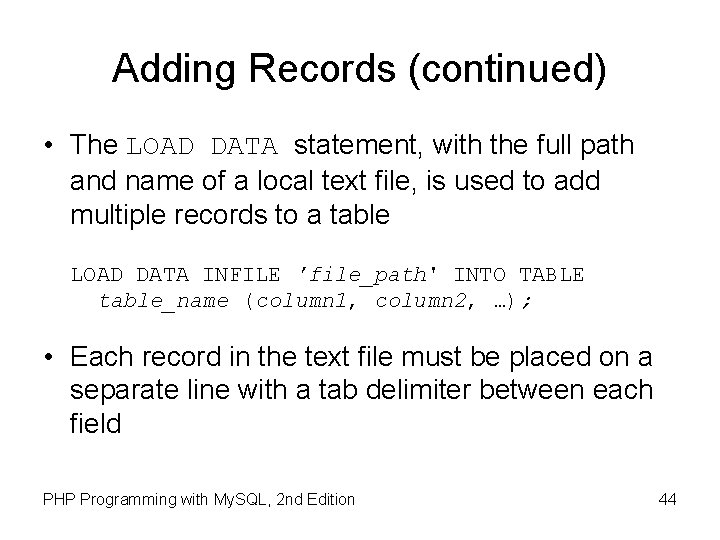
Adding Records (continued) • The LOAD DATA statement, with the full path and name of a local text file, is used to add multiple records to a table LOAD DATA INFILE 'file_path' INTO TABLE table_name (column 1, column 2, …); • Each record in the text file must be placed on a separate line with a tab delimiter between each field PHP Programming with My. SQL, 2 nd Edition 44
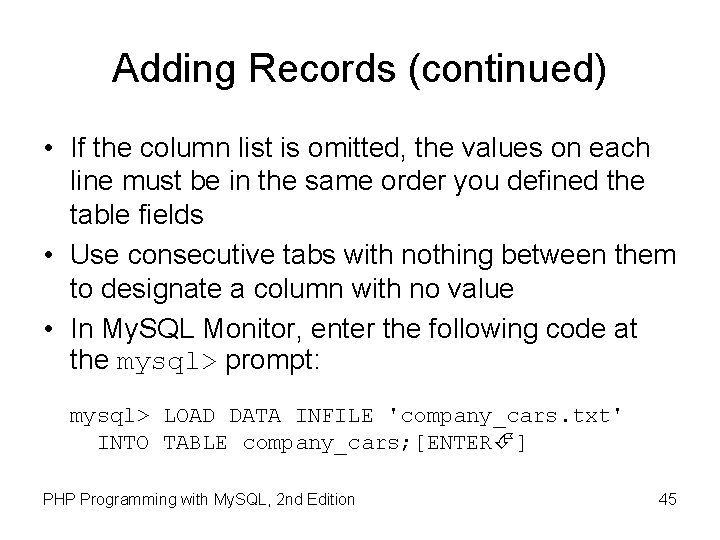
Adding Records (continued) • If the column list is omitted, the values on each line must be in the same order you defined the table fields • Use consecutive tabs with nothing between them to designate a column with no value • In My. SQL Monitor, enter the following code at the mysql> prompt: mysql> LOAD DATA INFILE 'company_cars. txt' INTO TABLE company_cars; [ENTER ] PHP Programming with My. SQL, 2 nd Edition 45
Adding Records (continued) • The optional FIELDS TERMINATED BY clause of the LOAD DATA statement allows you to change the field separator to a character such as (~ or , ) instead of the default tab character • In My. SQL Monitor, enter the following code at the mysql> prompt: mysql> LOAD DATA INFILE 'company_cars. txt‘ INTO TABLE company_cars; [ENTER ] PHP Programming with My. SQL, 2 nd Edition 46
Retrieving Records • Use the SELECT statement to retrieve records from a table: SELECT criteria FROM table_name; • Use the asterisk (*) wildcard with the SELECT statement to retrieve all fields from a table • To return multiple fields, separate field names with a comma PHP Programming with My. SQL, 2 nd Edition 47
Retrieving Records (continued) • In My. SQL Monitor, enter the following code at the mysql> prompt: mysql> SELECT model, mileage FROM company_cars; [ENTER ] PHP Programming with My. SQL, 2 nd Edition 48
Using Aggregate Functions • Aggregate functions summarize data in record sets rather than display the individual records • The COUNT() function is unique in that – The wildcard (*) can be used as a function argument instead of a field name – The keyword DISTINCT can be used after the opening parentheses • The DISTINCT keyword can also be used with the SELECT statement to retrieve records with a unique value in the WHERE clause PHP Programming with My. SQL, 2 nd Edition 49
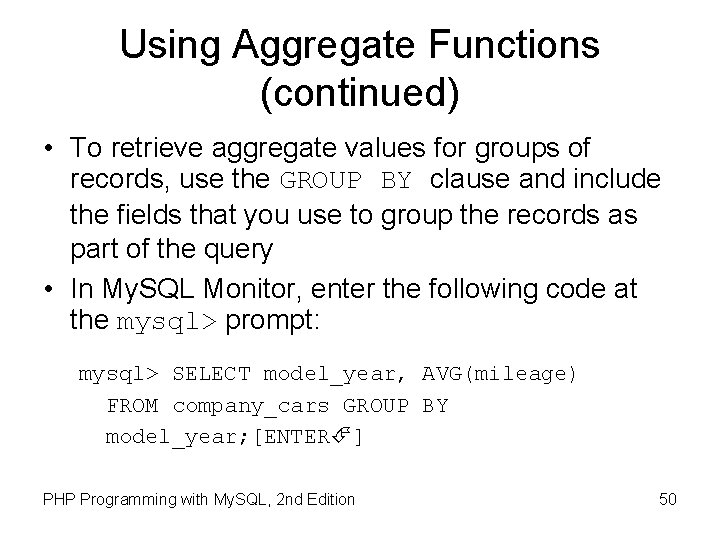
Using Aggregate Functions (continued) • To retrieve aggregate values for groups of records, use the GROUP BY clause and include the fields that you use to group the records as part of the query • In My. SQL Monitor, enter the following code at the mysql> prompt: mysql> SELECT model_year, AVG(mileage) FROM company_cars GROUP BY model_year; [ENTER ] PHP Programming with My. SQL, 2 nd Edition 50
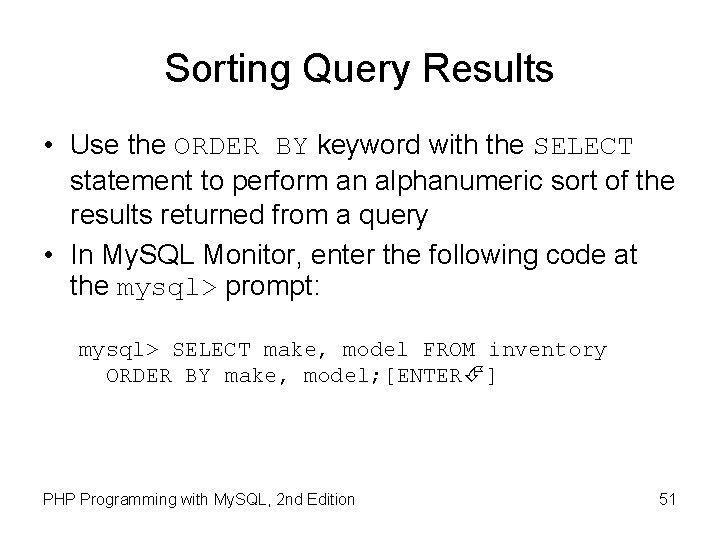
Sorting Query Results • Use the ORDER BY keyword with the SELECT statement to perform an alphanumeric sort of the results returned from a query • In My. SQL Monitor, enter the following code at the mysql> prompt: mysql> SELECT make, model FROM inventory ORDER BY make, model; [ENTER ] PHP Programming with My. SQL, 2 nd Edition 51
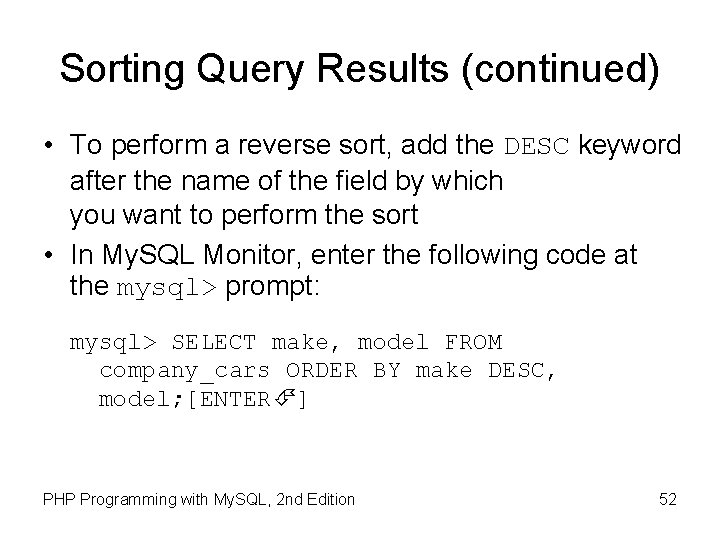
Sorting Query Results (continued) • To perform a reverse sort, add the DESC keyword after the name of the field by which you want to perform the sort • In My. SQL Monitor, enter the following code at the mysql> prompt: mysql> SELECT make, model FROM company_cars ORDER BY make DESC, model; [ENTER ] PHP Programming with My. SQL, 2 nd Edition 52
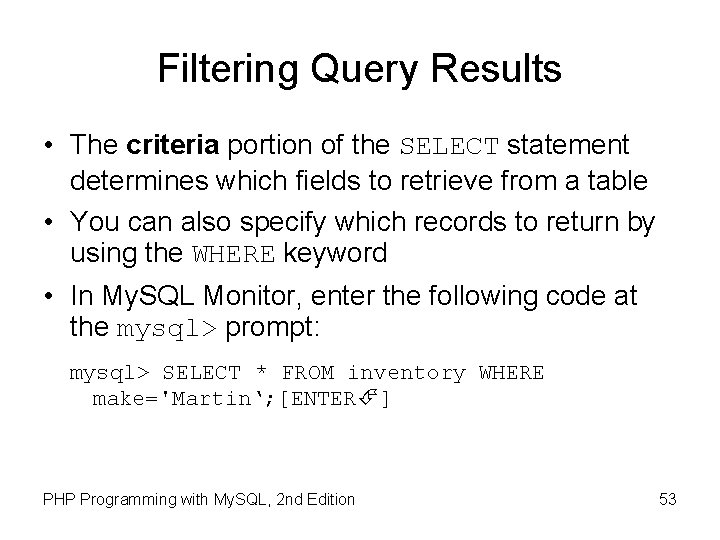
Filtering Query Results • The criteria portion of the SELECT statement determines which fields to retrieve from a table • You can also specify which records to return by using the WHERE keyword • In My. SQL Monitor, enter the following code at the mysql> prompt: mysql> SELECT * FROM inventory WHERE make='Martin‘; [ENTER ] PHP Programming with My. SQL, 2 nd Edition 53
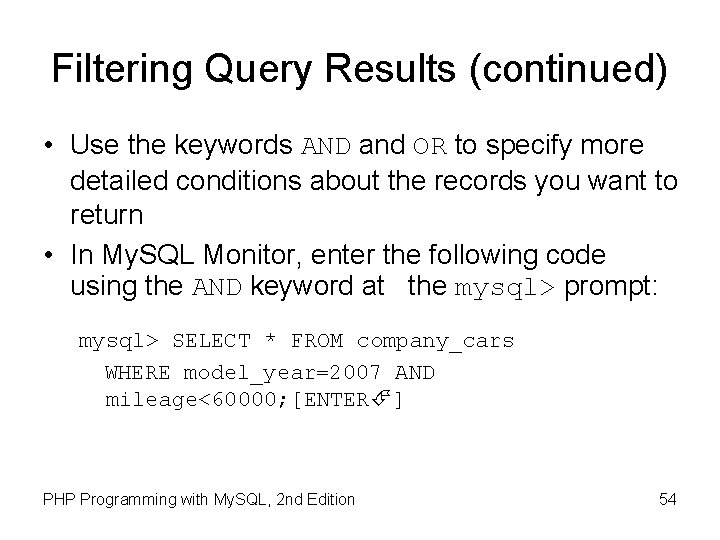
Filtering Query Results (continued) • Use the keywords AND and OR to specify more detailed conditions about the records you want to return • In My. SQL Monitor, enter the following code using the AND keyword at the mysql> prompt: mysql> SELECT * FROM company_cars WHERE model_year=2007 AND mileage<60000; [ENTER ] PHP Programming with My. SQL, 2 nd Edition 54
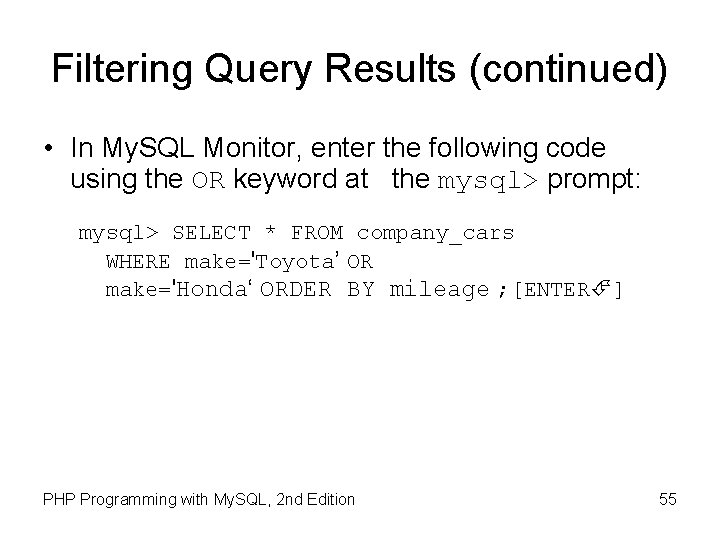
Filtering Query Results (continued) • In My. SQL Monitor, enter the following code using the OR keyword at the mysql> prompt: mysql> SELECT * FROM company_cars WHERE make='Toyota’ OR make='Honda‘ ORDER BY mileage ; [ENTER ] PHP Programming with My. SQL, 2 nd Edition 55
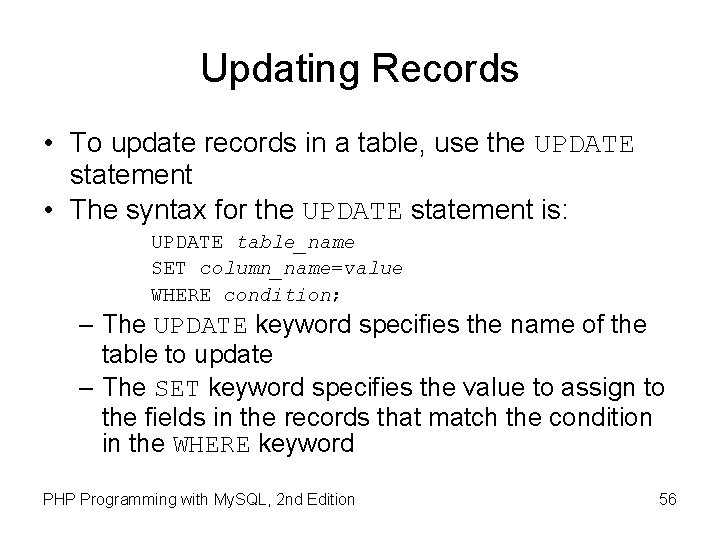
Updating Records • To update records in a table, use the UPDATE statement • The syntax for the UPDATE statement is: UPDATE table_name SET column_name=value WHERE condition; – The UPDATE keyword specifies the name of the table to update – The SET keyword specifies the value to assign to the fields in the records that match the condition in the WHERE keyword PHP Programming with My. SQL, 2 nd Edition 56
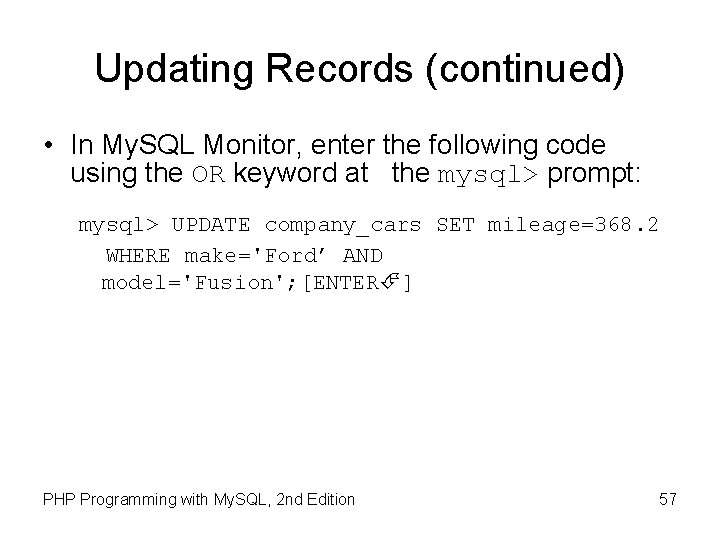
Updating Records (continued) • In My. SQL Monitor, enter the following code using the OR keyword at the mysql> prompt: mysql> UPDATE company_cars SET mileage=368. 2 WHERE make='Ford’ AND model='Fusion'; [ENTER ] PHP Programming with My. SQL, 2 nd Edition 57
Deleting Records • Use the DELETE statement to delete records in a table • The syntax for the DELETE statement is: DELETE FROM table_name WHERE condition; • The DELETE statement deletes all records that match the condition • To delete all the records in a table, leave off the WHERE keyword PHP Programming with My. SQL, 2 nd Edition 58
Deleting Records (continued) • In My. SQL Monitor, enter the following code at the mysql> prompt: mysql> DELETE FROM company_cars WHERE model_year=2006 AND make='Honda' AND model='Accord'; [ENTER ] • To delete all records from a table, omit the WHERE clause PHP Programming with My. SQL, 2 nd Edition 59
Summary • A database is an ordered collection of information from which a computer program can quickly access information • A record in a database is a single, complete set of related information • Fields are the individual categories of information stored in a record • A flat-file database stores information in a single table PHP Programming with My. SQL, 2 nd Edition 60
Summary (continued) • A relational database stores information across multiple related tables • A query is a structured set of instructions and criteria for retrieving, adding, modifying, and deleting database information • Structured query language, or SQL (pronounced sequel), is a standard data manipulation language among many database management systems PHP Programming with My. SQL, 2 nd Edition 61
Summary (continued) • My. SQL Monitor is a command-line program that you use to manipulate My. SQL databases • To work with a database, you must first select it by executing the USE DATEBASE statement • You use the CREATE DATABASE statement to create a new database • To delete a database, you execute the DROP DATABASE statement, which removes all tables from the database and deletes the database itself PHP Programming with My. SQL, 2 nd Edition 62
Summary (continued) • The fields in a table also store data according to type • To keep your database from growing too large, you should choose the smallest data type possible for each field • To create a table, you use the CREATE TABLE statement, which specifies the table and column names and the data type for each column PHP Programming with My. SQL, 2 nd Edition 63
Summary (continued) • To modify a table, you use the ALTER TABLE statement, which specifies the table being changed and the change to make • To delete a table, you execute the DROP TABLE statement, which removes all data and the table definition • You use a GRANT statement to create user accounts and assign privileges, which refer to the operations that a user can perform with a database PHP Programming with My. SQL, 2 nd Edition 64
Summary (continued) • You use the REVOKE statement to take away privileges from an existing user account for a specified table or database • You add individual records to a table with the INSERT statement • To add multiple records to a database, you use the LOAD DATA statement with a local text file that contains the records you want to add PHP Programming with My. SQL, 2 nd Edition 65
Summary (continued) • You use the SELECT statement to retrieve records from a table • You use the ORDER BY keyword with the SELECT statement to perform an alphanumeric sort of the results returned from a query • To perform a reverse sort, add the DESC keyword after the name of the field by which you want to perform the sort PHP Programming with My. SQL, 2 nd Edition 66
Summary (continued) • You can specify which records to return from a database by using the WHERE keyword • You use the UPDATE statement to update records in a table • You use the DELETE statement to delete records from a table • The php. My. Admin graphical tool simplifies the tasks associated with creating and maintaining databases and tables PHP Programming with My. SQL, 2 nd Edition 67
- Slides: 66