
Chapter 7 Work and Kinetic Energy Introduction The
- Slides: 57
Chapter 7 Work and Kinetic Energy
Introduction The concept of energy is one of the most important topics in science and engineering. In everyday life, we think of energy in terms of fuel for transportation and heating, electricity for lights and appliances, and foods for consumption. However, these ideas do not really define energy. They merely tell us that fuels are needed to do a job and that those fuels provide us with something we call energy. 2
Introduction In this chapter, • we first introduce the concept of work. • Work is done by a force acting on an object when the point of application of that force moves through some distance and the force has a component along the line of motion. • Next, we define kinetic energy, energy which is energy an object possesses because of its motion. • We shall see that the concepts of work and kinetic energy can be applied to the dynamics of a mechanical system without resorting to Newton’s laws. 3
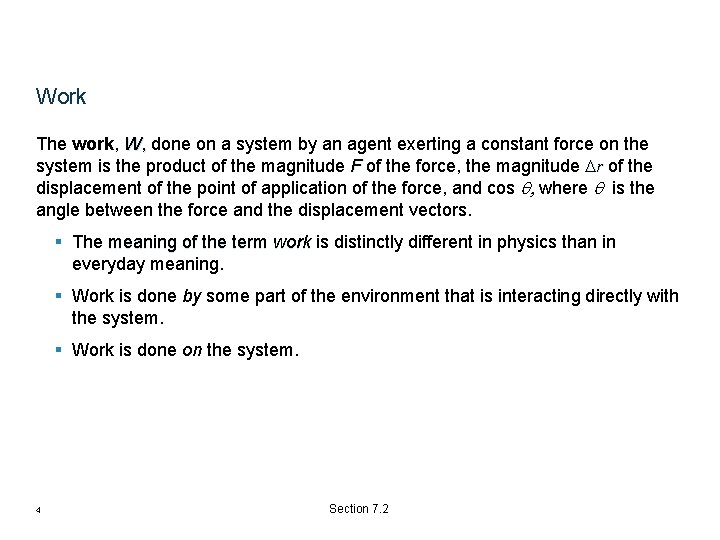
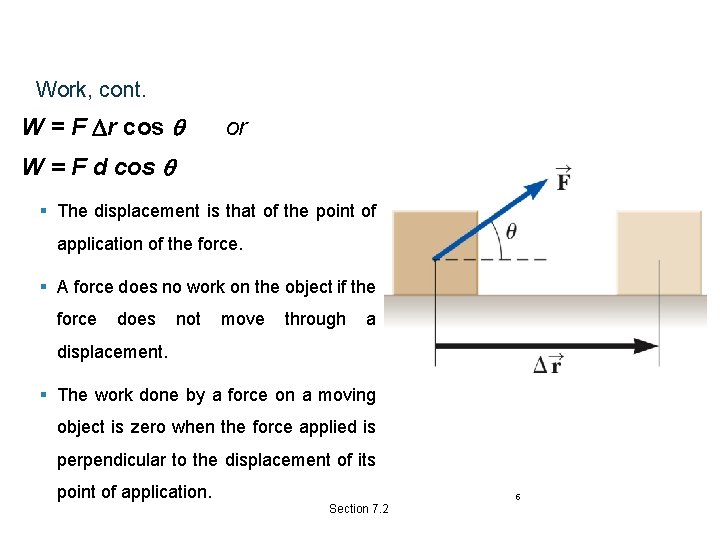
Work The work, W, done on a system by an agent exerting a constant force on the system is the product of the magnitude F of the force, the magnitude Dr of the displacement of the point of application of the force, and cos q, where q is the angle between the force and the displacement vectors. § The meaning of the term work is distinctly different in physics than in everyday meaning. § Work is done by some part of the environment that is interacting directly with the system. § Work is done on the system. 4 Section 7. 2
Work, cont. W = F Dr cos q or W = F d cos q § The displacement is that of the point of application of the force. § A force does no work on the object if the force does not move through a displacement. § The work done by a force on a moving object is zero when the force applied is perpendicular to the displacement of its point of application. 5 Section 7. 2
Displacement in the Work Equation The displacement is that of the point of application of the force. If the force is applied to a rigid object that can be modeled as a particle, the displacement is the same as that of the particle. For a deformable system, the displacement of the object generally is not the same as the displacement associated with the forces applied. 6 Section 7. 2
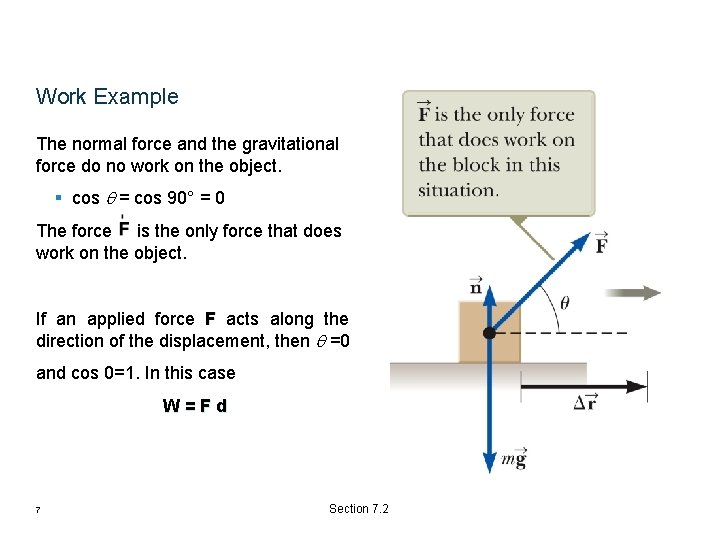
Work Example The normal force and the gravitational force do no work on the object. § cos q = cos 90° = 0 The force is the only force that does work on the object. If an applied force F acts along the direction of the displacement, then q =0 and cos 0=1. In this case W=Fd 7 Section 7. 2
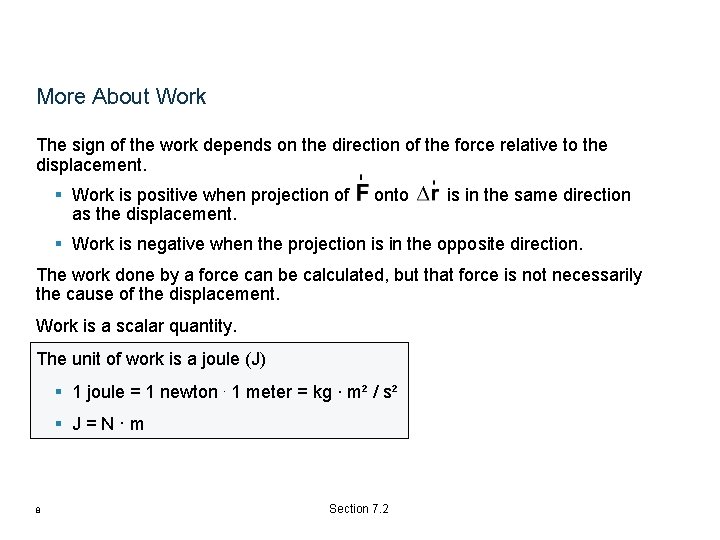
More About Work The sign of the work depends on the direction of the force relative to the displacement. § Work is positive when projection of as the displacement. onto is in the same direction § Work is negative when the projection is in the opposite direction. The work done by a force can be calculated, but that force is not necessarily the cause of the displacement. Work is a scalar quantity. The unit of work is a joule (J) § 1 joule = 1 newton. 1 meter = kg ∙ m² / s² § J=N·m 8 Section 7. 2
Work Is An Energy Transfer This is important for a system approach to solving a problem. If the work is done on a system and it is positive, positive energy is transferred to the system. If the work done on the system is negative, negative energy is transferred from the system. If a system interacts with its environment, environment this interaction can be described as a transfer of energy across the system boundary. § This will result in a change in the amount of energy stored in the system. 9 Section 7. 2
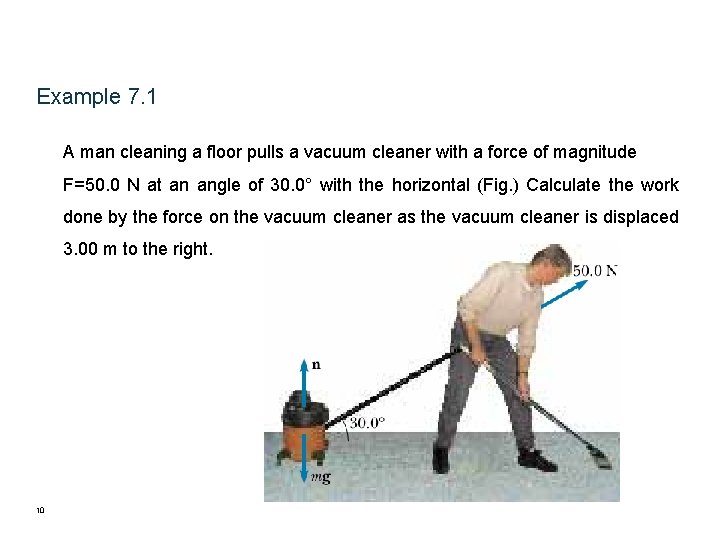
Example 7. 1 A man cleaning a floor pulls a vacuum cleaner with a force of magnitude F=50. 0 N at an angle of 30. 0° with the horizontal (Fig. ) Calculate the work done by the force on the vacuum cleaner as the vacuum cleaner is displaced 3. 00 m to the right. 10
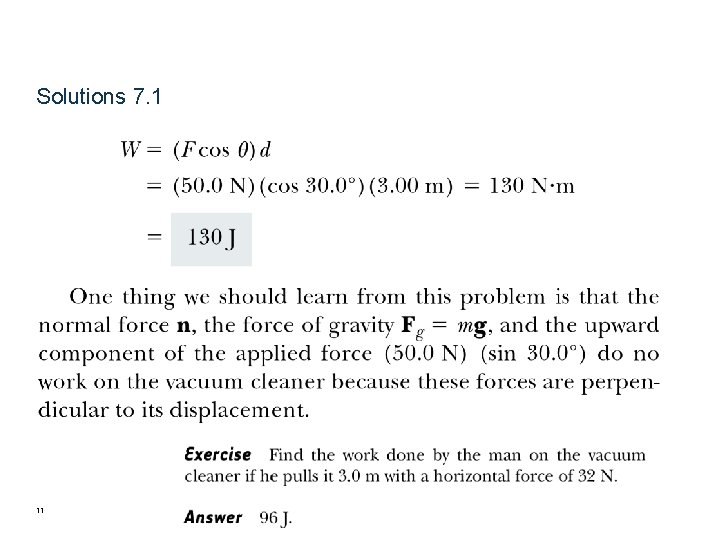
Solutions 7. 1 11
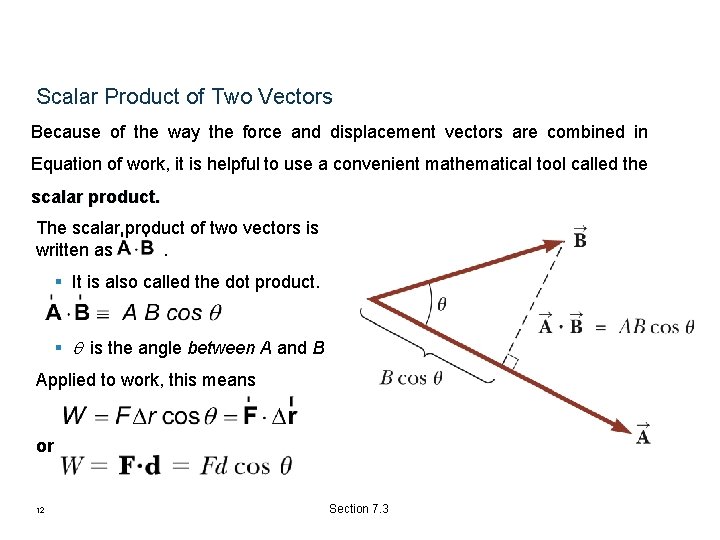
Scalar Product of Two Vectors Because of the way the force and displacement vectors are combined in Equation of work, it is helpful to use a convenient mathematical tool called the scalar product. The scalar product of two vectors is written as. § It is also called the dot product. § q is the angle between A and B Applied to work, this means or 12 Section 7. 3
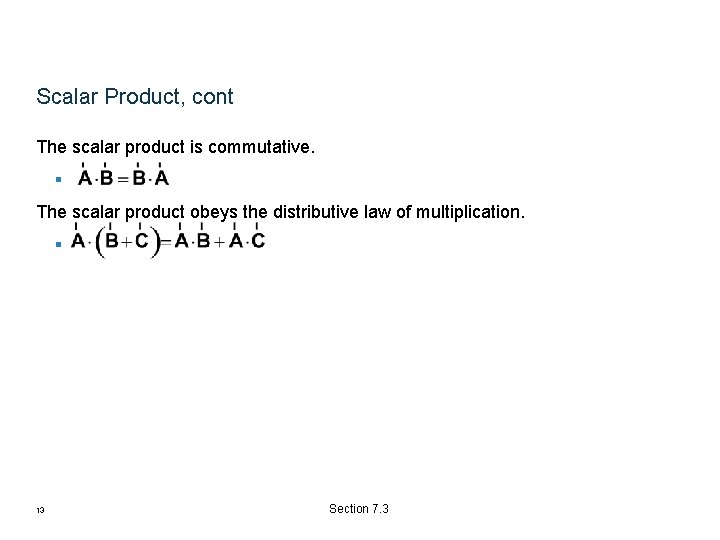
Scalar Product, cont The scalar product is commutative. § The scalar product obeys the distributive law of multiplication. § 13 Section 7. 3
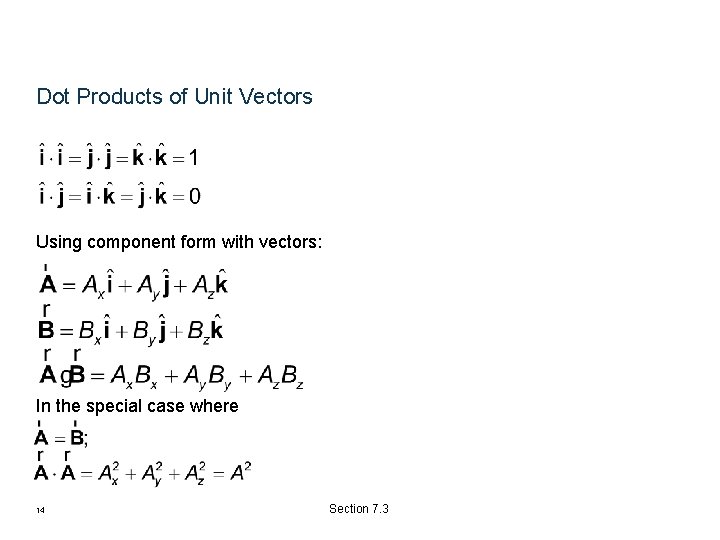
Dot Products of Unit Vectors Using component form with vectors: In the special case where 14 Section 7. 3
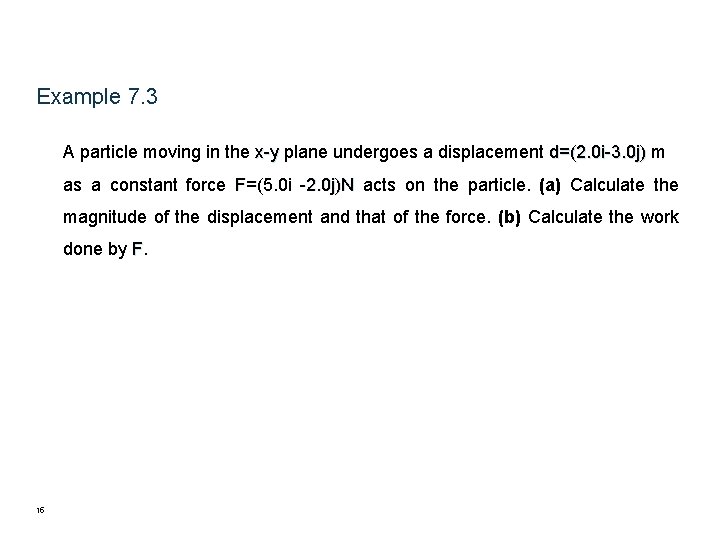
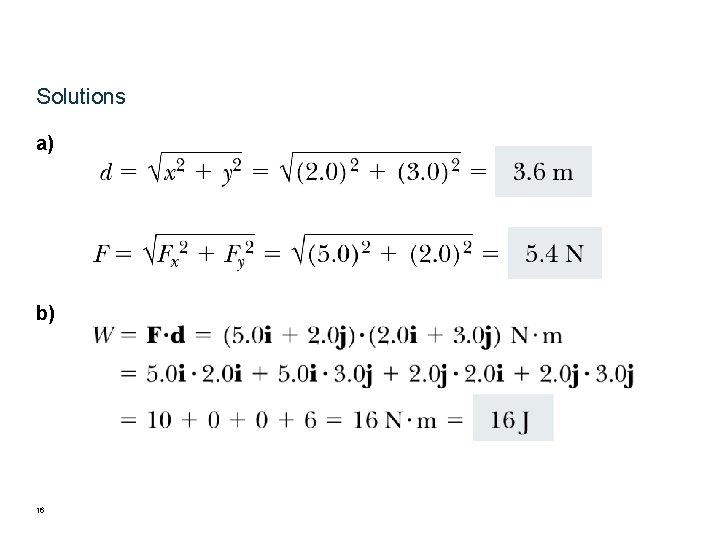
Example 7. 3 A particle moving in the x-y plane undergoes a displacement d=(2. 0 i-3. 0 j) m as a constant force F=(5. 0 i -2. 0 j)N acts on the particle. (a) Calculate the magnitude of the displacement and that of the force. (b) Calculate the work done by F. 15
Solutions a) b) 16
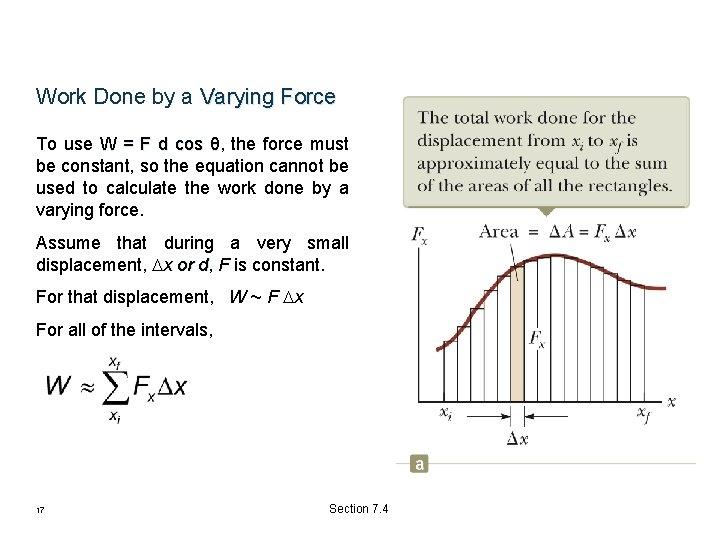
Work Done by a Varying Force To use W = F d cos θ, the force must be constant, so the equation cannot be used to calculate the work done by a varying force. Assume that during a very small displacement, Dx or d, d F is constant. For that displacement, W ~ F Dx For all of the intervals, 17 Section 7. 4
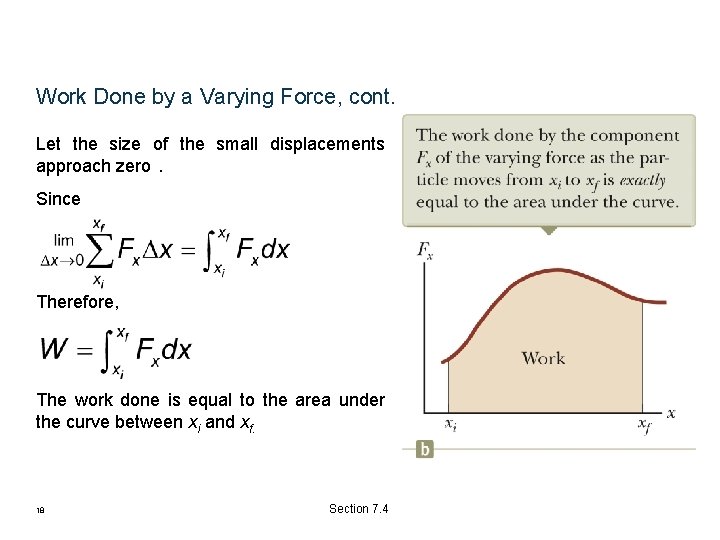
Work Done by a Varying Force, cont. Let the size of the small displacements approach zero. Since Therefore, The work done is equal to the area under the curve between xi and xf. 18 Section 7. 4
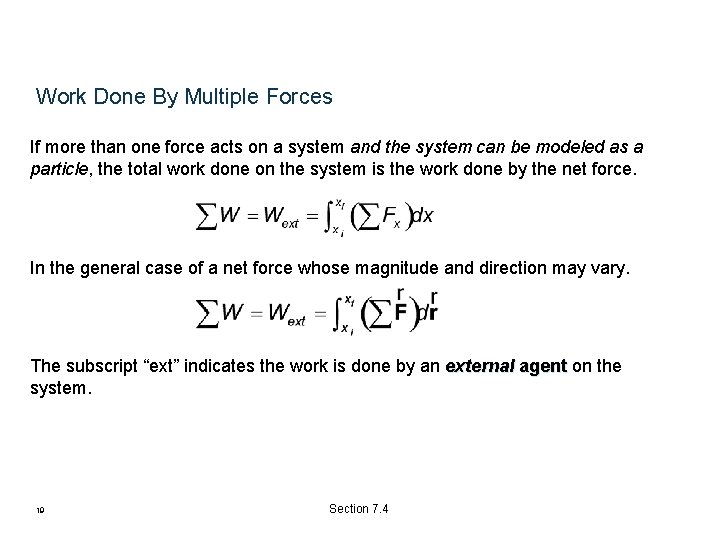
Work Done By Multiple Forces If more than one force acts on a system and the system can be modeled as a particle, the total work done on the system is the work done by the net force. In the general case of a net force whose magnitude and direction may vary. The subscript “ext” indicates the work is done by an external agent on the system. 19 Section 7. 4
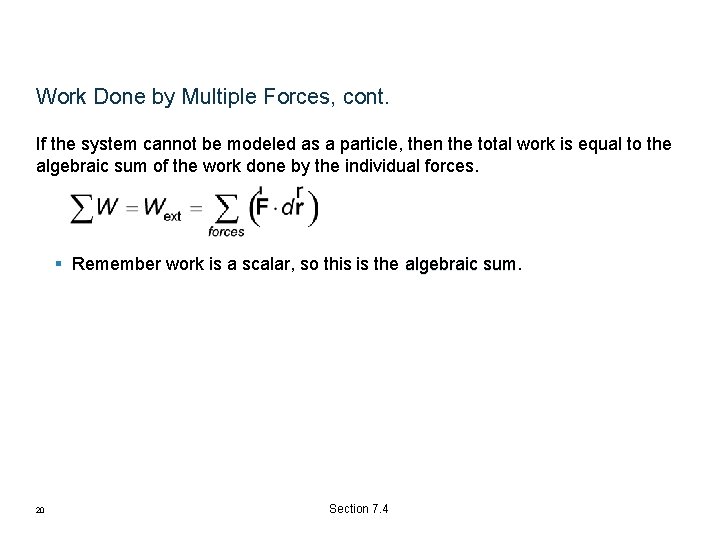
Work Done by Multiple Forces, cont. If the system cannot be modeled as a particle, then the total work is equal to the algebraic sum of the work done by the individual forces. § Remember work is a scalar, so this is the algebraic sum 20 Section 7. 4
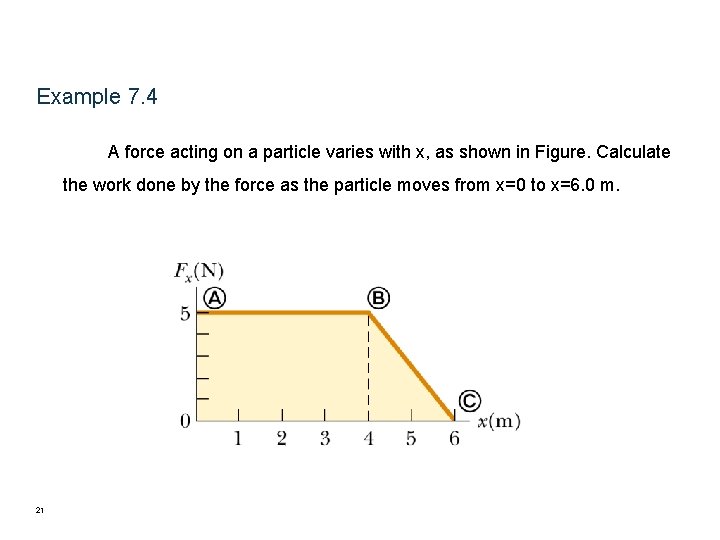
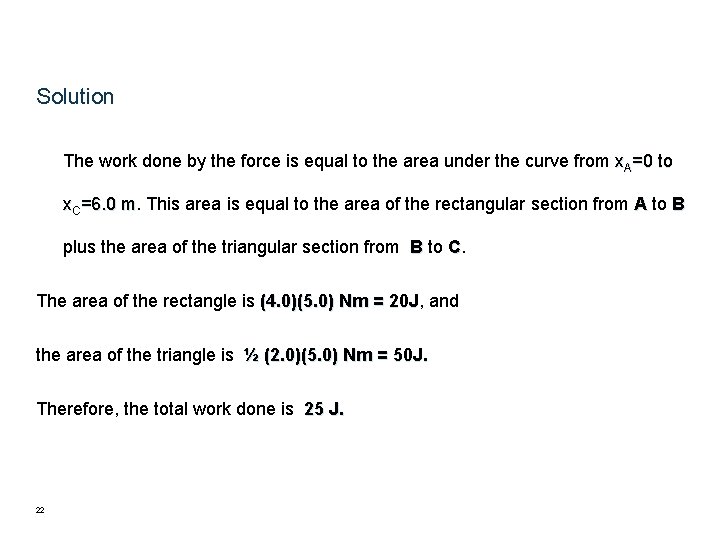
Example 7. 4 A force acting on a particle varies with x, as shown in Figure. Calculate the work done by the force as the particle moves from x=0 to x=6. 0 m. 21
Solution The work done by the force is equal to the area under the curve from x. A=0 to x. C=6. 0 m. This area is equal to the area of the rectangular section from A to B plus the area of the triangular section from B to C. The area of the rectangle is (4. 0)(5. 0) Nm = 20 J, 20 J and the area of the triangle is ½ (2. 0)(5. 0) Nm = 50 J. Therefore, the total work done is 25 J. 22
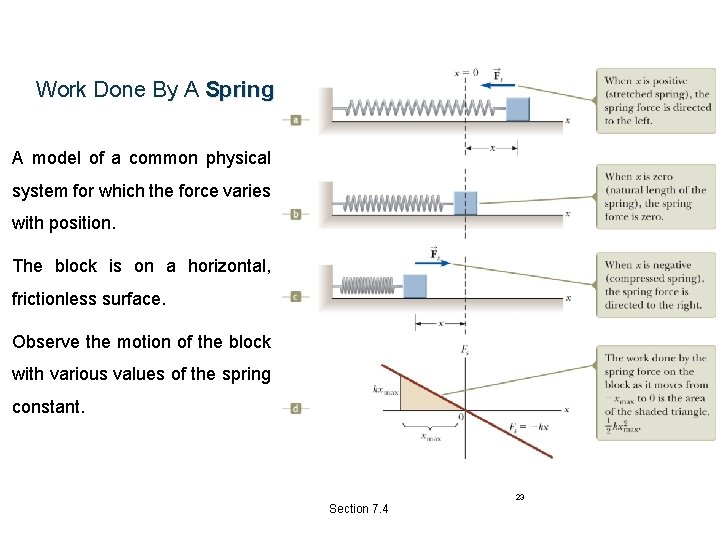
Work Done By A Spring A model of a common physical system for which the force varies with position. The block is on a horizontal, frictionless surface. Observe the motion of the block with various values of the spring constant. 23 Section 7. 4
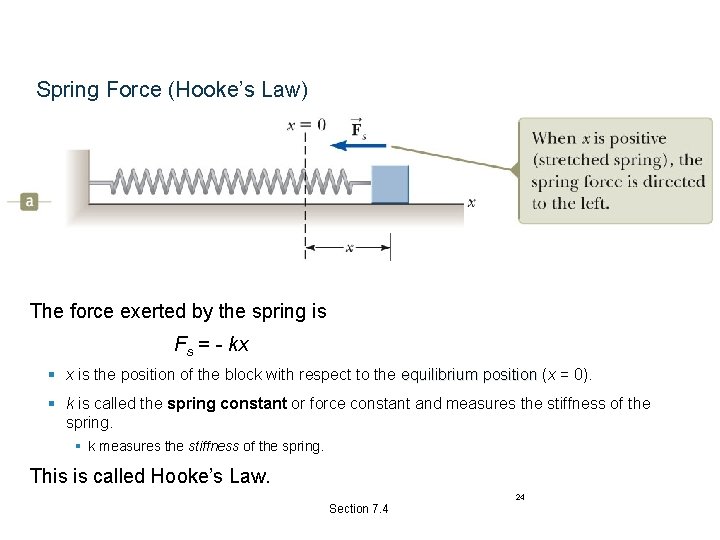
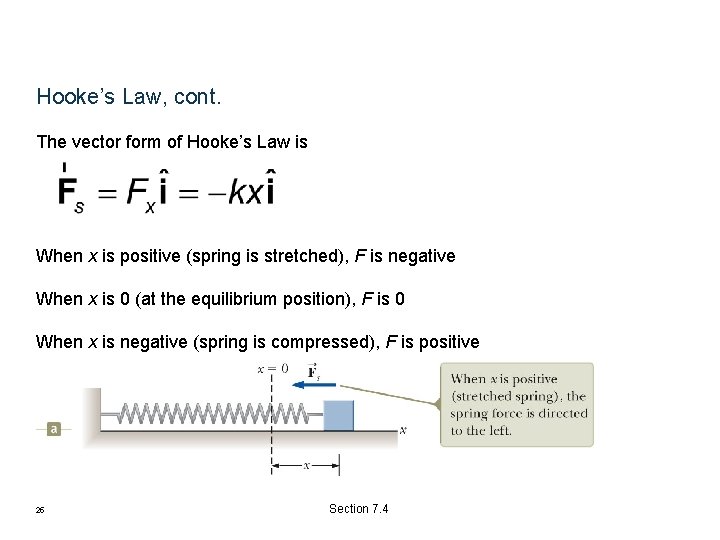
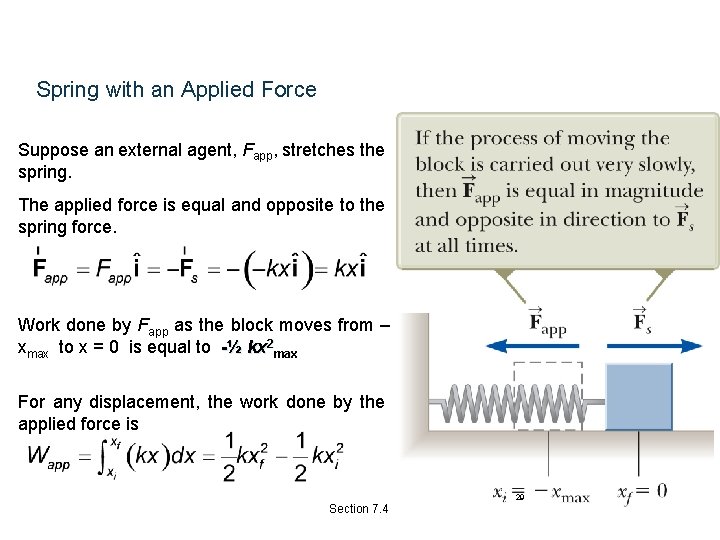
Spring Force (Hooke’s Law) The force exerted by the spring is Fs = - kx § x is the position of the block with respect to the equilibrium position (x = 0). § k is called the spring constant or force constant and measures the stiffness of the spring. § k measures the stiffness of the spring. This is called Hooke’s Law. 24 Section 7. 4
Hooke’s Law, cont. The vector form of Hooke’s Law is When x is positive (spring is stretched), F is negative When x is 0 (at the equilibrium position), F is 0 When x is negative (spring is compressed), F is positive 25 Section 7. 4
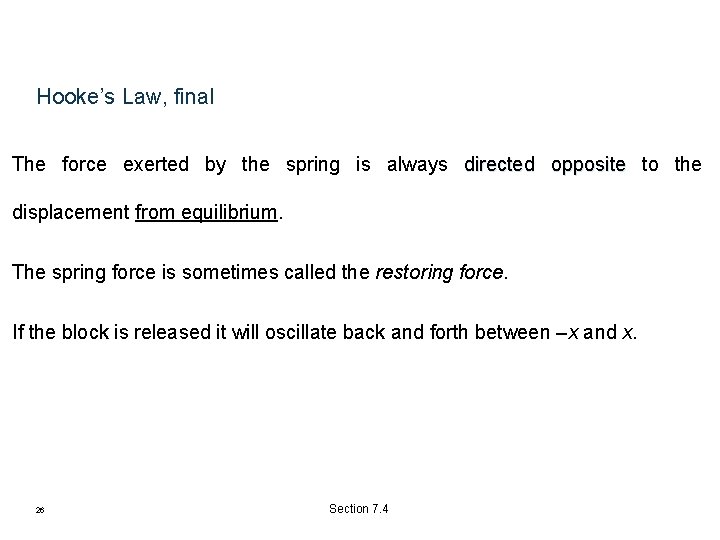
Hooke’s Law, final The force exerted by the spring is always directed opposite to the displacement from equilibrium. The spring force is sometimes called the restoring force. If the block is released it will oscillate back and forth between –x and x. 26 Section 7. 4
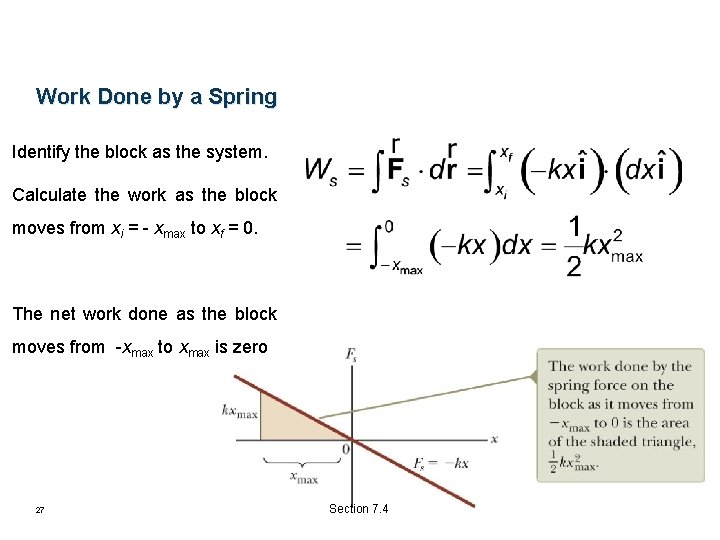
Work Done by a Spring Identify the block as the system. Calculate the work as the block moves from xi = - xmax to xf = 0. The net work done as the block moves from -xmax to xmax is zero 27 Section 7. 4
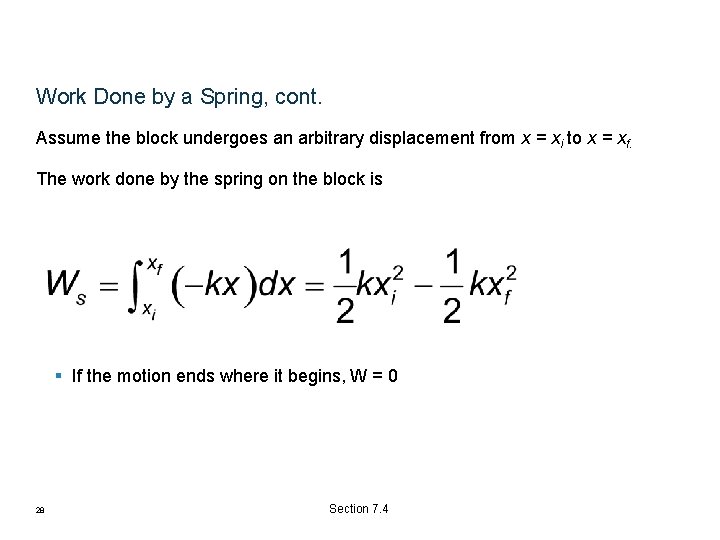
Work Done by a Spring, cont. Assume the block undergoes an arbitrary displacement from x = xi to x = xf. The work done by the spring on the block is § If the motion ends where it begins, W = 0 28 Section 7. 4
Spring with an Applied Force Suppose an external agent, Fapp, stretches the spring. The applied force is equal and opposite to the spring force. Work done by Fapp as the block moves from – xmax to x = 0 is equal to -½ kx 2 max For any displacement, the work done by the applied force is 29 Section 7. 4
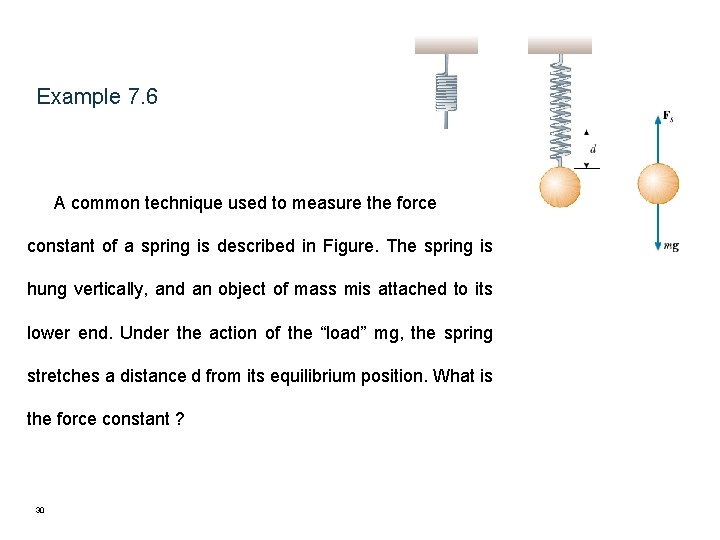
Example 7. 6 A common technique used to measure the force constant of a spring is described in Figure. The spring is hung vertically, and an object of mass mis attached to its lower end. Under the action of the “load” mg, the spring stretches a distance d from its equilibrium position. What is the force constant ? 30
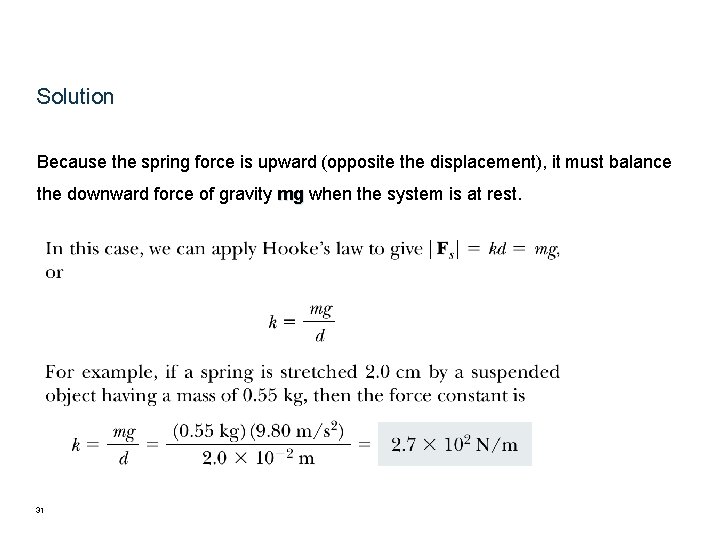
Solution Because the spring force is upward (opposite the displacement), it must balance the downward force of gravity mg when the system is at rest. 31
Energy Review Kinetic Energy § Associated with movement of members of a system Potential Energy § Determined by the configuration of the system § Gravitational and Elastic Potential Energies have been studied Internal Energy § Related to the temperature of the system 32 Introduction
Types of Systems Non-isolated systems § Energy can cross the system boundary in a variety of ways. § Total energy of the system changes Isolated systems § Energy does not cross the boundary of the system § Total energy of the system is constant Conservation of energy § Can be used if no non-conservative forces act within the isolated system § Applies to biological organisms, technological systems, engineering situations, etc 33 Introduction
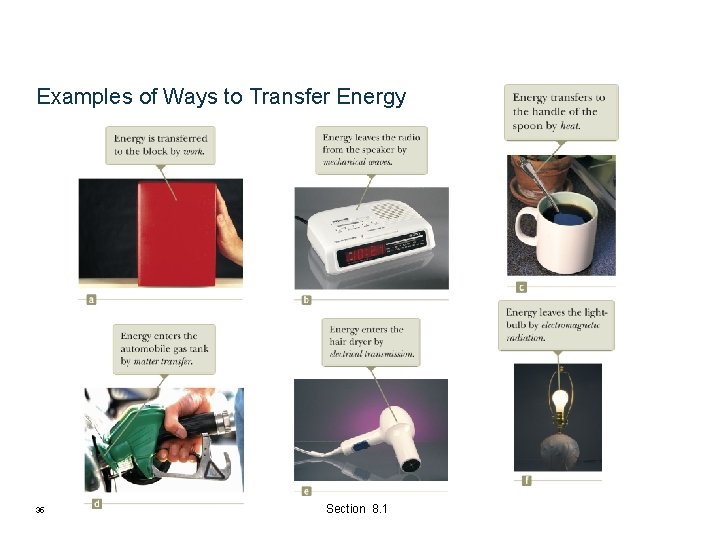
Ways to Transfer Energy Into or Out of A System In non-isolated systems, energy crosses the boundary of the system during some time interval due to an interaction with the environment. Work – transfers energy by applying a force and causing a displacement of the point of application of the force. Mechanical Wave – transfers energy by allowing a disturbance to propagate through a medium. Heat – the mechanism of energy transfer that is driven by a temperature difference between two regions in space. Matter Transfer – matter physically crosses the boundary of the system, carrying energy with it. Electrical Transmission – energy transfer into or out of a system by electric current. Electromagnetic Radiation – energy is transferred by electromagnetic waves. 34 Section 8. 1
Examples of Ways to Transfer Energy 35 Section 8. 1
Conservation of Energy is conserved § This means that energy cannot be created nor destroyed. § If the total amount of energy in a system changes, it can only be due to the fact that energy has crossed the boundary of the system by some method of energy transfer. 36 Section 8. 1
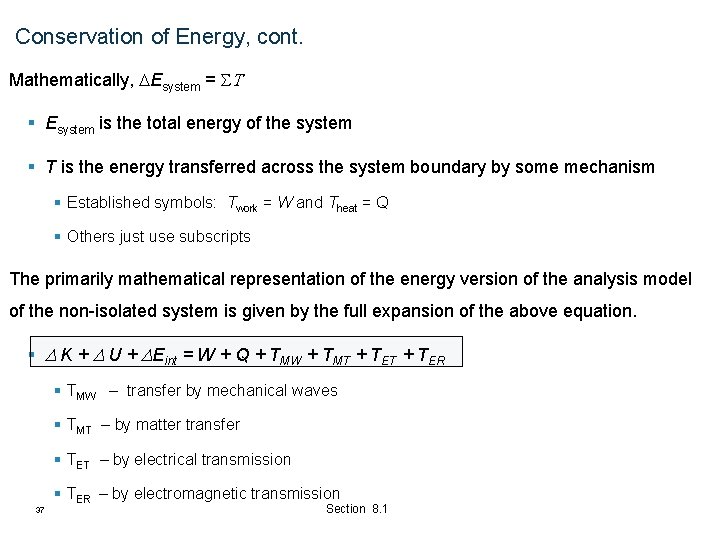
Conservation of Energy, cont. Mathematically, DEsystem = ST § Esystem is the total energy of the system § T is the energy transferred across the system boundary by some mechanism § Established symbols: Twork = W and Theat = Q § Others just use subscripts The primarily mathematical representation of the energy version of the analysis model of the non-isolated system is given by the full expansion of the above equation. § K + U + Eint = W + Q + TMW + TMT + TER § TMW – transfer by mechanical waves § TMT – by matter transfer § TET – by electrical transmission 37 § TER – by electromagnetic transmission Section 8. 1
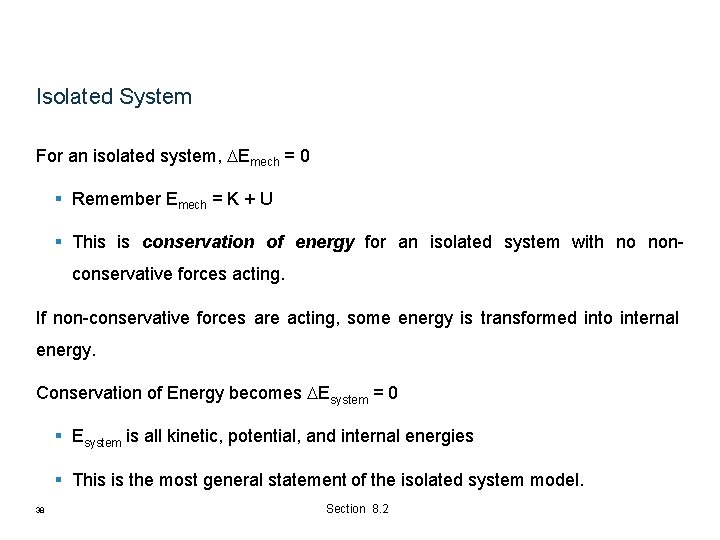
Isolated System For an isolated system, DEmech = 0 § Remember Emech = K + U § This is conservation of energy for an isolated system with no nonconservative forces acting. If non-conservative forces are acting, some energy is transformed into internal energy. Conservation of Energy becomes DEsystem = 0 § Esystem is all kinetic, potential, and internal energies § This is the most general statement of the isolated system model. 38 Section 8. 2
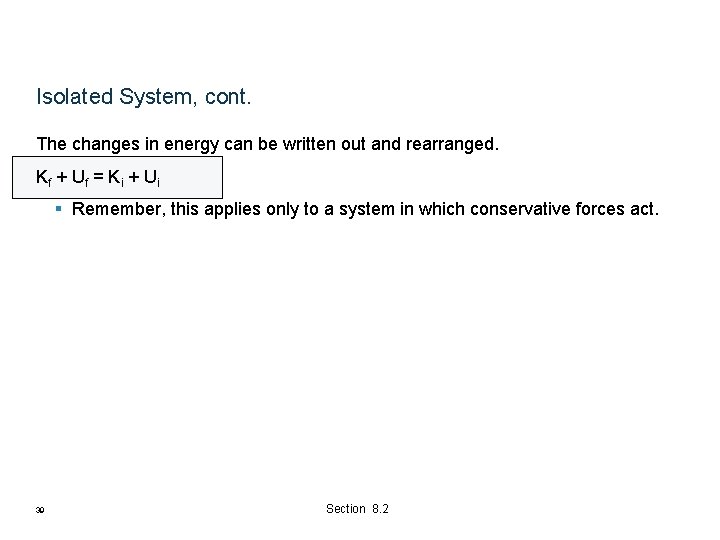
Isolated System, cont. The changes in energy can be written out and rearranged. Kf + U f = K i + U i § Remember, this applies only to a system in which conservative forces act. 39 Section 8. 2
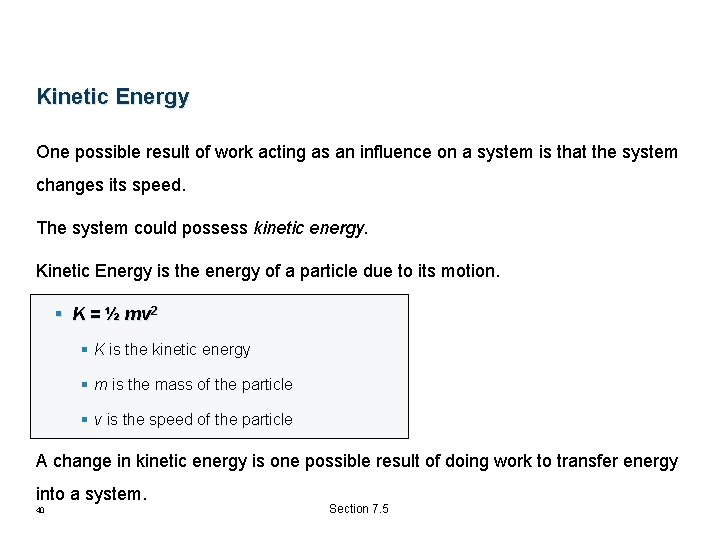
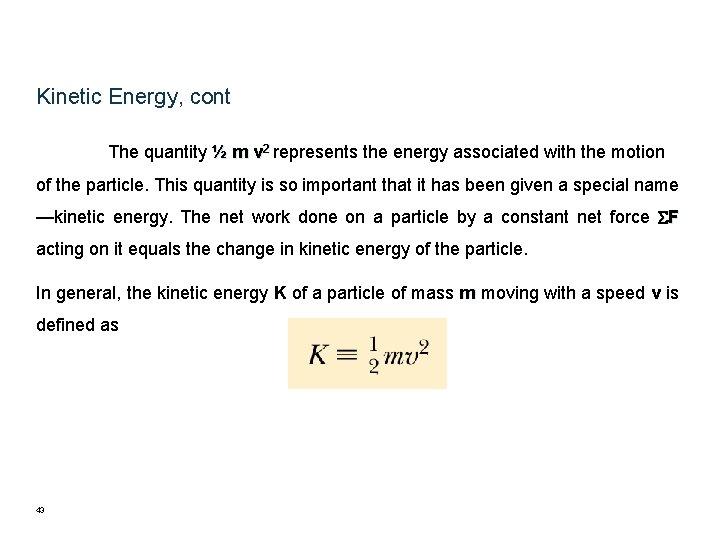
Kinetic Energy One possible result of work acting as an influence on a system is that the system changes its speed. The system could possess kinetic energy. Kinetic Energy is the energy of a particle due to its motion. § K = ½ mv 2 § K is the kinetic energy § m is the mass of the particle § v is the speed of the particle A change in kinetic energy is one possible result of doing work to transfer energy into a system. 40 Section 7. 5
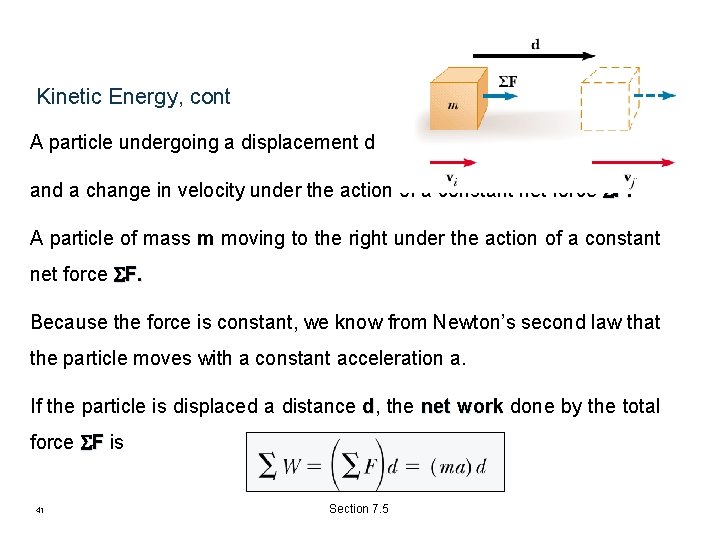
Kinetic Energy, cont A particle undergoing a displacement d and a change in velocity under the action of a constant net force F. A particle of mass m moving to the right under the action of a constant net force F. Because the force is constant, we know from Newton’s second law that the particle moves with a constant acceleration a. If the particle is displaced a distance d, the net work done by the total force F is 41 Section 7. 5
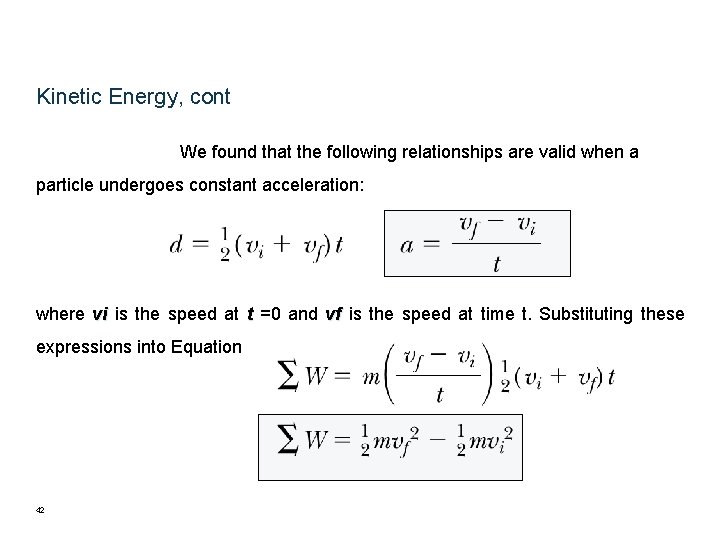
Kinetic Energy, cont We found that the following relationships are valid when a particle undergoes constant acceleration: where vi is the speed at t =0 and vf is the speed at time t. Substituting these expressions into Equation 42
Kinetic Energy, cont The quantity ½ m v 2 represents the energy associated with the motion of the particle. This quantity is so important that it has been given a special name —kinetic energy. The net work done on a particle by a constant net force F acting on it equals the change in kinetic energy of the particle. In general, the kinetic energy K of a particle of mass m moving with a speed v is defined as 43
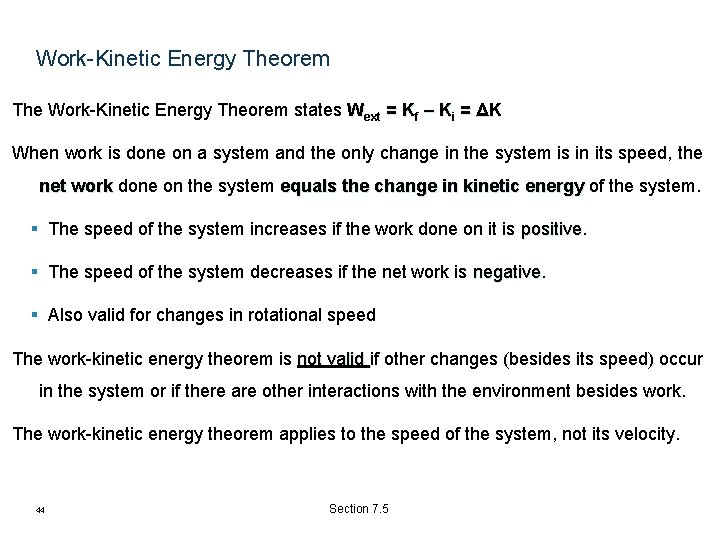
Work-Kinetic Energy Theorem The Work-Kinetic Energy Theorem states Wext = Kf – Ki = ΔK When work is done on a system and the only change in the system is in its speed, the net work done on the system equals the change in kinetic energy of the system. § The speed of the system increases if the work done on it is positive § The speed of the system decreases if the net work is negative § Also valid for changes in rotational speed The work-kinetic energy theorem is not valid if other changes (besides its speed) occur in the system or if there are other interactions with the environment besides work. The work-kinetic energy theorem applies to the speed of the system, not its velocity. 44 Section 7. 5
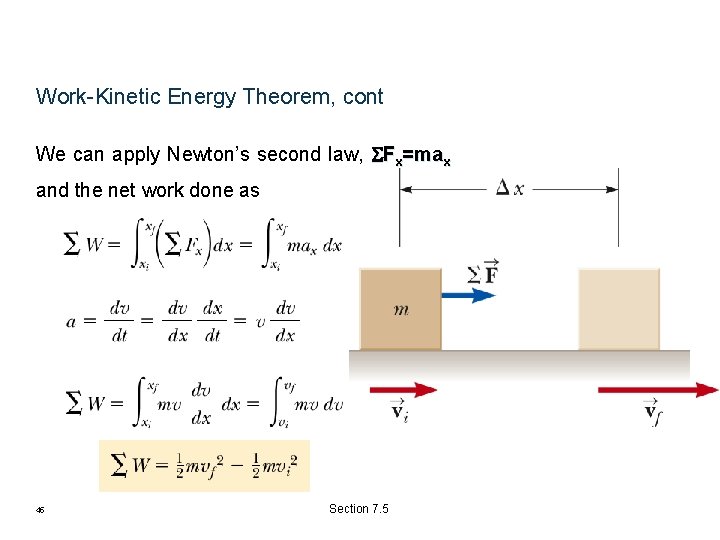
Work-Kinetic Energy Theorem, cont We can apply Newton’s second law, Fx=max and the net work done as 45 Section 7. 5
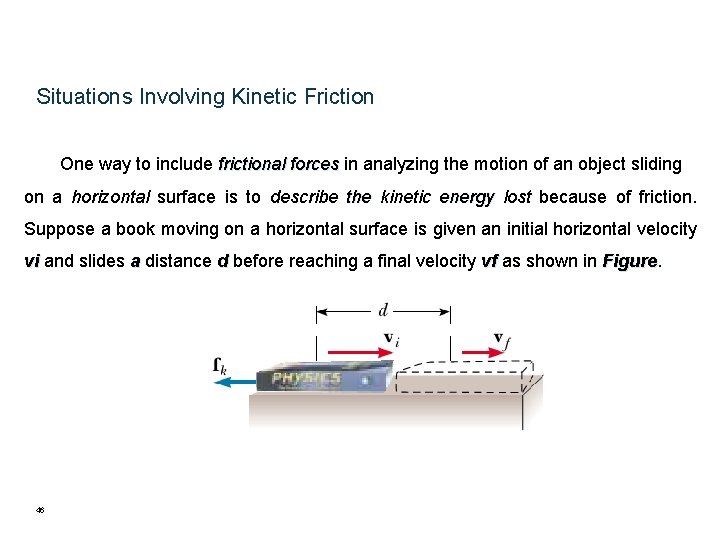
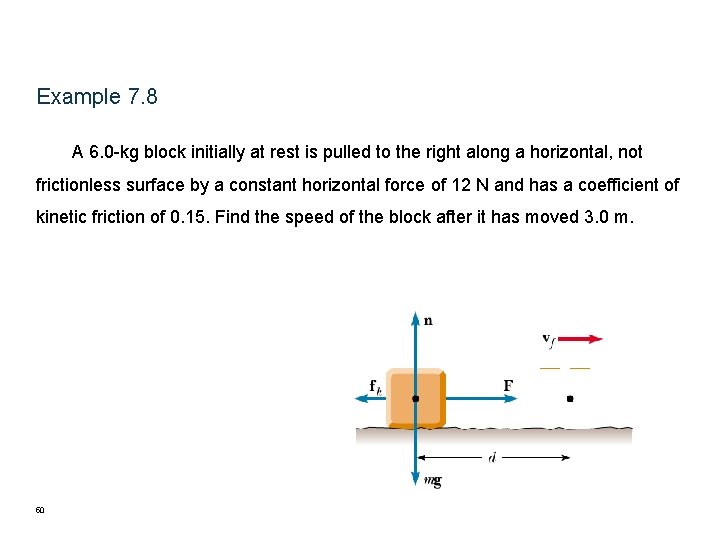
Situations Involving Kinetic Friction One way to include frictional forces in analyzing the motion of an object sliding on a horizontal surface is to describe the kinetic energy lost because of friction. Suppose a book moving on a horizontal surface is given an initial horizontal velocity vi and slides a distance d before reaching a final velocity vf as shown in Figure 46
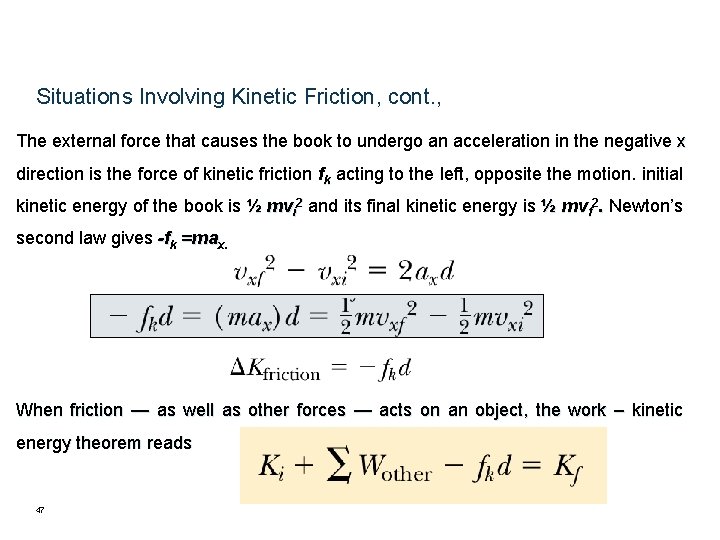
Situations Involving Kinetic Friction, cont. , The external force that causes the book to undergo an acceleration in the negative x direction is the force of kinetic friction fk acting to the left, opposite the motion. initial kinetic energy of the book is ½ mvi 2 and its final kinetic energy is ½ mvf 2. Newton’s second law gives -fk =max. When friction — as well as other forces — acts on an object, the work – kinetic energy theorem reads 47
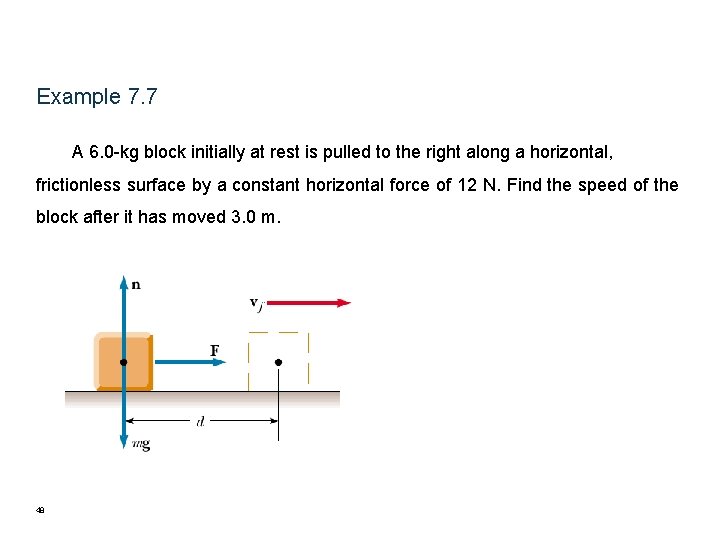
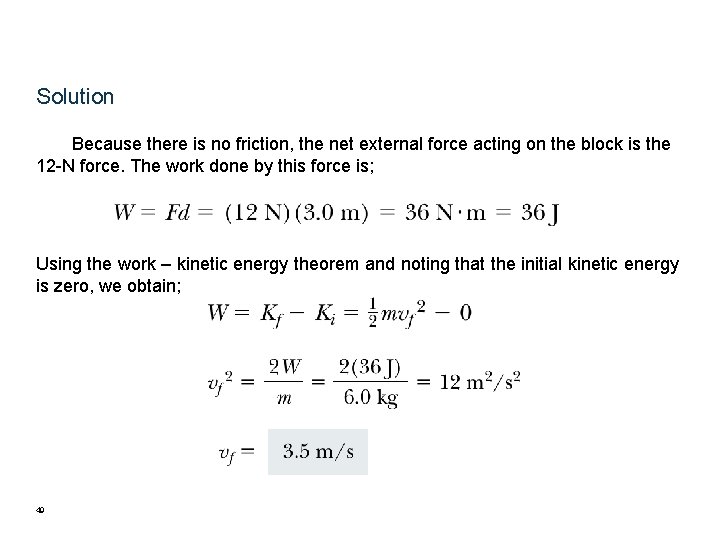
Example 7. 7 A 6. 0 -kg block initially at rest is pulled to the right along a horizontal, frictionless surface by a constant horizontal force of 12 N. Find the speed of the block after it has moved 3. 0 m. 48
Solution Because there is no friction, the net external force acting on the block is the 12 -N force. The work done by this force is; Using the work – kinetic energy theorem and noting that the initial kinetic energy is zero, we obtain; 49
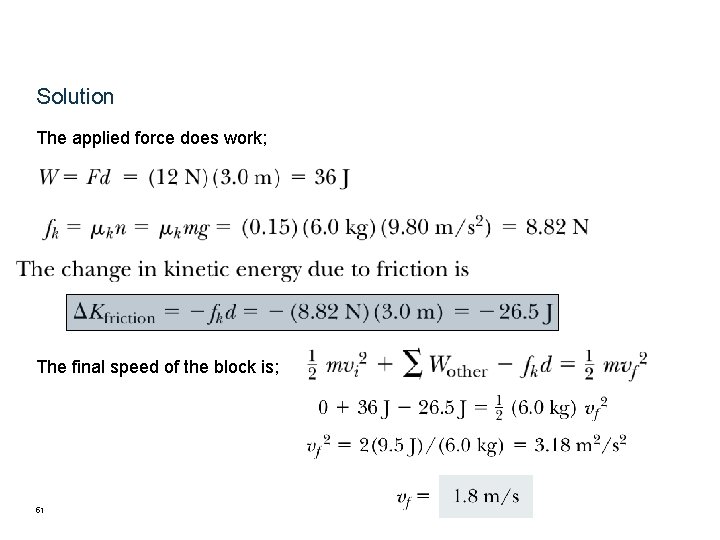
Example 7. 8 A 6. 0 -kg block initially at rest is pulled to the right along a horizontal, not frictionless surface by a constant horizontal force of 12 N and has a coefficient of kinetic friction of 0. 15. Find the speed of the block after it has moved 3. 0 m. 50
Solution The applied force does work; The final speed of the block is; 51
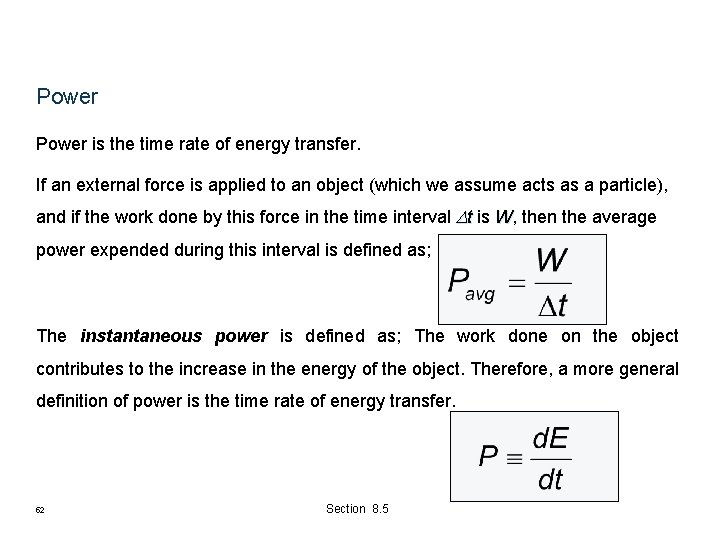
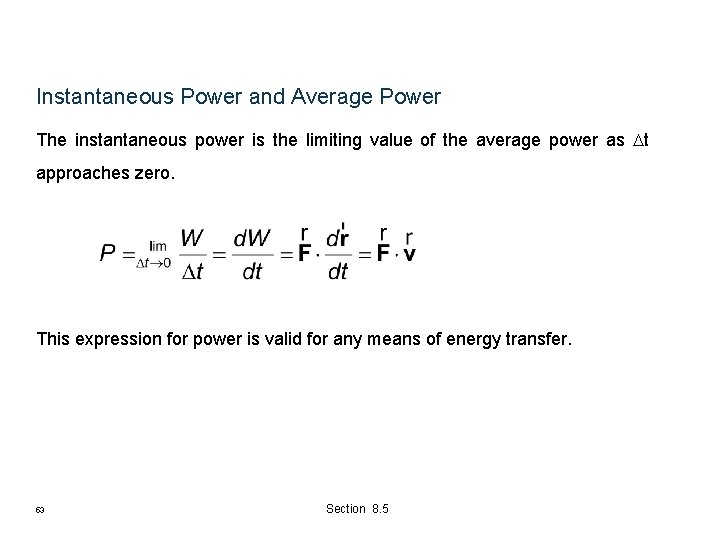
Power is the time rate of energy transfer. If an external force is applied to an object (which we assume acts as a particle), and if the work done by this force in the time interval t is W, then the average power expended during this interval is defined as; The instantaneous power is defined as; The work done on the object contributes to the increase in the energy of the object. Therefore, a more general definition of power is the time rate of energy transfer. 52 Section 8. 5
Instantaneous Power and Average Power The instantaneous power is the limiting value of the average power as Dt approaches zero. This expression for power is valid for any means of energy transfer. 53 Section 8. 5
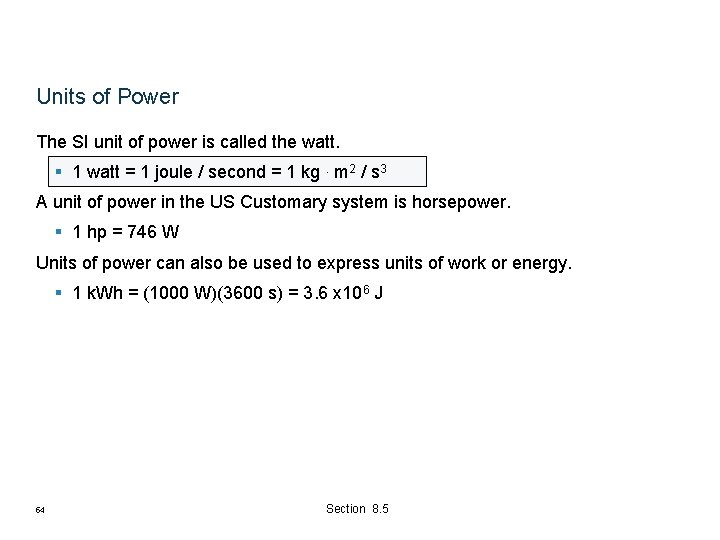
Units of Power The SI unit of power is called the watt. § 1 watt = 1 joule / second = 1 kg. m 2 / s 3 A unit of power in the US Customary system is horsepower. § 1 hp = 746 W Units of power can also be used to express units of work or energy. § 1 k. Wh = (1000 W)(3600 s) = 3. 6 x 10⁶ J 54 Section 8. 5
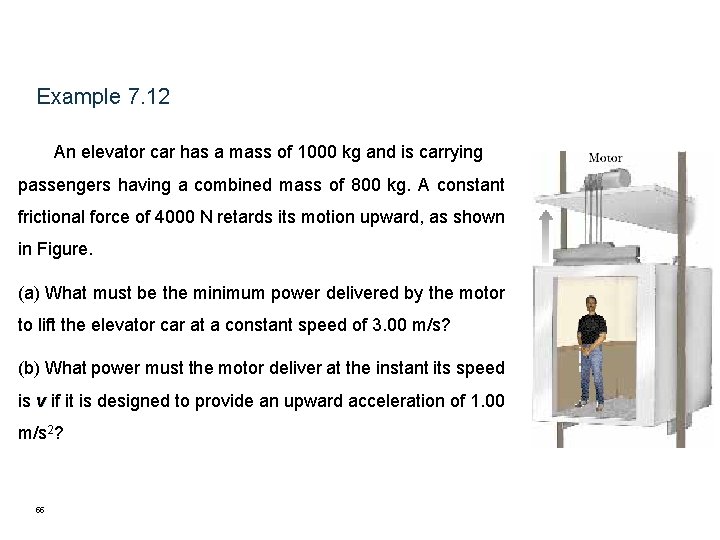
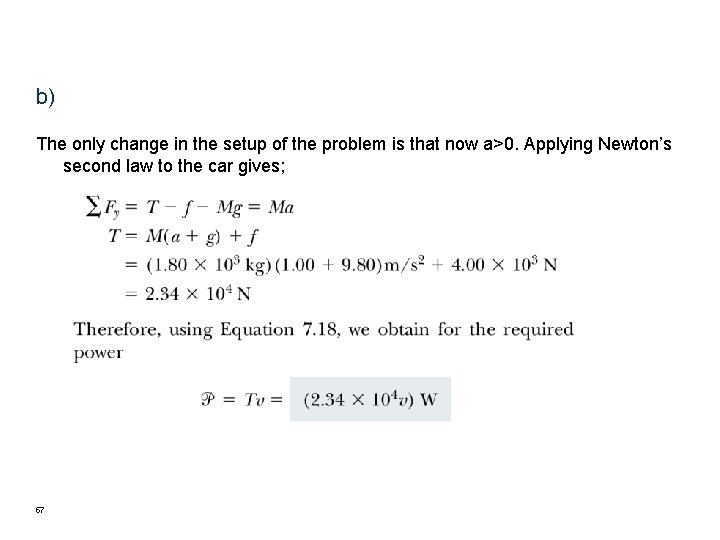
Example 7. 12 An elevator car has a mass of 1000 kg and is carrying passengers having a combined mass of 800 kg. A constant frictional force of 4000 N retards its motion upward, as shown in Figure. (a) What must be the minimum power delivered by the motor to lift the elevator car at a constant speed of 3. 00 m/s? (b) What power must the motor deliver at the instant its speed is v if it is designed to provide an upward acceleration of 1. 00 m/s 2? 55
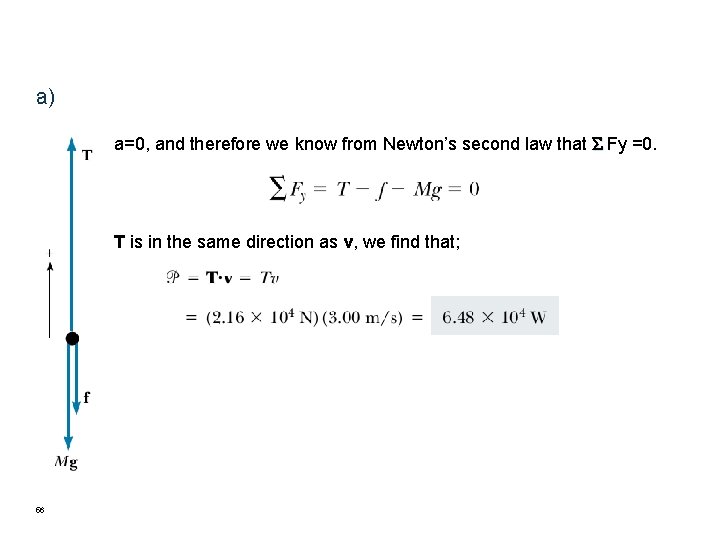
a) a=0, and therefore we know from Newton’s second law that Fy =0. T is in the same direction as v, we find that; 56
b) The only change in the setup of the problem is that now a>0. Applying Newton’s second law to the car gives; 57