
Chapter 7 Work And Energy Ms Brown 8
Chapter 7 : Work And Energy Ms. Brown 8 th Grade General Science Jennifer C. Brown
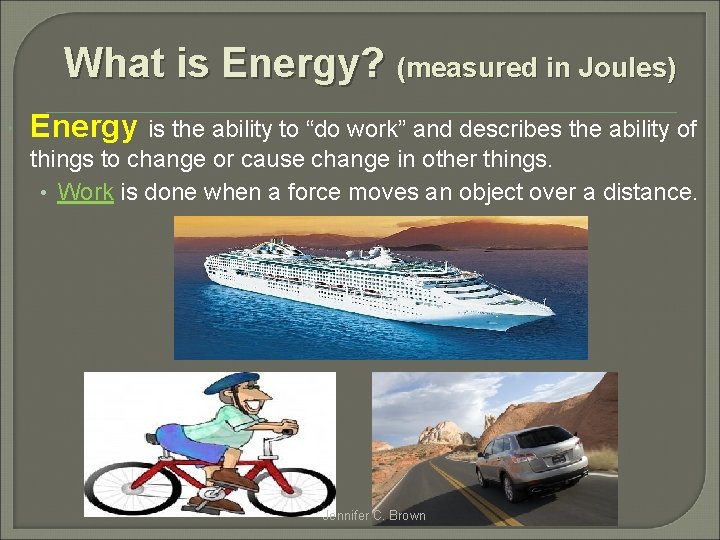
What is Energy? (measured in Joules) Energy is the ability to “do work” and describes the ability of things to change or cause change in other things. • Work is done when a force moves an object over a distance. Jennifer C. Brown
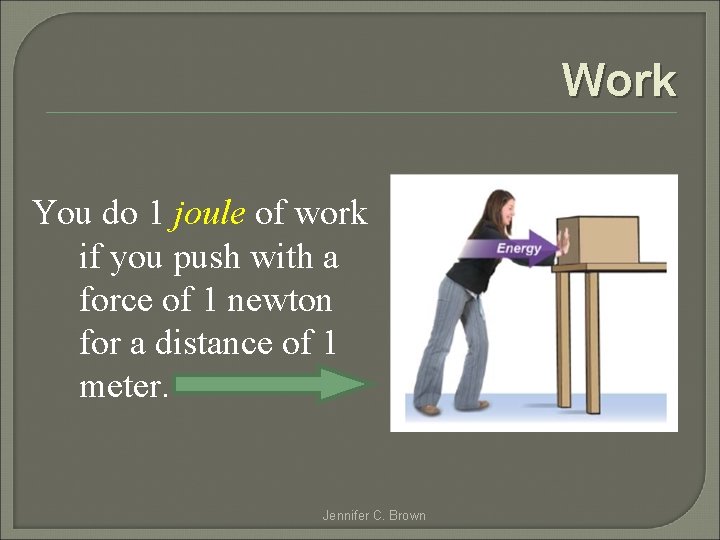
Work You do 1 joule of work if you push with a force of 1 newton for a distance of 1 meter. Jennifer C. Brown
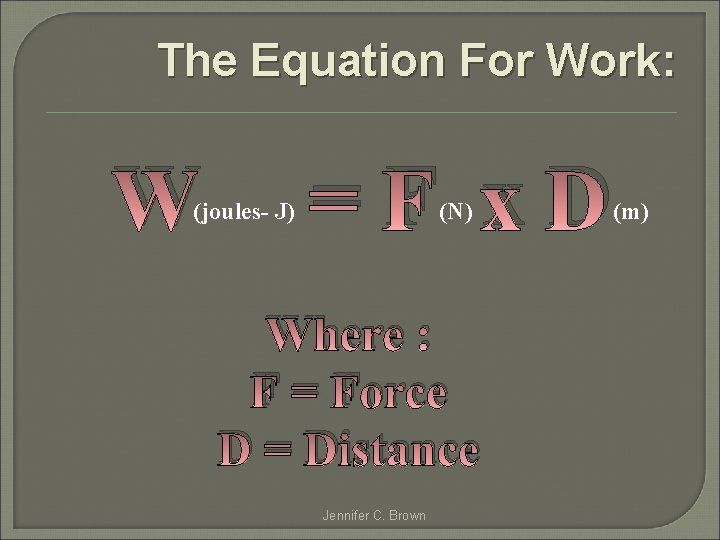
The Equation For Work: W (joules- J) =F x. D (N) Where : F = Force D = Distance Jennifer C. Brown (m)
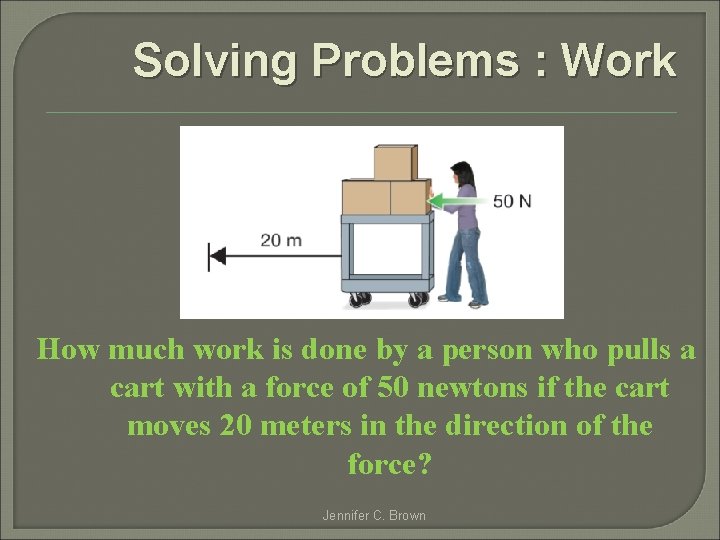
Solving Problems : Work How much work is done by a person who pulls a cart with a force of 50 newtons if the cart moves 20 meters in the direction of the force? Jennifer C. Brown
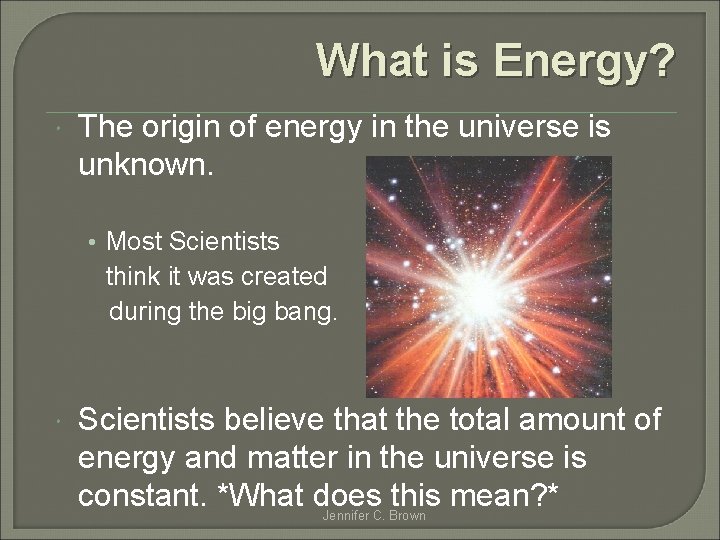
What is Energy? The origin of energy in the universe is unknown. • Most Scientists think it was created during the big bang. Scientists believe that the total amount of energy and matter in the universe is constant. *What does this mean? * Jennifer C. Brown
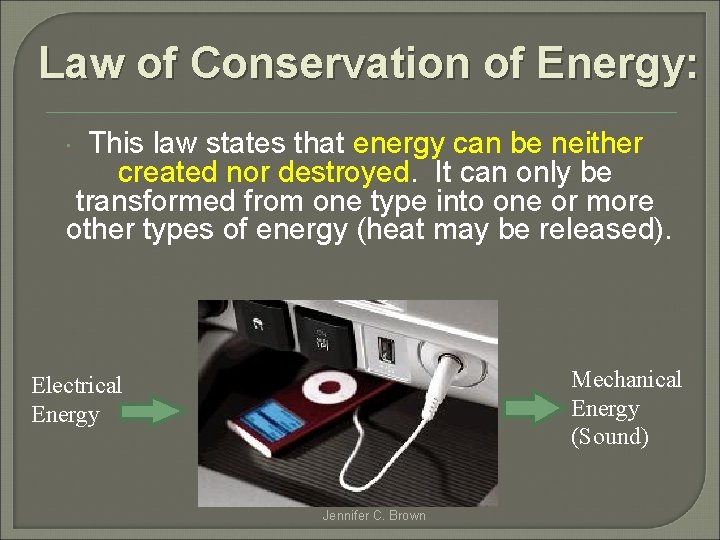
Law of Conservation of Energy: This law states that energy can be neither created nor destroyed. It can only be transformed from one type into one or more other types of energy (heat may be released). Mechanical Energy (Sound) Electrical Energy Jennifer C. Brown
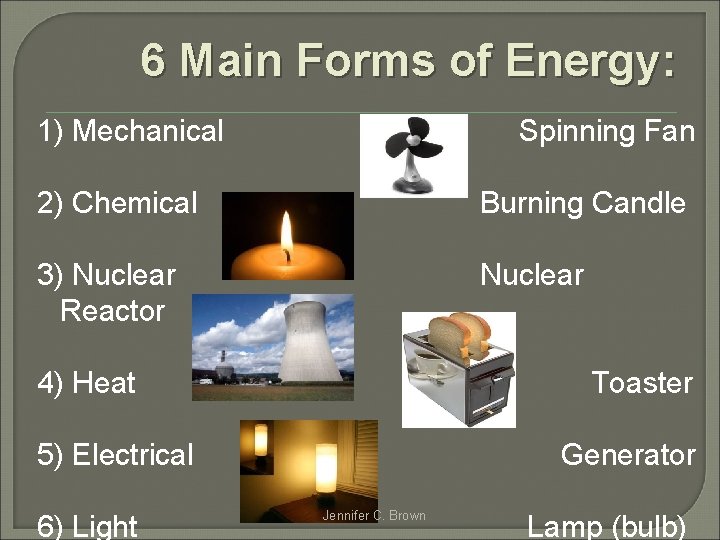
6 Main Forms of Energy: 1) Mechanical Spinning Fan 2) Chemical Burning Candle 3) Nuclear Reactor Nuclear 4) Heat Toaster 5) Electrical 6) Light Generator Jennifer C. Brown Lamp (bulb)
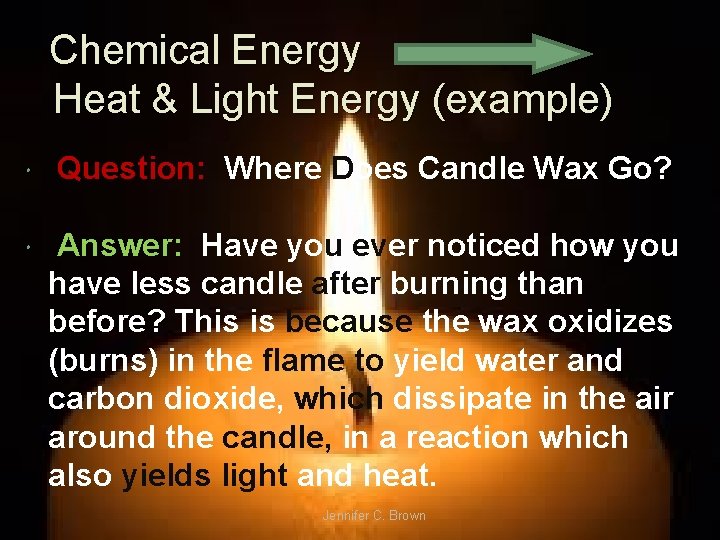
Chemical Energy Heat & Light Energy (example) Question: Where Does Candle Wax Go? Answer: Have you ever noticed how you have less candle after burning than before? This is because the wax oxidizes (burns) in the flame to yield water and carbon dioxide, which dissipate in the air around the candle, in a reaction which also yields light and heat. Jennifer C. Brown
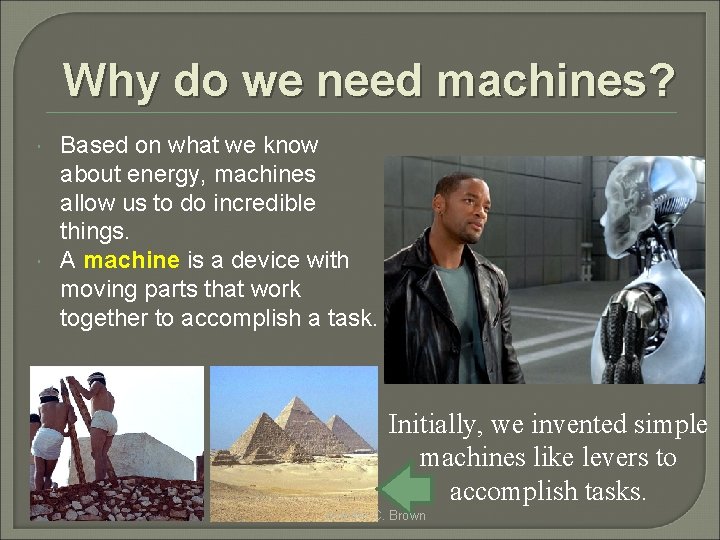
Why do we need machines? Based on what we know about energy, machines allow us to do incredible things. A machine is a device with moving parts that work together to accomplish a task. Initially, we invented simple machines like levers to accomplish tasks. Jennifer C. Brown
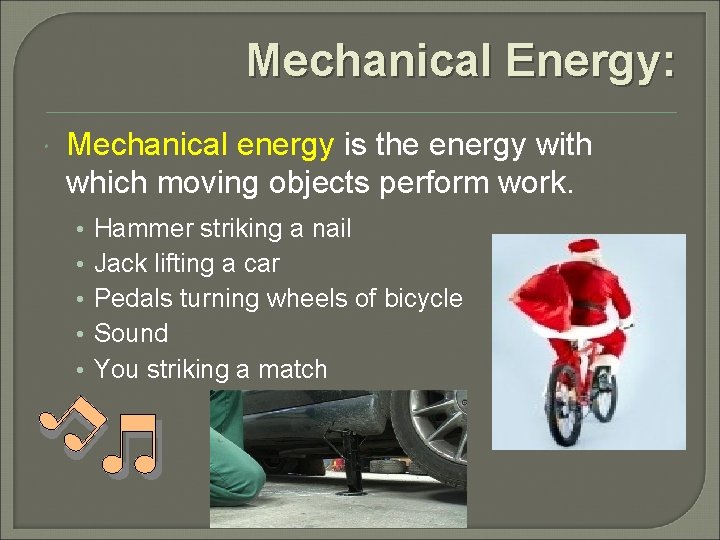
Mechanical Energy: Mechanical energy is the energy with which moving objects perform work. • • • Hammer striking a nail Jack lifting a car Pedals turning wheels of bicycle Sound You striking a match Jennifer C. Brown
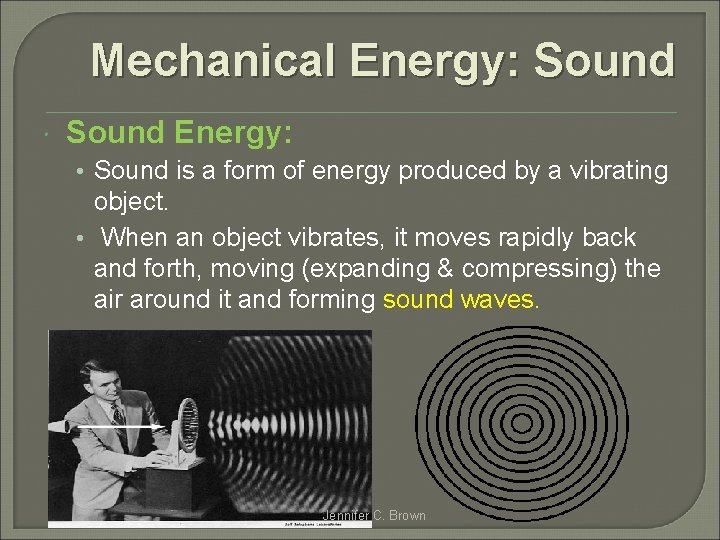
Mechanical Energy: Sound Energy: • Sound is a form of energy produced by a vibrating object. • When an object vibrates, it moves rapidly back and forth, moving (expanding & compressing) the air around it and forming sound waves. Jennifer C. Brown
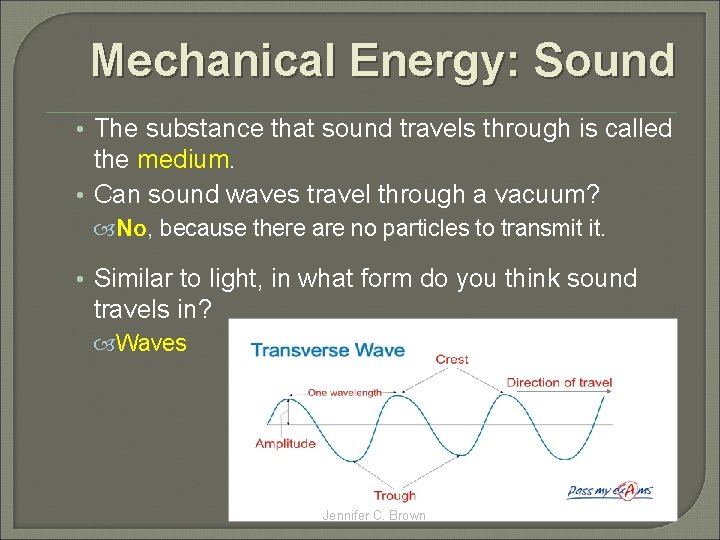
Mechanical Energy: Sound • The substance that sound travels through is called the medium. • Can sound waves travel through a vacuum? No, because there are no particles to transmit it. • Similar to light, in what form do you think sound travels in? Waves Jennifer C. Brown
Waves: Important Parts of a Wave: • Wavelength – the distance from one point in a wave to a corresponding point in the next wave. • Amplitude – the height of the crest measured from the undisturbed surface. • Frequency – the number of waves that pass by a fixed point in a given amount of time. Jennifer C. Brown
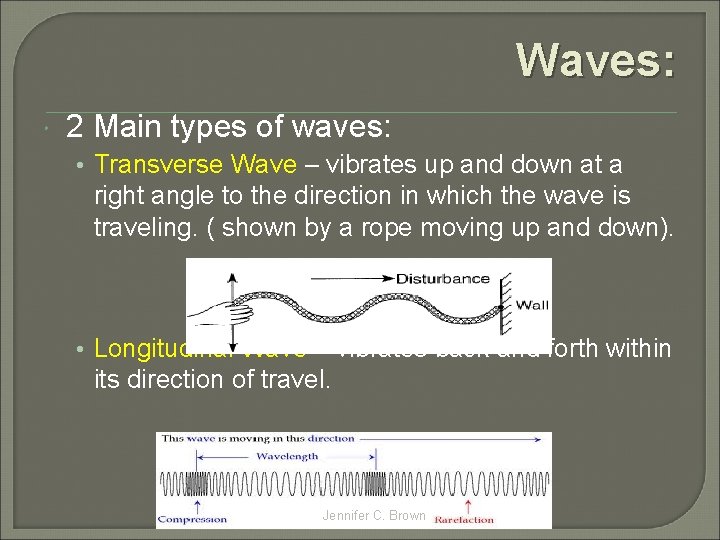
Waves: 2 Main types of waves: • Transverse Wave – vibrates up and down at a right angle to the direction in which the wave is traveling. ( shown by a rope moving up and down). • Longitudinal Wave – vibrates back and forth within its direction of travel. Jennifer C. Brown
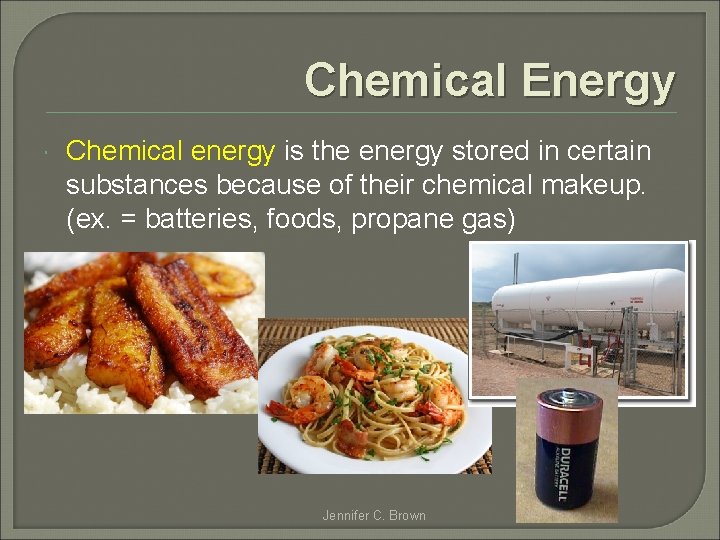
Chemical Energy Chemical energy is the energy stored in certain substances because of their chemical makeup. (ex. = batteries, foods, propane gas) Jennifer C. Brown
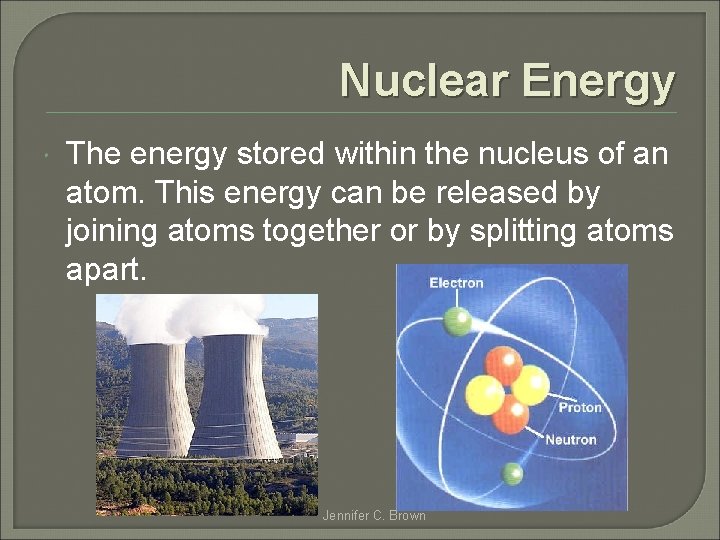
Nuclear Energy The energy stored within the nucleus of an atom. This energy can be released by joining atoms together or by splitting atoms apart. Jennifer C. Brown
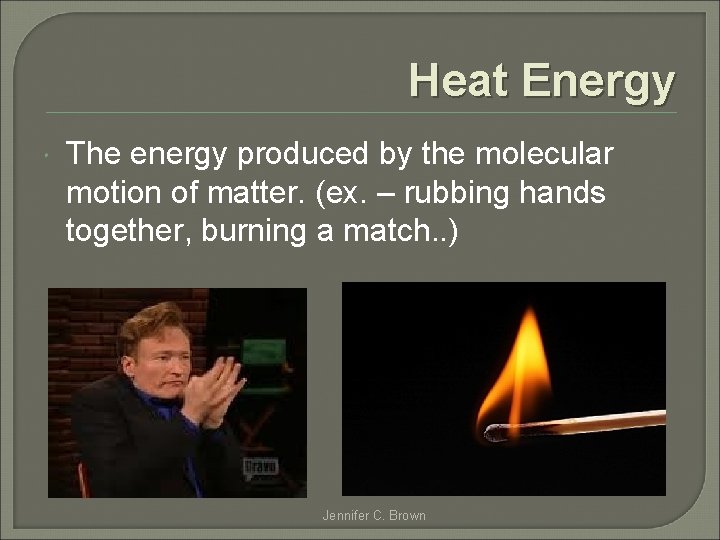
Heat Energy The energy produced by the molecular motion of matter. (ex. – rubbing hands together, burning a match. . ) Jennifer C. Brown
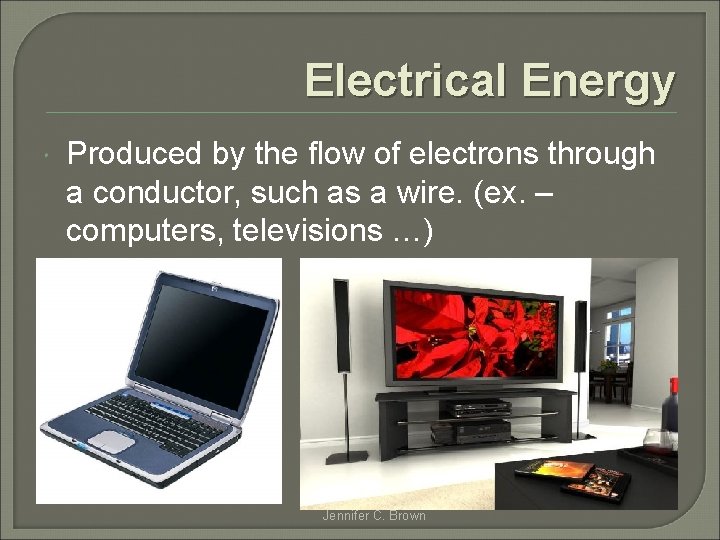
Electrical Energy Produced by the flow of electrons through a conductor, such as a wire. (ex. – computers, televisions …) Jennifer C. Brown
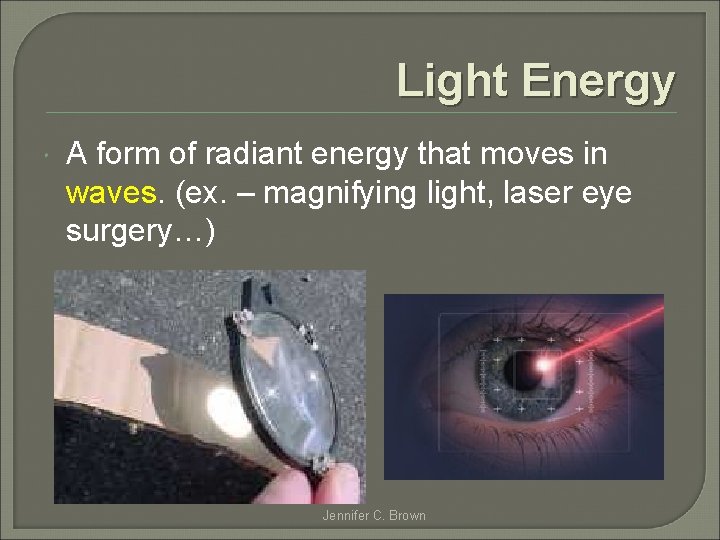
Light Energy A form of radiant energy that moves in waves. (ex. – magnifying light, laser eye surgery…) Jennifer C. Brown
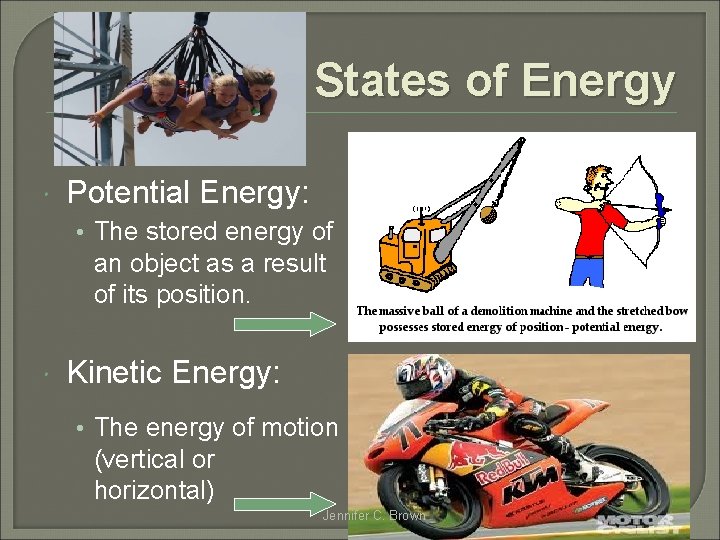
States of Energy Potential Energy: • The stored energy of an object as a result of its position. Kinetic Energy: • The energy of motion (vertical or horizontal) Jennifer C. Brown
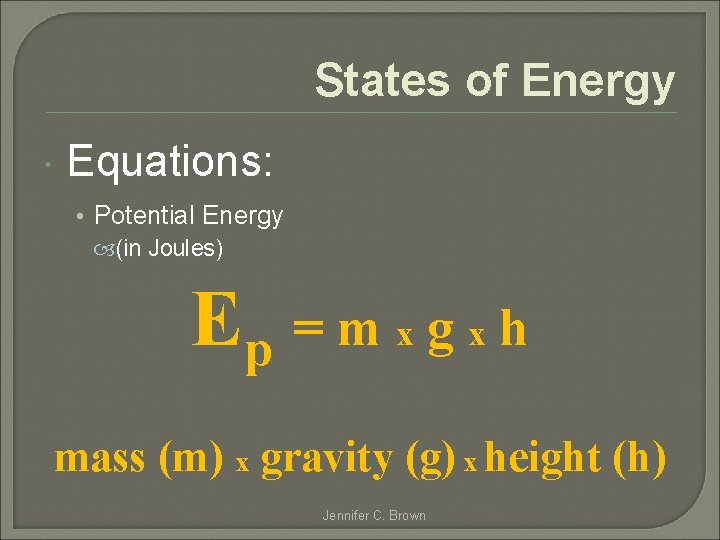
States of Energy Equations: • Potential Energy (in Joules) Ep = m x g x h mass (m) x gravity (g) x height (h) Jennifer C. Brown
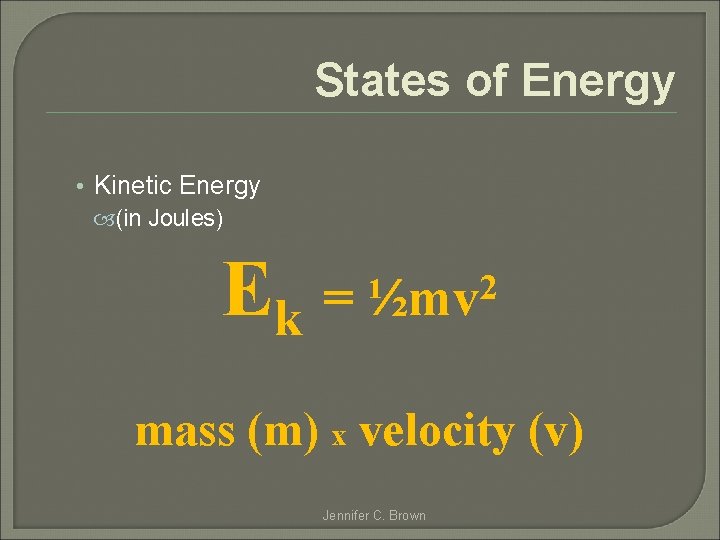
States of Energy • Kinetic Energy (in Joules) Ek = 2 ½mv mass (m) x velocity (v) Jennifer C. Brown
Sound Energy The speed of sound depends primarily on what 2 factors? • The medium through which it is passing Denser medium = faster speed of sound • The temperature Colder temperature = faster speed of sound Jennifer C. Brown
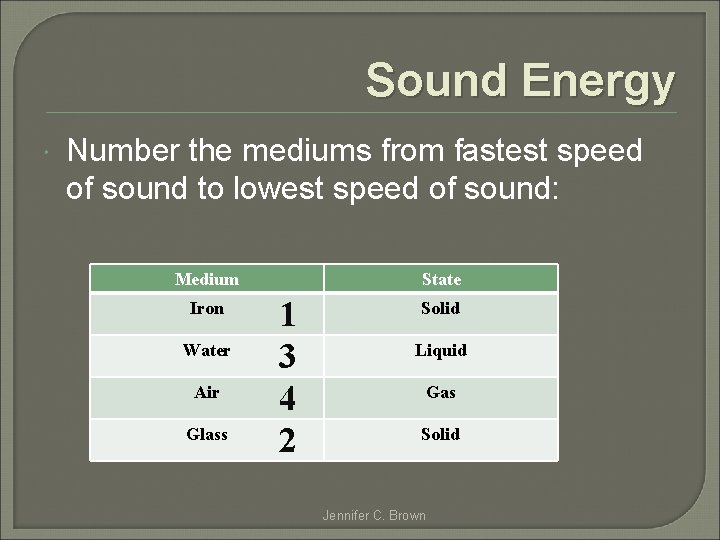
Sound Energy Number the mediums from fastest speed of sound to lowest speed of sound: Medium Iron Water Air Glass State 1 3 4 2 Solid Liquid Gas Solid Jennifer C. Brown
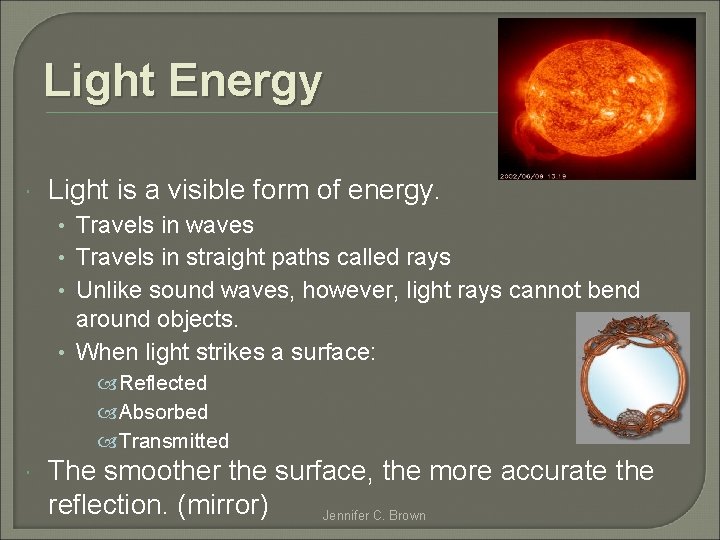
Light Energy Light is a visible form of energy. • Travels in waves • Travels in straight paths called rays • Unlike sound waves, however, light rays cannot bend around objects. • When light strikes a surface: Reflected Absorbed Transmitted The smoother the surface, the more accurate the reflection. (mirror) Jennifer C. Brown
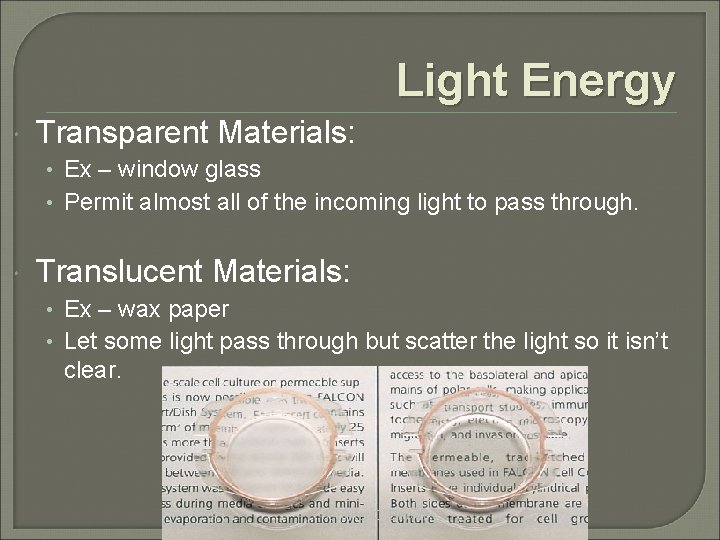
Light Energy Transparent Materials: • Ex – window glass • Permit almost all of the incoming light to pass through. Translucent Materials: • Ex – wax paper • Let some light pass through but scatter the light so it isn’t clear. Jennifer C. Brown
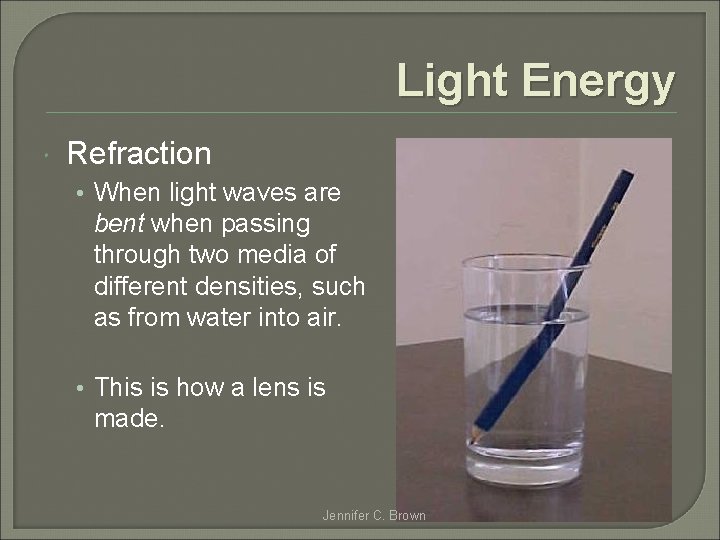
Light Energy Refraction • When light waves are bent when passing through two media of different densities, such as from water into air. • This is how a lens is made. Jennifer C. Brown
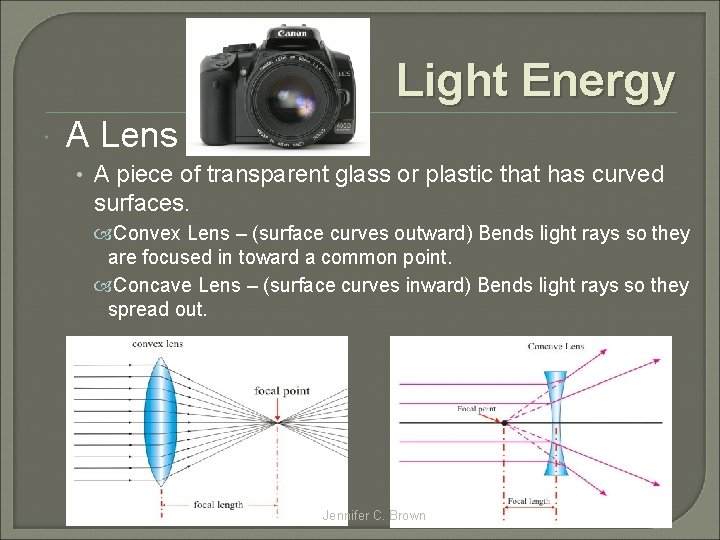
Light Energy A Lens • A piece of transparent glass or plastic that has curved surfaces. Convex Lens – (surface curves outward) Bends light rays so they are focused in toward a common point. Concave Lens – (surface curves inward) Bends light rays so they spread out. Jennifer C. Brown
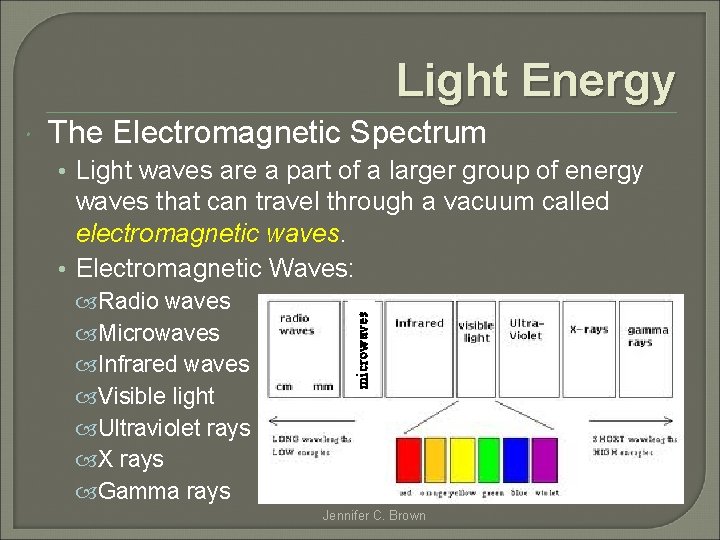
Light Energy The Electromagnetic Spectrum • Light waves are a part of a larger group of energy waves that can travel through a vacuum called electromagnetic waves. • Electromagnetic Waves: Radio waves Microwaves Infrared waves Visible light Ultraviolet rays X rays Gamma rays microwaves Jennifer C. Brown
- Slides: 30