
Chapter 7 Unsoundness of horses UNSOUNDNESSES Of the





- Slides: 66
Chapter 7 Unsoundness of horses
UNSOUNDNESSES Of the head Shelbie Weeder
Common Unsoundnesses of the head • • • BLINDNESS MOON BLINDNESS BAD MOUTH POLL EVIL QUIDDING
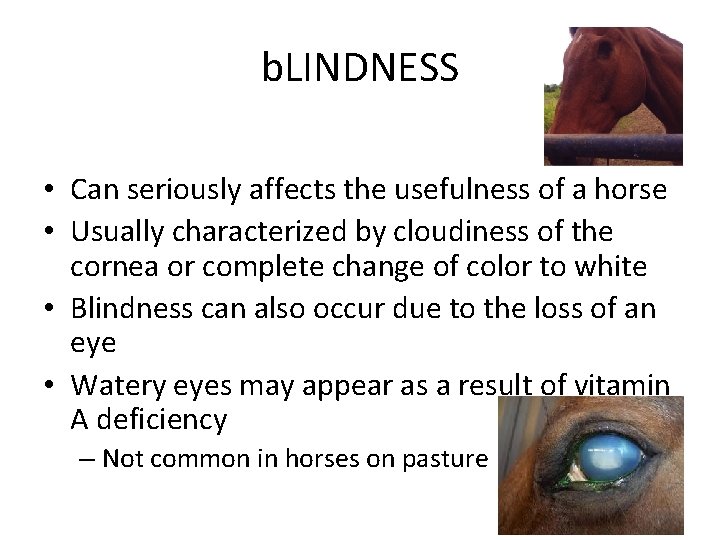
b. LINDNESS • Can seriously affects the usefulness of a horse • Usually characterized by cloudiness of the cornea or complete change of color to white • Blindness can also occur due to the loss of an eye • Watery eyes may appear as a result of vitamin A deficiency – Not common in horses on pasture
Moon Blindness • Also known as ophthamalia • Inflammation of the inner eye due in part to a vitamin B deficiency • Usually impairs vision • Treatment is usually unsucessful
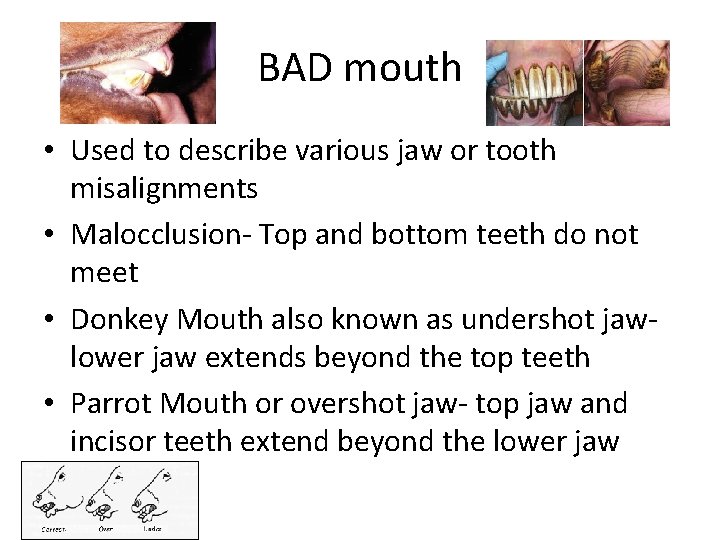
BAD mouth • Used to describe various jaw or tooth misalignments • Malocclusion- Top and bottom teeth do not meet • Donkey Mouth also known as undershot jaw- lower jaw extends beyond the top teeth • Parrot Mouth or overshot jaw- top jaw and incisor teeth extend beyond the lower jaw
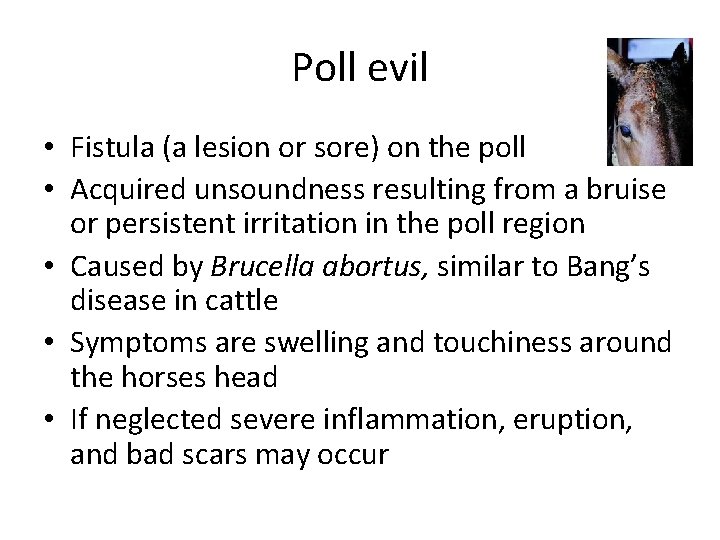
Poll evil • Fistula (a lesion or sore) on the poll • Acquired unsoundness resulting from a bruise or persistent irritation in the poll region • Caused by Brucella abortus, similar to Bang’s disease in cattle • Symptoms are swelling and touchiness around the horses head • If neglected severe inflammation, eruption, and bad scars may occur
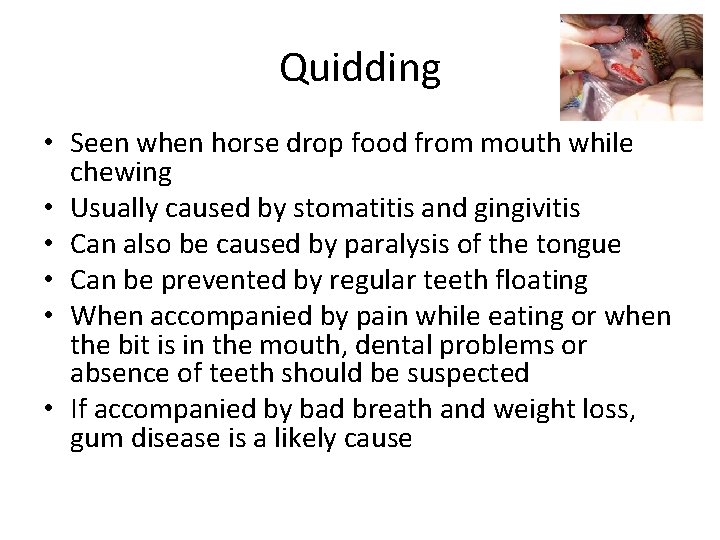
Quidding • Seen when horse drop food from mouth while chewing • Usually caused by stomatitis and gingivitis • Can also be caused by paralysis of the tongue • Can be prevented by regular teeth floating • When accompanied by pain while eating or when the bit is in the mouth, dental problems or absence of teeth should be suspected • If accompanied by bad breath and weight loss, gum disease is a likely cause
Stable Vices Chy Black
Stall Walking • It’s exactly how it sounds. • Pacing in the stall. • Affects their condition and energy level. – Lower the condition of the horse from the constant movement. – Induces fatigue.
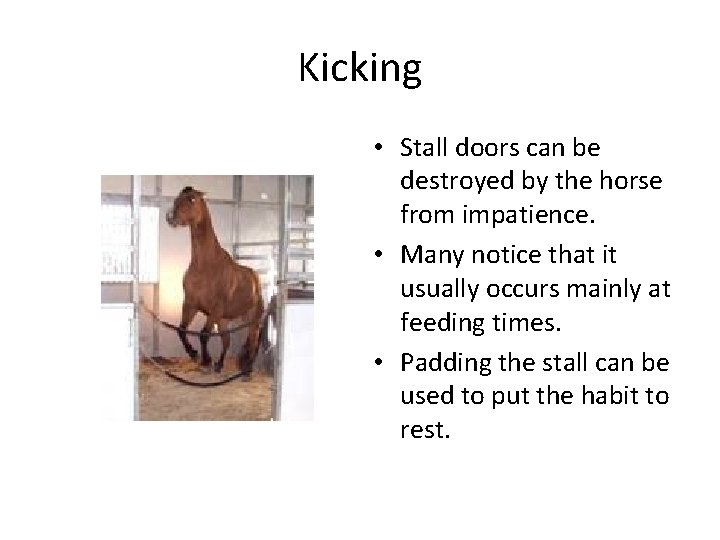
Kicking • Stall doors can be destroyed by the horse from impatience. • Many notice that it usually occurs mainly at feeding times. • Padding the stall can be used to put the habit to rest.
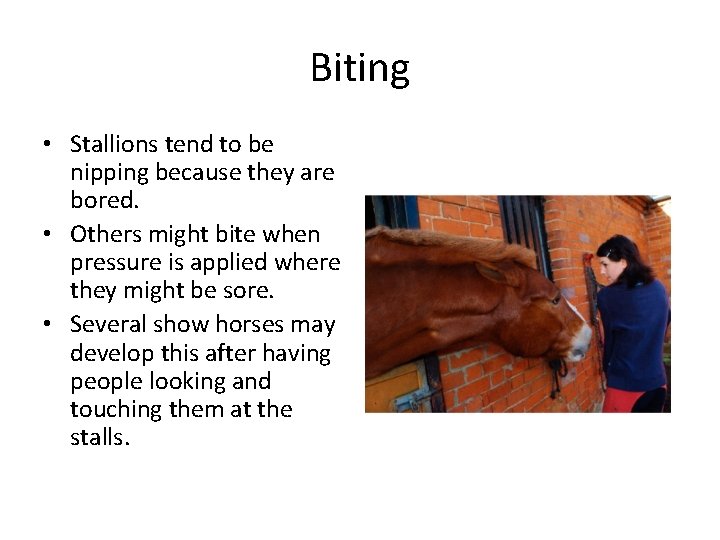
Biting • Stallions tend to be nipping because they are bored. • Others might bite when pressure is applied where they might be sore. • Several show horses may develop this after having people looking and touching them at the stalls.
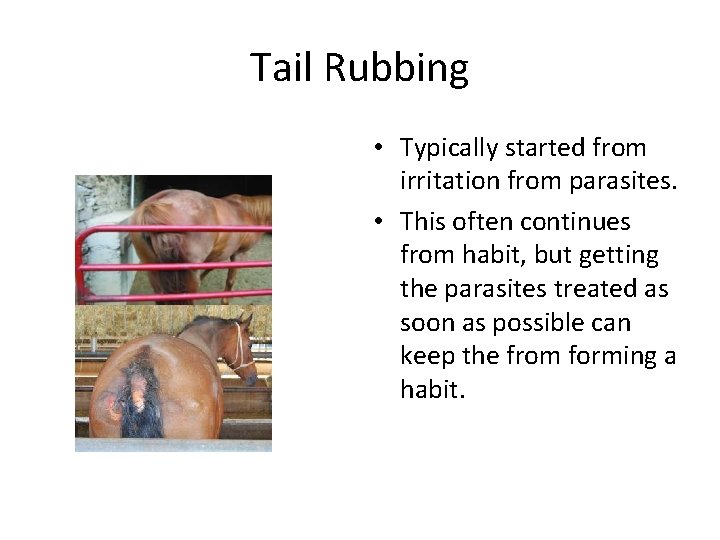
Tail Rubbing • Typically started from irritation from parasites. • This often continues from habit, but getting the parasites treated as soon as possible can keep the from forming a habit.
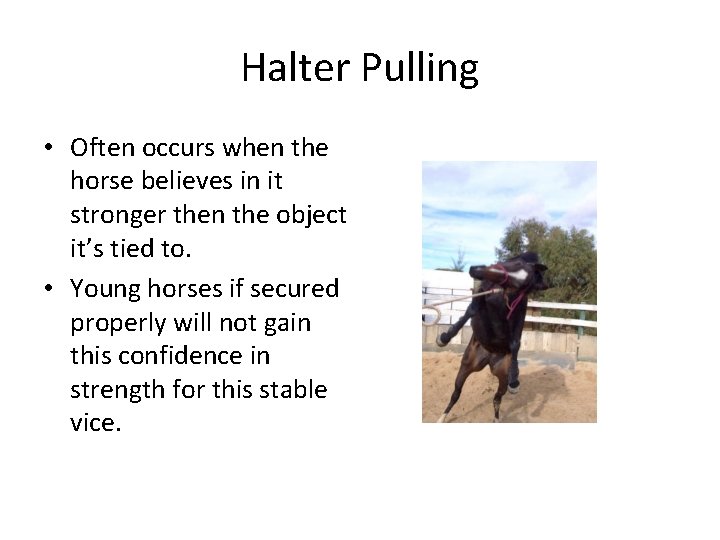
Halter Pulling • Often occurs when the horse believes in it stronger then the object it’s tied to. • Young horses if secured properly will not gain this confidence in strength for this stable vice.
Wesley Cole
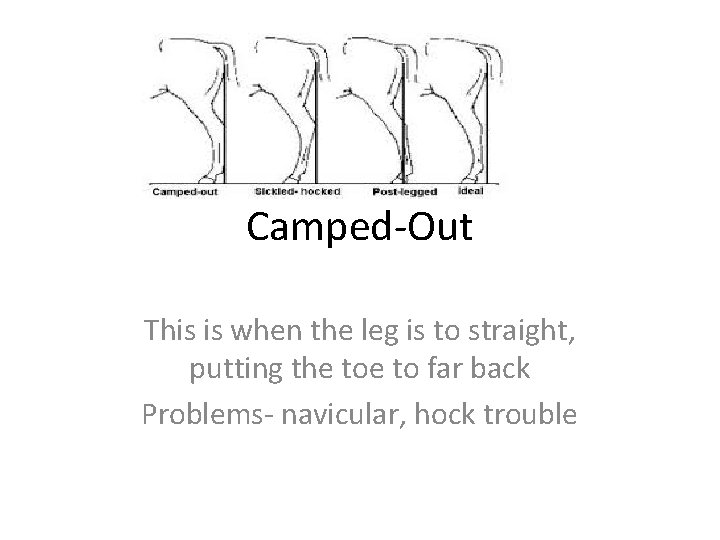
Camped-Out This is when the leg is to straight, putting the to far back Problems- navicular, hock trouble
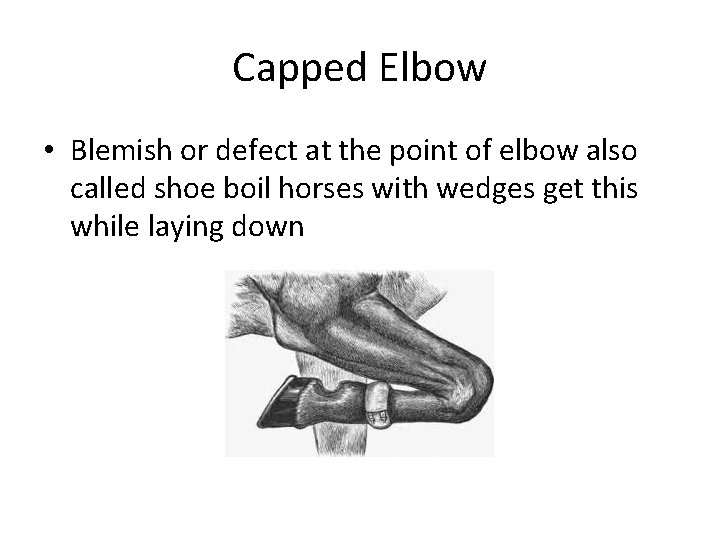
Capped Elbow • Blemish or defect at the point of elbow also called shoe boil horses with wedges get this while laying down
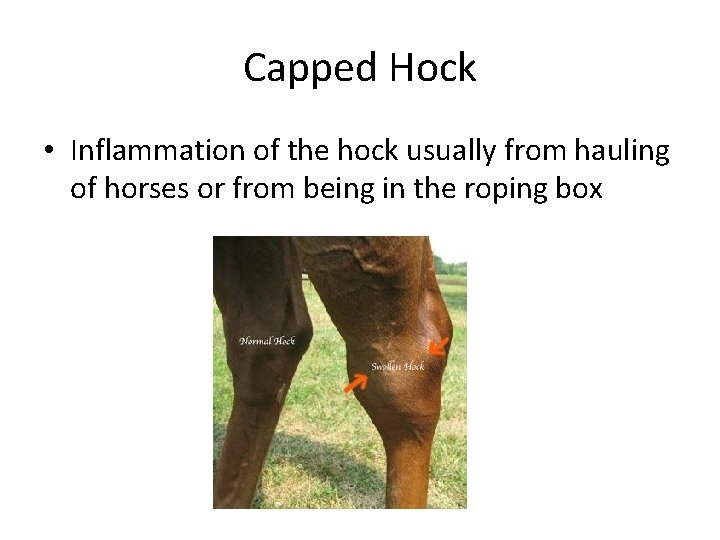
Capped Hock • Inflammation of the hock usually from hauling of horses or from being in the roping box
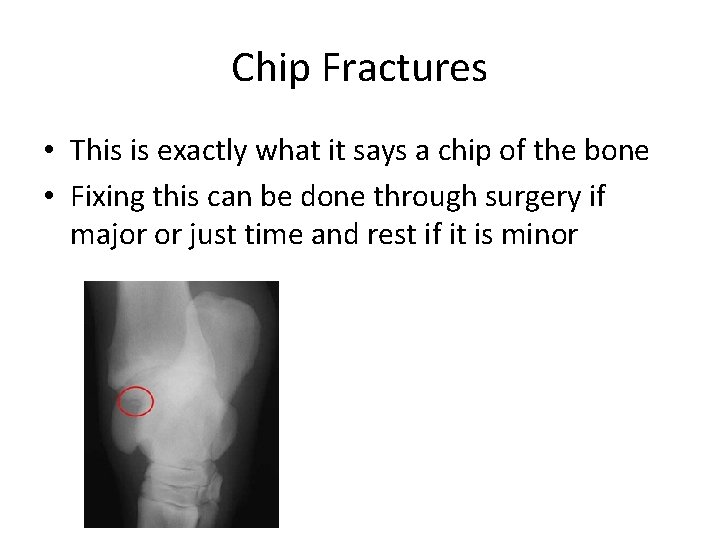
Chip Fractures • This is exactly what it says a chip of the bone • Fixing this can be done through surgery if major or just time and rest if it is minor
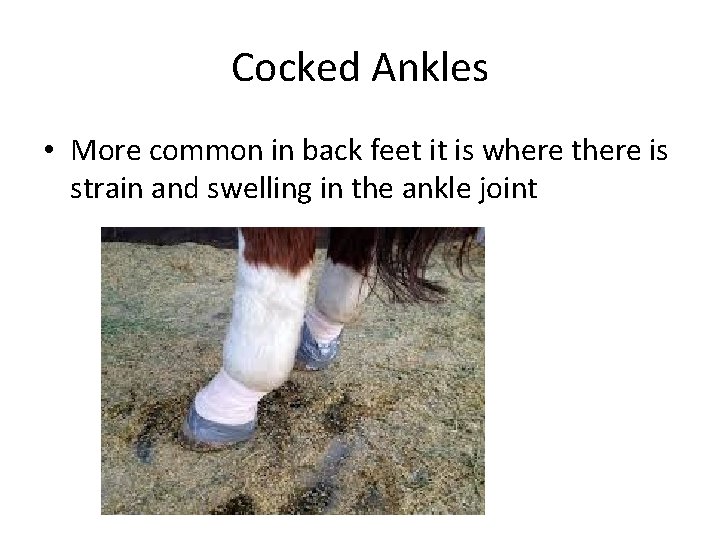
Cocked Ankles • More common in back feet it is where there is strain and swelling in the ankle joint
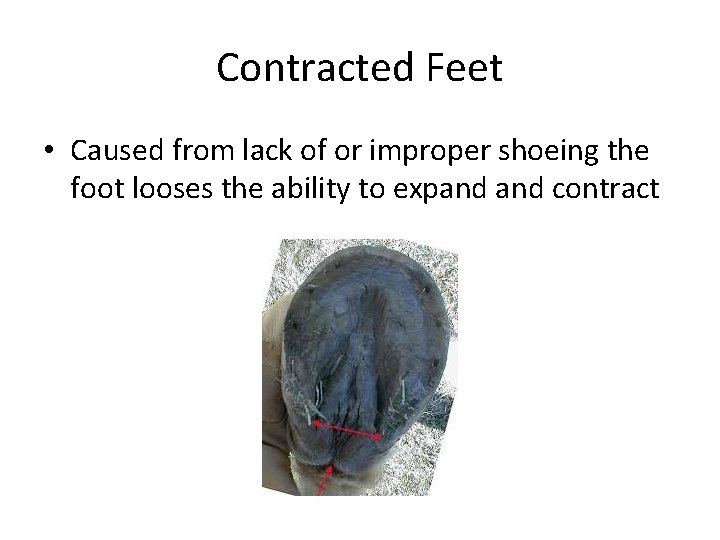
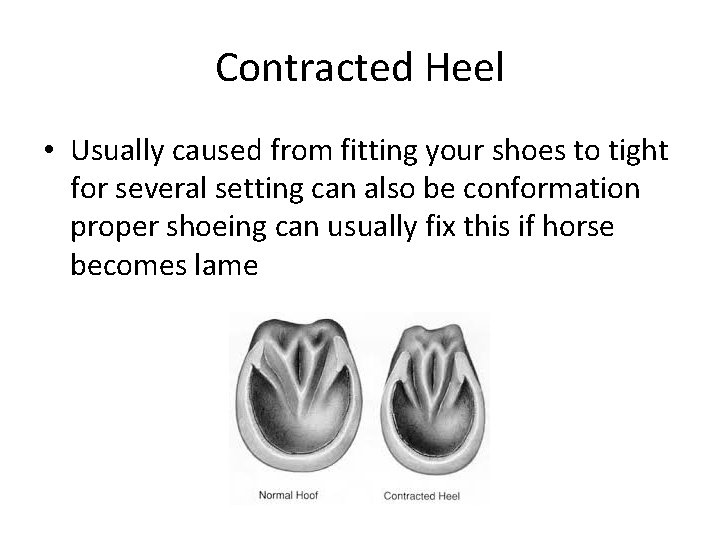
Contracted Feet • Caused from lack of or improper shoeing the foot looses the ability to expand contract
Contracted Heel • Usually caused from fitting your shoes to tight for several setting can also be conformation proper shoeing can usually fix this if horse becomes lame
Splints
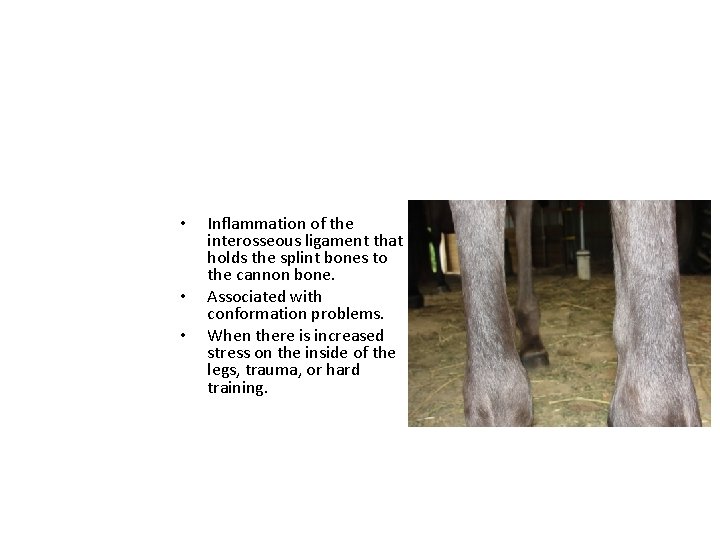
• • • Inflammation of the interosseous ligament that holds the splint bones to the cannon bone. Associated with conformation problems. When there is increased stress on the inside of the legs, trauma, or hard training.
Most common: • • • On forelimbs On the inside of the leg On top of the splint bone, below the knee At the middle or end of the cannon bones 2 -3 year olds
Kelsey Rea Stifled
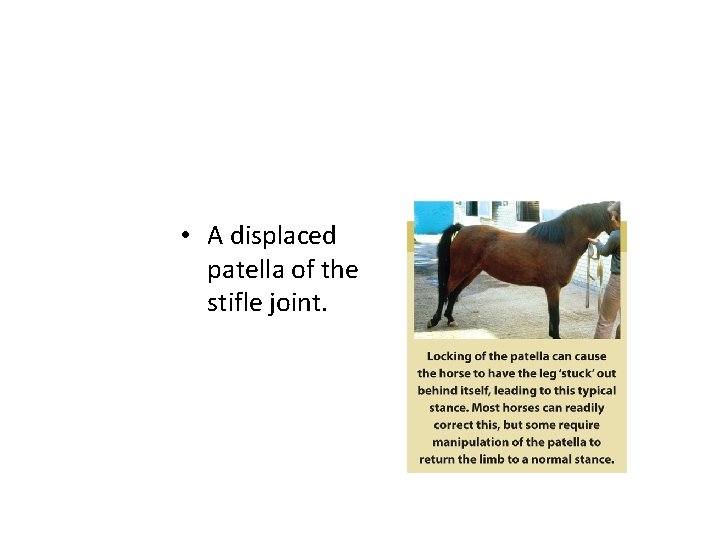
• A displaced patella of the stifle joint.
Stringhalt
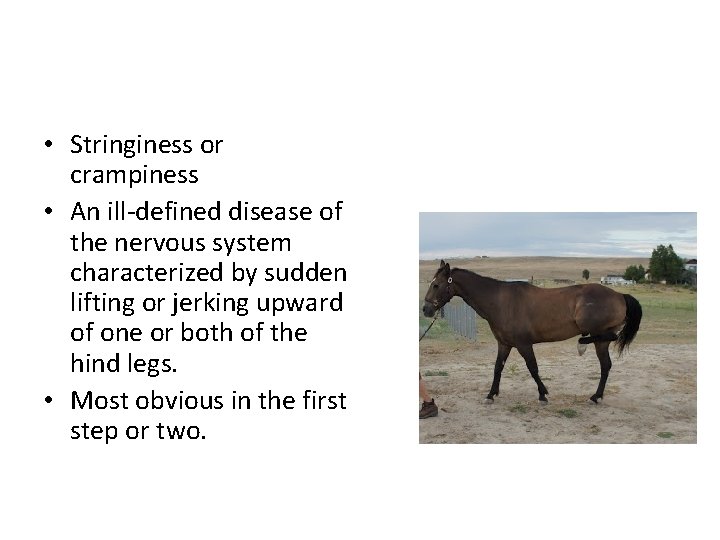
• Stringiness or crampiness • An ill-defined disease of the nervous system characterized by sudden lifting or jerking upward of one or both of the hind legs. • Most obvious in the first step or two.
Sprain
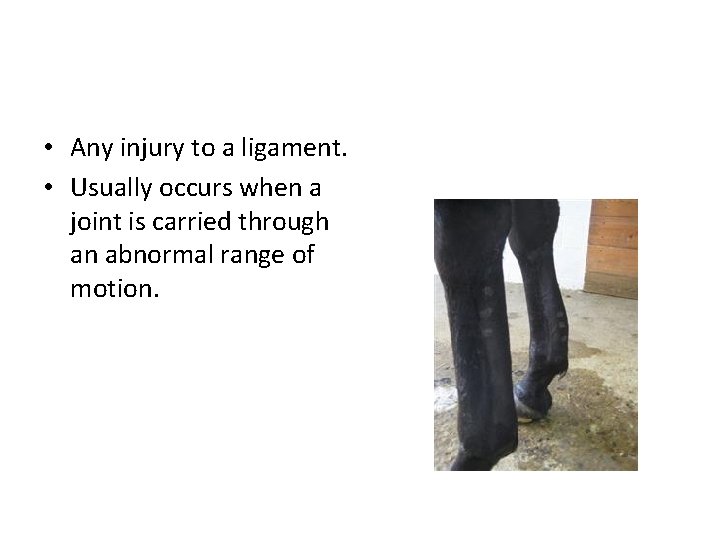
• Any injury to a ligament. • Usually occurs when a joint is carried through an abnormal range of motion.
Thoroughpin
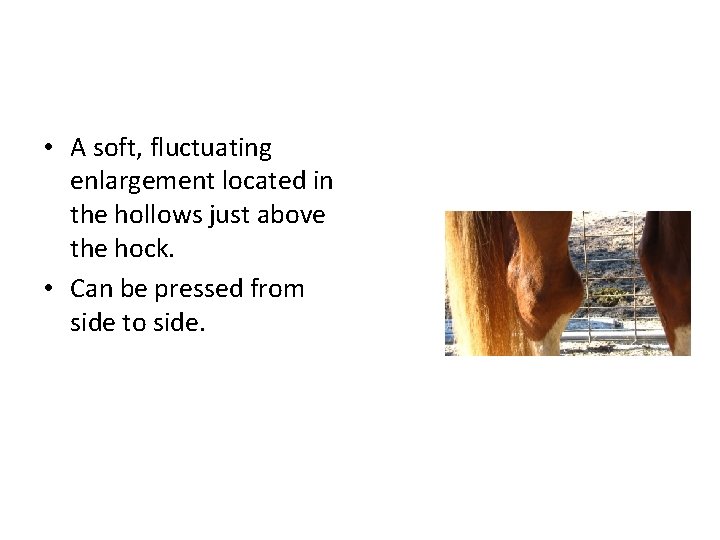
• A soft, fluctuating enlargement located in the hollows just above the hock. • Can be pressed from side to side.
Thrush
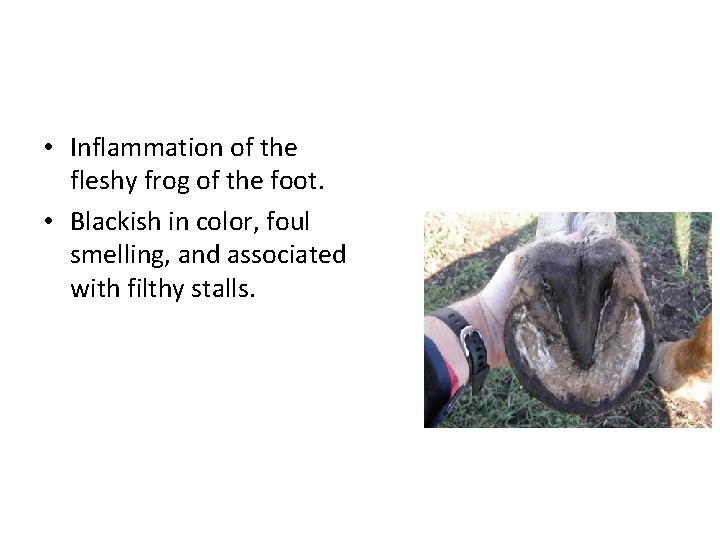
• Inflammation of the fleshy frog of the foot. • Blackish in color, foul smelling, and associated with filthy stalls.
Unsoundness By Madison Hughes
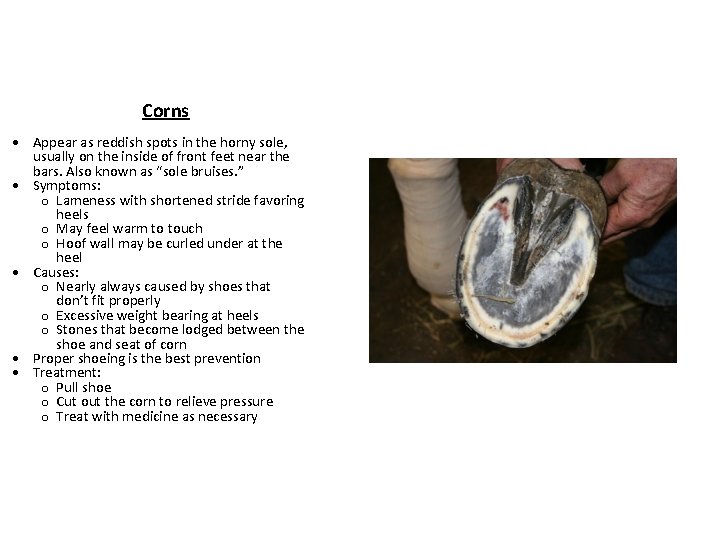
Corns Appear as reddish spots in the horny sole, usually on the inside of front feet near the bars. Also known as “sole bruises. ” Symptoms: o Lameness with shortened stride favoring heels o May feel warm to touch o Hoof wall may be curled under at the heel Causes: o Nearly always caused by shoes that don’t fit properly o Excessive weight bearing at heels o Stones that become lodged between the shoe and seat of corn Proper shoeing is the best prevention Treatment: o Pull shoe o Cut out the corn to relieve pressure o Treat with medicine as necessary
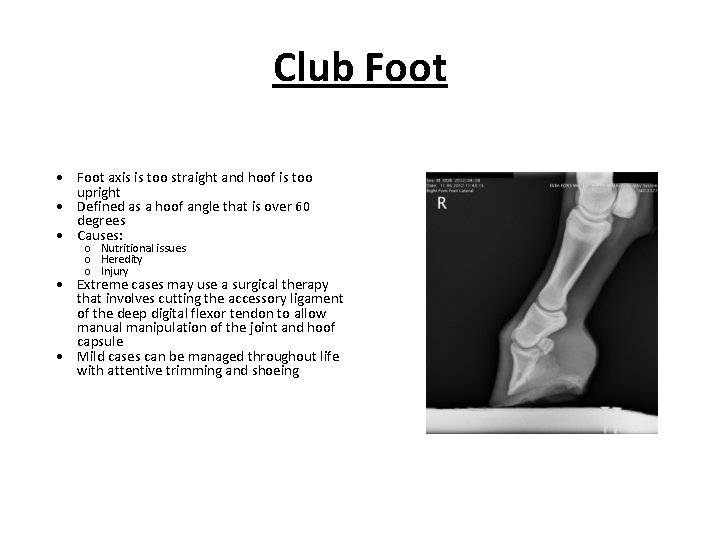
Club Foot axis is too straight and hoof is too upright Defined as a hoof angle that is over 60 degrees Causes: o Nutritional issues o Heredity o Injury Extreme cases may use a surgical therapy that involves cutting the accessory ligament of the deep digital flexor tendon to allow manual manipulation of the joint and hoof capsule Mild cases can be managed throughout life with attentive trimming and shoeing
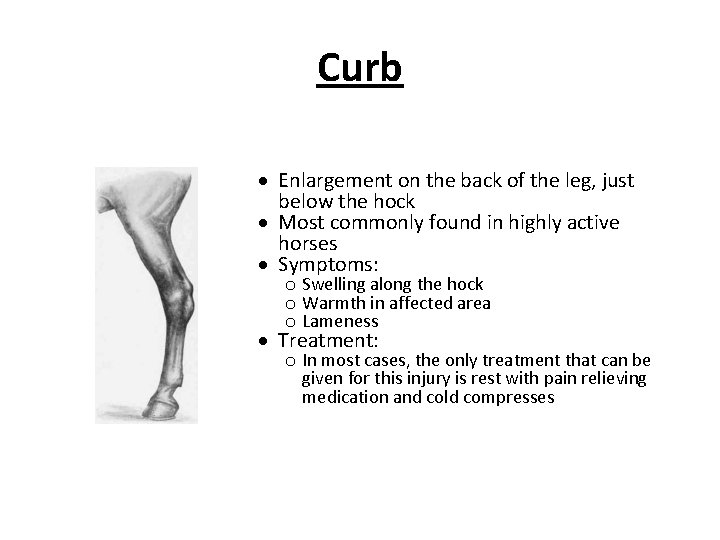
Curb Enlargement on the back of the leg, just below the hock Most commonly found in highly active horses Symptoms: o Swelling along the hock o Warmth in affected area o Lameness Treatment: o In most cases, the only treatment that can be given for this injury is rest with pain relieving medication and cold compresses
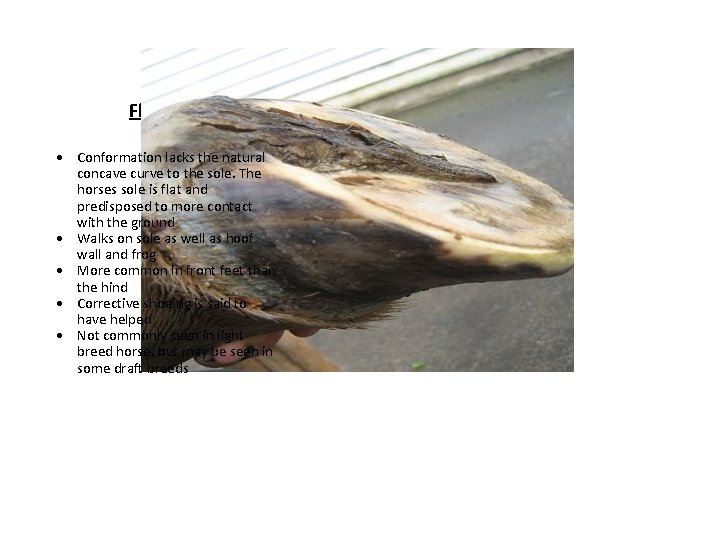
Flat Foot Conformation lacks the natural concave curve to the sole. The horses sole is flat and predisposed to more contact with the ground Walks on sole as well as hoof wall and frog More common in front feet than the hind Corrective shoeing is said to have helped Not commonly seen in light breed horse, but may be seen in some draft breeds
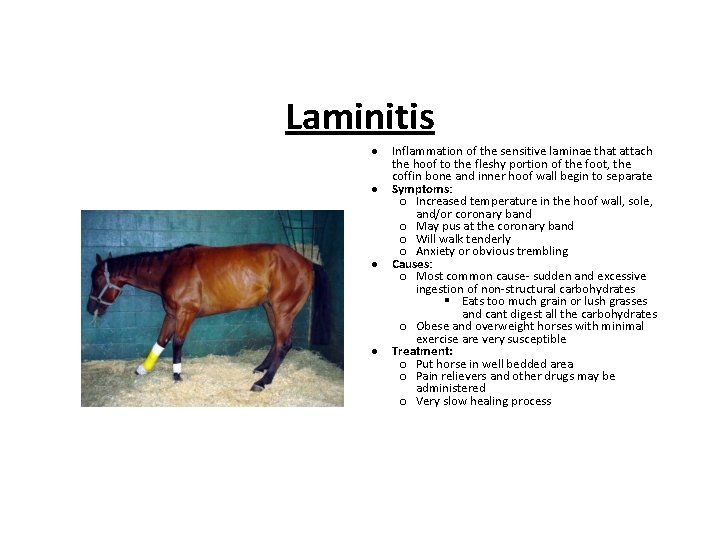
Laminitis Inflammation of the sensitive laminae that attach the hoof to the fleshy portion of the foot, the coffin bone and inner hoof wall begin to separate Symptoms: o Increased temperature in the hoof wall, sole, and/or coronary band o May pus at the coronary band o Will walk tenderly o Anxiety or obvious trembling Causes: o Most common cause- sudden and excessive ingestion of non-structural carbohydrates Eats too much grain or lush grasses and cant digest all the carbohydrates o Obese and overweight horses with minimal exercise are very susceptible Treatment: o Put horse in well bedded area o Pain relievers and other drugs may be administered o Very slow healing process
Spencer Jobman
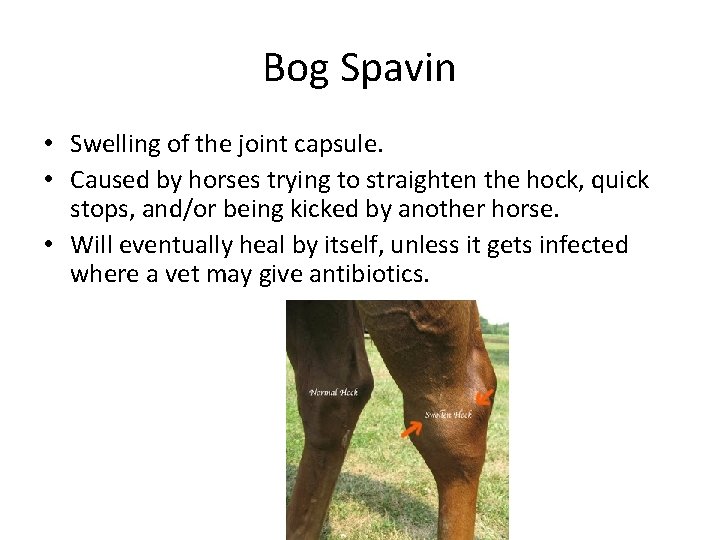
Bog Spavin • Swelling of the joint capsule. • Caused by horses trying to straighten the hock, quick stops, and/or being kicked by another horse. • Will eventually heal by itself, unless it gets infected where a vet may give antibiotics.
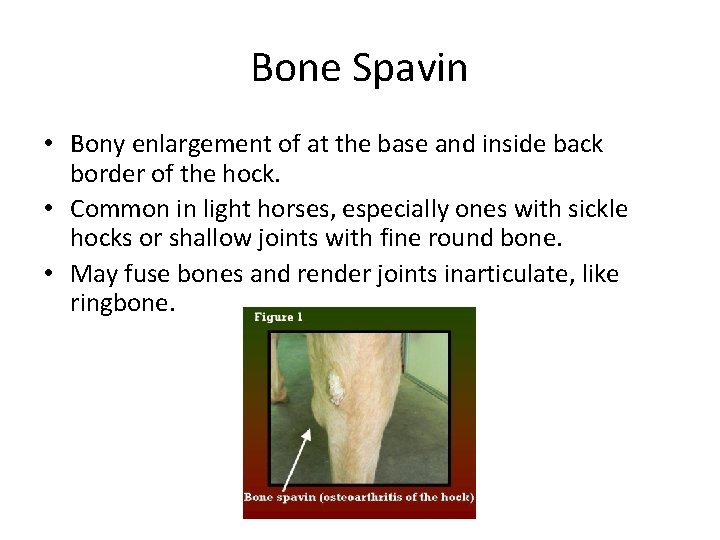
Bone Spavin • Bony enlargement of at the base and inside back border of the hock. • Common in light horses, especially ones with sickle hocks or shallow joints with fine round bone. • May fuse bones and render joints inarticulate, like ringbone.
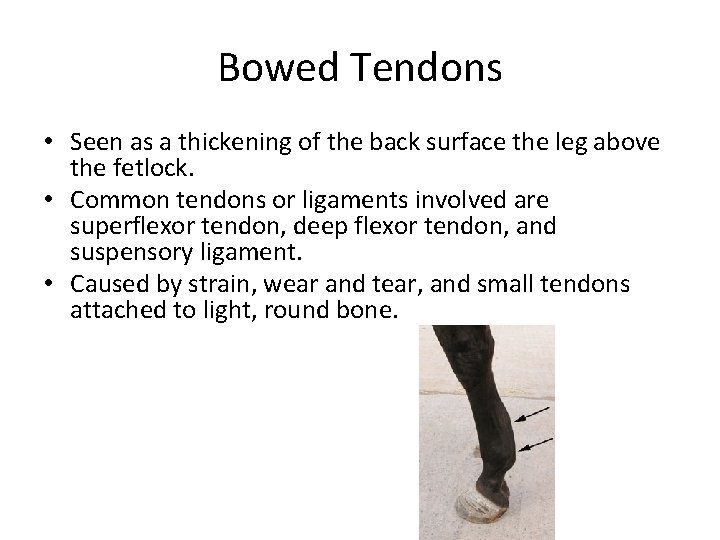
Bowed Tendons • Seen as a thickening of the back surface the leg above the fetlock. • Common tendons or ligaments involved are superflexor tendon, deep flexor tendon, and suspensory ligament. • Caused by strain, wear and tear, and small tendons attached to light, round bone.
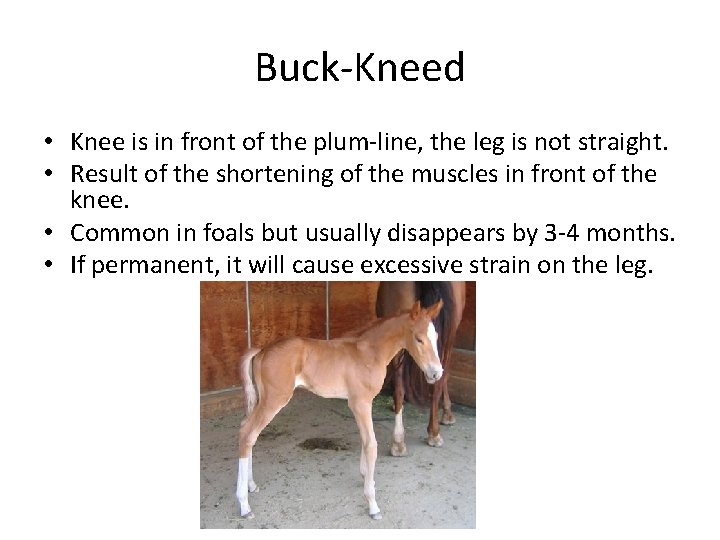
Buck-Kneed • Knee is in front of the plum-line, the leg is not straight. • Result of the shortening of the muscles in front of the knee. • Common in foals but usually disappears by 3 -4 months. • If permanent, it will cause excessive strain on the leg.
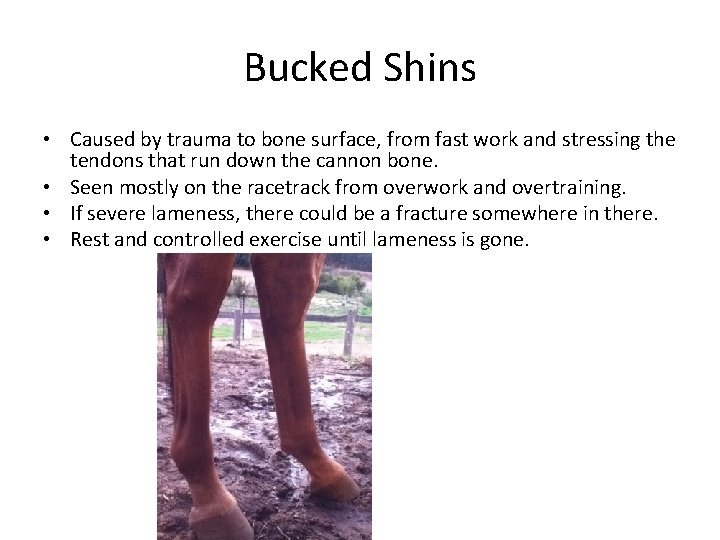
Bucked Shins • Caused by trauma to bone surface, from fast work and stressing the tendons that run down the cannon bone. • Seen mostly on the racetrack from overwork and overtraining. • If severe lameness, there could be a fracture somewhere in there. • Rest and controlled exercise until lameness is gone.
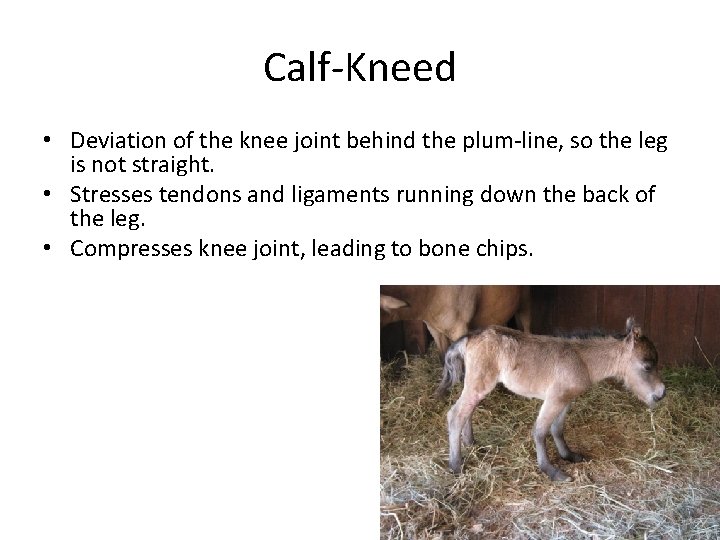
Calf-Kneed • Deviation of the knee joint behind the plum-line, so the leg is not straight. • Stresses tendons and ligaments running down the back of the leg. • Compresses knee joint, leading to bone chips.
Horse Science Unsoundness in Horses Kristina Alm
• Unsoundness: a condition that interferes with the serviceability of the horse. Animal will not be able to perform properly because of the problem. • Blemish: an injury or condition that, while cosmetically distracting, does not interfere with performance
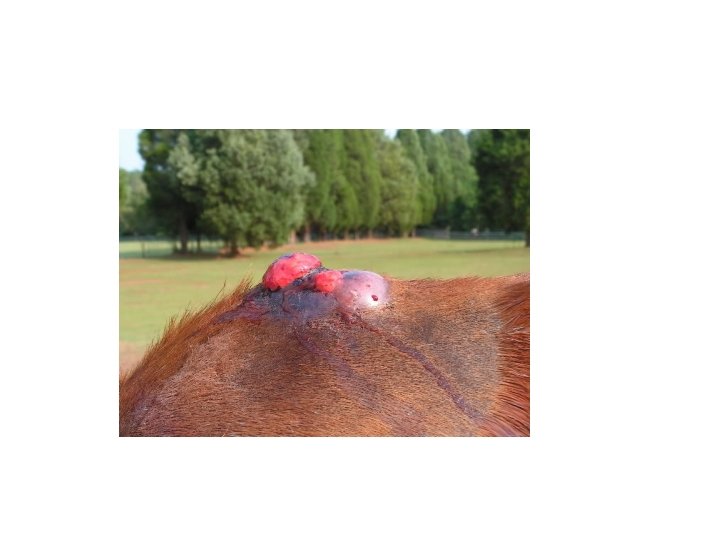
Fistulous Withers (Unsoundness & Blemishes of the Body) • Also known as: Saddle sore, wither sinus inflammation • An abnormal passage that leads from an infection within the horse’s body to the outside of the body, the horse’s withers. • Chronic inflammatory disease of the bursa caused by either infection, parasites, or physical factors. • Swelling of the withers, drainage of pus from an open lesion resulting from inflammation, and infection that spreads from the infected bursa to surrounding tissues are common characteristics of the disease.
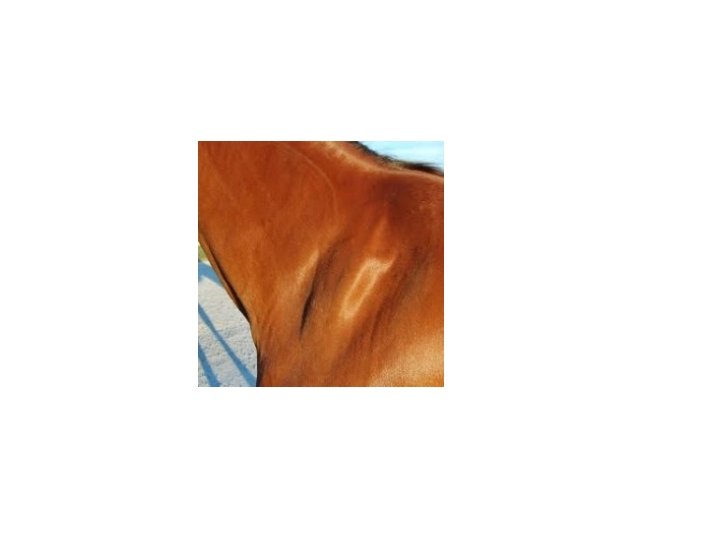
Sweeney (Unsoundness & Blemishes of the Body) • • Muscle atrophy or “wasting away” of the muscles that are located in the shoulder area. Caused by damage to the suprascapular nerve that controls the Suprapinatus, Infraspinatus, and Triceps muscles. – Disuse Sweeney: Caused by the horse using their shoulder muscles improperly. – Neurogenic atrophy (“Wasting away” that originates in the nerve tissues) – This could be from direct impact to the suprascapular nerve or a kick from another horse. • Horses that are in Polo or in jumping events are more prone because of the sudden movement of weight change from their front end to the hind end.
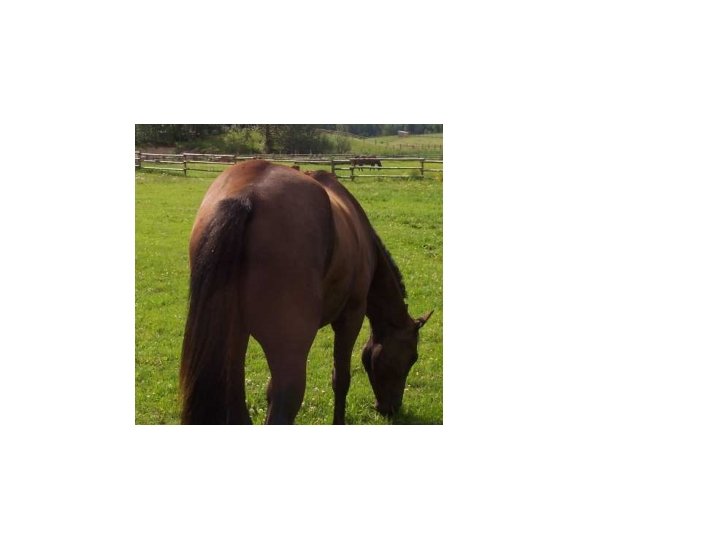
Knocked-down Hip (Unsoundness & Blemishes of the Body) • A fracture of the external angle of the hipbone. • Results in a lowering of the point of the hip that can be identified best by standing directly behind the horse. • Caused by when a horse bumps the tuber coxae while exiting a starting gate or entering a stall where the door isn’t completely open.
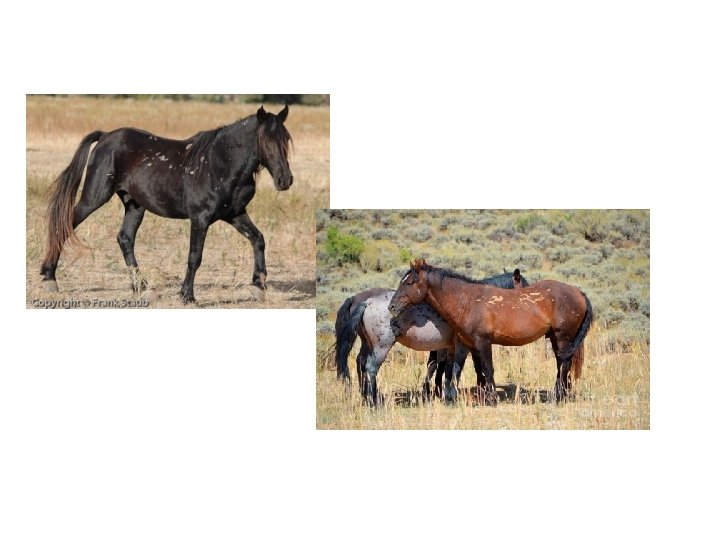
Scars (Unsoundness & Blemishes of the Body) • Marks left on the skin after the healing of a wound or sore. • White hairs often begin to show the presence of scars • Working horses with scars are not discriminated against, but gaited and parade horses are faulted for them.
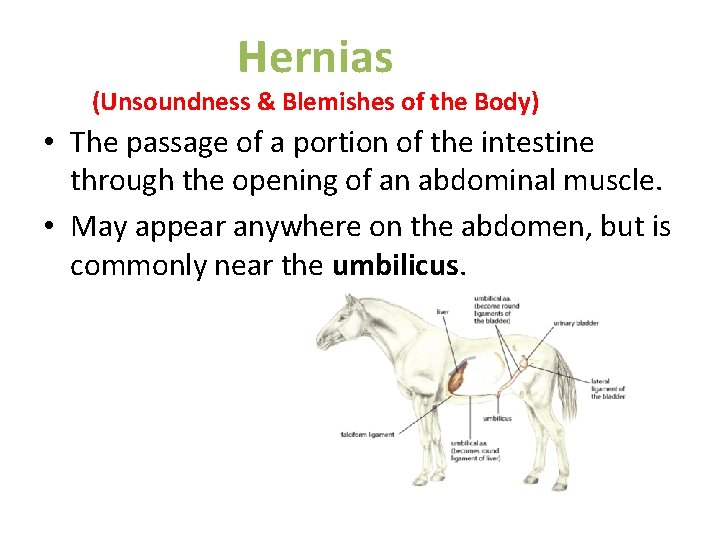
Hernias (Unsoundness & Blemishes of the Body) • The passage of a portion of the intestine through the opening of an abdominal muscle. • May appear anywhere on the abdomen, but is commonly near the umbilicus.
Roaring (whistling) (Unsoundness of the Lungs) • “Roaring, ” formally known as left laryngeal hemiplegia, is an upper airway obstruction that occurs when a horse suffers from paralysis or weakening of one of the crucial structures in his throat. • Horses with a roar often exhibit raspy or wheezy breath during strenuous exercise.
Heaving (Unsoundness of the Lungs) • Heaves are a chronic, non-infectious airway condition of horses that are also called recurrent airway obstructions, or RAO, and was formerly known as chronic obstructive pulmonary disease or COPD. • The disease occurs in horses more than 6 years of age and is the result of an allergic reaction to inhaled particles.
• https: //www. youtube. com/watch? v=o. Kpxhgz GNKc
• http: //smg. photobucket. com/user/Shortand. Sassy. Stables/media/PI CT 0007 -2. jpg. html • http: //riverroadveterinary. com/sweeney-shoulder-in-horses/ • http: //myhorseforum. com/attachments/100_8087 -jpg. 51283/ • http: //images. fineartamerica. com/images-medium-large/wildhorses--great-divide-basin-wyoming-donna-van-vlack. jpg • http: //wildhorsephotos. net/Sanctuaries/content/bin/images/large/ fsbhwh 10_05_23. jpg • http: //s 148. photobucket. com/user/ocfcoyoteart/media/dollytit. jpg. html • http: //www. merckvetmanual. com/media/pet/figures/DDH_horse_l aryngeal_hemiplegia. gif • http: //www. chronofhorse. com/article/helping-roarers-breatheeasy
• http: //veterinaryextension. colostate. edu/men u 2/equine/treatingheaves-1. pdf