
Chapter 7 Triggers and Active Databases Trigger Overview
Chapter 7 Triggers and Active Databases
Trigger Overview • Element of the database schema • General form: ON <event> IF <condition> THEN <action> – Event- request to execute database operation – Condition - predicate evaluated on databaase state – Action – execution of procedure that might involve database updates • Example: ON updating maximum course enrollment IF number registered > new max enrollment limit THEN deregister students using LIFO policy Copyright © 2005 Pearson Addison-Wesley. All rights reserved. 2
Trigger Details • Activation - Occurrence of the event • Consideration - The point, after activation, when condition is evaluated – Immediate or deferred (when the transaction requests to commit) – Condition might refer to both the state before and the state after event occurs Copyright © 2005 Pearson Addison-Wesley. All rights reserved. 3

Trigger Details • Execution – point at which action occurs – With deferred consideration, execution is also deferred – With immediate consideration, execution can occur immediately after consideration or it can be deferred • If execution is immediate, execution can occur before, after, or instead of triggering event. • Before triggers adapt naturally to maintaining integrity constraints: violation results in rejection of event. Copyright © 2005 Pearson Addison-Wesley. All rights reserved. 4
Trigger Details • Granularity – Row-level granularity: change of a single row is an event (a single UPDATE statement might result in multiple events) – Statement-level granularity: events are statements (a single UPDATE statement that changes multiple rows is a single event). Copyright © 2005 Pearson Addison-Wesley. All rights reserved. 5
Trigger Details • Multiple Triggers – How should multiple triggers activated by a single event be handled? • Evaluate one condition at a time and if true immediately execute action or • Evaluate all conditions, then execute actions – The execution of an action can affect the truth of a subsequently evaluated condition so the choice is significant. Copyright © 2005 Pearson Addison-Wesley. All rights reserved. 6
Triggers in SQL: 1999 • Events: INSERT, DELETE, or UPDATE statements or changes to individual rows caused by these statements • Condition: Anything that is allowed in a WHERE clause • Action: An individual SQL statement or a program written in the language of Procedural Stored Modules (PSM) (which can contain embedded SQL statements) Copyright © 2005 Pearson Addison-Wesley. All rights reserved. 7
Triggers in SQL: 1999 • Consideration: Immediate – Condition can refer to both the state of the affected row or table before and after the event occurs • Execution: Immediate – can be before or after the execution of the triggering event – Action of before trigger cannot modify the database • Granularity: Both row-level and statement-level Copyright © 2005 Pearson Addison-Wesley. All rights reserved. 8
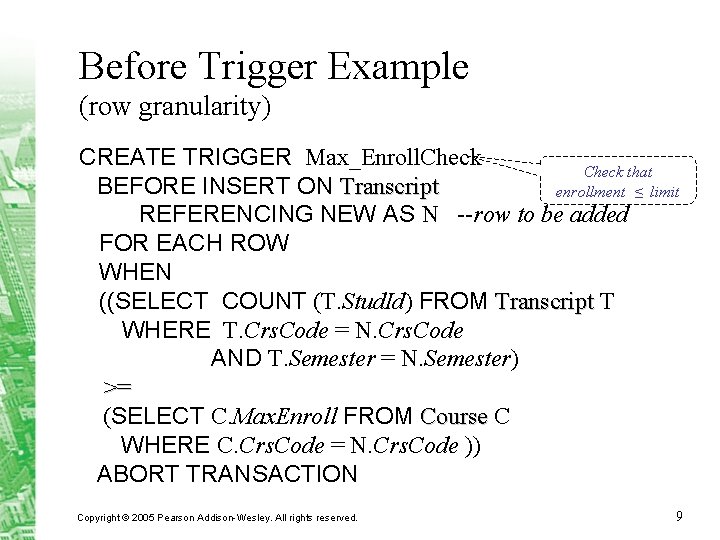
Before Trigger Example (row granularity) CREATE TRIGGER Max_Enroll. Check that BEFORE INSERT ON Transcript enrollment ≤ limit REFERENCING NEW AS N --row to be added FOR EACH ROW WHEN ((SELECT COUNT (T. Stud. Id) FROM Transcript T WHERE T. Crs. Code = N. Crs. Code AND T. Semester = N. Semester) >= (SELECT C. Max. Enroll FROM Course C WHERE C. Crs. Code = N. Crs. Code )) ABORT TRANSACTION Copyright © 2005 Pearson Addison-Wesley. All rights reserved. 9
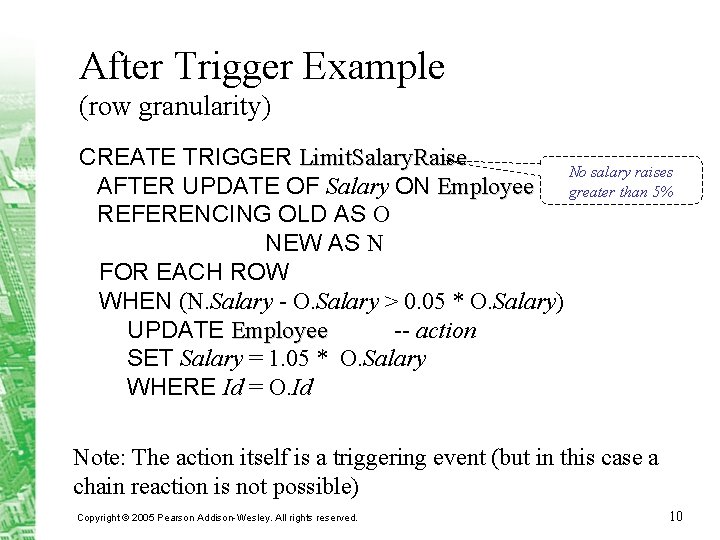
After Trigger Example (row granularity) CREATE TRIGGER Limit. Salary. Raise No salary raises AFTER UPDATE OF Salary ON Employee greater than 5% REFERENCING OLD AS O NEW AS N FOR EACH ROW WHEN (N. Salary - O. Salary > 0. 05 * O. Salary) UPDATE Employee -- action SET Salary = 1. 05 * O. Salary WHERE Id = O. Id Note: The action itself is a triggering event (but in this case a chain reaction is not possible) Copyright © 2005 Pearson Addison-Wesley. All rights reserved. 10
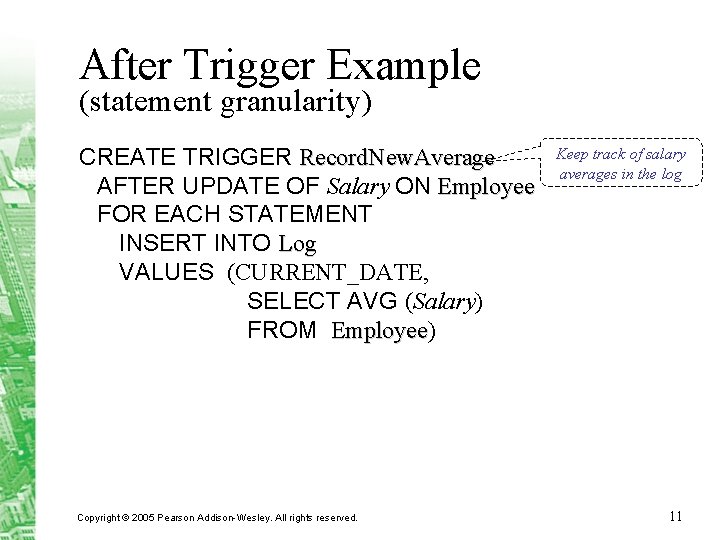
After Trigger Example (statement granularity) CREATE TRIGGER Record. New. Average AFTER UPDATE OF Salary ON Employee FOR EACH STATEMENT INSERT INTO Log VALUES (CURRENT_DATE, SELECT AVG (Salary) FROM Employee) Employee Copyright © 2005 Pearson Addison-Wesley. All rights reserved. Keep track of salary averages in the log 11
- Slides: 11