
Chapter 7 Transportation Management Learning Objectives To examine

Chapter 7 Transportation Management

Learning Objectives • To examine the background of the transportation management function • To discuss the functions of transportation management • To identify the role negotiations play in the transportation management function • To examine the new options available for private carriage • To understand the purpose of freight consolidation © 2008 Prentice Hall 7 -2

Transportation Management • Key Terms – – – – – Amodal shipper Bill of lading Class rate system Commodity rate Demurrage and detention Density Diver Documentation Expediting • Key Terms – – – – – Freight bill Freight claims Hazardous material Reconsignment Routing Guide Stowability Tracing Private transportation Weight break 7 -3
Transportation Management • Transportation management refers to the buying and controlling of transportation service by either a shipper or consignee. Source: John J. Coyle, Edward J. Bardi, and Robert A. Novack, Transportation, 6 th ed. (Mason, OH: South-Western, 2006). • Transportation is the most costly logistics activity • Transportation managers can help: – – Marketing Manufacturing Outbound shipping Purchasing 13 -4
Rate (Pricing) Considerations • Rate Determination – Often located on carrier Web sites – Transportation rates based on three factors • Product • Weight • Distance – Three factors are defined numerically and then tied to a rate of cents per hundredweight (cwt) © Pearson Education, Inc. publishing as Prentice Hall 13 -5
Rate (Pricing) Considerations • Rate Determination – Commodity rate • One specific rate for every possible combination of product, weight, and distance – Class rate system • System to simplify rate determination • Freight classification used to simplify the number of commodities • National Motor Freight Classification (NMFC) © Pearson Education, Inc. publishing as Prentice Hall 13 -6
Rate (Pricing) Considerations • Rate Determination – Factors used for determine product’s freight classification • • Density (higher classification for low-density) Stowability (how easy to pack into a load) Ease of handling Liability to damage and theft © Pearson Education, Inc. publishing as Prentice Hall 13 -7
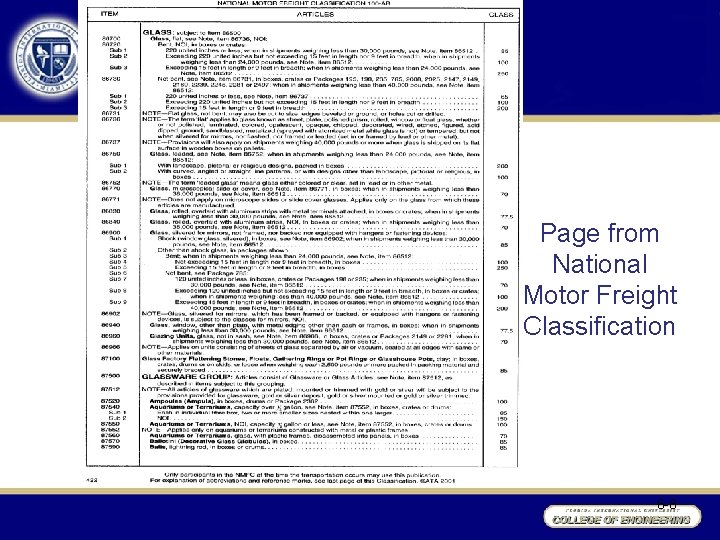
Page from National Motor Freight Classification 6 -8
National Motor Freight Classification • National Motor Freight Classification Procedures – http: //www. nmfta. org/Documents/CCSB %20 Procedures%202009. pdf • Find classification online – http: //freight 88. com/NMFC-Codes. Freight_class. html 6 -9
Rate (Pricing) Considerations • Rate Determination – Weight groups are used to simplify shipment weight – Weight group examples: • <500 lbs (highest rate) • 500 -999 lbs • 1000 -1, 999 lbs – Distances are simplified through rate basis numbers • Zip codes are replacing rate basis numbers © Pearson Education, Inc. publishing as Prentice Hall 13 -10
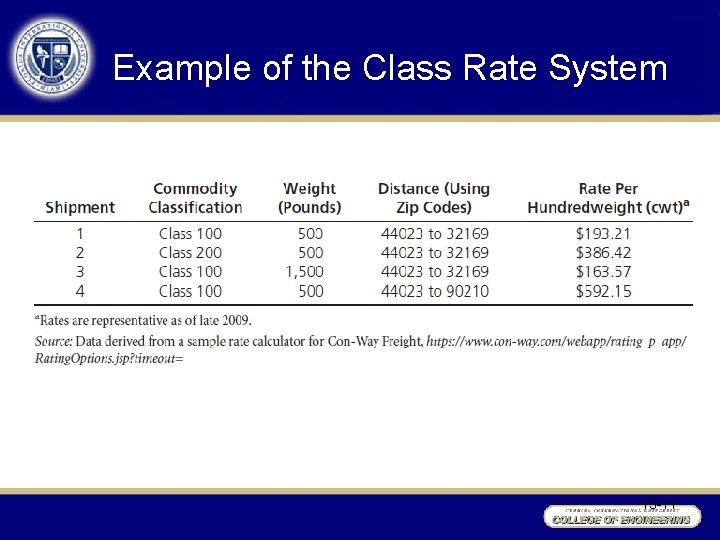
Example of the Class Rate System 13 -11
Rate (Pricing) Considerations • Rate Determination – Commodity Classification Standards Borad develops and maintains commodity freight classifications – Shippers prefer lower classification number (lower rate) – Carriers prefer higher classification number (higher rate) – Transportation managers can appeal a commodity’s classification © Pearson Education, Inc. publishing as Prentice Hall 13 -12

Figure 7 -2: Motor Carrier Classification Docket Proposal for Changing the Classification of Sparkplugs © Pearson Education, Inc. publishing as Prentice Hall 13 -13
Transportation Rates • To find LTL rates usually need: – Origin and destination zip codes – Weight of shipment – Classification of shipment – Supplemental services needed – Discount awarded to shipper by carrier • Rates may be on carrier Web sites © 2008 Prentice Hall 6 -14
Rate and Service Negotiations • Both rates and service levels may be negotiated • Long-term relationships are encouraged • Negotiations are subject to antitrust laws • Allows transportation managers to take advantage of trade-offs between price and service © 2008 Prentice Hall 7 -15

Table 7 -1: Representative Rate and Service Items in the Carrier-Shipper Negotiation Process © Pearson Education, Inc. publishing as Prentice Hall 13 -16
Rate Regulatory Bodies • U. S. Department of Commerce Foreign Trade Zone Board • Department of Transportation committees • House of Representatives subcommittees © 2008 Prentice Hall 7 -17
Modal and Carrier Selection • Two-step process – First determine appropriate mode(s) – Then select carrier(s) within the chosen mode(s) • Carrier selection is more challenging – Difficult to be aware of every possible carrier – Lack of agreement on the number of relevant factors © Pearson Education, Inc. publishing as Prentice Hall 13 -18
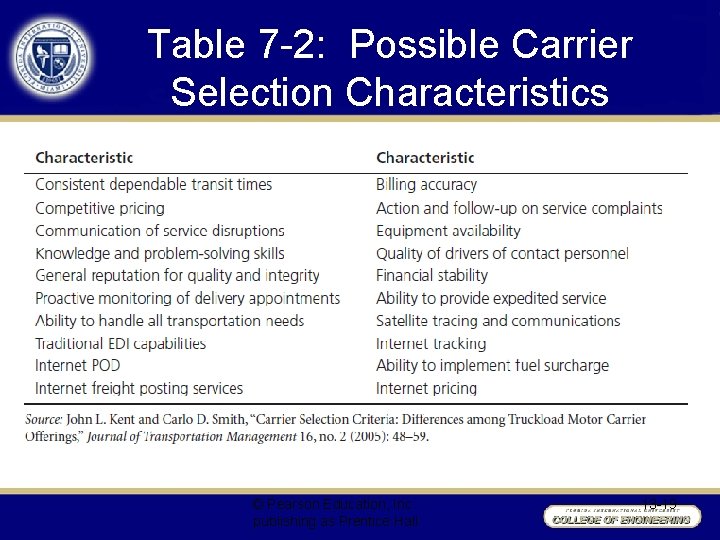
Table 7 -2: Possible Carrier Selection Characteristics © Pearson Education, Inc. publishing as Prentice Hall 13 -19
Modal and Carrier Selection • Amodal shipper refers to a transportation manager who purchases a prespecified level of transportation service and is indifferent to the mode(s) and or carrier(s) used to provide the actual transportation service. • Research indicates shippers are more interested in transportation metrics than in modes © Pearson Education, Inc. publishing as Prentice Hall 13 -20
Documentation • Documentation – Serves practical function (what, where, and how much is being transported – Potentially provides legal recourse • Bill of lading – Straight bill of lading – Order bill of lading – Long-form bill of lading – Preprinted short-form bill of lading • Freight bill • Freight claims © Pearson Education, Inc. publishing as Prentice Hall 13 -21
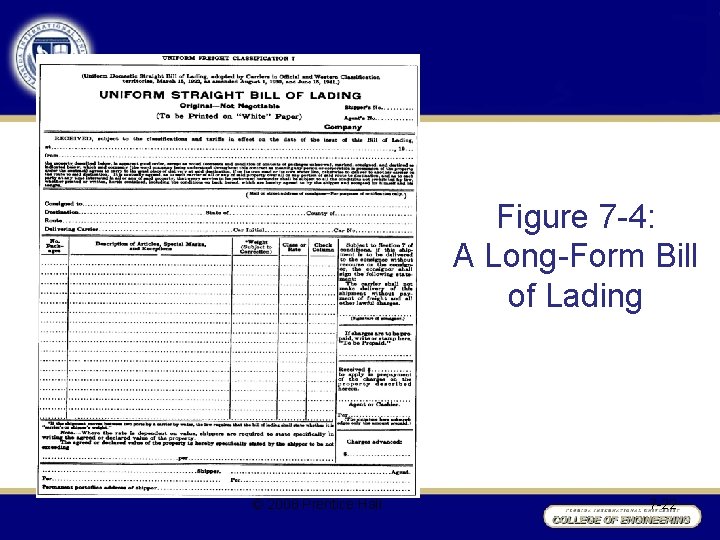
Figure 7 -4: A Long-Form Bill of Lading © 2008 Prentice Hall 7 -22
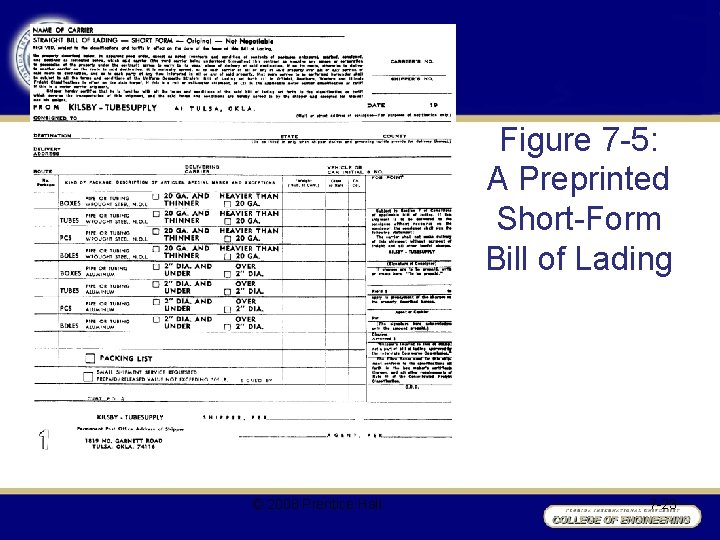
Figure 7 -5: A Preprinted Short-Form Bill of Lading © 2008 Prentice Hall 7 -23
Documentation • Freight bill – Invoice submitted by the carrier requesting to be paid – Freight bill-paying service – Internal audits – External audits • Freight claims – Refers to a document that notifies a carrier of wrong or defective deliveries, delays, or other delivery shortcomings – Concealed loss or damage is when loss or damage is not apparent until after a shipment has been unpacked and inspected © Pearson Education, Inc. publishing as Prentice Hall 13 -24
Making and Receiving Shipments • Consolidating small shipments – Shipments > 150 and < 500 pounds – To get a lower rate, shipment consolidation may occur: aggregating customer orders across time or place or both © Pearson Education, Inc. publishing as Prentice Hall 13 -25
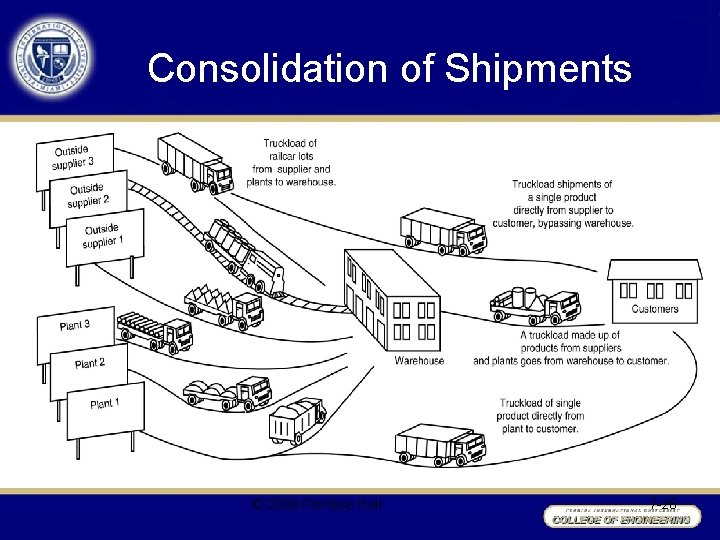
Consolidation of Shipments © 2008 Prentice Hall 7 -26
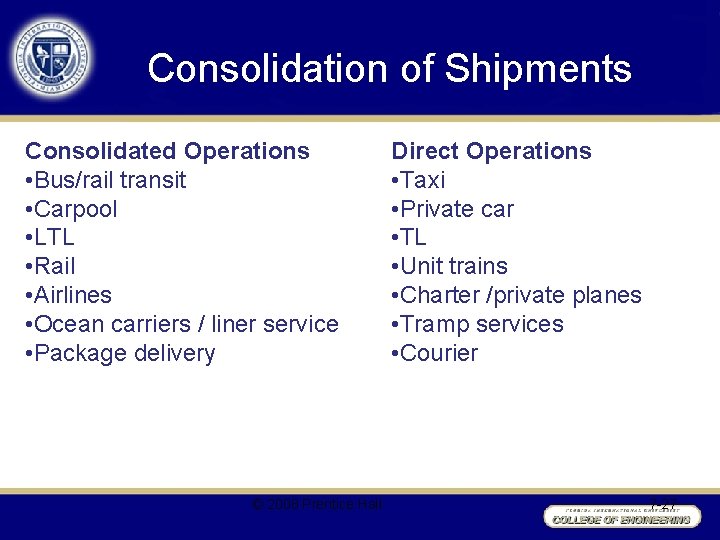
Consolidation of Shipments Consolidated Operations • Bus/rail transit • Carpool • LTL • Rail • Airlines • Ocean carriers / liner service • Package delivery © 2008 Prentice Hall Direct Operations • Taxi • Private car • TL • Unit trains • Charter /private planes • Tramp services • Courier 7 -27
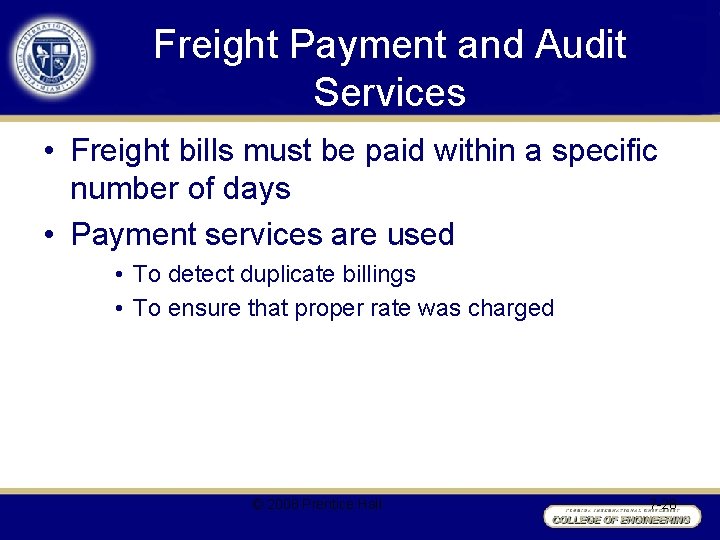
Freight Payment and Audit Services • Freight bills must be paid within a specific number of days • Payment services are used • To detect duplicate billings • To ensure that proper rate was charged © 2008 Prentice Hall 7 -28
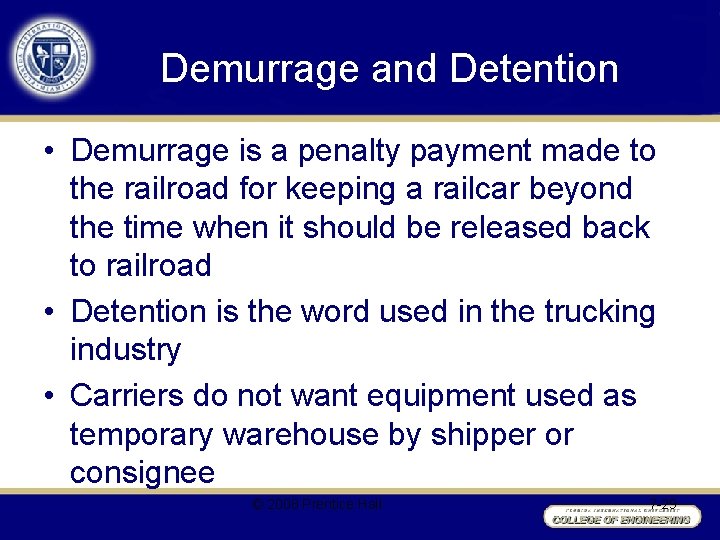
Demurrage and Detention • Demurrage is a penalty payment made to the railroad for keeping a railcar beyond the time when it should be released back to railroad • Detention is the word used in the trucking industry • Carriers do not want equipment used as temporary warehouse by shipper or consignee © 2008 Prentice Hall 7 -29
Diversion and Reconsignment • Diversion occurs when the shipper notifies the carrier, prior to arrival, of a change in destination • Reconsignment occurs when the shipper notifies the carrier, after arrival, of a change in destination © 2008 Prentice Hall 7 -30
Routing • Shippers have the right to select the carriers along the route to shipment destination • More often need to be specified for hazmat • Generally are computer generated • Alternative routes and carriers are also important © 2008 Prentice Hall 7 -31
Transportation of Hazardous Materials • Hazardous material is a substance or material in a quantity and form which may pose an unreasonable risk to health and safety or property when transported in commerce – Must be moved safely – Labeled with placard – Must have 24 -hour hotline used in event of spills © 2008 Prentice Hall 7 -32
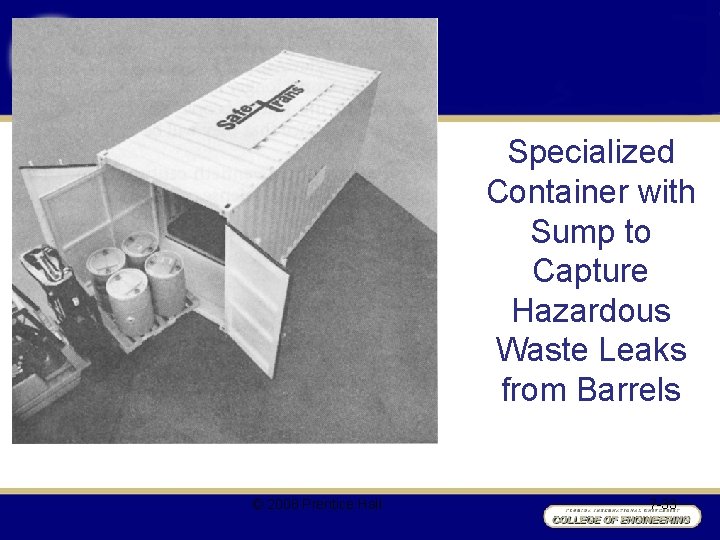
Specialized Container with Sump to Capture Hazardous Waste Leaks from Barrels © 2008 Prentice Hall 7 -33
Tracing and Expediting • Tracing is the attempt to locate lost or late shipments – Done by computer at no cost • Expediting is rapidly moving a shipment through a carrier’s system. • Both of these are less likely to be used today since shipments can be pinpointed en route and carriers provide better on-time performance © 2008 Prentice Hall 7 -34
Loss and Damage • Shippers and carriers try to resolve first – What is the full actual loss? – Concealed loss or damage – Who takes possession of damaged goods after claim settled? • If unresolved, moves to court system © 2008 Prentice Hall 7 -35
Transit Privileges • Transit privileges allow cargo to be stopped en route between origin and destination to be unloaded, stored, or processed and then reloaded for delivery to original destination • Often used in household goods moving and storage industry © 2008 Prentice Hall 7 -36
Reparations • Reparations are payments made to a shipper by a carrier that has charged illegally high rates in the past • Also collected when carriers do not live up to terms of contracts with shippers © 2008 Prentice Hall 7 -37
Transportation Service Quality • Macroenvironmental changes have caused organizations to demand higher levels of service quality • Economic deregulation allowed for both price and service competition resulting in a need to measure performance • Can measure performance through the use a performance scorecard © Pearson Education, Inc. publishing as Prentice Hall 13 -38
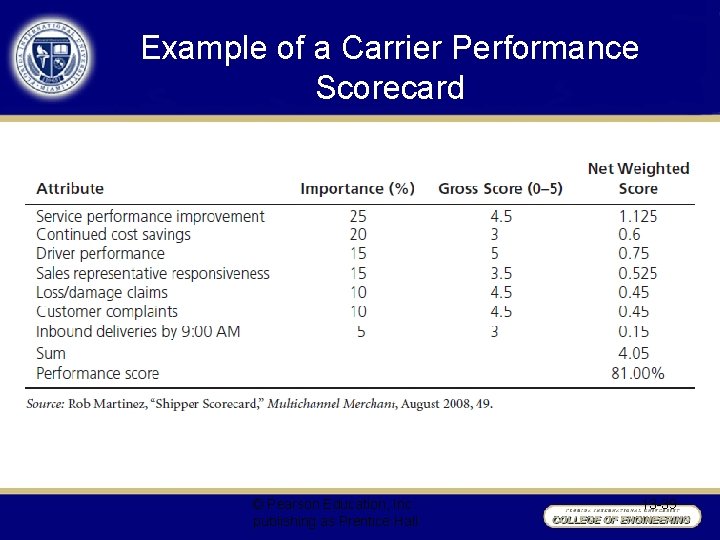
Example of a Carrier Performance Scorecard © Pearson Education, Inc. publishing as Prentice Hall 13 -39
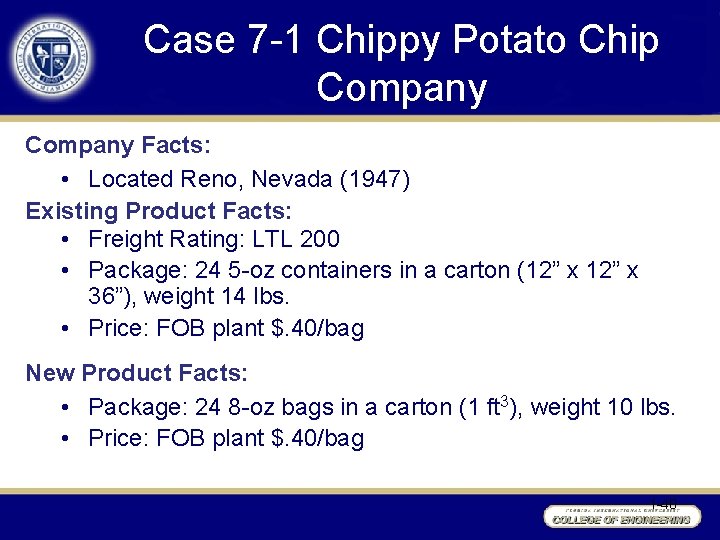
Case 7 -1 Chippy Potato Chip Company Facts: • Located Reno, Nevada (1947) Existing Product Facts: • Freight Rating: LTL 200 • Package: 24 5 -oz containers in a carton (12” x 36”), weight 14 lbs. • Price: FOB plant $. 40/bag New Product Facts: • Package: 24 8 -oz bags in a carton (1 ft 3), weight 10 lbs. • Price: FOB plant $. 40/bag 1 -40
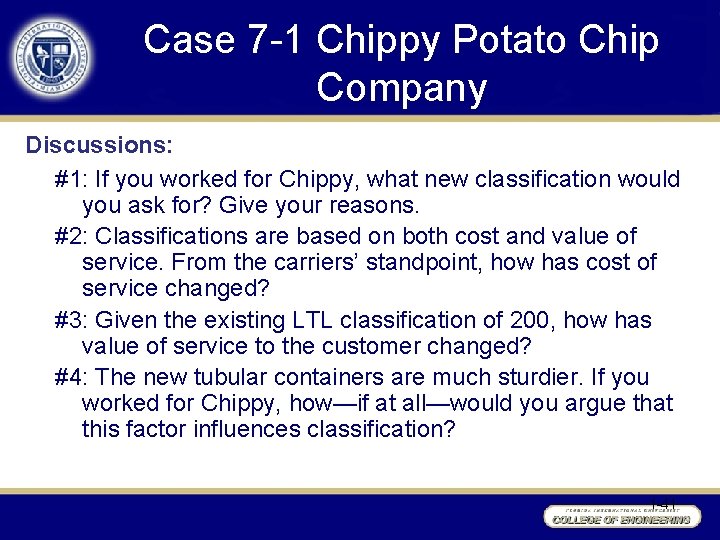
Case 7 -1 Chippy Potato Chip Company Discussions: #1: If you worked for Chippy, what new classification would you ask for? Give your reasons. #2: Classifications are based on both cost and value of service. From the carriers’ standpoint, how has cost of service changed? #3: Given the existing LTL classification of 200, how has value of service to the customer changed? #4: The new tubular containers are much sturdier. If you worked for Chippy, how—if at all—would you argue that this factor influences classification? 1 -41
Case 7 -1 Chippy Potato Chip Company Discussions: #5: You work for the motor carrier classification bureau and notice that the relationship between the weight of potato chips and the weight of packaging has changed. How, it at all, should this influence changes in the product’s classification? #6: One of Chippy’s own trucks, used for local deliveries, has two axles and an enclosed body measuring (inside) seven feet by eight feet by twenty feet and is limited by law to carrying a load of no more than 8, 000 pounds. Because the truck is not supposed to be overloaded, what combinations, expressed in terms of cartons of each, of new- and old-style chips can it legally carry? 1 -42
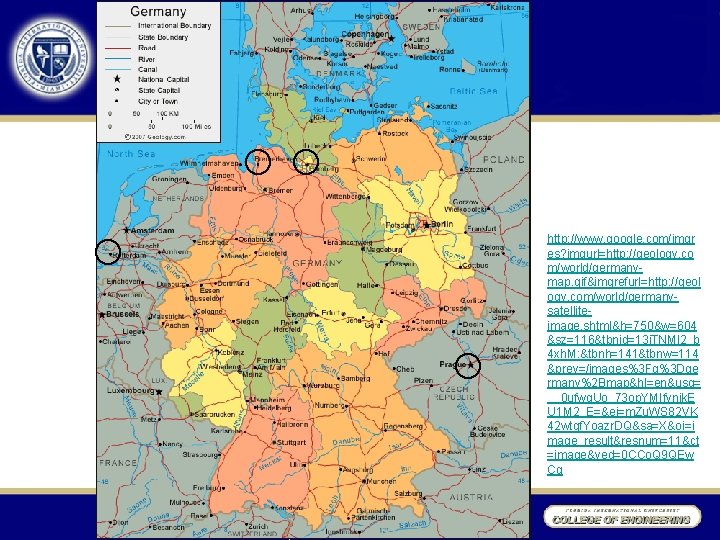
Case 7 -2 Nurnberg Augsburg Maschinenwerke (N. A. M. ) Company Facts: • Located Munich, Germany Product Facts: • Heavy truck and bus design, engineering, and manuf. Order Requested: • 224 N. A. M. Class #4 -G two-section buses • First 25 to be delivered to Santos, Brazil by 11/15 (3 mo. ) • 190 vehicles to be delivered in 18 mo. 1 -43
http: //www. google. com/imgr es? imgurl=http: //geology. co m/world/germanymap. gif&imgrefurl=http: //geol ogy. com/world/germanysatelliteimage. shtml&h=750&w=604 &sz=116&tbnid=13 j. TNMl 2_b 4 xh. M: &tbnh=141&tbnw=114 &prev=/images%3 Fq%3 Dge rmany%2 Bmap&hl=en&usg= __0 ufwg. Uo_73 op. YMIfvnjk. E U 1 M 2_E=&ei=m. Zu. WS 82 VK 42 wtgf. Yoazr. DQ&sa=X&oi=i mage_result&resnum=11&ct =image&ved=0 CCo. Q 9 QEw Cg
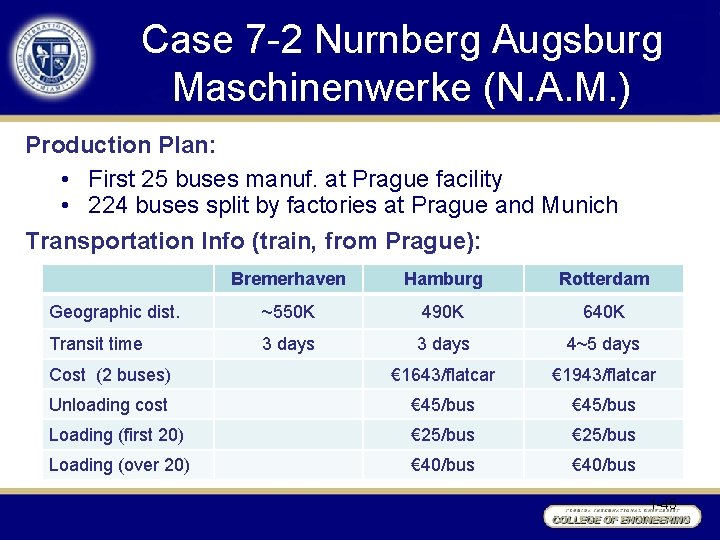
Case 7 -2 Nurnberg Augsburg Maschinenwerke (N. A. M. ) Production Plan: • First 25 buses manuf. at Prague facility • 224 buses split by factories at Prague and Munich Transportation Info (train, from Prague): Bremerhaven Hamburg Rotterdam Geographic dist. ~550 K 490 K 640 K Transit time 3 days 4~5 days Cost (2 buses) € 1643/flatcar € 1943/flatcar Unloading cost € 45/bus Loading (first 20) € 25/bus Loading (over 20) € 40/bus 1 -45
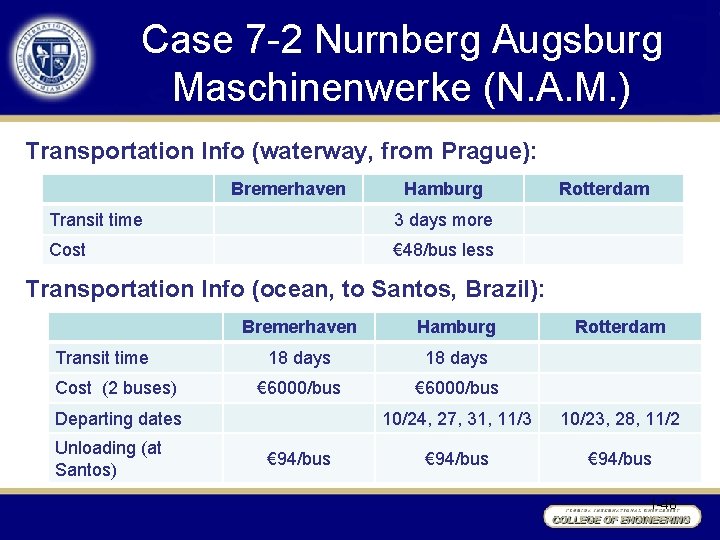
Case 7 -2 Nurnberg Augsburg Maschinenwerke (N. A. M. ) Transportation Info (waterway, from Prague): Bremerhaven Hamburg Transit time 3 days more Cost € 48/bus less Rotterdam Transportation Info (ocean, to Santos, Brazil): Transit time Cost (2 buses) Bremerhaven Hamburg 18 days € 6000/bus Departing dates Unloading (at Santos) € 94/bus Rotterdam 10/24, 27, 31, 11/3 10/23, 28, 11/2 € 94/bus 1 -46
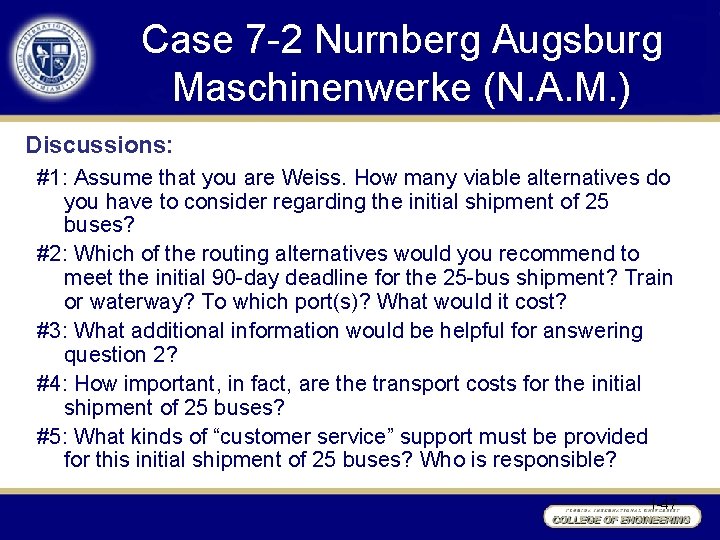
Case 7 -2 Nurnberg Augsburg Maschinenwerke (N. A. M. ) Discussions: #1: Assume that you are Weiss. How many viable alternatives do you have to consider regarding the initial shipment of 25 buses? #2: Which of the routing alternatives would you recommend to meet the initial 90 -day deadline for the 25 -bus shipment? Train or waterway? To which port(s)? What would it cost? #3: What additional information would be helpful for answering question 2? #4: How important, in fact, are the transport costs for the initial shipment of 25 buses? #5: What kinds of “customer service” support must be provided for this initial shipment of 25 buses? Who is responsible? 1 -47
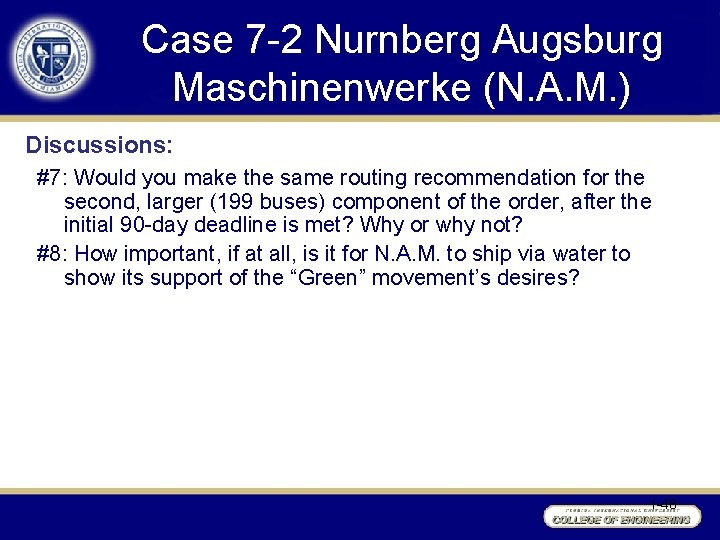
Case 7 -2 Nurnberg Augsburg Maschinenwerke (N. A. M. ) Discussions: #7: Would you make the same routing recommendation for the second, larger (199 buses) component of the order, after the initial 90 -day deadline is met? Why or why not? #8: How important, if at all, is it for N. A. M. to ship via water to show its support of the “Green” movement’s desires? 1 -48
- Slides: 48