
Chapter 7 Transport Layer Introduction to Networking PresentationID




- Slides: 34
Chapter 7: Transport Layer Introduction to Networking Presentation_ID © 2008 Cisco Systems, Inc. All rights reserved. Cisco Confidential 1
Chapter 7 7. 1 Transport Layer Protocols 7. 2 TCP and UDP 7. 3 Summary Presentation_ID © 2008 Cisco Systems, Inc. All rights reserved. Cisco Confidential 2
Chapter 7: Objectives § Describe the purpose of the transport layer in managing the transportation of data in end-to-end communication. § Describe characteristics of the TCP and UDP protocols, including port numbers and their uses. § Explain how TCP session establishment and termination processes facilitate reliable communication. § Explain how TCP protocol data units are transmitted and acknowledged to guarantee delivery. § Explain the UDP client processes to establish communication with a server. § Determine whether high-reliability TCP transmissions, or nonguaranteed UDP transmissions, are best suited for common applications. Presentation_ID © 2008 Cisco Systems, Inc. All rights reserved. Cisco Confidential 3
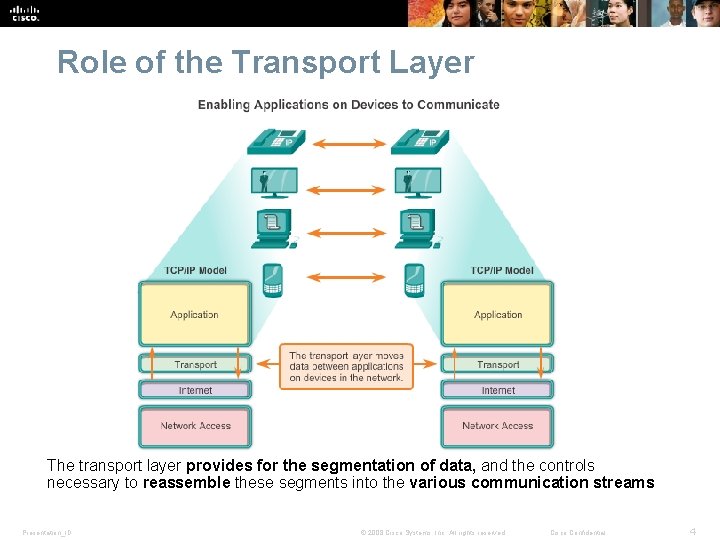
Role of the Transport Layer The transport layer provides for the segmentation of data, and the controls necessary to reassemble these segments into the various communication streams Presentation_ID © 2008 Cisco Systems, Inc. All rights reserved. Cisco Confidential 4
Transportation of Data Role of the Transport Layer The Transport Layer is responsible for establishing a temporary communication session (Link) between two applications and delivering (Link) data between them. TCP/IP uses two protocols to achieve this: § Transmission Control Protocol (TCP) § User Datagram Protocol (UDP) Primary Responsibilities of Transport layer Protocols: § Tracking the individual communication between applications on the source and destination hosts § Segmenting data for manageability and reassembling segmented data into streams of application data at the destination § Identifying the proper application for each communication stream Presentation_ID © 2008 Cisco Systems, Inc. All rights reserved. Cisco Confidential 5
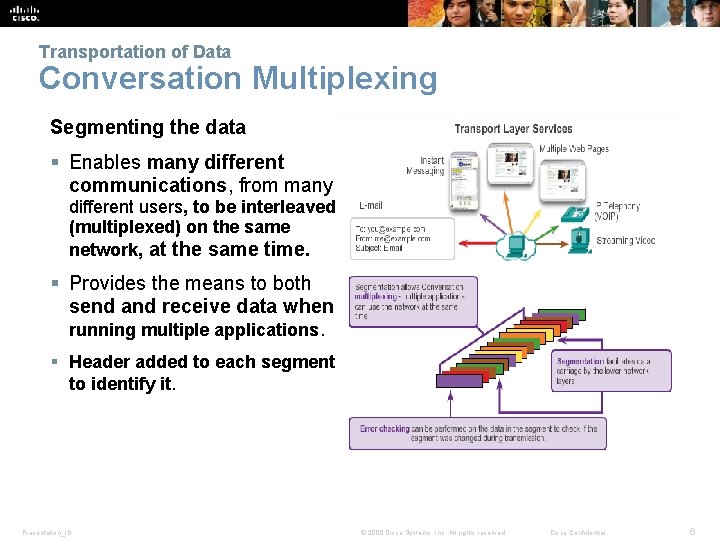
Transportation of Data Conversation Multiplexing Segmenting the data § Enables many different communications, from many different users, to be interleaved (multiplexed) on the same network, at the same time. § Provides the means to both send and receive data when running multiple applications. § Header added to each segment to identify it. Presentation_ID © 2008 Cisco Systems, Inc. All rights reserved. Cisco Confidential 6
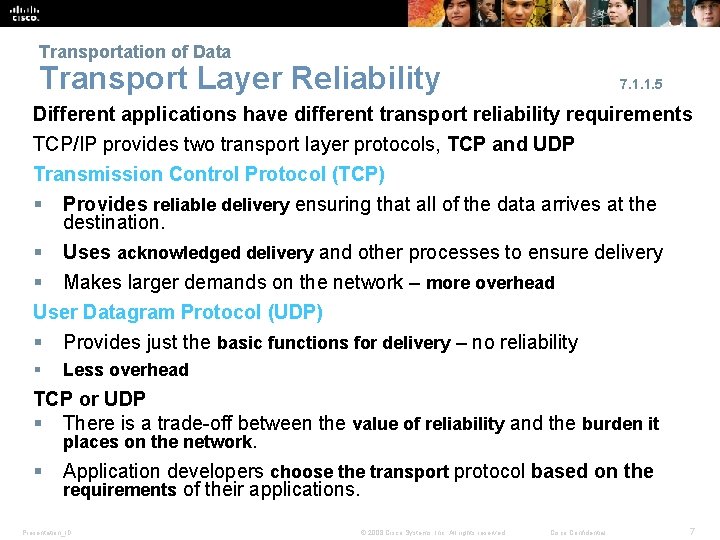
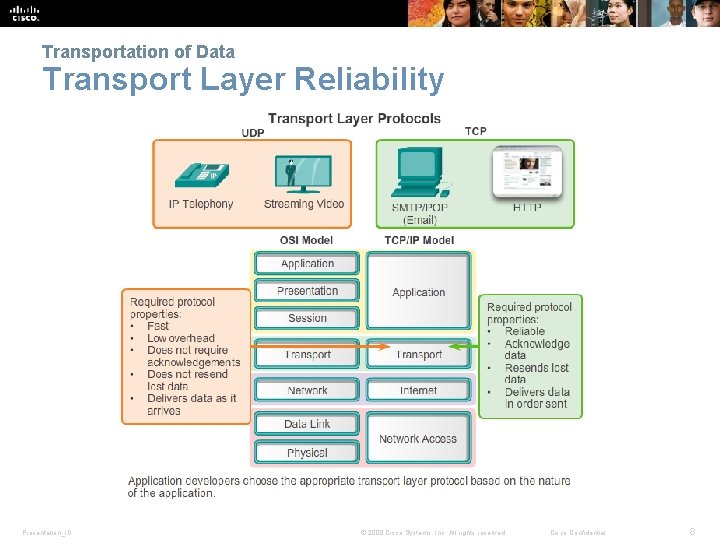
Transportation of Data Transport Layer Reliability 7. 1. 1. 5 Different applications have different transport reliability requirements TCP/IP provides two transport layer protocols, TCP and UDP Transmission Control Protocol (TCP) § Provides reliable delivery ensuring that all of the data arrives at the destination. § Uses acknowledged delivery and other processes to ensure delivery § Makes larger demands on the network – more overhead User Datagram Protocol (UDP) § Provides just the basic functions for delivery – no reliability § Less overhead TCP or UDP § There is a trade-off between the value of reliability and the burden it places on the network. § Application developers choose the transport protocol based on the requirements of their applications. Presentation_ID © 2008 Cisco Systems, Inc. All rights reserved. Cisco Confidential 7
Transportation of Data Transport Layer Reliability Presentation_ID © 2008 Cisco Systems, Inc. All rights reserved. Cisco Confidential 8
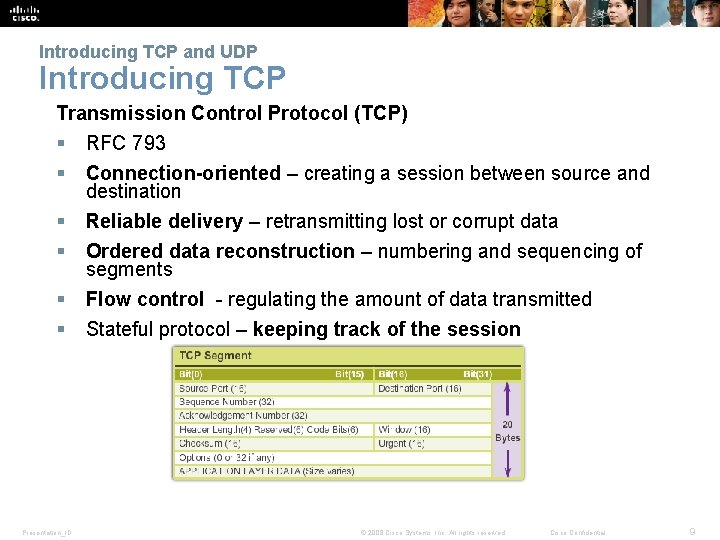
Introducing TCP and UDP Introducing TCP Transmission Control Protocol (TCP) § RFC 793 § Connection-oriented – creating a session between source and destination § Reliable delivery – retransmitting lost or corrupt data § Ordered data reconstruction – numbering and sequencing of segments § Flow control - regulating the amount of data transmitted § Stateful protocol – keeping track of the session Presentation_ID © 2008 Cisco Systems, Inc. All rights reserved. Cisco Confidential 9
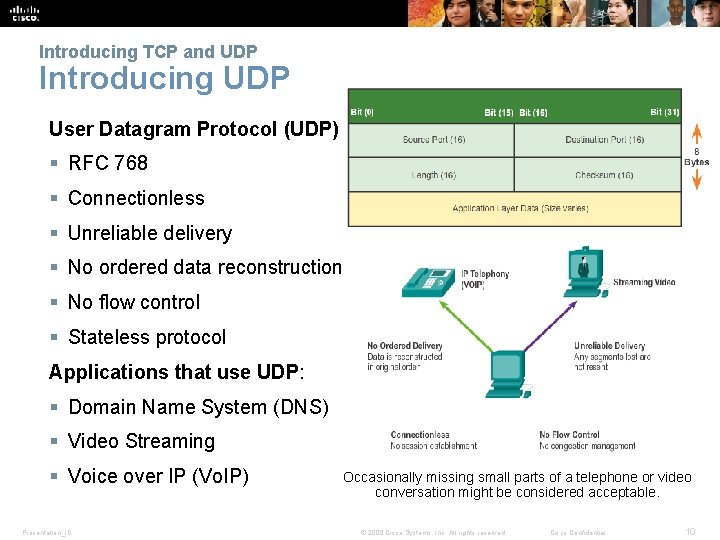
Introducing TCP and UDP Introducing UDP User Datagram Protocol (UDP) § RFC 768 § Connectionless § Unreliable delivery § No ordered data reconstruction § No flow control § Stateless protocol Applications that use UDP: § Domain Name System (DNS) § Video Streaming § Voice over IP (Vo. IP) Presentation_ID Occasionally missing small parts of a telephone or video conversation might be considered acceptable. © 2008 Cisco Systems, Inc. All rights reserved. Cisco Confidential 10
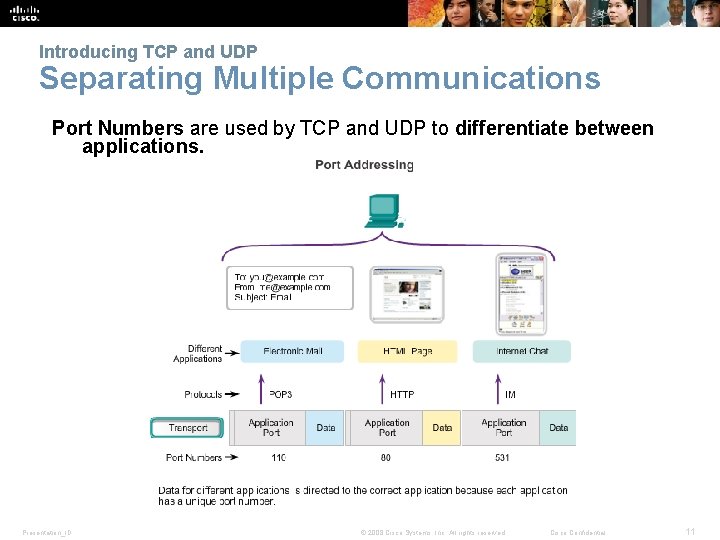
Introducing TCP and UDP Separating Multiple Communications Port Numbers are used by TCP and UDP to differentiate between applications. Presentation_ID © 2008 Cisco Systems, Inc. All rights reserved. Cisco Confidential 11
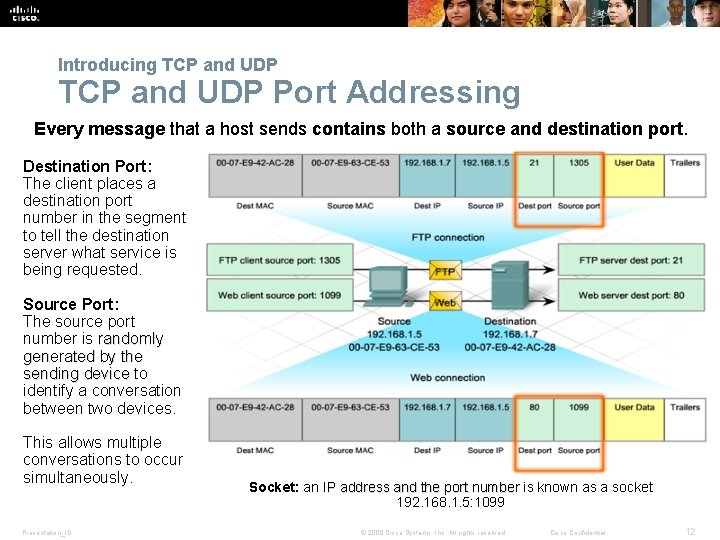
Introducing TCP and UDP Port Addressing Every message that a host sends contains both a source and destination port. Destination Port: The client places a destination port number in the segment to tell the destination server what service is being requested. Source Port: The source port number is randomly generated by the sending device to sending device identify a conversation between two devices. This allows multiple conversations to occur simultaneously. Presentation_ID Socket: an IP address and the port number is known as a socket IP address and the port number 192. 168. 1. 5: 1099 © 2008 Cisco Systems, Inc. All rights reserved. Cisco Confidential 12
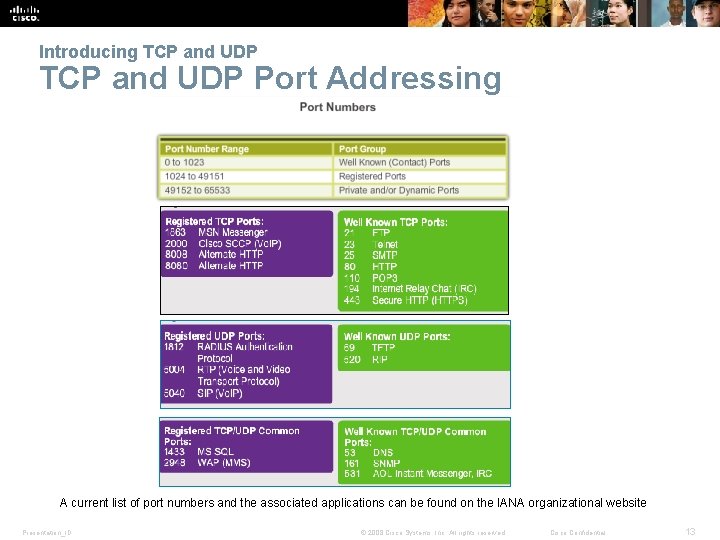
Introducing TCP and UDP Port Addressing A current list of port numbers and the associated applications can be found on the IANA organizational website Presentation_ID © 2008 Cisco Systems, Inc. All rights reserved. Cisco Confidential 13
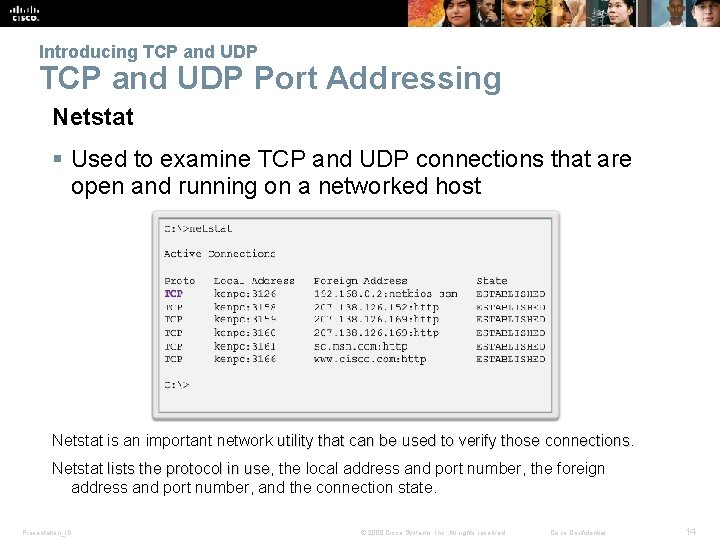
Introducing TCP and UDP Port Addressing Netstat § Used to examine TCP and UDP connections that are open and running on a networked host Netstat is an important network utility that can be used to verify those connections Netstat lists the protocol in use, the local address and port number, the foreign lists the protocol in use address and port number, and the connection state. Presentation_ID © 2008 Cisco Systems, Inc. All rights reserved. Cisco Confidential 14
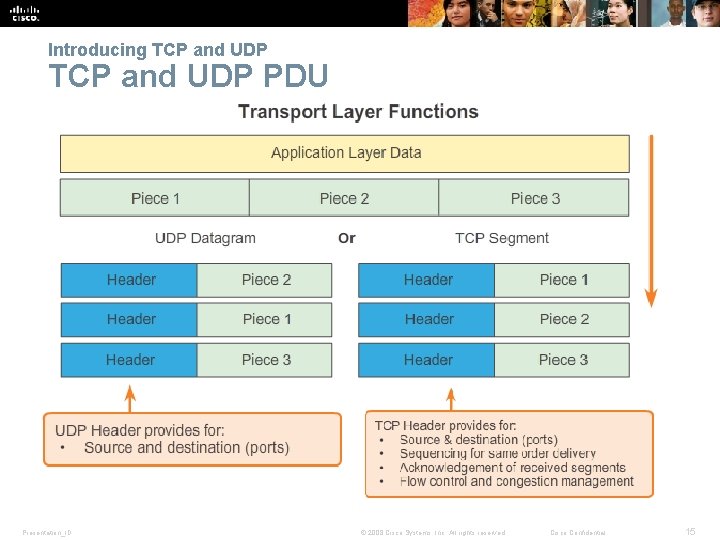
Introducing TCP and UDP PDU Presentation_ID © 2008 Cisco Systems, Inc. All rights reserved. Cisco Confidential 15
TCP Communication Presentation_ID TCP Server Processes © 2008 Cisco Systems, Inc. All rights reserved. Cisco Confidential 16
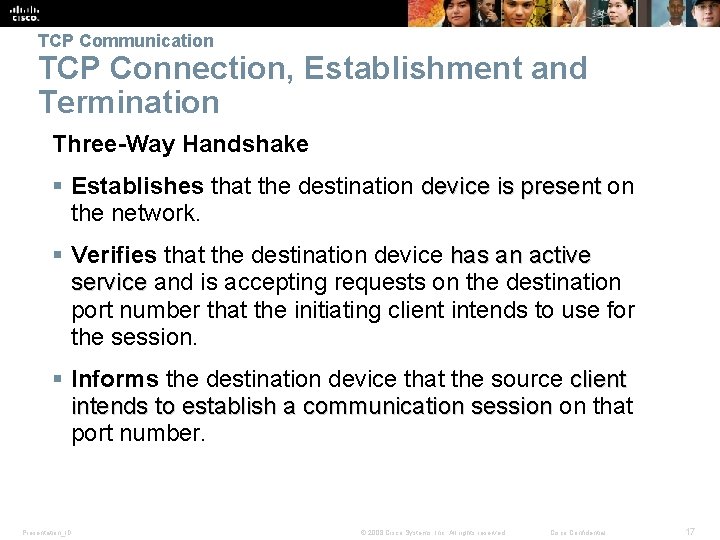
TCP Communication TCP Connection, Establishment and Termination Three-Way Handshake § Establishes that the destination device is present the network. § Verifies that the destination device has an active service and is accepting requests on the destination service port number that the initiating client intends to use for the session. § Informs the destination device that the source client intends to establish a communication session on that intends to establish a communication session port number. Presentation_ID © 2008 Cisco Systems, Inc. All rights reserved. Cisco Confidential 17
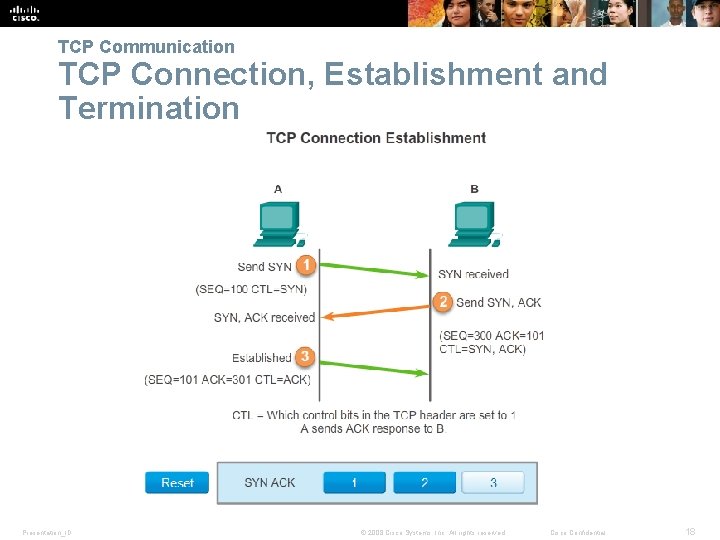
TCP Communication TCP Connection, Establishment and Termination Presentation_ID © 2008 Cisco Systems, Inc. All rights reserved. Cisco Confidential 18
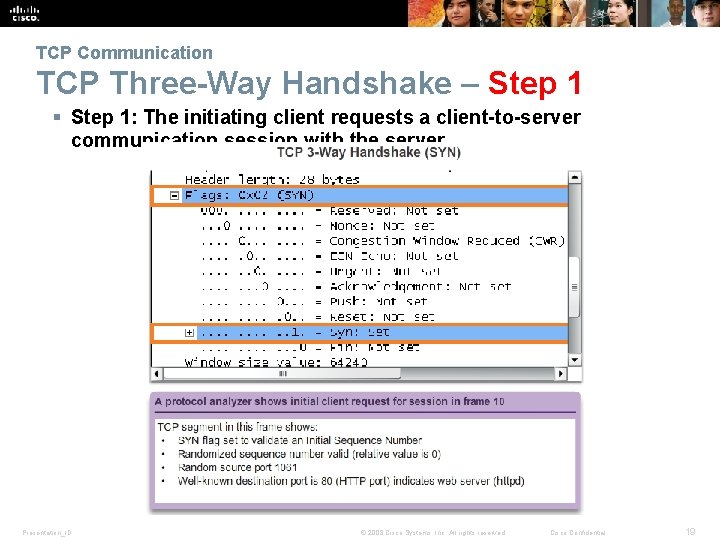
TCP Communication TCP Three-Way Handshake – Step 1 § Step 1: The initiating client requests a client-to-server communication session with the server. Presentation_ID © 2008 Cisco Systems, Inc. All rights reserved. Cisco Confidential 19
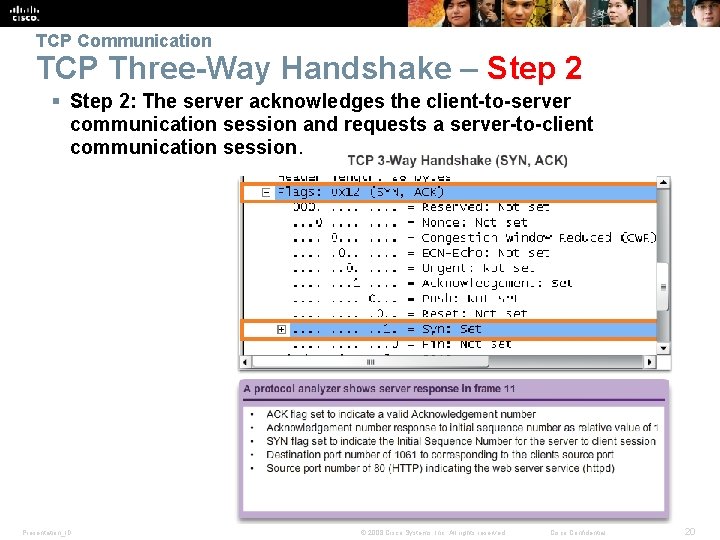
TCP Communication TCP Three-Way Handshake – Step 2 § Step 2: The server acknowledges the client-to-server communication session and requests a server-to-client communication session. Presentation_ID © 2008 Cisco Systems, Inc. All rights reserved. Cisco Confidential 20
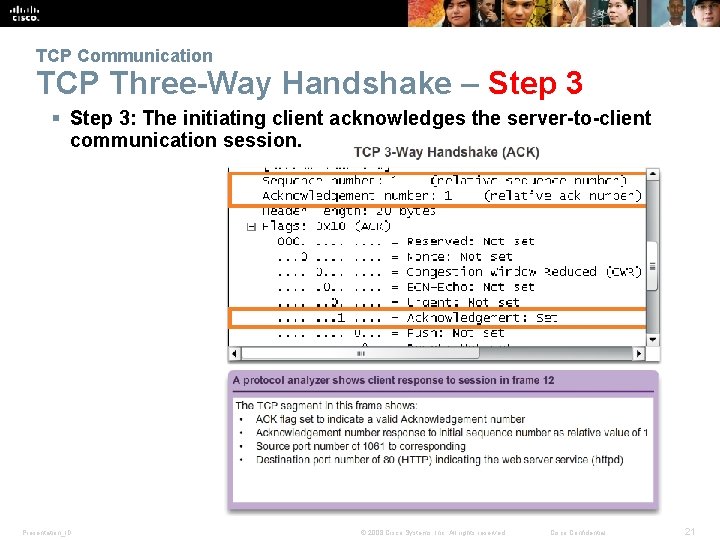
TCP Communication TCP Three-Way Handshake – Step 3 § Step 3: The initiating client acknowledges the server-to-client communication session. Presentation_ID © 2008 Cisco Systems, Inc. All rights reserved. Cisco Confidential 21
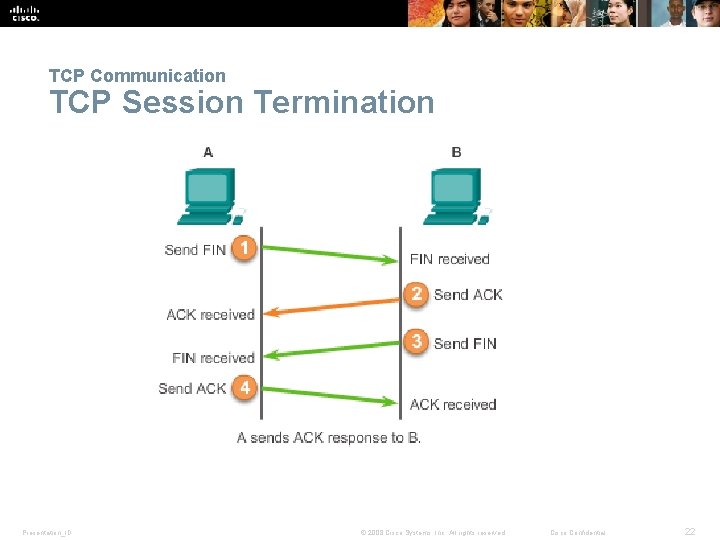
TCP Communication TCP Session Termination Presentation_ID © 2008 Cisco Systems, Inc. All rights reserved. Cisco Confidential 22
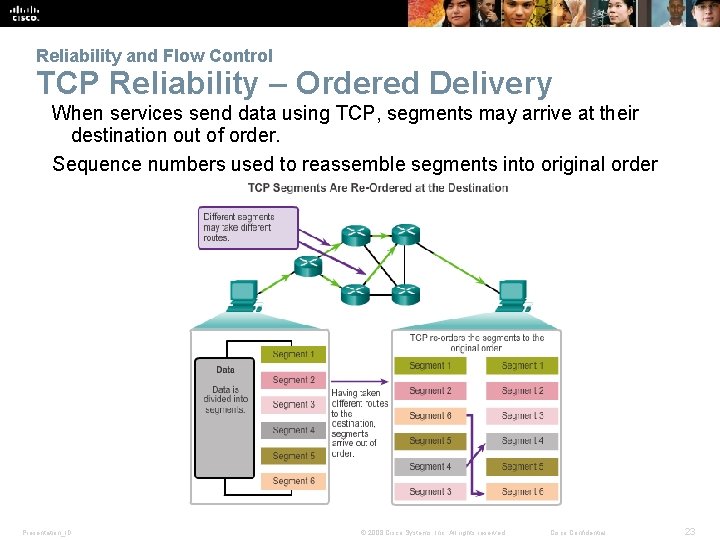
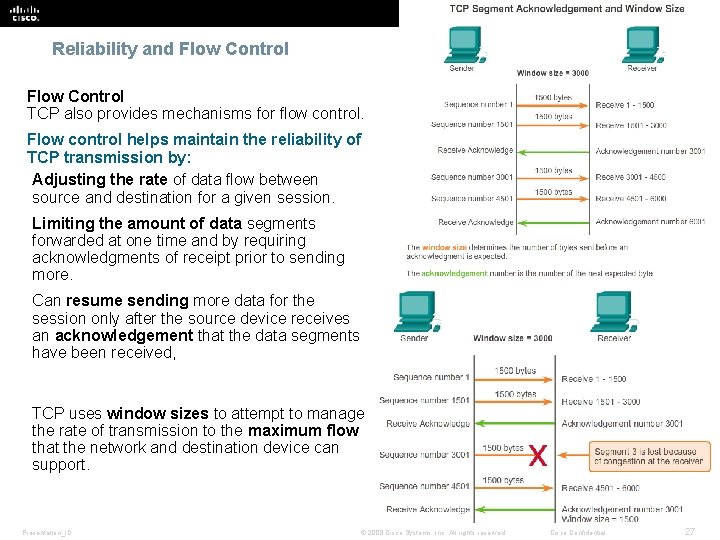
Reliability and Flow Control TCP Reliability – Ordered Delivery When services send data using TCP, segments may arrive at their destination out of order. Sequence numbers used to reassemble segments into original order Presentation_ID © 2008 Cisco Systems, Inc. All rights reserved. Cisco Confidential 23
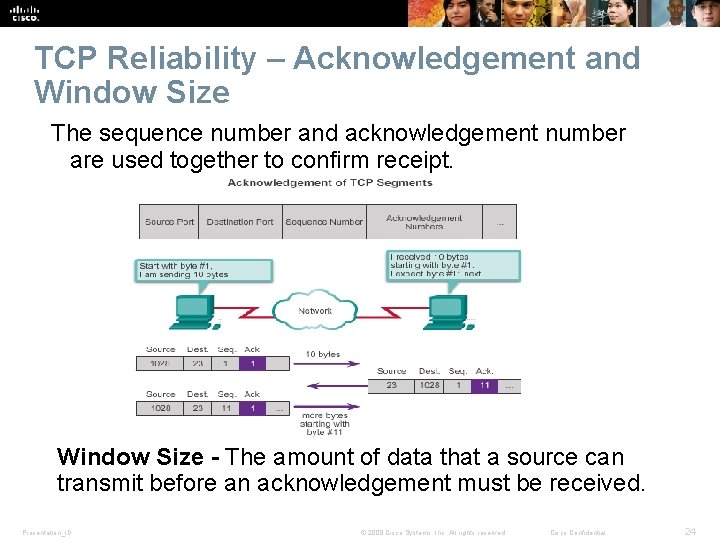
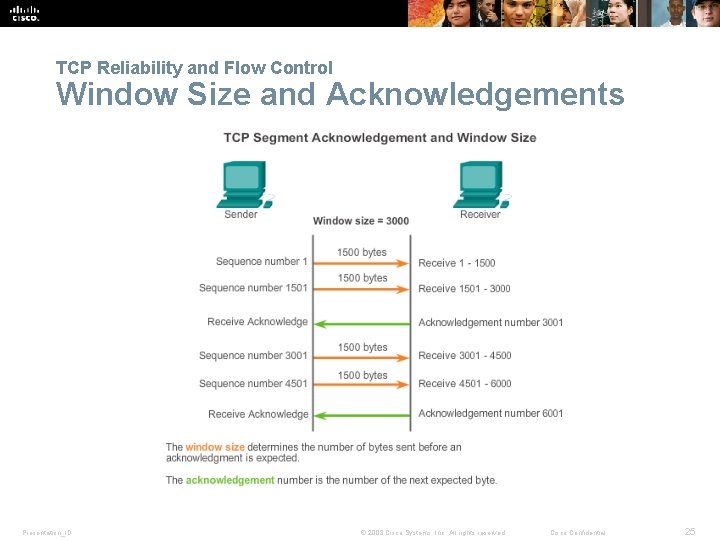
TCP Reliability – Acknowledgement and Window Size The sequence number and acknowledgement number are used together to confirm receipt. Window Size - The amount of data that a source can transmit before an acknowledgement must be received. Presentation_ID © 2008 Cisco Systems, Inc. All rights reserved. Cisco Confidential 24
TCP Reliability and Flow Control Window Size and Acknowledgements Presentation_ID © 2008 Cisco Systems, Inc. All rights reserved. Cisco Confidential 25
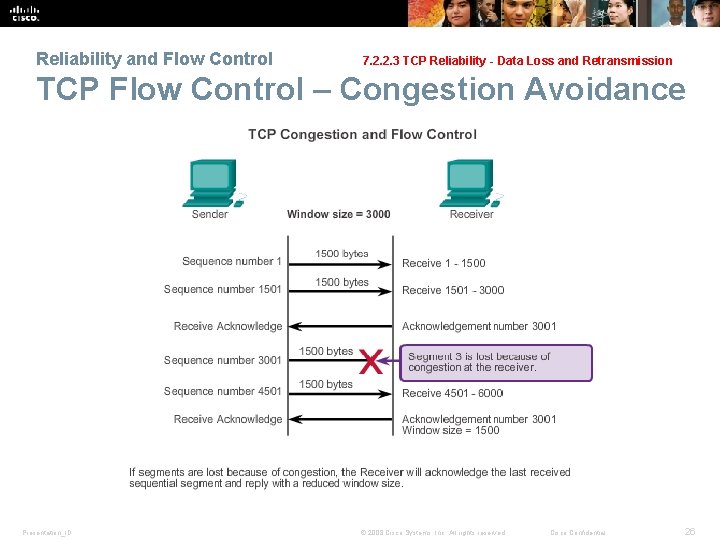
Reliability and Flow Control 7. 2. 2. 3 TCP Reliability - Data Loss and Retransmission TCP Flow Control – Congestion Avoidance Presentation_ID © 2008 Cisco Systems, Inc. All rights reserved. Cisco Confidential 26
Reliability and Flow Control TCP also provides mechanisms for flow control. Flow control helps maintain the reliability of TCP transmission by: Adjusting the rate of data flow between source and destination for a given session. Limiting the amount of data segments forwarded at one time and by requiring acknowledgments of receipt prior to sending more. Can resume sending more data for the session only after the source device receives an acknowledgement that the data segments have been received, TCP uses window sizes to attempt to manage the rate of transmission to the maximum flow that the network and destination device can support. Presentation_ID © 2008 Cisco Systems, Inc. All rights reserved. Cisco Confidential 27
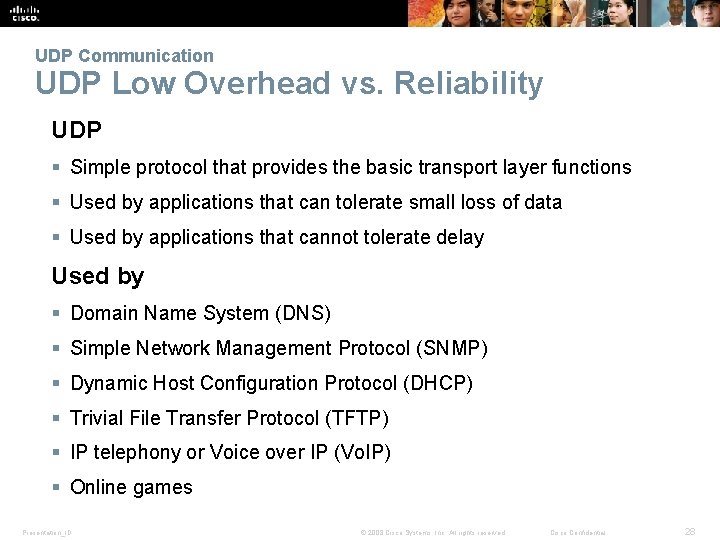
UDP Communication UDP Low Overhead vs. Reliability UDP § Simple protocol that provides the basic transport layer functions § Used by applications that can tolerate small loss of data § Used by applications that cannot tolerate delay Used by § Domain Name System (DNS) § Simple Network Management Protocol (SNMP) § Dynamic Host Configuration Protocol (DHCP) § Trivial File Transfer Protocol (TFTP) § IP telephony or Voice over IP (Vo. IP) § Online games Presentation_ID © 2008 Cisco Systems, Inc. All rights reserved. Cisco Confidential 28
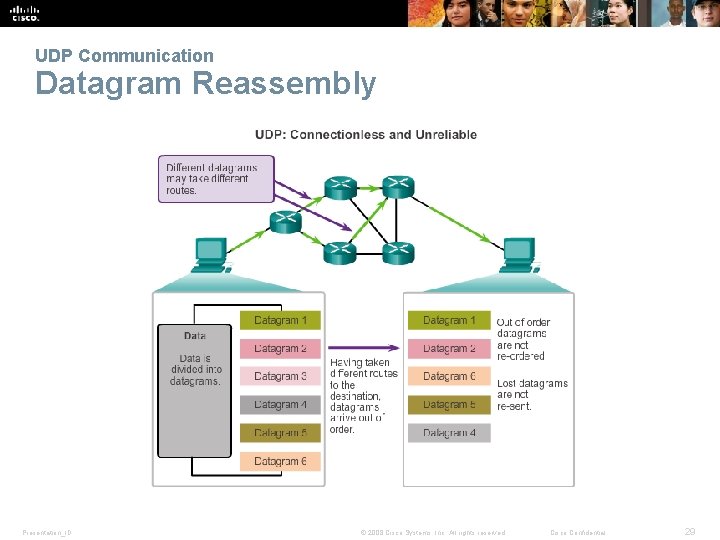
UDP Communication Datagram Reassembly Presentation_ID © 2008 Cisco Systems, Inc. All rights reserved. Cisco Confidential 29
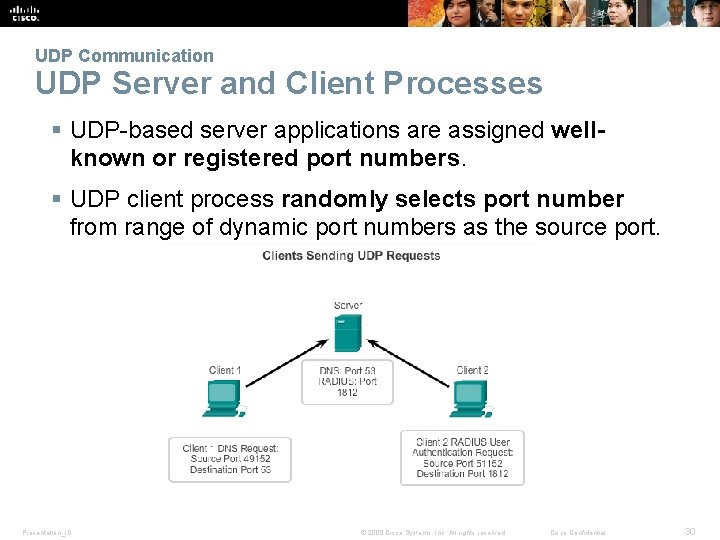
UDP Communication UDP Server and Client Processes § UDP-based server applications are assigned wellknown or registered port numbers. § UDP client process randomly selects port number from range of dynamic port numbers as the source port. Presentation_ID © 2008 Cisco Systems, Inc. All rights reserved. Cisco Confidential 30
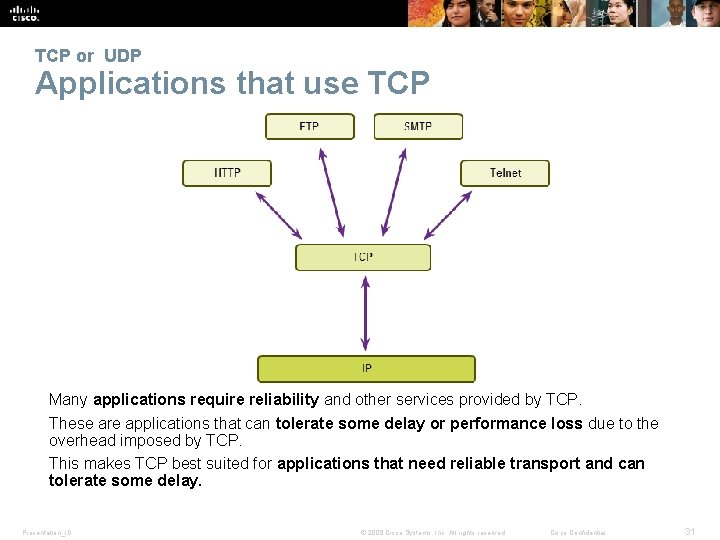
TCP or UDP Applications that use TCP Many applications require reliability and other services provided by TCP. These are applications that can tolerate some delay or performance loss due to the overhead imposed by TCP. This makes TCP best suited for applications that need reliable transport and can tolerate some delay. Presentation_ID © 2008 Cisco Systems, Inc. All rights reserved. Cisco Confidential 31
TCP or UDP Applications that use UDP There are three types of applications that are best suited for UDP: 1. Applications that can tolerate some data loss, but require little or no delay 2. Applications with simple request and reply transactions 3. Unidirectional communications where reliability is not required or can be handled by the application Video and multimedia applications, such as Vo. IP and Internet Protocol Television (IPTV) use UDP. These applications can tolerate some data loss with little or no noticeable effect Presentation_ID © 2008 Cisco Systems, Inc. All rights reserved. Cisco Confidential 32
Chapter 7: Summary § The role of the Transport layer is to provide three main functions: multiplexing, segmentation and reassembly, and error checking. § These functions are necessary in order to address issues in quality of service and security on networks. § Knowing how TCP and UDP operate and which popular applications use each protocol will allow the implementation of quality of service and build more reliable networks. § Ports provide a “tunnel” for data to get from the Transport layer to the appropriate application at the destination. Presentation_ID © 2008 Cisco Systems, Inc. All rights reserved. Cisco Confidential 33
Presentation_ID © 2008 Cisco Systems, Inc. All rights reserved. Cisco Confidential 34