
Chapter 7 TopDown Development Problemsolving approach Breaking a
Chapter 7 Top-Down Development § Problem-solving approach § Breaking a task down into smaller subtasks § First level of subtasks translates into the main() method § Levels of tasks below main() are developed into a series of additional methods © 2005 Lawrenceville Press
Chapter 7 Using Methods § Used to implement a specific task § Methods must be part of a class § A main() method defines the first level of subtasks with calls to methods that implement the subtasks § Using methods to define tasks is called procedural abstraction © 2005 Lawrenceville Press

Chapter 7 A Method e d l m o pe e a h v n t y e e t l d o s m n r s th es u s t e c m re ac cla public static void fahrenheit. To. Celsius() { double f. Temp, c. Temp; Scanner input = new Scanner(System. in); body System. out. println("Enter a Fahrenheit temperature: "); f. Temp = input. next. Double(); input. close; c. Temp = (double)5/(double)9 * (f. Temp - 32); System. out. println("The Celsius temperature is "+c. Temp); } © 2005 Lawrenceville Press
Chapter 7 Method Parameters § A method can have parameters for accepting values from a calling statement § Parameters are used inside the method to perform the method's task § The data passed to a method are called arguments § The draw. Bar() method declaration has one parameter named length: public static void draw. Bar(int length) © 2005 Lawrenceville Press
Chapter 7 Pass by Value § In Java, arguments are passed by value § A primitive data type gives the method a copy of its value. The method does not have access to the original data. § An object gives the method a copy of its reference that points to methods for changing object data. A method can change the data stored in an object because the method has access to the object's methods. © 2005 Lawrenceville Press

Chapter 7 Multiple Parameters § A method can have multiple parameters § Multiple parameters must be separated by commas § The order of the arguments passed must match the order of the parameters § The modified draw. Bar() method declaration has two parameters: public static void draw. Bar(int length, String mark) © 2005 Lawrenceville Press
Chapter 7 Method Overloading § More than one method of the same name can be included in a class § The compiler uses the types, order, and number of parameters to determine which method to execute © 2005 Lawrenceville Press
Chapter 7 The return Statement § A return statement is used to send a value back to the calling statement § A return statement can return only one value § A method that returns a value must include the return type in the method declaration. For example, the cube. Of() method returns a double: public static double cube. Of(double x) § A method that returns a value is called from a statement that will make use of the returned value. For example: cube = cube. Of(num); © 2005 Lawrenceville Press

Chapter 7 Documenting Methods § Methods should be carefully commented so that a reader of the program understands what task the method is performing and what data, if any, will be returned by the method § Method documentation should appear just above a method § Documentation should include a brief description of the method, any preconditions, and the postcondition © 2005 Lawrenceville Press

Chapter 7 Preconditions and Postconditions § The precondition states what must be true at the beginning of a method for the method to work properly. § The postcondition states what must be true after the method has executed if the method has worked properly. § Preconditions and postconditions should not state facts that the compiler will verify. They should also not refer to variables of information outside the method. § The postcondition should not state how the method accomplished its task. © 2005 Lawrenceville Press
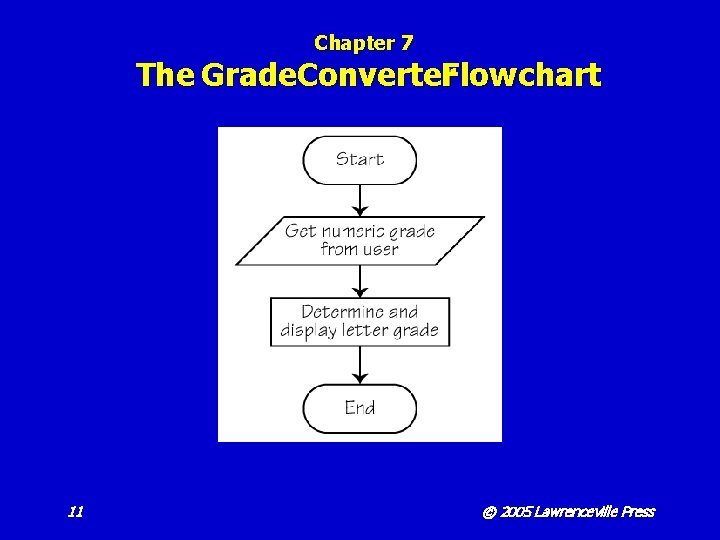
Chapter 7 The Grade. Converter. Flowchart 11 © 2005 Lawrenceville Press
- Slides: 11