
CHAPTER 7 THREE COGNITIVE THEORIES Chapter 7 Outline


- Slides: 63
CHAPTER 7 THREE COGNITIVE THEORIES
Chapter 7 Outline
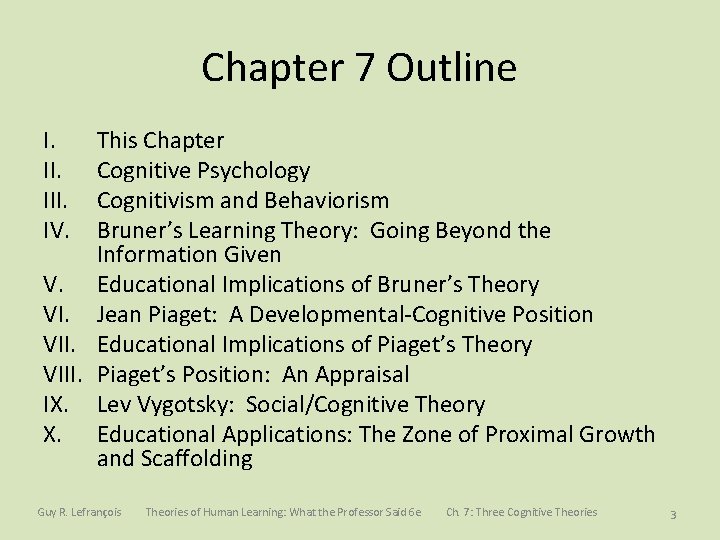
Chapter 7 Outline I. III. IV. This Chapter Cognitive Psychology Cognitivism and Behaviorism Bruner’s Learning Theory: Going Beyond the Information Given V. Educational Implications of Bruner’s Theory VI. Jean Piaget: A Developmental-Cognitive Position VII. Educational Implications of Piaget’s Theory VIII. Piaget’s Position: An Appraisal IX. Lev Vygotsky: Social/Cognitive Theory X. Educational Applications: The Zone of Proximal Growth and Scaffolding Guy R. Lefrançois Theories of Human Learning: What the Professor Said 6 e Ch. 7: Three Cognitive Theories 3
Cognitive Psychology
Cognitive Psychology • If the simpler behaviors of animals can’t be adequately explained using behavioristic positions, then the presumably more complex behaviors of humans might be even less well explained. • Even if animals have concepts and apparent thought processes, then psychology should perhaps concern itself with these as well as with more easily observed and described behaviors. Guy R. Lefrançois Theories of Human Learning: What the Professor Said 6 e Ch. 7: Three Cognitive Theories 5
Cognitivism and Behaviorism Guy R. Lefrançois Theories of Human Learning: What the Professor Said 6 e Ch. 7: Three Cognitive Theories
Cognitivism and Behaviorism • Cognitive theories are concerned mainly with explaining higher mental processes: – perception, information processing, decision making, and knowing • Cognitive theories based more on human than on animal research • Cognitive theories are often based on an information-processing model • Cognitive theories tend to be less ambitious in scope than the behavioristic theories Guy R. Lefrançois Theories of Human Learning: What the Professor Said 6 e Ch. 7: Three Cognitive Theories 7
The Main Metaphor of Cognitive Psychology • The dominant metaphor in cognitive psychology is essentially a computer-based, information processing metaphor. • The emphasis is on the perceptual and conceptual processes that: – allow the perceiver to perceive – determine how the actor acts, and – underlie thinking, remembering, solving problems, etc. Guy R. Lefrançois Theories of Human Learning: What the Professor Said 6 e Ch. 7: Three Cognitive Theories 8
Main Beliefs of Cognitive Theories • Current learning builds on previous learning • Learning involves information processing • Meaning depends on relationships among concepts Guy R. Lefrançois Theories of Human Learning: What the Professor Said 6 e Ch. 7: Three Cognitive Theories 9
Bruner’s Learning Theory: Going Beyond the Information Given Guy R. Lefrançois Theories of Human Learning: What the Professor Said 6 e Ch. 7: Three Cognitive Theories
Evolution of the Brain • Humans were far from the fastest, the fiercest, or the strongest of the predators on this planet. • The human proved, in the end, to be more intelligent than all who preyed on human flesh. • The human eventually took the course of evolution into its own hands by using its brains. Guy R. Lefrançois Theories of Human Learning: What the Professor Said 6 e Ch. 7: Three Cognitive Theories 11
Jerome Seymour Bruner (1915 – ) Guy R. Lefrançois Theories of Human Learning: What the Professor Said 6 e Ch. 7: Three Cognitive Theories
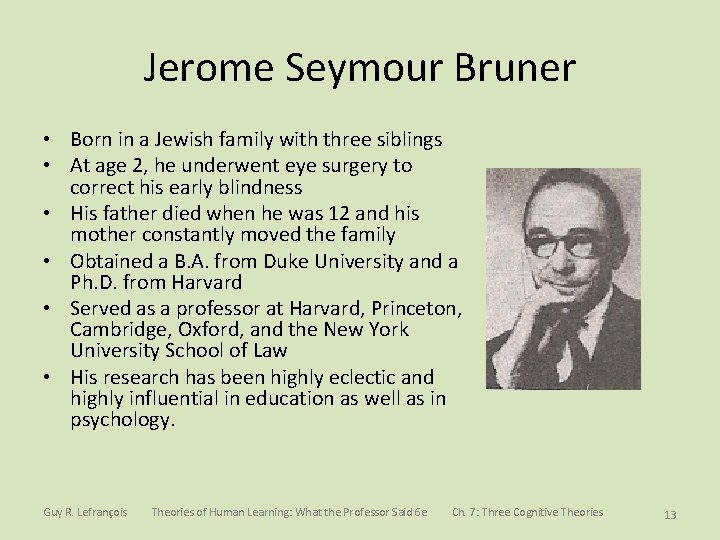
Jerome Seymour Bruner • Born in a Jewish family with three siblings • At age 2, he underwent eye surgery to correct his early blindness • His father died when he was 12 and his mother constantly moved the family • Obtained a B. A. from Duke University and a Ph. D. from Harvard • Served as a professor at Harvard, Princeton, Cambridge, Oxford, and the New York University School of Law • His research has been highly eclectic and highly influential in education as well as in psychology. Guy R. Lefrançois Theories of Human Learning: What the Professor Said 6 e Ch. 7: Three Cognitive Theories 13
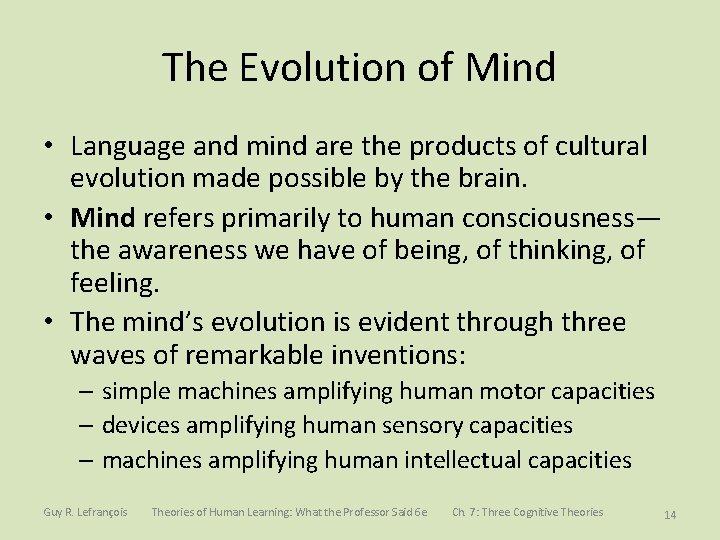
The Evolution of Mind • Language and mind are the products of cultural evolution made possible by the brain. • Mind refers primarily to human consciousness— the awareness we have of being, of thinking, of feeling. • The mind’s evolution is evident through three waves of remarkable inventions: – simple machines amplifying human motor capacities – devices amplifying human sensory capacities – machines amplifying human intellectual capacities Guy R. Lefrançois Theories of Human Learning: What the Professor Said 6 e Ch. 7: Three Cognitive Theories 14
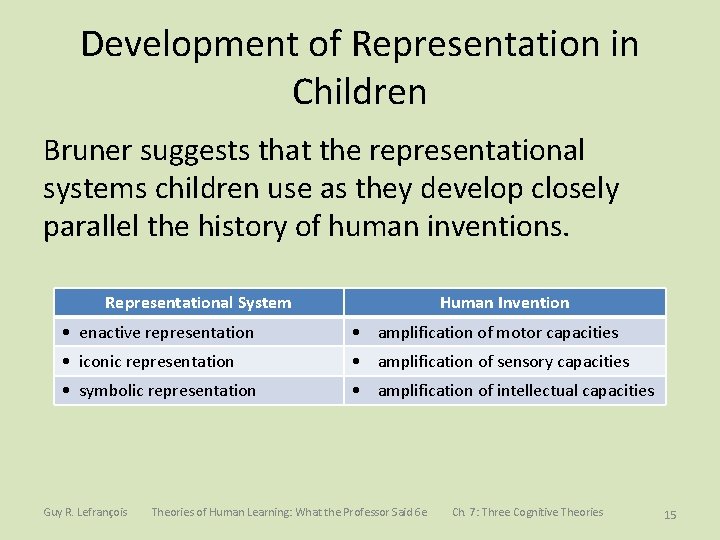
Development of Representation in Children Bruner suggests that the representational systems children use as they develop closely parallel the history of human inventions. Representational System Human Invention • enactive representation • amplification of motor capacities • iconic representation • amplification of sensory capacities • symbolic representation • amplification of intellectual capacities Guy R. Lefrançois Theories of Human Learning: What the Professor Said 6 e Ch. 7: Three Cognitive Theories 15
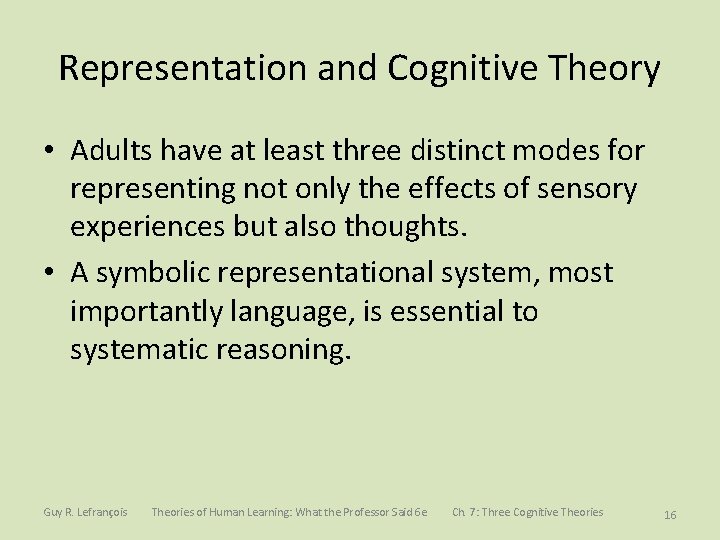
Representation and Cognitive Theory • Adults have at least three distinct modes for representing not only the effects of sensory experiences but also thoughts. • A symbolic representational system, most importantly language, is essential to systematic reasoning. Guy R. Lefrançois Theories of Human Learning: What the Professor Said 6 e Ch. 7: Three Cognitive Theories 16
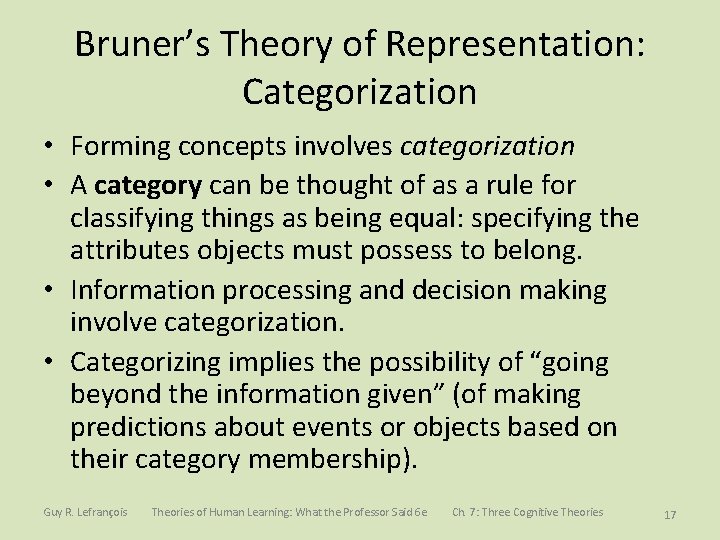
Bruner’s Theory of Representation: Categorization • Forming concepts involves categorization • A category can be thought of as a rule for classifying things as being equal: specifying the attributes objects must possess to belong. • Information processing and decision making involve categorization. • Categorizing implies the possibility of “going beyond the information given” (of making predictions about events or objects based on their category membership). Guy R. Lefrançois Theories of Human Learning: What the Professor Said 6 e Ch. 7: Three Cognitive Theories 17
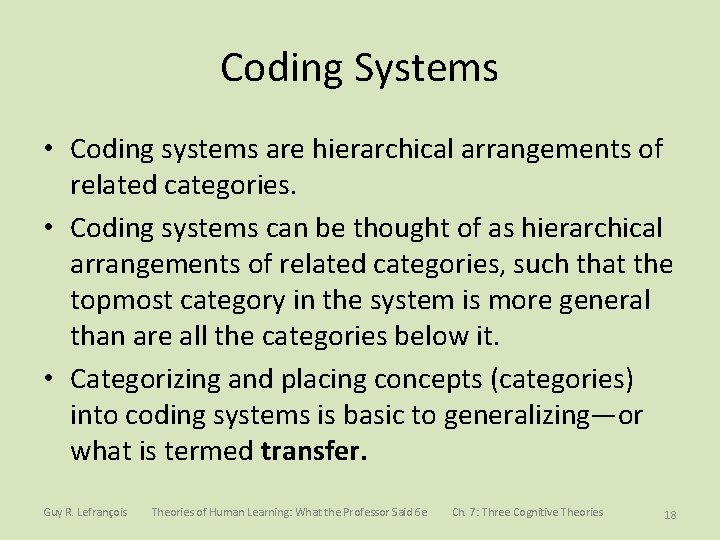
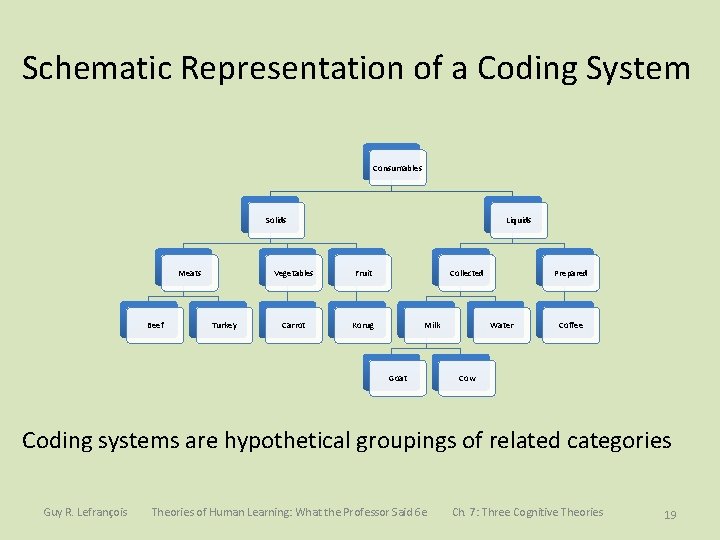
Coding Systems • Coding systems are hierarchical arrangements of related categories. • Coding systems can be thought of as hierarchical arrangements of related categories, such that the topmost category in the system is more general than are all the categories below it. • Categorizing and placing concepts (categories) into coding systems is basic to generalizing—or what is termed transfer. Guy R. Lefrançois Theories of Human Learning: What the Professor Said 6 e Ch. 7: Three Cognitive Theories 18
Schematic Representation of a Coding System Consumables Solids Meats Beef Turkey Liquids Vegetables Fruit Carrot Korug Collected Milk Goat Prepared Water Coffee Cow Coding systems are hypothetical groupings of related categories Guy R. Lefrançois Theories of Human Learning: What the Professor Said 6 e Ch. 7: Three Cognitive Theories 19
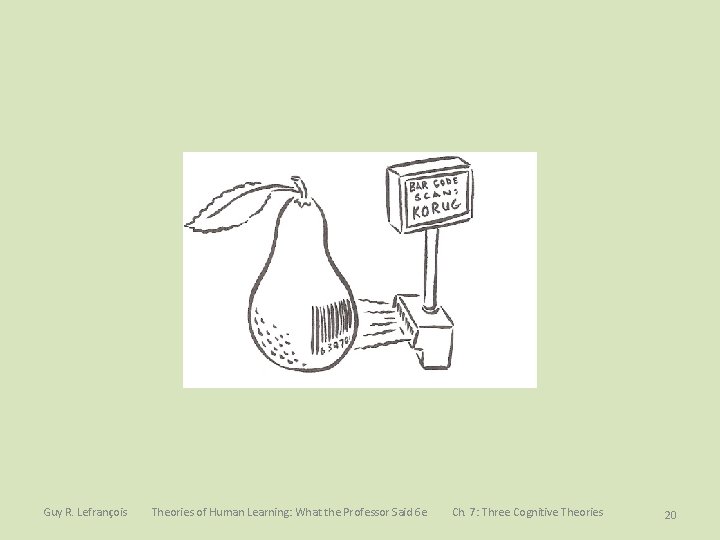
Guy R. Lefrançois Theories of Human Learning: What the Professor Said 6 e Ch. 7: Three Cognitive Theories 20
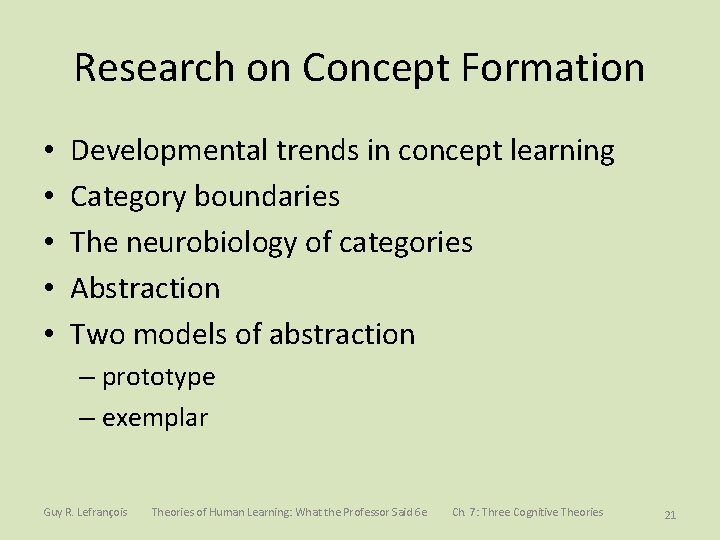
Research on Concept Formation • • • Developmental trends in concept learning Category boundaries The neurobiology of categories Abstraction Two models of abstraction – prototype – exemplar Guy R. Lefrançois Theories of Human Learning: What the Professor Said 6 e Ch. 7: Three Cognitive Theories 21
Meaning and the Narrative Construction of Reality • How humans make meaning • How humans use personal narratives to make sense of their lives Guy R. Lefrançois Theories of Human Learning: What the Professor Said 6 e Ch. 7: Three Cognitive Theories 22
Educational Implications of Bruner’s Theory Guy R. Lefrançois Theories of Human Learning: What the Professor Said 6 e Ch. 7: Three Cognitive Theories
Educational Implications of Bruner’s Theory • Bruner strongly advocates discovery-oriented, constructivist teaching methods. • Bruner suggests that some form of spiral curriculum is often the best for learnercentered education. • The conceptual change movement in education is also in harmony with Bruner’s theory. Guy R. Lefrançois Theories of Human Learning: What the Professor Said 6 e Ch. 7: Three Cognitive Theories 24
Jean Piaget: A Developmental-Cognitive Position Guy R. Lefrançois Theories of Human Learning: What the Professor Said 6 e Ch. 7: Three Cognitive Theories
Jean Piaget: A Developmental. Cognitive Position • Piaget’s research and theories influenced psychology and education • Cognitive: mental representation • Developmental: processes by which children achieve a progressively more advanced understanding of their environment and of themselves Guy R. Lefrançois Theories of Human Learning: What the Professor Said 6 e Ch. 7: Three Cognitive Theories 26
Jean Piaget (1896 – 1980) Guy R. Lefrançois Theories of Human Learning: What the Professor Said 6 e Ch. 7: Three Cognitive Theories
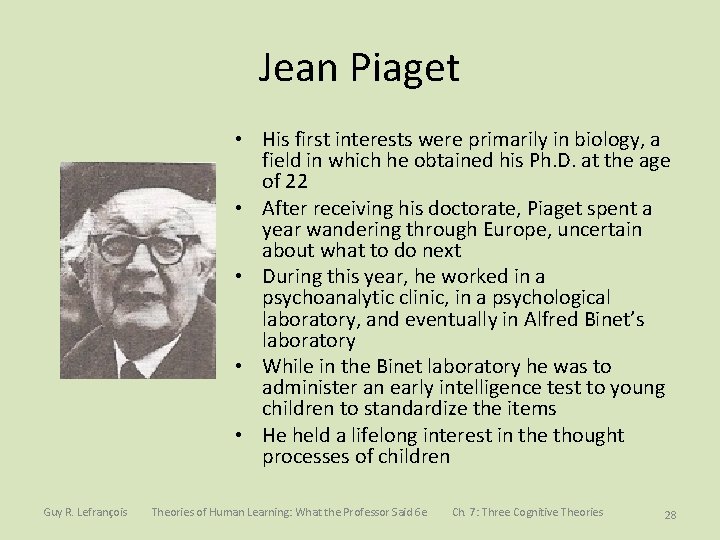
Jean Piaget • His first interests were primarily in biology, a field in which he obtained his Ph. D. at the age of 22 • After receiving his doctorate, Piaget spent a year wandering through Europe, uncertain about what to do next • During this year, he worked in a psychoanalytic clinic, in a psychological laboratory, and eventually in Alfred Binet’s laboratory • While in the Binet laboratory he was to administer an early intelligence test to young children to standardize the items • He held a lifelong interest in the thought processes of children Guy R. Lefrançois Theories of Human Learning: What the Professor Said 6 e Ch. 7: Three Cognitive Theories 28
The Méthode Clinique • The méthode clinique: a semi-structured interview technique in which subjects’ answers to questions often determine what the next question will be. • Borrowed from clinical psychology and especially from psychoanalysis • Requires that the interviewer listen while letting the child talk • Requires the interviewer go where the child’s explanations and questions lead • One of the advantages of the méthode clinique lies in the considerable flexibility it permits Guy R. Lefrançois Theories of Human Learning: What the Professor Said 6 e Ch. 7: Three Cognitive Theories 29
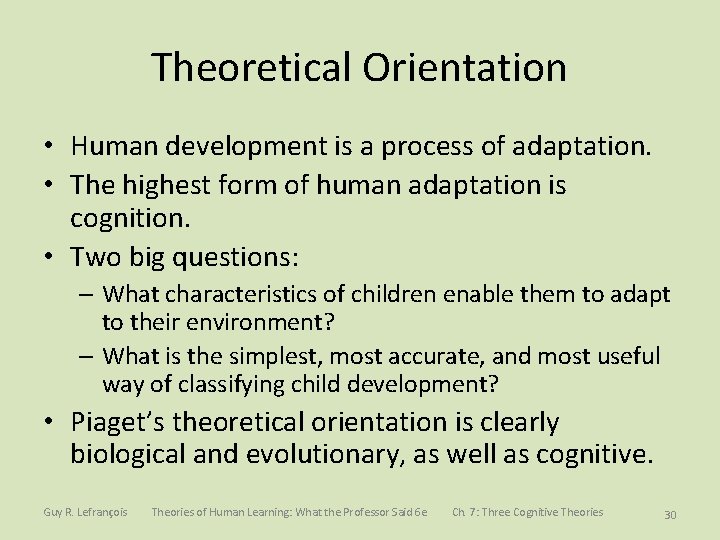
Theoretical Orientation • Human development is a process of adaptation. • The highest form of human adaptation is cognition. • Two big questions: – What characteristics of children enable them to adapt to their environment? – What is the simplest, most accurate, and most useful way of classifying child development? • Piaget’s theoretical orientation is clearly biological and evolutionary, as well as cognitive. Guy R. Lefrançois Theories of Human Learning: What the Professor Said 6 e Ch. 7: Three Cognitive Theories 30
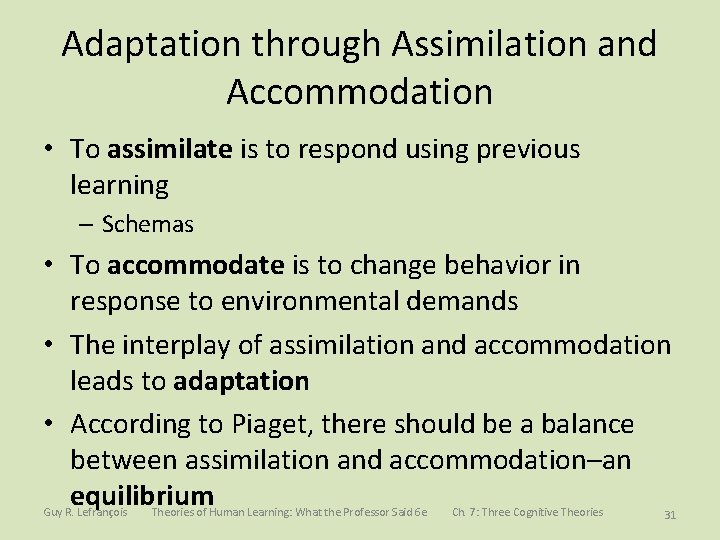
Adaptation through Assimilation and Accommodation • To assimilate is to respond using previous learning – Schemas • To accommodate is to change behavior in response to environmental demands • The interplay of assimilation and accommodation leads to adaptation • According to Piaget, there should be a balance between assimilation and accommodation–an equilibrium Guy R. Lefrançois Theories of Human Learning: What the Professor Said 6 e Ch. 7: Three Cognitive Theories 31
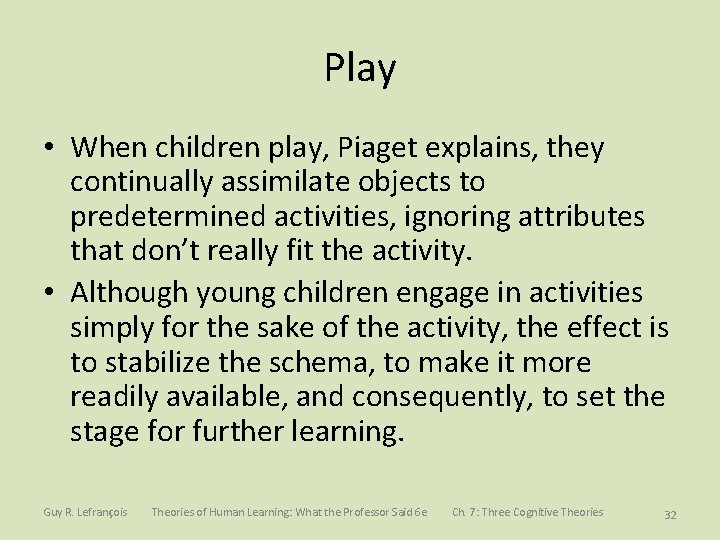
Play • When children play, Piaget explains, they continually assimilate objects to predetermined activities, ignoring attributes that don’t really fit the activity. • Although young children engage in activities simply for the sake of the activity, the effect is to stabilize the schema, to make it more readily available, and consequently, to set the stage for further learning. Guy R. Lefrançois Theories of Human Learning: What the Professor Said 6 e Ch. 7: Three Cognitive Theories 32
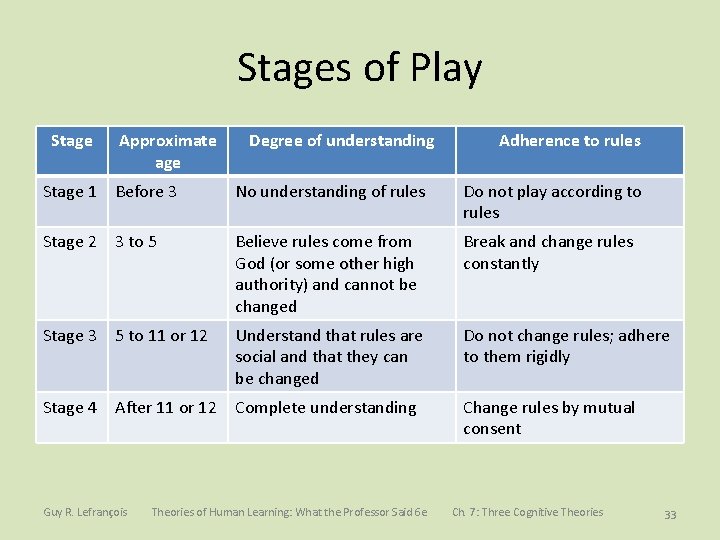
Stages of Play Stage Approximate age Degree of understanding Adherence to rules Stage 1 Before 3 No understanding of rules Do not play according to rules Stage 2 3 to 5 Believe rules come from God (or some other high authority) and cannot be changed Break and change rules constantly Stage 3 5 to 11 or 12 Understand that rules are social and that they can be changed Do not change rules; adhere to them rigidly Stage 4 After 11 or 12 Complete understanding Change rules by mutual consent Guy R. Lefrançois Theories of Human Learning: What the Professor Said 6 e Ch. 7: Three Cognitive Theories 33
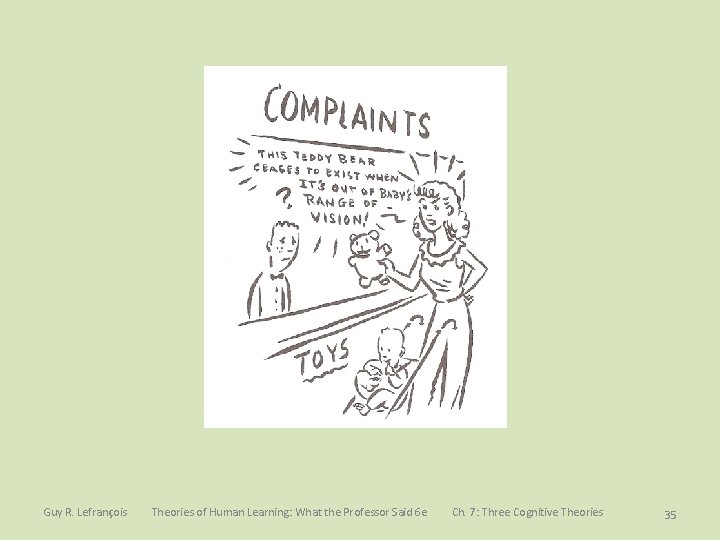
Imitation • Imitation is primarily accommodation. • When imitating, children constantly modify their behavior in accordance with the demands imposed on them by their desire to be something they aren’t or to be like someone else. • Through the imitation of activity, children’s repertoires of behaviors expand gradually begin to be internalized (forming mental concepts). • Many of the infant’s imitative behaviors occur only in the presence of the model being imitated. • Deferred imitation—the ability to imitate things and people not immediately present—is evidence that the infant has internalized a representation of that which is being imitated. Guy R. Lefrançois Theories of Human Learning: What the Professor Said 6 e Ch. 7: Three Cognitive Theories 34
Guy R. Lefrançois Theories of Human Learning: What the Professor Said 6 e Ch. 7: Three Cognitive Theories 35
Intelligence • Piaget asserts that intelligence is a more active process than portrayed by the Gestalt theorists. • Instead of describing intelligence as a relatively fixed quality or quantity, Piaget describes it as mobile—something that changes. • Intelligence is the property of activity that is reflected in maximally adaptive behavior, and it can therefore be understood as the entire process of adapting. Guy R. Lefrançois Theories of Human Learning: What the Professor Said 6 e Ch. 7: Three Cognitive Theories 36
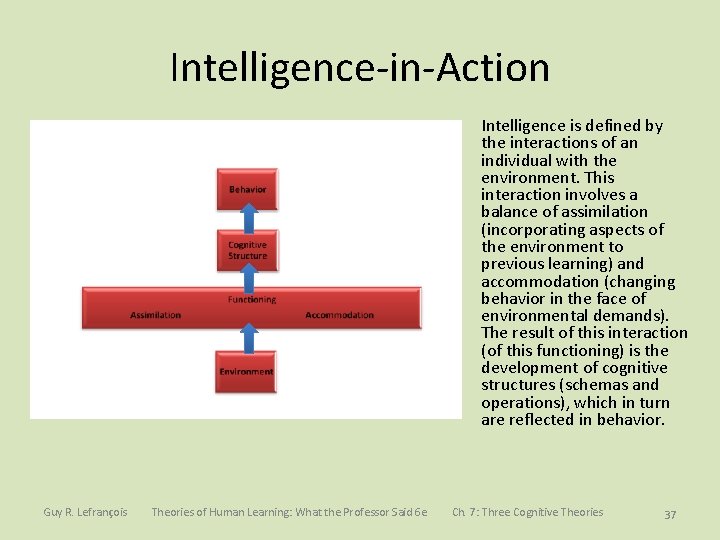
Intelligence-in-Action Intelligence is defined by the interactions of an individual with the environment. This interaction involves a balance of assimilation (incorporating aspects of the environment to previous learning) and accommodation (changing behavior in the face of environmental demands). The result of this interaction (of this functioning) is the development of cognitive structures (schemas and operations), which in turn are reflected in behavior. Guy R. Lefrançois Theories of Human Learning: What the Professor Said 6 e Ch. 7: Three Cognitive Theories 37
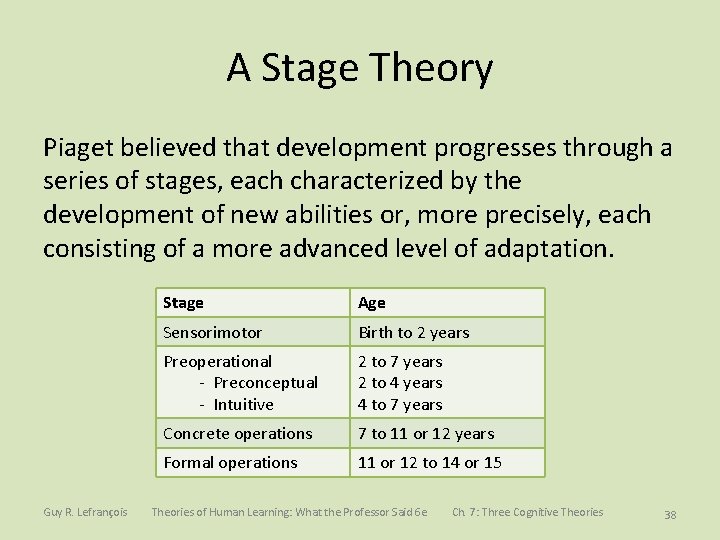
A Stage Theory Piaget believed that development progresses through a series of stages, each characterized by the development of new abilities or, more precisely, each consisting of a more advanced level of adaptation. Guy R. Lefrançois Stage Age Sensorimotor Birth to 2 years Preoperational - Preconceptual - Intuitive 2 to 7 years 2 to 4 years 4 to 7 years Concrete operations 7 to 11 or 12 years Formal operations 11 or 12 to 14 or 15 Theories of Human Learning: What the Professor Said 6 e Ch. 7: Three Cognitive Theories 38
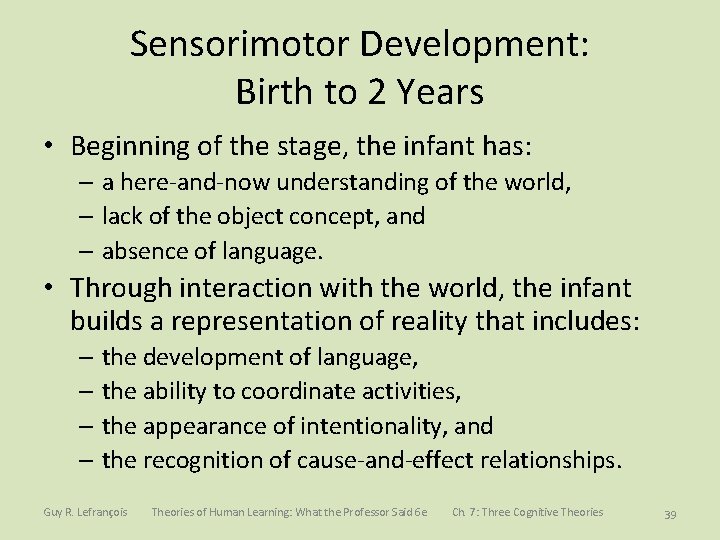
Sensorimotor Development: Birth to 2 Years • Beginning of the stage, the infant has: – a here-and-now understanding of the world, – lack of the object concept, and – absence of language. • Through interaction with the world, the infant builds a representation of reality that includes: – the development of language, – the ability to coordinate activities, – the appearance of intentionality, and – the recognition of cause-and-effect relationships. Guy R. Lefrançois Theories of Human Learning: What the Professor Said 6 e Ch. 7: Three Cognitive Theories 39
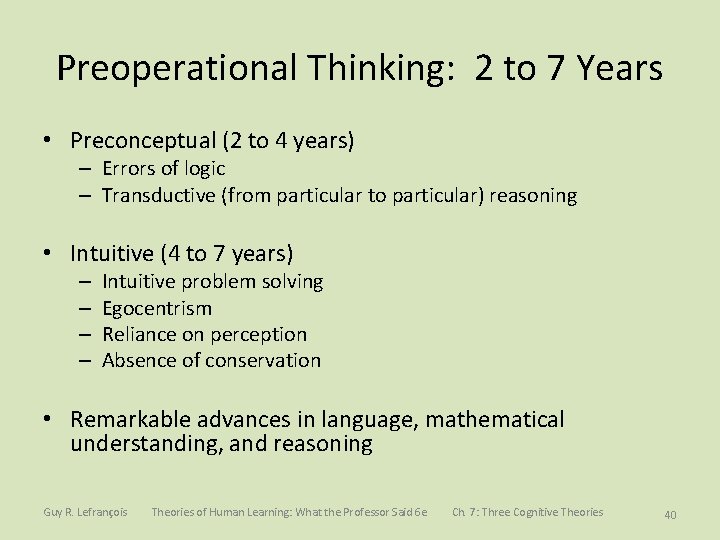
Preoperational Thinking: 2 to 7 Years • Preconceptual (2 to 4 years) – Errors of logic – Transductive (from particular to particular) reasoning • Intuitive (4 to 7 years) – – Intuitive problem solving Egocentrism Reliance on perception Absence of conservation • Remarkable advances in language, mathematical understanding, and reasoning Guy R. Lefrançois Theories of Human Learning: What the Professor Said 6 e Ch. 7: Three Cognitive Theories 40
Guy R. Lefrançois Theories of Human Learning: What the Professor Said 6 e Ch. 7: Three Cognitive Theories 41
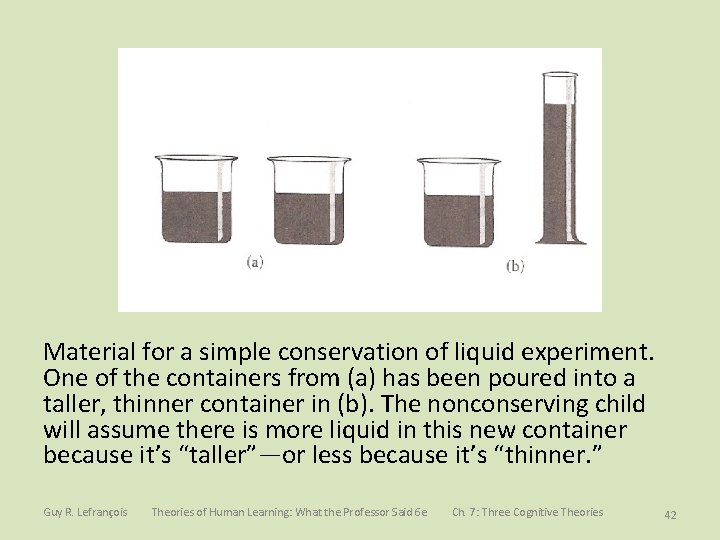
Material for a simple conservation of liquid experiment. One of the containers from (a) has been poured into a taller, thinner container in (b). The nonconserving child will assume there is more liquid in this new container because it’s “taller”—or less because it’s “thinner. ” Guy R. Lefrançois Theories of Human Learning: What the Professor Said 6 e Ch. 7: Three Cognitive Theories 42
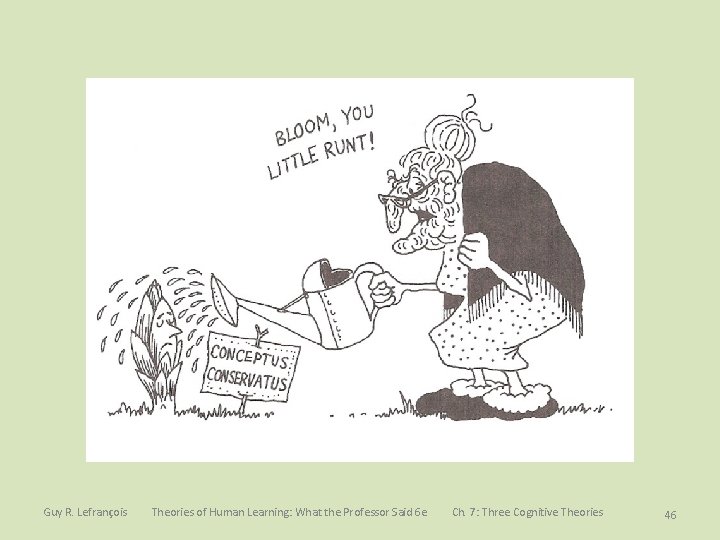
Operations • An operation can be defined as an internalized activity (in other words, a thought) that is subject to certain rules of logic. • The ability to conserve (reflecting logical rules of reversibility, identity, and compensation) Guy R. Lefrançois Theories of Human Learning: What the Professor Said 6 e Ch. 7: Three Cognitive Theories 43
Concrete Operations: 7 to 11 or 12 Years • Conservations • Children can now deal more adequately with classes, series, and number. • Thinking is tied to what is concrete. Guy R. Lefrançois Theories of Human Learning: What the Professor Said 6 e Ch. 7: Three Cognitive Theories 44
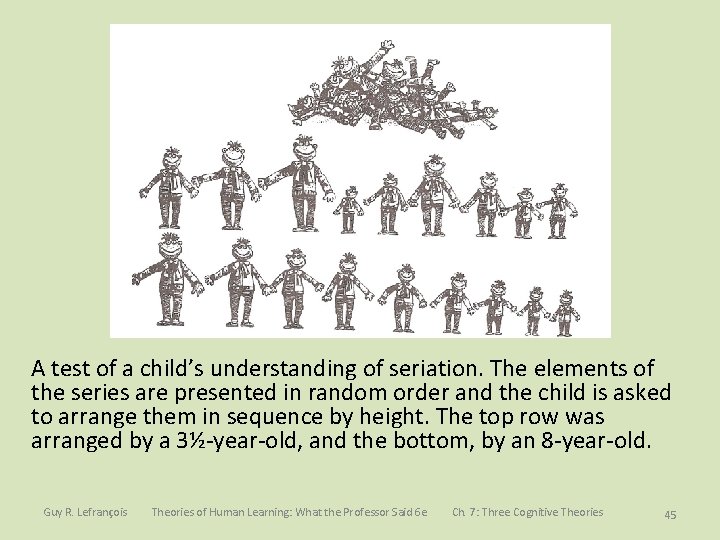
A test of a child’s understanding of seriation. The elements of the series are presented in random order and the child is asked to arrange them in sequence by height. The top row was arranged by a 3½-year-old, and the bottom, by an 8 -year-old. Guy R. Lefrançois Theories of Human Learning: What the Professor Said 6 e Ch. 7: Three Cognitive Theories 45
Guy R. Lefrançois Theories of Human Learning: What the Professor Said 6 e Ch. 7: Three Cognitive Theories 46
Formal Operations: After 11 or 12 Years • Defined by the appearance of propositional thinking • Abstract relations • Hypothetical nature of thought • The child’s thought processes are freed from the immediate and real and are potentially as logical as they will ever be Guy R. Lefrançois Theories of Human Learning: What the Professor Said 6 e Ch. 7: Three Cognitive Theories 47
Piaget’s Theory as a Theory of Learning Piaget’s position is primarily a theory of human development; however, it is also a theory of learning. In summary: – The acquisition of knowledge is a gradual developmental process made possible through the interaction of the child with the environment. – The sophistication of children’s representation of the world is a function of their stage of development. That stage is defined by the thought structures they then possess. – Maturation, active experience, equilibration, and social interaction are the forces that shape learning. Guy R. Lefrançois Theories of Human Learning: What the Professor Said 6 e Ch. 7: Three Cognitive Theories 48
Educational Implications of Piaget’s Theory Guy R. Lefrançois Theories of Human Learning: What the Professor Said 6 e Ch. 7: Three Cognitive Theories
Educational Implications of Piaget’s Theory • Piaget’s theory: – profoundly and significantly impacts school curricula, instructional procedures, and measurement practices – supports constructivism – suggests a number of very specific instructional approaches and principles – Implies providing opportunities for both mental and physical activity – suggests that schools should take pains to provide students with tasks and challenges of optimal difficulty – gives a very important role to social interaction Guy R. Lefrançois Theories of Human Learning: What the Professor Said 6 e Ch. 7: Three Cognitive Theories 50
Piaget’s Position: An Appraisal • The theory is remarkably consistent, coherent, and comprehensive. • Some research indicates that Piaget’s system may not reflect all the facts accurately. • On occasion, theory underestimates children’s abilities, but at other times, it may be guilty of overestimating abilities. • Is theory clear and understandable? Yes and no. • Does theory explain and predict well? Again, yes and no. • How useful and influential is theory? Very. Guy R. Lefrançois Theories of Human Learning: What the Professor Said 6 e Ch. 7: Three Cognitive Theories 51
Lev Vygotsky: Social/Cognitive Theory Guy R. Lefrançois Theories of Human Learning: What the Professor Said 6 e Ch. 7: Three Cognitive Theories
Lev Vygotsky: Social/Cognitive Theory • There is evidence that Piaget and Vygotsky did communicate with each other, and each seems to have modified his theories as a result of the other’s work. • History now suggests that Vygotsky singlehandedly introduced one of the biggest ideas that Russian psychology has contributed to the world: the notion of the zone of proximal development. Guy R. Lefrançois Theories of Human Learning: What the Professor Said 6 e Ch. 7: Three Cognitive Theories 53
Lev Semenovich Vygotsky (1896– 1934) Guy R. Lefrançois Theories of Human Learning: What the Professor Said 6 e Ch. 7: Three Cognitive Theories
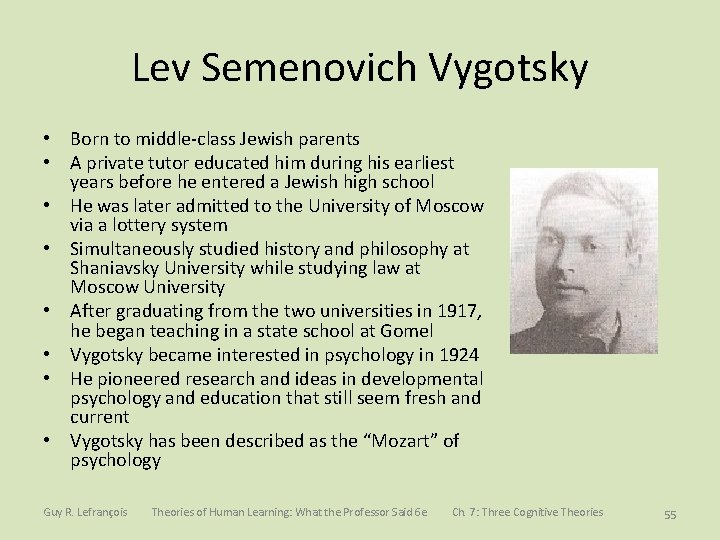
Lev Semenovich Vygotsky • Born to middle-class Jewish parents • A private tutor educated him during his earliest years before he entered a Jewish high school • He was later admitted to the University of Moscow via a lottery system • Simultaneously studied history and philosophy at Shaniavsky University while studying law at Moscow University • After graduating from the two universities in 1917, he began teaching in a state school at Gomel • Vygotsky became interested in psychology in 1924 • He pioneered research and ideas in developmental psychology and education that still seem fresh and current • Vygotsky has been described as the “Mozart” of psychology Guy R. Lefrançois Theories of Human Learning: What the Professor Said 6 e Ch. 7: Three Cognitive Theories 55
Main Ideas in Vygotsky's Theory • Vygotsky’s theory is often referred to as an example of constructivism. • According to Vygotsky, culture and social interaction are involved in the development of human consciousness. • Whereas Piaget’s theory gives a primary role to forces that are within the child, Vygotsky’s system emphasizes forces that are outside the child—in other words, the forces of culture. Guy R. Lefrançois Theories of Human Learning: What the Professor Said 6 e Ch. 7: Three Cognitive Theories 56
The Role of Culture • Social interaction is fundamentally involved in the development of cognition. • Cultures are very powerful, dynamic, changing things that exert a tremendous influence on each of us. • Vygotsky’s theory was profoundly shaped by the politics of his culture reflecting his Marxist-socialist beliefs, particularly in the role he gives culture and social interaction in determining development. • The importance of culture in Vygotsky’s theory is highlighted in the distinction he makes between elementary mental functions and higher mental functions. Guy R. Lefrançois Theories of Human Learning: What the Professor Said 6 e Ch. 7: Three Cognitive Theories 57
Language and Thought • Cognitive development is mainly a function of the largely verbal interaction that occurs between the child and adults. • The child develops language and, as a result, logical thinking. • Vygotsky concluded that while language is an extraordinarily powerful tool for organizing and manipulating thoughts, thinking is not entirely dependent on language. • The Vygotsky Blocks Study • Stages of language and conceptual development – Social speech – Egocentric speech – Inner speech Guy R. Lefrançois Theories of Human Learning: What the Professor Said 6 e Ch. 7: Three Cognitive Theories 58
Educational Applications: The Zone of Proximal Growth and Scaffolding Guy R. Lefrançois Theories of Human Learning: What the Professor Said 6 e Ch. 7: Three Cognitive Theories
Educational Applications: The Zone of Proximal Growth and Scaffolding • Vygotsky’s theory says a great deal about the forces that shape children’s learning. • It says much about the special relationship that exists between teachers and learners. • The Tools of the Mind curriculum reflects two aspects of Vygotsky’s theory that have especially clear and important educational implications: his notions of the zone of proximal growth and of scaffolding. Guy R. Lefrançois Theories of Human Learning: What the Professor Said 6 e Ch. 7: Three Cognitive Theories 60
The Zone of Proximal Growth • Much of the current popularity of Vygotsky’s theoretical framework has to do with his description of the relationship between learner and teacher—or between parent and child. • The teacher learns from and about the child even as the child learns because of the teacher’s actions. • Vygotsky’s zone of proximal growth is the child’s potential for development, defined by what the child cannot accomplish alone initially, but is capable of with the help of competent others and can subsequently accomplish alone. Guy R. Lefrançois Theories of Human Learning: What the Professor Said 6 e Ch. 7: Three Cognitive Theories 61
Scaffolding • Scaffolding describes an interactive teaching or learning technique where educators or parents provide learners with various forms of support as they learn. • By telling, demonstrating, showing, correcting, pointing, urging, providing models, explaining procedures, asking questions, identifying objects, and so on, teachers and parents build scaffolds for children. • Scaffolding is a metaphor that leads to a model of learning through gradual increments. Guy R. Lefrançois Theories of Human Learning: What the Professor Said 6 e Ch. 7: Three Cognitive Theories 62
Vygotsky’s Theory: An Appraisal • Vygotsky’s cultural/cognitive theory can easily be criticized on the grounds that it is not a highly scientific theory. • Some critics argue that Vygotsky’s description of stages in language development is not particularly useful or accurate. • Many consider him to be one of the most influential and important psychologists of the twentieth century. • Vygotsky’s theory fares relatively well relative to the major criteria of good theories, as it: – – – is relatively clear and understandable, attempts to simplify complex observations, is consistent, has very important practical implications, and continues to stimulate and guide a considerable amount of research in the social sciences. Guy R. Lefrançois Theories of Human Learning: What the Professor Said 6 e Ch. 7: Three Cognitive Theories 63