
Chapter 7 THERMODYNAMICS THE FIRST LAW SYSTEMS STATES

- Slides: 95
Chapter 7. THERMODYNAMICS: THE FIRST LAW SYSTEMS, STATES, AND ENERGY 7. 1 Systems 7. 2 Work and Energy 7. 3 Expansion Work 7. 4 Heat 7. 5 The Measurement of Heat 7. 6 The First Law 7. 7 A Molecular Interlude: The Origin of Internal Energy 2012 2013 General Chemistry II
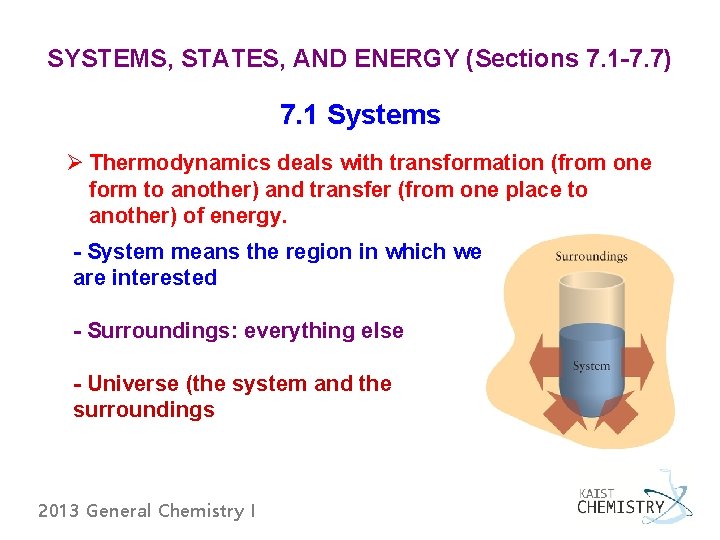
SYSTEMS, STATES, AND ENERGY (Sections 7. 1 -7. 7) 7. 1 Systems Ø Thermodynamics deals with transformation (from one form to another) and transfer (from one place to another) of energy. - System means the region in which we are interested - Surroundings: everything else - Universe (the system and the surroundings 2013 General Chemistry I
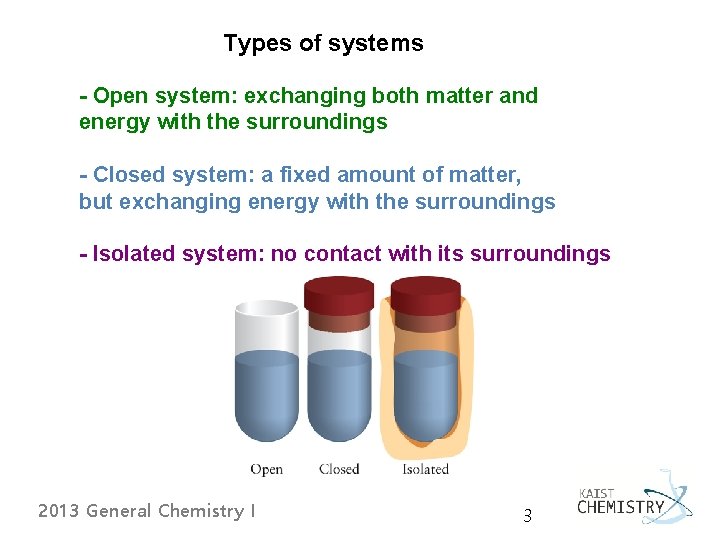
Types of systems - Open system: exchanging both matter and energy with the surroundings - Closed system: a fixed amount of matter, but exchanging energy with the surroundings - Isolated system: no contact with its surroundings 2013 General Chemistry I 3
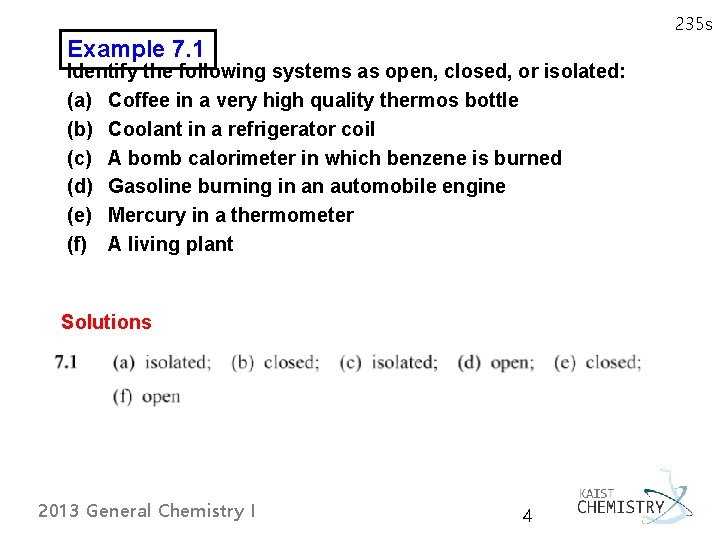
235 s Example 7. 1 Identify the following systems as open, closed, or isolated: (a) Coffee in a very high quality thermos bottle (b) Coolant in a refrigerator coil (c) A bomb calorimeter in which benzene is burned (d) Gasoline burning in an automobile engine (e) Mercury in a thermometer (f) A living plant Solutions 2013 General Chemistry I 4
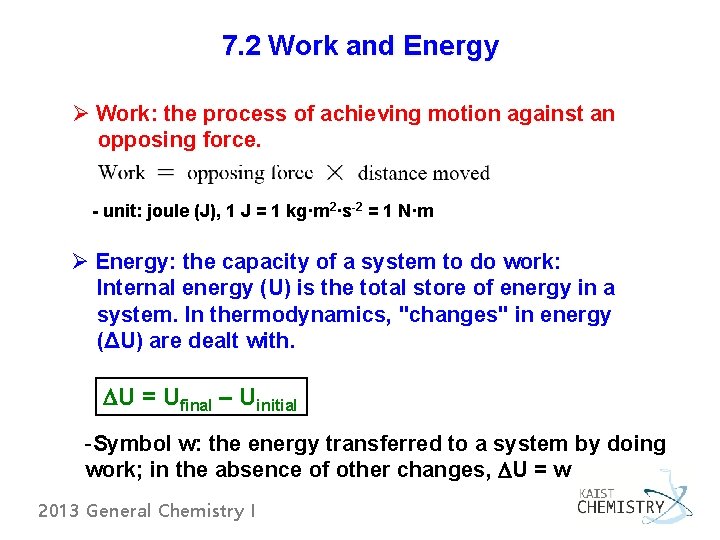
7. 2 Work and Energy Ø Work: the process of achieving motion against an opposing force. - unit: joule (J), 1 J = 1 kg·m 2·s-2 = 1 N·m Ø Energy: the capacity of a system to do work: Internal energy (U) is the total store of energy in a system. In thermodynamics, "changes" in energy (ΔU) are dealt with. DU = Ufinal – Uinitial -Symbol w: the energy transferred to a system by doing work; in the absence of other changes, DU = w 2013 General Chemistry I
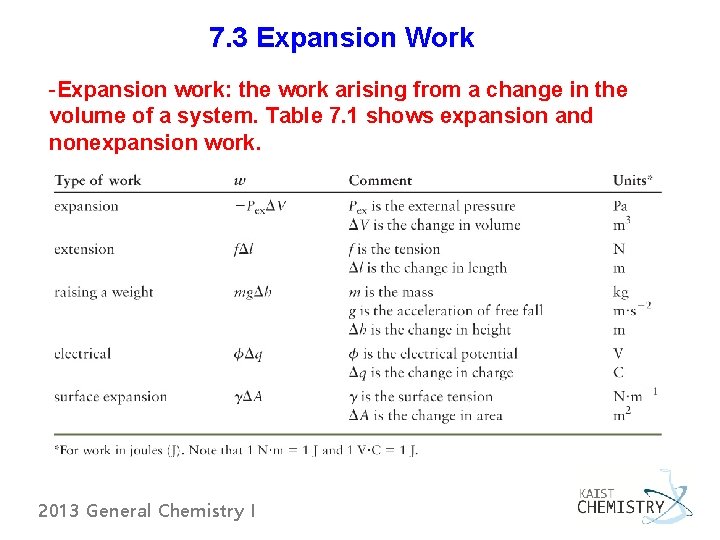
7. 3 Expansion Work -Expansion work: the work arising from a change in the volume of a system. Table 7. 1 shows expansion and nonexpansion work. 2013 General Chemistry I
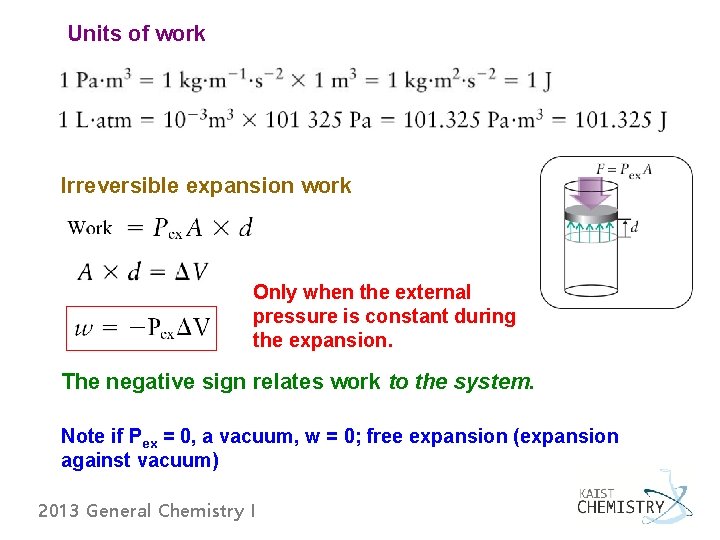
Units of work Irreversible expansion work Only when the external pressure is constant during the expansion. The negative sign relates work to the system. Note if Pex = 0, a vacuum, w = 0; free expansion (expansion against vacuum) 2013 General Chemistry I
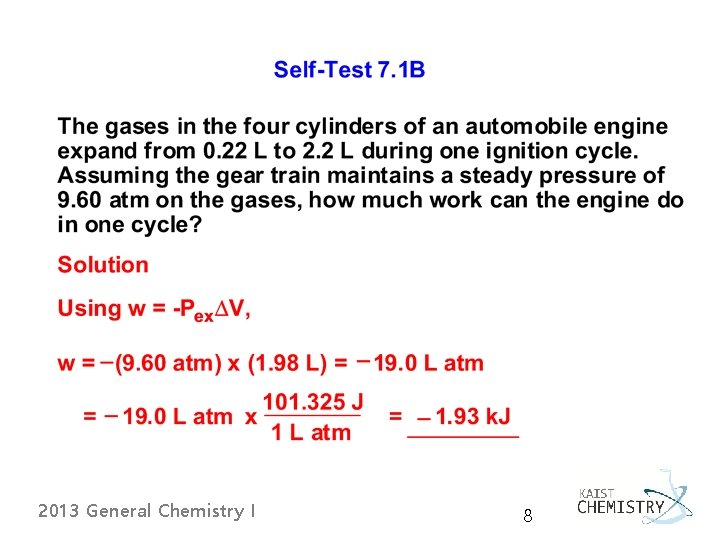
2013 General Chemistry I 8
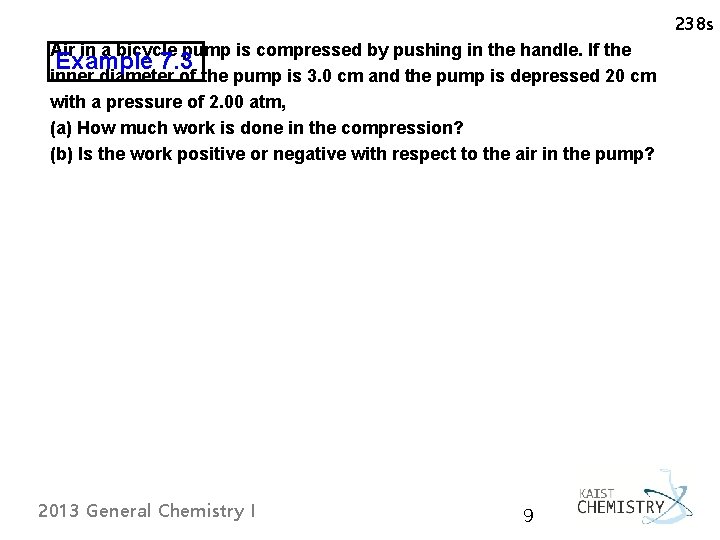
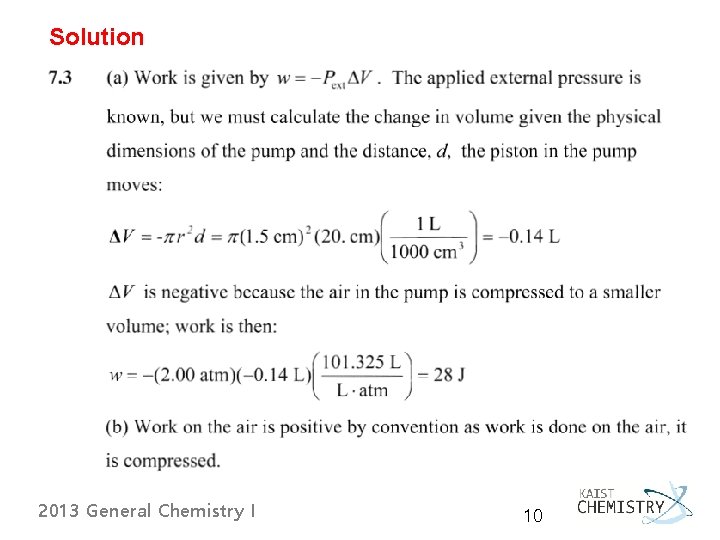
238 s Air in a bicycle pump is compressed by pushing in the handle. If the Example 7. 3 inner diameter of the pump is 3. 0 cm and the pump is depressed 20 cm with a pressure of 2. 00 atm, (a) How much work is done in the compression? (b) Is the work positive or negative with respect to the air in the pump? 2013 General Chemistry I 9
Solution 2013 General Chemistry I 10
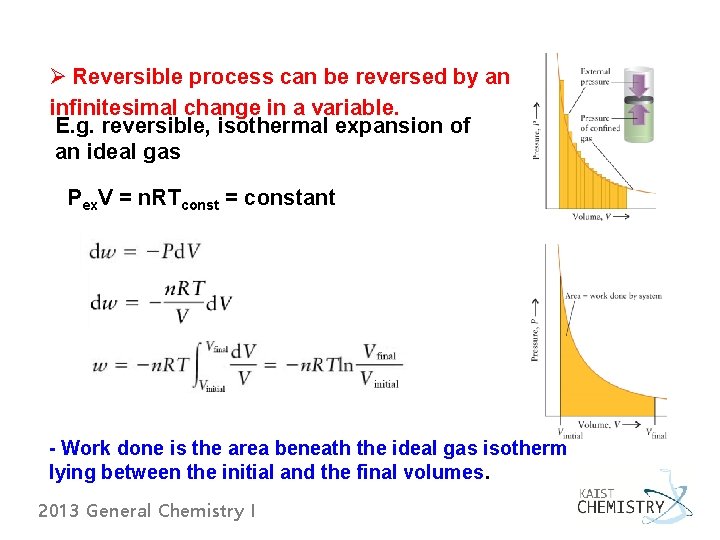
Ø Reversible process can be reversed by an infinitesimal change in a variable. E. g. reversible, isothermal expansion of an ideal gas Pex. V = n. RTconst = constant - Work done is the area beneath the ideal gas isotherm lying between the initial and the final volumes. 2013 General Chemistry I
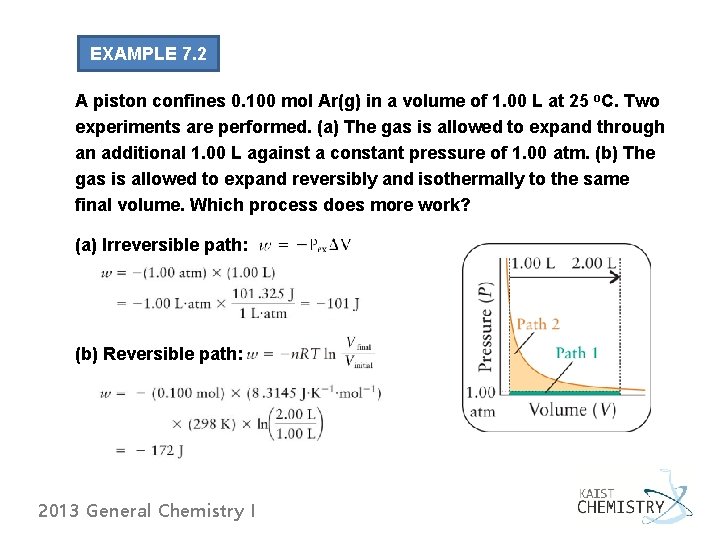
EXAMPLE 7. 2 A piston confines 0. 100 mol Ar(g) in a volume of 1. 00 L at 25 o. C. Two experiments are performed. (a) The gas is allowed to expand through an additional 1. 00 L against a constant pressure of 1. 00 atm. (b) The gas is allowed to expand reversibly and isothermally to the same final volume. Which process does more work? (a) Irreversible path: (b) Reversible path: 2013 General Chemistry I
2013 General Chemistry I 13
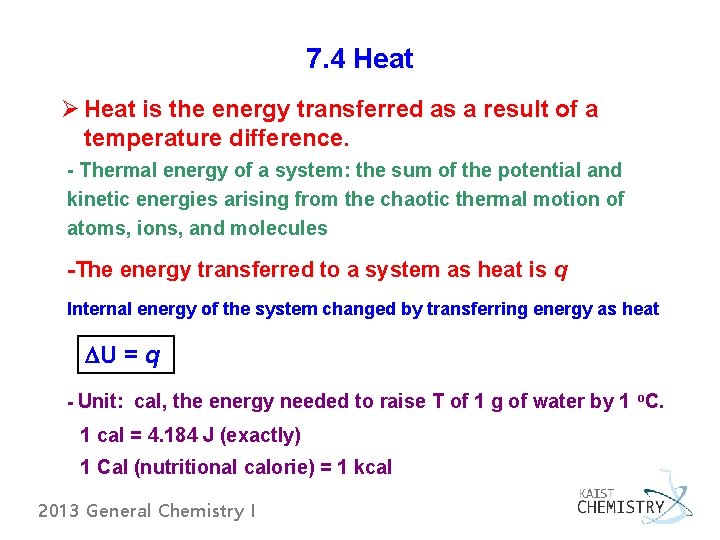
7. 4 Heat Ø Heat is the energy transferred as a result of a temperature difference. - Thermal energy of a system: the sum of the potential and kinetic energies arising from the chaotic thermal motion of atoms, ions, and molecules -The energy transferred to a system as heat is q Internal energy of the system changed by transferring energy as heat DU = q - Unit: cal, the energy needed to raise T of 1 g of water by 1 o. C. 1 cal = 4. 184 J (exactly) 1 Cal (nutritional calorie) = 1 kcal 2013 General Chemistry I
Ø Exothermic process: releasing heat into the surroundings - Thermite reaction: 2013 General Chemistry I Ø Endothermic process: absorbing heat from the surroundings
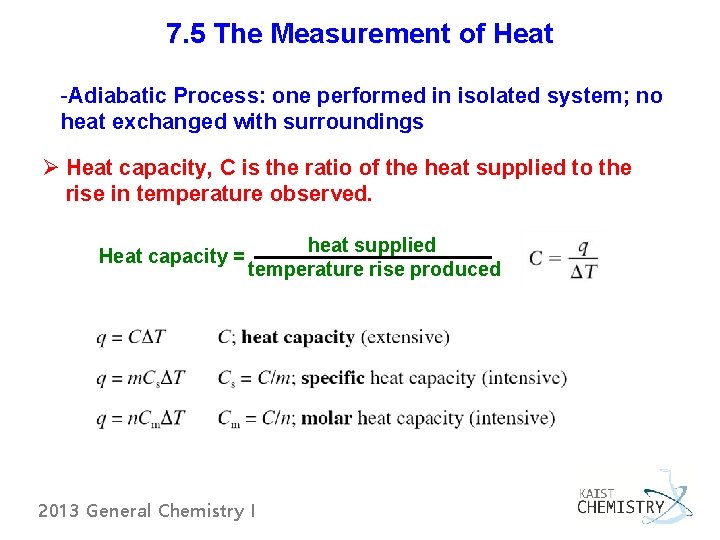
7. 5 The Measurement of Heat -Adiabatic Process: one performed in isolated system; no heat exchanged with surroundings Ø Heat capacity, C is the ratio of the heat supplied to the rise in temperature observed. Heat capacity = heat supplied temperature rise produced 2013 General Chemistry I
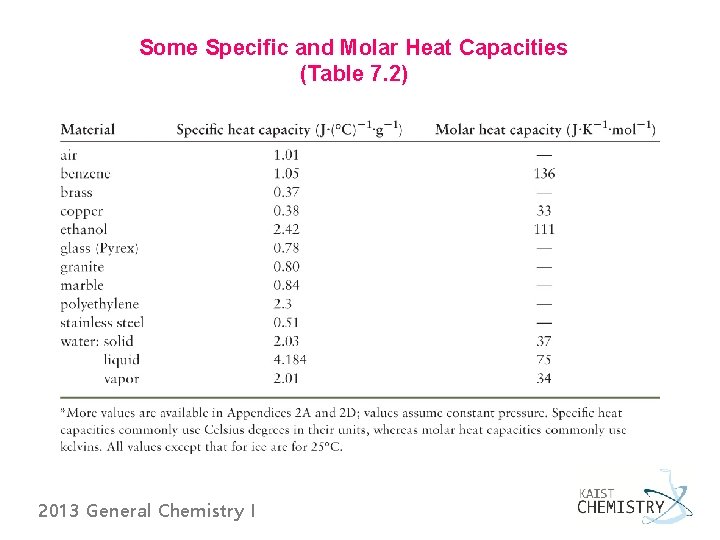
Some Specific and Molar Heat Capacities (Table 7. 2) 2013 General Chemistry I
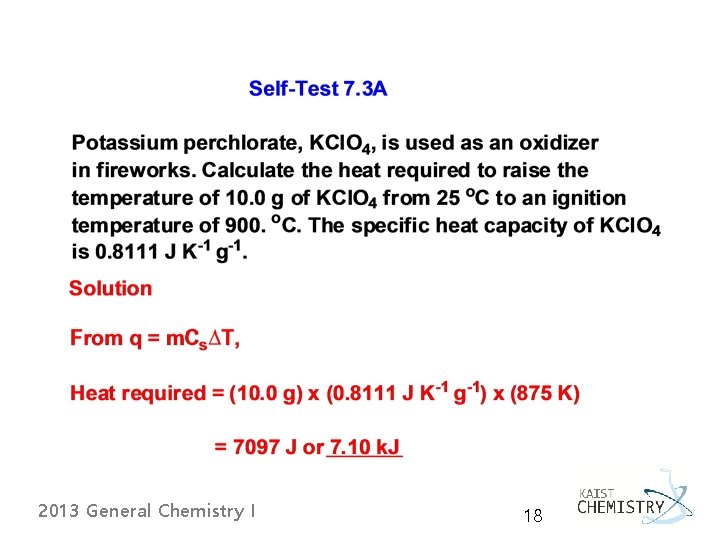
2013 General Chemistry I 18
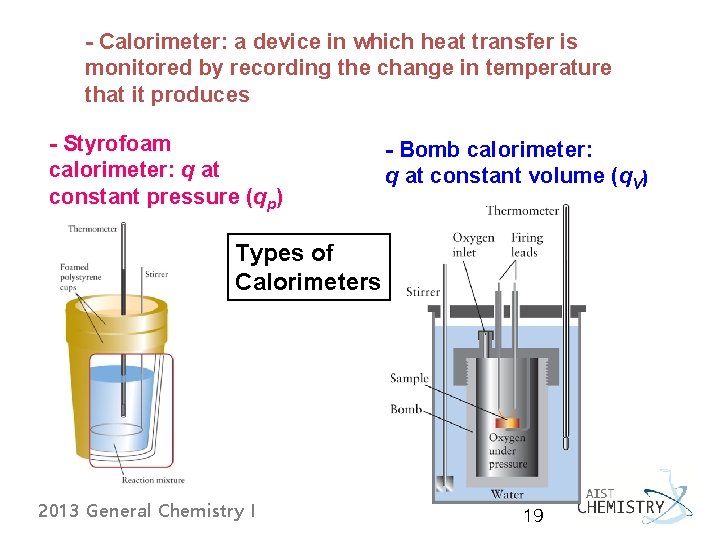
- Calorimeter: a device in which heat transfer is monitored by recording the change in temperature that it produces - Styrofoam calorimeter: q at constant pressure (qp) - Bomb calorimeter: q at constant volume (q. V) Types of Calorimeters 2013 General Chemistry I 19
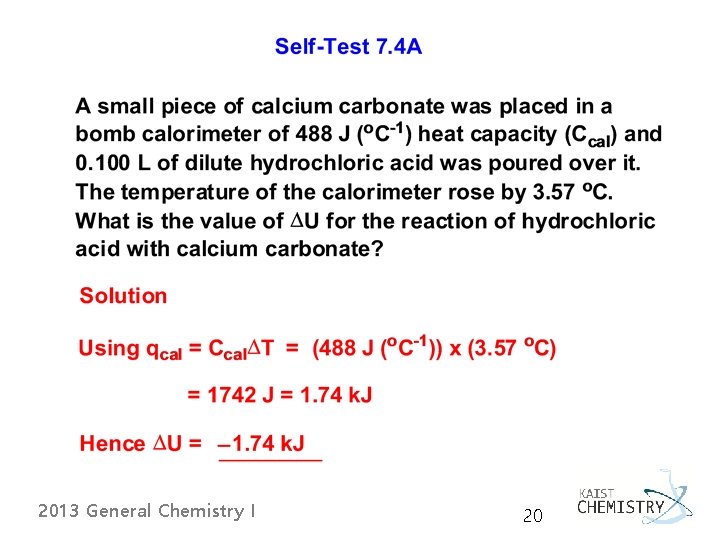
2013 General Chemistry I 20
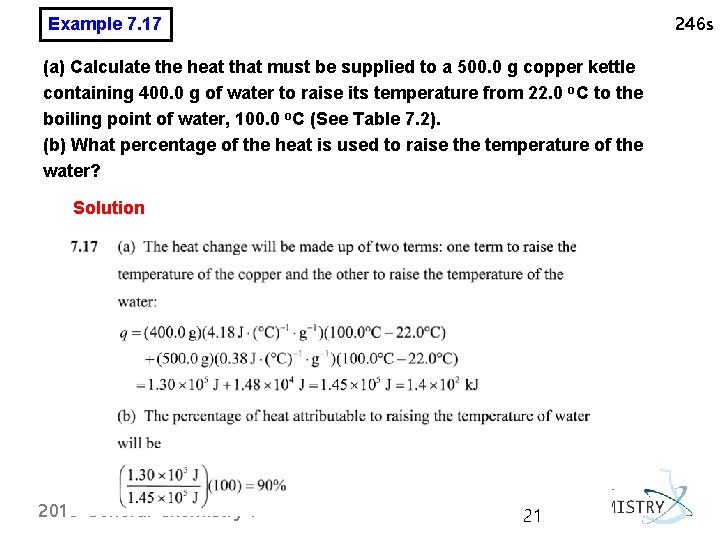
246 s Example 7. 17 (a) Calculate the heat that must be supplied to a 500. 0 g copper kettle containing 400. 0 g of water to raise its temperature from 22. 0 o. C to the boiling point of water, 100. 0 o. C (See Table 7. 2). (b) What percentage of the heat is used to raise the temperature of the water? Solution 2013 General Chemistry I 21
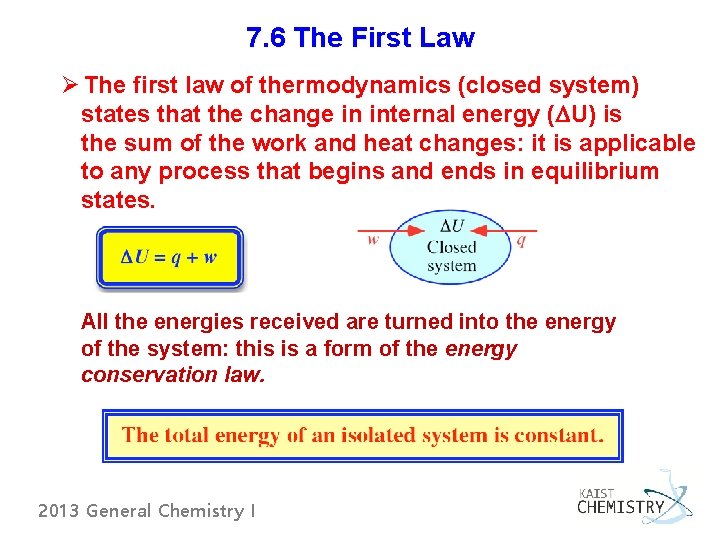
7. 6 The First Law Ø The first law of thermodynamics (closed system) states that the change in internal energy (DU) is the sum of the work and heat changes: it is applicable to any process that begins and ends in equilibrium states. All the energies received are turned into the energy of the system: this is a form of the energy conservation law. 2013 General Chemistry I
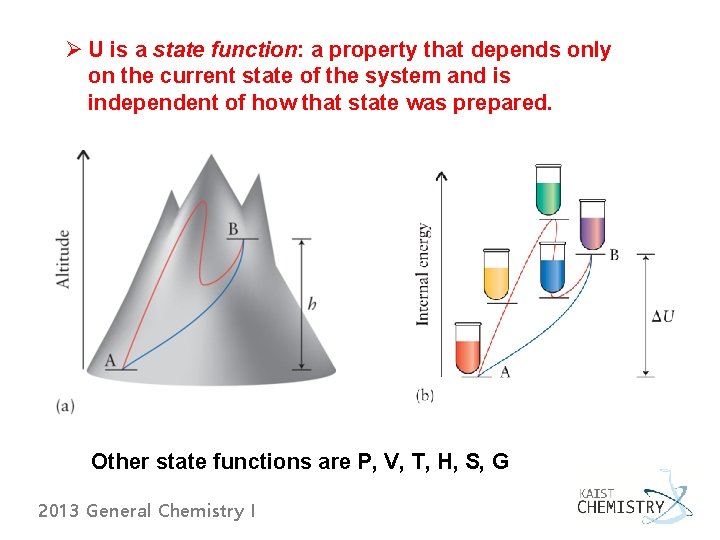
Ø U is a state function: a property that depends only on the current state of the system and is independent of how that state was prepared. Other state functions are P, V, T, H, S, G 2013 General Chemistry I
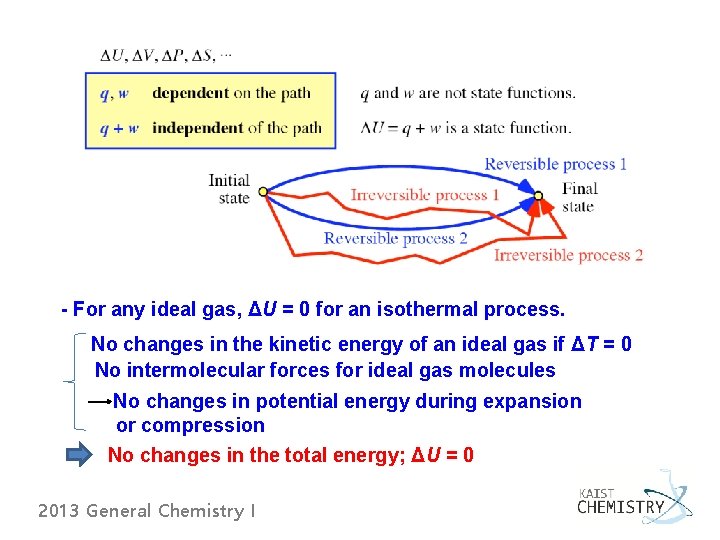
- For any ideal gas, ΔU = 0 for an isothermal process. No changes in the kinetic energy of an ideal gas if ΔT = 0 No intermolecular forces for ideal gas molecules No changes in potential energy during expansion or compression No changes in the total energy; ΔU = 0 2013 General Chemistry I
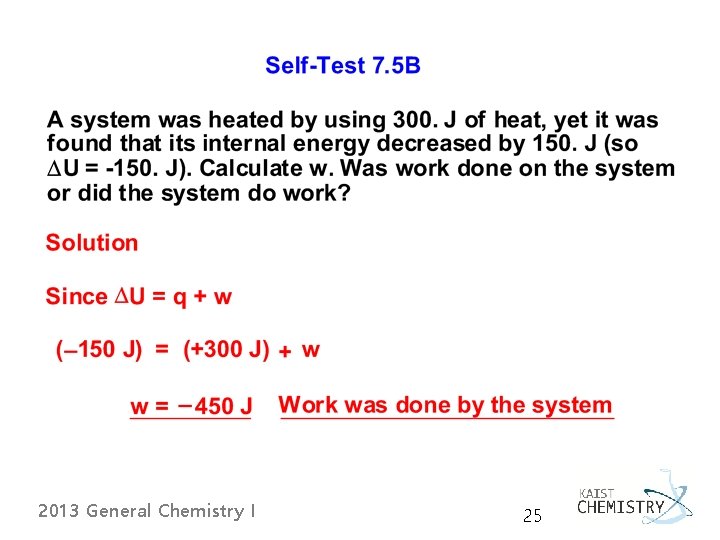
2013 General Chemistry I 25
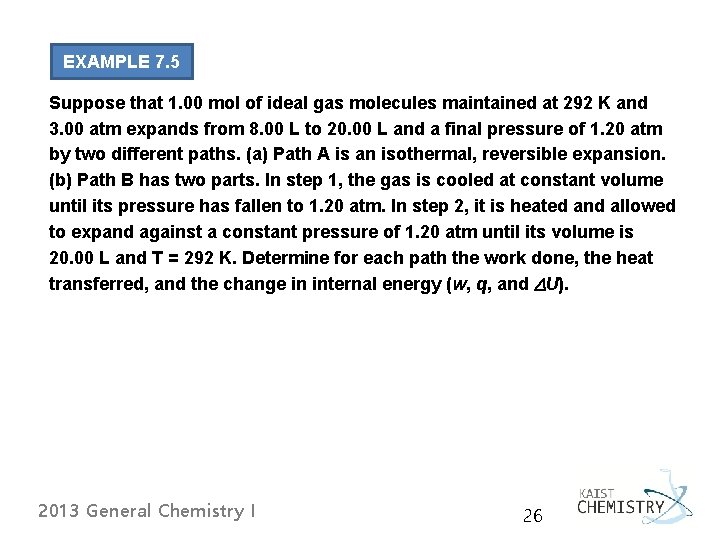
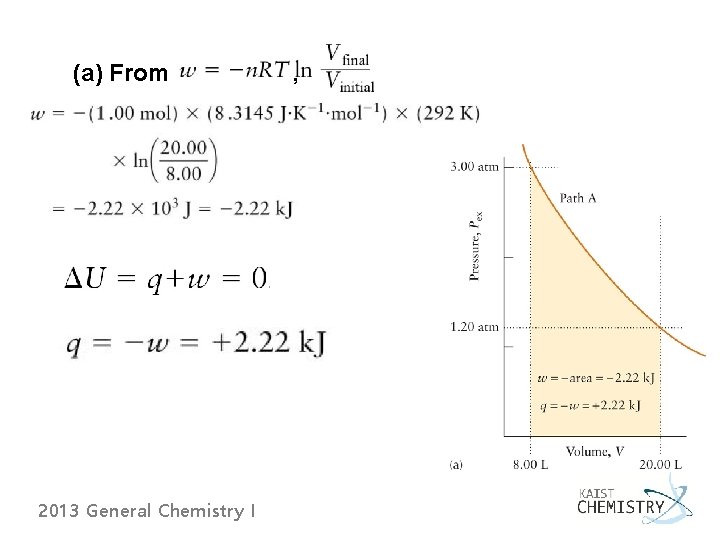
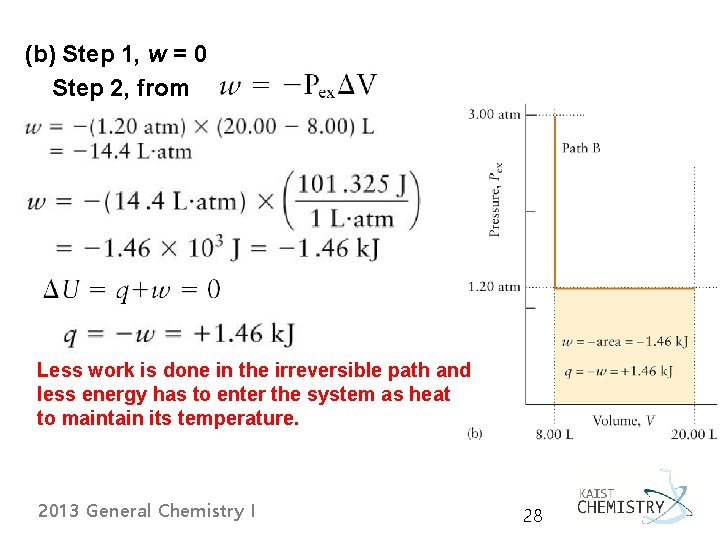
EXAMPLE 7. 5 Suppose that 1. 00 mol of ideal gas molecules maintained at 292 K and 3. 00 atm expands from 8. 00 L to 20. 00 L and a final pressure of 1. 20 atm by two different paths. (a) Path A is an isothermal, reversible expansion. (b) Path B has two parts. In step 1, the gas is cooled at constant volume until its pressure has fallen to 1. 20 atm. In step 2, it is heated and allowed to expand against a constant pressure of 1. 20 atm until its volume is 20. 00 L and T = 292 K. Determine for each path the work done, the heat transferred, and the change in internal energy (w, q, and DU). 2013 General Chemistry I 26
(a) From 2013 General Chemistry I ,
(b) Step 1, w = 0 Step 2, from Less work is done in the irreversible path and less energy has to enter the system as heat to maintain its temperature. 2013 General Chemistry I 28
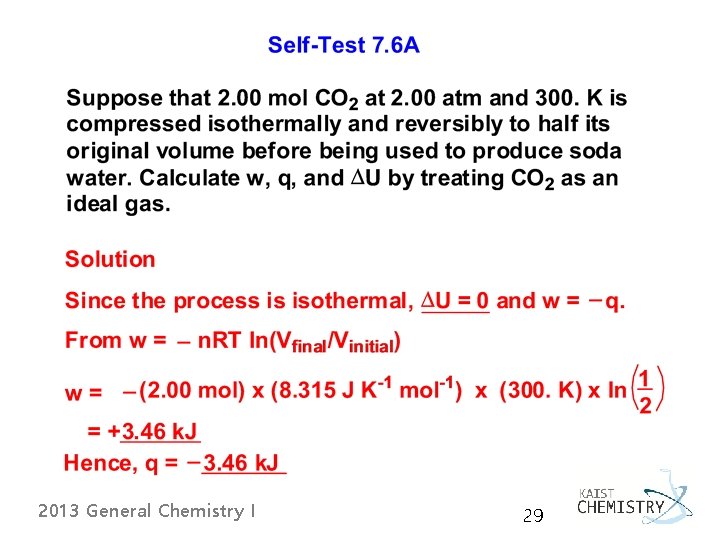
2013 General Chemistry I 29
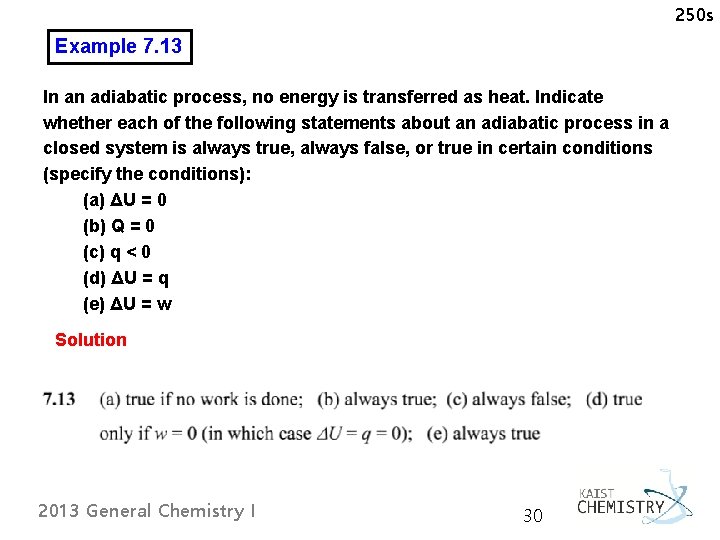
250 s Example 7. 13 In an adiabatic process, no energy is transferred as heat. Indicate whether each of the following statements about an adiabatic process in a closed system is always true, always false, or true in certain conditions (specify the conditions): (a) ΔU = 0 (b) Q = 0 (c) q < 0 (d) ΔU = q (e) ΔU = w Solution 2013 General Chemistry I 30
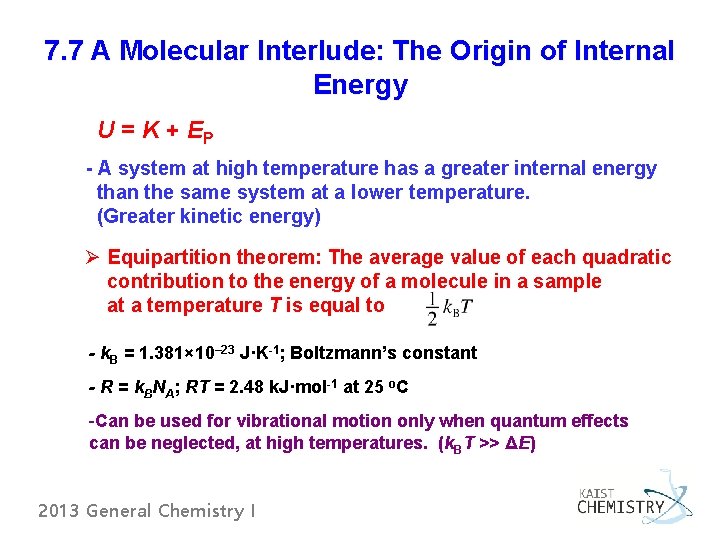
7. 7 A Molecular Interlude: The Origin of Internal Energy U = K + EP - A system at high temperature has a greater internal energy than the same system at a lower temperature. (Greater kinetic energy) Ø Equipartition theorem: The average value of each quadratic contribution to the energy of a molecule in a sample at a temperature T is equal to. - k. B = 1. 381× 10– 23 J·K-1; Boltzmann’s constant - R = k. BNA; RT = 2. 48 k. J·mol-1 at 25 o. C -Can be used for vibrational motion only when quantum effects can be neglected, at high temperatures. (k. BT >> ΔE) 2013 General Chemistry I
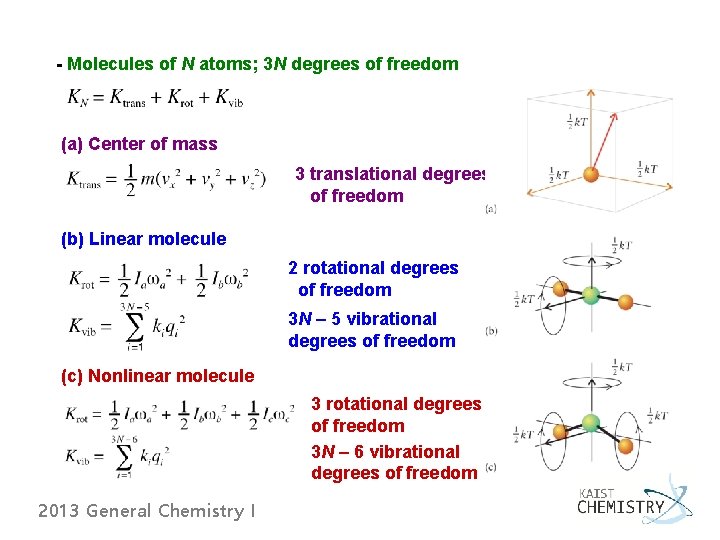
- Molecules of N atoms; 3 N degrees of freedom (a) Center of mass 3 translational degrees of freedom (b) Linear molecule 2 rotational degrees of freedom 3 N – 5 vibrational degrees of freedom (c) Nonlinear molecule 3 rotational degrees of freedom 3 N – 6 vibrational degrees of freedom 2013 General Chemistry I
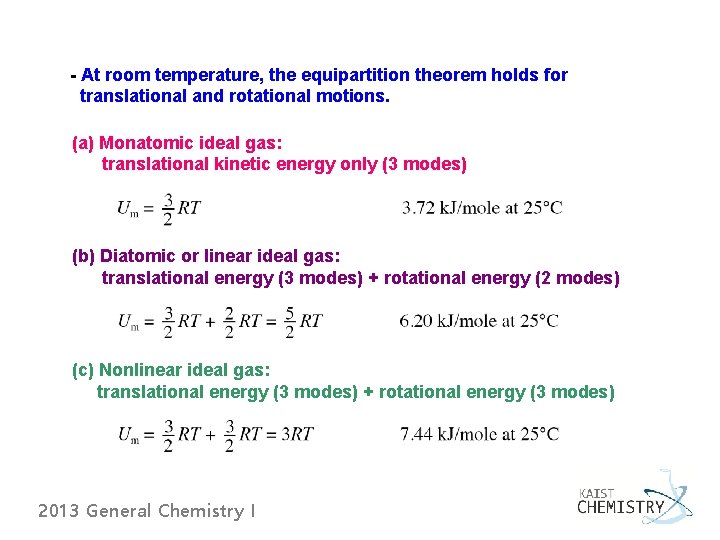
- At room temperature, the equipartition theorem holds for translational and rotational motions. (a) Monatomic ideal gas: translational kinetic energy only (3 modes) (b) Diatomic or linear ideal gas: translational energy (3 modes) + rotational energy (2 modes) (c) Nonlinear ideal gas: translational energy (3 modes) + rotational energy (3 modes) 2013 General Chemistry I
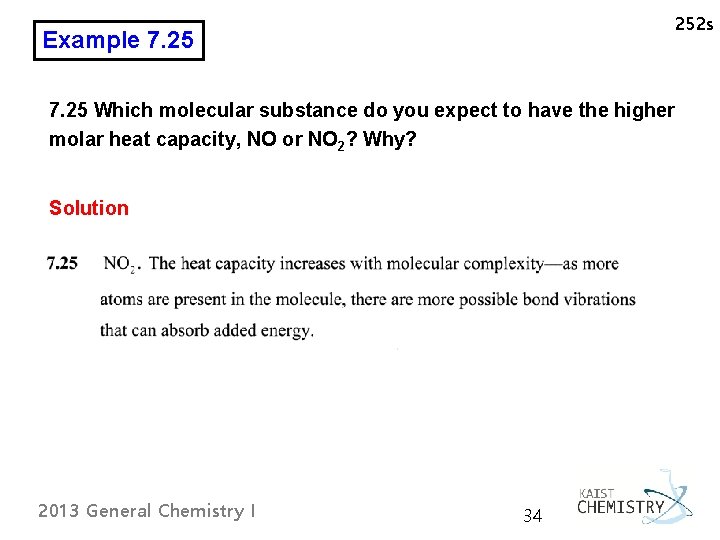
252 s Example 7. 25 Which molecular substance do you expect to have the higher molar heat capacity, NO or NO 2? Why? Solution 2013 General Chemistry I 34
Chapter 7. THERMODYNAMICS: THE FIRST LAW ENTHALPY 7. 8 Heat Transfers at Constant Pressure 7. 9 Heat Capacities at Constant Volume and Constant Pressure 7. 10 A Molecular Interlude: The Origin of the Heat Capacities of Gases 7. 11 The Enthalpy of Physical Change 7. 12 Heating Curves 2012 2013 General Chemistry II
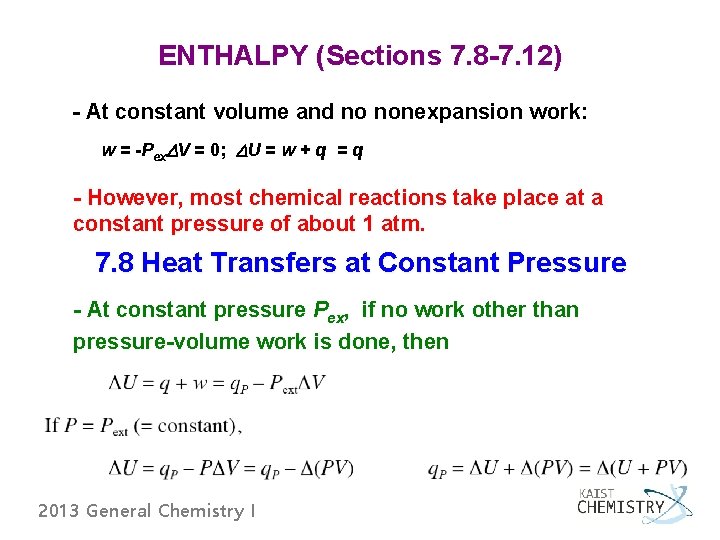
ENTHALPY (Sections 7. 8 -7. 12) - At constant volume and no nonexpansion work: w = -Pex. DV = 0; DU = w + q = q - However, most chemical reactions take place at a constant pressure of about 1 atm. 7. 8 Heat Transfers at Constant Pressure - At constant pressure Pex, if no work other than pressure-volume work is done, then 2013 General Chemistry I
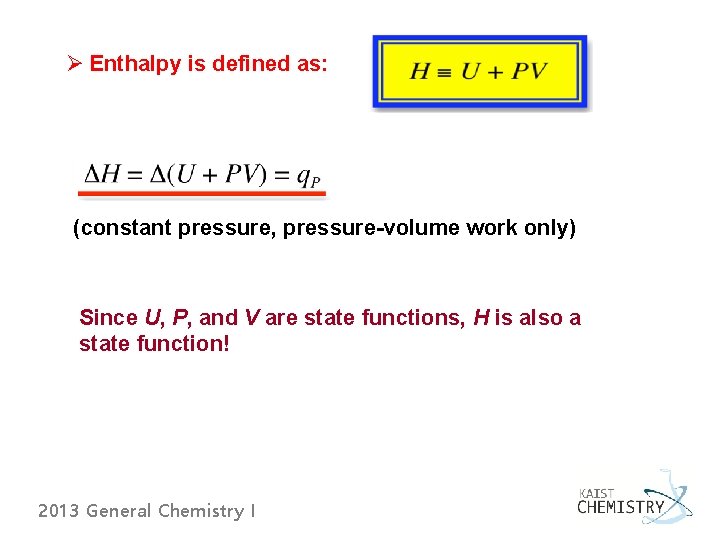
Ø Enthalpy is defined as: (constant pressure, pressure-volume work only) Since U, P, and V are state functions, H is also a state function! 2013 General Chemistry I
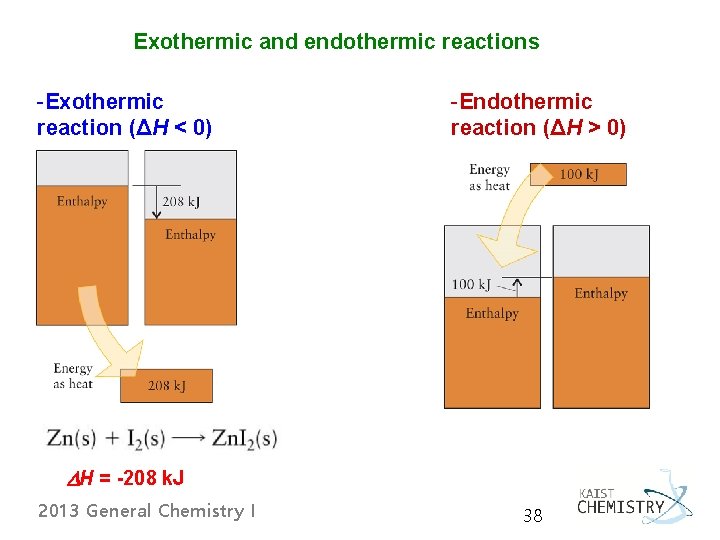
Exothermic and endothermic reactions -Exothermic reaction (ΔH < 0) -Endothermic reaction (ΔH > 0) DH = -208 k. J 2013 General Chemistry I 38
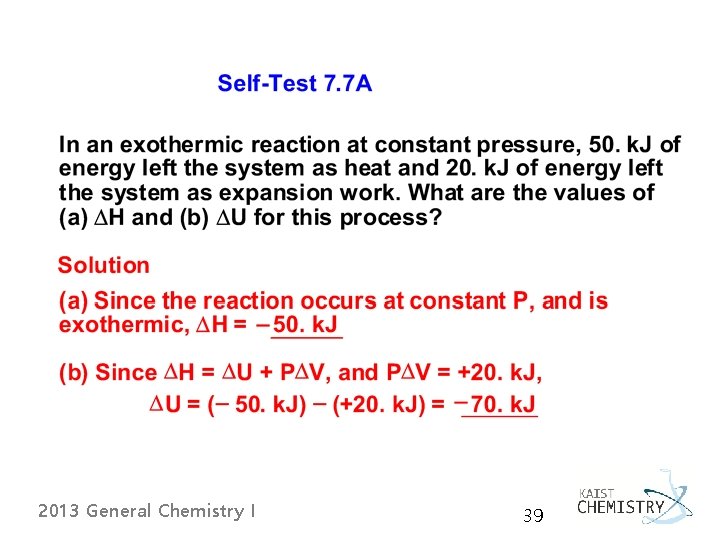
2013 General Chemistry I 39
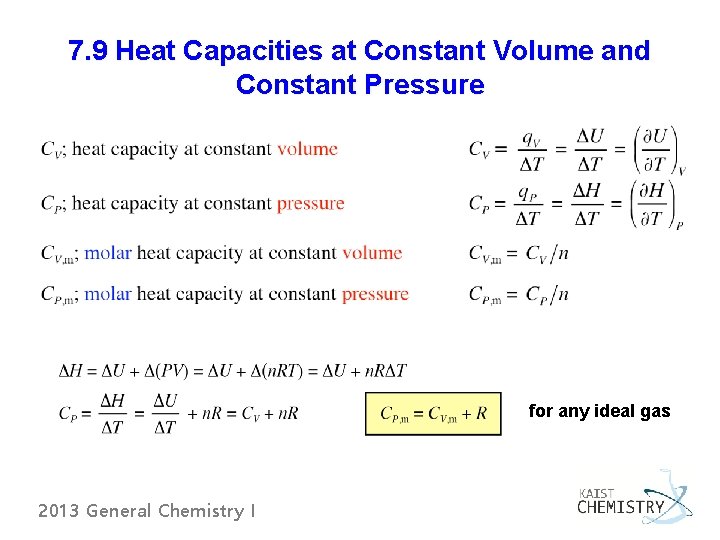
7. 9 Heat Capacities at Constant Volume and Constant Pressure for any ideal gas 2013 General Chemistry I
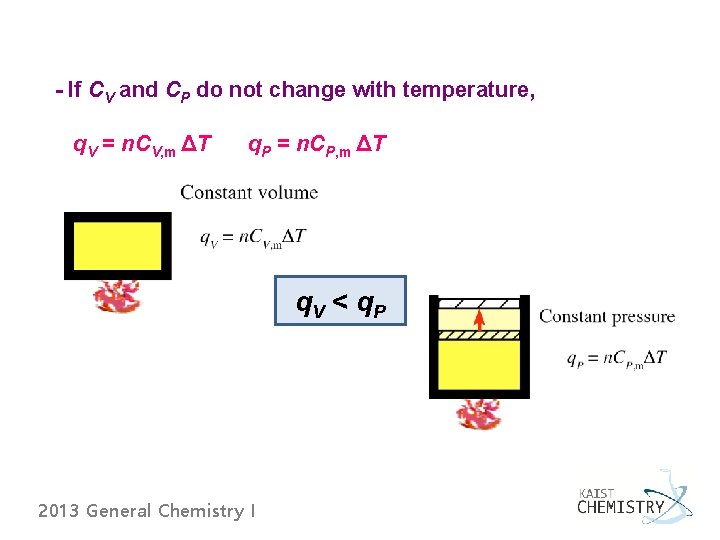
- If CV and CP do not change with temperature, q. V = n. CV, m ΔT q. P = n. CP, m ΔT q. V < q. P 2013 General Chemistry I
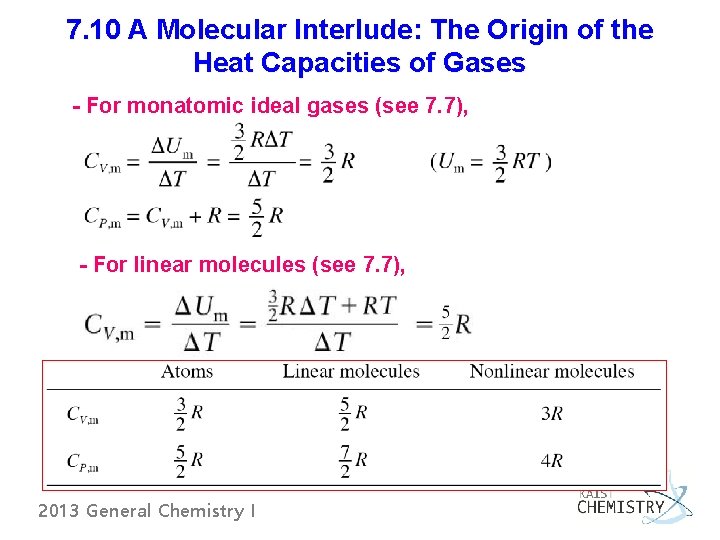
7. 10 A Molecular Interlude: The Origin of the Heat Capacities of Gases - For monatomic ideal gases (see 7. 7), - For linear molecules (see 7. 7), 2013 General Chemistry I
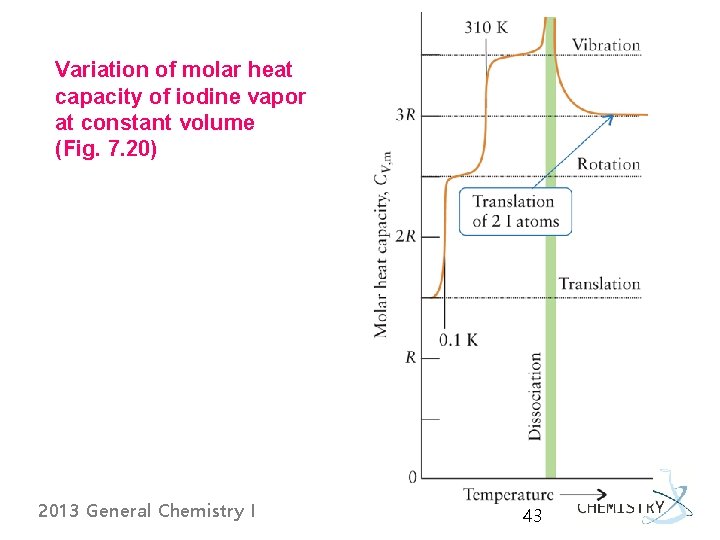
Variation of molar heat capacity of iodine vapor at constant volume (Fig. 7. 20) 2013 General Chemistry I 43
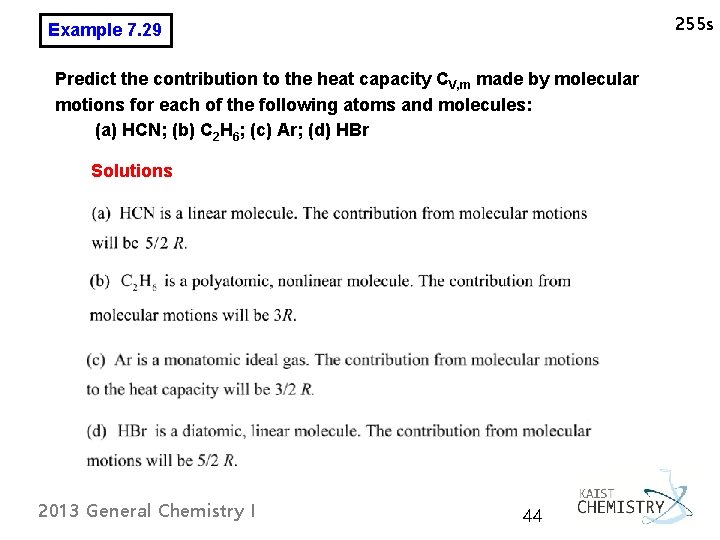
255 s Example 7. 29 Predict the contribution to the heat capacity CV, m made by molecular motions for each of the following atoms and molecules: (a) HCN; (b) C 2 H 6; (c) Ar; (d) HBr Solutions 2013 General Chemistry I 44
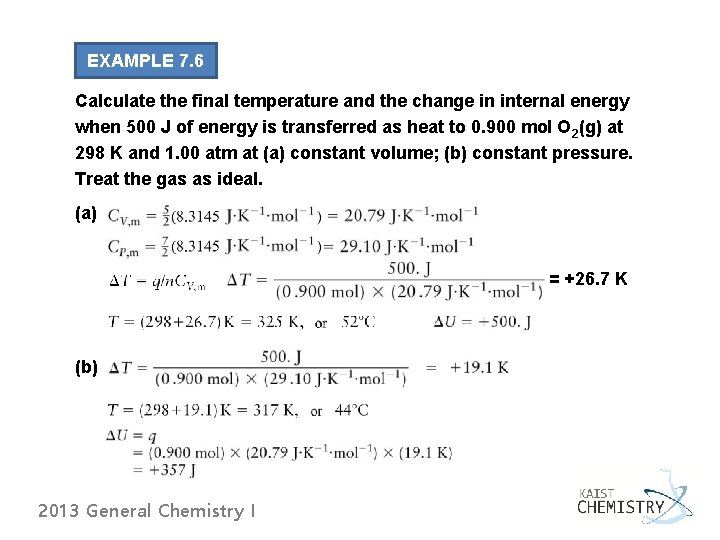
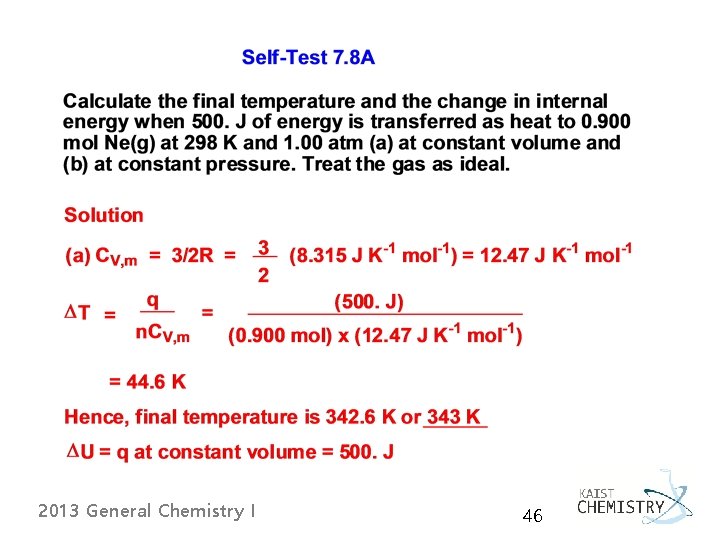
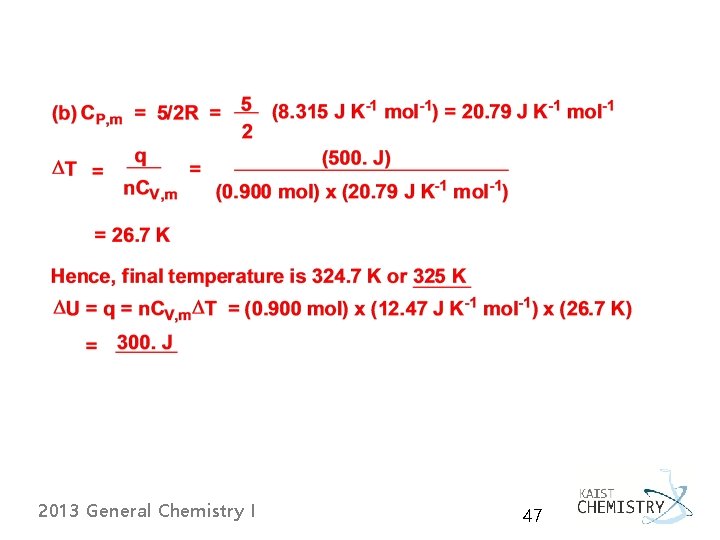
EXAMPLE 7. 6 Calculate the final temperature and the change in internal energy when 500 J of energy is transferred as heat to 0. 900 mol O 2(g) at 298 K and 1. 00 atm at (a) constant volume; (b) constant pressure. Treat the gas as ideal. (a) = +26. 7 K (b) 2013 General Chemistry I
2013 General Chemistry I 46
2013 General Chemistry I 47
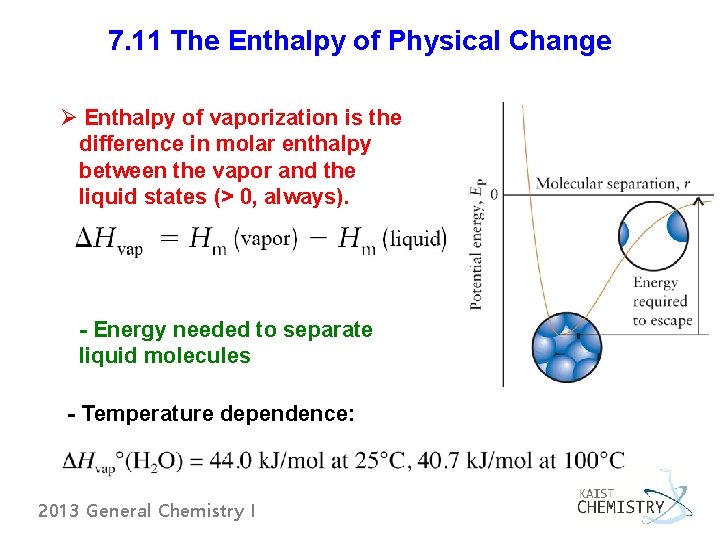
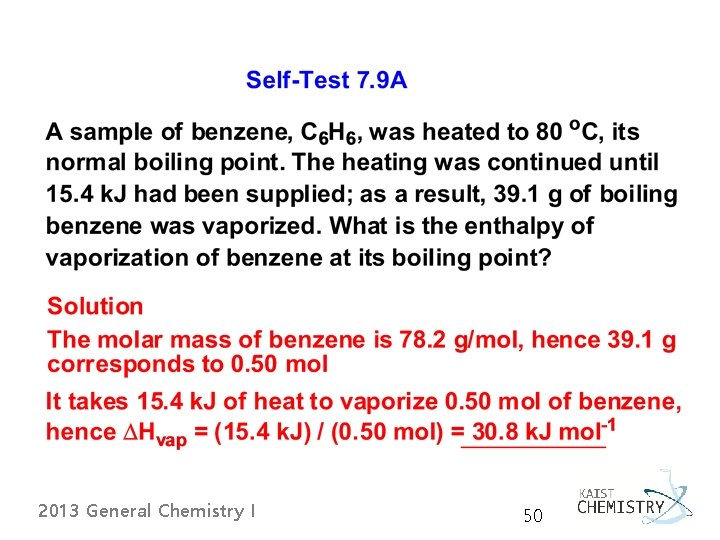
7. 11 The Enthalpy of Physical Change Ø Enthalpy of vaporization is the difference in molar enthalpy between the vapor and the liquid states (> 0, always). - Energy needed to separate liquid molecules - Temperature dependence: 2013 General Chemistry I
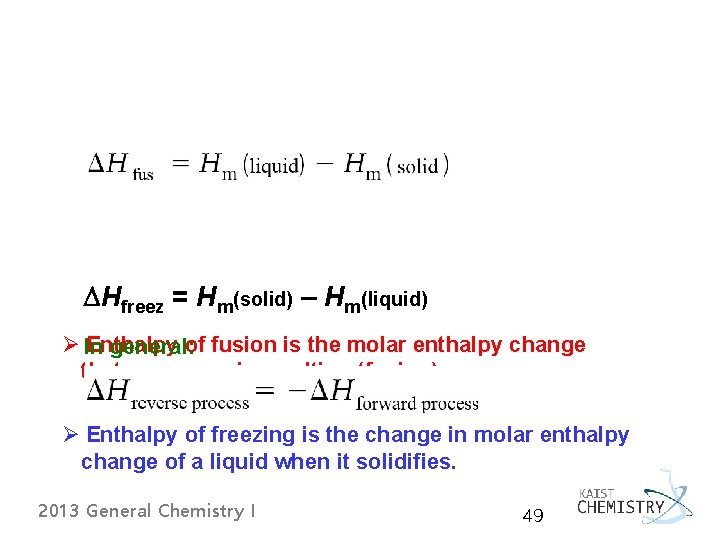
DHfreez = Hm(solid) – Hm(liquid) Ø In Enthalpy general: of fusion is the molar enthalpy change that accompanies melting (fusion). Ø Enthalpy of freezing is the change in molar enthalpy change of a liquid when it solidifies. 2013 General Chemistry I 49
2013 General Chemistry I 50
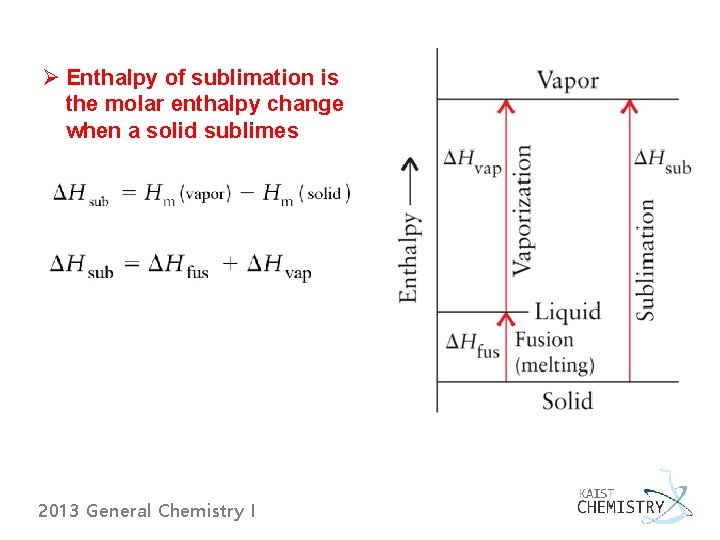
Ø Enthalpy of sublimation is the molar enthalpy change when a solid sublimes 2013 General Chemistry I
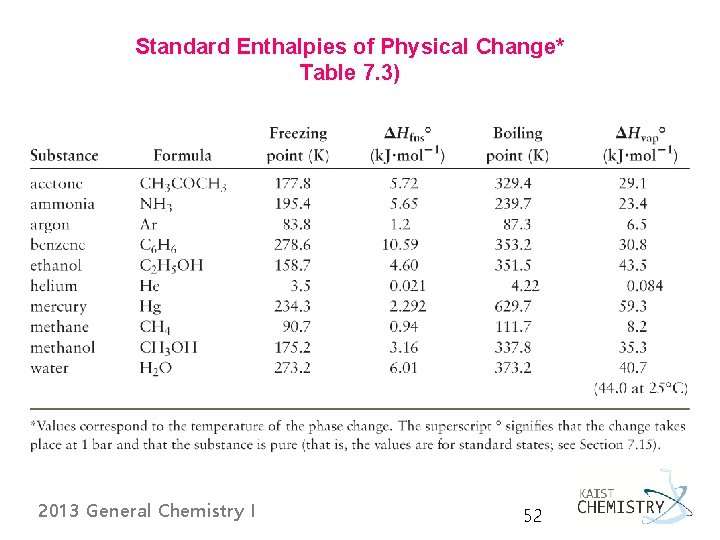
Standard Enthalpies of Physical Change* Table 7. 3) 2013 General Chemistry I 52
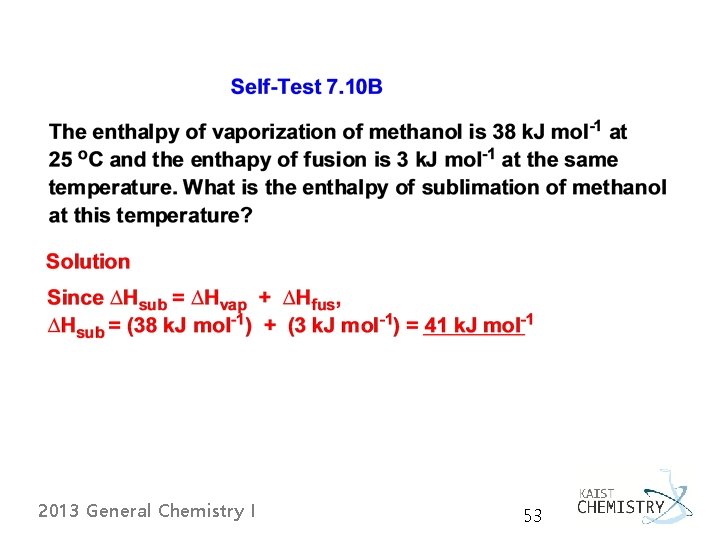
2013 General Chemistry I 53
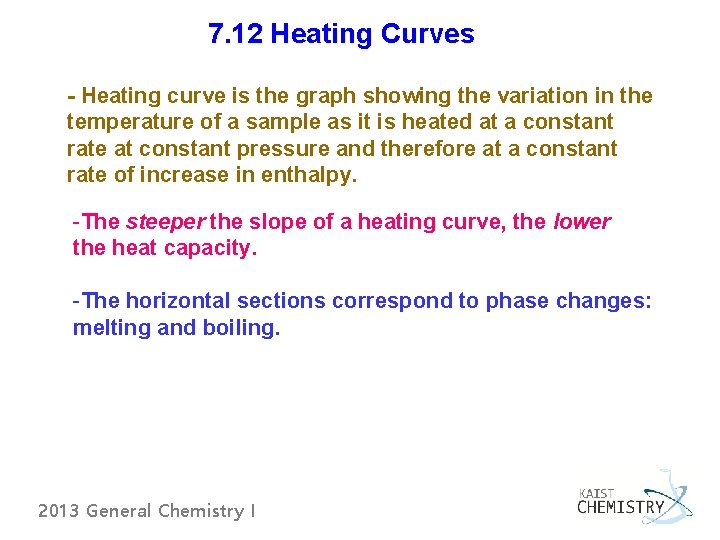
7. 12 Heating Curves - Heating curve is the graph showing the variation in the temperature of a sample as it is heated at a constant rate at constant pressure and therefore at a constant rate of increase in enthalpy. -The steeper the slope of a heating curve, the lower the heat capacity. -The horizontal sections correspond to phase changes: melting and boiling. 2013 General Chemistry I
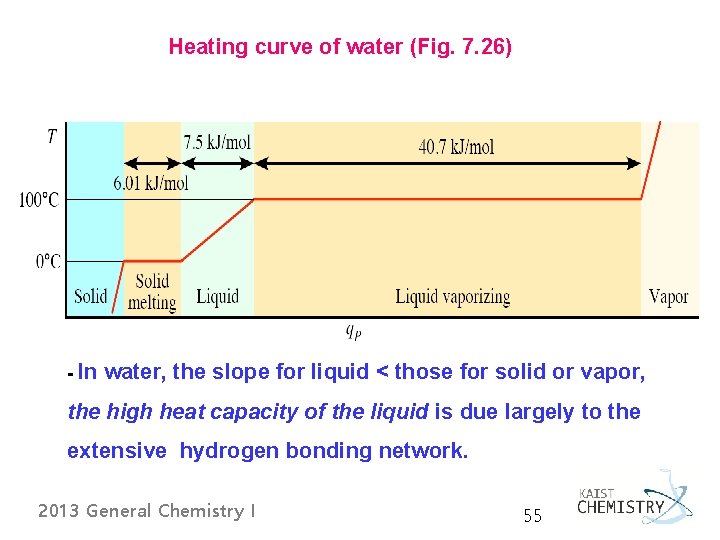
Heating curve of water (Fig. 7. 26) - In water, the slope for liquid < those for solid or vapor, the high heat capacity of the liquid is due largely to the extensive hydrogen bonding network. 2013 General Chemistry I 55
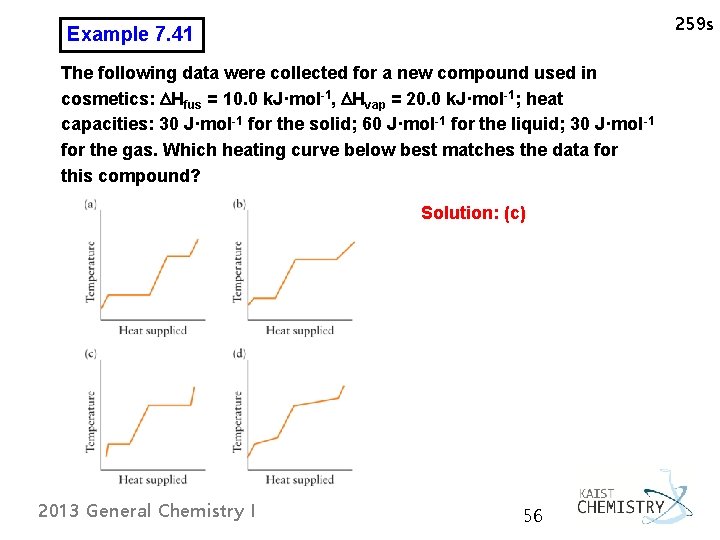
259 s Example 7. 41 The following data were collected for a new compound used in cosmetics: DHfus = 10. 0 k. J·mol-1, DHvap = 20. 0 k. J·mol-1; heat capacities: 30 J·mol-1 for the solid; 60 J·mol-1 for the liquid; 30 J·mol-1 for the gas. Which heating curve below best matches the data for this compound? Solution: (c) 2013 General Chemistry I 56
Chapter 7. THERMODYNAMICS: THE FIRST LAW THE ENTHALPY OF CHEMICAL CHANGE 7. 13 Reaction Enthalpies 7. 14 The Relation Between DH and DU 7. 15 Standard Reaction Enthalpies 7. 16 Combining Reaction Enthalpies: Hess’s Law 7. 17 The Heat Output of Reactions 7. 18 Standard Reaction Enthalpies 7. 19 The Born-Haber Cycle 7. 20 Bond Enthalpies 7. 21 The Variation of Reaction Enthalpy with Temperature 2012 2013 General Chemistry II
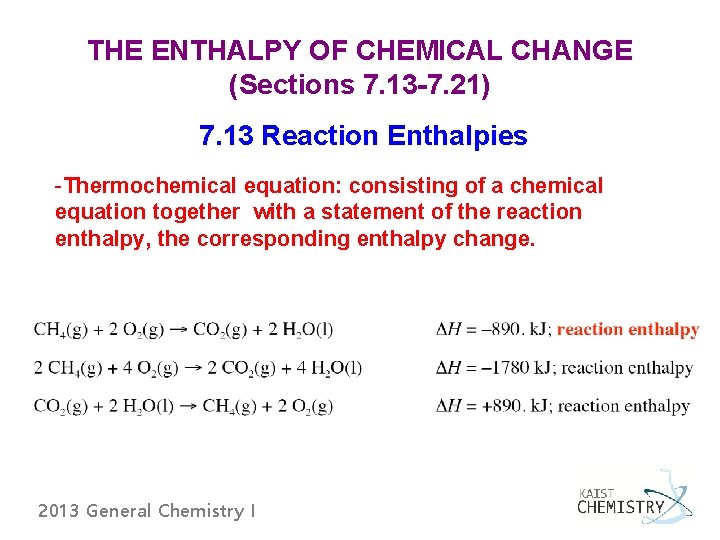
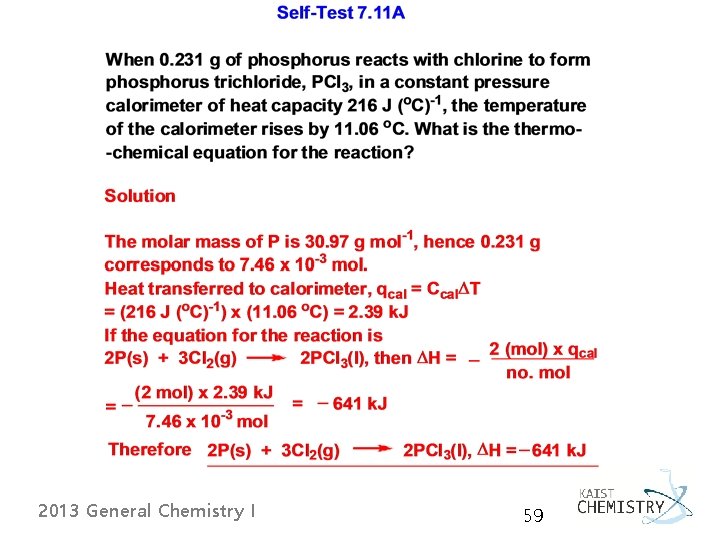
THE ENTHALPY OF CHEMICAL CHANGE (Sections 7. 13 -7. 21) 7. 13 Reaction Enthalpies -Thermochemical equation: consisting of a chemical equation together with a statement of the reaction enthalpy, the corresponding enthalpy change. 2013 General Chemistry I
2013 General Chemistry I 59
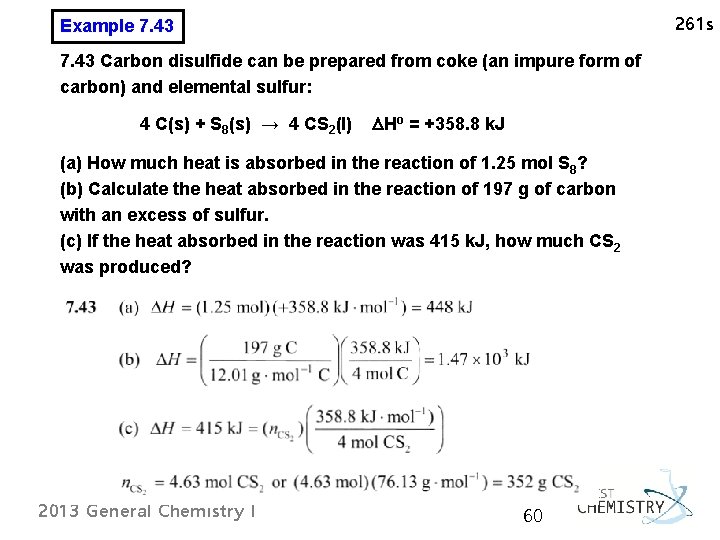
261 s Example 7. 43 Carbon disulfide can be prepared from coke (an impure form of carbon) and elemental sulfur: 4 C(s) + S 8(s) → 4 CS 2(l) DHo = +358. 8 k. J (a) How much heat is absorbed in the reaction of 1. 25 mol S 8? (b) Calculate the heat absorbed in the reaction of 197 g of carbon with an excess of sulfur. (c) If the heat absorbed in the reaction was 415 k. J, how much CS 2 was produced? 2013 General Chemistry I 60
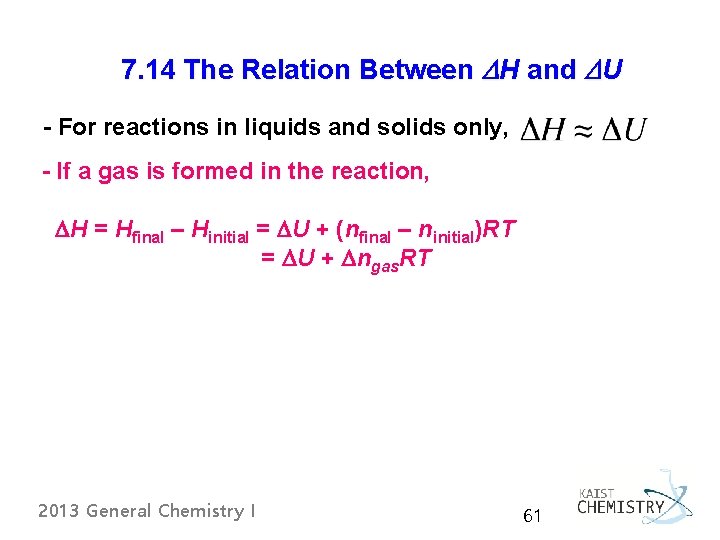
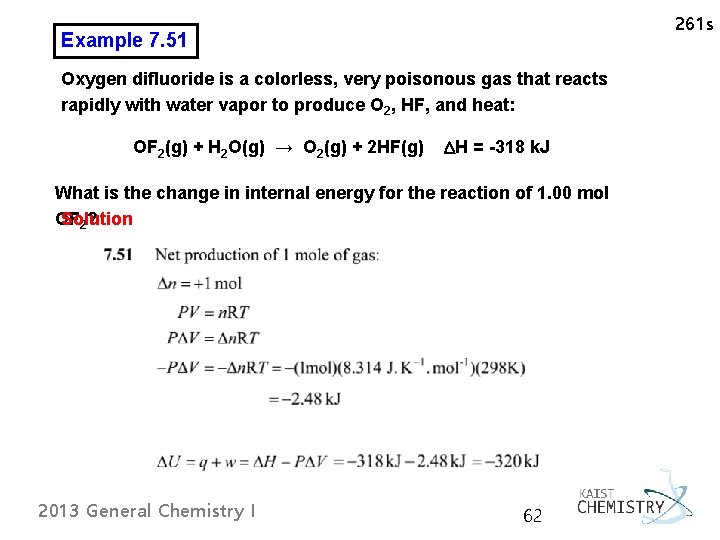
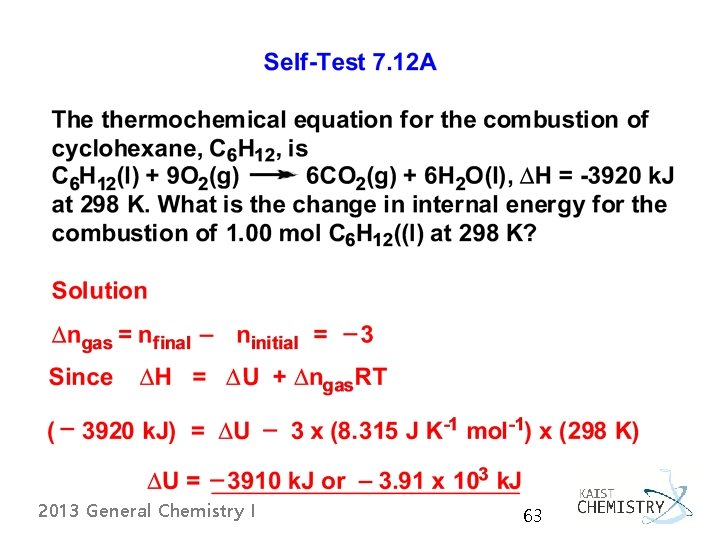
7. 14 The Relation Between DH and DU - For reactions in liquids and solids only, - If a gas is formed in the reaction, DH = Hfinal – Hinitial = DU + (nfinal – ninitial)RT = DU + Dngas. RT 2013 General Chemistry I 61
261 s Example 7. 51 Oxygen difluoride is a colorless, very poisonous gas that reacts rapidly with water vapor to produce O 2, HF, and heat: OF 2(g) + H 2 O(g) → O 2(g) + 2 HF(g) DH = -318 k. J What is the change in internal energy for the reaction of 1. 00 mol OF Solution 2? 2013 General Chemistry I 62
2013 General Chemistry I 63
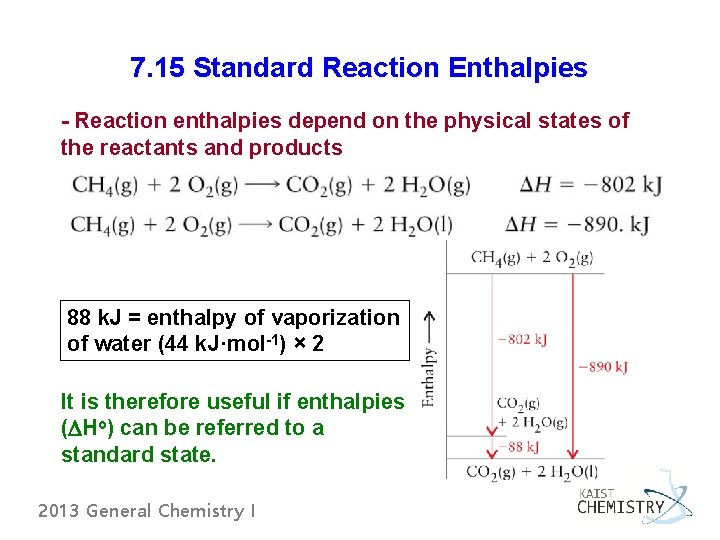
7. 15 Standard Reaction Enthalpies - Reaction enthalpies depend on the physical states of the reactants and products 88 k. J = enthalpy of vaporization of water (44 k. J·mol-1) × 2 It is therefore useful if enthalpies (DHo) can be referred to a standard state. 2013 General Chemistry I
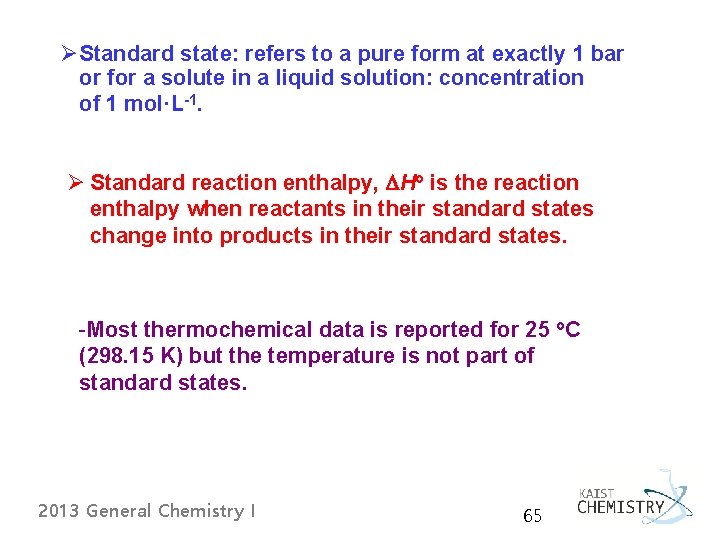
ØStandard state: refers to a pure form at exactly 1 bar or for a solute in a liquid solution: concentration of 1 mol·L-1. Ø Standard reaction enthalpy, DHo is the reaction enthalpy when reactants in their standard states change into products in their standard states. -Most thermochemical data is reported for 25 o. C (298. 15 K) but the temperature is not part of standard states. 2013 General Chemistry I 65
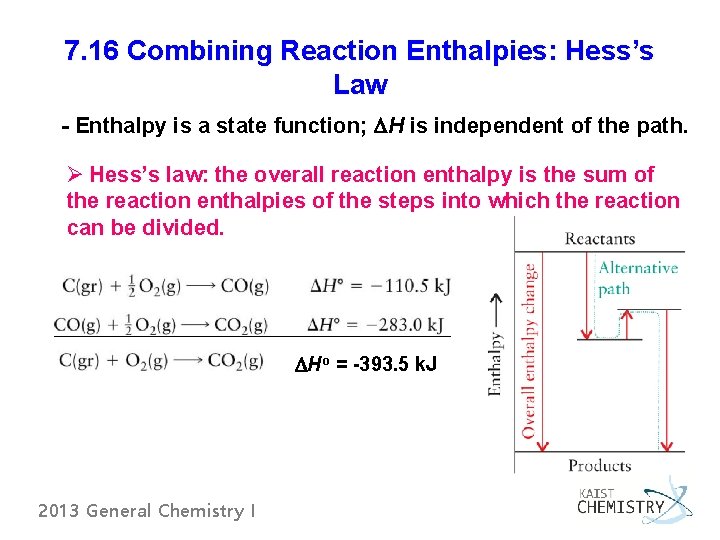
7. 16 Combining Reaction Enthalpies: Hess’s Law - Enthalpy is a state function; DH is independent of the path. Ø Hess’s law: the overall reaction enthalpy is the sum of the reaction enthalpies of the steps into which the reaction can be divided. DHo = -393. 5 k. J 2013 General Chemistry I
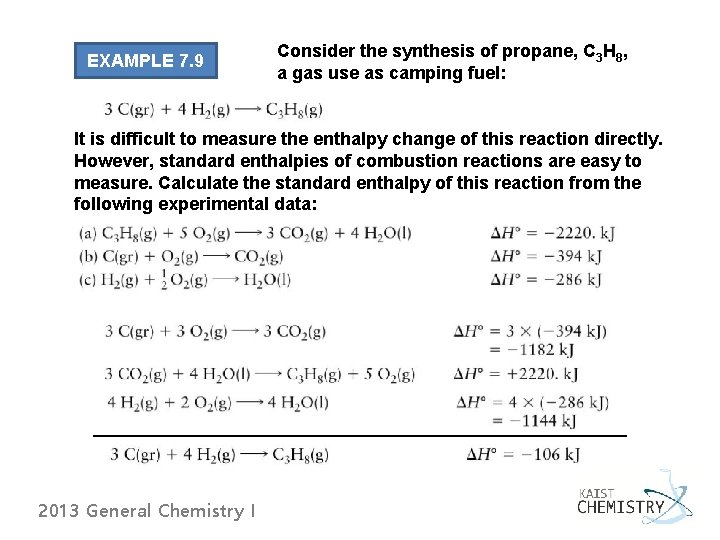
EXAMPLE 7. 9 Consider the synthesis of propane, C 3 H 8, a gas use as camping fuel: It is difficult to measure the enthalpy change of this reaction directly. However, standard enthalpies of combustion reactions are easy to measure. Calculate the standard enthalpy of this reaction from the following experimental data: 2013 General Chemistry I
2013 General Chemistry I 68
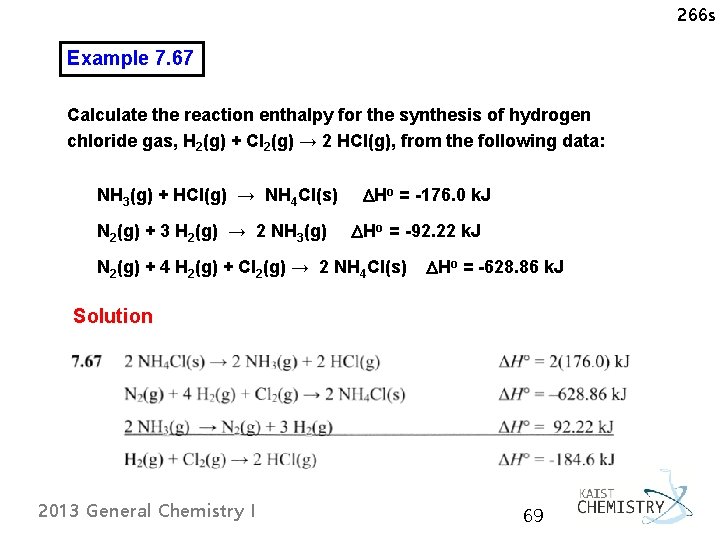
266 s Example 7. 67 Calculate the reaction enthalpy for the synthesis of hydrogen chloride gas, H 2(g) + Cl 2(g) → 2 HCl(g), from the following data: NH 3(g) + HCl(g) → NH 4 Cl(s) N 2(g) + 3 H 2(g) → 2 NH 3(g) DHo = -176. 0 k. J DHo = -92. 22 k. J N 2(g) + 4 H 2(g) + Cl 2(g) → 2 NH 4 Cl(s) DHo = -628. 86 k. J Solution 2013 General Chemistry I 69
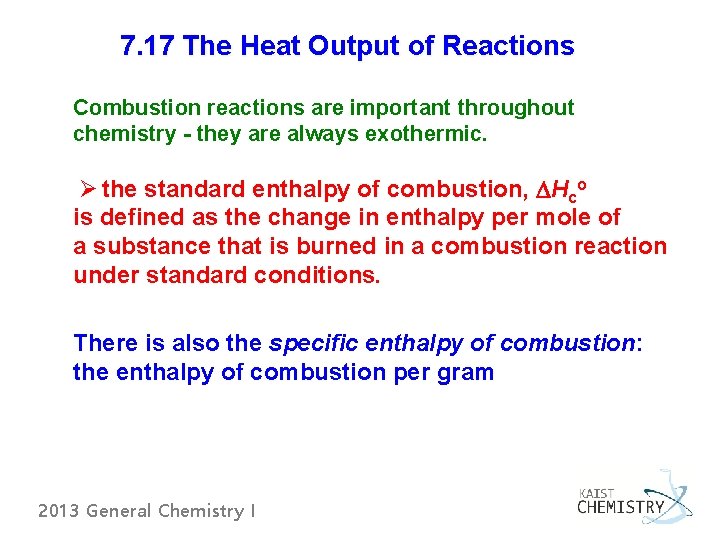
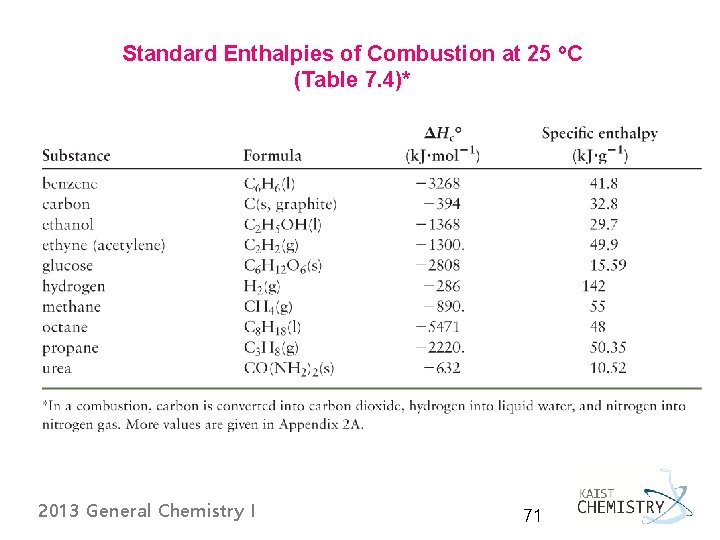
7. 17 The Heat Output of Reactions Combustion reactions are important throughout chemistry - they are always exothermic. Ø the standard enthalpy of combustion, DHco is defined as the change in enthalpy per mole of a substance that is burned in a combustion reaction under standard conditions. There is also the specific enthalpy of combustion: the enthalpy of combustion per gram 2013 General Chemistry I
Standard Enthalpies of Combustion at 25 o. C (Table 7. 4)* 2013 General Chemistry I 71
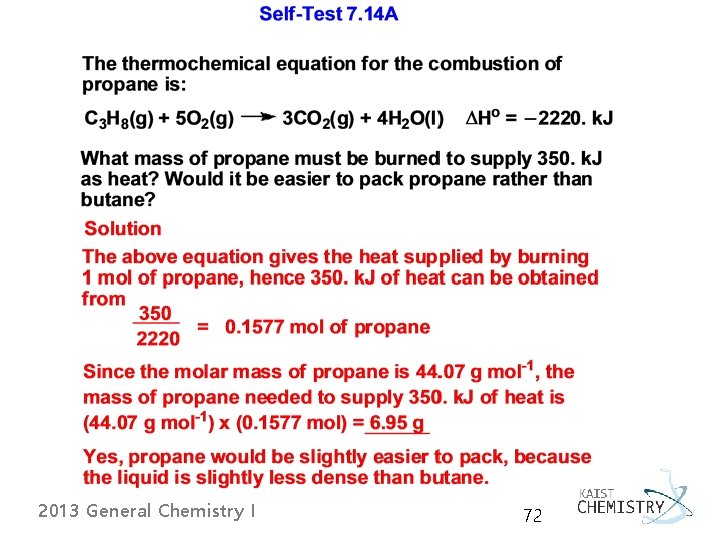
2013 General Chemistry I 72
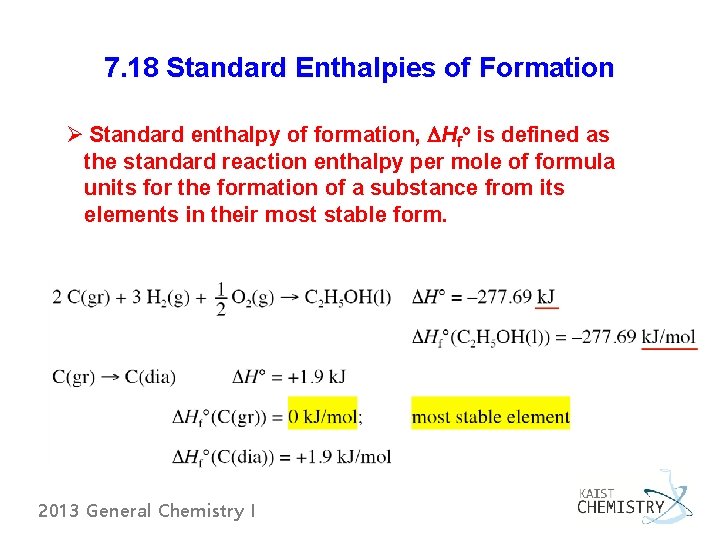
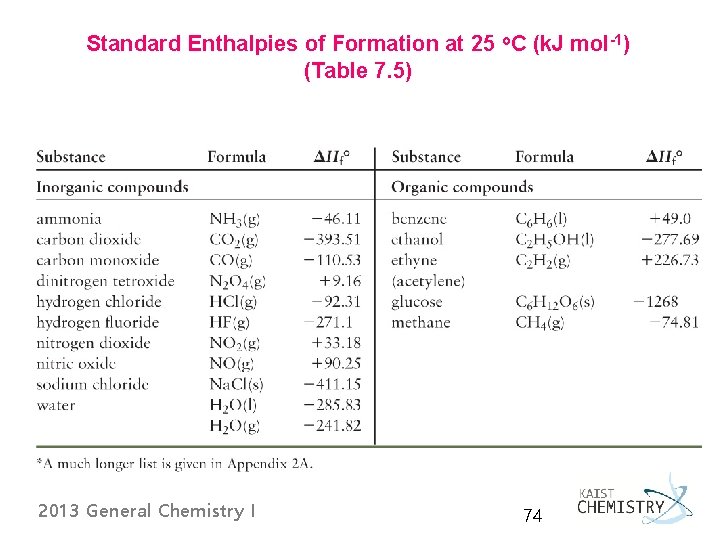
7. 18 Standard Enthalpies of Formation Ø Standard enthalpy of formation, DHfo is defined as the standard reaction enthalpy per mole of formula units for the formation of a substance from its elements in their most stable form. 2013 General Chemistry I
Standard Enthalpies of Formation at 25 o. C (k. J mol-1) (Table 7. 5) 2013 General Chemistry I 74
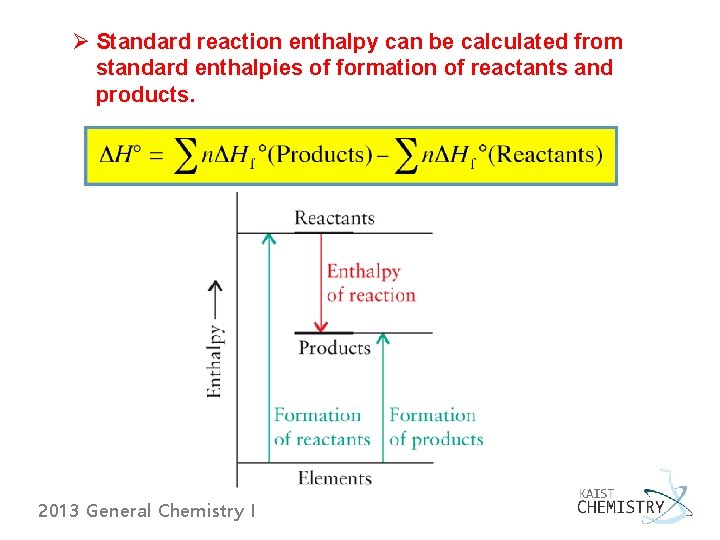
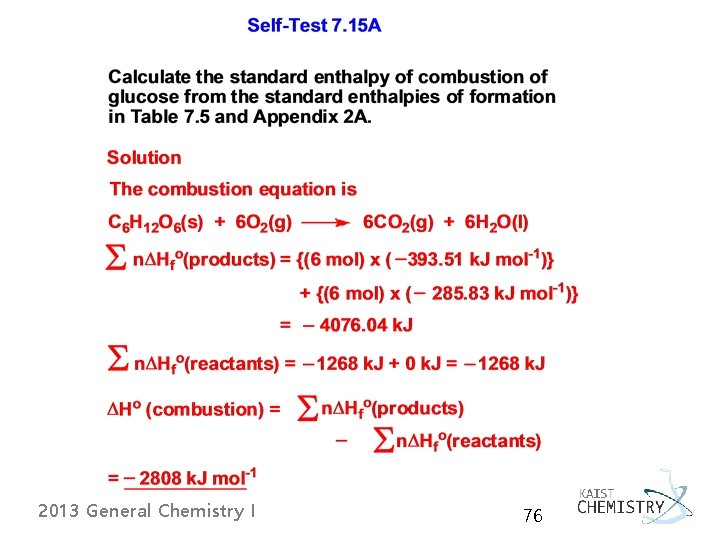
Ø Standard reaction enthalpy can be calculated from standard enthalpies of formation of reactants and products. 2013 General Chemistry I
2013 General Chemistry I 76
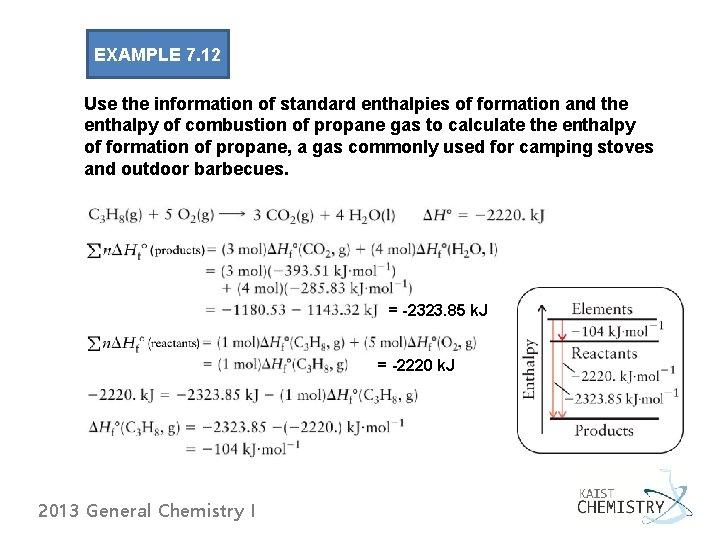
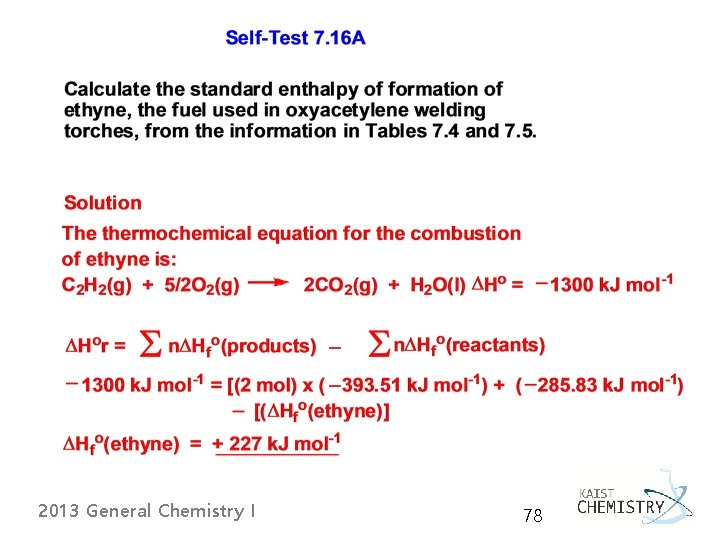
EXAMPLE 7. 12 Use the information of standard enthalpies of formation and the enthalpy of combustion of propane gas to calculate the enthalpy of formation of propane, a gas commonly used for camping stoves and outdoor barbecues. = -2323. 85 k. J = -2220 k. J 2013 General Chemistry I
2013 General Chemistry I 78
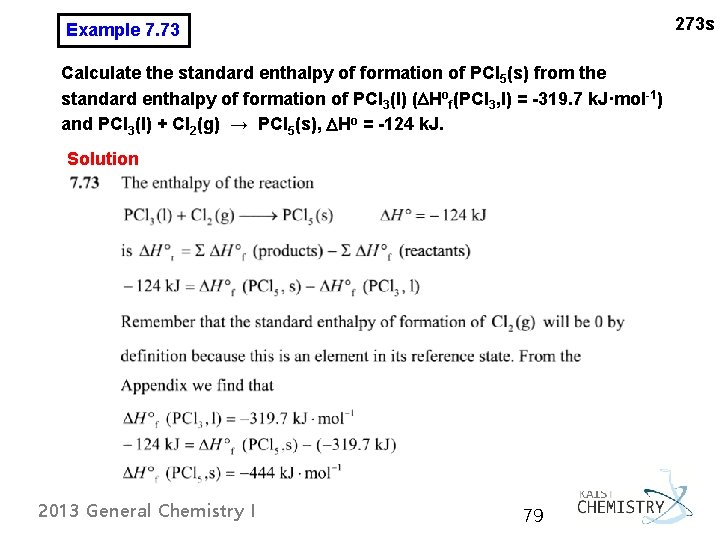
273 s Example 7. 73 Calculate the standard enthalpy of formation of PCl 5(s) from the standard enthalpy of formation of PCl 3(l) (DHof(PCl 3, l) = -319. 7 k. J·mol-1) and PCl 3(l) + Cl 2(g) → PCl 5(s), DHo = -124 k. J. Solution 2013 General Chemistry I 79
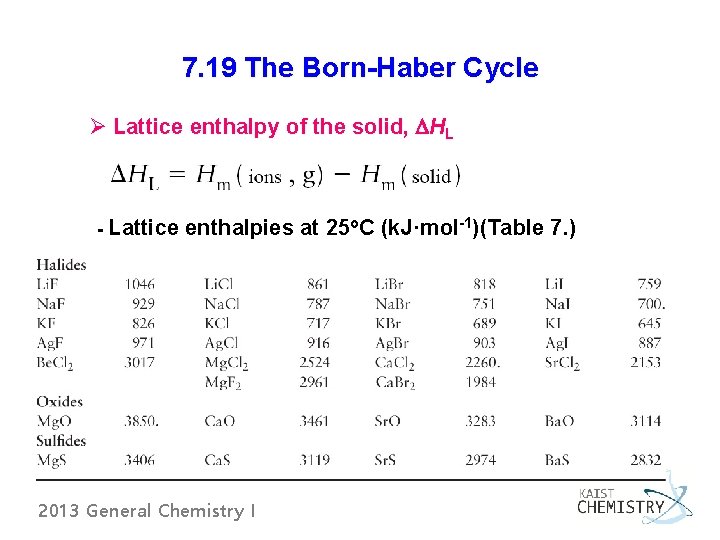
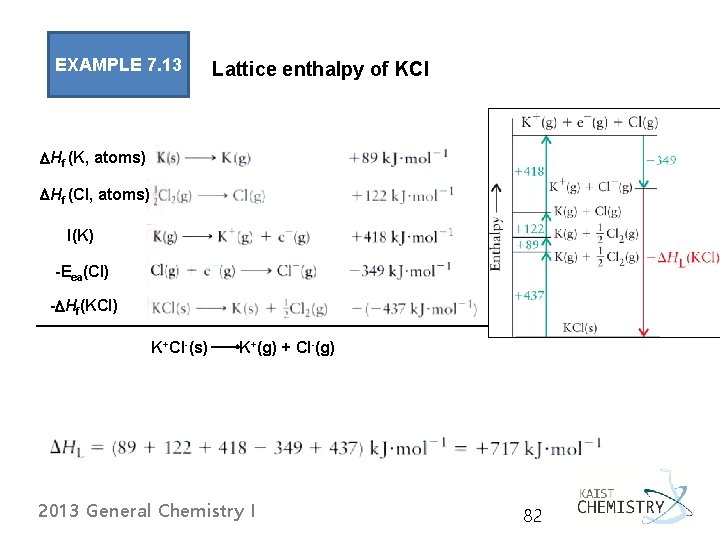
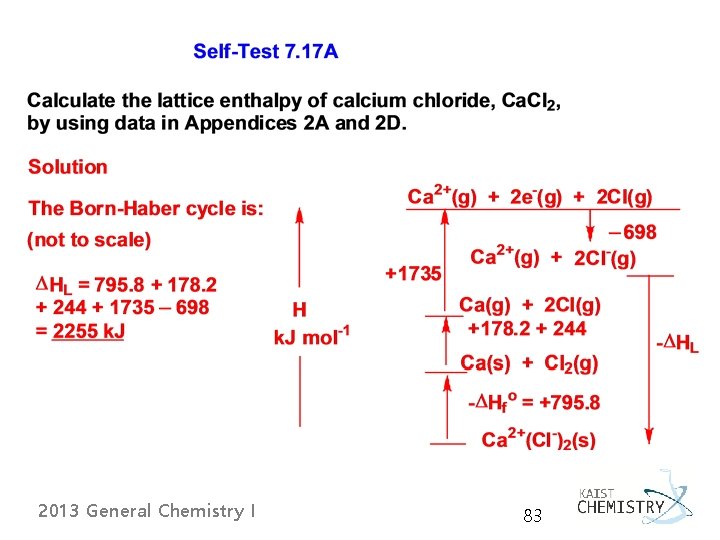
7. 19 The Born-Haber Cycle Ø Lattice enthalpy of the solid, DHL - Lattice enthalpies at 25 o. C (k. J·mol-1)(Table 7. ) 2013 General Chemistry I
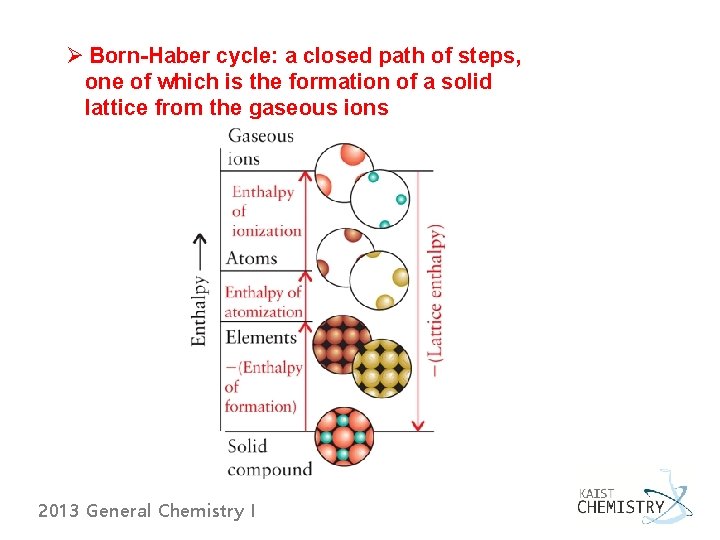
Ø Born-Haber cycle: a closed path of steps, one of which is the formation of a solid lattice from the gaseous ions 2013 General Chemistry I
EXAMPLE 7. 13 Lattice enthalpy of KCl DHf (K, atoms) DHf (Cl, atoms) I(K) -Eea(Cl) -DHf(KCl) K+Cl-(s) K+(g) + Cl-(g) 2013 General Chemistry I 82
2013 General Chemistry I 83
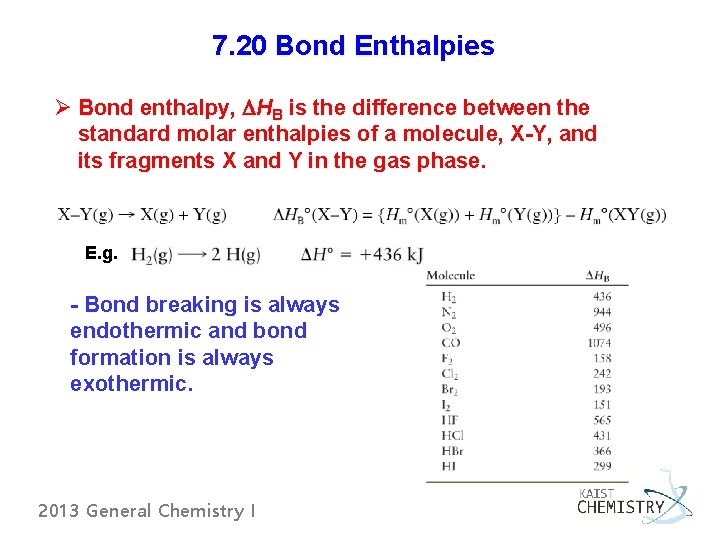
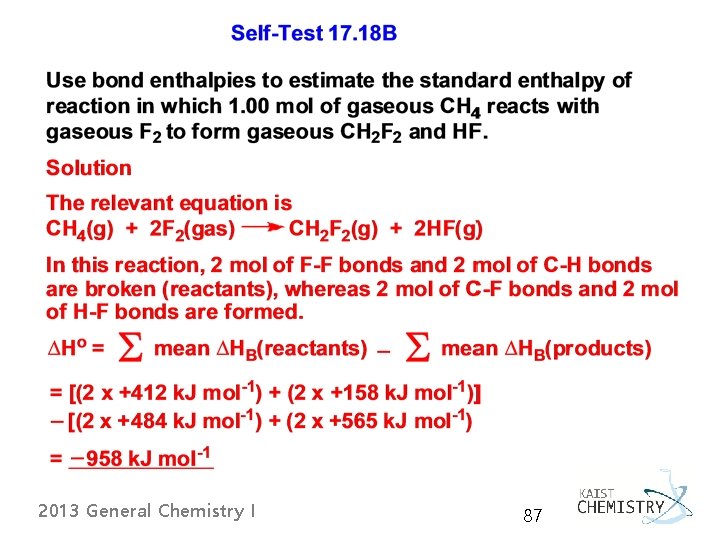
7. 20 Bond Enthalpies Ø Bond enthalpy, DHB is the difference between the standard molar enthalpies of a molecule, X-Y, and its fragments X and Y in the gas phase. E. g. - Bond breaking is always endothermic and bond formation is always exothermic. 2013 General Chemistry I
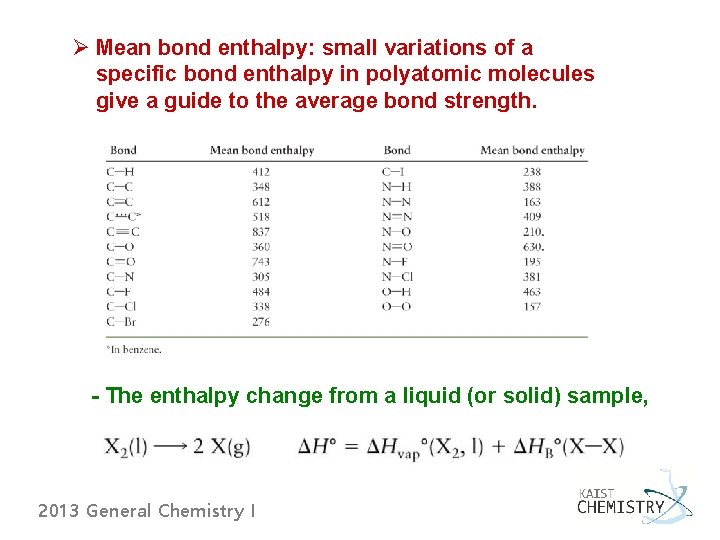
Ø Mean bond enthalpy: small variations of a specific bond enthalpy in polyatomic molecules give a guide to the average bond strength. - The enthalpy change from a liquid (or solid) sample, 2013 General Chemistry I
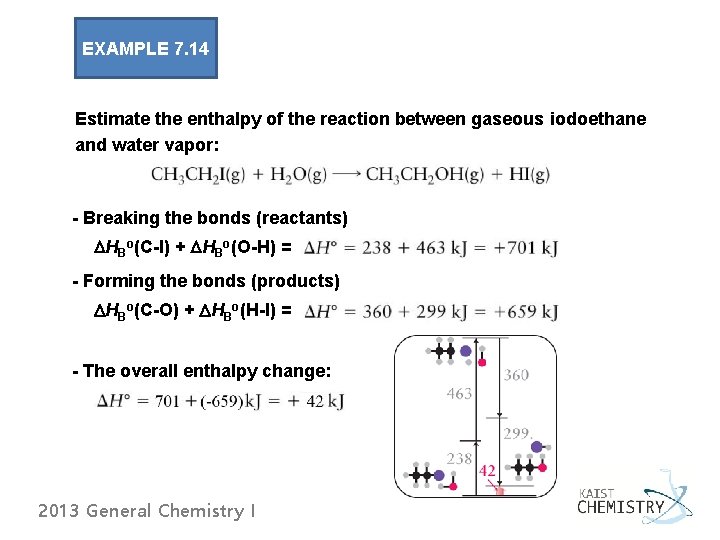
EXAMPLE 7. 14 Estimate the enthalpy of the reaction between gaseous iodoethane and water vapor: - Breaking the bonds (reactants) DHBo(C-I) + DHBo(O-H) = - Forming the bonds (products) DHBo(C-O) + DHBo(H-I) = - The overall enthalpy change: 2013 General Chemistry I
2013 General Chemistry I 87
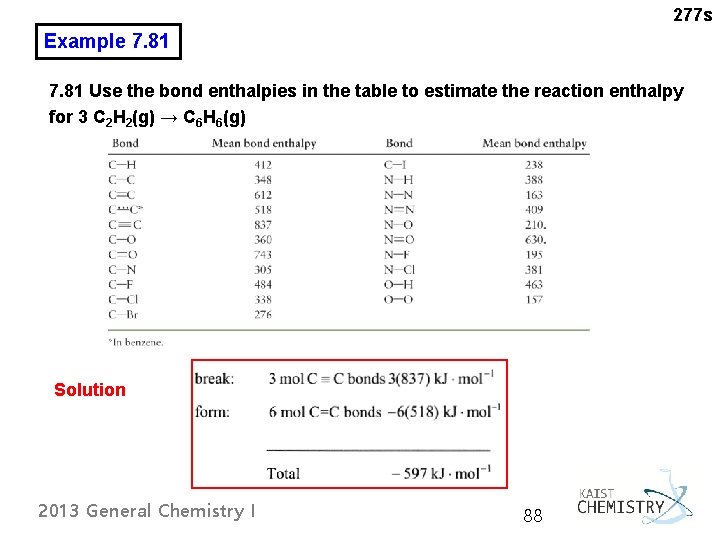
277 s Example 7. 81 Use the bond enthalpies in the table to estimate the reaction enthalpy for 3 C 2 H 2(g) → C 6 H 6(g) Solution 2013 General Chemistry I 88
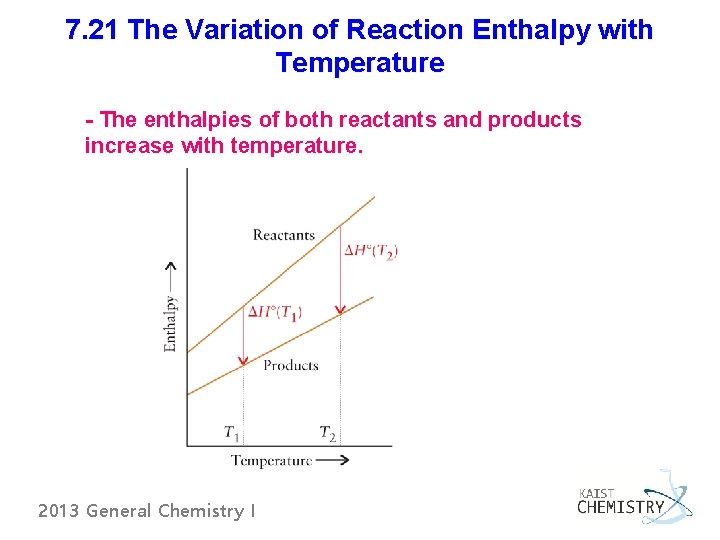
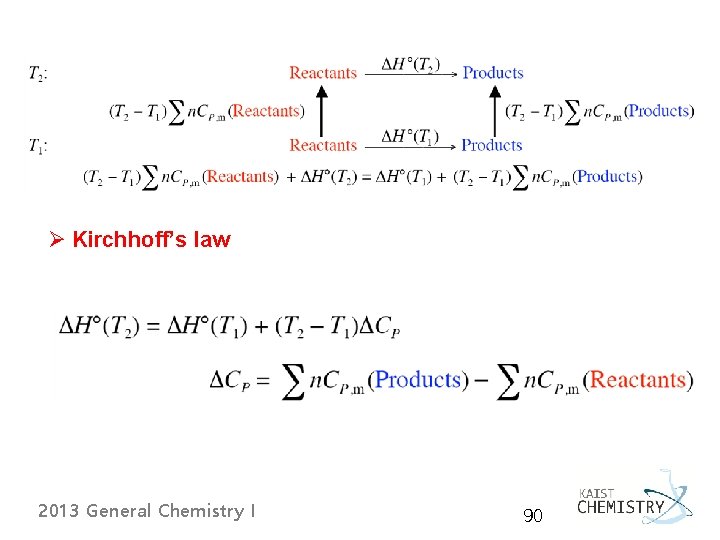
7. 21 The Variation of Reaction Enthalpy with Temperature - The enthalpies of both reactants and products increase with temperature. 2013 General Chemistry I
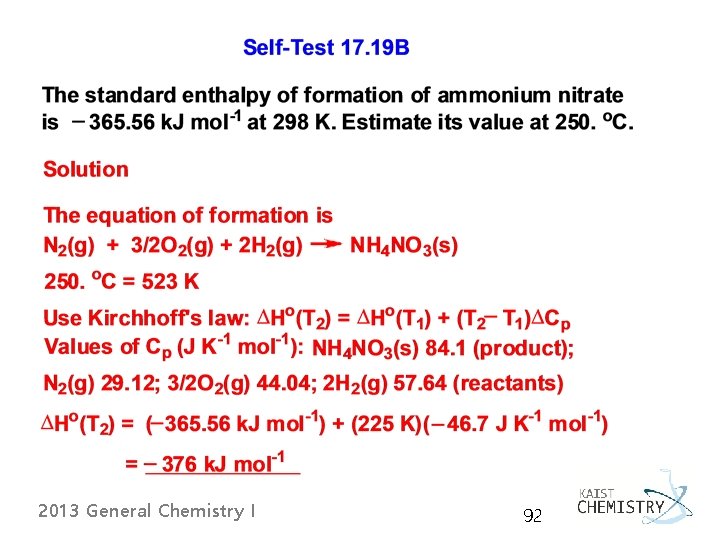
Ø Kirchhoff’s law 2013 General Chemistry I 90
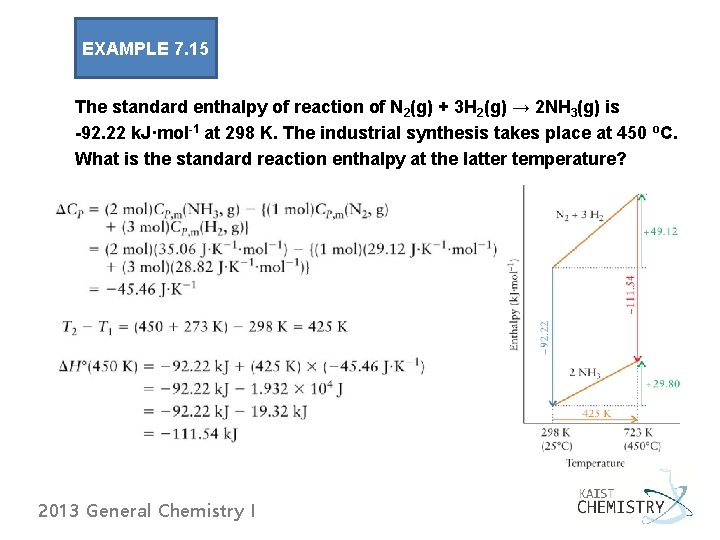
EXAMPLE 7. 15 The standard enthalpy of reaction of N 2(g) + 3 H 2(g) → 2 NH 3(g) is -92. 22 k. J·mol-1 at 298 K. The industrial synthesis takes place at 450 o. C. What is the standard reaction enthalpy at the latter temperature? 2013 General Chemistry I
2013 General Chemistry I 92
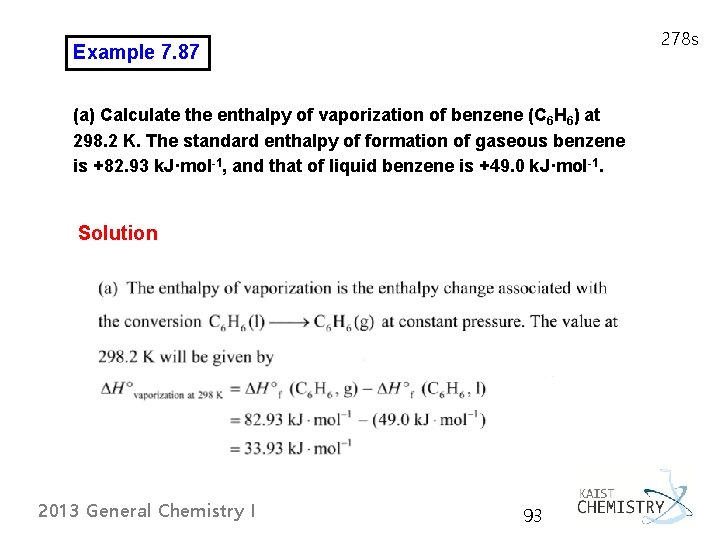
278 s Example 7. 87 (a) Calculate the enthalpy of vaporization of benzene (C 6 H 6) at 298. 2 K. The standard enthalpy of formation of gaseous benzene is +82. 93 k. J·mol-1, and that of liquid benzene is +49. 0 k. J·mol-1. Solution 2013 General Chemistry I 93
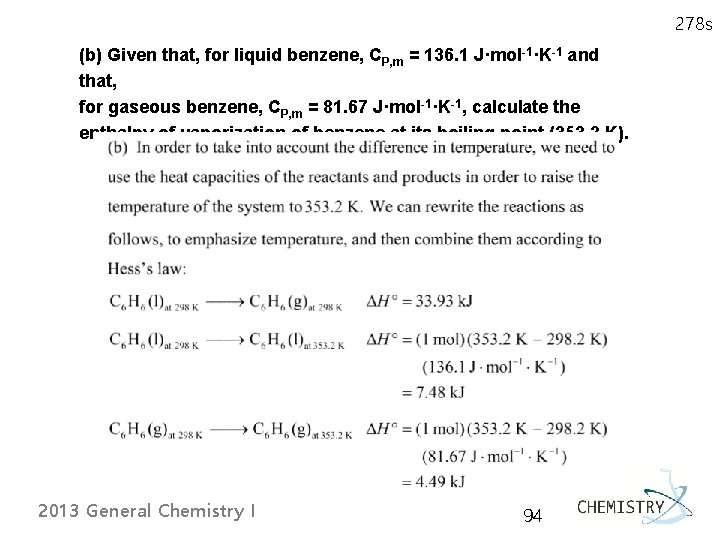
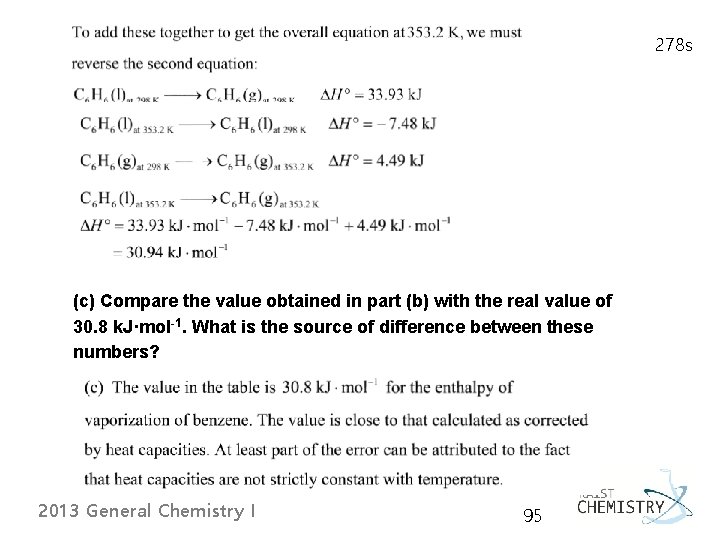
278 s (b) Given that, for liquid benzene, CP, m = 136. 1 J·mol-1·K-1 and that, for gaseous benzene, CP, m = 81. 67 J·mol-1·K-1, calculate the enthalpy of vaporization of benzene at its boiling point (353. 2 K). 2013 General Chemistry I 94
278 s (c) Compare the value obtained in part (b) with the real value of 30. 8 k. J·mol-1. What is the source of difference between these numbers? 2013 General Chemistry I 95