
Chapter 7 Thermochemistry Juana Mendenhall Ph D Assistant
- Slides: 31
Chapter 7: Thermochemistry Juana Mendenhall, Ph. D. Assistant Professor Lecture 1 March 29 1 General Chemistry: Chapter 20 Prentice-Hall © 2007
Objectives 1. 2. 3. 2 Define Terms involved in energy of chemical reactions. Define, explain, and apply the first law of thermodynamics. Define, explain, and apply the second law of thermodynamics. General Chemistry: Chapter 20 Prentice-Hall © 2007
Definition of Terms ¨ Every chemical reaction obeys two fundamental laws: · The law of conservation of mass · The law of conservation of energy ¨ Energy (U): the capacity to do work · Work: directed energy chance resulting from a process i. e. , force x distance ¨ ¨ ¨ Kinetic Energy: movement Radiant Energy: from sun (solar) Thermal Energy: random motion of atoms & molecules Chemical Energy: structural units of chemical substances Potential Energy: stationary Law of conservation of energy: energy can either be created nor destroyed, it is transferred from one object to another 3 General Chemistry: Chapter 20 Prentice-Hall © 2007
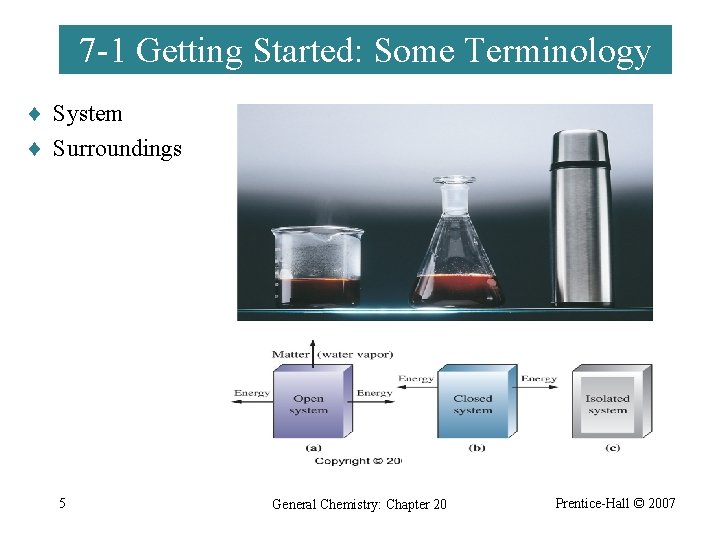
Definition of Terms ¨ Heat: transfer of thermal energy b/w two bodies that are at different temperatures. ¨ Thermochemistry: study of heat changes in chemical reactions ¨ In order to analyze energy changes associated with chemical reactions, we first define the system & its surroundings. 4 General Chemistry: Chapter 20 Prentice-Hall © 2007
7 -1 Getting Started: Some Terminology ¨ System ¨ Surroundings 5 General Chemistry: Chapter 20 Prentice-Hall © 2007
Heat Transfer Energy transferred between a system and its surroundings as a result of a temperature difference. ¨ Exothermic process: any process that gives off heat (transfers thermal energy to its surroundings) ¨ Endothermic process: any process in which heat has to be applied to the system by the surroundings. 6 General Chemistry: Chapter 20 Prentice-Hall © 2007
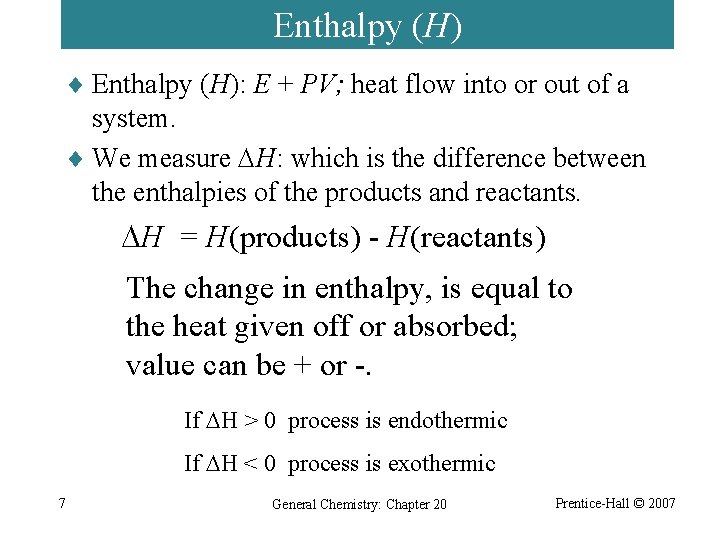
Enthalpy (H) ¨ Enthalpy (H): E + PV; heat flow into or out of a system. ¨ We measure H: which is the difference between the enthalpies of the products and reactants. H = H(products) - H(reactants) The change in enthalpy, is equal to the heat given off or absorbed; value can be + or -. If H > 0 process is endothermic If H < 0 process is exothermic 7 General Chemistry: Chapter 20 Prentice-Hall © 2007
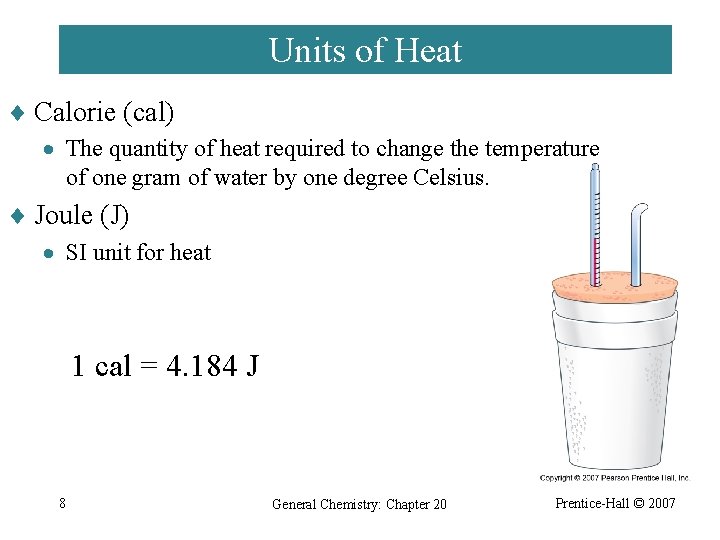
Units of Heat ¨ Calorie (cal) · The quantity of heat required to change the temperature of one gram of water by one degree Celsius. ¨ Joule (J) · SI unit for heat 1 cal = 4. 184 J 8 General Chemistry: Chapter 20 Prentice-Hall © 2007
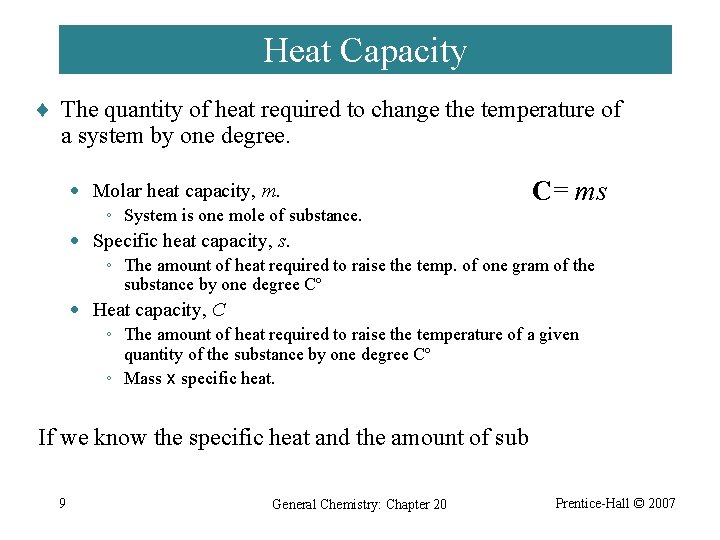
Heat Capacity ¨ The quantity of heat required to change the temperature of a system by one degree. · Molar heat capacity, m. ◦ System is one mole of substance. C= ms · Specific heat capacity, s. ◦ The amount of heat required to raise the temp. of one gram of the substance by one degree Cº · Heat capacity, C ◦ The amount of heat required to raise the temperature of a given quantity of the substance by one degree Cº ◦ Mass x specific heat. If we know the specific heat and the amount of sub 9 General Chemistry: Chapter 20 Prentice-Hall © 2007
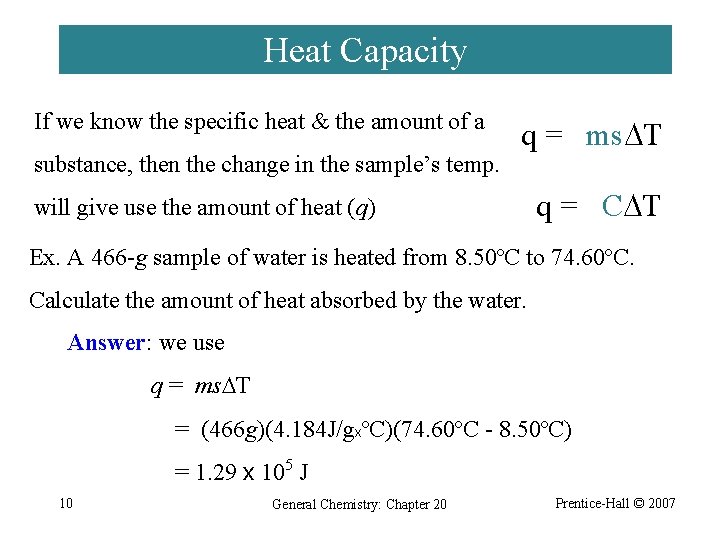
Heat Capacity If we know the specific heat & the amount of a substance, then the change in the sample’s temp. q = ms T will give use the amount of heat (q) q = C T Ex. A 466 -g sample of water is heated from 8. 50ºC to 74. 60ºC. Calculate the amount of heat absorbed by the water. Answer: we use q = ms T = (466 g)(4. 184 J/gxºC)(74. 60ºC - 8. 50ºC) = 1. 29 x 105 J 10 General Chemistry: Chapter 20 Prentice-Hall © 2007
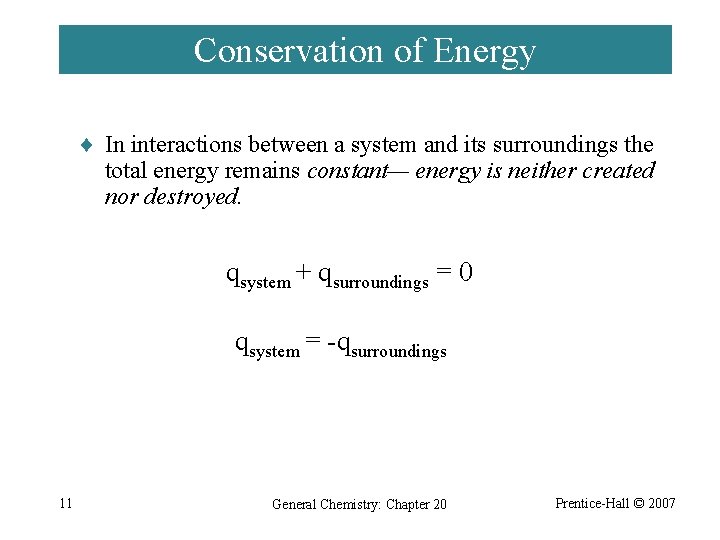
Conservation of Energy ¨ In interactions between a system and its surroundings the total energy remains constant— energy is neither created nor destroyed. qsystem + qsurroundings = 0 qsystem = -qsurroundings 11 General Chemistry: Chapter 20 Prentice-Hall © 2007
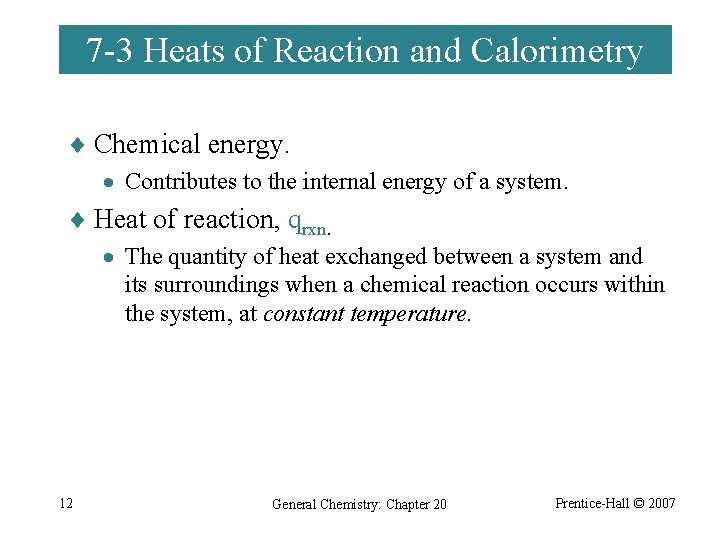
7 -3 Heats of Reaction and Calorimetry ¨ Chemical energy. · Contributes to the internal energy of a system. ¨ Heat of reaction, qrxn. · The quantity of heat exchanged between a system and its surroundings when a chemical reaction occurs within the system, at constant temperature. 12 General Chemistry: Chapter 20 Prentice-Hall © 2007
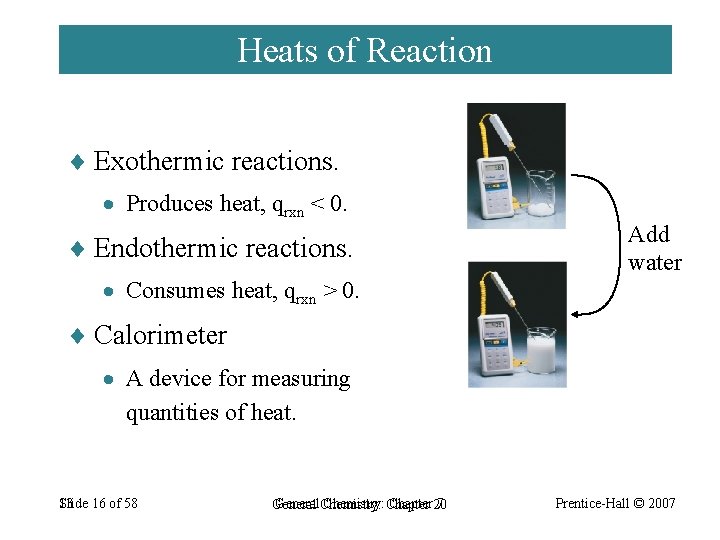
Heats of Reaction ¨ Exothermic reactions. · Produces heat, qrxn < 0. ¨ Endothermic reactions. · Consumes heat, qrxn > 0. Add water ¨ Calorimeter · A device for measuring quantities of heat. 13 Slide 16 of 58 General. Chemistry: Chapter 20 7 General Prentice-Hall © 2007
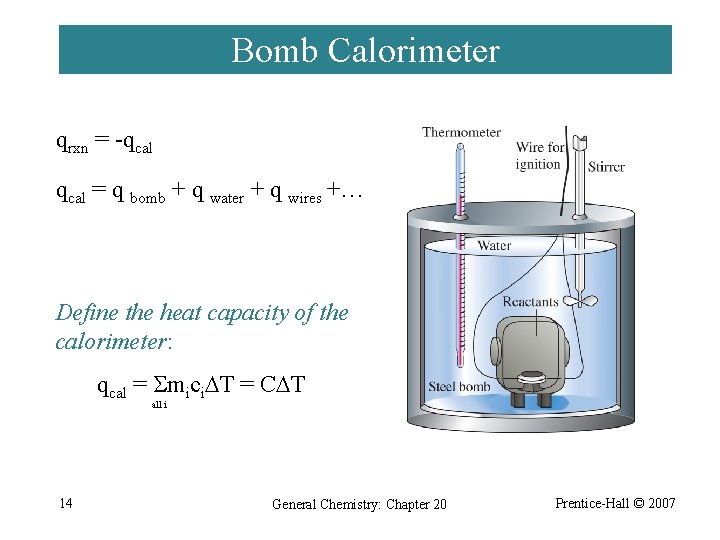
Bomb Calorimeter qrxn = -qcal = q bomb + q water + q wires +… Define the heat capacity of the calorimeter: qcal = mici T = C T heat all i 14 General Chemistry: Chapter 20 Prentice-Hall © 2007
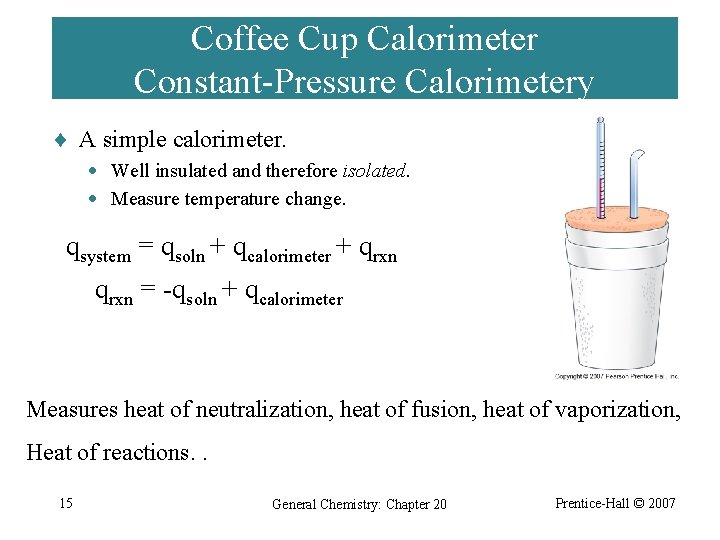
Coffee Cup Calorimeter Constant-Pressure Calorimetery ¨ A simple calorimeter. · Well insulated and therefore isolated. · Measure temperature change. qsystem = qsoln + qcalorimeter + qrxn = -qsoln + qcalorimeter Measures heat of neutralization, heat of fusion, heat of vaporization, Heat of reactions. . 15 General Chemistry: Chapter 20 Prentice-Hall © 2007
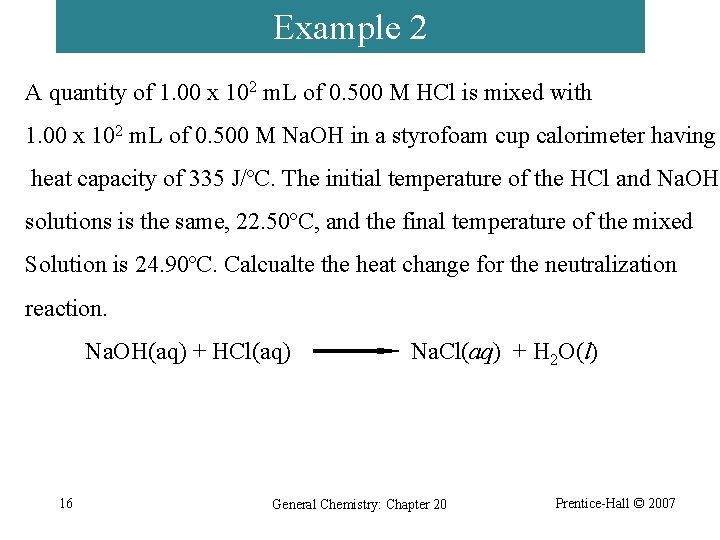
Example 2 A quantity of 1. 00 x 102 m. L of 0. 500 M HCl is mixed with 1. 00 x 102 m. L of 0. 500 M Na. OH in a styrofoam cup calorimeter having heat capacity of 335 J/ºC. The initial temperature of the HCl and Na. OH solutions is the same, 22. 50ºC, and the final temperature of the mixed Solution is 24. 90ºC. Calcualte the heat change for the neutralization reaction. Na. OH(aq) + HCl(aq) 16 Na. Cl(aq) + H 2 O(l) General Chemistry: Chapter 20 Prentice-Hall © 2007
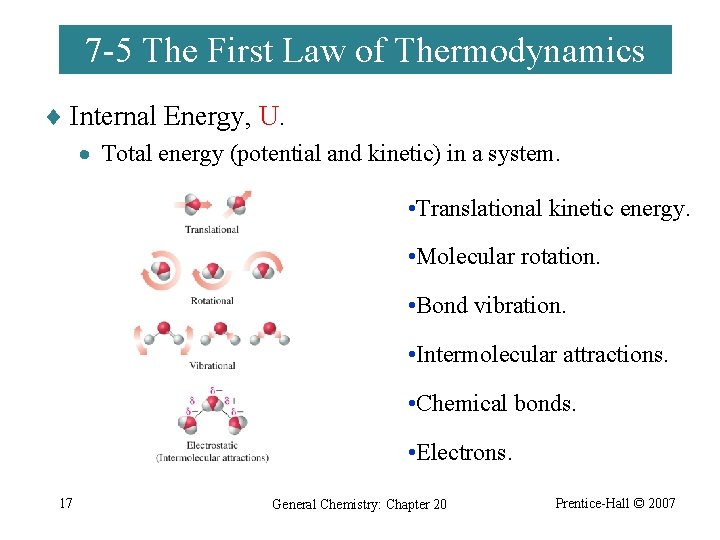
7 -5 The First Law of Thermodynamics ¨ Internal Energy, U. · Total energy (potential and kinetic) in a system. • Translational kinetic energy. • Molecular rotation. • Bond vibration. • Intermolecular attractions. • Chemical bonds. • Electrons. 17 General Chemistry: Chapter 20 Prentice-Hall © 2007
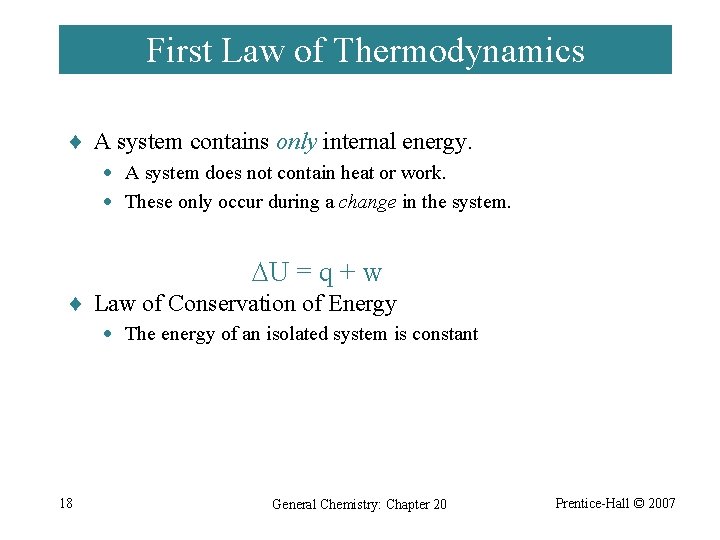
First Law of Thermodynamics ¨ A system contains only internal energy. · A system does not contain heat or work. · These only occur during a change in the system. U = q + w ¨ Law of Conservation of Energy · The energy of an isolated system is constant 18 General Chemistry: Chapter 20 Prentice-Hall © 2007
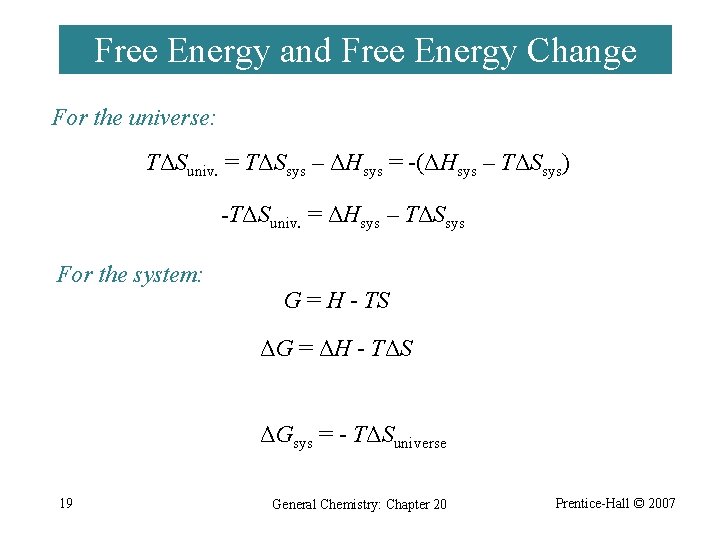
Free Energy and Free Energy Change For the universe: TΔSuniv. = TΔSsys – ΔHsys = -(ΔHsys – TΔSsys) -TΔSuniv. = ΔHsys – TΔSsys For the system: G = H - TS ΔG = ΔH - TΔS ΔGsys = - TΔSuniverse 19 General Chemistry: Chapter 20 Prentice-Hall © 2007
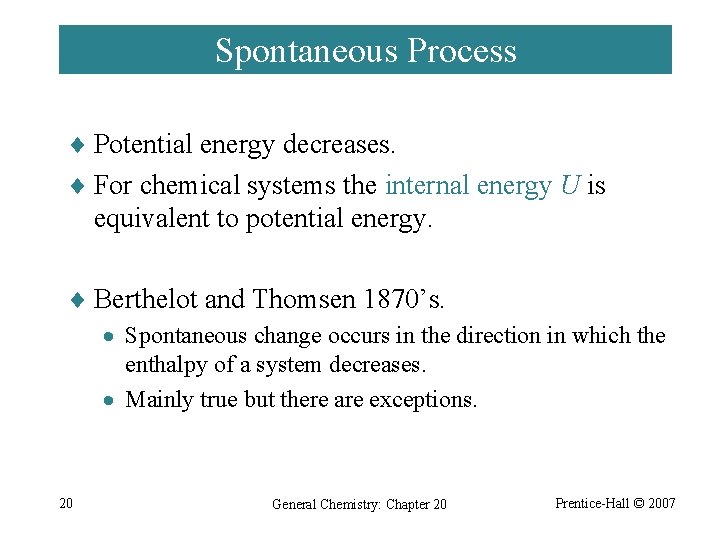
Spontaneous Process ¨ Potential energy decreases. ¨ For chemical systems the internal energy U is equivalent to potential energy. ¨ Berthelot and Thomsen 1870’s. · Spontaneous change occurs in the direction in which the enthalpy of a system decreases. · Mainly true but there are exceptions. 20 General Chemistry: Chapter 20 Prentice-Hall © 2007
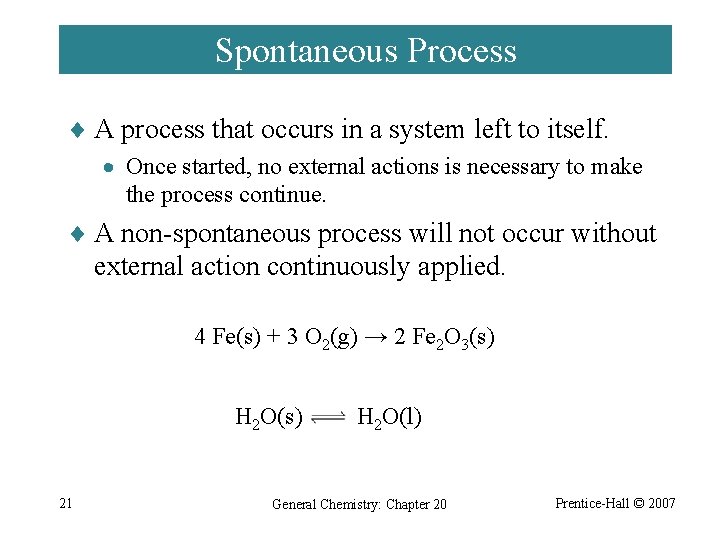
Spontaneous Process ¨ A process that occurs in a system left to itself. · Once started, no external actions is necessary to make the process continue. ¨ A non-spontaneous process will not occur without external action continuously applied. 4 Fe(s) + 3 O 2(g) → 2 Fe 2 O 3(s) H 2 O(s) 21 H 2 O(l) General Chemistry: Chapter 20 Prentice-Hall © 2007
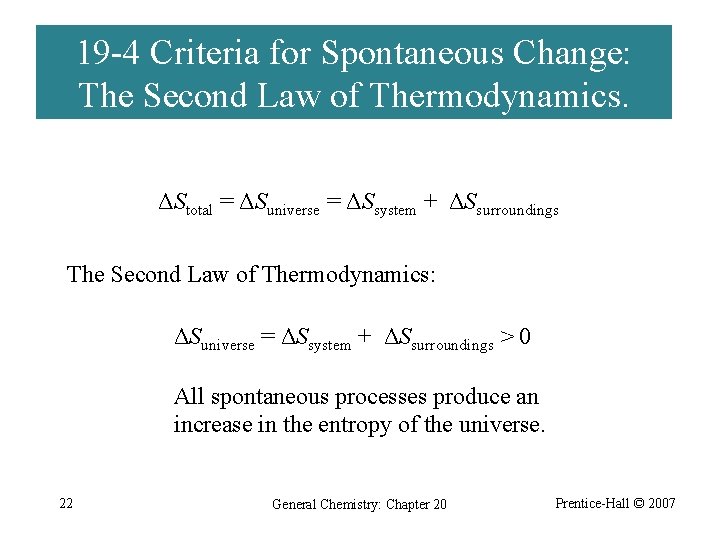
19 -4 Criteria for Spontaneous Change: The Second Law of Thermodynamics. ΔStotal = ΔSuniverse = ΔSsystem + ΔSsurroundings The Second Law of Thermodynamics: ΔSuniverse = ΔSsystem + ΔSsurroundings > 0 All spontaneous processes produce an increase in the entropy of the universe. 22 General Chemistry: Chapter 20 Prentice-Hall © 2007
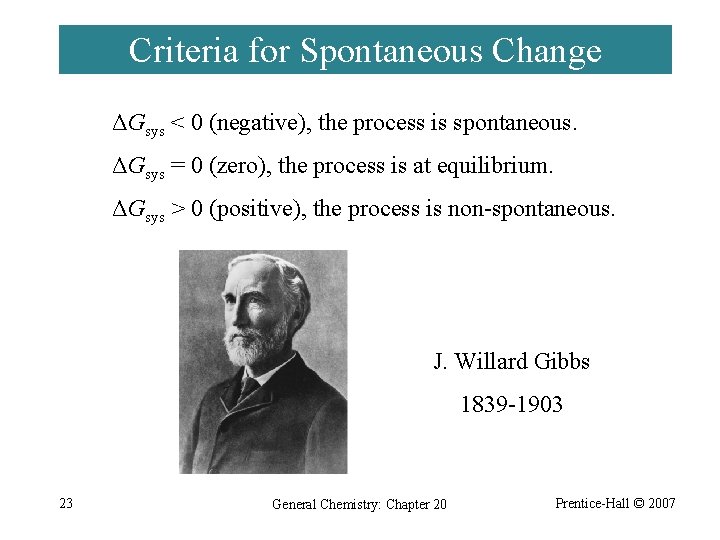
Criteria for Spontaneous Change ΔGsys < 0 (negative), the process is spontaneous. ΔGsys = 0 (zero), the process is at equilibrium. ΔGsys > 0 (positive), the process is non-spontaneous. J. Willard Gibbs 1839 -1903 23 General Chemistry: Chapter 20 Prentice-Hall © 2007
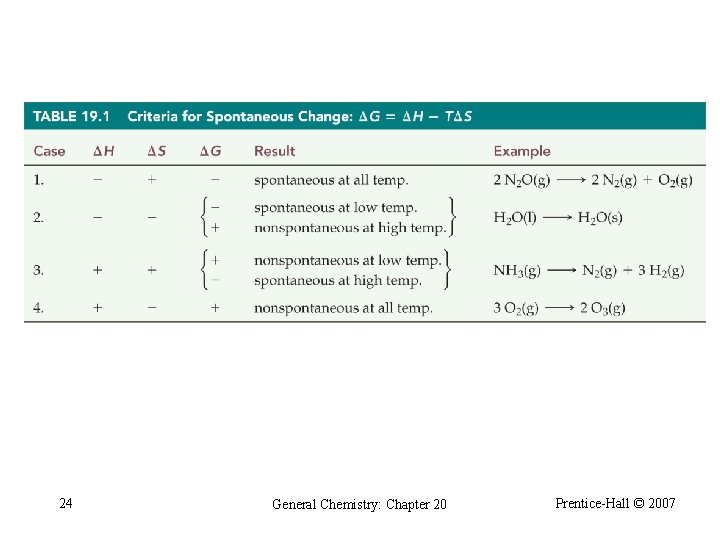
Table 19. 1 Criteria for Spontaneous Change 24 General Chemistry: Chapter 20 Prentice-Hall © 2007
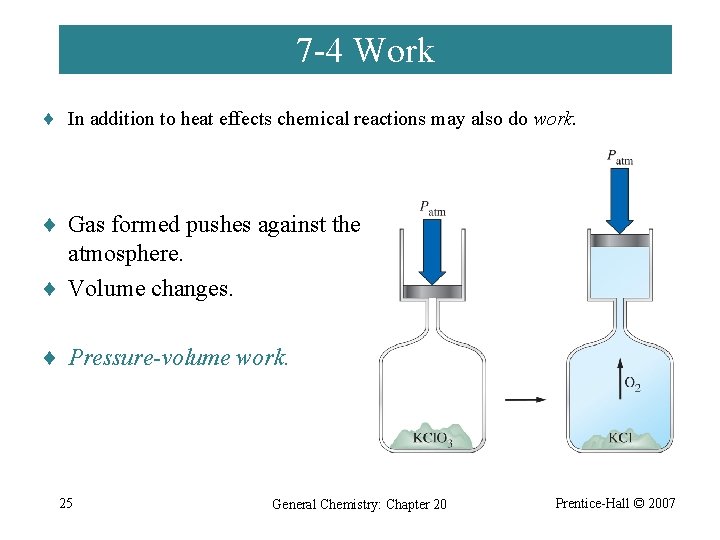
7 -4 Work ¨ In addition to heat effects chemical reactions may also do work. ¨ Gas formed pushes against the atmosphere. ¨ Volume changes. ¨ Pressure-volume work. 25 General Chemistry: Chapter 20 Prentice-Hall © 2007
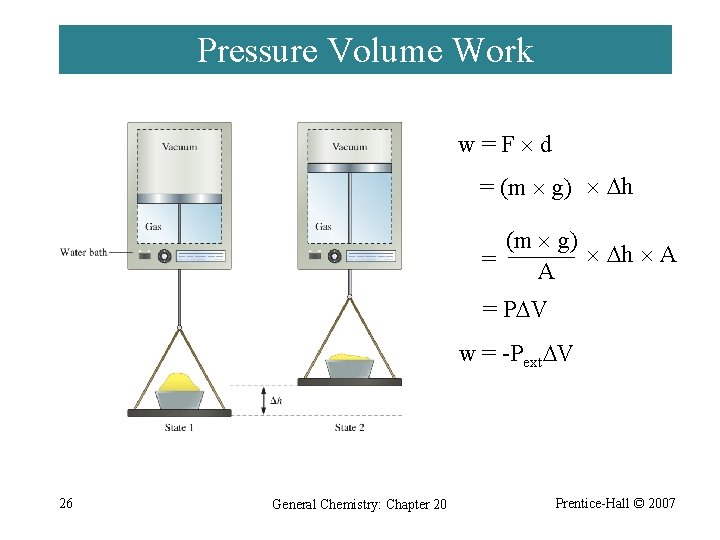
Pressure Volume Work w=F d = (m g) h A = P V w = -Pext V 26 General Chemistry: Chapter 20 Prentice-Hall © 2007
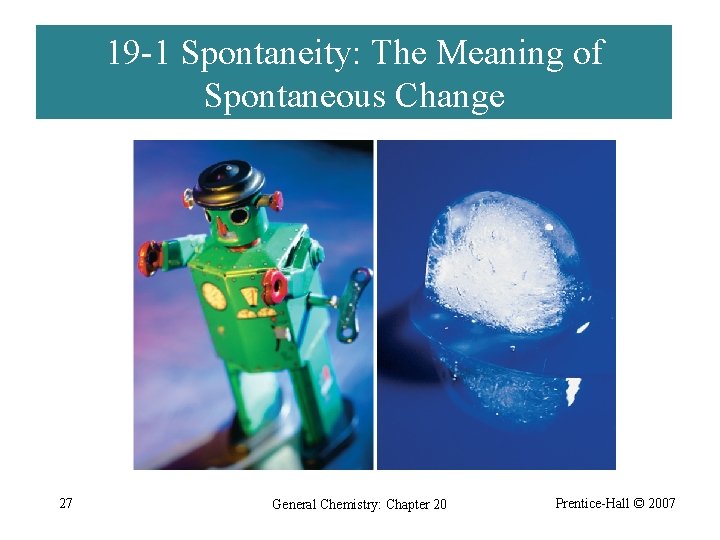
19 -1 Spontaneity: The Meaning of Spontaneous Change 27 General Chemistry: Chapter 20 Prentice-Hall © 2007
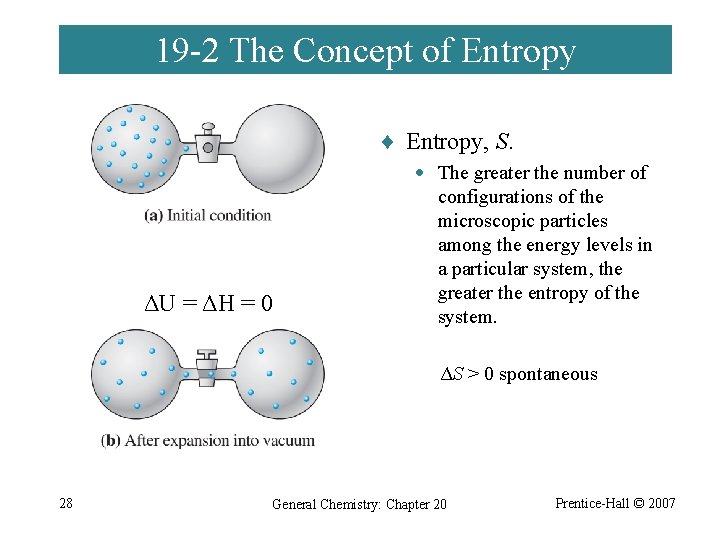
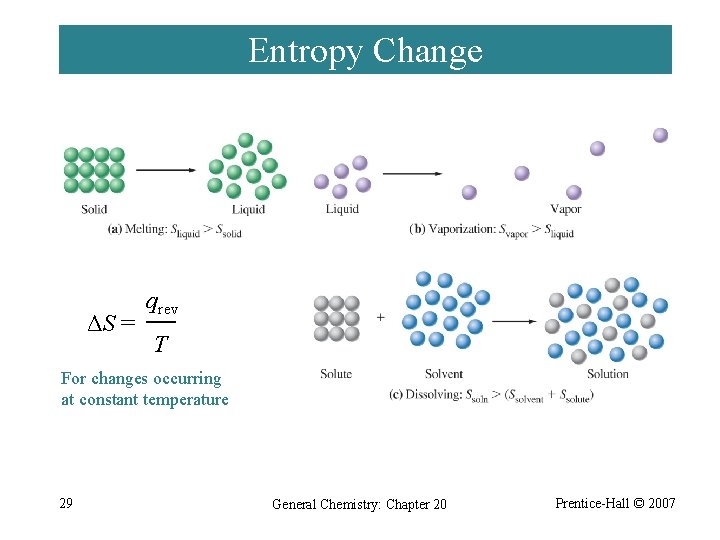
19 -2 The Concept of Entropy ¨ Entropy, S. ΔU = ΔH = 0 · The greater the number of configurations of the microscopic particles among the energy levels in a particular system, the greater the entropy of the system. ΔS > 0 spontaneous 28 General Chemistry: Chapter 20 Prentice-Hall © 2007
Entropy Change ΔS = qrev T For changes occurring at constant temperature 29 General Chemistry: Chapter 20 Prentice-Hall © 2007
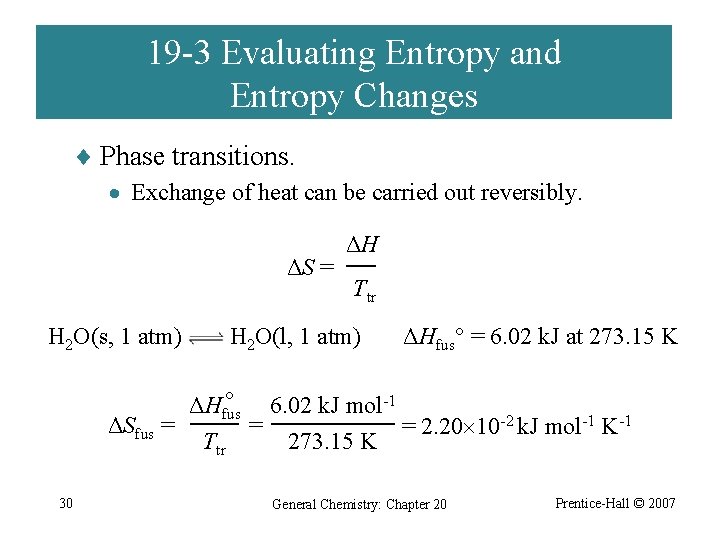
19 -3 Evaluating Entropy and Entropy Changes ¨ Phase transitions. · Exchange of heat can be carried out reversibly. ΔS = H 2 O(s, 1 atm) ΔH Ttr H 2 O(l, 1 atm) ΔHfus = 6. 02 k. J at 273. 15 K ° ΔHfus 6. 02 k. J mol-1 ΔSfus = = = 2. 20 10 -2 k. J mol-1 K-1 Ttr 273. 15 K 30 General Chemistry: Chapter 20 Prentice-Hall © 2007
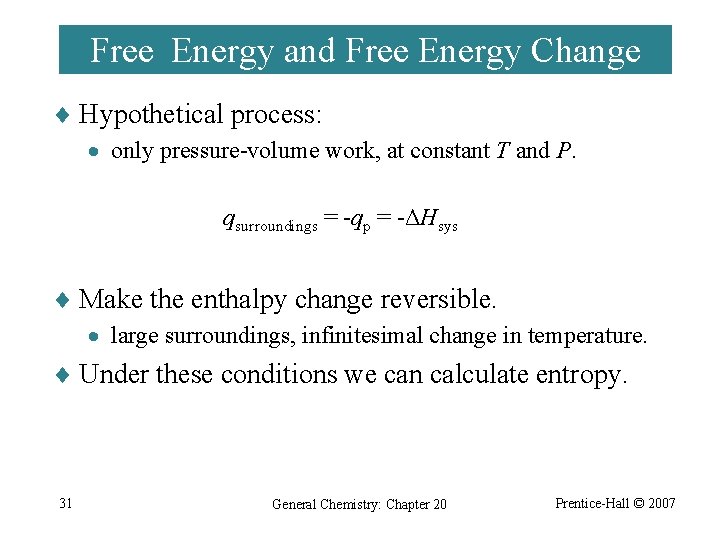
Free Energy and Free Energy Change ¨ Hypothetical process: · only pressure-volume work, at constant T and P. qsurroundings = -qp = -ΔHsys ¨ Make the enthalpy change reversible. · large surroundings, infinitesimal change in temperature. ¨ Under these conditions we can calculate entropy. 31 General Chemistry: Chapter 20 Prentice-Hall © 2007