
Chapter 7 Theory of Portfolio Choice Fundamental Issues
- Slides: 18
Chapter 7 Theory of Portfolio Choice
Fundamental Issues 1. What is a financial portfolio? 2. What are the key determinants of portfolio choice? 3. What is the distinction between idiosyncratic risk and market risk? 4. How does holding international financial instruments make a portfolio more diversified? 5. What are the special risks of holding international financial instruments? Copyright © 2004 South-Western. All rights reserved. 2
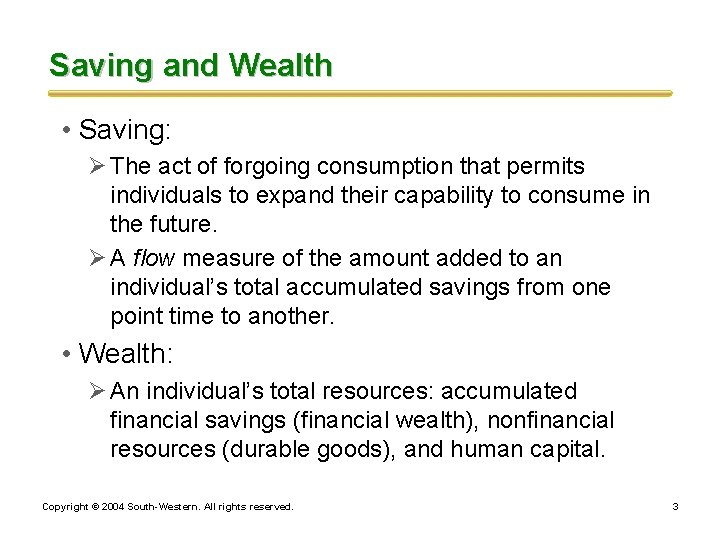
Saving and Wealth • Saving: Ø The act of forgoing consumption that permits individuals to expand their capability to consume in the future. Ø A flow measure of the amount added to an individual’s total accumulated savings from one point time to another. • Wealth: Ø An individual’s total resources: accumulated financial savings (financial wealth), nonfinancial resources (durable goods), and human capital. Copyright © 2004 South-Western. All rights reserved. 3
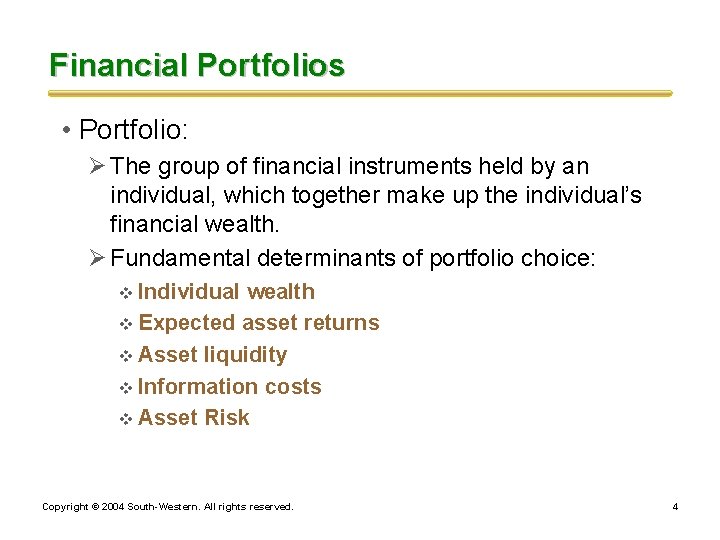
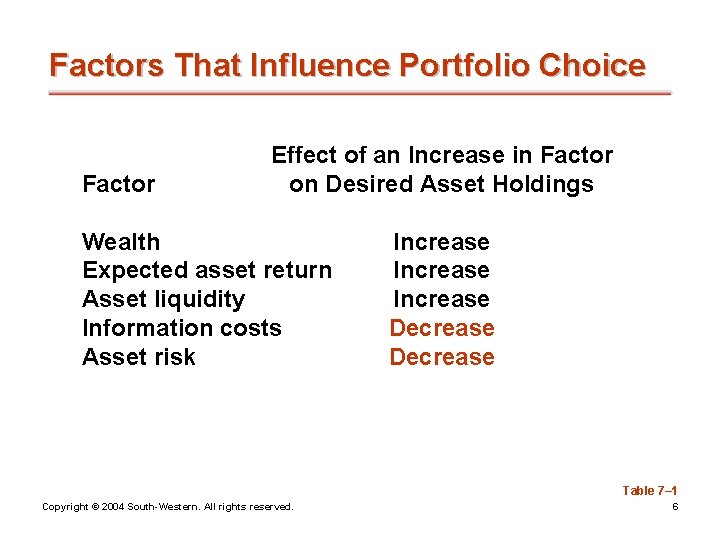
Financial Portfolios • Portfolio: Ø The group of financial instruments held by an individual, which together make up the individual’s financial wealth. Ø Fundamental determinants of portfolio choice: v Individual wealth v Expected asset returns v Asset liquidity v Information costs v Asset Risk Copyright © 2004 South-Western. All rights reserved. 4
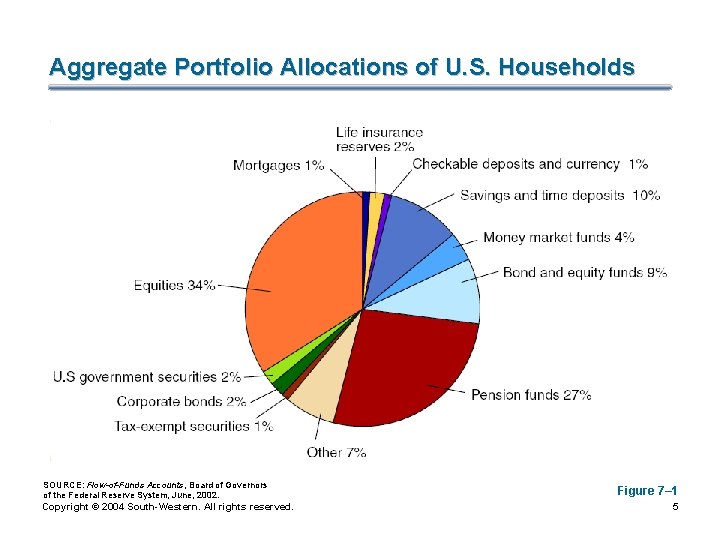
Aggregate Portfolio Allocations of U. S. Households SOURCE: Flow-of-Funds Accounts, Board of Governors of the Federal Reserve System, June, 2002. Copyright © 2004 South-Western. All rights reserved. Figure 7– 1 5
Factors That Influence Portfolio Choice Factor Effect of an Increase in Factor on Desired Asset Holdings Wealth Expected asset return Asset liquidity Information costs Asset risk Increase Decrease Table 7– 1 Copyright © 2004 South-Western. All rights reserved. 6
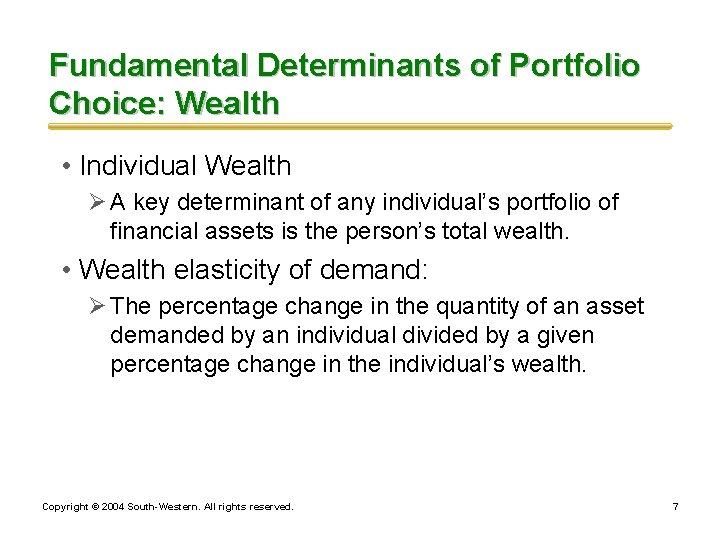
Fundamental Determinants of Portfolio Choice: Wealth • Individual Wealth Ø A key determinant of any individual’s portfolio of financial assets is the person’s total wealth. • Wealth elasticity of demand: Ø The percentage change in the quantity of an asset demanded by an individual divided by a given percentage change in the individual’s wealth. Copyright © 2004 South-Western. All rights reserved. 7
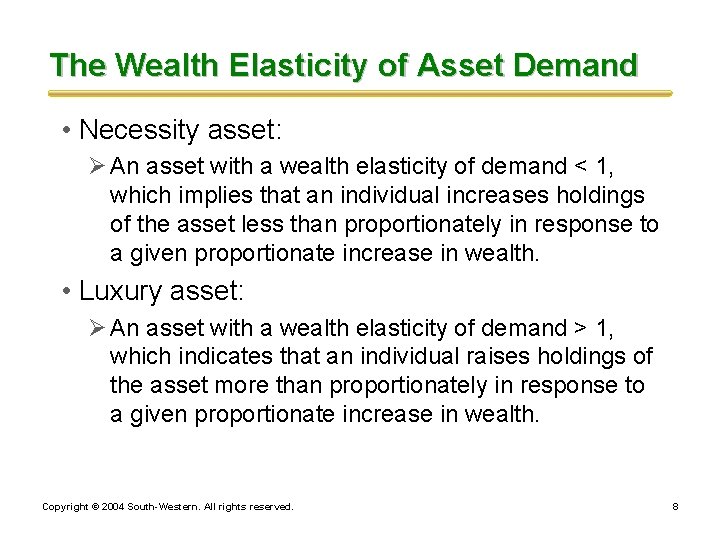
The Wealth Elasticity of Asset Demand • Necessity asset: Ø An asset with a wealth elasticity of demand < 1, which implies that an individual increases holdings of the asset less than proportionately in response to a given proportionate increase in wealth. • Luxury asset: Ø An asset with a wealth elasticity of demand > 1, which indicates that an individual raises holdings of the asset more than proportionately in response to a given proportionate increase in wealth. Copyright © 2004 South-Western. All rights reserved. 8
Asset Risk • Risk aversion: Ø The preference, other things being equal, to hold assets whose returns exhibit less variability. • Measuring risk: Ø Statistical variance—a summary statistic that indicates how widely actual values of an asset’s return tend to vary relative to the expected return. Ø Mean-variance analysis—the evaluation of tradeoffs between financial assets’ expected returns and variances of returns. Copyright © 2004 South-Western. All rights reserved. 9
International Diversification • Idiosyncratic risk: Ø Risk that is unique to a particular financial instrument; also known as nonsystematic risk. • Diversification: Ø Holding a mix of financial instruments with returns that normally do not move together. • Market risk: Ø Risk that is common to all financial assets within a portfolio; also called systematic risk. Copyright © 2004 South-Western. All rights reserved. 10
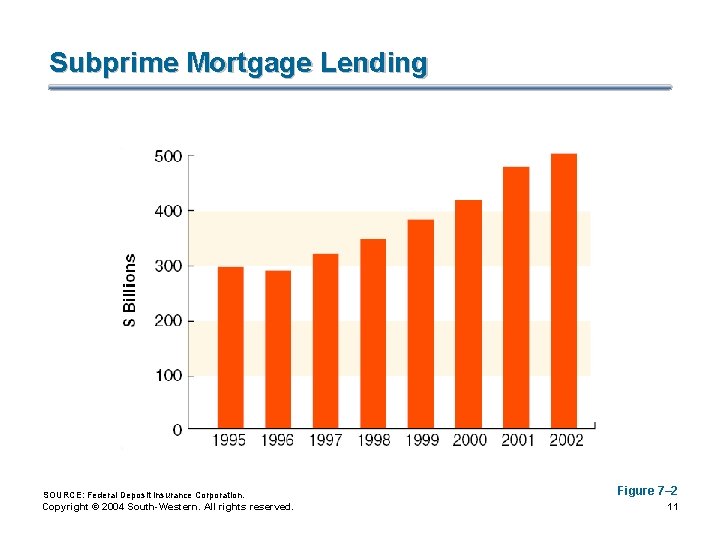
Subprime Mortgage Lending SOURCE: Federal Deposit Insurance Corporation. Copyright © 2004 South-Western. All rights reserved. Figure 7– 2 11
Portfolio Diversification • Beta: Ø A measure of the sensitivity of a financial instrument’s expected return to changes in the value of all financial instruments in a market portfolio Ø Calculated as the percentage change in the value of a financial instrument resulting from a 1% change in the value of all financial instruments in the portfolio. Copyright © 2004 South-Western. All rights reserved. 12
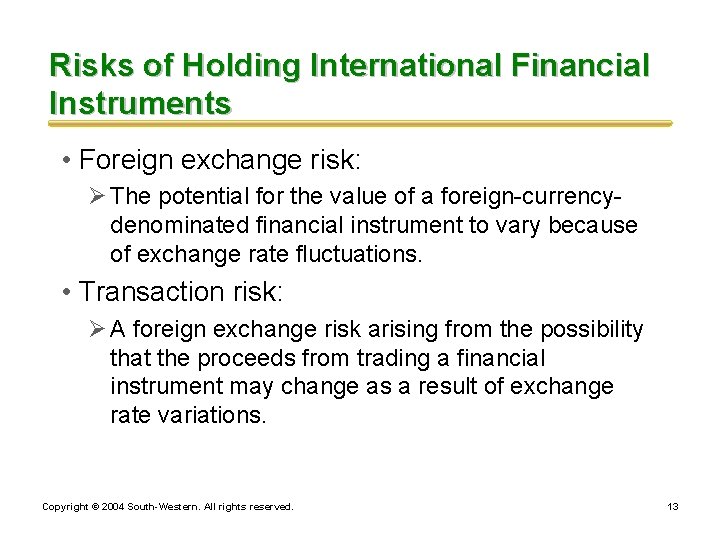
Risks of Holding International Financial Instruments • Foreign exchange risk: Ø The potential for the value of a foreign-currencydenominated financial instrument to vary because of exchange rate fluctuations. • Transaction risk: Ø A foreign exchange risk arising from the possibility that the proceeds from trading a financial instrument may change as a result of exchange rate variations. Copyright © 2004 South-Western. All rights reserved. 13
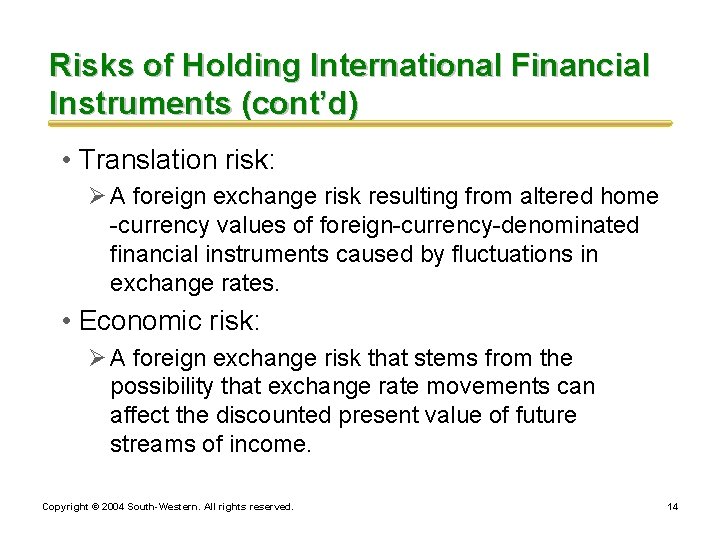
Risks of Holding International Financial Instruments (cont’d) • Translation risk: Ø A foreign exchange risk resulting from altered home -currency values of foreign-currency-denominated financial instruments caused by fluctuations in exchange rates. • Economic risk: Ø A foreign exchange risk that stems from the possibility that exchange rate movements can affect the discounted present value of future streams of income. Copyright © 2004 South-Western. All rights reserved. 14
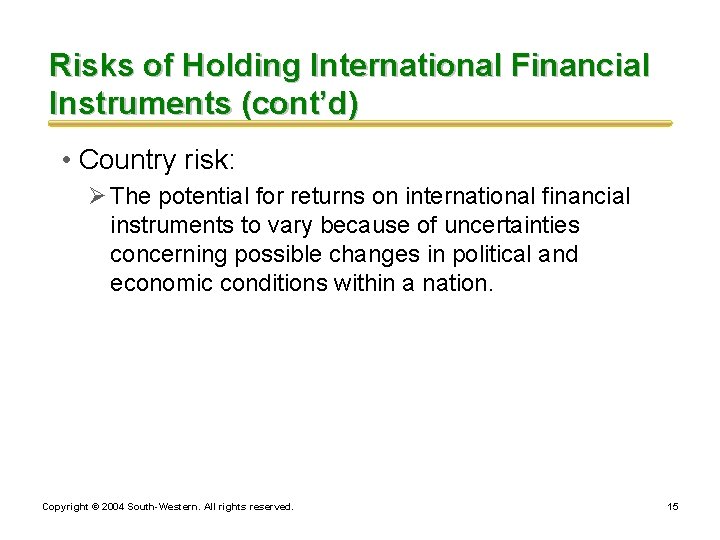
Risks of Holding International Financial Instruments (cont’d) • Country risk: Ø The potential for returns on international financial instruments to vary because of uncertainties concerning possible changes in political and economic conditions within a nation. Copyright © 2004 South-Western. All rights reserved. 15
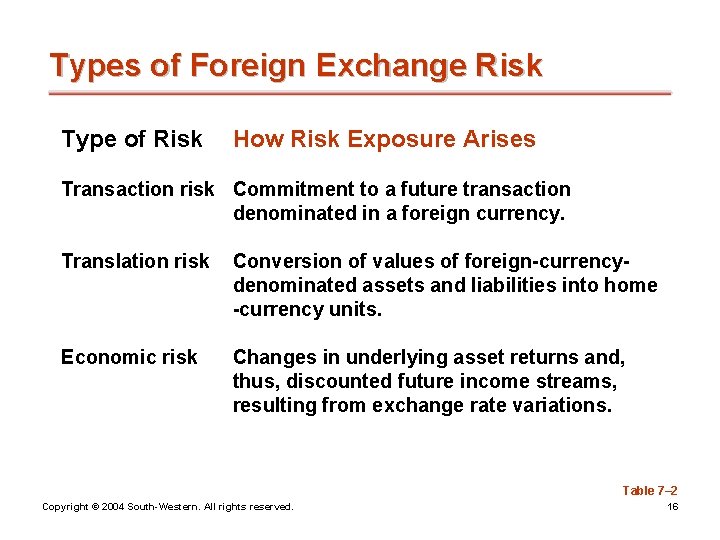
Types of Foreign Exchange Risk Type of Risk How Risk Exposure Arises Transaction risk Commitment to a future transaction denominated in a foreign currency. Translation risk Conversion of values of foreign-currencydenominated assets and liabilities into home -currency units. Economic risk Changes in underlying asset returns and, thus, discounted future income streams, resulting from exchange rate variations. Table 7– 2 Copyright © 2004 South-Western. All rights reserved. 16
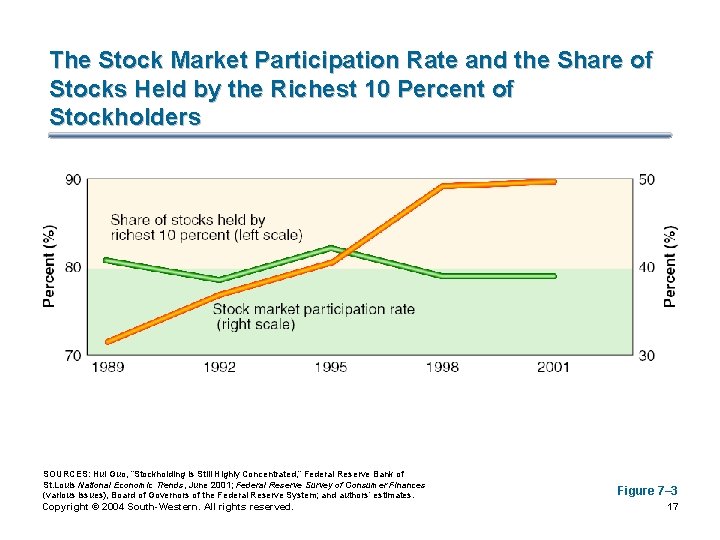
The Stock Market Participation Rate and the Share of Stocks Held by the Richest 10 Percent of Stockholders SOURCES: Hui Guo, “Stockholding Is Still Highly Concentrated, ” Federal Reserve Bank of St. Louis National Economic Trends, June 2001; Federal Reserve Survey of Consumer Finances (various issues), Board of Governors of the Federal Reserve System; and authors’ estimates. Copyright © 2004 South-Western. All rights reserved. Figure 7– 3 17
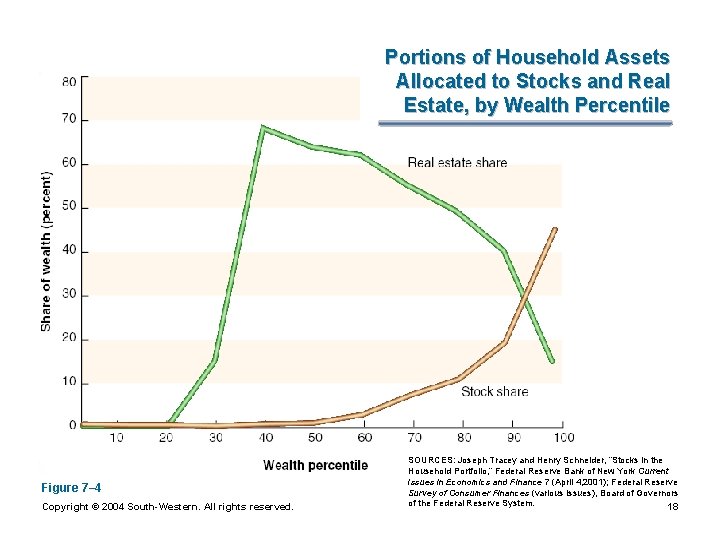
Portions of Household Assets Allocated to Stocks and Real Estate, by Wealth Percentile Figure 7– 4 Copyright © 2004 South-Western. All rights reserved. SOURCES: Joseph Tracey and Henry Schneider, “Stocks in the Household Portfolio, ” Federal Reserve Bank of New York Current Issues in Economics and Finance 7 (April 4, 2001); Federal Reserve Survey of Consumer Finances (various issues), Board of Governors of the Federal Reserve System. 18