
Chapter 7 The Skeletal System Appendicular Division Lecture
- Slides: 69
Chapter 7 The Skeletal System Appendicular Division Lecture Presentation by Steven Bassett Southeast Community College © 2015 Pearson Education, Inc.
Introduction • The appendicular skeleton includes: • Pectoral girdle • Shoulder bones • Upper limbs • Pelvic girdle • Hip bones • Lower limbs © 2015 Pearson Education, Inc.
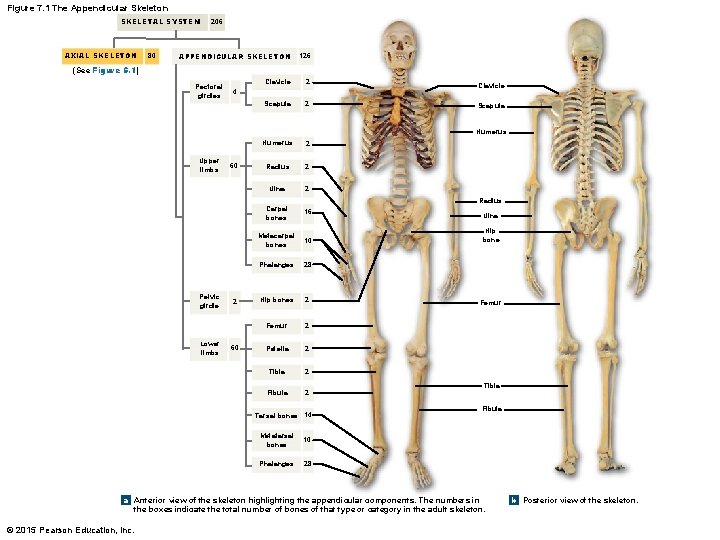
Figure 7. 1 The Appendicular Skeleton SKELETAL SYSTEM AXIAL SKELETON 80 206 APPENDICULAR SKELETON 126 Clavicle 2 Scapula 2 Humerus 2 Radius 2 Ulna 2 Carpal bones 16 Ulna Metacarpal bones 10 Hip bone Phalanges 28 Hip bones 2 Femur 2 Patella 2 Tibia 2 Fibula 2 (See Figure 6. 1) Pectoral girdles 4 Clavicle Scapula Humerus Upper limbs Pelvic girdle Lower limbs 60 2 60 Radius Tarsal bones 14 Metatarsal bones 10 Phalanges 28 Femur Tibia Fibula a Anterior view of the skeleton highlighting the appendicular components. The numbers in the boxes indicate the total number of bones of that type or category in the adult skeleton. © 2015 Pearson Education, Inc. b Posterior view of the skeleton.
The Pectoral Girdle and Upper Limb • Pectoral girdle consists of: • Clavicle • Scapula © 2015 Pearson Education, Inc.
The Pectoral Girdle and Upper Limb • Upper limb consists of: • • • Humerus Radius Ulna Carpals Metacarpals Pollex and other digits © 2015 Pearson Education, Inc.
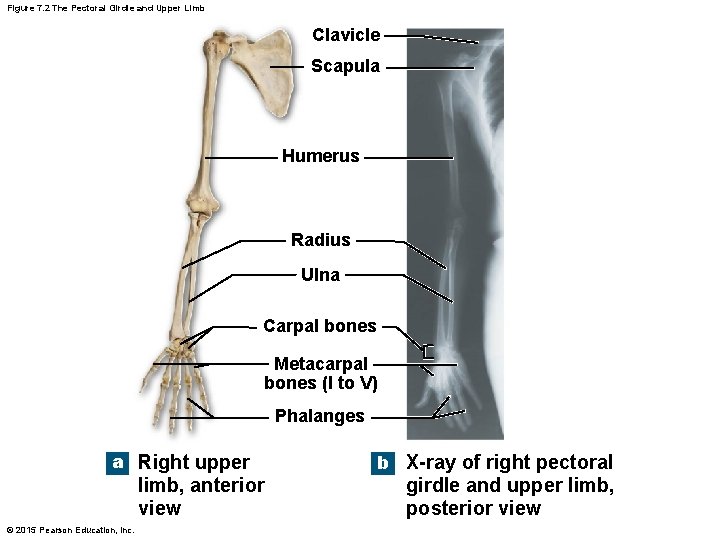
Figure 7. 2 The Pectoral Girdle and Upper Limb Clavicle Scapula Humerus Radius Ulna Carpal bones Metacarpal bones (I to V) Phalanges a Right upper limb, anterior view © 2015 Pearson Education, Inc. b X-ray of right pectoral girdle and upper limb, posterior view
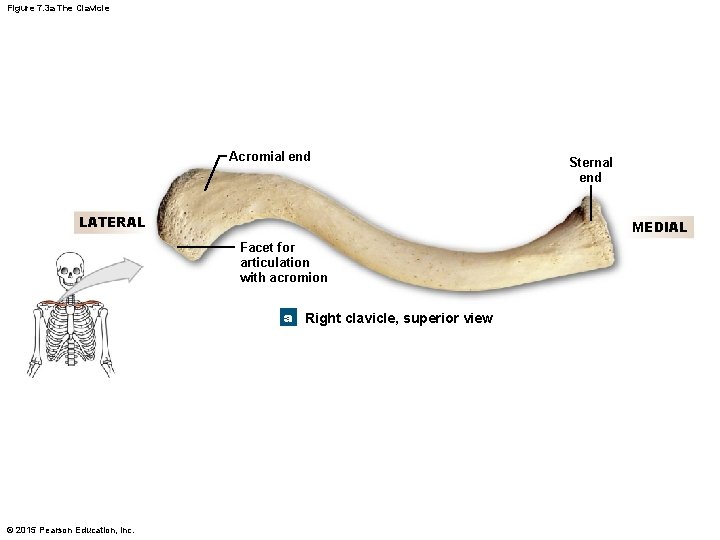
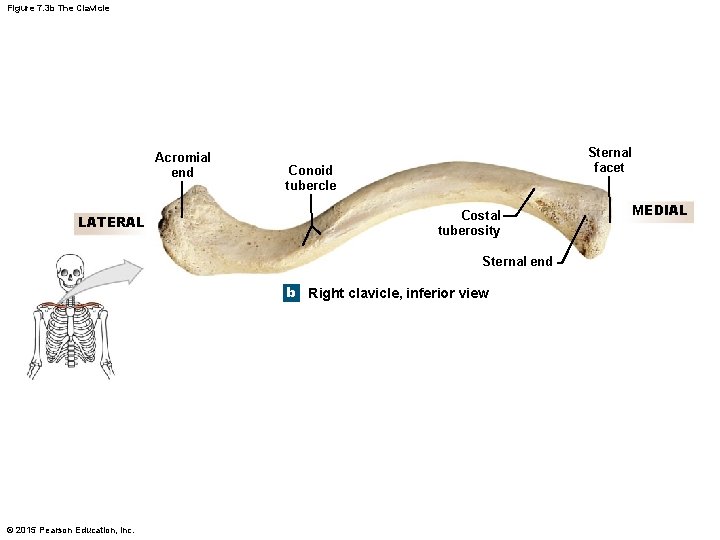
The Pectoral Girdle and Upper Limb • The Clavicle • Connects the scapula to the manubrium of the sternum • It extends from the manubrium of the sternum, laterally to the acromion process of the scapula • It is an S-shaped bone • Structures • • Sternal end Acromial end Conoid tubercle Costal tuberosity © 2015 Pearson Education, Inc.
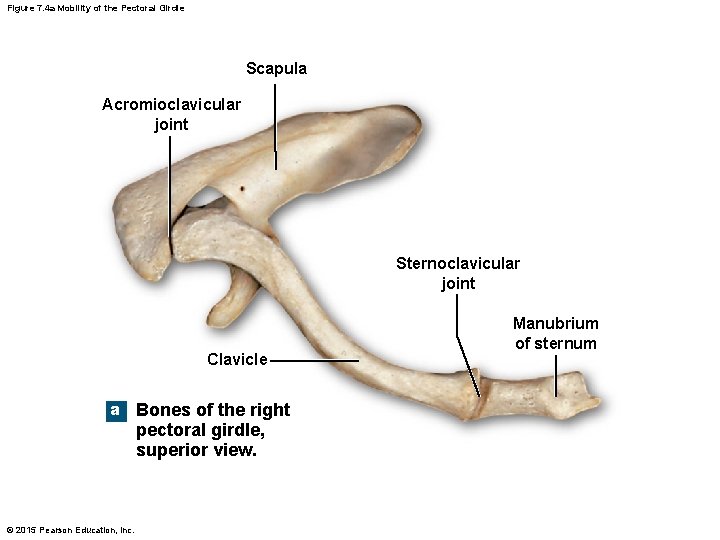
Figure 7. 4 a Mobility of the Pectoral Girdle Scapula Acromioclavicular joint Sternoclavicular joint Clavicle a Bones of the right pectoral girdle, superior view. © 2015 Pearson Education, Inc. Manubrium of sternum
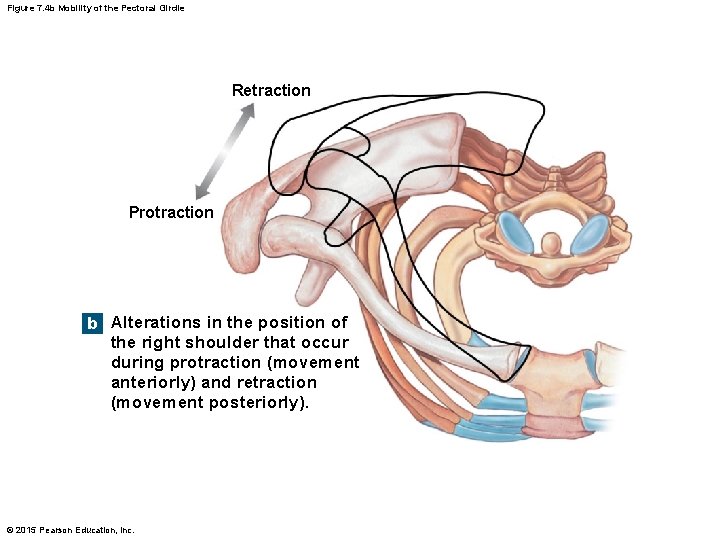
Figure 7. 4 b Mobility of the Pectoral Girdle Retraction Protraction b Alterations in the position of the right shoulder that occur during protraction (movement anteriorly) and retraction (movement posteriorly). © 2015 Pearson Education, Inc.
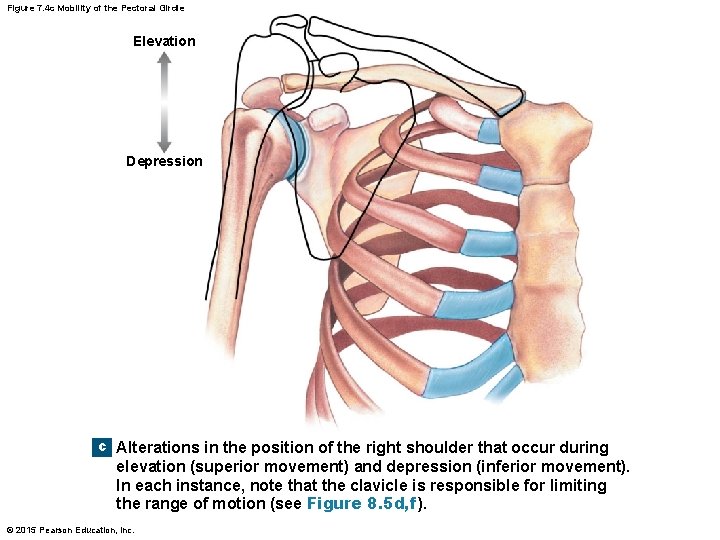
Figure 7. 4 c Mobility of the Pectoral Girdle Elevation Depression c Alterations in the position of the right shoulder that occur during elevation (superior movement) and depression (inferior movement). In each instance, note that the clavicle is responsible for limiting the range of motion (see Figure 8. 5 d, f ). © 2015 Pearson Education, Inc.
Figure 7. 3 a The Clavicle Acromial end LATERAL MEDIAL Facet for articulation with acromion a Right clavicle, superior view © 2015 Pearson Education, Inc. Sternal end
Figure 7. 3 b The Clavicle Acromial end LATERAL Sternal facet Conoid tubercle Costal tuberosity Sternal end b Right clavicle, inferior view © 2015 Pearson Education, Inc. MEDIAL
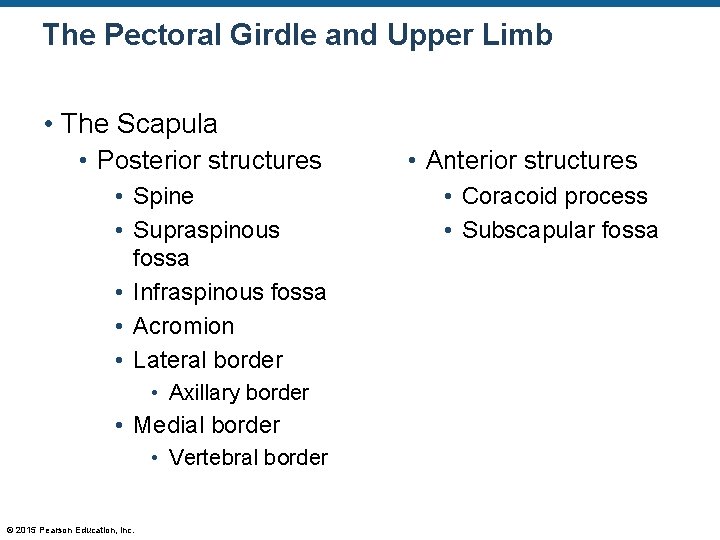
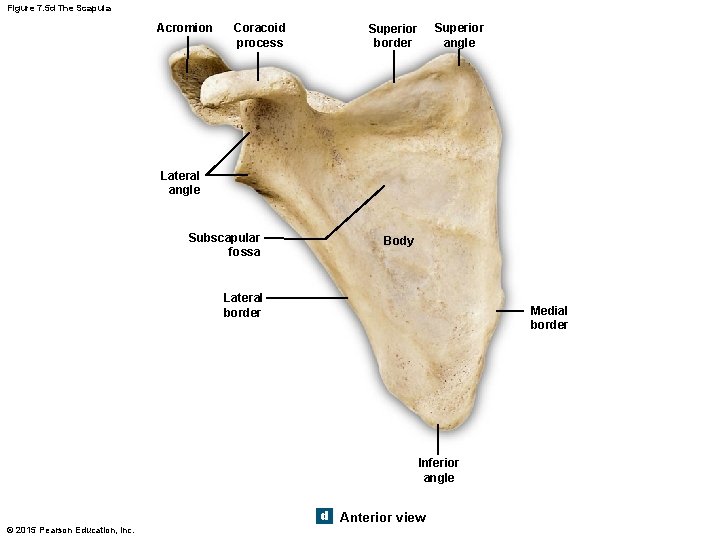
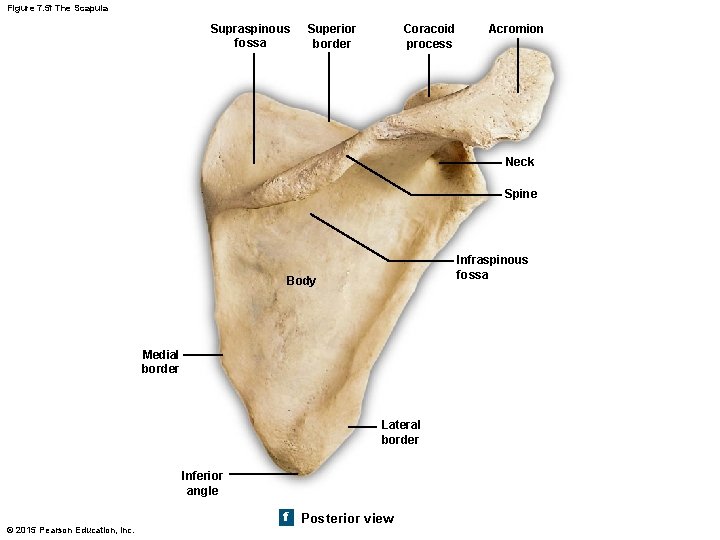
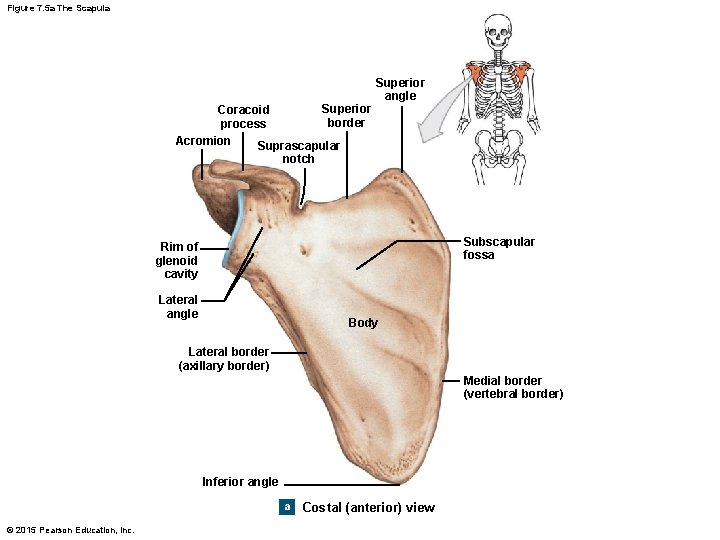
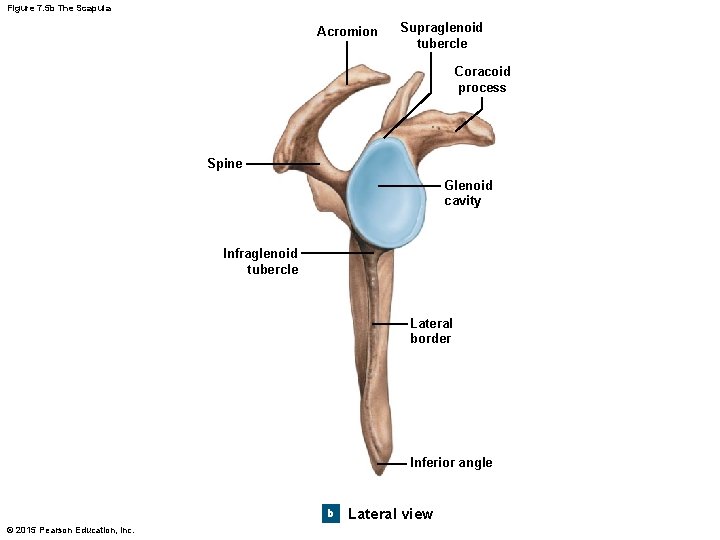
The Pectoral Girdle and Upper Limb • The Scapula • Posterior structures • Spine • Supraspinous fossa • Infraspinous fossa • Acromion • Lateral border • Axillary border • Medial border • Vertebral border © 2015 Pearson Education, Inc. • Anterior structures • Coracoid process • Subscapular fossa
Figure 7. 5 d The Scapula Acromion Coracoid process Superior angle Superior border Lateral angle Subscapular fossa Body Lateral border Medial border Inferior angle © 2015 Pearson Education, Inc. d Anterior view
Figure 7. 5 f The Scapula Supraspinous fossa Coracoid process Superior border Acromion Neck Spine Infraspinous fossa Body Medial border Lateral border Inferior angle © 2015 Pearson Education, Inc. f Posterior view
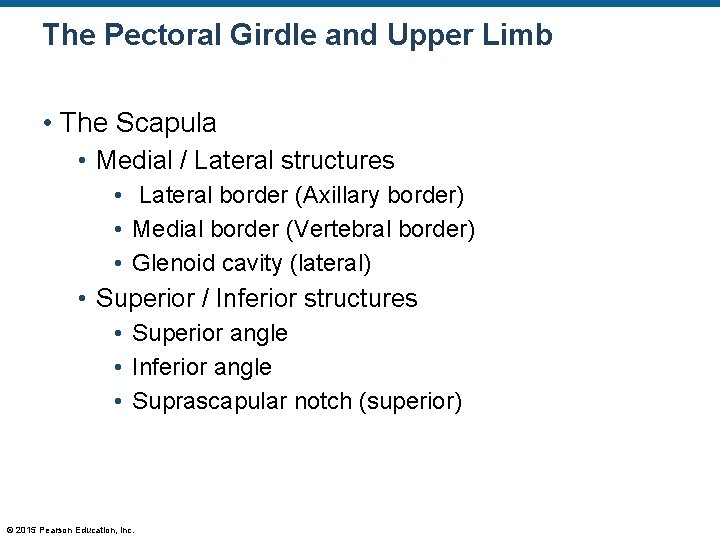
The Pectoral Girdle and Upper Limb • The Scapula • Medial / Lateral structures • Lateral border (Axillary border) • Medial border (Vertebral border) • Glenoid cavity (lateral) • Superior / Inferior structures • Superior angle • Inferior angle • Suprascapular notch (superior) © 2015 Pearson Education, Inc.
Figure 7. 5 a The Scapula Superior Coracoid border process Acromion Suprascapular notch Superior angle Subscapular fossa Rim of glenoid cavity Lateral angle Body Lateral border (axillary border) Medial border (vertebral border) Inferior angle a Costal (anterior) view © 2015 Pearson Education, Inc.
Figure 7. 5 b The Scapula Acromion Supraglenoid tubercle Coracoid process Spine Glenoid cavity Infraglenoid tubercle Lateral border Inferior angle b © 2015 Pearson Education, Inc. Lateral view
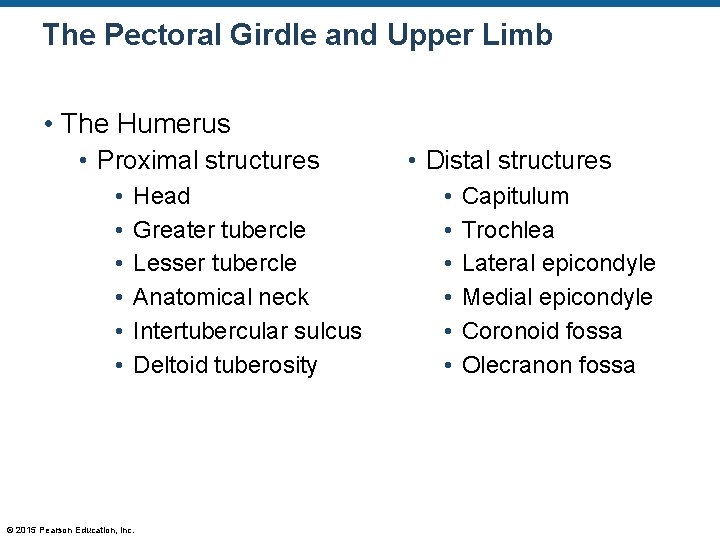
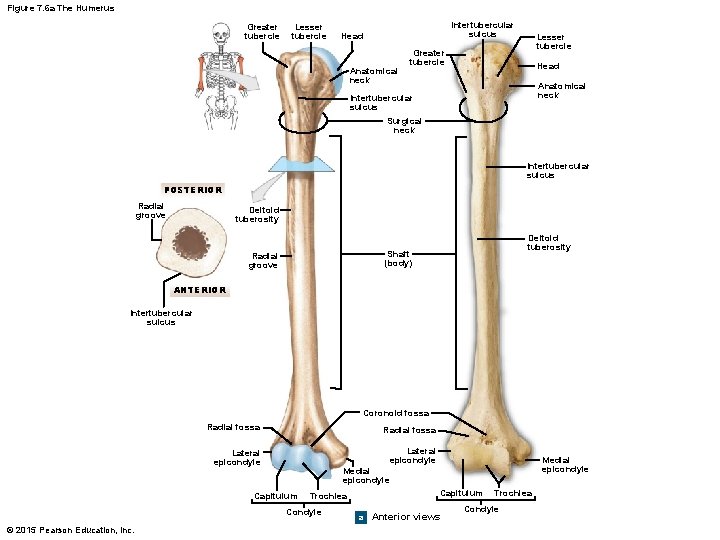
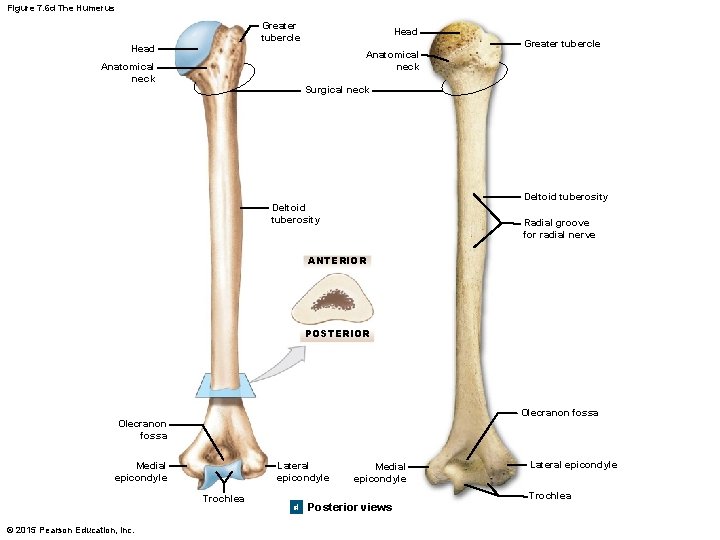
The Pectoral Girdle and Upper Limb • The Humerus • Proximal structures • • • Head Greater tubercle Lesser tubercle Anatomical neck Intertubercular sulcus Deltoid tuberosity © 2015 Pearson Education, Inc. • Distal structures • • • Capitulum Trochlea Lateral epicondyle Medial epicondyle Coronoid fossa Olecranon fossa
Figure 7. 6 a The Humerus Greater tubercle Lesser tubercle Intertubercular sulcus Head Anatomical neck Lesser tubercle Greater tubercle Head Anatomical neck Intertubercular sulcus Surgical neck Intertubercular sulcus POSTERIOR Radial groove Deltoid tuberosity Shaft (body) Radial groove ANTERIOR Intertubercular sulcus Coronoid fossa Radial fossa Lateral epicondyle Capitulum Trochlea Condyle © 2015 Pearson Education, Inc. Medial epicondyle Capitulum a Anterior views Trochlea Condyle
Figure 7. 6 d The Humerus Greater tubercle Head Anatomical neck Surgical neck Deltoid tuberosity Radial groove for radial nerve ANTERIOR POSTERIOR Olecranon fossa Medial epicondyle Lateral epicondyle Trochlea © 2015 Pearson Education, Inc. d Medial epicondyle Posterior views Lateral epicondyle Trochlea
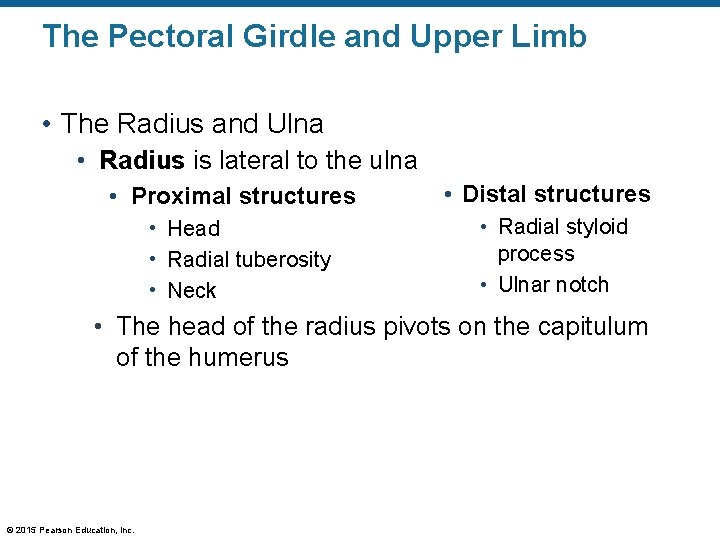
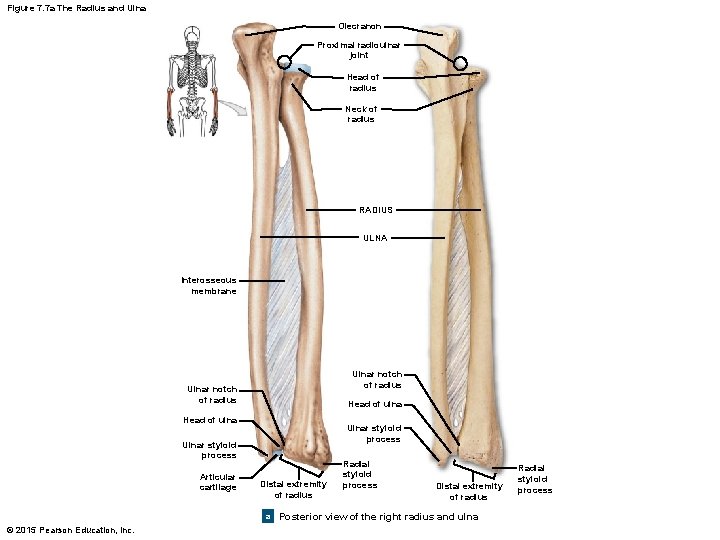
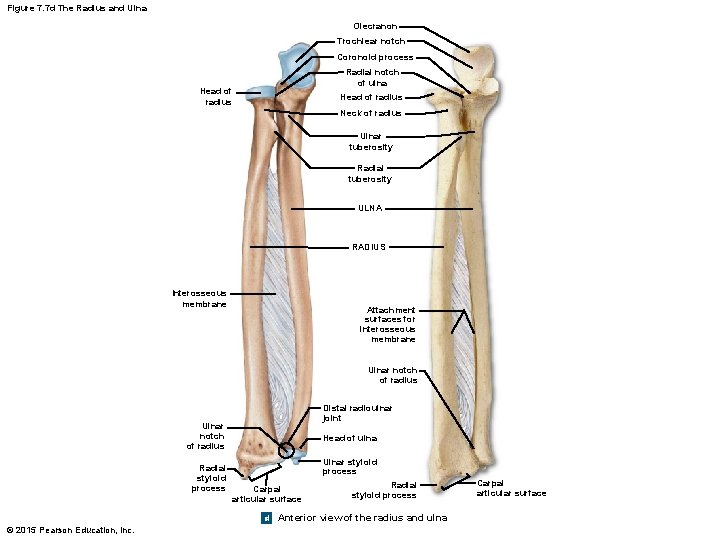
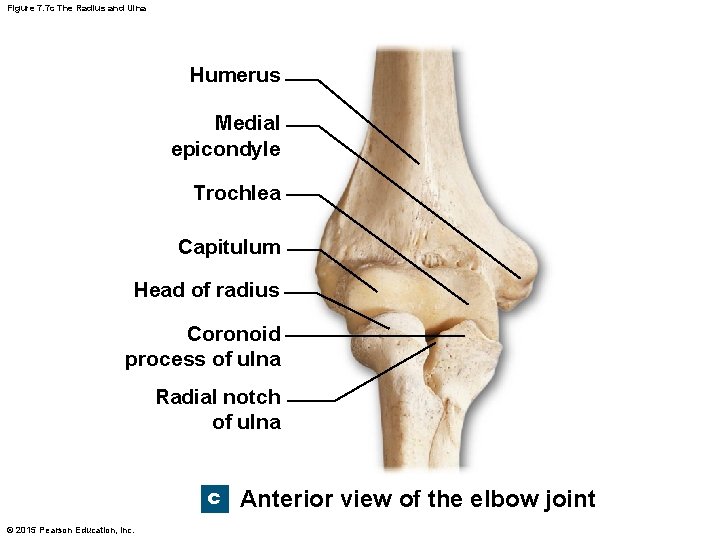
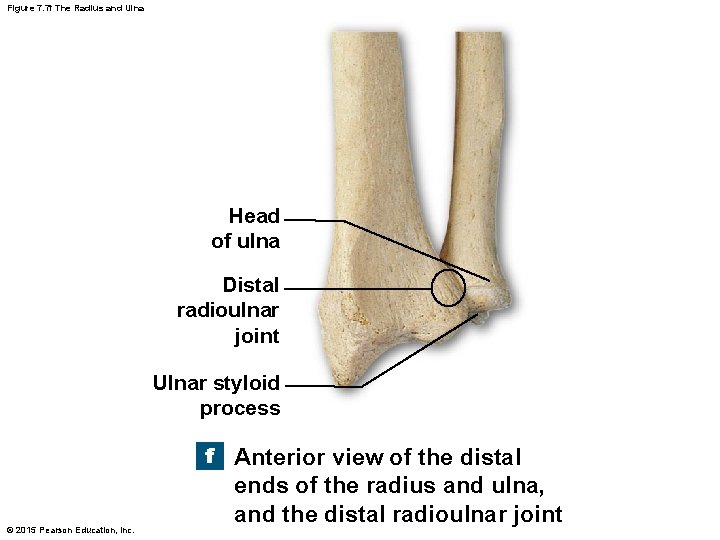
The Pectoral Girdle and Upper Limb • The Radius and Ulna • Radius is lateral to the ulna • Proximal structures • Head • Radial tuberosity • Neck • Distal structures • Radial styloid process • Ulnar notch • The head of the radius pivots on the capitulum of the humerus © 2015 Pearson Education, Inc.
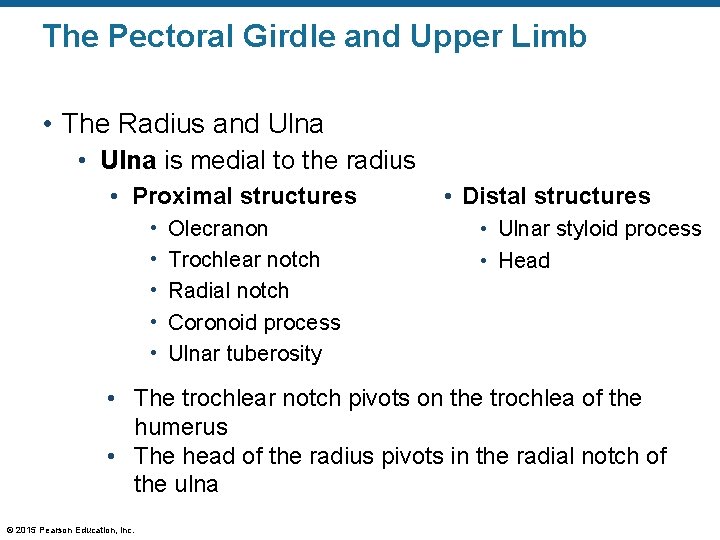
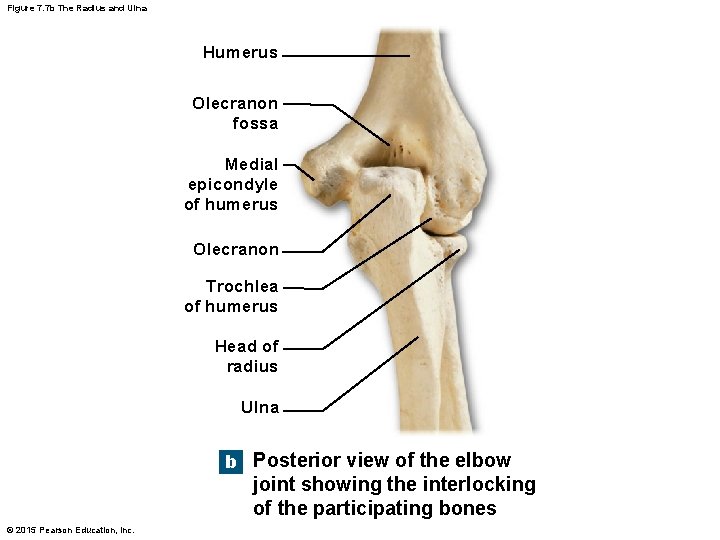
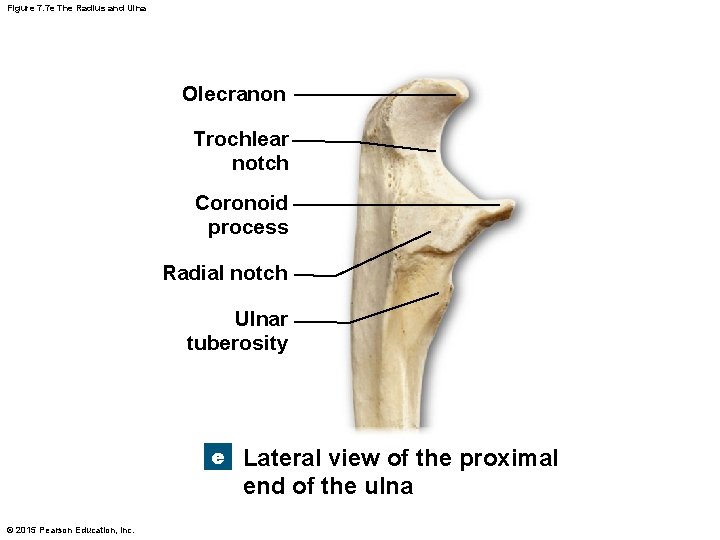
The Pectoral Girdle and Upper Limb • The Radius and Ulna • Ulna is medial to the radius • Proximal structures • • • Olecranon Trochlear notch Radial notch Coronoid process Ulnar tuberosity • Distal structures • Ulnar styloid process • Head • The trochlear notch pivots on the trochlea of the humerus • The head of the radius pivots in the radial notch of the ulna © 2015 Pearson Education, Inc.
Figure 7. 7 a The Radius and Ulna Olecranon Proximal radioulnar joint Head of radius Neck of radius RADIUS ULNA Interosseous membrane Ulnar notch of radius Head of ulna Ulnar styloid process Articular cartilage Distal extremity of radius Radial styloid process Distal extremity of radius a Posterior view of the right radius and ulna © 2015 Pearson Education, Inc. Radial styloid process
Figure 7. 7 d The Radius and Ulna Olecranon Trochlear notch Coronoid process Radial notch of ulna Head of radius Neck of radius Ulnar tuberosity Radial tuberosity ULNA RADIUS Interosseous membrane Attachment surfaces for interosseous membrane Ulnar notch of radius Distal radioulnar joint Ulnar notch of radius Radial styloid process Head of ulna Ulnar styloid process Carpal articular surface Radial styloid process d Anterior view of the radius and ulna © 2015 Pearson Education, Inc. Carpal articular surface
Figure 7. 7 b The Radius and Ulna Humerus Olecranon fossa Medial epicondyle of humerus Olecranon Trochlea of humerus Head of radius Ulna b Posterior view of the elbow joint showing the interlocking of the participating bones © 2015 Pearson Education, Inc.
Figure 7. 7 c The Radius and Ulna Humerus Medial epicondyle Trochlea Capitulum Head of radius Coronoid process of ulna Radial notch of ulna c © 2015 Pearson Education, Inc. Anterior view of the elbow joint
Figure 7. 7 e The Radius and Ulna Olecranon Trochlear notch Coronoid process Radial notch Ulnar tuberosity e Lateral view of the proximal end of the ulna © 2015 Pearson Education, Inc.
Figure 7. 7 f The Radius and Ulna Head of ulna Distal radioulnar joint Ulnar styloid process f Anterior view of the distal © 2015 Pearson Education, Inc. ends of the radius and ulna, and the distal radioulnar joint
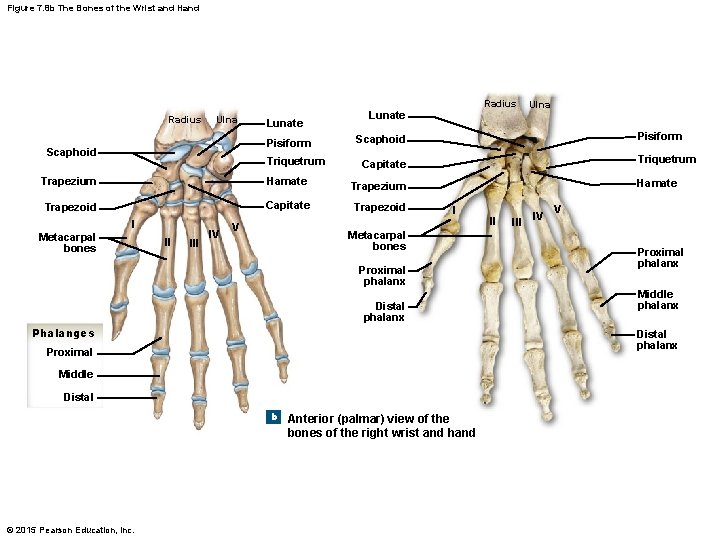
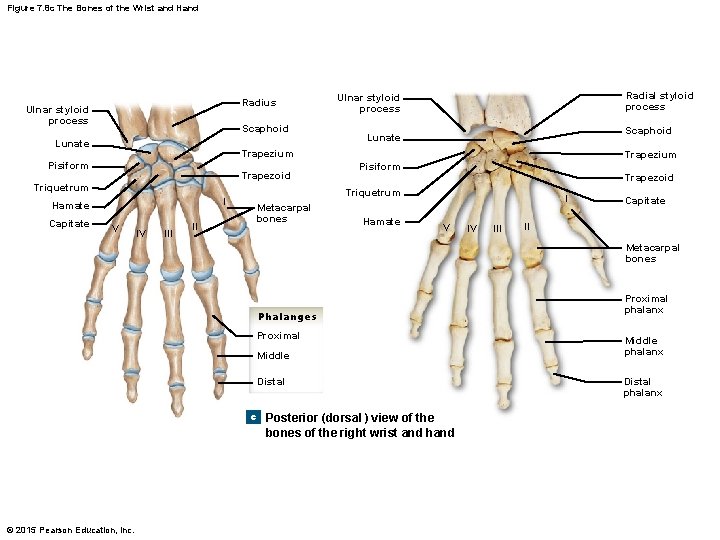
The Pectoral Girdle and Upper Limb • The Wrist and Hand • Carpal bones • Eight bones of the wrist • Metacarpal bones • Five metacarpals (make up the “back of the hand”) • Phalanges • Pollex has two phalanges • All other digits of the hand have three phalanges © 2015 Pearson Education, Inc.
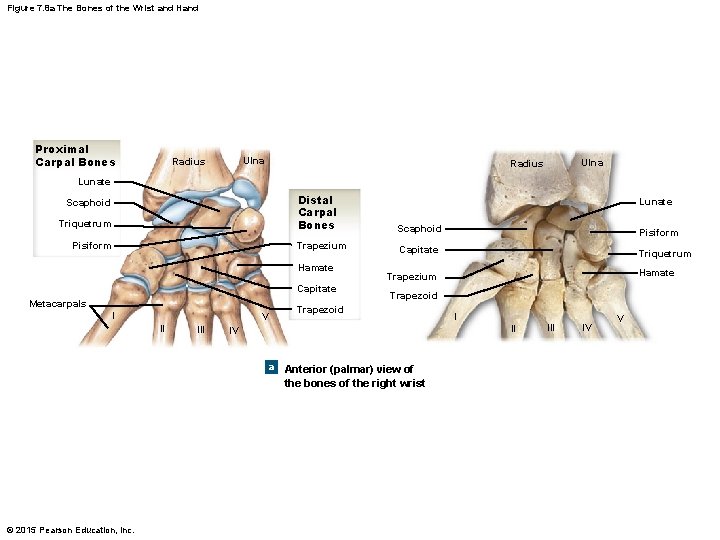
The Pectoral Girdle and Upper Limb • The Wrist and Hand • Carpal bones • Proximal bones • • © 2015 Pearson Education, Inc. Scaphoid Lunate Triquetrum Pisiform • Distal structures • • Trapezium Trapezoid Capitate Hamate
Figure 7. 8 a The Bones of the Wrist and Hand Proximal Carpal Bones Ulna Radius Lunate Scaphoid Triquetrum Pisiform Distal Carpal Bones Scaphoid Pisiform Trapezium Capitate Triquetrum Hamate Capitate Metacarpals I V II III Lunate Trapezoid I II IV a Anterior (palmar) view of the bones of the right wrist © 2015 Pearson Education, Inc. Hamate Trapezium III IV V
Figure 7. 8 b The Bones of the Wrist and Hand Radius Ulna Lunate Pisiform Scaphoid Triquetrum Trapezium Hamate Trapezoid Capitate I Metacarpal bones II IV V Radius Lunate Pisiform Scaphoid Triquetrum Capitate Hamate Trapezium Trapezoid I Metacarpal bones Proximal phalanx Distal phalanx Phalanges II IV V Proximal phalanx Middle phalanx Distal phalanx Proximal Middle Distal b © 2015 Pearson Education, Inc. Ulna Anterior (palmar) view of the bones of the right wrist and hand
Figure 7. 8 c The Bones of the Wrist and Hand Radius Ulnar styloid process Scaphoid Lunate Trapezium Pisiform Trapezoid Triquetrum I Hamate Capitate Radial styloid process Ulnar styloid process V IV III II Trapezium Pisiform Trapezoid Triquetrum Metacarpal bones Hamate I V IV III Capitate II Metacarpal bones Phalanges Proximal Middle Distal c © 2015 Pearson Education, Inc. Posterior (dorsal ) view of the bones of the right wrist and hand Proximal phalanx Middle phalanx Distal phalanx
The Pelvic Girdle and Lower Limb • Pelvic Girdle consists of: • Hip bones (three coxal bones) • Ilium • Pubis • Ischium © 2015 Pearson Education, Inc.
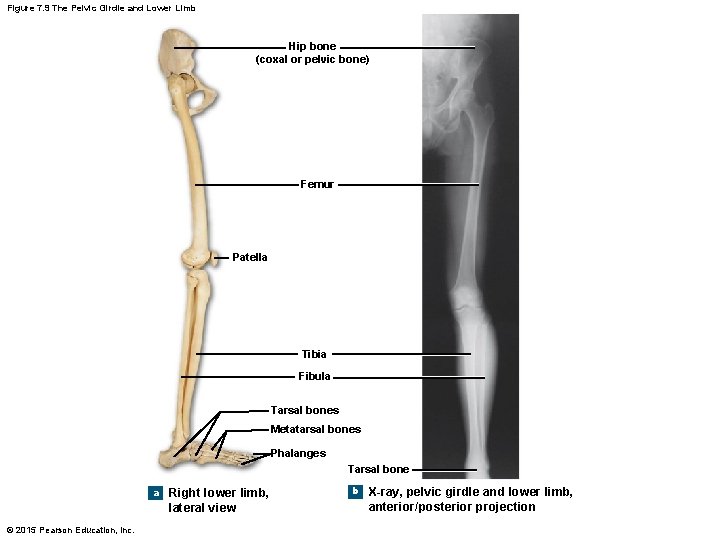
The Pelvic Girdle and Lower Limb • The lower limb consists of: • • Femur Patella Tibia Fibula Tarsals Metatarsals Hallux and other digits © 2015 Pearson Education, Inc.
Figure 7. 9 The Pelvic Girdle and Lower Limb Hip bone (coxal or pelvic bone) Femur Patella Tibia Fibula Tarsal bones Metatarsal bones Phalanges Tarsal bone a © 2015 Pearson Education, Inc. Right lower limb, lateral view b X-ray, pelvic girdle and lower limb, anterior/posterior projection
The Pelvic Girdle and Lower Limb • Pelvic Girdle • Supports and protects the lower viscera and developing fetus in females • The bones of the pelvic girdle and lower limb are much more massive than their homologues of the upper limb © 2015 Pearson Education, Inc.
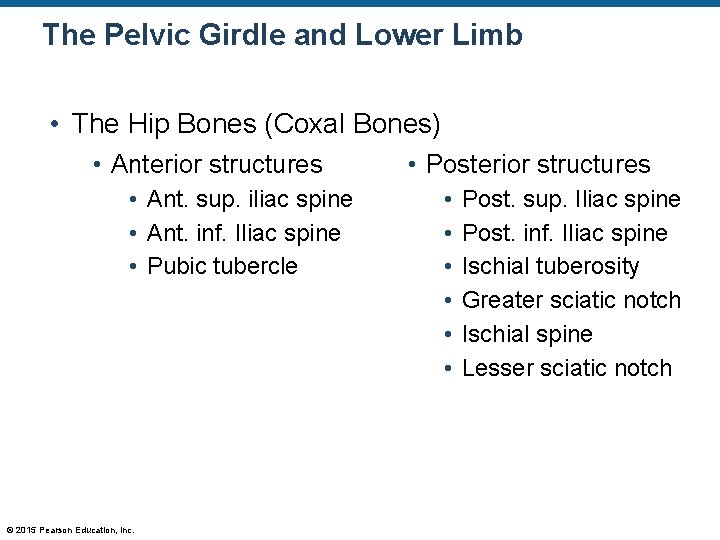
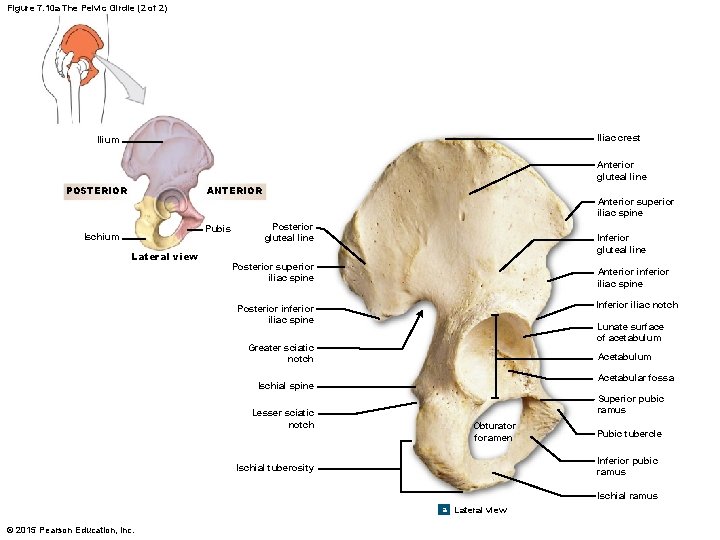
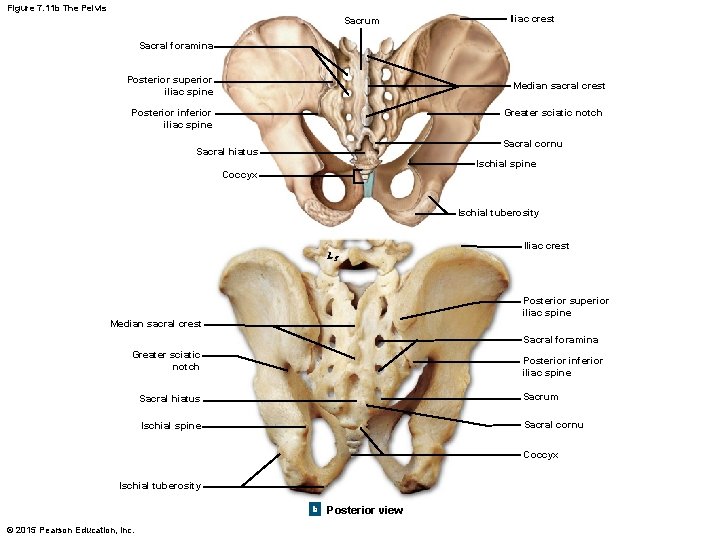
The Pelvic Girdle and Lower Limb • The Hip Bones (Coxal Bones) • Anterior structures • Ant. sup. iliac spine • Ant. inf. Iliac spine • Pubic tubercle © 2015 Pearson Education, Inc. • Posterior structures • • • Post. sup. Iliac spine Post. inf. Iliac spine Ischial tuberosity Greater sciatic notch Ischial spine Lesser sciatic notch
Figure 7. 10 a The Pelvic Girdle (2 of 2) Iliac crest Ilium Anterior gluteal line POSTERIOR ANTERIOR Pubis Ischium Lateral view Anterior superior iliac spine Posterior gluteal line Inferior gluteal line Posterior superior iliac spine Anterior inferior iliac spine Inferior iliac notch Posterior inferior iliac spine Lunate surface of acetabulum Greater sciatic notch Acetabulum Acetabular fossa Ischial spine Superior pubic ramus Lesser sciatic notch Obturator foramen Pubic tubercle Inferior pubic ramus Ischial tuberosity Ischial ramus a © 2015 Pearson Education, Inc. Lateral view
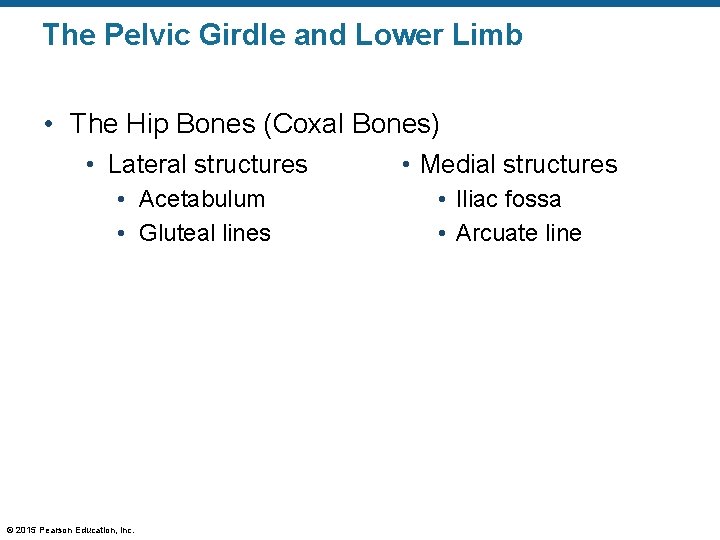
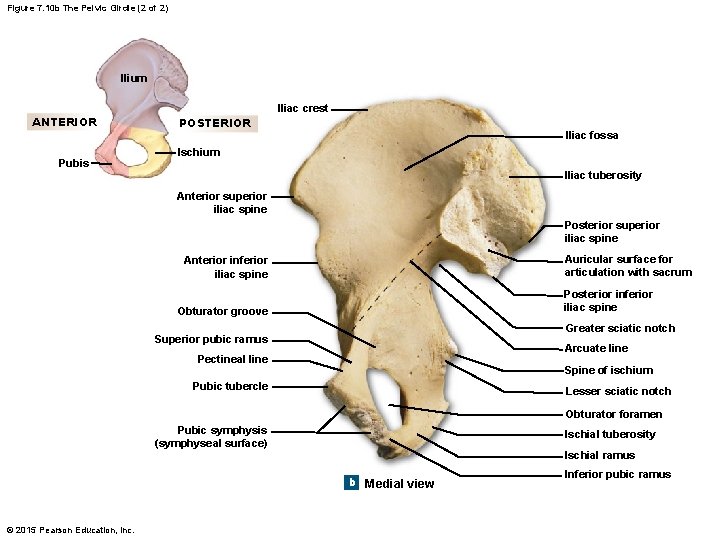
The Pelvic Girdle and Lower Limb • The Hip Bones (Coxal Bones) • Lateral structures • Medial structures • Acetabulum • Gluteal lines • Iliac fossa • Arcuate line © 2015 Pearson Education, Inc.
Figure 7. 10 b The Pelvic Girdle (2 of 2) Ilium ANTERIOR Pubis Iliac crest POSTERIOR Iliac fossa Ischium Iliac tuberosity Anterior superior iliac spine Posterior superior iliac spine Auricular surface for articulation with sacrum Anterior inferior iliac spine Posterior inferior iliac spine Obturator groove Greater sciatic notch Superior pubic ramus Arcuate line Pectineal line Spine of ischium Pubic tubercle Lesser sciatic notch Obturator foramen Pubic symphysis (symphyseal surface) Ischial tuberosity Ischial ramus b Medial view © 2015 Pearson Education, Inc. Inferior pubic ramus
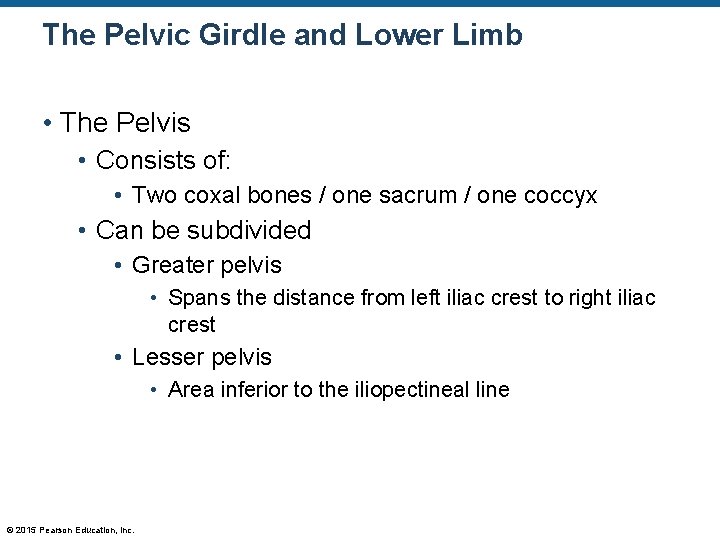
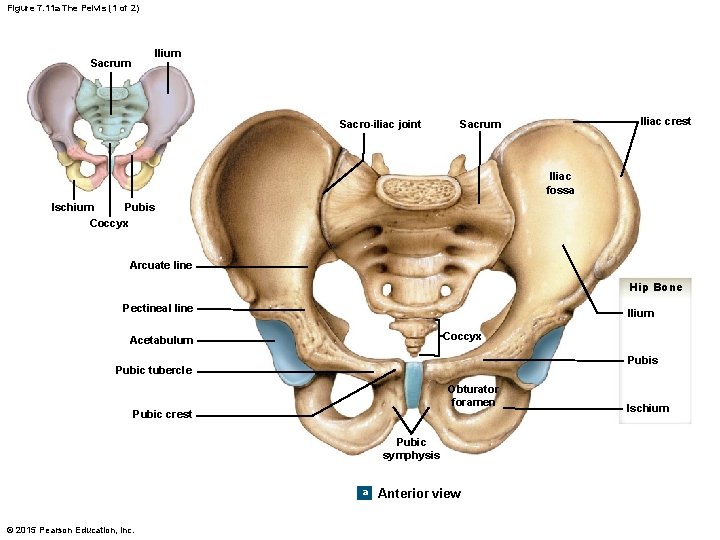
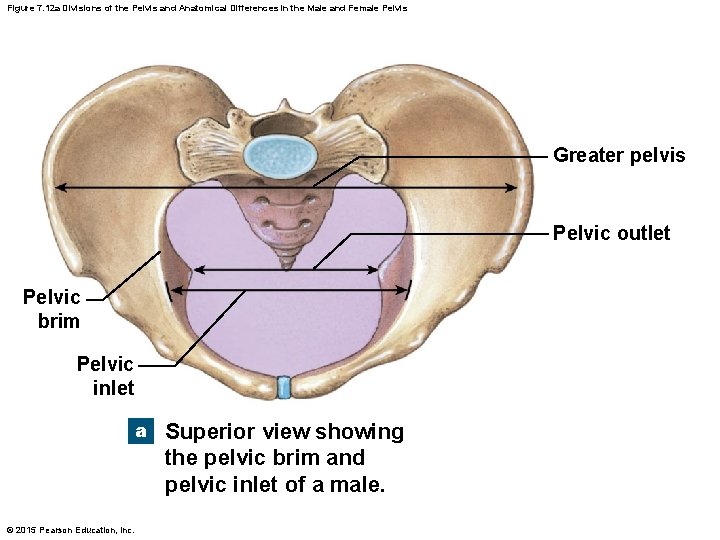
The Pelvic Girdle and Lower Limb • The Pelvis • Consists of: • Two coxal bones / one sacrum / one coccyx • Can be subdivided • Greater pelvis • Spans the distance from left iliac crest to right iliac crest • Lesser pelvis • Area inferior to the iliopectineal line © 2015 Pearson Education, Inc.
Figure 7. 11 a The Pelvis (1 of 2) Ilium Sacro-iliac joint Iliac crest Sacrum Iliac fossa Pubis Ischium Coccyx Arcuate line Hip Bone Pectineal line Ilium Coccyx Acetabulum Pubis Pubic tubercle Obturator foramen Pubic crest Pubic symphysis a © 2015 Pearson Education, Inc. Anterior view Ischium
Figure 7. 11 b The Pelvis Sacrum Iliac crest Sacral foramina Posterior superior iliac spine Median sacral crest Posterior inferior iliac spine Greater sciatic notch Sacral cornu Sacral hiatus Ischial spine Coccyx Ischial tuberosity L 5 Iliac crest Posterior superior iliac spine Median sacral crest Sacral foramina Greater sciatic notch Posterior inferior iliac spine Sacral hiatus Sacrum Ischial spine Sacral cornu Coccyx Ischial tuberosity b © 2015 Pearson Education, Inc. Posterior view
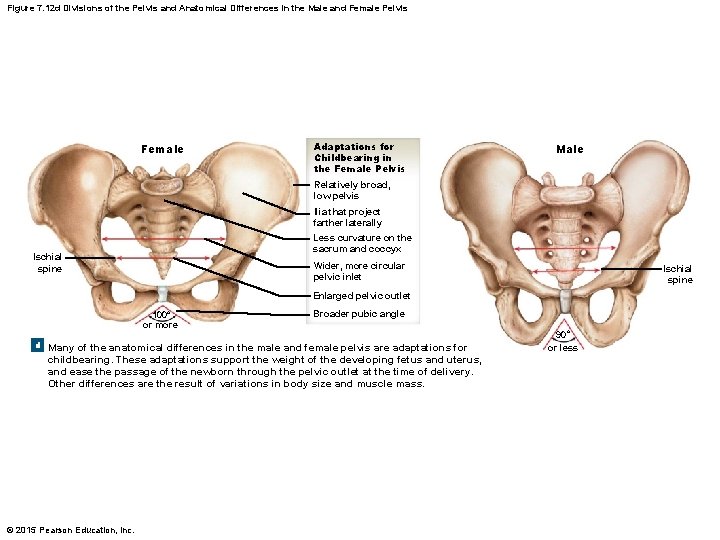
The Pelvic Girdle and Lower Limb • The Pelvis • Consists of two pelvic spaces • Pelvic inlet (superior space between the brim of each coxal bone) • Pelvic outlet (inferior space between the ischial spine of each coxal bone) © 2015 Pearson Education, Inc.
Figure 7. 12 a Divisions of the Pelvis and Anatomical Differences in the Male and Female Pelvis Greater pelvis Pelvic outlet Pelvic brim Pelvic inlet a © 2015 Pearson Education, Inc. Superior view showing the pelvic brim and pelvic inlet of a male.
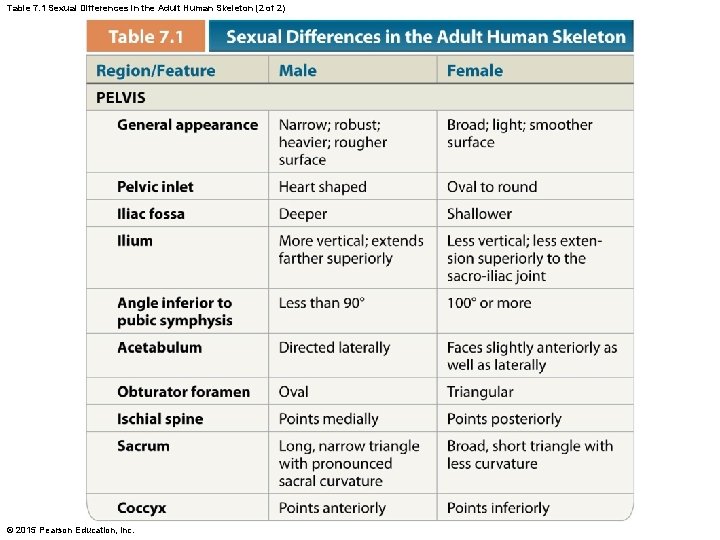
The Pelvic Girdle and Lower Limb • Male and Female Pelvis • The main anatomical difference is in regard to childbearing • Pelvic outlet • Larger in females than in males • Sacrum curve • Less curvature in females than in males • Pelvic inlet • Wider in females than in males • Pubic angle • Greater than 100 in females and less than 90 ) in males © 2015 Pearson Education, Inc.
Figure 7. 12 d Divisions of the Pelvis and Anatomical Differences in the Male and Female Pelvis Female Adaptations for Childbearing in the Female Pelvis Male Relatively broad, low pelvis Ilia that project farther laterally Less curvature on the sacrum and coccyx Ischial spine Wider, more circular pelvic inlet Ischial spine Enlarged pelvic outlet 100° or more d Broader pubic angle Many of the anatomical differences in the male and female pelvis are adaptations for childbearing. These adaptations support the weight of the developing fetus and uterus, and ease the passage of the newborn through the pelvic outlet at the time of delivery. Other differences are the result of variations in body size and muscle mass. © 2015 Pearson Education, Inc. 90° or less
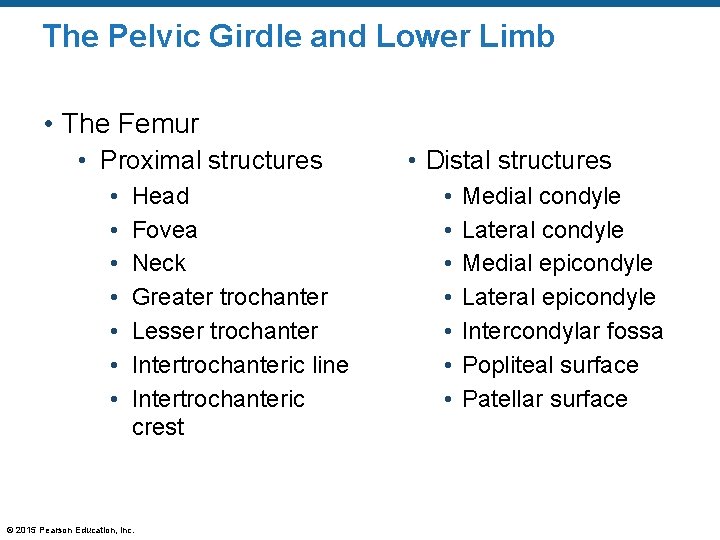
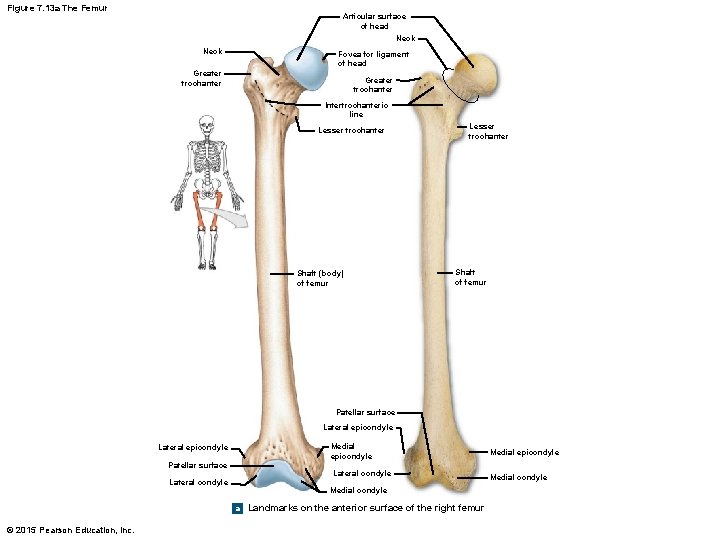
The Pelvic Girdle and Lower Limb • The Femur • Proximal structures • • Head Fovea Neck Greater trochanter Lesser trochanter Intertrochanteric line Intertrochanteric crest © 2015 Pearson Education, Inc. • Distal structures • • Medial condyle Lateral condyle Medial epicondyle Lateral epicondyle Intercondylar fossa Popliteal surface Patellar surface
Figure 7. 13 a The Femur Articular surface of head Neck Fovea for ligament of head Greater trochanter Intertrochanteric line Lesser trochanter Shaft (body) of femur Lesser trochanter Shaft of femur Patellar surface Lateral epicondyle Patellar surface Lateral condyle Medial epicondyle Lateral condyle Medial condyle a Landmarks on the anterior surface of the right femur © 2015 Pearson Education, Inc.
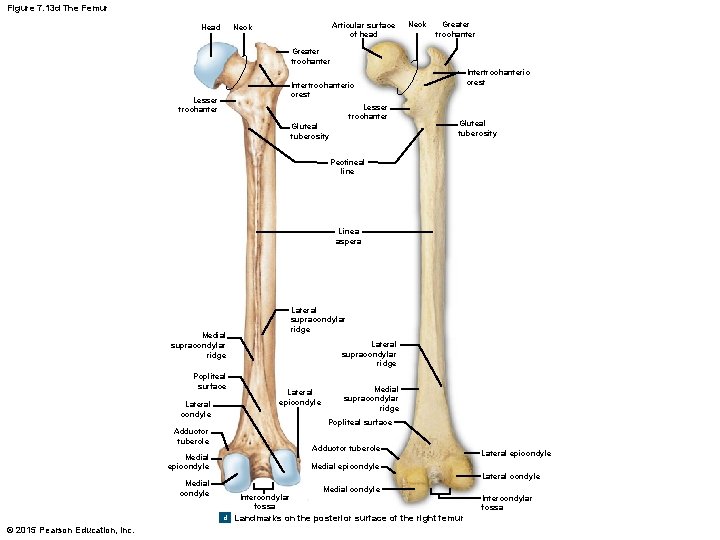
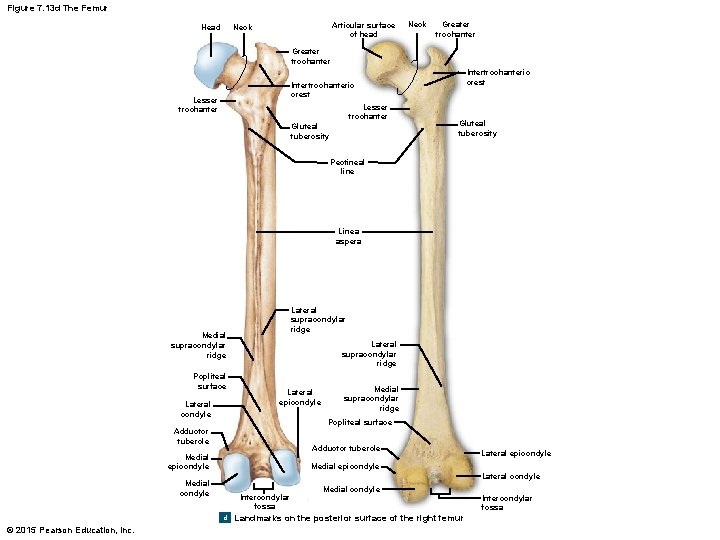
Figure 7. 13 d The Femur Articular surface of head Neck Head Neck Greater trochanter Intertrochanteric crest Lesser trochanter Gluteal tuberosity Pectineal line Linea aspera Lateral supracondylar ridge Medial supracondylar ridge Popliteal surface Lateral condyle Lateral supracondylar ridge Lateral epicondyle Popliteal surface Adductor tubercle Medial epicondyle Lateral epicondyle Medial epicondyle Lateral condyle Medial condyle Intercondylar fossa d © 2015 Pearson Education, Inc. Medial supracondylar ridge Medial condyle Landmarks on the posterior surface of the right femur Intercondylar fossa
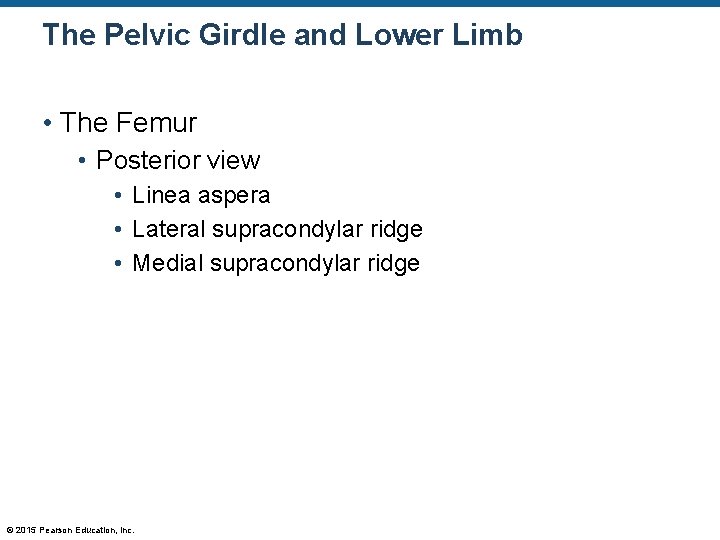
The Pelvic Girdle and Lower Limb • The Femur • Posterior view • Linea aspera • Lateral supracondylar ridge • Medial supracondylar ridge © 2015 Pearson Education, Inc.
Figure 7. 13 d The Femur Articular surface of head Neck Head Neck Greater trochanter Intertrochanteric crest Lesser trochanter Gluteal tuberosity Pectineal line Linea aspera Lateral supracondylar ridge Medial supracondylar ridge Popliteal surface Lateral condyle Lateral supracondylar ridge Lateral epicondyle Popliteal surface Adductor tubercle Medial epicondyle Lateral epicondyle Medial epicondyle Lateral condyle Medial condyle Intercondylar fossa d © 2015 Pearson Education, Inc. Medial supracondylar ridge Medial condyle Landmarks on the posterior surface of the right femur Intercondylar fossa
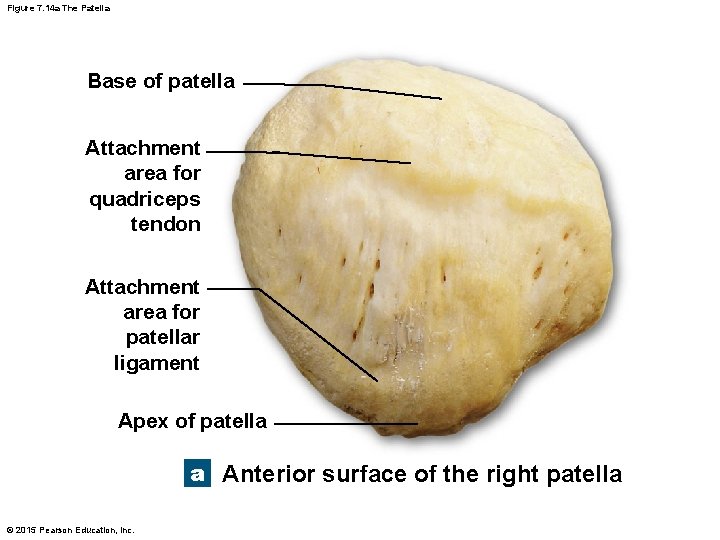
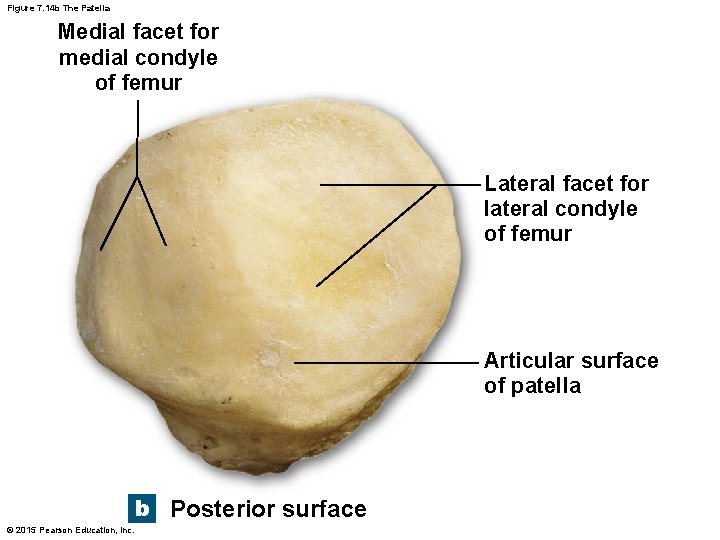
The Pelvic Girdle and Lower Limb • The Patella • This is a large sesamoid bone • Protects the knee joint • Anterior surface is rough for strong tendon attachment • Posterior surface has concave facets for the femoral condyles © 2015 Pearson Education, Inc.
Figure 7. 14 a The Patella Base of patella Attachment area for quadriceps tendon Attachment area for patellar ligament Apex of patella a Anterior surface of the right patella © 2015 Pearson Education, Inc.
Figure 7. 14 b The Patella Medial facet for medial condyle of femur Lateral facet for lateral condyle of femur Articular surface of patella b Posterior surface © 2015 Pearson Education, Inc.
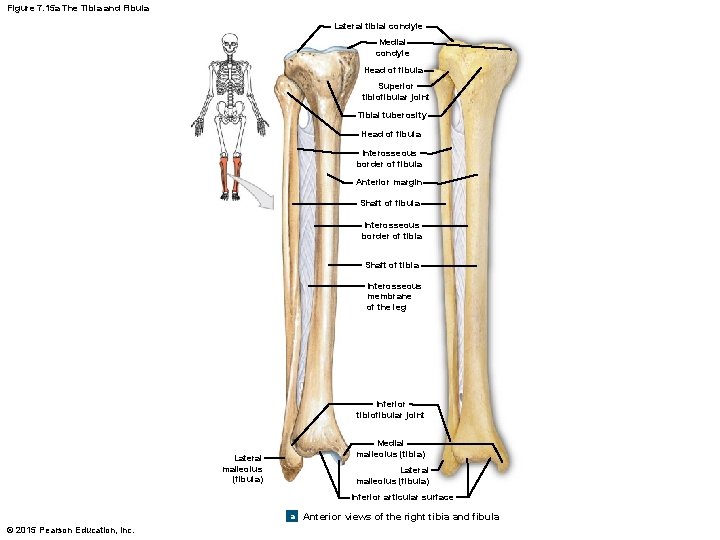
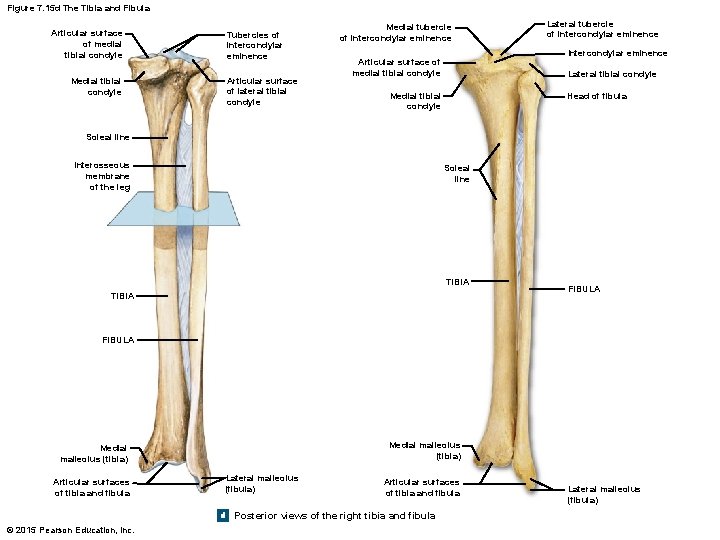
The Pelvic Girdle and Lower Limb • The Tibia and Fibula • Tibia is medial to the fibula • Proximal structures • Tibial tuberosity • Intercondylar eminence • Medial and lateral tubercles of the intercondylar eminence • Articular surfaces • Soleal line © 2015 Pearson Education, Inc. • Distal structures • Medial malleolus
The Pelvic Girdle and Lower Limb • The Tibia and Fibula • Fibula is lateral to the tibia • Proximal structures • Head © 2015 Pearson Education, Inc. • Distal structures • Lateral malleolus
Figure 7. 15 a The Tibia and Fibula Lateral tibial condyle Medial condyle Head of fibula Superior tibiofibular joint Tibial tuberosity Head of fibula Interosseous border of fibula Anterior margin Shaft of fibula Interosseous border of tibia Shaft of tibia Interosseous membrane of the leg Inferior tibiofibular joint Medial malleolus (tibia) Lateral malleolus (fibula) Inferior articular surface a © 2015 Pearson Education, Inc. Anterior views of the right tibia and fibula
Figure 7. 15 d The Tibia and Fibula Articular surface of medial tibial condyle Tubercles of intercondylar eminence Articular surface of lateral tibial condyle Medial tubercle of intercondylar eminence Lateral tubercle of intercondylar eminence Intercondylar eminence Articular surface of medial tibial condyle Lateral tibial condyle Medial tibial condyle Head of fibula Soleal line Interosseous membrane of the leg Soleal line TIBIA FIBULA Medial malleolus (tibia) Articular surfaces of tibia and fibula Lateral malleolus (fibula) d © 2015 Pearson Education, Inc. Articular surfaces of tibia and fibula Posterior views of the right tibia and fibula Lateral malleolus (fibula)
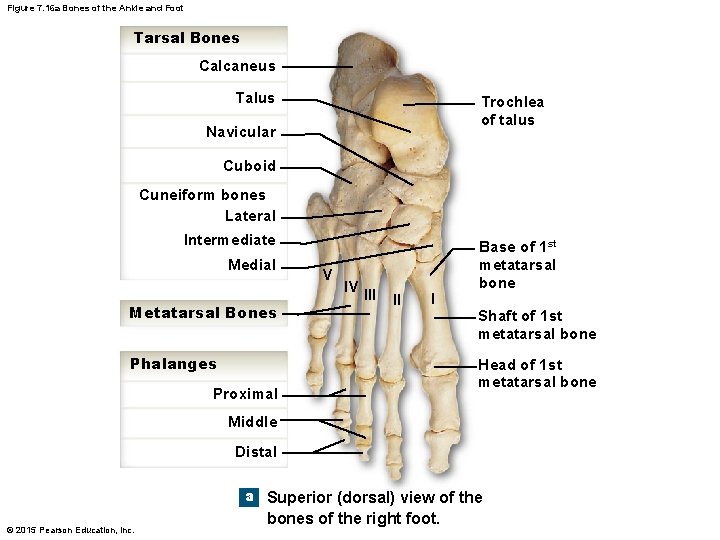
The Pelvic Girdle and Lower Limb • The Ankle and Foot • Tarsal bones • Seven bones of the ankle • Metatarsal bones • Five metatarsals (make up the “arch of the foot”) • Phalanges • Hallux has two phalanges • All other digits of the foot have three phalanges © 2015 Pearson Education, Inc.
The Pelvic Girdle and Lower Limb • The Ankle and Foot • Tarsal bones • • Calcaneus Talus Navicular Cuboid Medial cuneiform Intermediate cuneiform Lateral cuneiform © 2015 Pearson Education, Inc.
Figure 7. 16 a Bones of the Ankle and Foot Tarsal Bones Calcaneus Talus Trochlea of talus Navicular Cuboid Cuneiform bones Lateral Intermediate Medial Metatarsal Bones V IV III II I Phalanges Proximal Base of 1 st metatarsal bone Shaft of 1 st metatarsal bone Head of 1 st metatarsal bone Middle Distal a Superior (dorsal) view of the © 2015 Pearson Education, Inc. bones of the right foot.
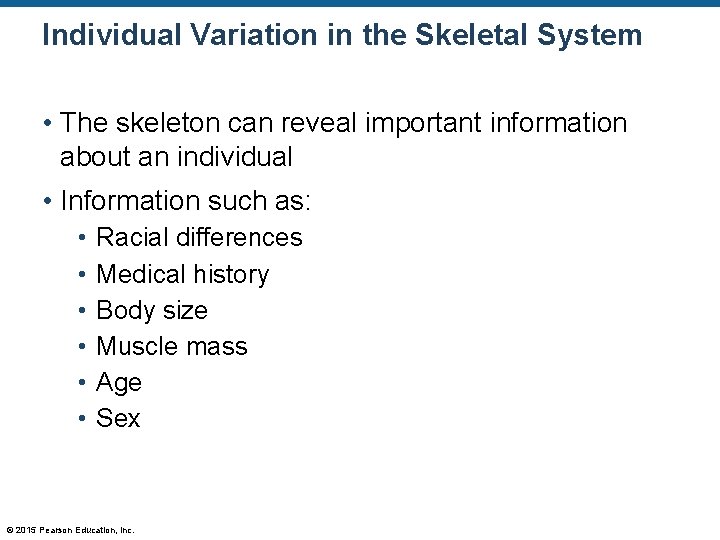
Individual Variation in the Skeletal System • The skeleton can reveal important information about an individual • Information such as: • • • Racial differences Medical history Body size Muscle mass Age Sex © 2015 Pearson Education, Inc.
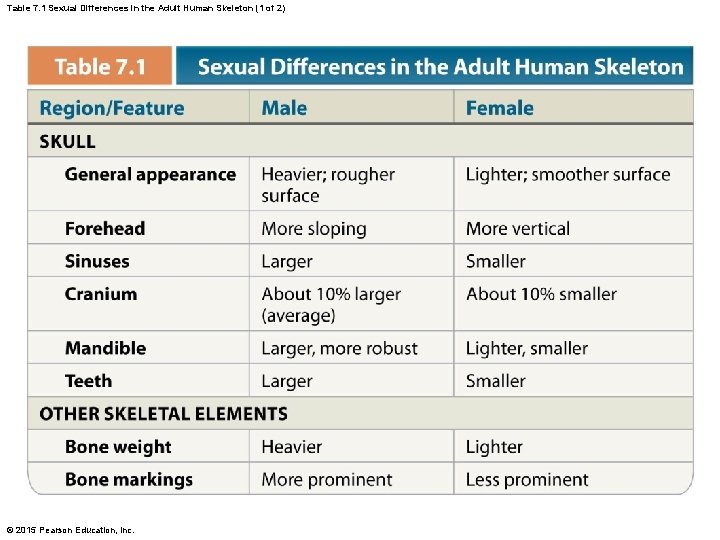
Table 7. 1 Sexual Differences in the Adult Human Skeleton (1 of 2) © 2015 Pearson Education, Inc.
Table 7. 1 Sexual Differences in the Adult Human Skeleton (2 of 2) © 2015 Pearson Education, Inc.
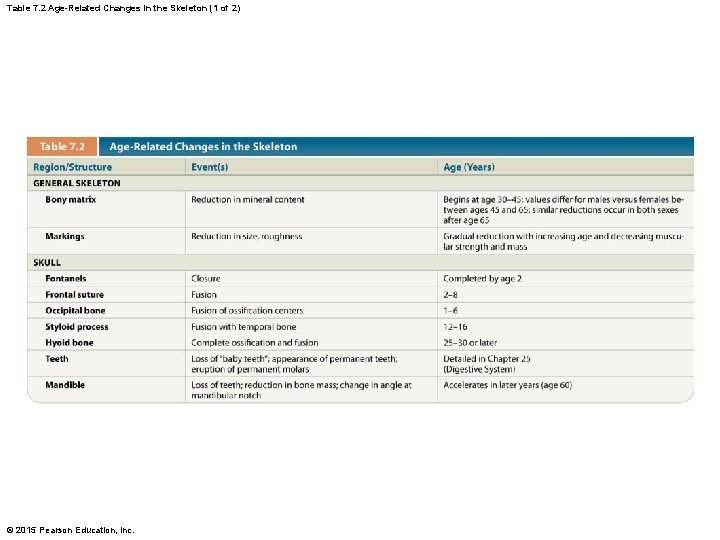
Table 7. 2 Age-Related Changes in the Skeleton (1 of 2) © 2015 Pearson Education, Inc.
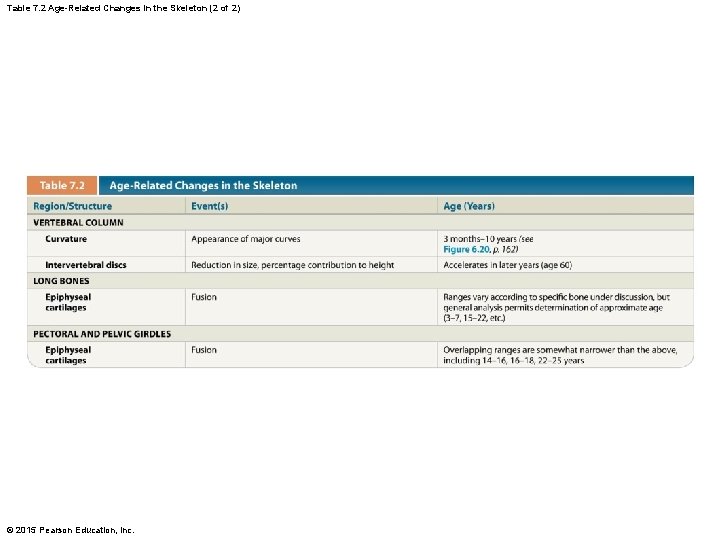
Table 7. 2 Age-Related Changes in the Skeleton (2 of 2) © 2015 Pearson Education, Inc.