
CHAPTER 7 The Respiratory System and Its Regulation

- Slides: 41
CHAPTER 7 The Respiratory System and Its Regulation
Respiratory System Introduction • Purpose: carry O 2 to and remove CO 2 from all body tissues • Carried out by four processes – – Pulmonary ventilation (external respiration) Pulmonary diffusion (external respiration) Transport of gases via blood Capillary diffusion (internal respiration)
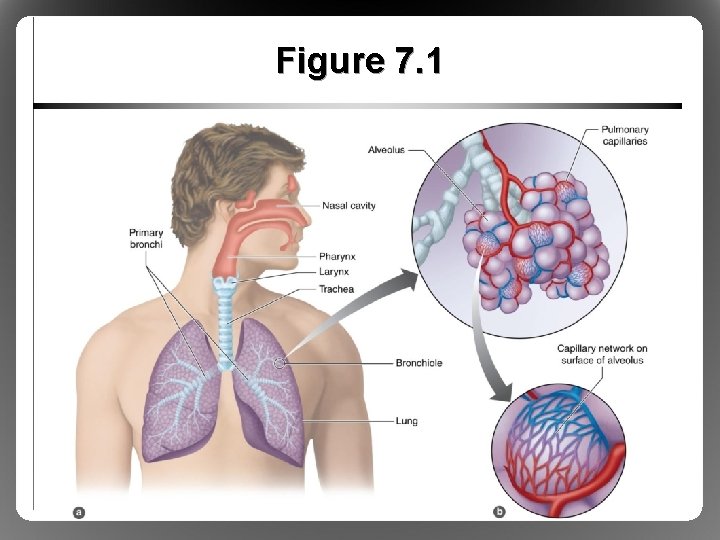
Pulmonary Ventilation • Process of moving air into and out of lungs – Transport zone – Exchange zone • Nose/mouth nasal conchae pharynx larynx trachea bronchial tree alveoli
Figure 7. 1
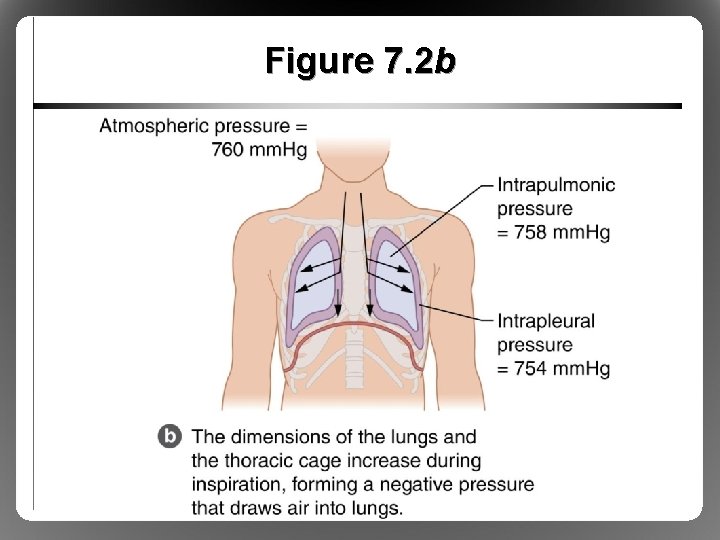
Pulmonary Ventilation: Inspiration • Active process • Involved muscles – Diaphragm flattens – External intercostals move rib cage and sternum up and out • Expands thoracic cavity in three dimensions • Expands volume inside thoracic cavity • Expands volume inside lungs
Pulmonary Ventilation: Inspiration • Lung volume , intrapulmonary pressure – Boyle’s Law regarding pressure versus volume – At constant temperature, pressure and volume inversely proportional • Air passively rushes in due to pressure difference • Forced breathing uses additional muscles – Scalenes, sternocleidomastoid, pectorals – Raise ribs even farther
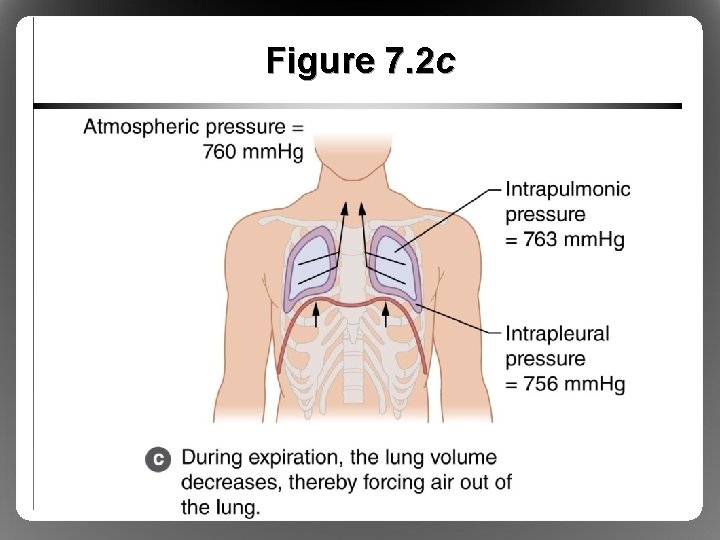
Pulmonary Ventilation: Expiration • Usually passive process – Inspiratory muscles relax – Lung volume , intrapulmonary pressure – Air forced out of lungs • Active process (forced breathing) – Internal intercostals pull ribs down – Also, latissimus dorsi, quadratus lumborum – Abdominal muscles force diaphragm back up
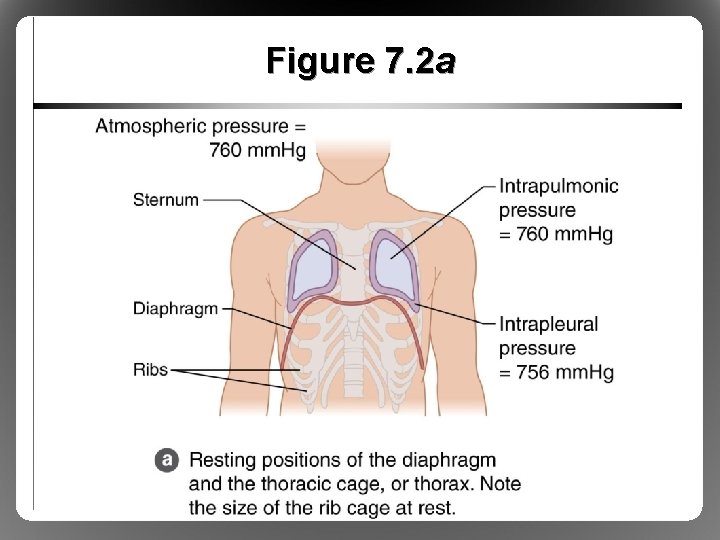
Figure 7. 2 a
Figure 7. 2 b
Figure 7. 2 c
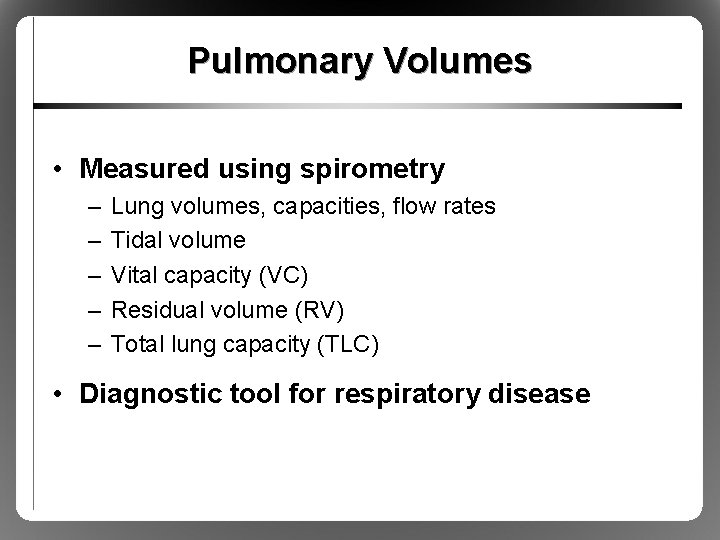
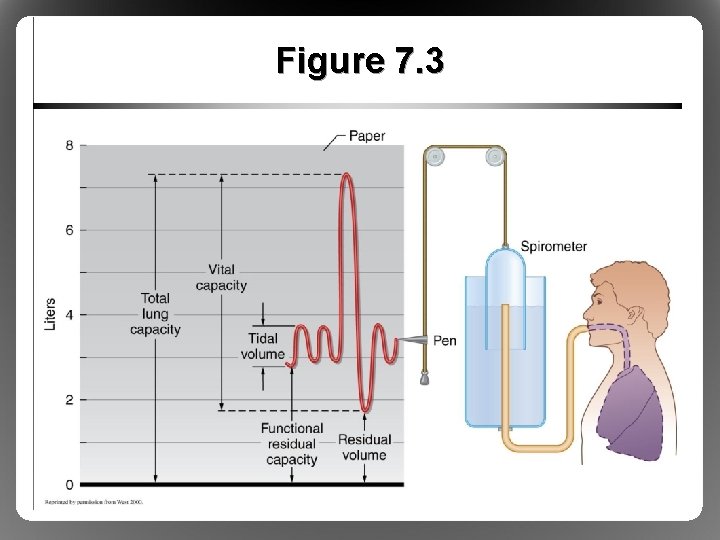
Pulmonary Volumes • Measured using spirometry – – – Lung volumes, capacities, flow rates Tidal volume Vital capacity (VC) Residual volume (RV) Total lung capacity (TLC) • Diagnostic tool for respiratory disease
Figure 7. 3
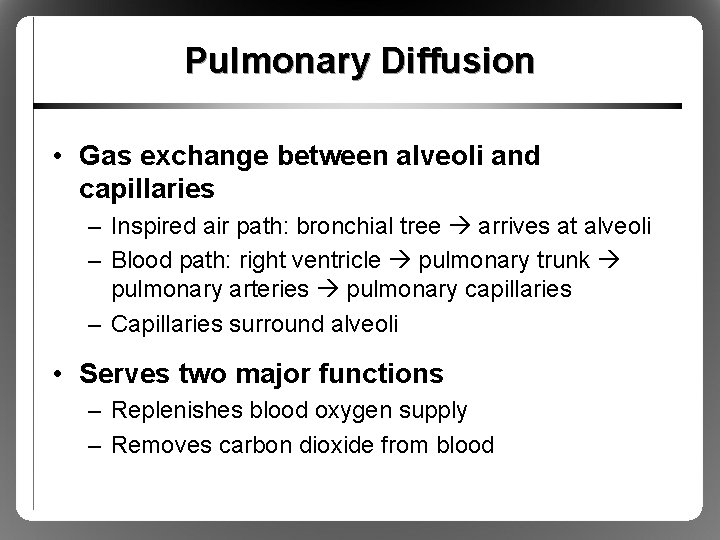
Pulmonary Diffusion • Gas exchange between alveoli and capillaries – Inspired air path: bronchial tree arrives at alveoli – Blood path: right ventricle pulmonary trunk pulmonary arteries pulmonary capillaries – Capillaries surround alveoli • Serves two major functions – Replenishes blood oxygen supply – Removes carbon dioxide from blood
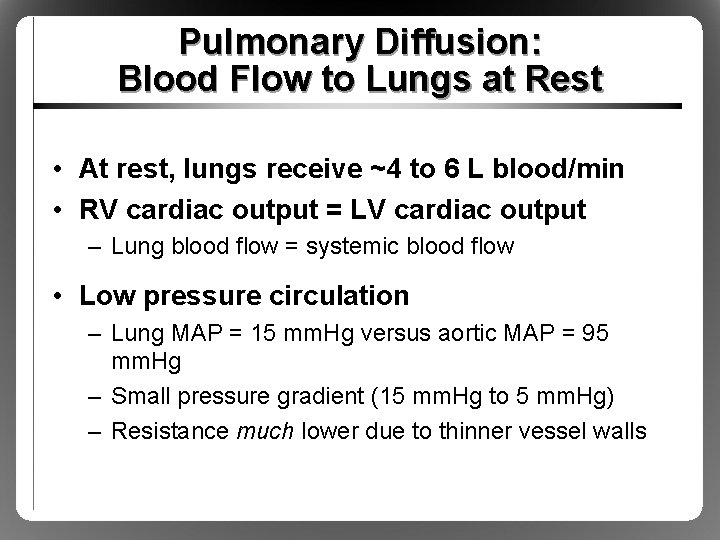
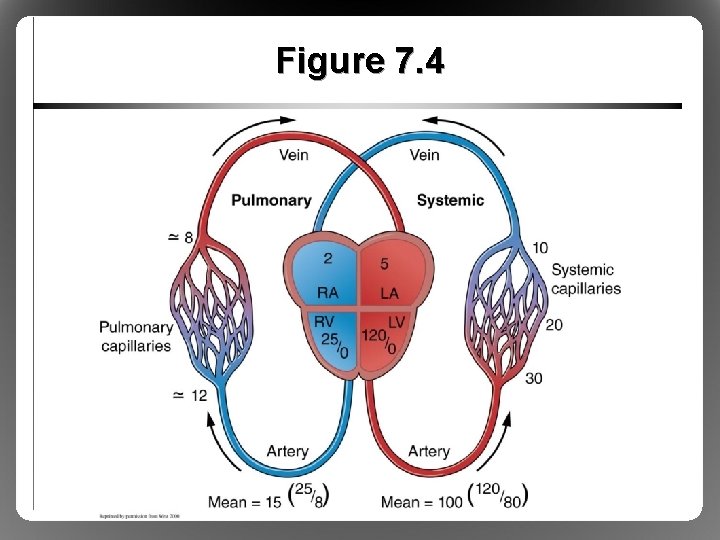
Pulmonary Diffusion: Blood Flow to Lungs at Rest • At rest, lungs receive ~4 to 6 L blood/min • RV cardiac output = LV cardiac output – Lung blood flow = systemic blood flow • Low pressure circulation – Lung MAP = 15 mm. Hg versus aortic MAP = 95 mm. Hg – Small pressure gradient (15 mm. Hg to 5 mm. Hg) – Resistance much lower due to thinner vessel walls
Figure 7. 4
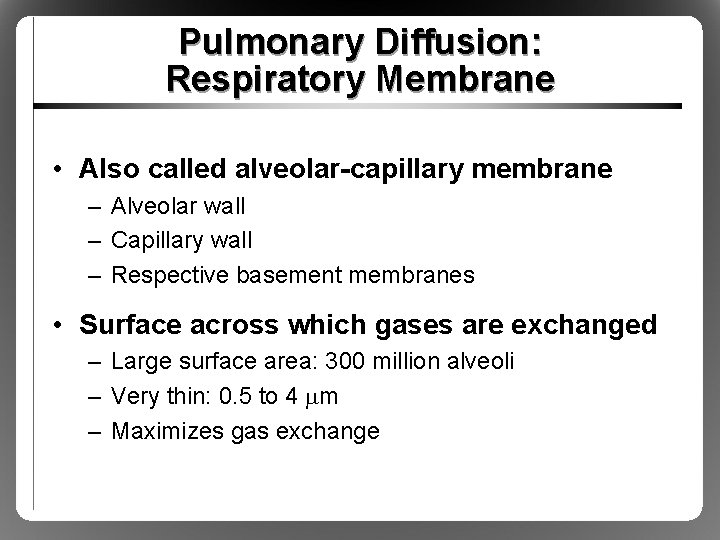
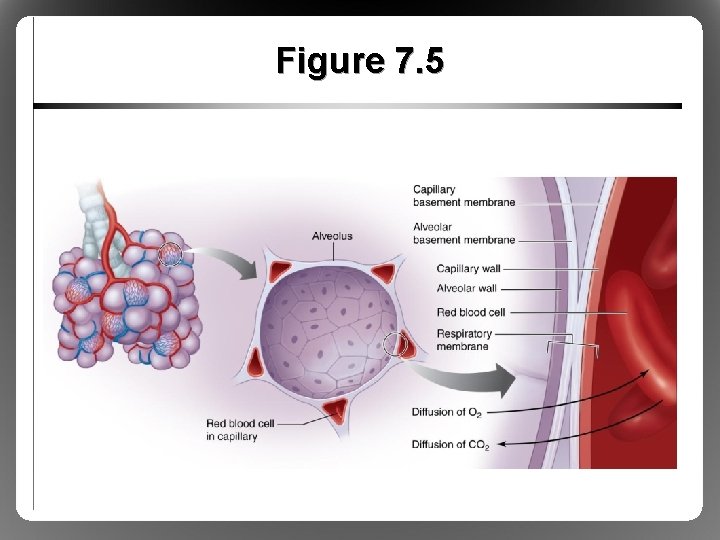
Pulmonary Diffusion: Respiratory Membrane • Also called alveolar-capillary membrane – Alveolar wall – Capillary wall – Respective basement membranes • Surface across which gases are exchanged – Large surface area: 300 million alveoli – Very thin: 0. 5 to 4 mm – Maximizes gas exchange
Figure 7. 5
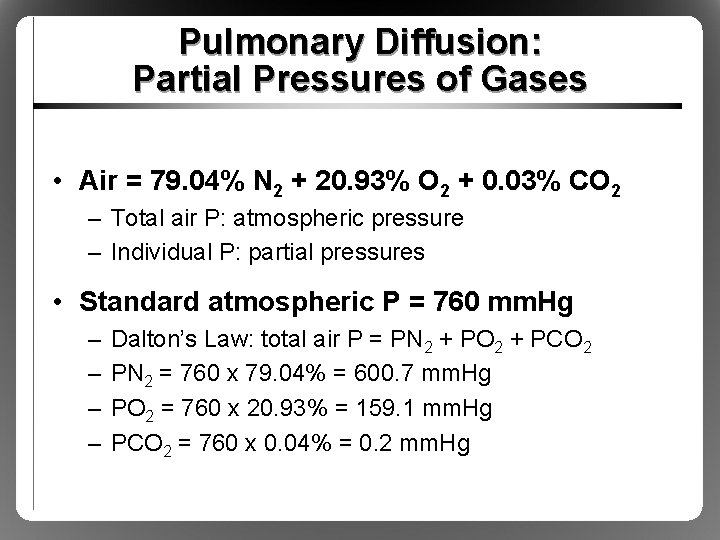
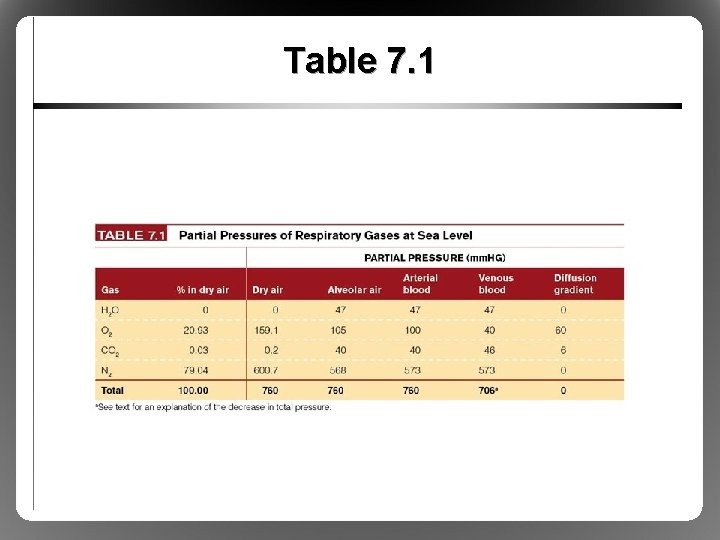
Pulmonary Diffusion: Partial Pressures of Gases • Air = 79. 04% N 2 + 20. 93% O 2 + 0. 03% CO 2 – Total air P: atmospheric pressure – Individual P: partial pressures • Standard atmospheric P = 760 mm. Hg – – Dalton’s Law: total air P = PN 2 + PO 2 + PCO 2 PN 2 = 760 x 79. 04% = 600. 7 mm. Hg PO 2 = 760 x 20. 93% = 159. 1 mm. Hg PCO 2 = 760 x 0. 04% = 0. 2 mm. Hg
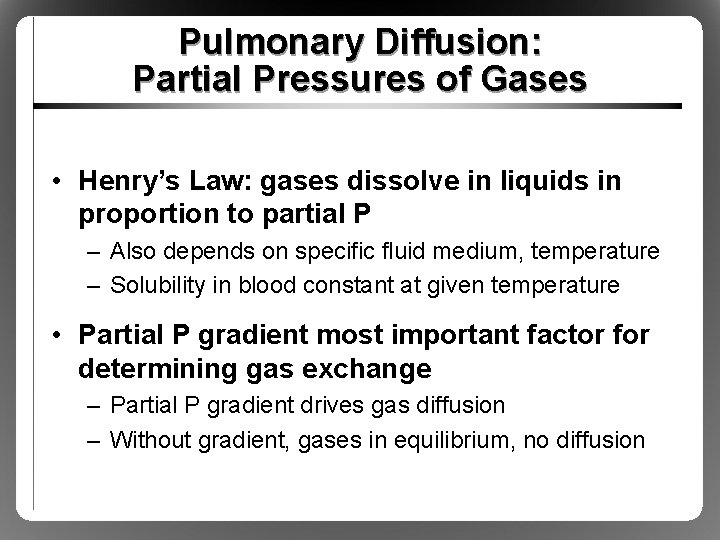
Pulmonary Diffusion: Partial Pressures of Gases • Henry’s Law: gases dissolve in liquids in proportion to partial P – Also depends on specific fluid medium, temperature – Solubility in blood constant at given temperature • Partial P gradient most important factor for determining gas exchange – Partial P gradient drives gas diffusion – Without gradient, gases in equilibrium, no diffusion
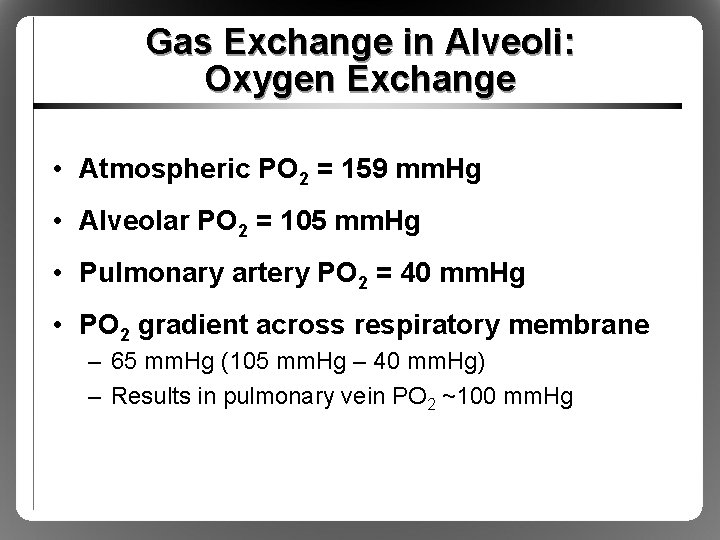
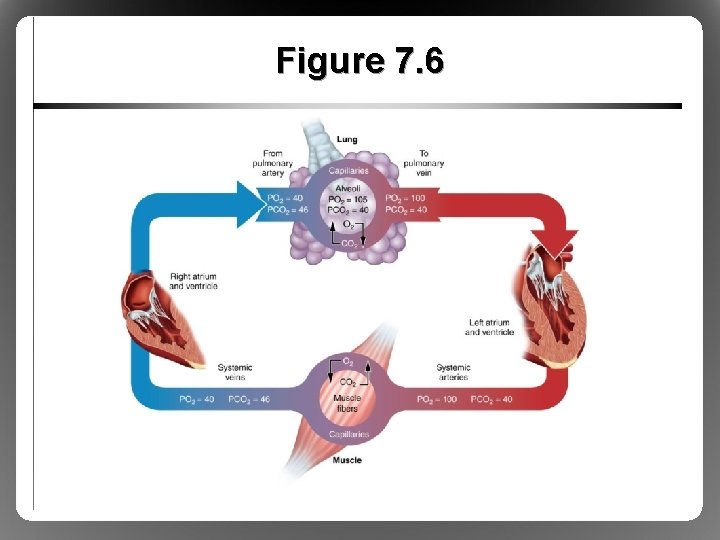
Gas Exchange in Alveoli: Oxygen Exchange • Atmospheric PO 2 = 159 mm. Hg • Alveolar PO 2 = 105 mm. Hg • Pulmonary artery PO 2 = 40 mm. Hg • PO 2 gradient across respiratory membrane – 65 mm. Hg (105 mm. Hg – 40 mm. Hg) – Results in pulmonary vein PO 2 ~100 mm. Hg
Figure 7. 6
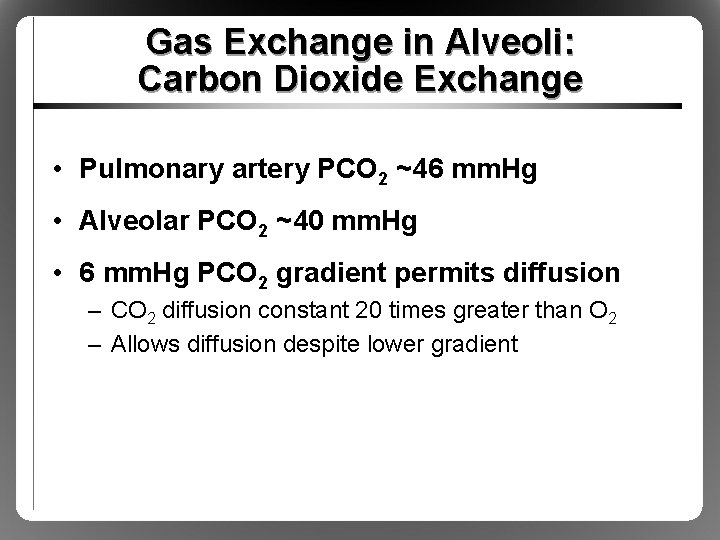
Gas Exchange in Alveoli: Carbon Dioxide Exchange • Pulmonary artery PCO 2 ~46 mm. Hg • Alveolar PCO 2 ~40 mm. Hg • 6 mm. Hg PCO 2 gradient permits diffusion – CO 2 diffusion constant 20 times greater than O 2 – Allows diffusion despite lower gradient
Table 7. 1
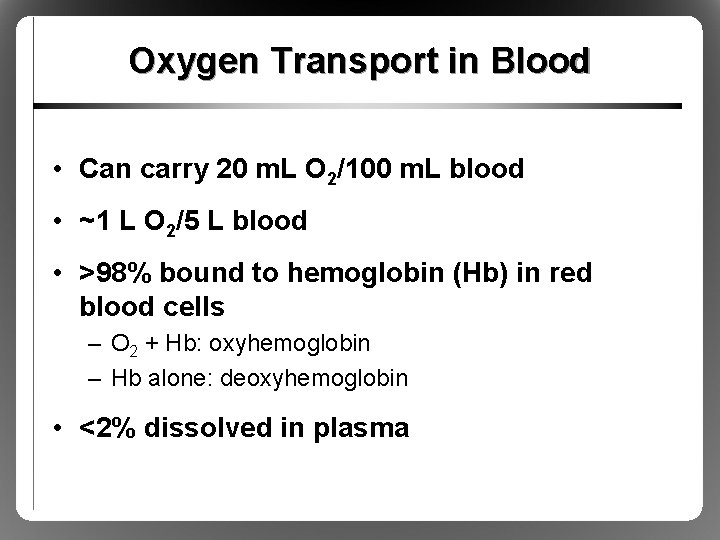
Oxygen Transport in Blood • Can carry 20 m. L O 2/100 m. L blood • ~1 L O 2/5 L blood • >98% bound to hemoglobin (Hb) in red blood cells – O 2 + Hb: oxyhemoglobin – Hb alone: deoxyhemoglobin • <2% dissolved in plasma
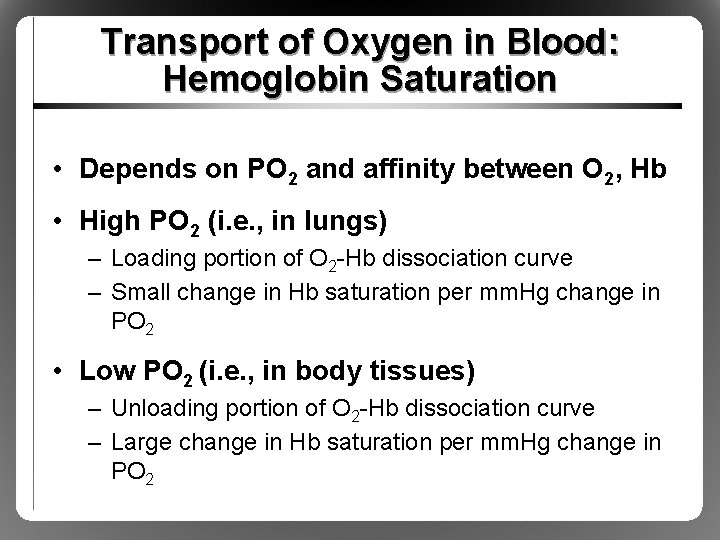
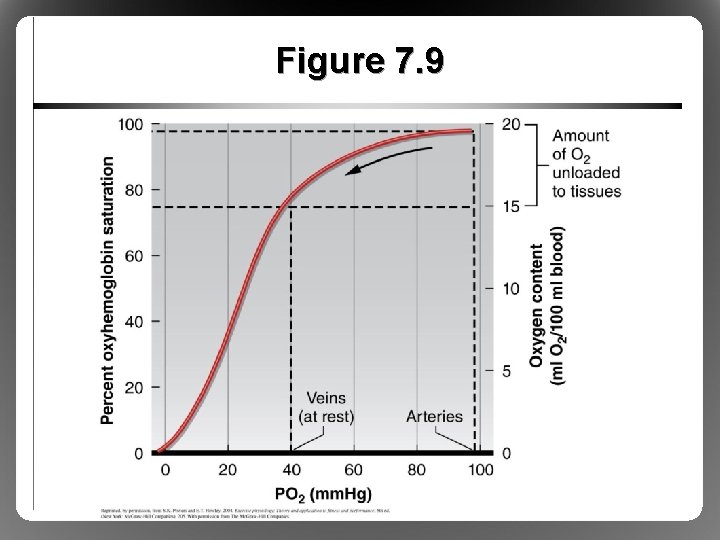
Transport of Oxygen in Blood: Hemoglobin Saturation • Depends on PO 2 and affinity between O 2, Hb • High PO 2 (i. e. , in lungs) – Loading portion of O 2 -Hb dissociation curve – Small change in Hb saturation per mm. Hg change in PO 2 • Low PO 2 (i. e. , in body tissues) – Unloading portion of O 2 -Hb dissociation curve – Large change in Hb saturation per mm. Hg change in PO 2
Figure 7. 9
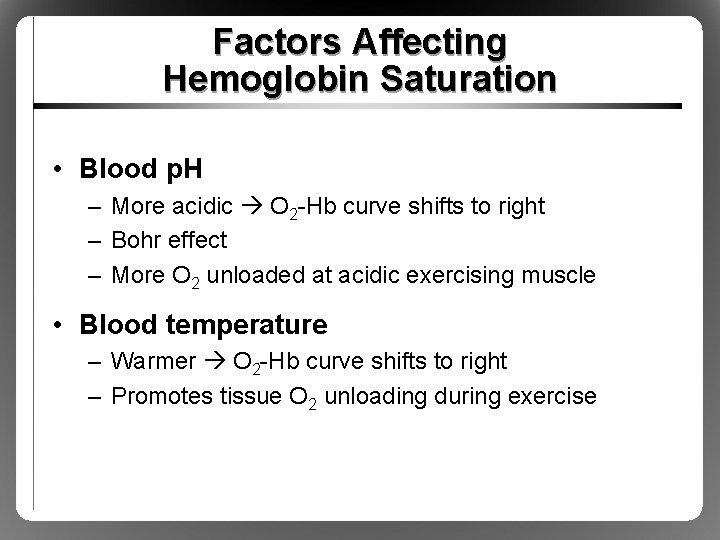
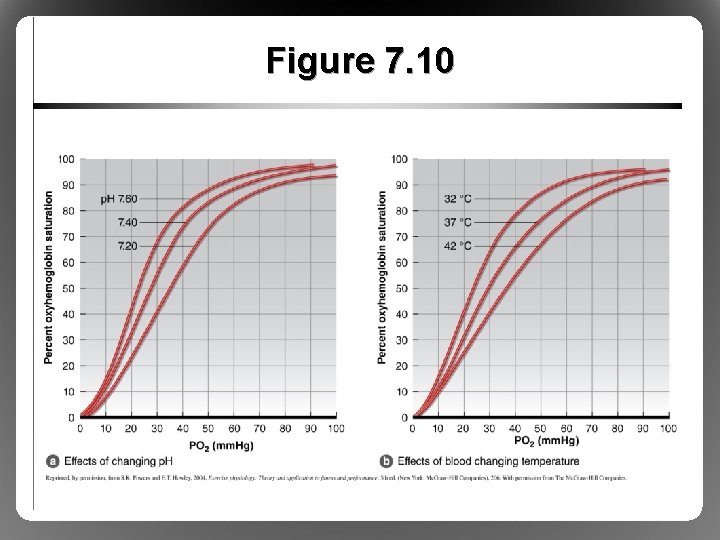
Factors Affecting Hemoglobin Saturation • Blood p. H – More acidic O 2 -Hb curve shifts to right – Bohr effect – More O 2 unloaded at acidic exercising muscle • Blood temperature – Warmer O 2 -Hb curve shifts to right – Promotes tissue O 2 unloading during exercise
Figure 7. 10
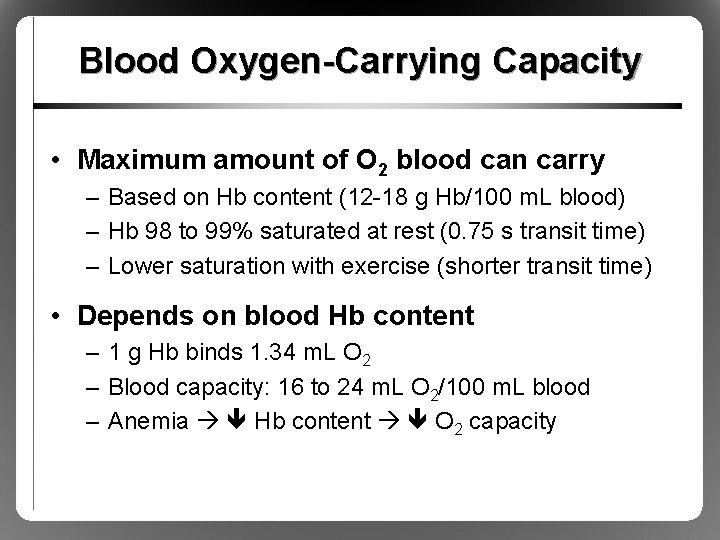
Blood Oxygen-Carrying Capacity • Maximum amount of O 2 blood can carry – Based on Hb content (12 -18 g Hb/100 m. L blood) – Hb 98 to 99% saturated at rest (0. 75 s transit time) – Lower saturation with exercise (shorter transit time) • Depends on blood Hb content – 1 g Hb binds 1. 34 m. L O 2 – Blood capacity: 16 to 24 m. L O 2/100 m. L blood – Anemia Hb content O 2 capacity
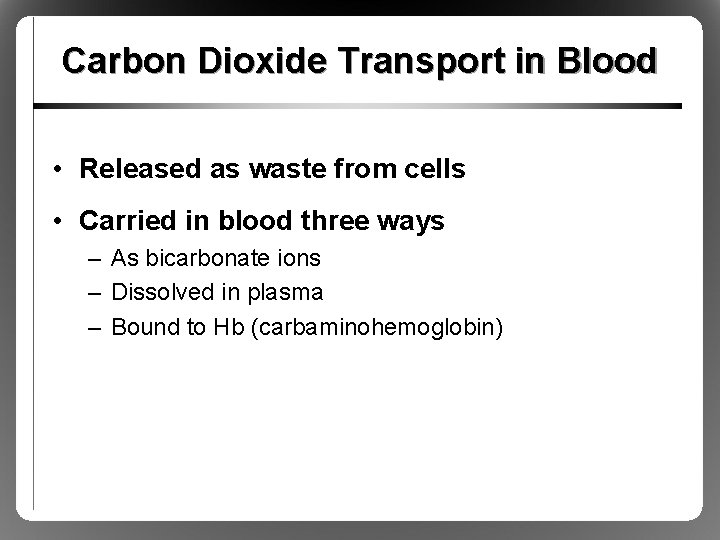
Carbon Dioxide Transport in Blood • Released as waste from cells • Carried in blood three ways – As bicarbonate ions – Dissolved in plasma – Bound to Hb (carbaminohemoglobin)
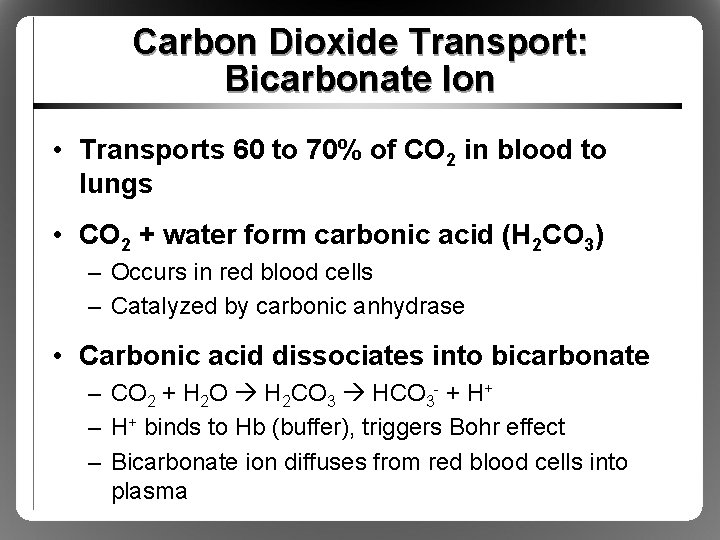
Carbon Dioxide Transport: Bicarbonate Ion • Transports 60 to 70% of CO 2 in blood to lungs • CO 2 + water form carbonic acid (H 2 CO 3) – Occurs in red blood cells – Catalyzed by carbonic anhydrase • Carbonic acid dissociates into bicarbonate – CO 2 + H 2 O H 2 CO 3 HCO 3 - + H+ – H+ binds to Hb (buffer), triggers Bohr effect – Bicarbonate ion diffuses from red blood cells into plasma
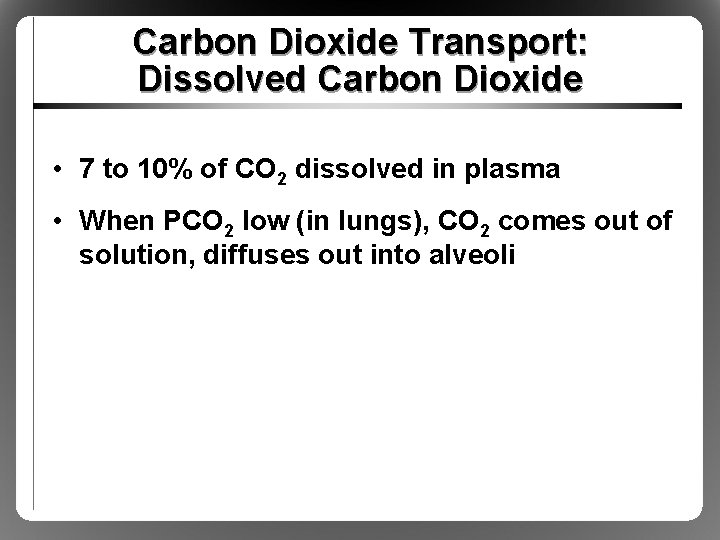
Carbon Dioxide Transport: Dissolved Carbon Dioxide • 7 to 10% of CO 2 dissolved in plasma • When PCO 2 low (in lungs), CO 2 comes out of solution, diffuses out into alveoli
Carbon Dioxide Transport: Carbaminohemoglobin • 20 to 33% of CO 2 transported bound to Hb • Does not compete with O 2 -Hb binding – O 2 binds to heme portion of Hb – CO 2 binds to protein (-globin) portion of Hb • Hb state, PCO 2 affect CO 2 -Hb binding – Deoxyhemoglobin binds CO 2 easier versus oxyhemoglobin – PCO 2 easier CO 2 -Hb binding – PCO 2 easier CO 2 -Hb dissociation
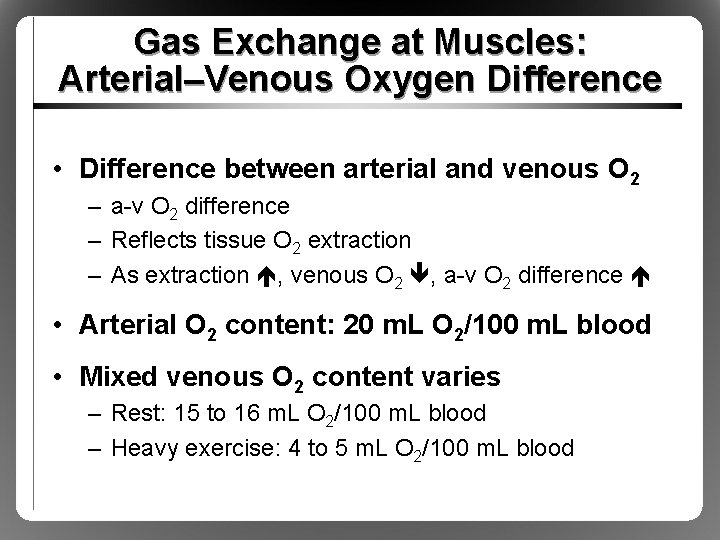
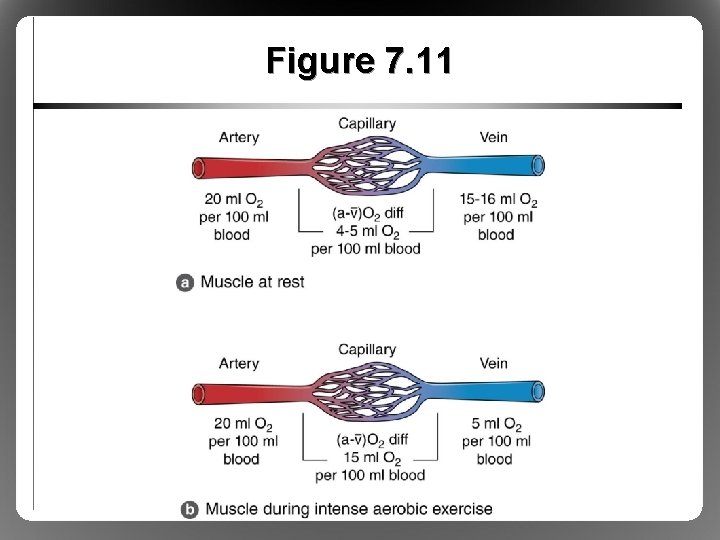
Gas Exchange at Muscles: Arterial–Venous Oxygen Difference • Difference between arterial and venous O 2 – a-v O 2 difference – Reflects tissue O 2 extraction – As extraction , venous O 2 , a-v O 2 difference • Arterial O 2 content: 20 m. L O 2/100 m. L blood • Mixed venous O 2 content varies – Rest: 15 to 16 m. L O 2/100 m. L blood – Heavy exercise: 4 to 5 m. L O 2/100 m. L blood
Figure 7. 11
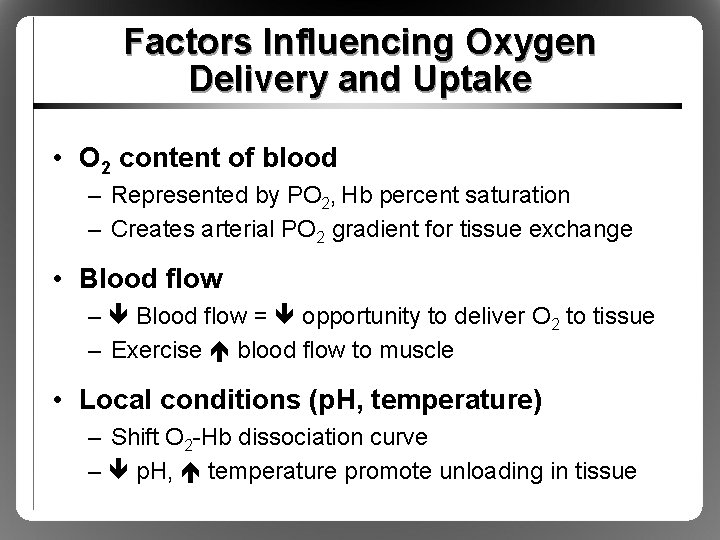
Factors Influencing Oxygen Delivery and Uptake • O 2 content of blood – Represented by PO 2, Hb percent saturation – Creates arterial PO 2 gradient for tissue exchange • Blood flow – Blood flow = opportunity to deliver O 2 to tissue – Exercise blood flow to muscle • Local conditions (p. H, temperature) – Shift O 2 -Hb dissociation curve – p. H, temperature promote unloading in tissue
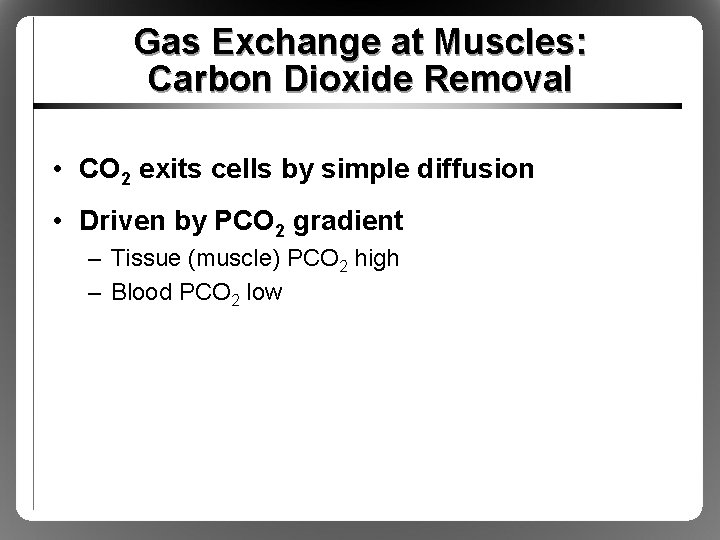
Gas Exchange at Muscles: Carbon Dioxide Removal • CO 2 exits cells by simple diffusion • Driven by PCO 2 gradient – Tissue (muscle) PCO 2 high – Blood PCO 2 low
Regulation of Pulmonary Ventilation • Body must maintain homeostatic balance between blood PO 2, PCO 2, p. H • Requires coordination between respiratory and cardiovascular systems • Coordination occurs via involuntary regulation of pulmonary ventilation
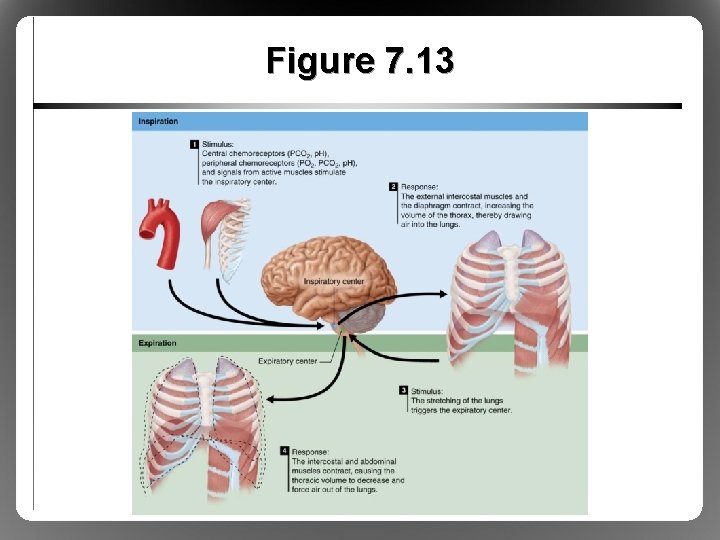
Central Mechanisms of Regulation • Respiratory centers – Inspiratory, expiratory centers – Located in brain stem (medulla oblongata, pons) – Establish rate, depth of breathing via signals to respiratory muscles – Cortex overrides signals if necessary • Central chemoreceptors – Stimulated by CO 2 in cerebrospinal fluid – Rate and depth of breathing, remove excess CO 2 from body
Peripheral Mechanisms of Regulation • Peripheral chemoreceptors – In aortic bodies, carotid bodies – Sensitive to blood PO 2, PCO 2, H+ • Mechanoreceptors (stretch) – In pleurae, bronchioles, alveoli – Excessive stretch reduced depth of breathing – Hering-Breuer reflex
Figure 7. 13