
Chapter 7 The Project Schedule and Budget 7
Chapter 7 The Project Schedule and Budget 7 -1
PMBOK® Project Cost Management Estimate Costs Focuses on the processes to estimate the monetary resources needed to complete the project work or activities. Determine Budget Aggregating the individual cost for each of the project activities or work package components to determine the cost baseline or overall project budget. Control Costs Updating the project’s status while monitoring the project’s budget and managing any changes to the baseline plan. 7 -2
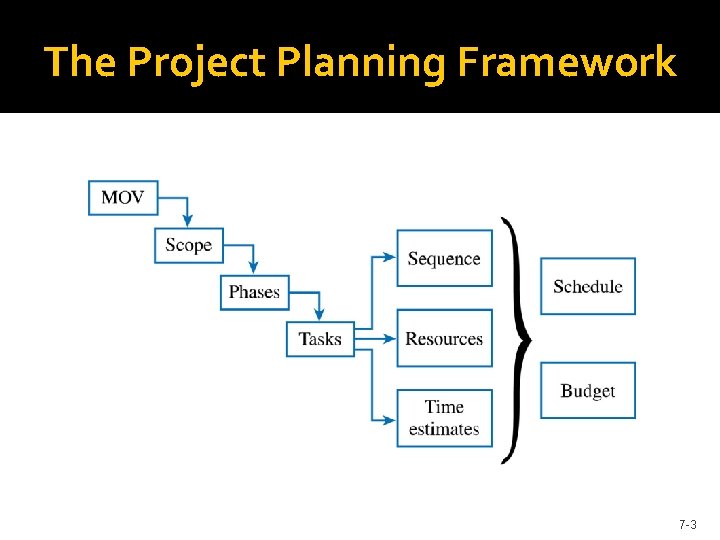
The Project Planning Framework 7 -3
Budget and Schedule Development The project’s schedule can be determined based the tasks and time estimates in the WBS upon The schedule will also depend on how these activities are sequenced The project’s budget can be determined based upon the activities and time estimates from the WBS as well as the cost of the resources assigned to the WBS tasks Iterations may still be necessary The objective is to create a realistic project schedule and budget! 7 -4
Developing the Project Schedule Project Management Tools Gantt Charts Project Network Diagrams ▪ Activity on the Node (AON) ▪ Critical Path Analysis ▪ Program Evaluation and Review Technique (PERT) ▪ Precedence Diagramming Method (PDM) 7 -5
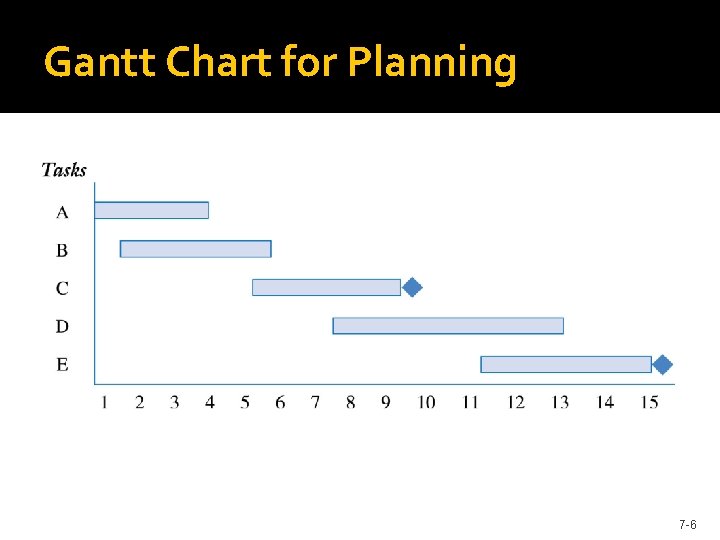
Gantt Chart for Planning 7 -6
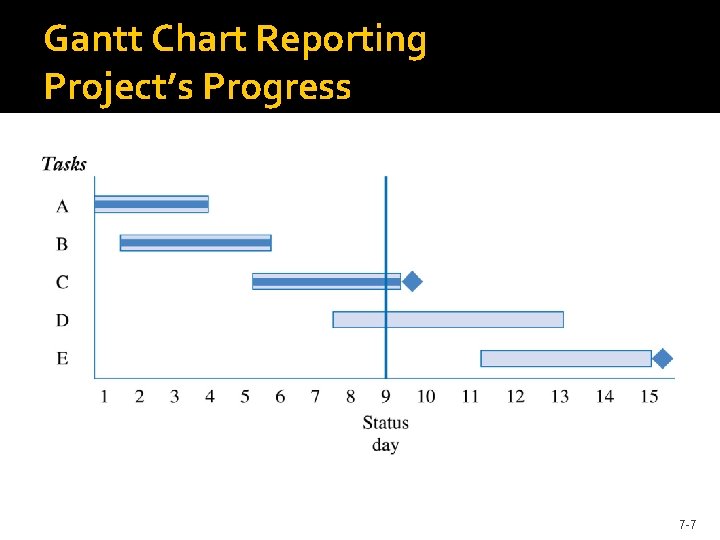
Gantt Chart Reporting Project’s Progress 7 -7
Developing the Project Schedule Project Management Tools Gantt Charts Project Network Diagrams ▪ Activity on the Node (AON) ▪ Critical Path Analysis ▪ Program Evaluation and Review Technique (PERT) ▪ Precedence Diagramming Method (PDM) 7 -8
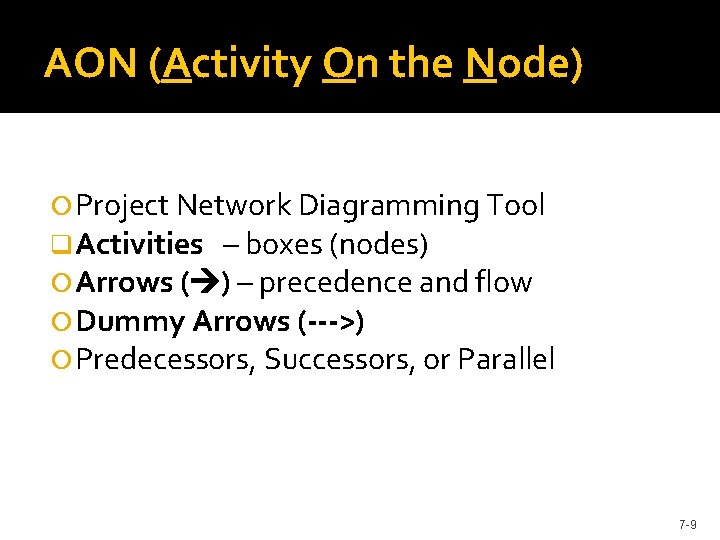
AON (Activity On the Node) Project Network Diagramming Tool q Activities – boxes (nodes) Arrows ( ) – precedence and flow Dummy Arrows (--->) Predecessors, Successors, or Parallel 7 -9
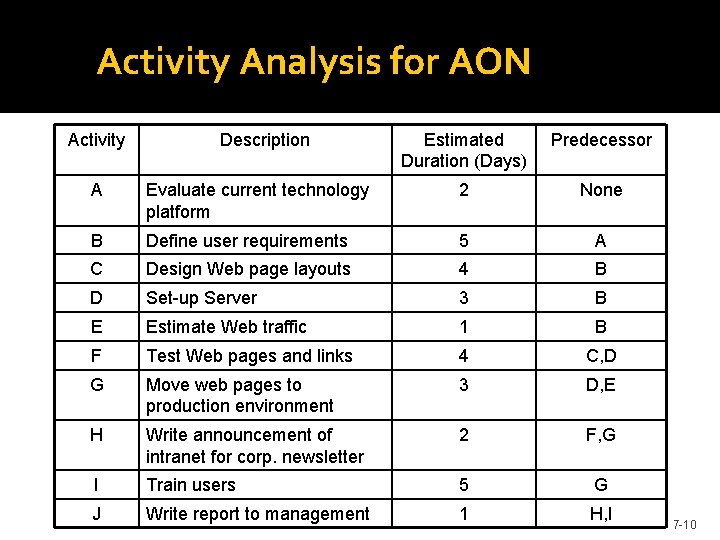
Activity Analysis for AON Activity Description Estimated Duration (Days) Predecessor A Evaluate current technology platform 2 None B Define user requirements 5 A C Design Web page layouts 4 B D Set-up Server 3 B E Estimate Web traffic 1 B F Test Web pages and links 4 C, D G Move web pages to production environment 3 D, E H Write announcement of intranet for corp. newsletter 2 F, G I Train users 5 G J Write report to management 1 H, I 7 -10
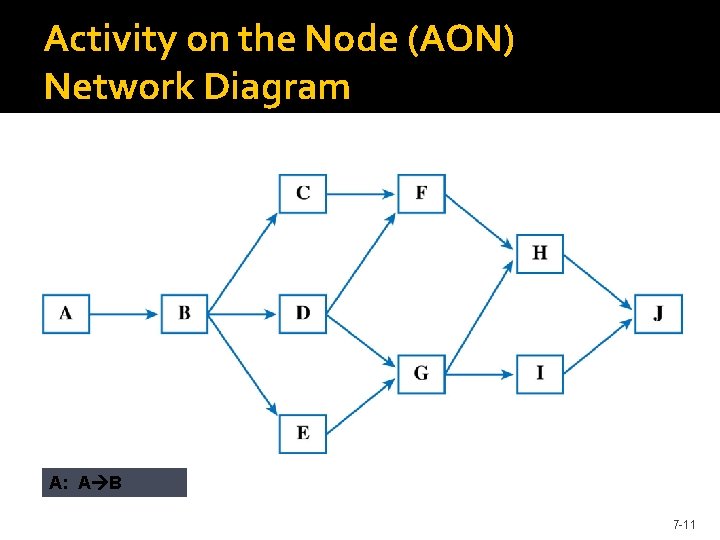
Activity on the Node (AON) Network Diagram A: A B 7 -11
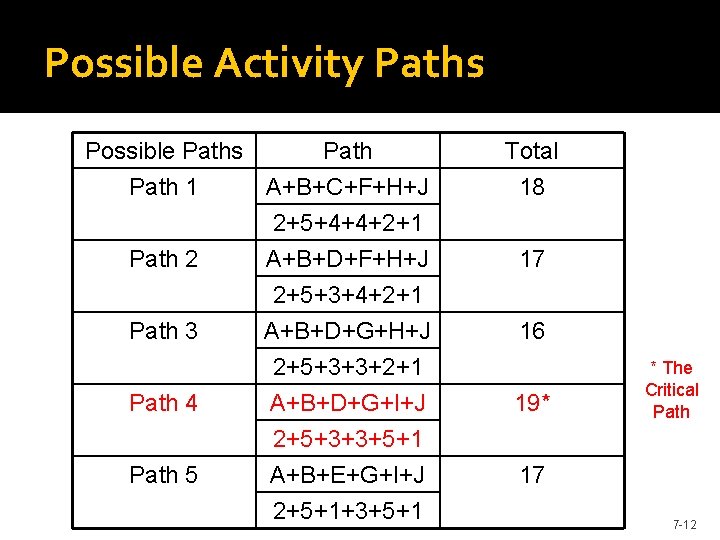
Possible Activity Paths Possible Paths Path 1 A+B+C+F+H+J 2+5+4+4+2+1 Path 2 A+B+D+F+H+J Path 3 Path 4 Path 5 2+5+3+4+2+1 A+B+D+G+H+J 2+5+3+3+2+1 A+B+D+G+I+J 2+5+3+3+5+1 A+B+E+G+I+J 2+5+1+3+5+1 Total 18 17 16 19* * The Critical Path 17 7 -12
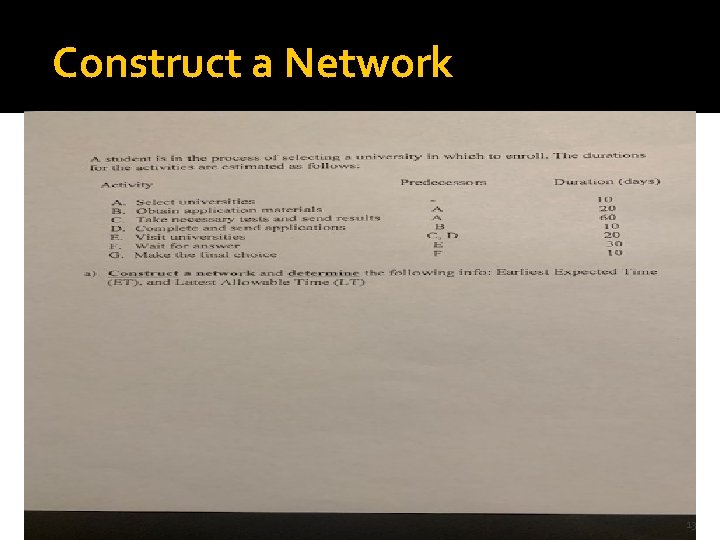
Construct a Network 13
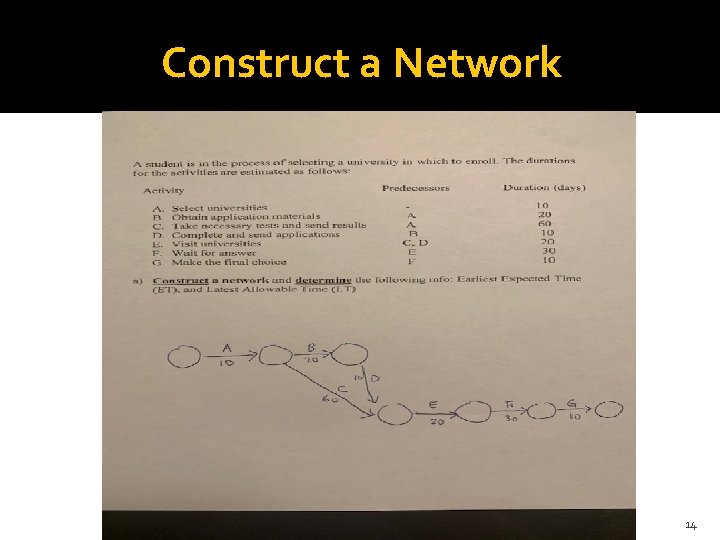
Construct a Network 14
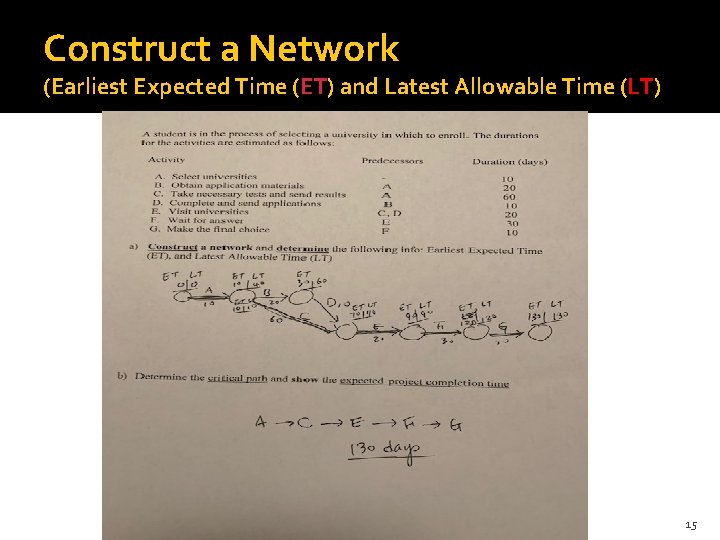
Construct a Network (Earliest Expected Time (ET) and Latest Allowable Time (LT) 15
Critical Path Longest path Shortest time project can be completed Zero slack (or float) ▪ The amount of time an activity can be delayed before it delays the project Must be monitored and managed! Project manager can expedite or crash by adding resources Fast tracking – running activities in parallel which were originally planned as sequential The CP can change Can have multiple CPs 7 -16
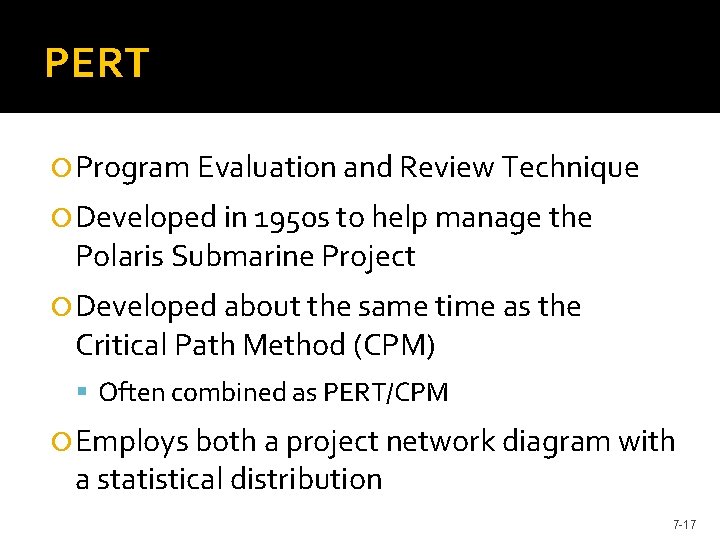
PERT Program Evaluation and Review Technique Developed in 1950 s to help manage the Polaris Submarine Project Developed about the same time as the Critical Path Method (CPM) Often combined as PERT/CPM Employs both a project network diagram with a statistical distribution 7 -17
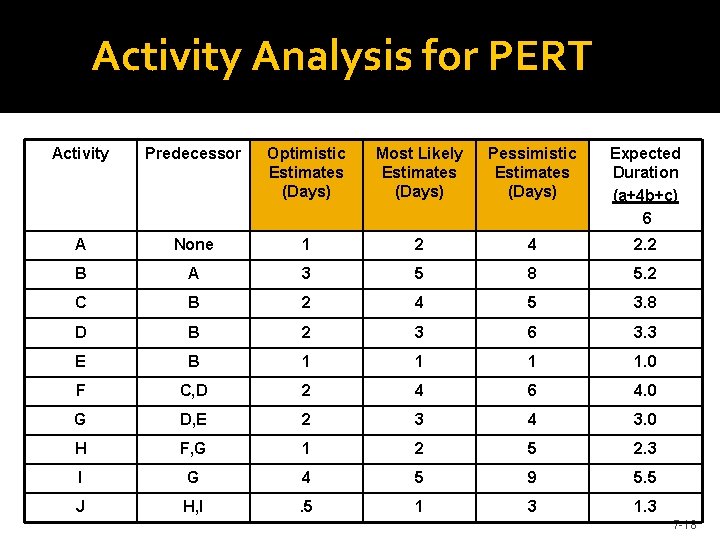
Activity Analysis for PERT Activity Predecessor Optimistic Estimates (Days) Most Likely Estimates (Days) Pessimistic Estimates (Days) Expected Duration (a+4 b+c) 6 A None 1 2 4 2. 2 B A 3 5 8 5. 2 C B 2 4 5 3. 8 D B 2 3 6 3. 3 E B 1 1. 0 F C, D 2 4 6 4. 0 G D, E 2 3 4 3. 0 H F, G 1 2 5 2. 3 I G 4 5 9 5. 5 J H, I . 5 1 3 1. 3 7 -18
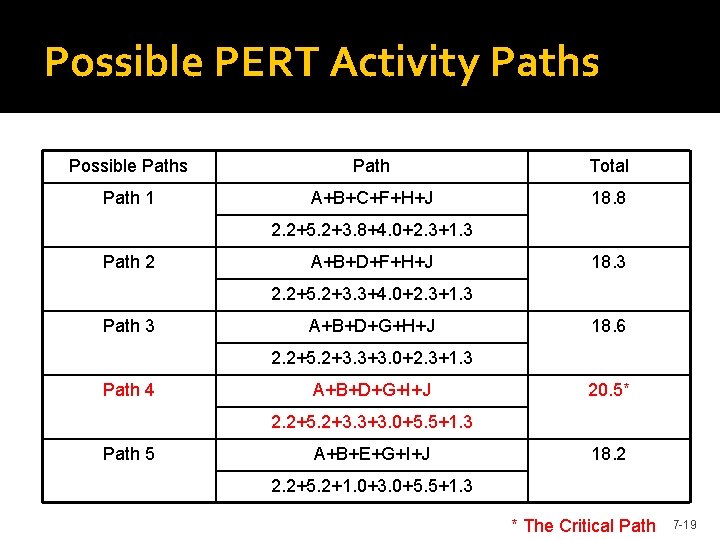
Possible PERT Activity Paths Possible Paths Path Total Path 1 A+B+C+F+H+J 18. 8 2. 2+5. 2+3. 8+4. 0+2. 3+1. 3 Path 2 A+B+D+F+H+J 18. 3 2. 2+5. 2+3. 3+4. 0+2. 3+1. 3 Path 3 A+B+D+G+H+J 18. 6 2. 2+5. 2+3. 3+3. 0+2. 3+1. 3 Path 4 A+B+D+G+I+J 20. 5* 2. 2+5. 2+3. 3+3. 0+5. 5+1. 3 Path 5 A+B+E+G+I+J 18. 2 2. 2+5. 2+1. 0+3. 0+5. 5+1. 3 * The Critical Path 7 -19
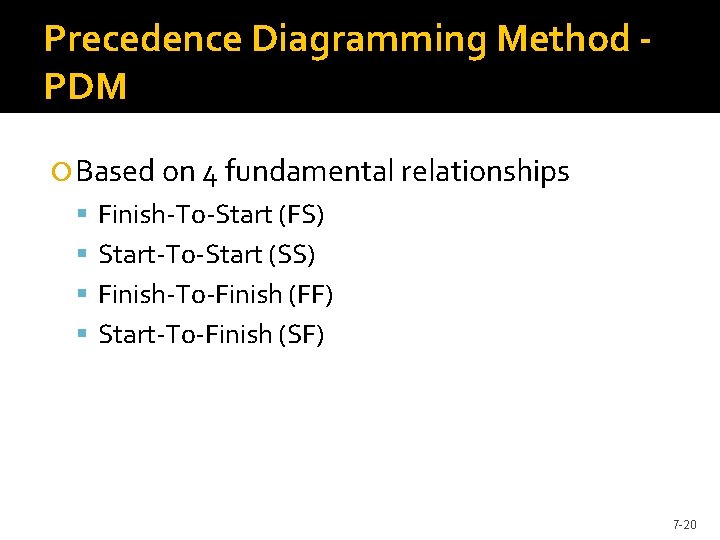
Precedence Diagramming Method PDM Based on 4 fundamental relationships Finish-To-Start (FS) Start-To-Start (SS) Finish-To-Finish (FF) Start-To-Finish (SF) 7 -20
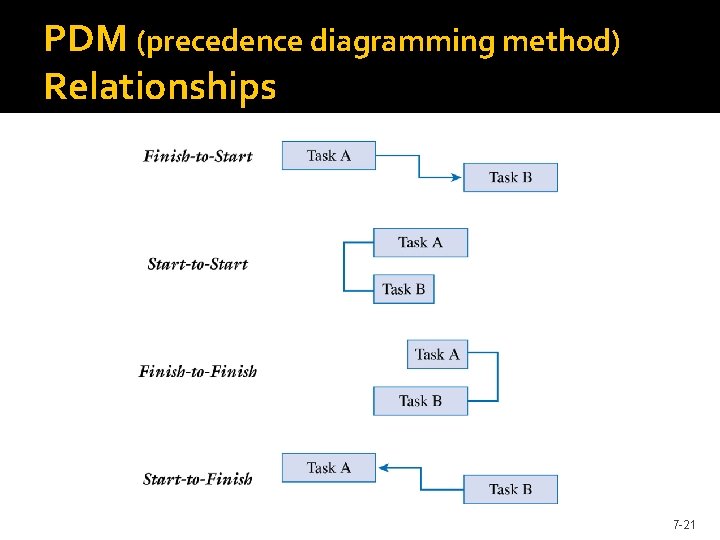
PDM (precedence diagramming method) Relationships 7 -21
Lead and Lag times Lead is starting the next task before the first task is complete ▪ Example: Begin installing the operating systems when half of the PCs are set up Lag (or negative lead) is the adding of a buffer of time before the next task begins ▪ Example: Once the walls have been painted, wait one day before laying the carpet so that the walls have had a chance to dry 7 -22
Critical Chain Project Management (CCPM) Introduced in 1997 in a book called Critical Chain by Eliyahu Goldratt Based on his previous work called the Theory of Constraints CCPM is based on the idea that people often inflate or add cushioning to their estimates to create a form of “safety” to compensate for uncertainty or risk because … Your work is dependent upon the work of someone else, and you believe that starting your work will be delayed Your pessimism from previous experience where things did not go as planned Your belief that the project sponsor or customer will cut your project schedule or budget so you inflate your estimates to guard against this cut 7 -23
If people build safety into their estimates, then … Why are projects still late? Student’s Syndrome or procrastinating until the last minute before starting to work on a task Parkinson’s Law or the idea that work expands to fill the time available ▪ People will rarely report finishing something early because there is little incentive to do so or because they may fear that management will cut their estimates next time Multitasking of resources or “resource contention” ▪ A person is often assigned to more than one project or required to attend meetings, training, etc. As a result, they can no longer devote their time to tasks that are on the critical path 7 -24
CCPM Assumptions Begins by asking each person or team working on a task to provide an estimate that would have a 50% chance of being completed as planned About half of the project tasks will be completed on time, about half won’t Instead of adding safety to each task, put that safety in the form of buffers where it is needed most Feeding buffers ▪ Reduce the likelihood of bottlenecks by ensuring that critical tasks will start on time when a task acts as a feeder to another task on the critical path Resource buffers ▪ Reduce resource contention End of Project buffers ▪ Are equal to one-half of the time saved from putting safety into each task 7 -25
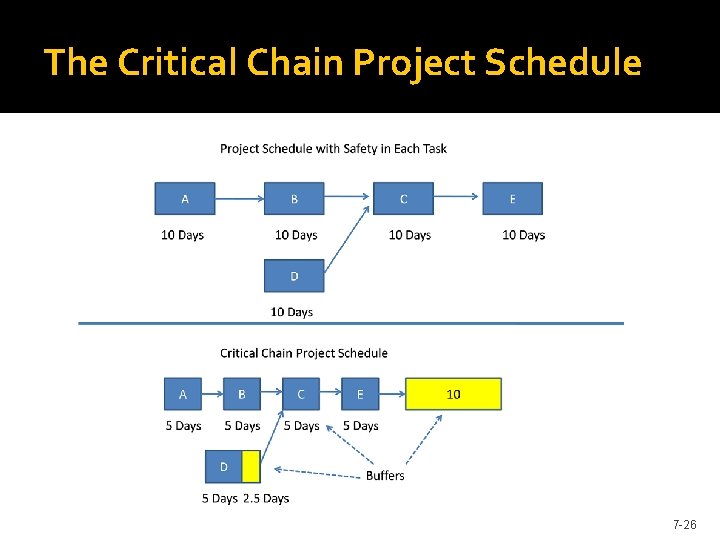
The Critical Chain Project Schedule 7 -26
Critical Chain Project Management And the critical path are similar The difference is the CCPM takes into account resource contention Takes a more project portfolio view Other projects should be scheduled so that a resource can be dedicated to a particular task Requires that everyone understand that each project task has a 50% chance of being completed as scheduled, so about half of the tasks will be late. This is the reason for having the project buffer. Instead of tracking each task individually, we become more concerned with the project buffer –i. e. , the project will be late only if it uses more than the allotted project buffer. Instead of penalties for being late, bonuses or other incentives for completing tasks early may be needed 7 -27
Developing the Project Budget 1. Define what resources will be needed to perform the work 2. Determine the quantity of resources that are needed 3. Define the cost of using each resource 4. Calculate the cost of the task or activity 5. Ensure that the resources are leveled, that is, resources have not been over allocated, assigned to more than one task scheduled at the same time 7 -28
Project Management Software Tools A number of project management software tools are available to plan and track the progress of your project However, having a fundamental understanding of these project management techniques is important to make the most of these software tools 7 -29
Other Costs Direct Costs Indirect Costs Often have to “Build one and throw it away” to understand a problem or a new technology Prorated Costs incurred prior to the project, such as a project that has been restarted after a failed attempt Learning Curve The cost for covering such things as rent, utilities, insurance, etc. Sunk Costs The direct cost of labor or other resources The idea that there is a cost associated with using a resource Reserves Contingency funds to be used at the discretion of the project manager 7 -30
Finalizing the Project Schedule and Budget The project schedule and budget may require several iterations before it is acceptable to the sponsor, the project manager, and the project team. Once the project schedule and project plan are accepted, the project plan becomes the baseline plan. Once accepted, the project manager and project team have the authority to execute or carry out the plan. 7 -31
Free MS ® Project Tutorials http: //www. profsr. com/msproject/msproj 01. htm http: //office. microsoft. com/en- us/training/FX 100565001033. aspx http: //www. project-blog. com/ 7 -32
- Slides: 32