
Chapter 7 The Primates Copyright 2013 Pearson Education

- Slides: 22
Chapter 7 The Primates Copyright © 2013 Pearson Education, Inc. All rights reserved.
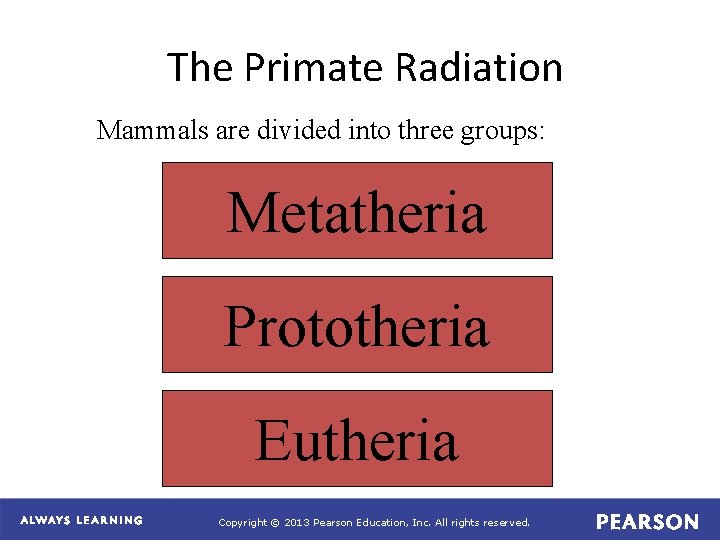
The Primate Radiation Mammals are divided into three groups: Metatheria Prototheria Eutheria Copyright © 2013 Pearson Education, Inc. All rights reserved.
Copyright © 2013 Pearson Education, Inc. All rights reserved.
Copyright © 2013 Pearson Education, Inc. All rights reserved.
Copyright © 2013 Pearson Education, Inc. All rights reserved.
The Primate Radiation (cont’d) • The extraordinary diversity of nonhuman primates – 300 species of nonhuman primates are recognized – More than 400 taxa or varieties – Size and form vary greatly – Body shapes vary tremendously Copyright © 2013 Pearson Education, Inc. All rights reserved.
The Primate Radiation (cont’d) What Exactly is a Primate? : Primate Suborders Strepsirhini and Haplorhini Prosimian and Anthropoid Copyright © 2013 Pearson Education, Inc. All rights reserved.
The Primate Radiation (cont’d) • Anatomical Traits – Grasping hands/opposable thumbs and big toes – Flattened nails – Forward-facing eyes with stereoscopic vision – Generalized body plan – Generalized teeth – Petrosal bulla – Enclosed orbits Copyright © 2013 Pearson Education, Inc. All rights reserved.
The Primate Radiation (cont’d) • Life History Traits – Single offspring – Large brains • Encephalization • Neocortex – Extended ontogeny • Lifecycle – Sociality • Living in groups Copyright © 2013 Pearson Education, Inc. All rights reserved.
The Primate Radiation (cont’d) • Behavioral Traits – Activity Patterns • Diurnal • Nocturnal • Crepuscular (active during dawn and dusk) – Sociality • Living in groups Copyright © 2013 Pearson Education, Inc. All rights reserved.
A Guide to the Nonhuman Primates • The Strepsirhines – The Lemurs • Madagascar • Lemuridae • Cheirogalidae • Indriidae • Daubentoniidae – The Lorises • Tropical Africa and Asia • Galagos Copyright © 2013 Pearson Education, Inc. All rights reserved.
A Guide to the Nonhuman Primates (cont’d) • The Haplorhines – The Tarsiers – New World Monkeys – Old World Monkeys – The Hominoids Copyright © 2013 Pearson Education, Inc. All rights reserved.
A Guide to the Nonhuman Primates (cont’d) • New World Monkeys – Infraorder Platyrrhini – Superfamily Ceboidea – Small body size – Three premolar teeth – Arboreality • Prehensile tails Copyright © 2013 Pearson Education, Inc. All rights reserved.
A Guide to the Nonhuman Primates (cont’d) • Old World Monkeys – Infraorder Catarrhini – Superfamily Cercopithecoidea – Ischial callosites – Bilophodant molars – Estrus (in some) Copyright © 2013 Pearson Education, Inc. All rights reserved.
A Guide to the Nonhuman Primates (cont’d) • The Hominoids – Apes • Hylobatidae • Pongidae • • Encephalization Brachiation Extended ontogeny Social complexity Copyright © 2013 Pearson Education, Inc. All rights reserved.
A Guide to the Nonhuman Primates (cont’d) • Apes – Gibbons • 14 species • Asia/ Indonesia – Orangutans • Indonesia – Gorillas • Africa – Chimpanzees • Africa • Bonobo/ Chimpanzee Copyright © 2013 Pearson Education, Inc. All rights reserved.
Primate Ecology • Diet – Most primates are herbivores – frugivores – folivores • Phenology • Dietary and Digestive Strategies – Strategic foraging Copyright © 2013 Pearson Education, Inc. All rights reserved.
Primate Ecology (cont’d) • You Are What You Eat: Dietary and Digestive Strategies – In general, the largest-bodied primates rely the least on insect prey – Chimpanzees and capuchin monkeys forage for insects intensively and at times consume large numbers of them – Gorillas don’t eat many insects – Very small-bodied primates rarely eat large quantities of leafy matter Copyright © 2013 Pearson Education, Inc. All rights reserved.
Primate Ecology (cont’d) • Diet – Primates select food to balance an energy budget of nutrients and calories that requires them to forage all day long • Diet and Feeding Competition – Nonhuman primates engage in feeding competition and use well-defined areas of their habitat to find food and shelter predation – Activity budget allows compensation for calories expended with calories consumed Copyright © 2013 Pearson Education, Inc. All rights reserved.
Primate Ecology (cont’d) • Territorial Ranges – All mammals, including nonhuman primates, live in defined places called home ranges – This area can be very limited, smaller than a football field in the case of some nocturnal strepsirhines, or many square kilometers in the case of some apes and monkeys – The range must contain all the resources needed by a nonhuman primate or a social group: water, food, shelter, and mates Copyright © 2013 Pearson Education, Inc. All rights reserved.
Primate Ecology (cont’d) • Predation – Nonhuman primates in the wild face challenge of finding food while avoiding attacks by predators – Failing to find food will leave a monkey hungry the next day, but failing to avoid an attack by an eagle or leopard will leave it dead or injured – Behavioral defenses against predators Copyright © 2013 Pearson Education, Inc. All rights reserved.
Primate Communities • Primate communities, like communities of other animals, are integral parts of tropical forest ecosystems Copyright © 2013 Pearson Education, Inc. All rights reserved.