
Chapter 7 The Geography of Three Economic Sectors

- Slides: 26
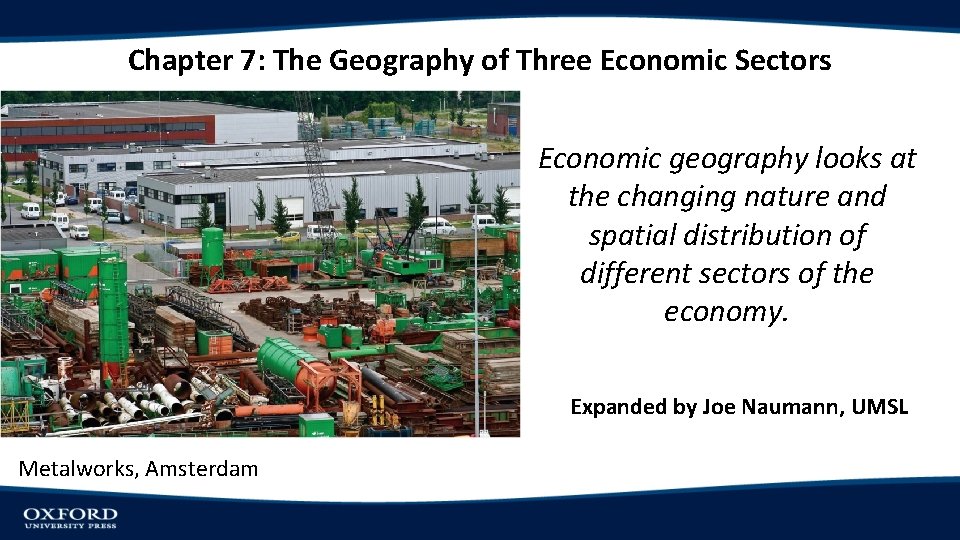
Chapter 7: The Geography of Three Economic Sectors Economic geography looks at the changing nature and spatial distribution of different sectors of the economy. Expanded by Joe Naumann, UMSL Metalworks, Amsterdam
Chapter Learning Objectives • Recall the three sectors of economic activity and relate to von Thünen’s model of land use. • Describe the Agrarian Transition, and relate its changes and challenges. • Discuss the requirements that accompany the commercialization of agriculture and specifically reference the Green Revolution. • Identify the secondary sector of economic activity and the four Kondratieff cycles of historical periods of manufacturing innovation. • Reflect on the rise and location of the tertiary and quaternary sectors.
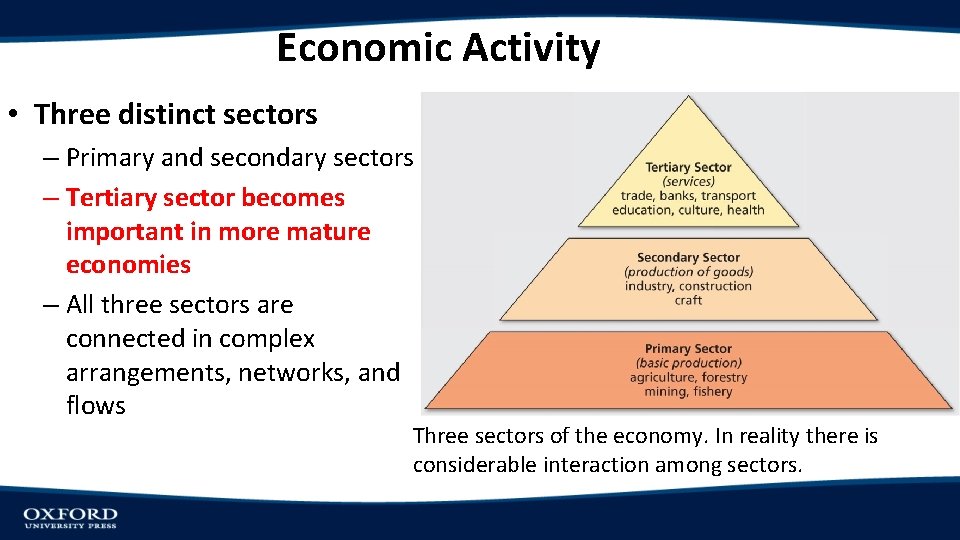
Economic Activity • Three distinct sectors – Primary and secondary sectors – Tertiary sector becomes important in more mature economies – All three sectors are connected in complex arrangements, networks, and flows Three sectors of the economy. In reality there is considerable interaction among sectors.
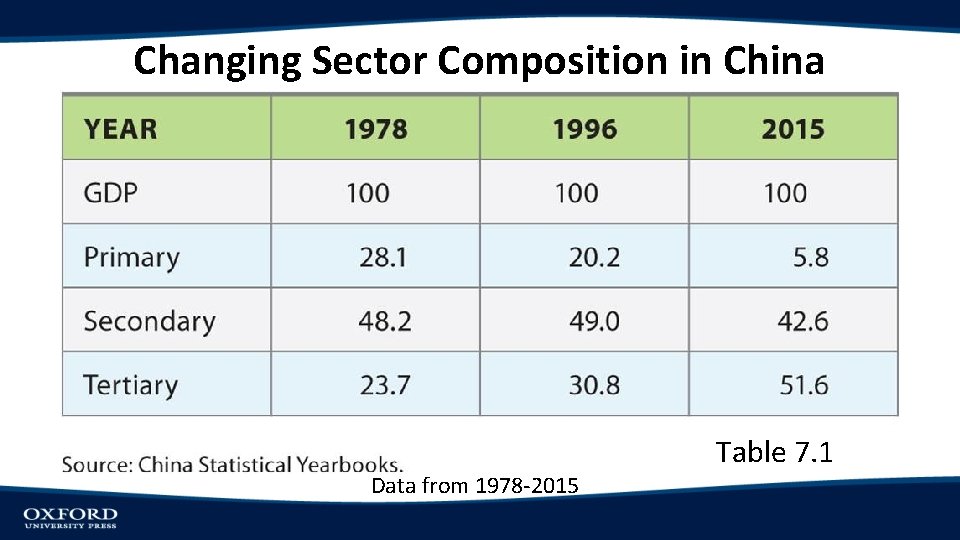
Changing Sector Composition in China Data from 1978 -2015 Table 7. 1
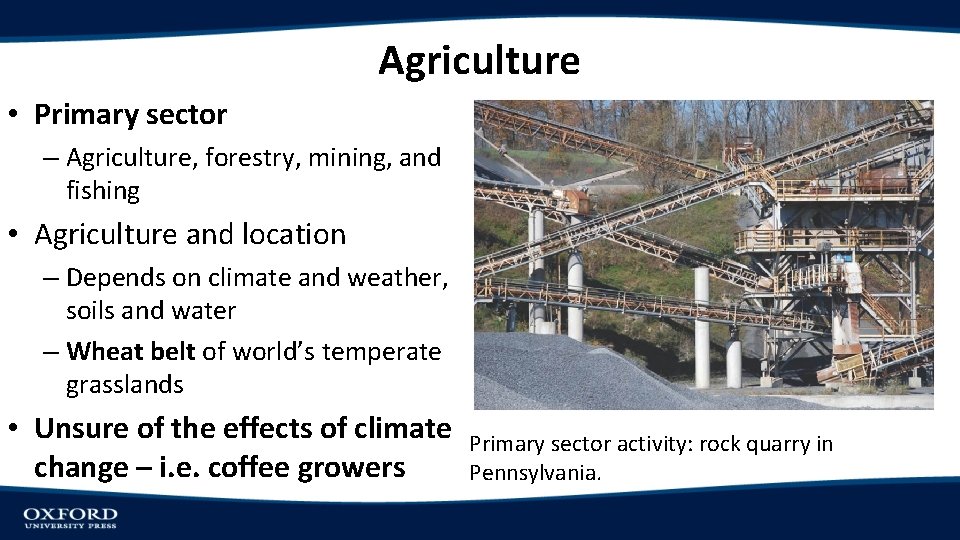
Agriculture • Primary sector – Agriculture, forestry, mining, and fishing • Agriculture and location – Depends on climate and weather, soils and water – Wheat belt of world’s temperate grasslands • Unsure of the effects of climate change – i. e. coffee growers Primary sector activity: rock quarry in Pennsylvania.
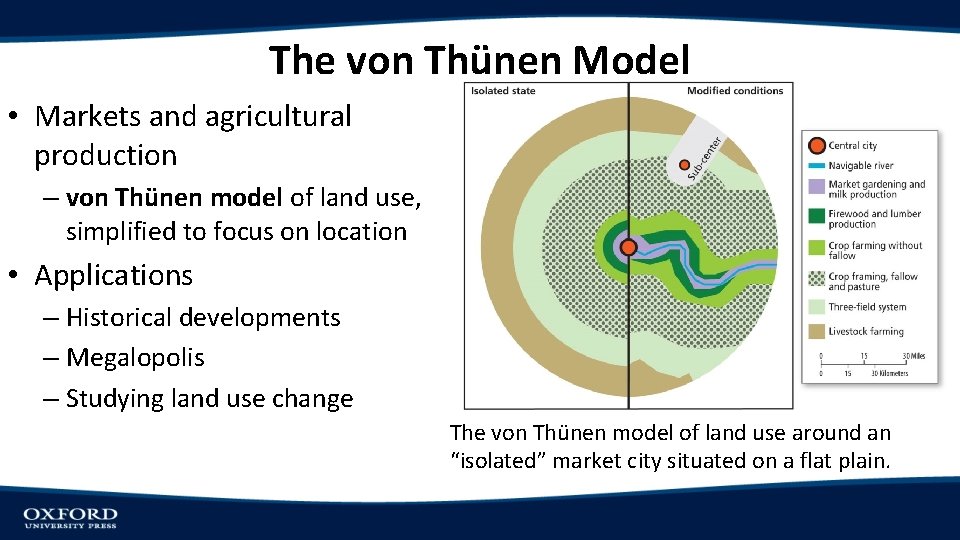
The von Thünen Model • Markets and agricultural production – von Thünen model of land use, simplified to focus on location • Applications – Historical developments – Megalopolis – Studying land use change The von Thünen model of land use around an “isolated” market city situated on a flat plain.
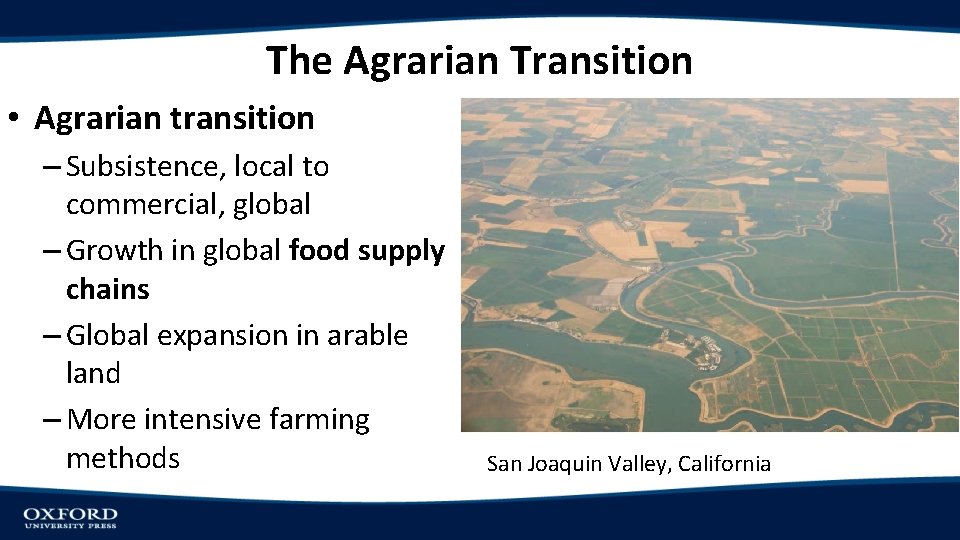
The Agrarian Transition • Agrarian transition – Subsistence, local to commercial, global – Growth in global food supply chains – Global expansion in arable land – More intensive farming methods San Joaquin Valley, California
The Agrarian Transition • Market integration of farmers and farmland • From subsistence to commercial farmers – Access to capital and technology • Rise in land grabs, forced commodification of land – England’s Enclosure Movement – Minority peasantry, often marginalized, are particularly vulnerable – Instances of resistance • USA – decline of the family farm
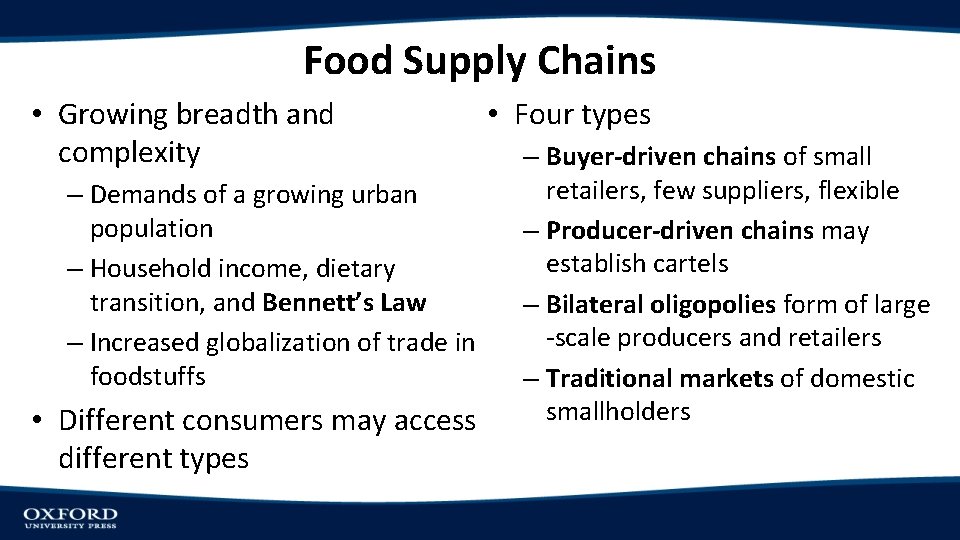
Food Supply Chains • Growing breadth and complexity – Demands of a growing urban population – Household income, dietary transition, and Bennett’s Law – Increased globalization of trade in foodstuffs • Different consumers may access different types • Four types – Buyer-driven chains of small retailers, few suppliers, flexible – Producer-driven chains may establish cartels – Bilateral oligopolies form of large -scale producers and retailers – Traditional markets of domestic smallholders
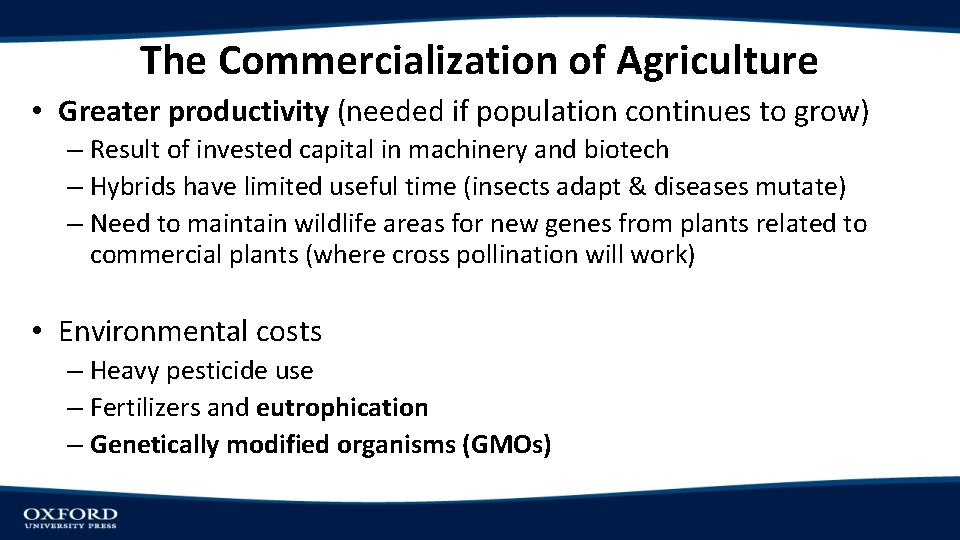
The Commercialization of Agriculture • Greater productivity (needed if population continues to grow) – Result of invested capital in machinery and biotech – Hybrids have limited useful time (insects adapt & diseases mutate) – Need to maintain wildlife areas for new genes from plants related to commercial plants (where cross pollination will work) • Environmental costs – Heavy pesticide use – Fertilizers and eutrophication – Genetically modified organisms (GMOs)
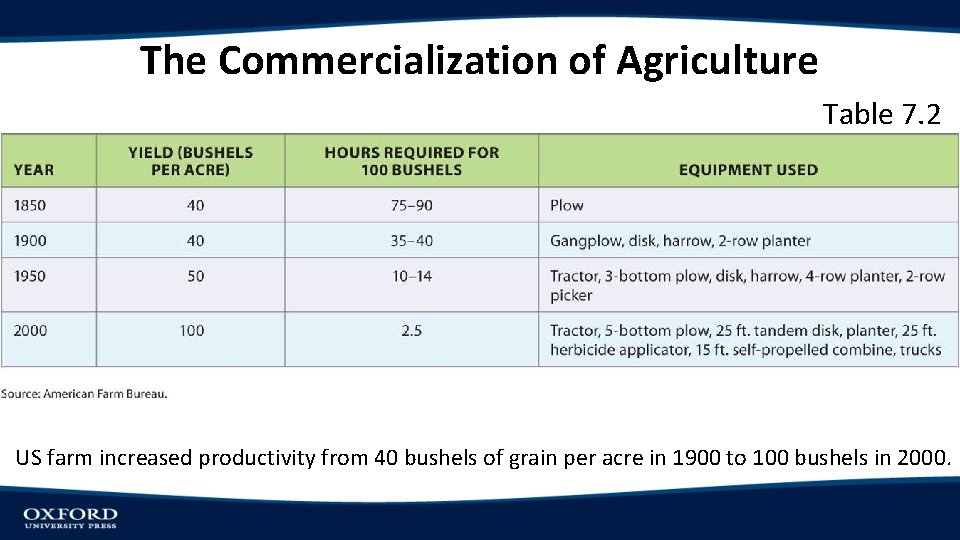
The Commercialization of Agriculture Table 7. 2 US farm increased productivity from 40 bushels of grain per acre in 1900 to 100 bushels in 2000.
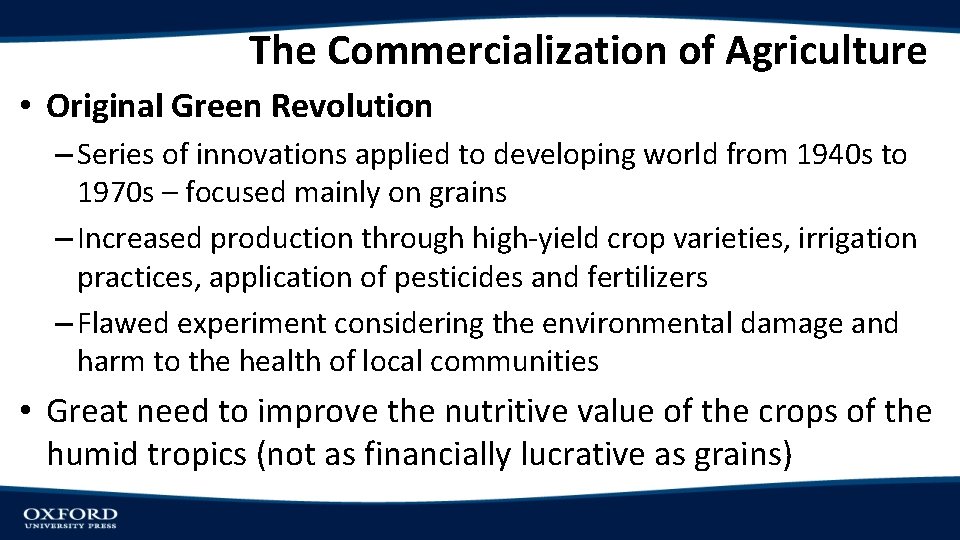
The Commercialization of Agriculture • Original Green Revolution – Series of innovations applied to developing world from 1940 s to 1970 s – focused mainly on grains – Increased production through high-yield crop varieties, irrigation practices, application of pesticides and fertilizers – Flawed experiment considering the environmental damage and harm to the health of local communities • Great need to improve the nutritive value of the crops of the humid tropics (not as financially lucrative as grains)
• Secondary sector Manufacturing – Has decreased in importance in more developed countries – “rust belts” • Industrial Revolution and Kondratieff cycles – Each associated with a primary industry, innovation, and city – Factory towns to industrial metros – Growth of conglomerates; mega-mergers and reduced competition – Global shifts • Role of unions in gaining better pay and working conditions for everyone – Reduced influence with the rise of the tertiary sector and the decline of the secondary sector
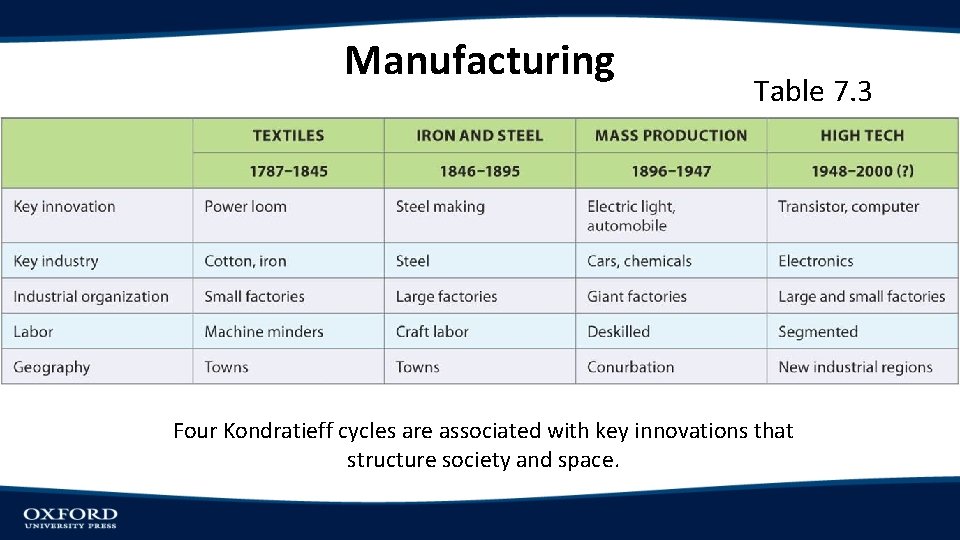
Manufacturing Table 7. 3 Four Kondratieff cycles are associated with key innovations that structure society and space.
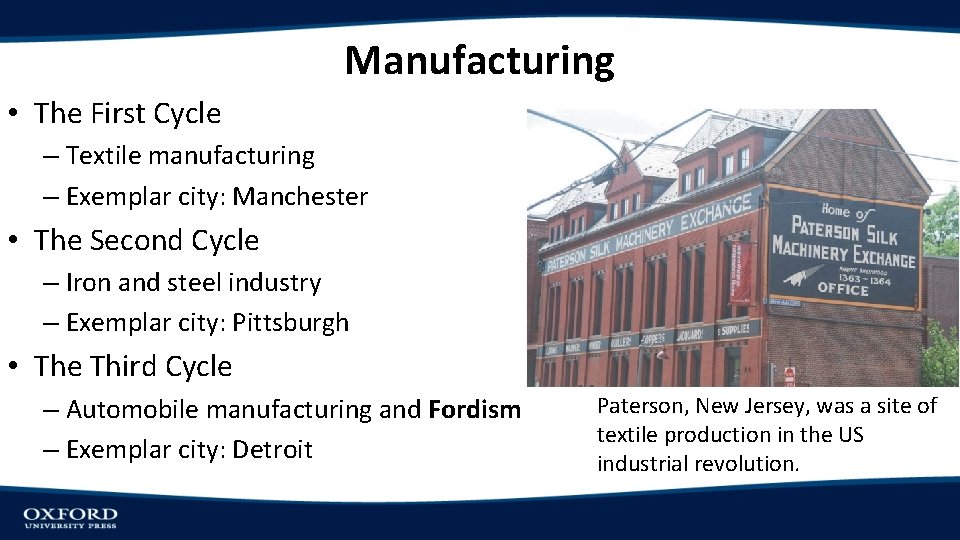
Manufacturing • The First Cycle – Textile manufacturing – Exemplar city: Manchester • The Second Cycle – Iron and steel industry – Exemplar city: Pittsburgh • The Third Cycle – Automobile manufacturing and Fordism – Exemplar city: Detroit Paterson, New Jersey, was a site of textile production in the US industrial revolution.
Global Shift • Global shift to the third cycle since 1970 s – Move from high-wage areas to low-wage areas (U. S. textiles to the South) – Enabled by low transportation costs – Newly industrializing Asian Tigers moved up the value added chain to more complex manufacturing • Consequences of manufacturing in a flat world – Deindustrialization in developed world – Sustained growth in new manufacturing regions – New class and gender identities associated with labor changes • India – small but growing “middle class” – educated women rejecting some customs associated with marriage.
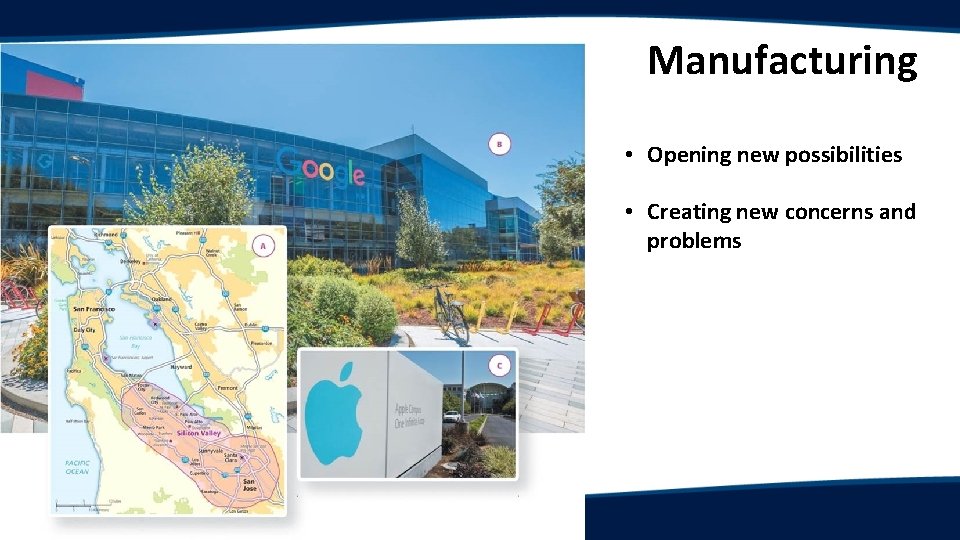
Manufacturing • The Fourth Cycle – High-tech information technology industries – Distinction between invention and innovation – Exemplar region: Silicon Valley – Movement to the “Sun Belt”
Manufacturing Table 7. 4 The IT wave took over a century to turn inventions into the wave of innovations since the 1980 s.
Manufacturing • Opening new possibilities • Creating new concerns and problems
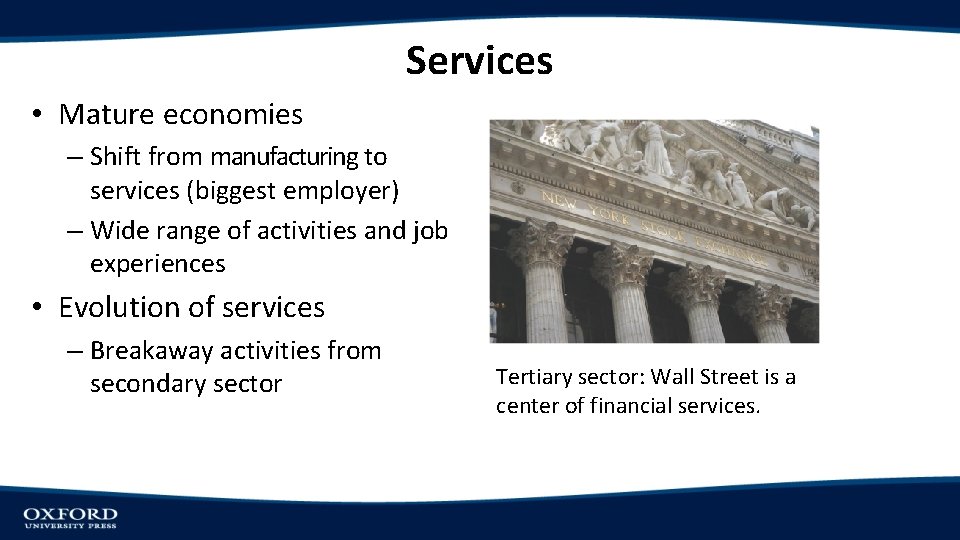
Services • Mature economies – Shift from manufacturing to services (biggest employer) – Wide range of activities and job experiences • Evolution of services – Breakaway activities from secondary sector Tertiary sector: Wall Street is a center of financial services.
Services • Characteristics – Polarized job market and wide range in compensation – Income distribution and employment opportunity – Increased female employment • Dangers of Baumol’s disease – As service employment increases, costs rise in the service sector – Price of goods in decline due to manufacturing efficiencies, yet cost of services keep rising both in absolute and relative terms • Particularly essential services
Services • Quaternary sector of knowledge and information services – Producer services • Quinary sector of executive decision-makers • Specialized, highly paid sector of “advanced producers services” – Increasingly important in more developed economies • Global Shift in Service – Economic globalization and new changes in technology – Lower wages and human capital advantages drive outsourcing – New global centers of service employment in China and India
The Cultural-Creative Economy • Cultural industry – Artistic industries and ‘cultural-products sectors’ – Enhances products and services in other sectors – Concentrated in world cities based on “path dependence” • Creative economy – Creative class of workers
Chapter Summary • Three distinct sectors of economic activity are primary, secondary, and tertiary. • The primary sector includes the agriculture, forestry, mining, and fishing industries. • The von Thünen model predicts land use around a city. Land closer to the city is expensive, used for more intensive market-oriented agriculture. • Agrarian transition is the shift from subsistence to commercial and moves from meeting local market demands to provisioning national and global food supply chains. Involves changes to agriculture. • Food supply chains have become longer and more complex due to urbanization, changing diets, and increased globalization. Four types of food supply chains.
Chapter Summary • Market integration of agricultural products happens when subsistence smallholders become commercial farmers or through land grabs and forced commercialization. • Commercialization of agriculture involves greater capital investment in machinery and biotechnology, leads to greater productivity, and has environmental costs. • Most sustained commercialization of agriculture in the developing world that involved large inputs of biotechnology was the Green Revolution, which increased agriculture prediction through new highyielding varieties of crops, irrigation, and liberal helpings of pesticides and fertilizers.
Chapter Summary • Four Kondratieff cycles of manufacturing depict fifty-year waves of increased innovation and invention. • Tertiary sector is the service industry, of selling, assistance, and providing expertise as opposed to making a tangible product. • Knowledge- and information-based activities, or advanced producer services, form the quaternary sector and with executive decision making levels defined as the quinary sector. • A region’s success rests more on the extent to which it can generate, retain, and attract knowledge-based employment. • Shift from a manufacturing-based economy to a service-based economy has profound effects on income distribution, gender relations, and urban growth.