
CHAPTER 7 THE FAMILY AND DELINQUENCY LEARNING OBJECTIVES
CHAPTER 7: THE FAMILY AND DELINQUENCY
LEARNING OBJECTIVES After reading this chapter, students should: 1. Be familiar with the link between family relationships and juvenile delinquency 2. Understand the complex association between family breakup and delinquent behavior 3. Discuss the nature and extent of child abuse 4. Be familiar with the child protection system and the stages in the child protection process 5. Know the various positions in the delinquency– child maltreatment debate
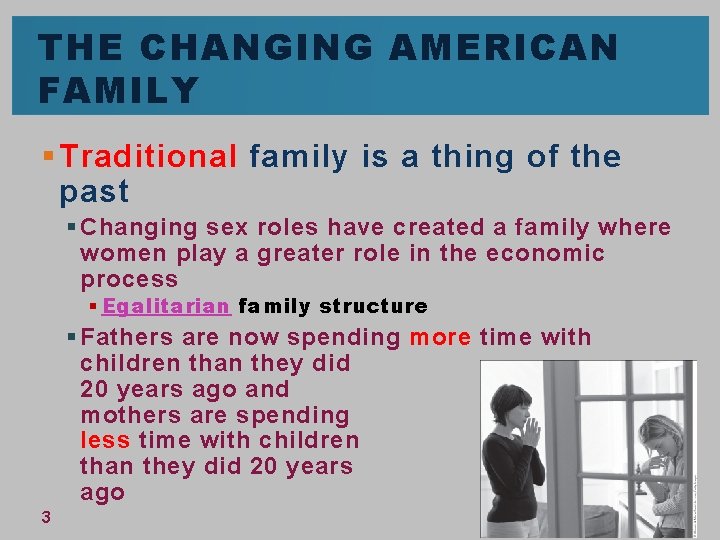
THE CHANGING AMERICAN FAMILY § Traditional family is a thing of the past § Changing sex roles have created a family where women play a greater role in the economic process § Egalitarian family structure § Fathers are now spending more time with children than they did 20 years ago and mothers are spending less time with children than they did 20 years ago 3
FAMILY MAKEUP § After a decades-long decline, 2/3 of underage minors now live in two parent families § Significant racial differences in family makeup still exist: Ø Children who live with two parents – 85 percent of Asian, § 75% of White, non-Hispanic children live with two parents § 61% of Hispanic children live with two parents (decreased from 75% in 1980) § 35% of Black children live with two parents § 4
TEEN MOMS/SINGLE MOMS § Today, more than 90% of teens who give birth are unmarried § Living a single parent home, especially one headed by an unmarried teenage mother, has been long associated with difficulties for both mother and child § Kids born into single-parent homes are more likely to live in poverty and to experience longterm physical and social difficulties § There are fewer teenage moms in the population today, due to birth control and the legalization of abortion
QUESTION 1. The time a father spends with his ch ildren has decreased over the past decades. a. True b. False
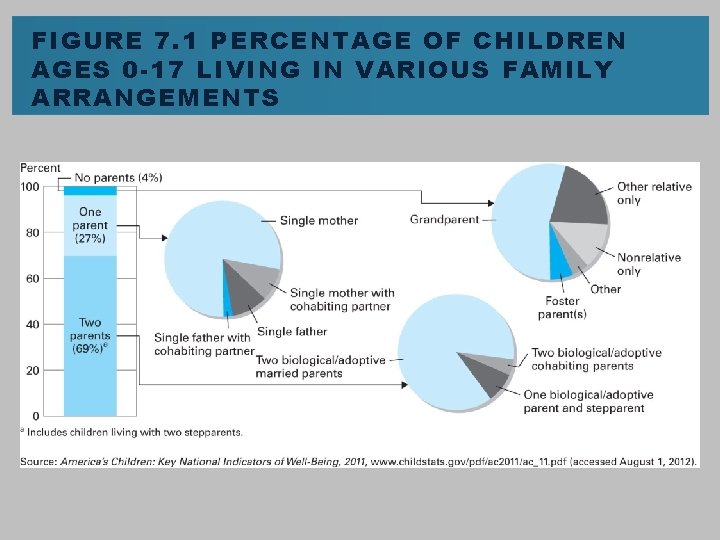
FIGURE 7. 1 PERCENTAGE OF CHILDREN AGES 0 -17 LIVING IN VARIOUS FAMILY ARRANGEMENTS
QUESTION 2. Which of the following children is least likely to live in a two-parent household? a. b. c. d. an African American child a Hispanic child an Asian American child a White non-Hispanic child
TEEN MOMS/SINGLE MOMS Why do children from single-parent families commit more delinquency? Ø Single parents can less effectively supervise their children. Ø Children in single-parent families grow up too fast. Ø Single mothers give adolescents too much autonomy, thus reducing control. Ø Children from single-parent families are more susceptible to peer pressure. Ø Role Fathers Play - The Impact of a Father 7
ECONOMIC STRESS § About 6 million American youth live in poverty (about 15%) § Majority of the families live in substandard housing without adequate health care, nutrition, or child care § Recent political trends suggest that the social “safety net” can not be sustained at current levels § Poor families can expect less government aid in the coming years § Will this economic pressure be reduced in the future? § The recent economic upheaval and high unemployment rate has caused families to remain under stress… 8
CHILD CARE § 48% of children ages 0 -4 with employed moms are cared for by a relative § 24% are cared for in a formal daycare or center § 14% are cared for by a nonrelative in a homebased environment § Day care workers are often paid minimum wage § Family day care homes: § Single provider takes care of three to nine children § Although some states mandate registration and inspection of day care providers, 90% are “underground” § Children from working poor families are likely to suffer from inadequate child care § According to Polakow, lack of access to affordable highquality child care is related to family poverty, joblessness, and homelessness 9
Family’s Influence of Delinquency § The family is the primary unit in which children learn the values and attitudes that guide their actions § Family disruption or changes can have a long lasting effect § Four categories of family dysfunction promote delinquency: ① Families disrupted by spousal conflict or breakup § Family breakup ② Families involved in interpersonal conflict § Family conflict ③ Ineffective parents who lack proper parenting skills § Family effectiveness ④ Families that contain deviant parents § Family deviance 10
QUESTION 3. What percentage of American children currently live in poverty? a. b. c. d. 25 percent 15 percent 35 percent
QUESTION 4. According to the text, there are four categories of family dysfunction that seem to promote delinquent behavior. Which of the following is not one of these four categories? a. b. c. d. family breakup effectiveness conflict makeup

FIGURE 7. 2 FAMILY INFLUENCES ON BEHAVIOR
QUESTION 5. About 90 percent of day care providers: a. routinely pass the stringent licensing requirements b. routinely keep youths in holding pens to manage their behavior c. have been under investigation at some time or another d. operate “underground”
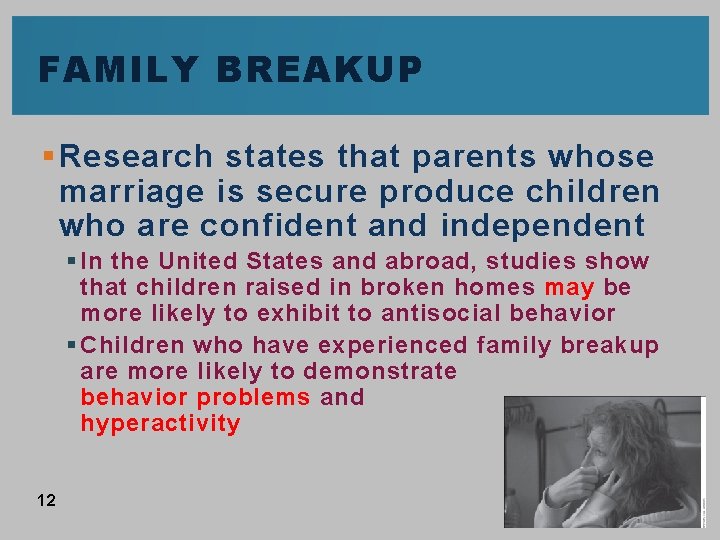
FAMILY BREAKUP § Research states that parents whose marriage is secure produce children who are confident and independent § In the United States and abroad, studies show that children raised in broken homes may be more likely to exhibit to antisocial behavior § Children who have experienced family breakup are more likely to demonstrate behavior problems and hyperactivity 12
THE EFFECTS OF DIVORCE § According to some sociologists, children who grow up apart from their biological fathers are typically less adjusted than children who grow up with both biological parents. § For example: § They are less likely to finish high school and attend college § They are less likely to find and keep a steady job § They are more likely to become teen parents § However, in some cases, divorce reduces stress and insulates kids from exposure to harmful parents

FAMILY CONFLICT § Intrafamily conflict is a common experience in many American families § The connection between parental conflict and delinquency was established more than 50 years ago by F. Ivan Nye § Contemporary studies also found that children who grow up in maladapted homes, and witness discord or violence, later exhibit emotional disturbance and behavior problems 14 § Adolescents who are incarcerated report growing up in dysfunctional homes § Parents of beyond control youngsters have been found to be inconsistent rule setters and less likely to show interest in their children
FAMILY EFFECTIVENESS § Children raised by parents who lack proper parenting skills are more at risk for delinquency § Delinquency will be reduced if parents provide the type of structure that integrates children into families, while also giving them the ability to assert their individuality- known as “parental efficacy” § “Violence begetting violence” cycle § Violent parents more likely to produce violent children § Evidence show that inconsistent supervision can promote delinquency § F. Ivan Nye found that mothers who threatened discipline, but failed to carry it out, were more likely to raise delinquent children than those who were consistent
FAMILY EFFECTIVENESS § Poor child/parent communications have been related to dysfunctional activities such as running away and entering the ranks of homelessness § The more children in a family, the greater the chance of youthful misbehavior – resource dilution 16
QUESTION 6. Nye found that mothers who threatened discipline but failed to carry it out were more likely to have delinquent children than those who were consistent in their discipline. a. True b. False

FAMILY DEVIANCE § Kids whose parents go to prison are at a much higher risk of delinquency than children of non-incarcerated parents § About 8% of sons with noncriminal fathers became chronic offenders, compared to 37% of sons WITH criminal fathers 18

FAMILY DEVIANCE § The causes of intergenerational deviance is uncertain; a number of factors may play a role: § Genetic factors § The link between parental deviance and child misbehavior may be genetic § Substance abuse § Children of drug abusing parents are more likely to get involved in drug abuse and delinquency § Parental skills § Deviant parents are likely to become incarcerated, and once released, will exhibit lower levels of effective parenting § Parental Absence § Stigma § Labeling and stigma associated with parental deviance
Family Members Arrested for the Same Crime – Current Example Ø In 2009, five individuals from the same family in Missouri were arrested in connection with child sex crimes. According to a press release from the Missouri Highway Patrol, the offenders, who ranged from ages from 48 to 77, were arrested on active warrants for sex crimes “perpetuated against children. ” ü Do you believe that “crime runs in the family”? ü Why do you think family members are more likely get involved in crime together?
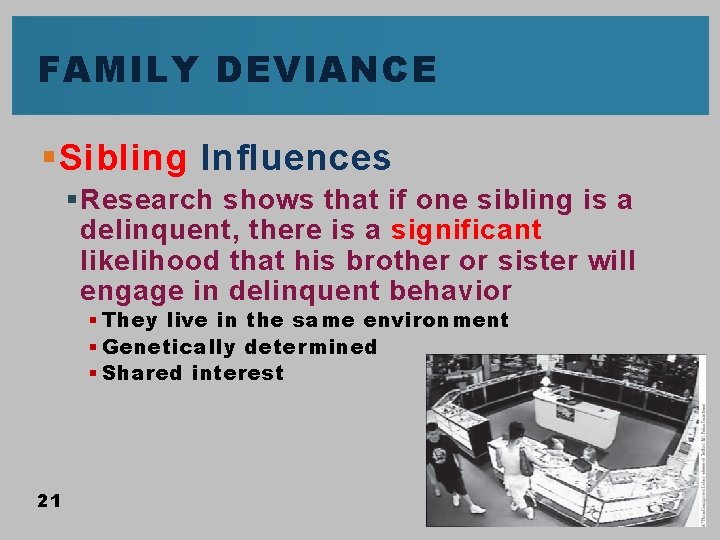
FAMILY DEVIANCE § Sibling Influences § Research shows that if one sibling is a delinquent, there is a significant likelihood that his brother or sister will engage in delinquent behavior § They live in the same environment § Genetically determined § Shared interest 21
Birth Order and Delinquency – Current Example Ø A study conducted by Argys, Rees, Averett, and Witoonchart (2006) stated that there was a strong correlation between birth order and delinquency. For example, their results strongly suggested that children with older siblings are more likely than the firstborn to have used tobacco, alcohol, and marijuana. ü Why do you think it is? ü Is birth order related to personality or other psychological traits? ü Do parents treat their children differently based on their birth order? 22
CHILD ABUSE AND NEGLECT § Historical Foundation § Maltreatment of children has occurred throughout history § Negative effects of maltreatment was voiced in the 18 th century in the United States, but dealing with problem did not begin until 1874 § In the United States today, an estimated 1600 children die each year because of abuse. 23
DEFINING ABUSE AND NEGLECT § Child abuse is defined as any physical or emotional trauma to a child for which no reasonable explanation can be found § Child abuse is seen as a pattern of behavior, rather than a single act § Effects of a pattern behavior are cumulative § Child abuse and neglect are sometimes used interchangeably; they represent different forms of maltreatment § Neglect refers to suffering at the hands of parents § Lack of food, shelter, health care, and love § Child abuse is a form of aggression against the child that often requires medical attention
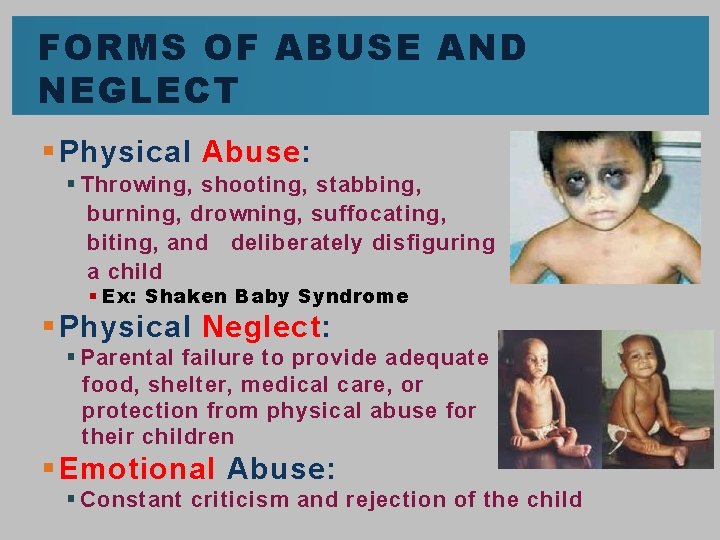
FORMS OF ABUSE AND NEGLECT § Physical Abuse: § Throwing, shooting, stabbing, burning, drowning, suffocating, biting, and deliberately disfiguring a child § Ex: Shaken Baby Syndrome § Physical Neglect: § Parental failure to provide adequate food, shelter, medical care, or protection from physical abuse for their children § Emotional Abuse: § Constant criticism and rejection of the child
FORMS OF ABUSE AND NEGLECT § Emotional Neglect: § Inadequate nurturing, inattention to a child’s emotional development, lack of concern about maladaptive behavior § Abandonment: § Parents leave their children with the intention of severing the parent-child relationship § Sexual Abuse: § Exploitation of children through rape, incest or molestation by parents, family members, friends, or legal guardians
QUESTION 7. In the United States, concerted efforts to deal with parental abuse and neglect did not begin until 1874. a. True b. False
QUESTION 8. In the United States today, an estimated ____ children die each year because of abuse. a. b. c. d. 500 900 1200 1600
QUESTION 9. Physical neglect results from parents’ failure to provide adequate food, shelter, or medical care for their children. a. True b. False
Fresno Family Massacre – Current Example Ø In 2005, Marcus Delon Wesson of Fresno, CA was convicted of nine counts of first-degree murder and 14 sex crimes, including the rape and molestation of his underage daughters. His victims were his own children, fathered by incestuous relationships with his daughters and nieces, as well as the children by his wife. He was sentenced to death on June 27, 2005. ü How can we spot domestic violence in our own neighborhood? ü What are the signs? ü What can we do to prevent/intervene when we do think something illegal is happening in our neighborhood?
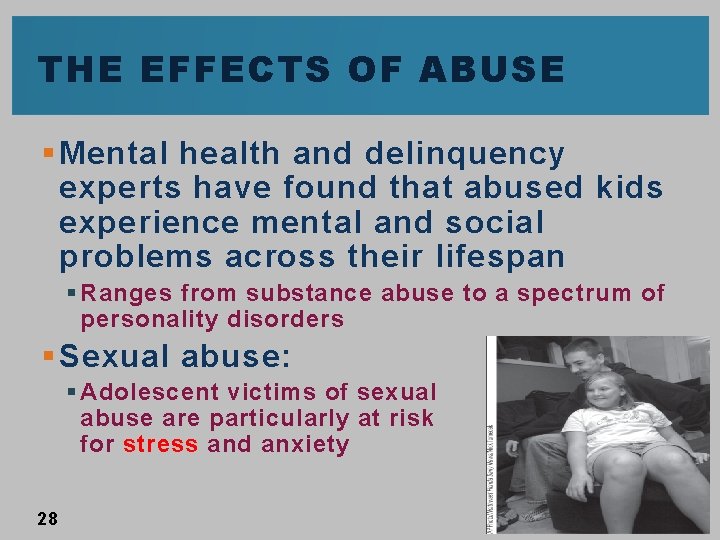
THE EFFECTS OF ABUSE § Mental health and delinquency experts have found that abused kids experience mental and social problems across their lifespan § Ranges from substance abuse to a spectrum of personality disorders § Sexual abuse: § Adolescent victims of sexual abuse are particularly at risk for stress and anxiety 28
Sex Abuse or Sex Assault § Criminal Sexual Abuse – "Sexual conduct" means any knowing touching or fondling by the victim or the accused, either directly or through clothing, of the sex organs, anus, or breast of the victim or the accused, or any part of the body of a child under 13 years of age, or any transfer or transmission of semen by the accused upon any part of the clothed or unclothed body of the victim, for the purpose of sexual gratification or arousal of the victim or the accused. § Criminal Sexual Assault (Rape) "Sexual penetration" means any contact, however slight, between the sex organ or anus of one person and an object or the sex organ, mouth, or anus of another person, or any intrusion, however slight, of any part of the body of one person or of any animal or object into the sex organ or anus of another person, including, but not limited to, cunnilingus, fellatio, or anal penetration. Evidence of emission of semen is not required to prove sexual penetration. 29
THE EXTENT OF CHILD ABUSE § It is almost impossible to estimate the extent of child abuse § Many victims are so young that they are not able to communicate § Study done by Gelles and Straus (1979) § Estimated that between 1. 4 and 1. 9 million children were subject to physical abuse from their parents § Study done by Gelles and Straus (1988) § Found that the incidence of severe violence toward children had declined due to a decrease in parental approval of corporal punishment § The Department of Health and Human Services has been monitoring the extent of maltreatment through its annual survey of child protective services
WHO ARE THE VICTIMS OF ABUSE? § The youngest children are the most vulnerable § Boys and girls have an almost equal chance of being victimized § Pacific Islander children and American Indian or Alaska Native children suffer much higher rates of child abuse than European American, Hispanic and Asian children § 4/5 of victims were maltreated by a parent either acting alone or with someone else § An additional 9% of maltreated children are subject to sexual abuse
CAUSES OF CHILD ABUSE AND NEGLECT § Maltreatment of children is a complex problem with neither a single cause nor a single solution § Factors associated with child abuse: § Parents who themselves suffered abuse § The presence of an unrelated adult increases the risk of abuse § Isolated and alienated families tend to become abusive § Other related causes: substance abuse, stepparents and abuse, and social class and abuse 32
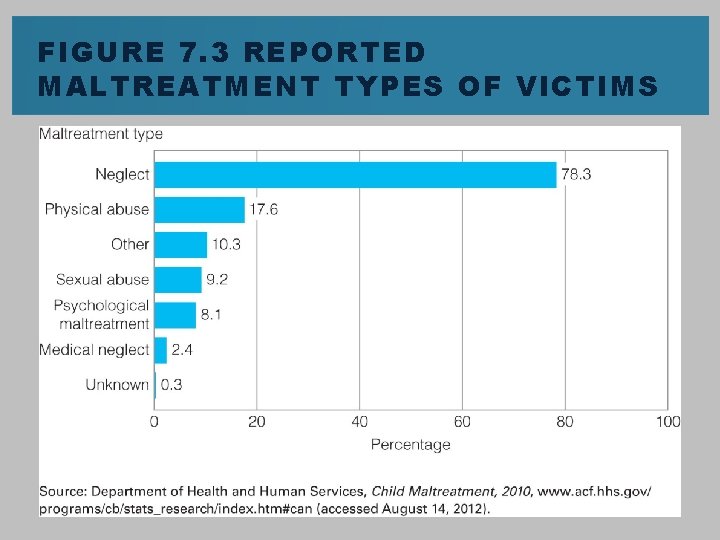
FIGURE 7. 3 REPORTED MALTREATMENT TYPES OF VICTIMS
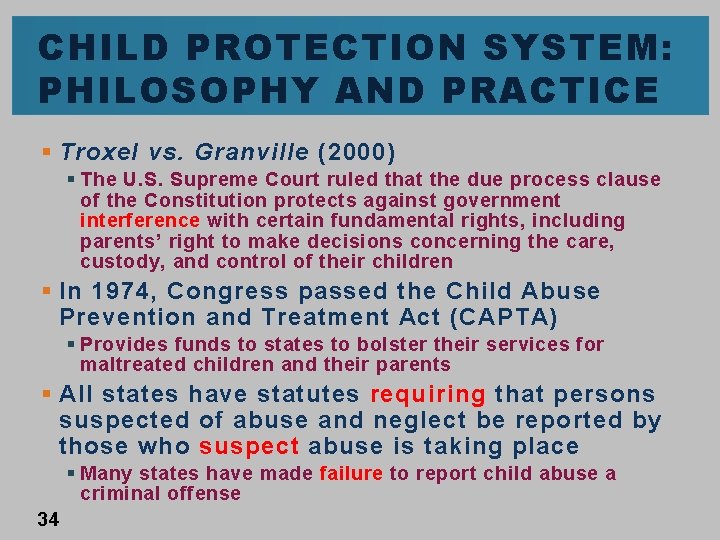
CHILD PROTECTION SYSTEM: PHILOSOPHY AND PRACTICE § Troxel vs. Granville (2000) § The U. S. Supreme Court ruled that the due process clause of the Constitution protects against government interference with certain fundamental rights, including parents’ right to make decisions concerning the care, custody, and control of their children § In 1974, Congress passed the Child Abuse Prevention and Treatment Act (CAPTA) § Provides funds to states to bolster their services for maltreated children and their parents § All states have statutes requiring that persons suspected of abuse and neglect be reported by those who suspect abuse is taking place § Many states have made failure to report child abuse a criminal offense 34
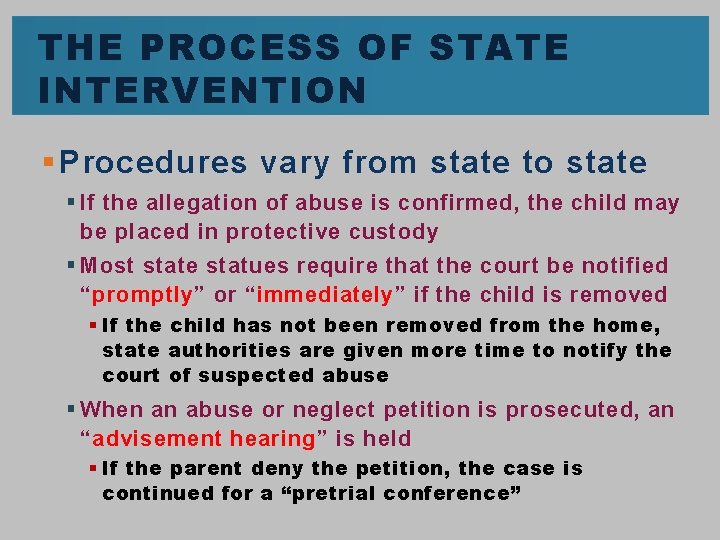
THE PROCESS OF STATE INTERVENTION § Procedures vary from state to state § If the allegation of abuse is confirmed, the child may be placed in protective custody § Most state statues require that the court be notified “promptly” or “immediately” if the child is removed § If the child has not been removed from the home, state authorities are given more time to notify the court of suspected abuse § When an abuse or neglect petition is prosecuted, an “advisement hearing” is held § If the parent deny the petition, the case is continued for a “pretrial conference”
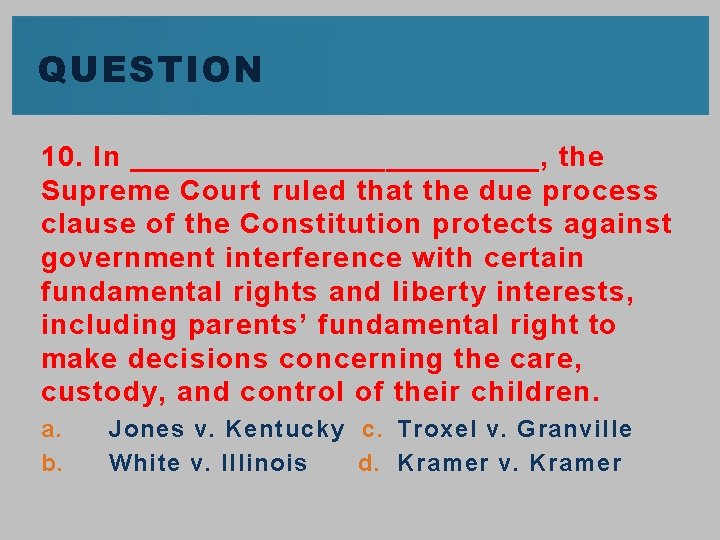
QUESTION 10. In ____________, the Supreme Court ruled that the due process clause of the Constitution protects against government interference with certain fundamental rights and liberty interests, including parents’ fundamental right to make decisions concerning the care, custody, and control of their children. a. b. Jones v. Kentucky c. Troxel v. Granville White v. Illinois d. Kramer v. Kramer
TRIAL AND DISPOSITION § Research has shown that no more than 10 cases out of every 100 actually reach the trial stage of the process § If the state’s case is proven, the parents may be found guilty of criminal charges of child abuse and face probation or a prison sentence § The most crucial part of an abuse or neglect proceeding is the “disposition hearing” § The social service agency presents its plan for how best to proceed § Utmost consideration given to well being of the child § Today, social service agents avoid removing children from the home § Instead try to employ techniques to control abusive relationship § Balancing-of-the-interests approach § The court is to balance the parents’ natural right to raise a child with the child’s right to grow into adulthood free from abuse 36
THE ABUSED CHILD IN COURT § The most significant problems associated with abuse cases is the trauma a child must go through in a court hearing § Innovative methods of testimony: § Videotaped statement, CCTV, anatomically correct dolls, hearsay § Two Legal Issues ① Ability of physicians and mental health professionals to testify about statements made to them by children ② The way children testify in court § In Court Statements: § Children who are victims of sexual or physical abuse often make poor witnesses
ABUSE, NEGLECT, AND DELINQUENCY § Literature suggests that victims of abuse are often associated with subsequent episodes of delinquency and violence § Children who are abused are likely to grow up to be abusers themselves § The Cycle of Violence: § Being abused or neglected increases the chances of arrest as a juvenile and as an adult § Maltreated children were younger at the time of their first arrest § Physically abused and neglected children were most likely to be arrested later for a violent crime § Abused/neglected females were at increased risk of arrest for violence as juveniles and adults § There are racial differences in the long-term effects § An out-of-home placement was not related to the number of arrests 38
QUESTION 11. It is estimated that about _____ out of every 100 child abuse or neglect cases reaches the trial stage. a. b. c. d. 2 10 25 46
THE ABUSE-DELINQUENCY LINK § Many questions remain to be answered about the abuse-delinquency link § Abuse and Delinquency link may be misleading § These two factors could be connected because of some other external factor § Research also shows that the Timing and Extent of abuse may shape its impact § Abuse may impact some groups of adolescents more than it does others 39
SUMMARY ü Be familiar with the link between family relationships and juvenile delinquency ü Chart the changes American families are now undergoing ü Understand the complex association between family breakup and delinquent behavior ü Understand why families in conflict produce more delinquents than those that function harmoniously ü Compare and contrast the effects of good and bad parenting on delinquency
SUMMARY ü Discuss whether having deviant parents affects a child’s behavioral choices ü Discuss the nature and extent of child abuse ü Be familiar with the child protection system and the stages in the child protection process ü Know how courts have protected child witnesses ü Know the various positions in the delinquency-child maltreatment debate
- Slides: 51