
Chapter 7 The Elementary and Secondary Education Act
- Slides: 45
Chapter 7 The Elementary and Secondary Education Act The Law and Special Education, 3 rd Edition © 2012 Pearson Education, Inc. All rights reserved.
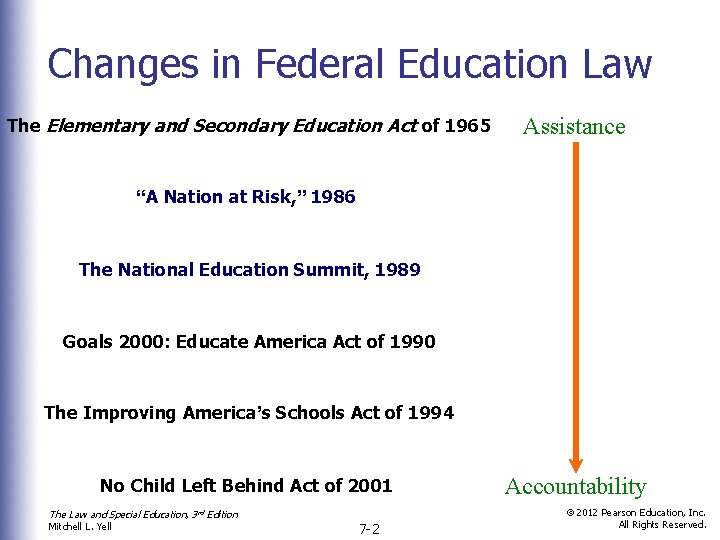
Changes in Federal Education Law The Elementary and Secondary Education Act of 1965 Assistance “A Nation at Risk, ” 1986 The National Education Summit, 1989 Goals 2000: Educate America Act of 1990 The Improving America’s Schools Act of 1994 No Child Left Behind Act of 2001 The Law and Special Education, 3 rd Edition Mitchell L. Yell 7 -2 Accountability © 2012 Pearson Education, Inc. All Rights Reserved.
The Purpose of NCLB n The primary purpose of NCLB is to ensure that students in every public school achieve important learning goals while being educated in safe classrooms by highly qualified teachers The Law and Special Education, 3 rd Edition Mitchell L. Yell 7 -3 © 2012 Pearson Education, Inc. All Rights Reserved.
The Goals of NCLB n The primary goals of NCLB are that: n n n All students will achieve high academic standards by attaining proficiency or better in reading and mathematics by the 2013– 2014 school year. All students will be taught by highly qualified teachers by the 2005– 2006 school year. All students will be educated in schools and classrooms that are safe, drug free, and conducive to learning. All limited-English-proficient students will become proficient in English All students will graduate from high school The Law and Special Education, 3 rd Edition Mitchell L. Yell 7 -4 © 2012 Pearson Education, Inc. All Rights Reserved.
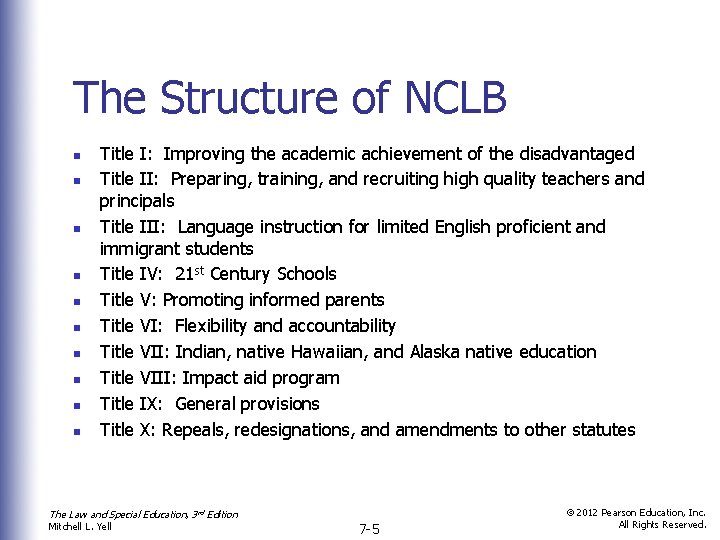
The Structure of NCLB n n n n n Title I: Improving the academic achievement of the disadvantaged Title II: Preparing, training, and recruiting high quality teachers and principals Title III: Language instruction for limited English proficient and immigrant students Title IV: 21 st Century Schools Title V: Promoting informed parents Title VI: Flexibility and accountability Title VII: Indian, native Hawaiian, and Alaska native education Title VIII: Impact aid program Title IX: General provisions Title X: Repeals, redesignations, and amendments to other statutes The Law and Special Education, 3 rd Edition Mitchell L. Yell 7 -5 © 2012 Pearson Education, Inc. All Rights Reserved.
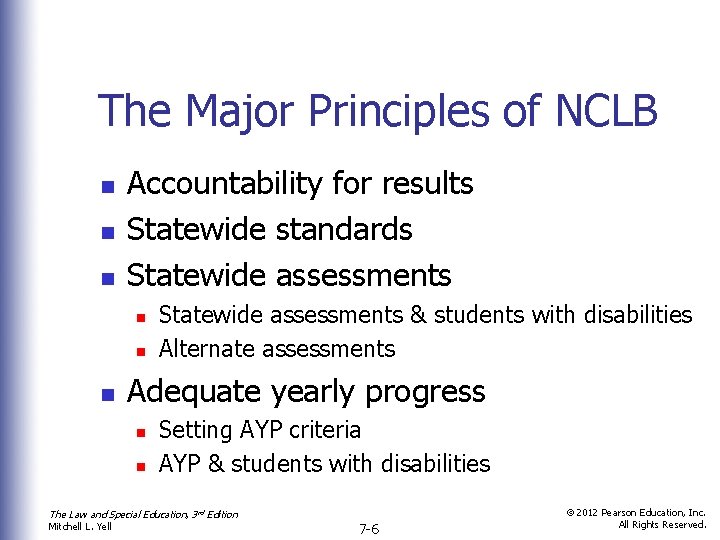
The Major Principles of NCLB n n n Accountability for results Statewide standards Statewide assessments n n n Statewide assessments & students with disabilities Alternate assessments Adequate yearly progress n n Setting AYP criteria AYP & students with disabilities The Law and Special Education, 3 rd Edition Mitchell L. Yell 7 -6 © 2012 Pearson Education, Inc. All Rights Reserved.
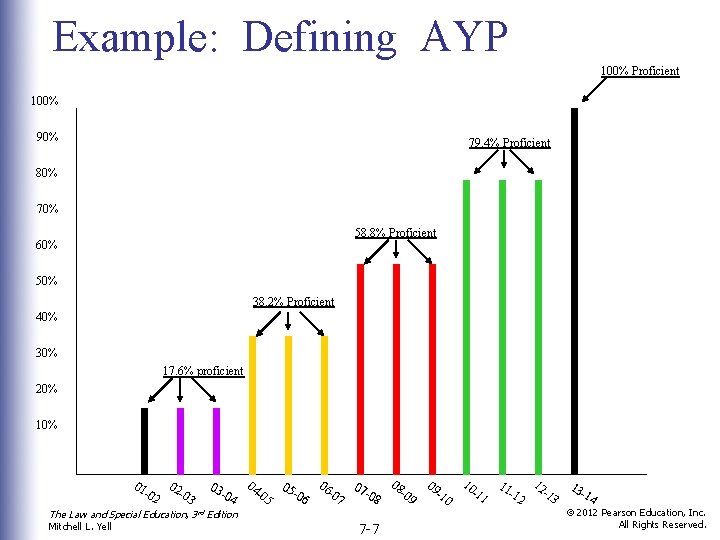
Example: Defining AYP 100% Proficient 100% 90% 79. 4% Proficient 80% 70% 58. 8% Proficient 60% 50% 38. 2% Proficient 40% 30% 17. 6% proficient 20% 10% 01 -02 02 -03 03 -04 The Law and Special Education, 3 rd Edition Mitchell L. Yell 04 -0 5 05 -06 06 -0 7 07 -08 7 -7 08 - 09 09 -1 0 10 -1 1 11 -12 12 -1 3 13 -14 © 2012 Pearson Education, Inc. All Rights Reserved.
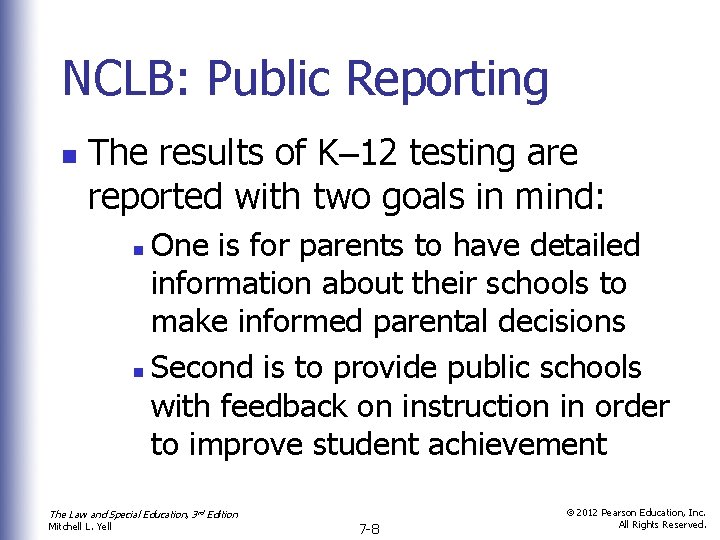
NCLB: Public Reporting n The results of K– 12 testing are reported with two goals in mind: One is for parents to have detailed information about their schools to make informed parental decisions n Second is to provide public schools with feedback on instruction in order to improve student achievement n The Law and Special Education, 3 rd Edition Mitchell L. Yell 7 -8 © 2012 Pearson Education, Inc. All Rights Reserved.
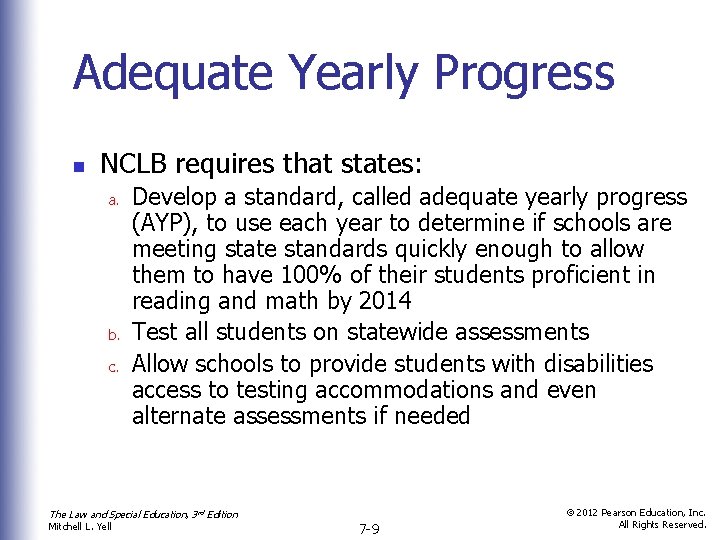
Adequate Yearly Progress n NCLB requires that states: a. b. c. Develop a standard, called adequate yearly progress (AYP), to use each year to determine if schools are meeting state standards quickly enough to allow them to have 100% of their students proficient in reading and math by 2014 Test all students on statewide assessments Allow schools to provide students with disabilities access to testing accommodations and even alternate assessments if needed The Law and Special Education, 3 rd Edition Mitchell L. Yell 7 -9 © 2012 Pearson Education, Inc. All Rights Reserved.
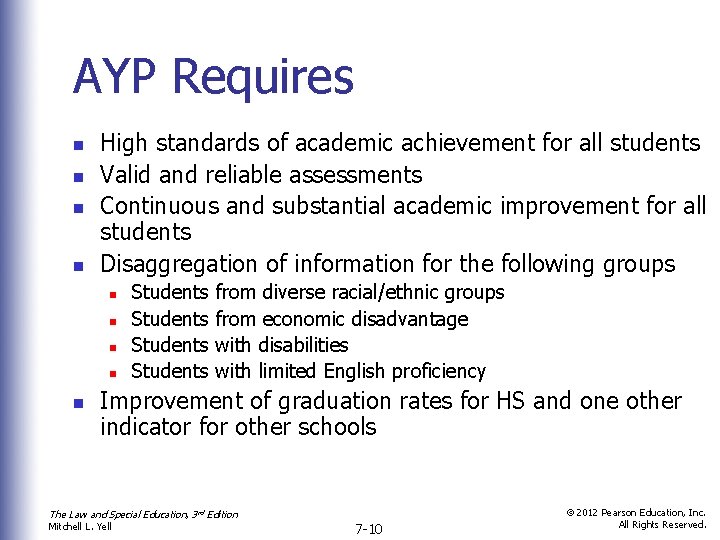
AYP Requires n n High standards of academic achievement for all students Valid and reliable assessments Continuous and substantial academic improvement for all students Disaggregation of information for the following groups n n n Students from diverse racial/ethnic groups Students from economic disadvantage Students with disabilities Students with limited English proficiency Improvement of graduation rates for HS and one other indicator for other schools The Law and Special Education, 3 rd Edition Mitchell L. Yell 7 -10 © 2012 Pearson Education, Inc. All Rights Reserved.
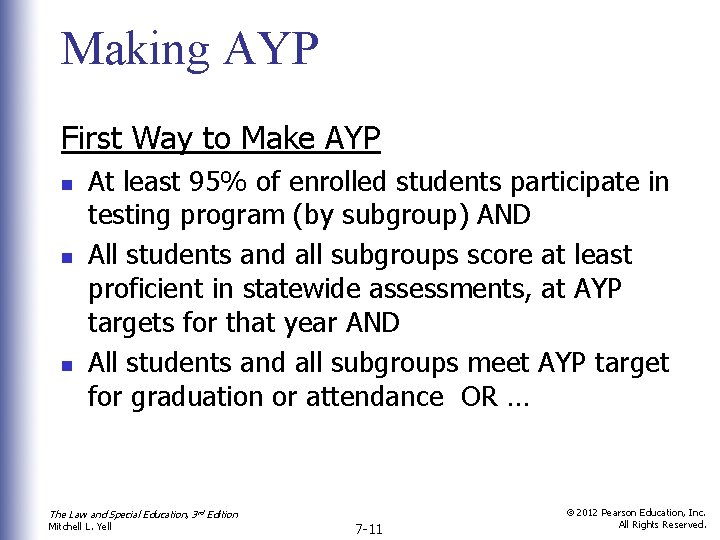
Making AYP First Way to Make AYP n n n At least 95% of enrolled students participate in testing program (by subgroup) AND All students and all subgroups score at least proficient in statewide assessments, at AYP targets for that year AND All students and all subgroups meet AYP target for graduation or attendance OR … The Law and Special Education, 3 rd Edition Mitchell L. Yell 7 -11 © 2012 Pearson Education, Inc. All Rights Reserved.
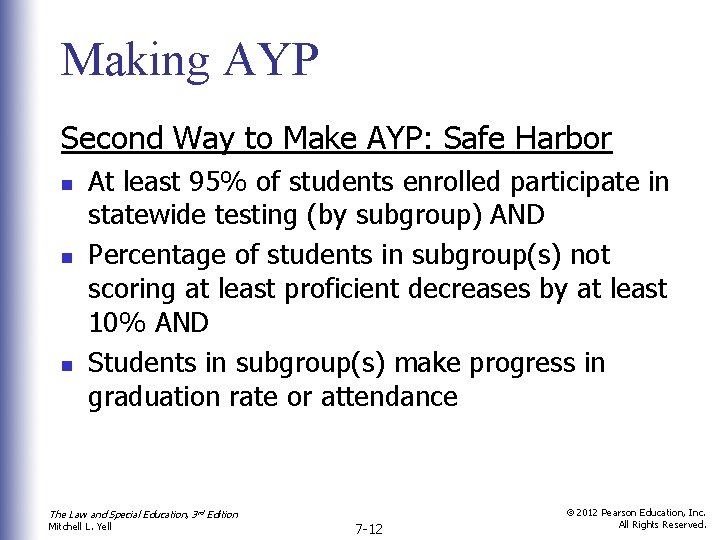
Making AYP Second Way to Make AYP: Safe Harbor n n n At least 95% of students enrolled participate in statewide testing (by subgroup) AND Percentage of students in subgroup(s) not scoring at least proficient decreases by at least 10% AND Students in subgroup(s) make progress in graduation rate or attendance The Law and Special Education, 3 rd Edition Mitchell L. Yell 7 -12 © 2012 Pearson Education, Inc. All Rights Reserved.
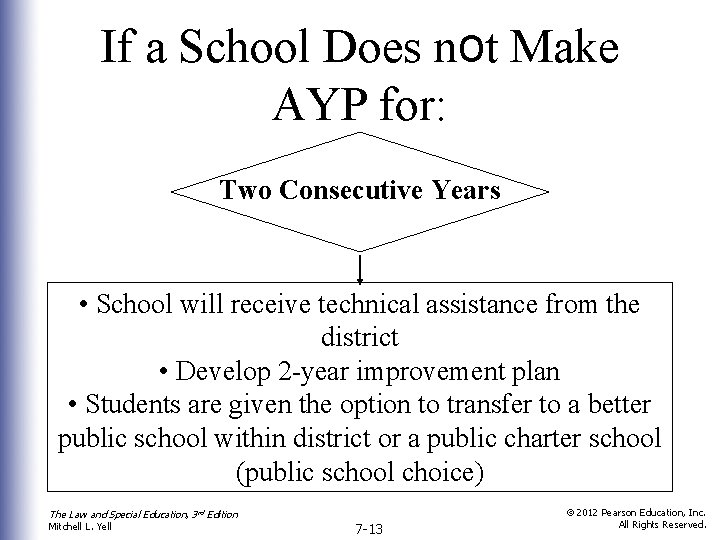
If a School Does not Make AYP for: Two Consecutive Years • School will receive technical assistance from the district • Develop 2 -year improvement plan • Students are given the option to transfer to a better public school within district or a public charter school (public school choice) The Law and Special Education, 3 rd Edition Mitchell L. Yell 7 -13 © 2012 Pearson Education, Inc. All Rights Reserved.
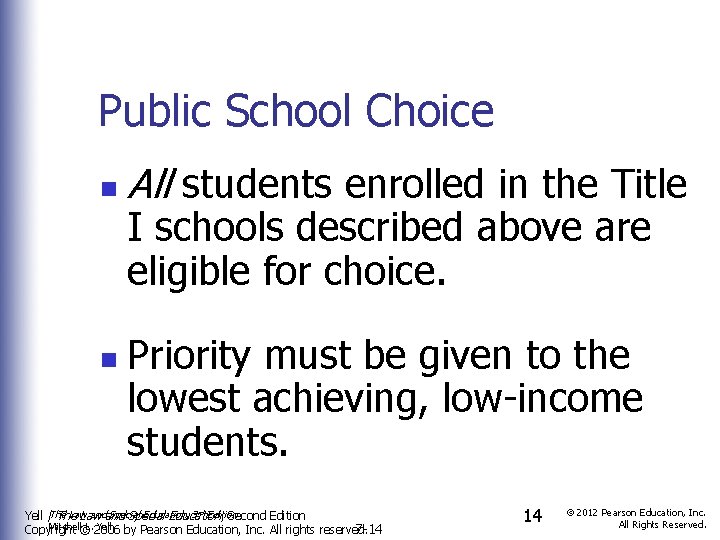
Public School Choice n n All students enrolled in the Title I schools described above are eligible for choice. Priority must be given to the lowest achieving, low-income students. The Law andand Special Education, 3 rd Edition Yell / The Law Special Education , Second Edition Mitchell L. Yell 7 -14 Copyright © 2006 by Pearson Education, Inc. All rights reserved. 14 © 2012 Pearson Education, Inc. All Rights Reserved.
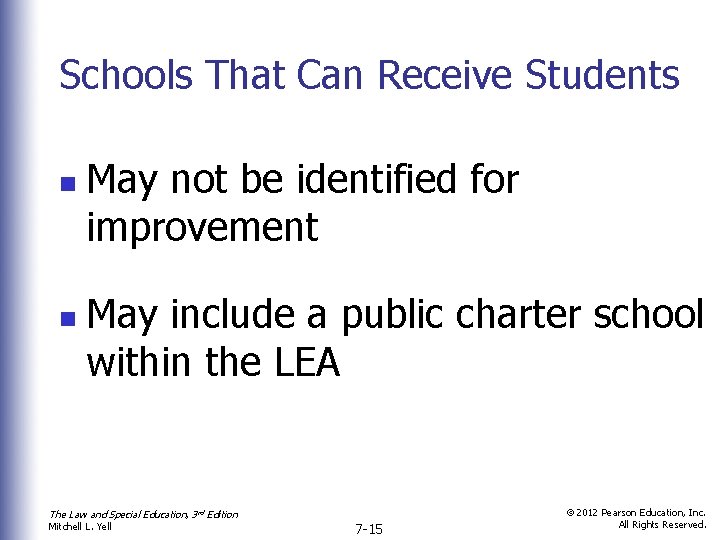
Schools That Can Receive Students n n May not be identified for improvement May include a public charter school within the LEA The Law and Special Education, 3 rd Edition Mitchell L. Yell 7 -15 © 2012 Pearson Education, Inc. All Rights Reserved.
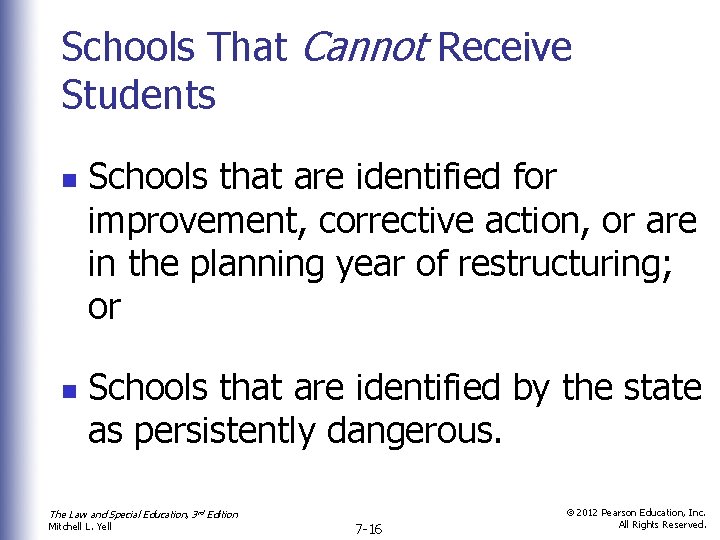
Schools That Cannot Receive Students n n Schools that are identified for improvement, corrective action, or are in the planning year of restructuring; or Schools that are identified by the state as persistently dangerous. The Law and Special Education, 3 rd Edition Mitchell L. Yell 7 -16 © 2012 Pearson Education, Inc. All Rights Reserved.
School Improvement n n n Each district must identify for school improvement any Title I school that fails to make AYP for 2 consecutive years. Identification must take place before the beginning of the school year following the failure to make AYP. Within 3 months, an identified school must develop a school plan, in consultation with parents, school staff, district staff, and outside experts. The Law and Special Education, 3 rd Edition Mitchell L. Yell 7 -17 © 2012 Pearson Education, Inc. All Rights Reserved.
The School Improvement Plan: n n n Cover a 2 -year period Incorporate strategies based on scientifically based research to address specific areas that caused the failure Adopt policies and practices concerning the school’s core academic subjects that have the greatest likelihood of raising student achievement to meet the state proficient level The Law and Special Education, 3 rd Edition Mitchell L. Yell 7 -18 © 2012 Pearson Education, Inc. All Rights Reserved.
The School Improvement Plan: n n n Assure that the school will spend at 10% of its Title I funds on professional development each year Establish annual measurable progress objectives to ensure that each subgroup will meet proficiency within 12 years Provide for effective parent involvement Incorporate extended-time activities Incorporate a teacher-mentoring program The Law and Special Education, 3 rd Edition Mitchell L. Yell 7 -19 © 2012 Pearson Education, Inc. All Rights Reserved.
The School Improvement Plan: n n n Be implemented no later than the beginning of the next full school year following identification for improvement Be reviewed, using a peer review process, within 45 days of receiving it and approve it if it meets the statutory requirements Provide all students in the school the option to transfer to another public school that is not identified for improvement The Law and Special Education, 3 rd Edition Mitchell L. Yell 7 -20 © 2012 Pearson Education, Inc. All Rights Reserved.
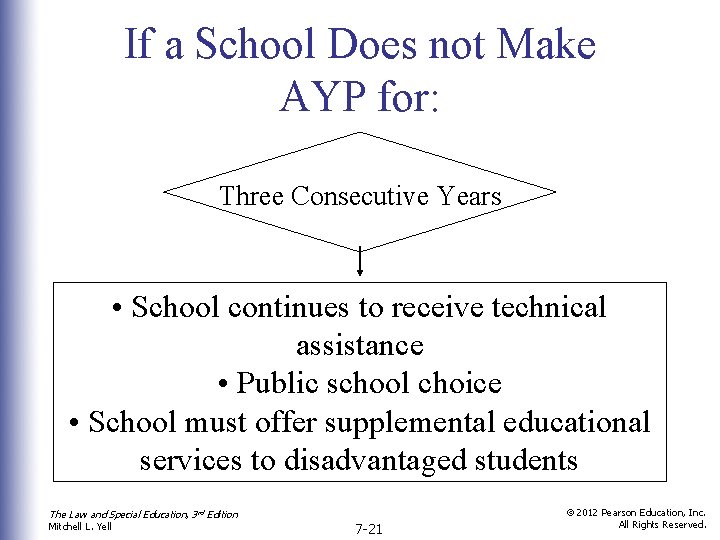
If a School Does not Make AYP for: Three Consecutive Years • School continues to receive technical assistance • Public school choice • School must offer supplemental educational services to disadvantaged students The Law and Special Education, 3 rd Edition Mitchell L. Yell 7 -21 © 2012 Pearson Education, Inc. All Rights Reserved.
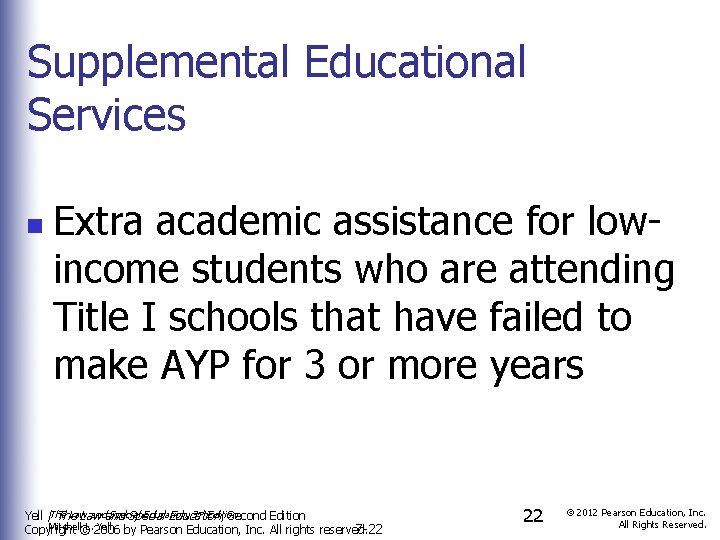
Supplemental Educational Services n Extra academic assistance for lowincome students who are attending Title I schools that have failed to make AYP for 3 or more years The Law andand Special Education, 3 rd Edition Yell / The Law Special Education , Second Edition Mitchell L. Yell 7 -22 Copyright © 2006 by Pearson Education, Inc. All rights reserved. 22 © 2012 Pearson Education, Inc. All Rights Reserved.
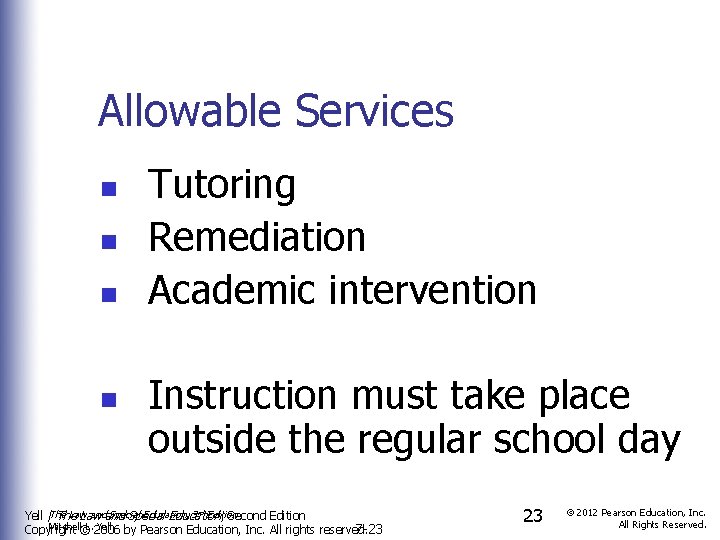
Allowable Services n n Tutoring Remediation Academic intervention Instruction must take place outside the regular school day The Law andand Special Education, 3 rd Edition Yell / The Law Special Education , Second Edition Mitchell L. Yell 7 -23 Copyright © 2006 by Pearson Education, Inc. All rights reserved. 23 © 2012 Pearson Education, Inc. All Rights Reserved.
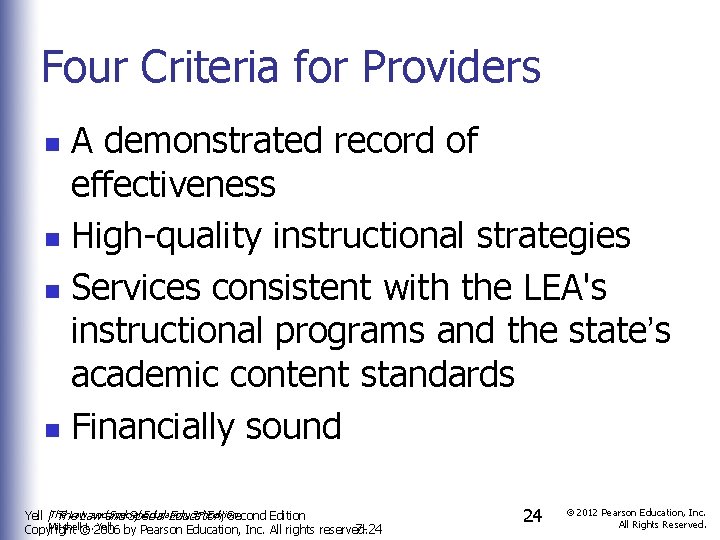
Four Criteria for Providers A demonstrated record of effectiveness n High-quality instructional strategies n Services consistent with the LEA's instructional programs and the state’s academic content standards n Financially sound n The Law andand Special Education, 3 rd Edition Yell / The Law Special Education , Second Edition Mitchell L. Yell 7 -24 Copyright © 2006 by Pearson Education, Inc. All rights reserved. 24 © 2012 Pearson Education, Inc. All Rights Reserved.
Provider Profile School or LEA n Institution of higher education n Educational service agency n Nonprofit or for-profit entity n Faith-based organization n The Law andand Special Education, 3 rd Edition Yell / The Law Special Education , Second Edition Mitchell L. Yell 7 -25 Copyright © 2006 by Pearson Education, Inc. All rights reserved. 25 © 2012 Pearson Education, Inc. All Rights Reserved.
Responsibilities of the Provider n n n Set specific achievement goals for the student Describe how the student’s progress will be measured Establish a timetable for improving the student’s achievement The Law andand Special Education, 3 rd Edition Yell / The Law Special Education , Second Edition Mitchell L. Yell 7 -26 Copyright © 2006 by Pearson Education, Inc. All rights reserved. 26 © 2012 Pearson Education, Inc. All Rights Reserved.
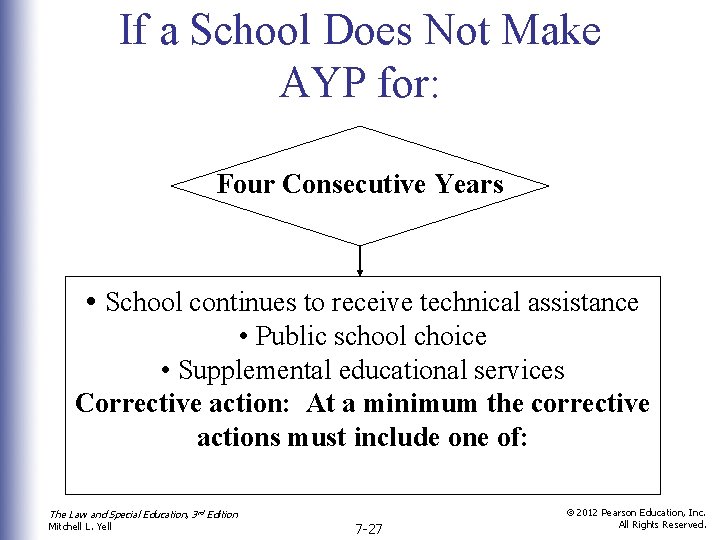
If a School Does Not Make AYP for: Four Consecutive Years • School continues to receive technical assistance • Public school choice • Supplemental educational services Corrective action: At a minimum the corrective actions must include one of: The Law and Special Education, 3 rd Edition Mitchell L. Yell 7 -27 © 2012 Pearson Education, Inc. All Rights Reserved.
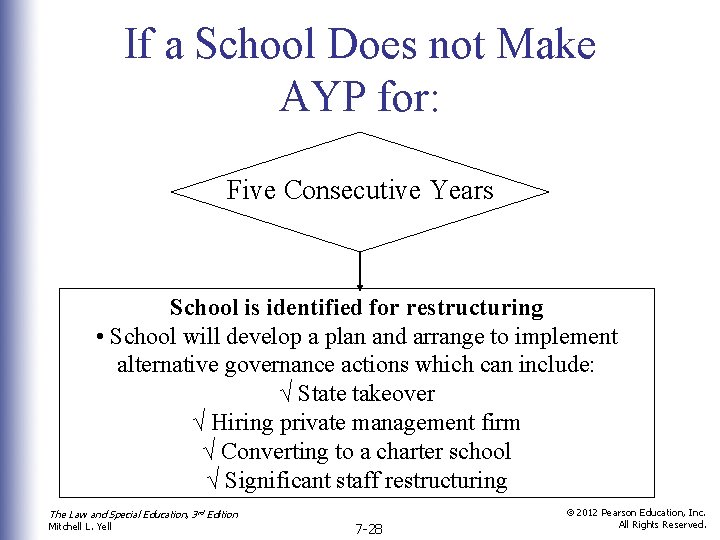
If a School Does not Make AYP for: Five Consecutive Years School is identified for restructuring • School will develop a plan and arrange to implement alternative governance actions which can include: √ State takeover √ Hiring private management firm √ Converting to a charter school √ Significant staff restructuring The Law and Special Education, 3 rd Edition Mitchell L. Yell 7 -28 © 2012 Pearson Education, Inc. All Rights Reserved.
Possible Corrective Actions n n n Replace school staff relevant to the failure Institute and implement a new curriculum Significantly decrease management authority in the school Appoint outside experts to advise the school Extend school year or school day Restructure internal organization of the school The Law and Special Education, 3 rd Edition Mitchell L. Yell 7 -29 © 2012 Pearson Education, Inc. All Rights Reserved.
Restructuring · If a school fails to make AYP after one full year of corrective action, the district must: Ø Continue to make public school choice available Ø Continue to make supplemental services available Ø Prepare a plan to restructure the school The Law and Special Education, 3 rd Edition Mitchell L. Yell 7 -30 © 2012 Pearson Education, Inc. All Rights Reserved.
Restructuring, continued n By the beginning of the next school year, the district must implement one of the following alternative governance arrangements: Ø Ø Ø Reopen school as a public charter school Replace all or most of school staff, including the principal Enter into a contract with an entity, such as a private management company, with a demonstrated record of effectiveness to operate the school State takeover Any other major restructuring of the school’s governance arrangement The Law and Special Education, 3 rd Edition Mitchell L. Yell 7 -31 © 2012 Pearson Education, Inc. All Rights Reserved.
Exiting School Improvement If a school identified for improvement, corrective action, or restructuring makes AYP for 2 consecutive years, the school is no longer subject to improvement. The Law and Special Education, 3 rd Edition Mitchell L. Yell 7 -32 © 2012 Pearson Education, Inc. All Rights Reserved.
Scientifically Based Research “…means research that involves the application of rigorous, systematic, and objective procedures to obtain reliable and valid knowledge relevant to education activities and programs” (No Child Left Behind Act of 2001) The Law and Special Education, 3 rd Edition Mitchell L. Yell 7 -33 © 2012 Pearson Education, Inc. All Rights Reserved.
Scientifically Based Instruction n According to NCLB, schools have too often relied on programs and practices based on fad, fancy, and personal bias at the expense of students NCLB, therefore, emphasizes using educational programs that have been demonstrated to be effective by rigorous scientific research All professional development activities and use of funds must be grounded in scientifically based research and must focus on improving student academic achievement The Law and Special Education, 3 rd Edition Mitchell L. Yell 7 -34 © 2012 Pearson Education, Inc. All Rights Reserved.
Reading First n n n Part B of Title 1 is titled Student Reading Skills Improvement Grants This section contains the Reading First initiative Reading First focuses on: n n n focuses on reading instruction that is supported by scientifically based reading research provides a large amount of money that states can receive to provide training to teachers and to implement professional development activities emphasizes early identification of children at risk for reading failure so that effective early instruction can be provided The Law and Special Education, 3 rd Edition Mitchell L. Yell 7 -35 © 2012 Pearson Education, Inc. All Rights Reserved.
Reading Instruction n n Research clearly identifies the critical skills that young children need to learn if they are to become good readers (National Reading Panel, 2000) The 5 essential components of effective reading instruction n n Phonemic awareness Phonics Vocabulary development Reading fluency Reading comprehension The Law and Special Education, 3 rd Edition Mitchell L. Yell 7 -36 © 2012 Pearson Education, Inc. All Rights Reserved.
Highly Qualified Teachers NCLB requires that all public school teachers had be highly qualified by the 2005 -2006 school year The Law and Special Education, 3 rd Edition Mitchell L. Yell 7 -37 © 2012 Pearson Education, Inc. All Rights Reserved.
Three Components of HQ 1. Education (minimum of bachelor’s) 2. Certification (full state, no waivers) 3. Competence (demonstrated) The Law and Special Education, 3 rd Edition Mitchell L. Yell 7 -38 © 2012 Pearson Education, Inc. All Rights Reserved.
Highly Qualified Elementary Teachers A teacher who has demonstrated subject knowledge and teaching skills in reading, writing, mathematics, and other areas of the basic elementary school curriculum by passing a rigorous state test (which may consist of passing a state-required certification or passing a licensing test or tests in reading, writing, mathematics, and other areas of basic elementary school curriculum). The Law and Special Education, 3 rd Edition Mitchell L. Yell 7 -39 © 2012 Pearson Education, Inc. All Rights Reserved.
Highly Qualified Middle and Secondary School Teachers • a. b. A teacher has demonstrated a high level of competency in each of the academic subjects in which the teacher teaches by: Passing a rigorous state academic subject test in each of the academic subjects in which the teacher teaches; or Successful completion, in each of the academic subjects in which the teacher teaches, of an academic major, a graduate degree, coursework equivalent to an undergraduate academic major, or advanced certification or credentialing The Law and Special Education, 3 rd Edition Mitchell L. Yell 7 -40 © 2012 Pearson Education, Inc. All Rights Reserved.
Highly Qualified Special Education Teachers n n n In IDEA 2004, Congress recognized that special education teachers need both content knowledge and training in teaching special education students IDEA’s definitions of highly qualified special education teachers work in concert with NCLB to ensure that children with disabilities are taught by highly qualified teachers All special education teachers must be highly qualified by the 2005 -2006 school year The Law and Special Education, 3 rd Edition Mitchell L. Yell 7 -41 © 2012 Pearson Education, Inc. All Rights Reserved.
HQ Special Education Teachers Bachelor’s degree or higher State certification (including state-approved alternative certification) with no waivers Competency (SC example) 1. 2. 3. a. b. c. Resource room—No testing requirements if the resource room teacher is not considered the teacher of record, otherwise Elementary Praxis II Self-contained—Elementary Praxis II (content area or curriculum instruction and assessment) SC HOUSSE (observations by teachers trained in the standards) The Law and Special Education, 3 rd Edition Mitchell L. Yell 7 -42 © 2012 Pearson Education, Inc. All Rights Reserved.
Highly Qualified Teachers Annual Measurable Objectives Ø LEAs must demonstrate increases in the percentage of highly qualified teachers teaching core subjects ØLEAs must demonstrate annual increases in teachers receiving highquality professional development The Law and Special Education, 3 rd Edition Mitchell L. Yell 7 -43 © 2012 Pearson Education, Inc. All Rights Reserved.
Professional Development Ø Ø Ø Providing high-quality professional development Developing programs designed to improve the quality of the teaching Building instructional leadership development programs for principals and superintendents Providing training on utilizing data and assessments to improve classroom instruction and student learning Providing training in effective methods to teach and address the needs of students with different learning styles and abilities The Law and Special Education, 3 rd Edition Mitchell L. Yell 7 -44 © 2012 Pearson Education, Inc. All Rights Reserved.
The Reauthorization of ESEA n n Priority 1: Implementing college- and career-ready standards and developing improved assessments aligned with those standards Priority 2: Improving teacher and principal effectiveness to ensure that every classroom has a great teacher and every school has a great leader Priority 3: Providing information to families to help them evaluate and improve their children’s schools and to educators to help them improve their students’ learning Priority 4: improving student learning and achievement in the lowest- performing U. S. schools by providing intensive support and effective interventions The Law and Special Education, 3 rd Edition Mitchell L. Yell 7 -45 © 2012 Pearson Education, Inc. All Rights Reserved.