
Chapter 7 The 2 nd Generation Cellular Systems























- Slides: 62
Chapter 7 The 2 nd Generation Cellular Systems North American Cellular System Based on TDMA (NA-TDMA) Prof. Huei-Wen Ferng
Background and Goals n n n Cellular phones entered commercial service in NA in 1983 AMPS: the first generation of cellular system (Analog) Three ways to expand the capacity of a cellular system: n n n Move into new spectrum bands Split existing cells into smaller cells by installing new BSs Propose new technology to make more efficient use of existing BW and BSs 10/22/2021 Prof. Huei-Wen Ferng 2
Background and Goals n The main goals of 2 G cellular systems: n n n Provide new modulation technologies such as TDMA, FDMA, and CDMA Enhance network security Support hand-held, portable terminal with selfcontained power supplies IS-54 was created after GSM, it support dual mode access capability (analog and digital transmission) IS-136 is a revised version of IS-54. NA-TDMA is specified in IS-136 10/22/2021 Prof. Huei-Wen Ferng 3
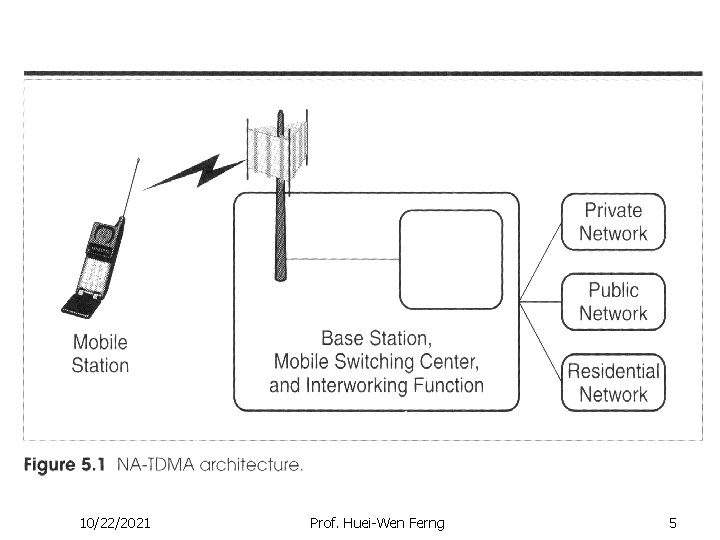
Architecture n n n NA-TDMA is an extension of AMPS IS-136 systems are capable of operating with AMPS terminals, dual mode terminals, and alldigital terminals NA-TDMA specifies three types of external network: n n n Public systems: terminal as a cellular phone Residential systems: terminal as a cordless phone Private systems: terminal as a business phone 10/22/2021 Prof. Huei-Wen Ferng 4
10/22/2021 Prof. Huei-Wen Ferng 5
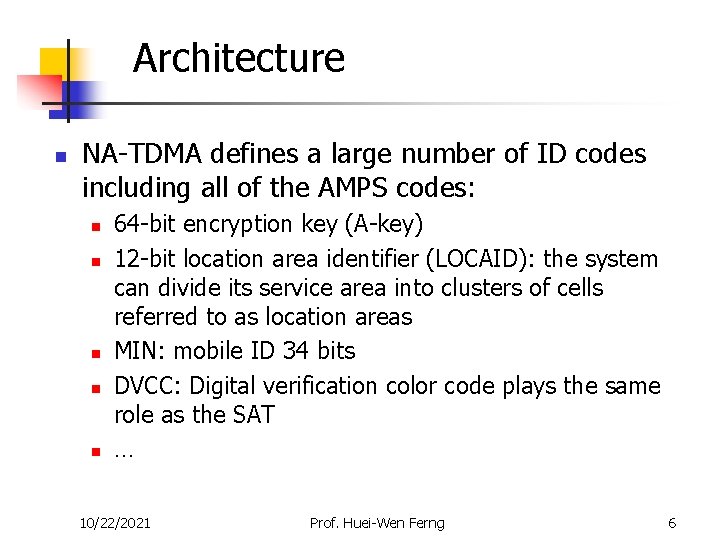
Architecture n NA-TDMA defines a large number of ID codes including all of the AMPS codes: n n n 64 -bit encryption key (A-key) 12 -bit location area identifier (LOCAID): the system can divide its service area into clusters of cells referred to as location areas MIN: mobile ID 34 bits DVCC: Digital verification color code plays the same role as the SAT … 10/22/2021 Prof. Huei-Wen Ferng 6
10/22/2021 Prof. Huei-Wen Ferng 7
Radio Transmission n n IS-136 specifies dual mode NA-TDMA/AMPS operation in the AMPS frequency bands Each band of NA-TDMA specifies carriers spaced at 30 k. Hz. Each pair of NA-TDMA carriers corresponds to an AMPS channel The access technology conforms to the hybrid FDMA/TDMA Each frame contains six time slots and the frame duration is 40 ms The length of each time slot is 6. 67 ms 10/22/2021 Prof. Huei-Wen Ferng 8
10/22/2021 Prof. Huei-Wen Ferng 9
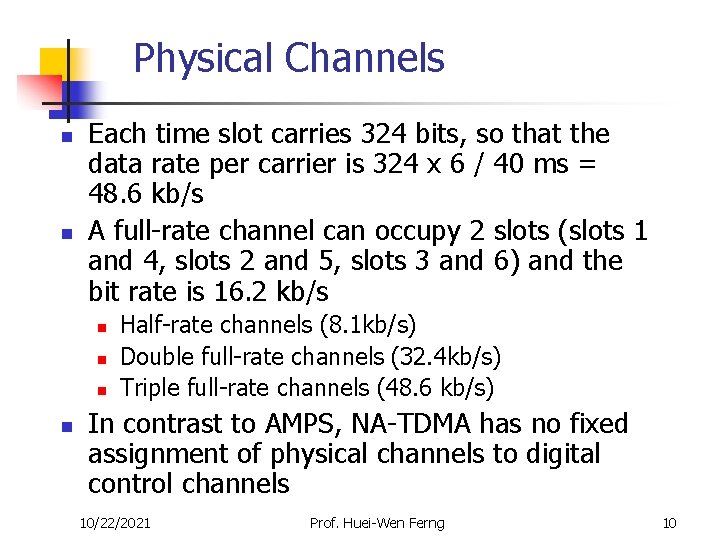
Physical Channels n n Each time slot carries 324 bits, so that the data rate per carrier is 324 x 6 / 40 ms = 48. 6 kb/s A full-rate channel can occupy 2 slots (slots 1 and 4, slots 2 and 5, slots 3 and 6) and the bit rate is 16. 2 kb/s n n Half-rate channels (8. 1 kb/s) Double full-rate channels (32. 4 kb/s) Triple full-rate channels (48. 6 kb/s) In contrast to AMPS, NA-TDMA has no fixed assignment of physical channels to digital control channels 10/22/2021 Prof. Huei-Wen Ferng 10
10/22/2021 Prof. Huei-Wen Ferng 11
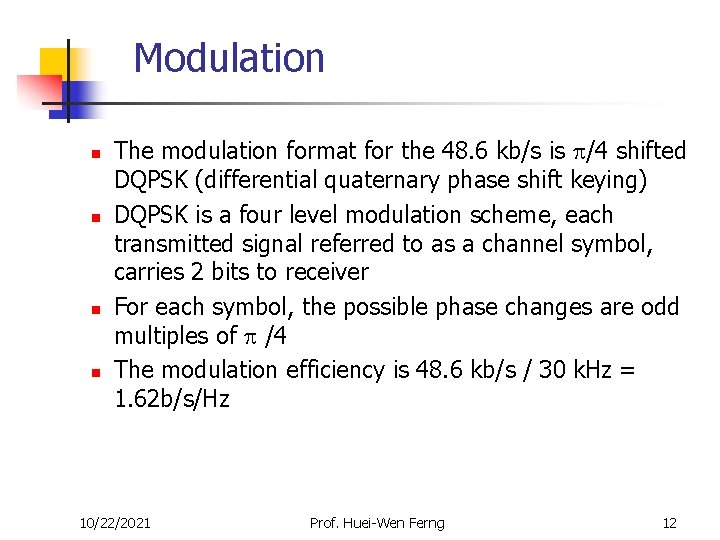
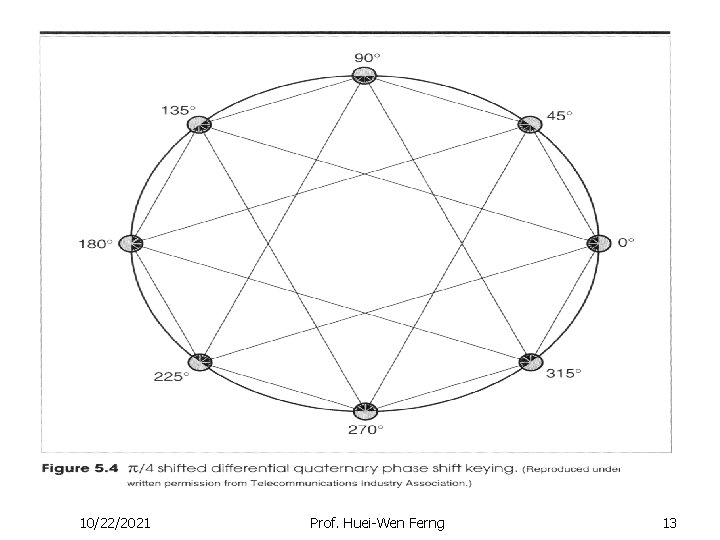
Modulation n n The modulation format for the 48. 6 kb/s is /4 shifted DQPSK (differential quaternary phase shift keying) DQPSK is a four level modulation scheme, each transmitted signal referred to as a channel symbol, carries 2 bits to receiver For each symbol, the possible phase changes are odd multiples of /4 The modulation efficiency is 48. 6 kb/s / 30 k. Hz = 1. 62 b/s/Hz 10/22/2021 Prof. Huei-Wen Ferng 12
10/22/2021 Prof. Huei-Wen Ferng 13
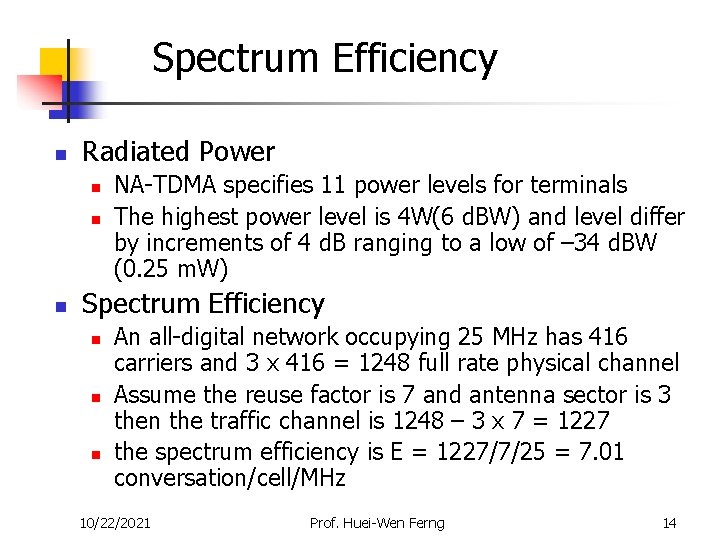
Spectrum Efficiency n Radiated Power n n n NA-TDMA specifies 11 power levels for terminals The highest power level is 4 W(6 d. BW) and level differ by increments of 4 d. B ranging to a low of – 34 d. BW (0. 25 m. W) Spectrum Efficiency n n n An all-digital network occupying 25 MHz has 416 carriers and 3 x 416 = 1248 full rate physical channel Assume the reuse factor is 7 and antenna sector is 3 then the traffic channel is 1248 – 3 x 7 = 1227 the spectrum efficiency is E = 1227/7/25 = 7. 01 conversation/cell/MHz 10/22/2021 Prof. Huei-Wen Ferng 14
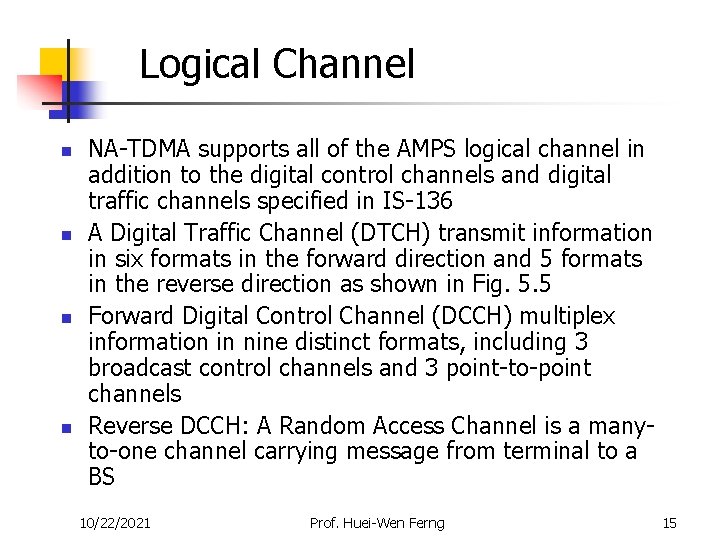
Logical Channel n n NA-TDMA supports all of the AMPS logical channel in addition to the digital control channels and digital traffic channels specified in IS-136 A Digital Traffic Channel (DTCH) transmit information in six formats in the forward direction and 5 formats in the reverse direction as shown in Fig. 5. 5 Forward Digital Control Channel (DCCH) multiplex information in nine distinct formats, including 3 broadcast control channels and 3 point-to-point channels Reverse DCCH: A Random Access Channel is a manyto-one channel carrying message from terminal to a BS 10/22/2021 Prof. Huei-Wen Ferng 15
10/22/2021 Prof. Huei-Wen Ferng 16
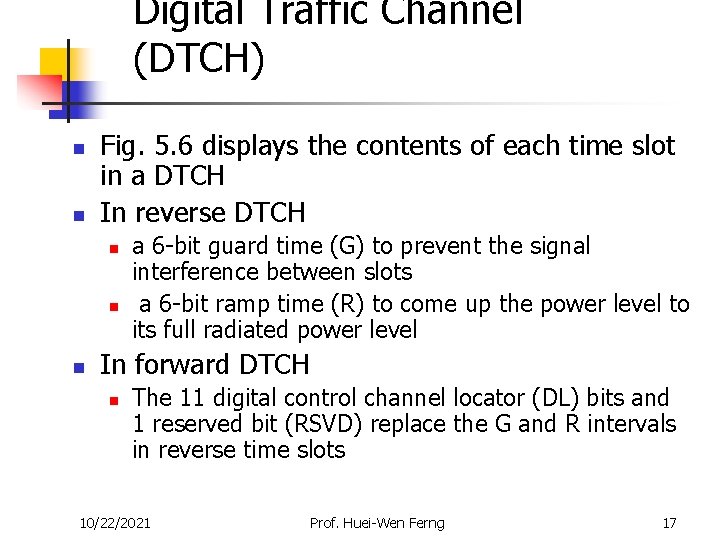
Digital Traffic Channel (DTCH) n n Fig. 5. 6 displays the contents of each time slot in a DTCH In reverse DTCH n n n a 6 -bit guard time (G) to prevent the signal interference between slots a 6 -bit ramp time (R) to come up the power level to its full radiated power level In forward DTCH n The 11 digital control channel locator (DL) bits and 1 reserved bit (RSVD) replace the G and R intervals in reverse time slots 10/22/2021 Prof. Huei-Wen Ferng 17
10/22/2021 Prof. Huei-Wen Ferng 18
10/22/2021 Prof. Huei-Wen Ferng 19
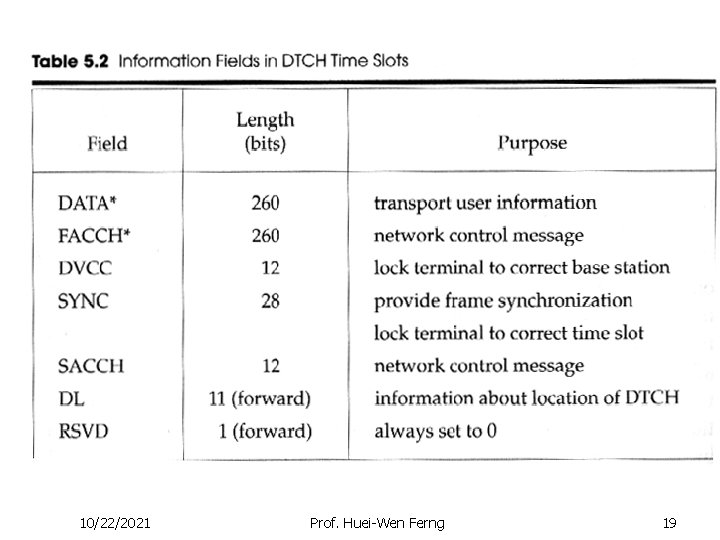
Digital Traffic Channel n Synchronization Bits (28 bits) n n It serves two purposes: to synchronize and to train an adaptive equalizer Six different 28 -bit SYNC sequences, one assigned to each time slot During a call, BS transmits a time-alignment parameters to specific terminals. A terminal uses this information to adjust the timing offset to correspond to the location of the terminal in a cell An adaptive equalizer in the receiver examines the received waveform in the SYNC field and compares it with the known transmitted waveform 10/22/2021 Prof. Huei-Wen Ferng 20
Digital Traffic Channel n Digital Verification Color Code (DVCC) n n The DVCC verifies mobile and BSs that they are receiving signals which is not sent from another cell using the same physical channel Each DVCC is represented by an 8 -bit word with (12, 8: 3) error correcting block code 10/22/2021 Prof. Huei-Wen Ferng 21
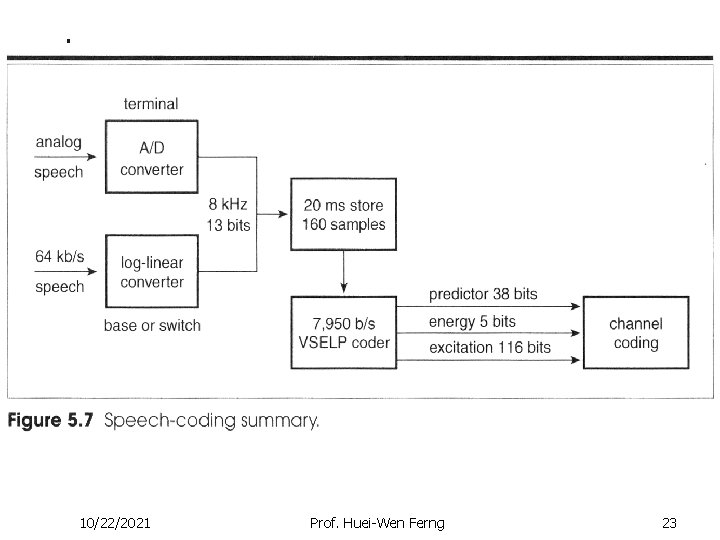
Digital Traffic Channel n User information and speech coding 10/22/2021 Prof. Huei-Wen Ferng 22
10/22/2021 Prof. Huei-Wen Ferng 23
10/22/2021 Prof. Huei-Wen Ferng 24
10/22/2021 Prof. Huei-Wen Ferng 25
10/22/2021 Prof. Huei-Wen Ferng 26
10/22/2021 Prof. Huei-Wen Ferng 27
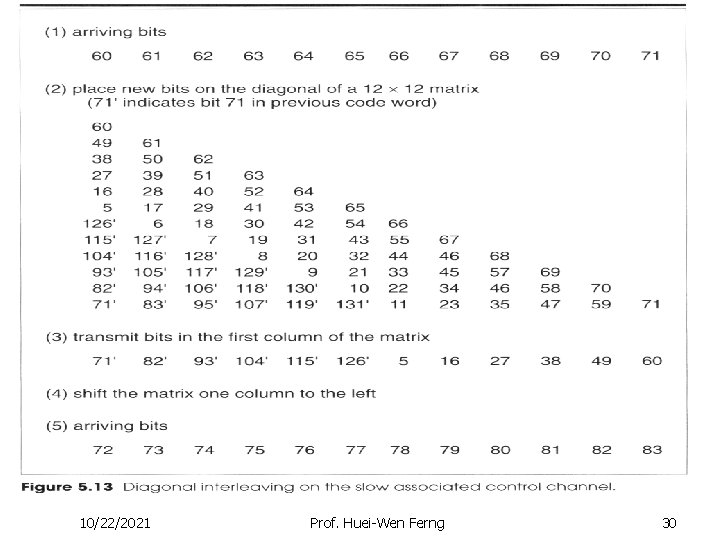
Digital Traffic Channel n Slow Associated Control Channel (SACCH) n n n an out-of-band signaling channel the bit rate is 2 x 12 / 0. 04 = 600 b/s in a full-rate physical channel 132 bits (11 time slots) comprise a code word The code word contains a 50 -bit network control message protected by a 16 bit CRC Use a diagonal interleave to spread the 132 bits over 12 transmission time slots 10/22/2021 Prof. Huei-Wen Ferng 28
10/22/2021 Prof. Huei-Wen Ferng 29
10/22/2021 Prof. Huei-Wen Ferng 30
Digital Traffic Channel n Digital Control Channel Locator (DL) n n It indicates the location of a carrier that presently contains a DCCH The 11 -bit DL field contains a 7 -bit digital locator value protected by an (11, 7; 3) error-correcting code 10/22/2021 Prof. Huei-Wen Ferng 31
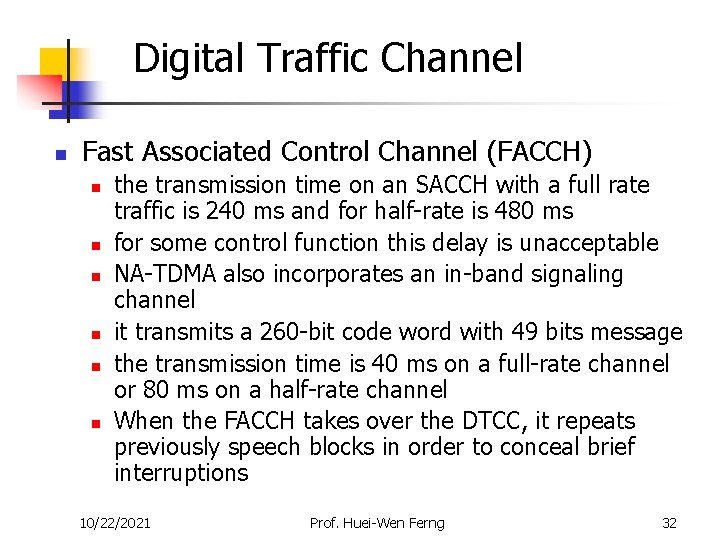
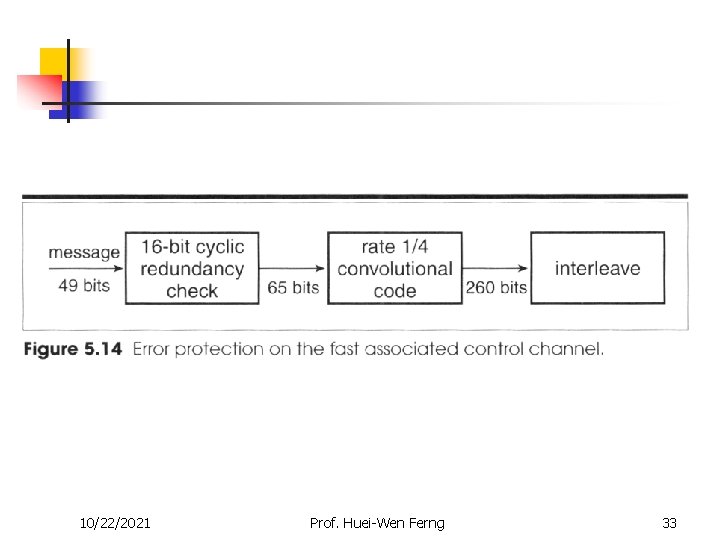
Digital Traffic Channel n Fast Associated Control Channel (FACCH) n n n the transmission time on an SACCH with a full rate traffic is 240 ms and for half-rate is 480 ms for some control function this delay is unacceptable NA-TDMA also incorporates an in-band signaling channel it transmits a 260 -bit code word with 49 bits message the transmission time is 40 ms on a full-rate channel or 80 ms on a half-rate channel When the FACCH takes over the DTCC, it repeats previously speech blocks in order to conceal brief interruptions 10/22/2021 Prof. Huei-Wen Ferng 32
10/22/2021 Prof. Huei-Wen Ferng 33
Digital Control Channel n Digital Control Channel (DCCH) n n Block = 3 Slots = 20 ms Superframe = 32 blocks = 0. 64 sec Hyperframe = 2 superframes = 1. 28 sec The structure of each DCCH time slot n In the reverse time slot, there are 40 bits of additional sync information relative to the DTCH n n 10/22/2021 16 -bit preamble that replace the 16 data bits of DTCH 24 bits SYNC + replaces the DVCC and SACCH of a reverse DTCH Prof. Huei-Wen Ferng 34
10/22/2021 Prof. Huei-Wen Ferng 35
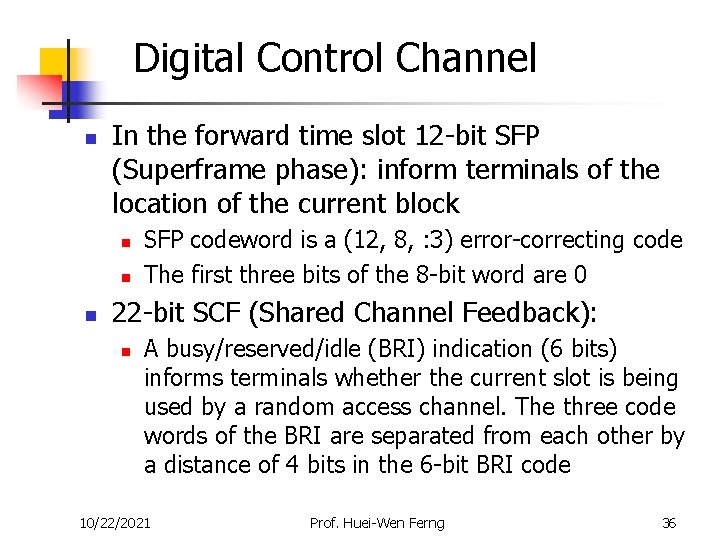
Digital Control Channel n In the forward time slot 12 -bit SFP (Superframe phase): inform terminals of the location of the current block n n n SFP codeword is a (12, 8, : 3) error-correcting code The first three bits of the 8 -bit word are 0 22 -bit SCF (Shared Channel Feedback): n A busy/reserved/idle (BRI) indication (6 bits) informs terminals whether the current slot is being used by a random access channel. The three code words of the BRI are separated from each other by a distance of 4 bits in the 6 -bit BRI code 10/22/2021 Prof. Huei-Wen Ferng 36
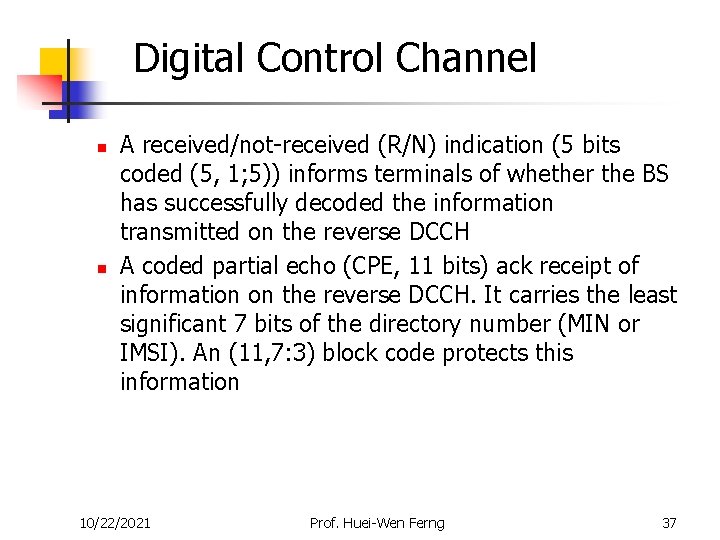
Digital Control Channel n n A received/not-received (R/N) indication (5 bits coded (5, 1; 5)) informs terminals of whether the BS has successfully decoded the information transmitted on the reverse DCCH A coded partial echo (CPE, 11 bits) ack receipt of information on the reverse DCCH. It carries the least significant 7 bits of the directory number (MIN or IMSI). An (11, 7: 3) block code protects this information 10/22/2021 Prof. Huei-Wen Ferng 37
Digital Control Channel n Multiplexed Logical Channels on the Forward DCCH n n n Fast broadcast control channel (F-BCCH) Extended broadcast control channel (E-BCCH) Short message service broadcast control channel (SBCCH) Short message service, paging, and access response channel (SPACH) Each superframe begins with the F-BCCH and ends with SPACH 10/22/2021 Prof. Huei-Wen Ferng 38
Digital Control Channel 10/22/2021 Prof. Huei-Wen Ferng 39
Digital Control Channel n Paging Channel Operation, Sleep Mode n n n Paging consumes the terminal power NA-TDMA makes it possible for terminal to recognize paging in sleep mode Paging message are always transmitted twice, once in each superframe of a hyperframe Paging message arrive in the SPACH blocks of each superframe the number of paging subchannels is a parameter, PFN, range from 1 to 96 10/22/2021 Prof. Huei-Wen Ferng 40
Digital Control Channel n n n With PFN = 1, there is only one paging subchannel that occupies all hyperframes With PFN =96, a subchannel appears once in 96 hyperframes Each terminal listen to a specific paging subchannel, it sleep PFN – 1 paging subchannel There is a hyperframe counter in the BCCH that informs terminals of the current paging subchannel Each terminal listen to an assigned subchannel which is determined by a hashing function with MIN 10/22/2021 Prof. Huei-Wen Ferng 41
Reverse Digital Control Channel n RACH Access Protocol n n There are two modes of transmission on the RACH, random access and reserved access In the random access mode: n Terminal waits for an IDLE indication in the BRI bits of a forward DCCH time slot. The terminal then transmits information in a specified slot of the reverse DCCH. The BS will report the result of this transmission after 120 ms 10/22/2021 Prof. Huei-Wen Ferng 42
Reverse Digital Control Channel n n n The BS indicates a successful result by means of a BUSY indication in the BRI bits, a RECEIVED indication in the R/N bits, and the final 7 bits of the mobile ID in the coded partial echo (CPE) Failing to receive a successful indication, the terminal waits a random time then try again In the reserved mode, the BS prompts the terminal for a transmission by means of a RESERVED indication in the BRI bits and the last 7 bits of the mobile ID in the CPE portion of the SCF 10/22/2021 Prof. Huei-Wen Ferng 43
Digital Control Channels n Data Fields of the DCCH n n Variable length header Variable length information (260, 244, 200) 16 -bit CRC 5 tail bits 10/22/2021 Prof. Huei-Wen Ferng 44
10/22/2021 Prof. Huei-Wen Ferng 45
Messages n Three sets of messages: n n n Messages transmitted on AMPS logical channels. ->Tab 5. 4 Messages transmitted on the in-band (FACCH) and out-of-band (SACCH) signaling channels. ->Tab 5. 5 Messages transmitted on the digital control channels. ->Tab 5. 7 10/22/2021 Prof. Huei-Wen Ferng 46
Network Operations n Relative to AMPS, the principle innovations in NA-TDMA are authentication and handoff 10/22/2021 Prof. Huei-Wen Ferng 47
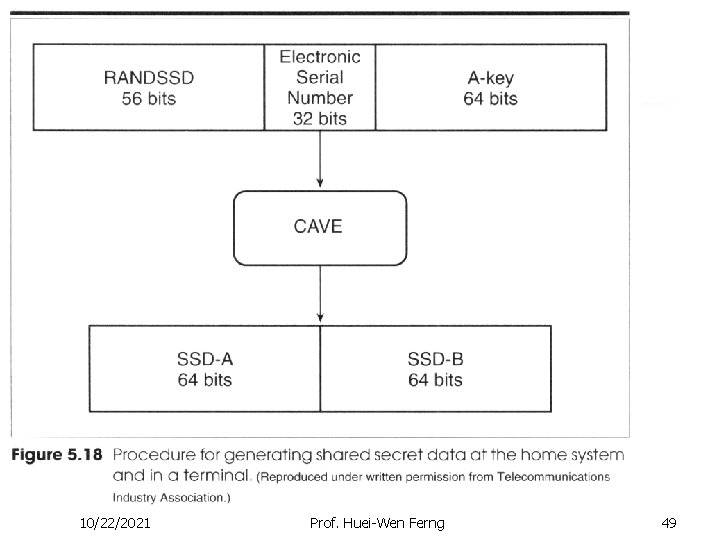
Authentication and Privacy n n A secret key (A-key: 64 bits) is stored in each cellular phone The key is also recorded in the subscriber’s home system in a secure database (authentication center) A shared secret data (SSD: 128 bits) is generated from a 56 -bit random number, a 32 bit ESN, and A-key. The system uses half SSD (SSD-A: 64 bits) for authentication purpose and the other 64 bits (SSD-B) as an encryption key 10/22/2021 Prof. Huei-Wen Ferng 48
10/22/2021 Prof. Huei-Wen Ferng 49
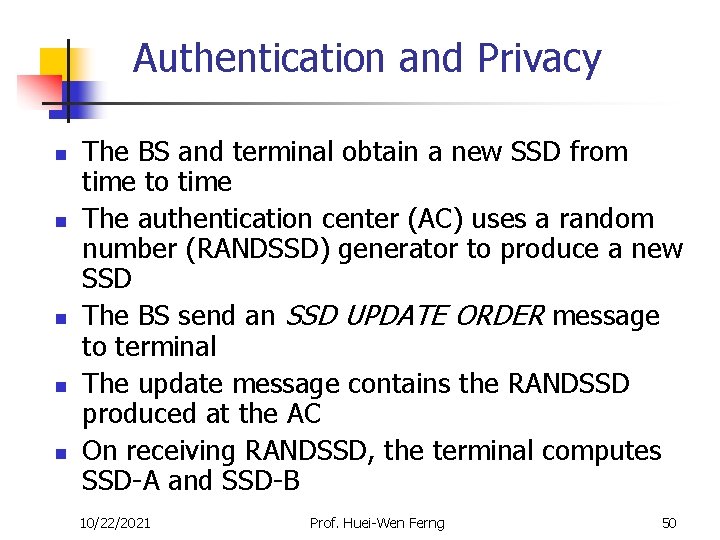
Authentication and Privacy n n n The BS and terminal obtain a new SSD from time to time The authentication center (AC) uses a random number (RANDSSD) generator to produce a new SSD The BS send an SSD UPDATE ORDER message to terminal The update message contains the RANDSSD produced at the AC On receiving RANDSSD, the terminal computes SSD-A and SSD-B 10/22/2021 Prof. Huei-Wen Ferng 50
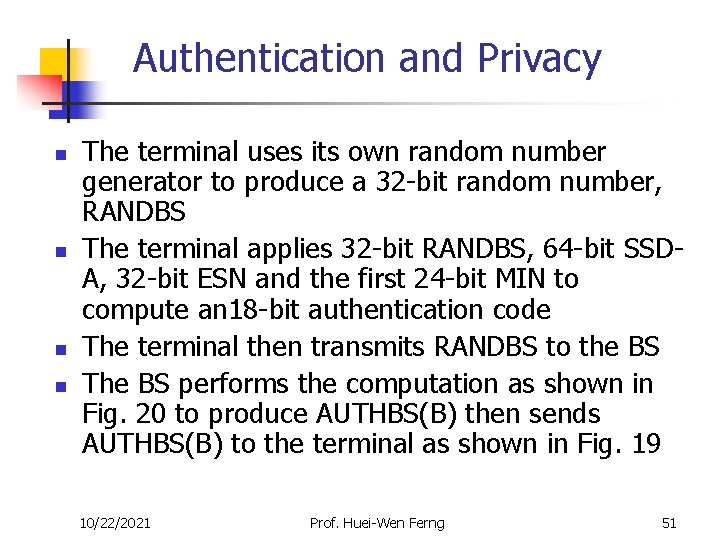
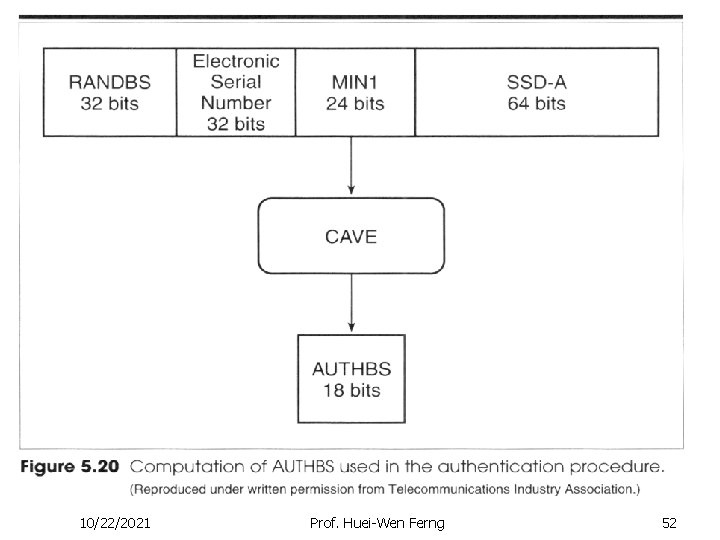
Authentication and Privacy n n The terminal uses its own random number generator to produce a 32 -bit random number, RANDBS The terminal applies 32 -bit RANDBS, 64 -bit SSDA, 32 -bit ESN and the first 24 -bit MIN to compute an 18 -bit authentication code The terminal then transmits RANDBS to the BS The BS performs the computation as shown in Fig. 20 to produce AUTHBS(B) then sends AUTHBS(B) to the terminal as shown in Fig. 19 10/22/2021 Prof. Huei-Wen Ferng 51
10/22/2021 Prof. Huei-Wen Ferng 52
10/22/2021 Prof. Huei-Wen Ferng 53
Authentication and Privacy n n Note that, neither the A-key nor the SSD appears in radio messages The same procedure can be used to generate AUTHR and AUTHU to verify the authenticity of a terminal n n Terminal can get a random number RAND from the FOCC or ACCESS PARAMETERS message on the digital broadcast control channel Terminal uses RAND, ESN, MIN, and SSD-A to produce AUTHUR code and transfers this code to BS to verify the id of the terminal 10/22/2021 Prof. Huei-Wen Ferng 54
Authentication and Privacy n n At any time, BS can send a message with a random number RANDU to a terminal The terminal uses RANDU, SSD-A, ESN, and MIN to produce an AUTHU code then sends this code to BS to verify itself 10/22/2021 Prof. Huei-Wen Ferng 55
Mobile-Assisted Handoff (MAHO) n n n NA-TDMA provides four types of handoff: analog to analog, analog to digital, digital to analog, and digital to digital Terminal measures the quality of the signal on the active traffic channel with a call in progress Terminal also measures the signal strength received from surrounding BSs when it is not required to send or receive information on the traffic channel 10/22/2021 Prof. Huei-Wen Ferng 56
Mobile-Assisted Handoff n n Each terminal reports its measurements to its own BS in CHANNEL QUALITY message on the SACCH The terminal performs two measurements on the active traffic channel n n n BER (3 bits): the binary error rate RSSI (5 bits): received signal strength indication With 6 surrounding channels measured, the time between measurement report is 240 ms in fullrate which is used to transfer 132 bits 10/22/2021 Prof. Huei-Wen Ferng 57
Mobile-Assisted Handoff n MAHO provides the following advantages over the centralized handoff procedures in AMPS n n MAHO monitors the signal received at the terminal and BS (AMPS only BS) MAHO responds more promptly to signal quality problem (AMPS begins to search new BS after signal level falls below a programmed threshold) MAHO provides BER estimate and signal-strength estimates MAHO moves some information control from switch to BSs and terminals (In AMPS, a switch handles on the order 5, 000 simultaneous calls -> bottleneck) 10/22/2021 Prof. Huei-Wen Ferng 58
Mobile-Assisted Handoff n Mobile-assisted channel allocation (MACA): n n n The BCCH transmits a MACA messages to terminals in a cell The message contains a list of idle channels available for new calls Terminals tune to these channels and perform signalstrength measurements and send the measurements to the BS through RACH The system uses these measurements to assign an appropriate channel to a conversation The aim of the channel assignment is to maximize capacity and minimize mutual interference 10/22/2021 Prof. Huei-Wen Ferng 59
Mobility Management n n n NA-TDMA borrows from GSM technology to provide for registration based on location areas When a terminal enters a new location area, it sends a REGISTRATION message to the local BS The system pages the terminal only in the location area where it last registered BS can transmit its LOCAID (12 -bit) on the BCCH or FOCC The terminal compares this LOCAID with the stored LOCAID of the previous BS to distinguish whether it enter a new location area or not 10/22/2021 Prof. Huei-Wen Ferng 60
Status of NA-TDMA n n n Dual-mode NA-TDMA began service in 1992 In addition to telephone service, the services include short message service, notification of voice mail, and caller identification The operating frequency is 1900 MHz but with dual-band terminal the operating frequencies are 850 MHz and 1900 MHz 10/22/2021 Prof. Huei-Wen Ferng 61
References n D. J. Goodman “Wireless Personal Communications Systems, ” Chapter 5. 10/22/2021 Prof. Huei-Wen Ferng 62