
Chapter 7 Synchronization Examples Operating System Concepts 10
![Dining-Philosophers Problem Algorithm n The structure of Philosopher i: do { wait (chopstick[i] );](https://slidetodoc.com/presentation_image_h2/d9d01c7b3311f543fe07f28b99aa2380/image-12.jpg "Dining-Philosophers Problem Algorithm n The structure of Philosopher i: do { wait (chopstick[i] );")
- Slides: 26
Chapter 7: Synchronization Examples Operating System Concepts – 10 th Edition Silberschatz, Galvin and Gagne © 2018
Chapter 7: Synchronization Examples n n n Classic Problems of Synchronization within the Kernel POSIX Synchronization in Java Alternative Approaches Operating System Concepts – 10 th Edition 7. 2 Silberschatz, Galvin and Gagne © 2018
Classical Problems of Synchronization n Classical problems used to test newly-proposed synchronization schemes l Bounded-Buffer Problem l Readers and Writers Problem l Dining-Philosophers Problem Operating System Concepts – 10 th Edition 7. 3 Silberschatz, Galvin and Gagne © 2018
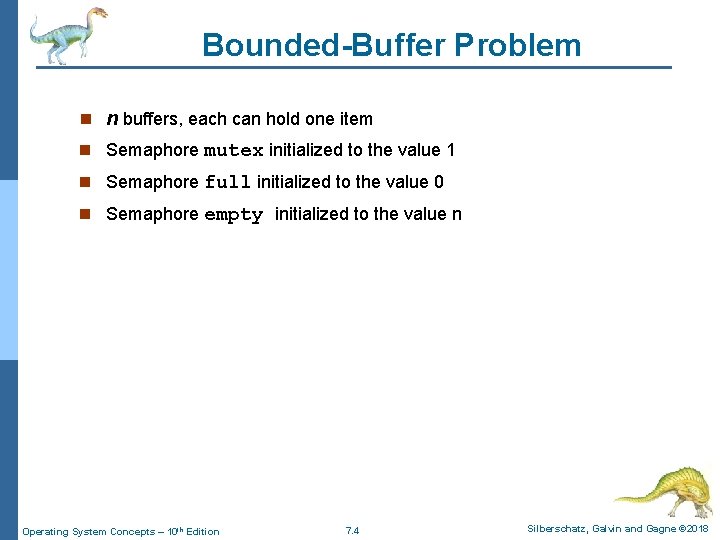
Bounded-Buffer Problem n n buffers, each can hold one item n Semaphore mutex initialized to the value 1 n Semaphore full initialized to the value 0 n Semaphore empty initialized to the value n Operating System Concepts – 10 th Edition 7. 4 Silberschatz, Galvin and Gagne © 2018
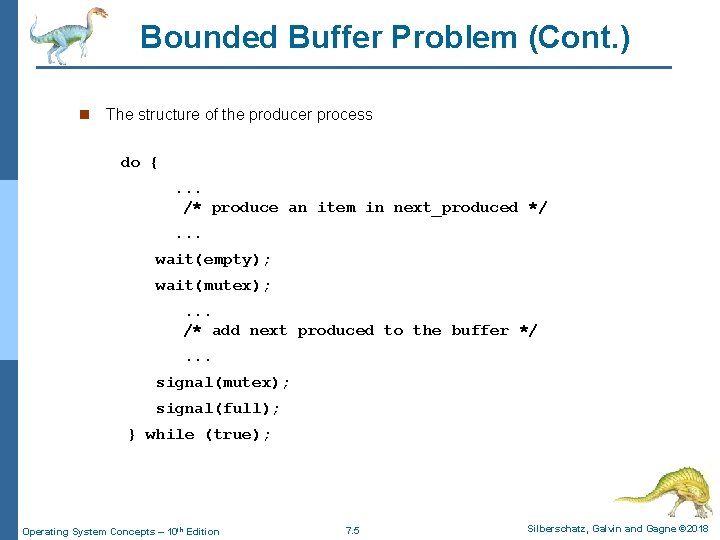
Bounded Buffer Problem (Cont. ) n The structure of the producer process do {. . . /* produce an item in next_produced */. . . wait(empty); wait(mutex); . . . /* add next produced to the buffer */. . . signal(mutex); signal(full); } while (true); Operating System Concepts – 10 th Edition 7. 5 Silberschatz, Galvin and Gagne © 2018
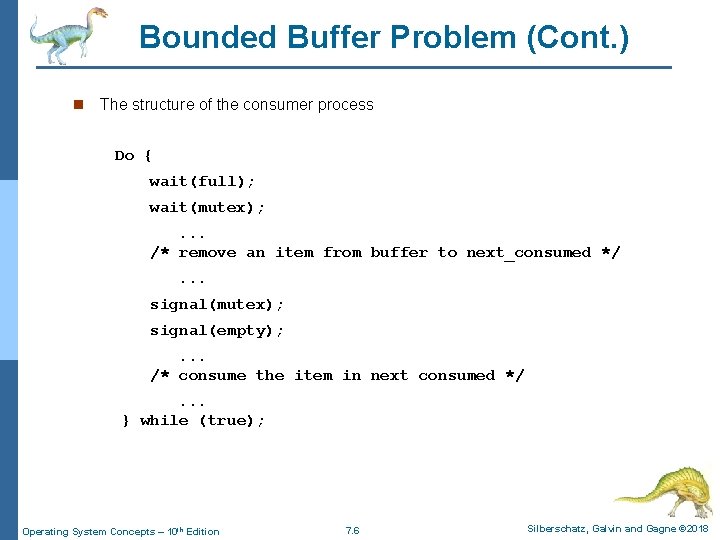
Bounded Buffer Problem (Cont. ) n The structure of the consumer process Do { wait(full); wait(mutex); . . . /* remove an item from buffer to next_consumed */. . . signal(mutex); signal(empty); . . . /* consume the item in next consumed */. . . } while (true); Operating System Concepts – 10 th Edition 7. 6 Silberschatz, Galvin and Gagne © 2018
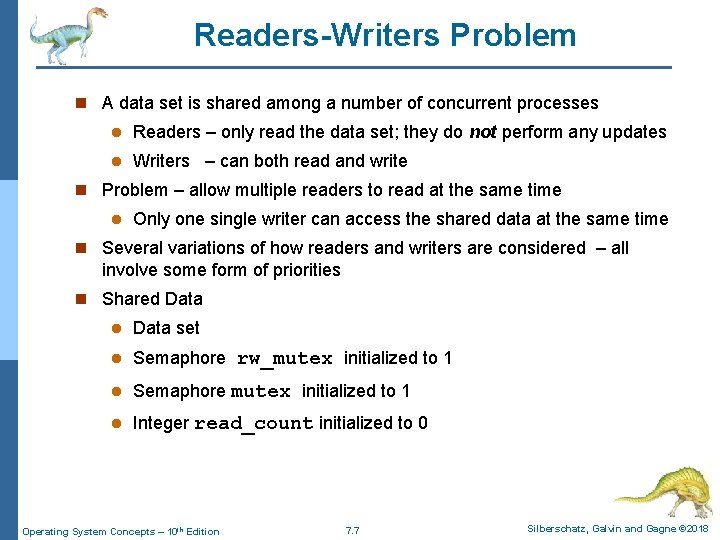
Readers-Writers Problem n A data set is shared among a number of concurrent processes l Readers – only read the data set; they do not perform any updates l Writers – can both read and write n Problem – allow multiple readers to read at the same time l Only one single writer can access the shared data at the same time n Several variations of how readers and writers are considered – all involve some form of priorities n Shared Data l Data set l Semaphore rw_mutex initialized to 1 l Semaphore mutex initialized to 1 l Integer read_count initialized to 0 Operating System Concepts – 10 th Edition 7. 7 Silberschatz, Galvin and Gagne © 2018
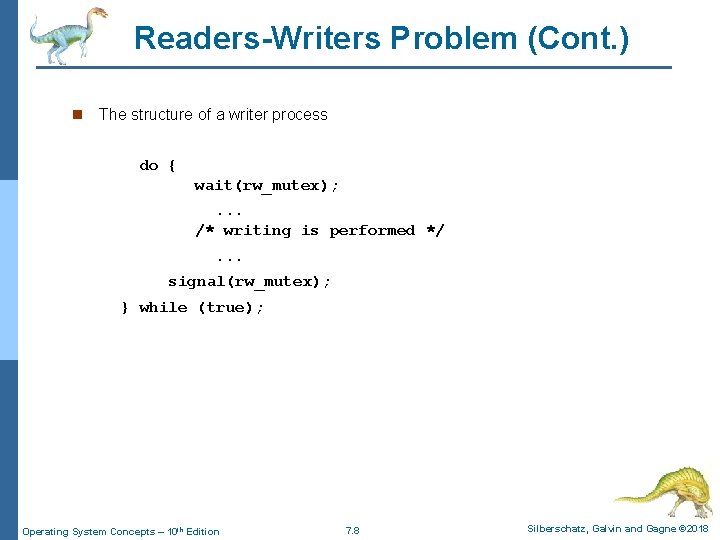
Readers-Writers Problem (Cont. ) n The structure of a writer process do { wait(rw_mutex); . . . /* writing is performed */. . . signal(rw_mutex); } while (true); Operating System Concepts – 10 th Edition 7. 8 Silberschatz, Galvin and Gagne © 2018
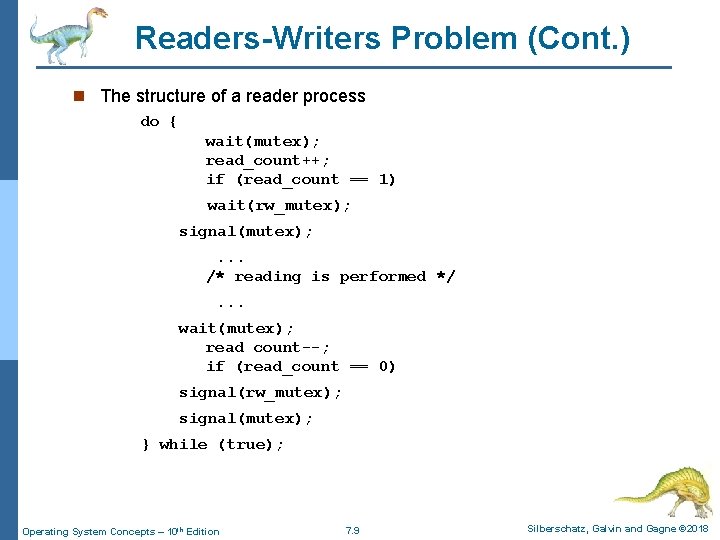
Readers-Writers Problem (Cont. ) n The structure of a reader process do { wait(mutex); read_count++; if (read_count == 1) wait(rw_mutex); signal(mutex); . . . /* reading is performed */. . . wait(mutex); read count--; if (read_count == 0) signal(rw_mutex); signal(mutex); } while (true); Operating System Concepts – 10 th Edition 7. 9 Silberschatz, Galvin and Gagne © 2018
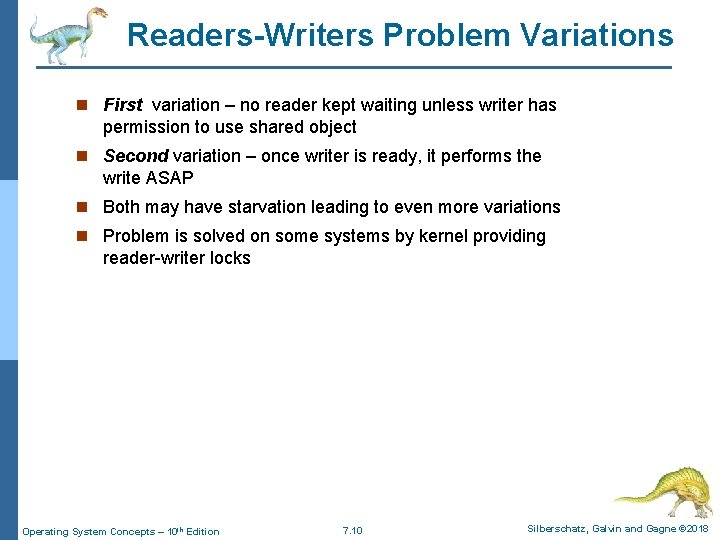
Readers-Writers Problem Variations n First variation – no reader kept waiting unless writer has permission to use shared object n Second variation – once writer is ready, it performs the write ASAP n Both may have starvation leading to even more variations n Problem is solved on some systems by kernel providing reader-writer locks Operating System Concepts – 10 th Edition 7. 10 Silberschatz, Galvin and Gagne © 2018
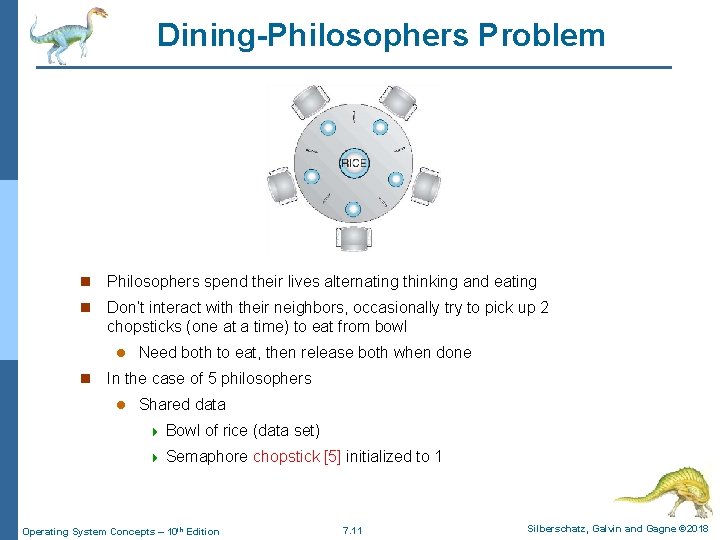
Dining-Philosophers Problem n Philosophers spend their lives alternating thinking and eating n Don’t interact with their neighbors, occasionally try to pick up 2 chopsticks (one at a time) to eat from bowl l n Need both to eat, then release both when done In the case of 5 philosophers l Shared data 4 Bowl of rice (data set) 4 Semaphore chopstick [5] initialized to 1 Operating System Concepts – 10 th Edition 7. 11 Silberschatz, Galvin and Gagne © 2018
Dining-Philosophers Problem Algorithm n The structure of Philosopher i: do { wait (chopstick[i] ); wait (chop. Stick[ (i + 1) % 5] ); // eat signal (chopstick[i] ); signal (chopstick[ (i + 1) % 5] ); // think } while (TRUE); n What is the problem with this algorithm? Operating System Concepts – 10 th Edition 7. 12 Silberschatz, Galvin and Gagne © 2018
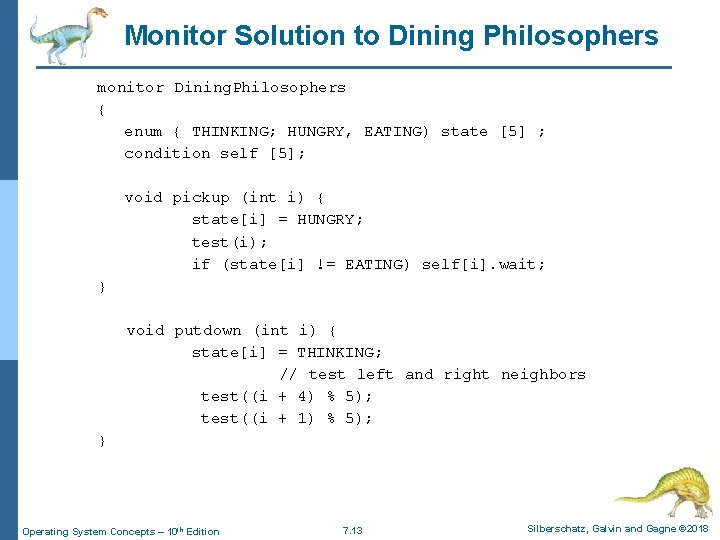
Monitor Solution to Dining Philosophers monitor Dining. Philosophers { enum { THINKING; HUNGRY, EATING) state [5] ; condition self [5]; void pickup (int i) { state[i] = HUNGRY; test(i); if (state[i] != EATING) self[i]. wait; } void putdown (int i) { state[i] = THINKING; // test left and right neighbors test((i + 4) % 5); test((i + 1) % 5); } Operating System Concepts – 10 th Edition 7. 13 Silberschatz, Galvin and Gagne © 2018
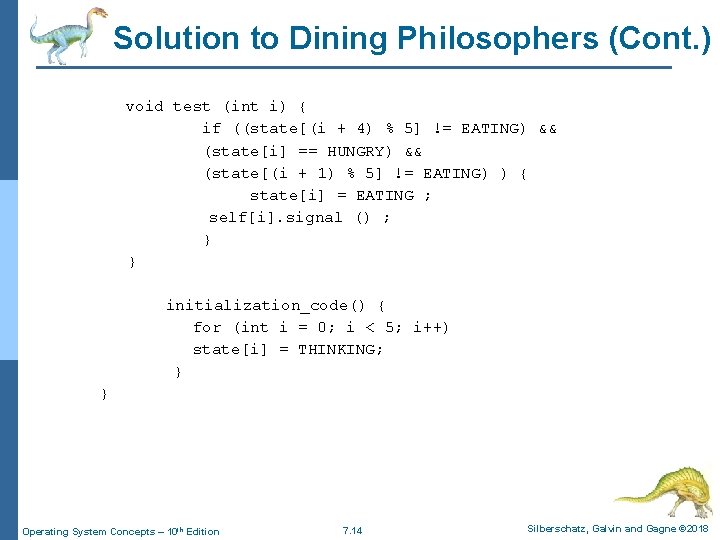
Solution to Dining Philosophers (Cont. ) void test (int i) { if ((state[(i + 4) % 5] != EATING) && (state[i] == HUNGRY) && (state[(i + 1) % 5] != EATING) ) { state[i] = EATING ; self[i]. signal () ; } } initialization_code() { for (int i = 0; i < 5; i++) state[i] = THINKING; } } Operating System Concepts – 10 th Edition 7. 14 Silberschatz, Galvin and Gagne © 2018
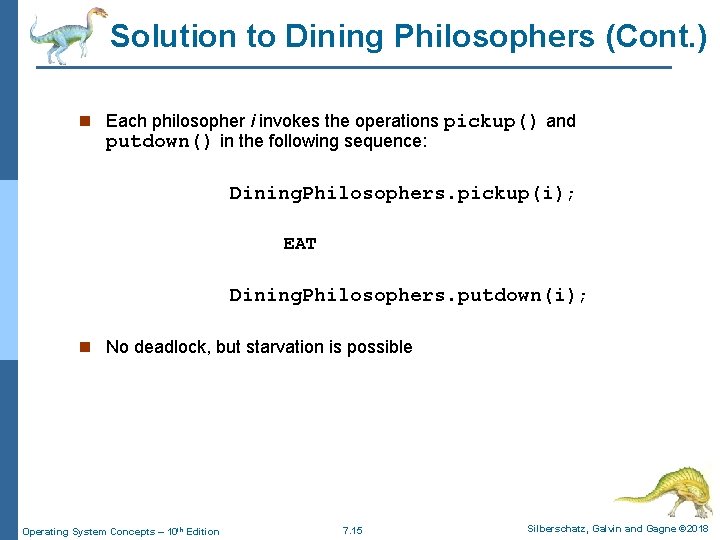
Solution to Dining Philosophers (Cont. ) n Each philosopher i invokes the operations pickup() and putdown() in the following sequence: Dining. Philosophers. pickup(i); EAT Dining. Philosophers. putdown(i); n No deadlock, but starvation is possible Operating System Concepts – 10 th Edition 7. 15 Silberschatz, Galvin and Gagne © 2018
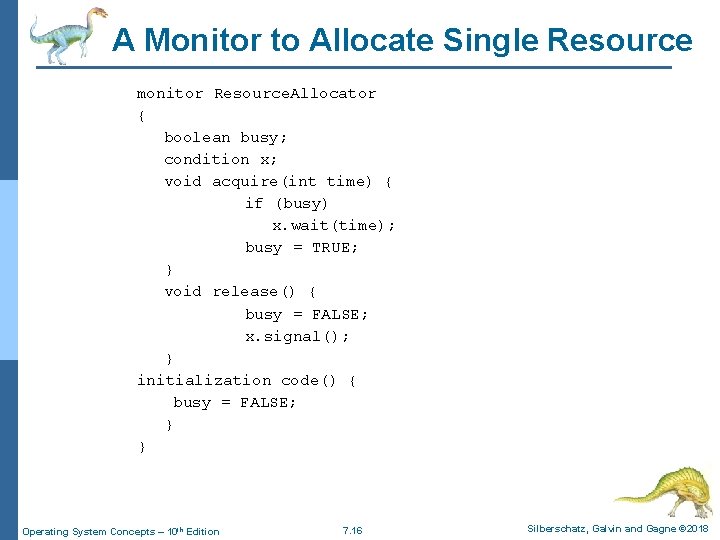
A Monitor to Allocate Single Resource monitor Resource. Allocator { boolean busy; condition x; void acquire(int time) { if (busy) x. wait(time); busy = TRUE; } void release() { busy = FALSE; x. signal(); } initialization code() { busy = FALSE; } } Operating System Concepts – 10 th Edition 7. 16 Silberschatz, Galvin and Gagne © 2018
Synchronization Examples n Solaris n Windows n Linux n Pthreads Operating System Concepts – 10 th Edition 7. 17 Silberschatz, Galvin and Gagne © 2018
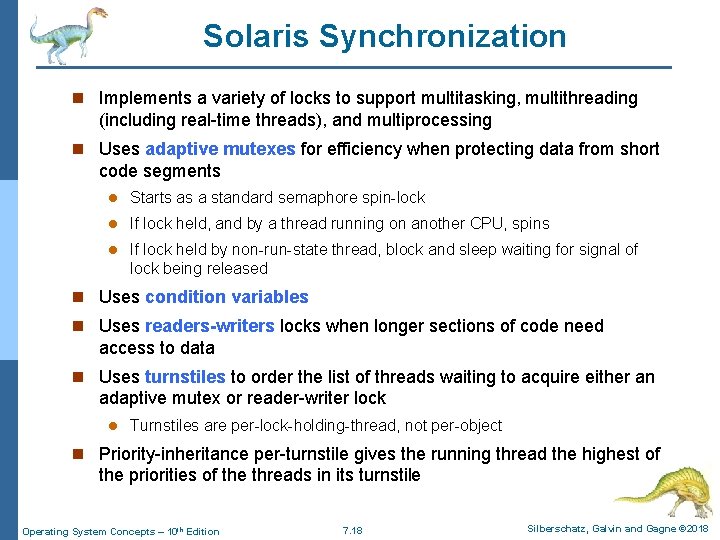
Solaris Synchronization n Implements a variety of locks to support multitasking, multithreading (including real-time threads), and multiprocessing n Uses adaptive mutexes for efficiency when protecting data from short code segments l Starts as a standard semaphore spin-lock l If lock held, and by a thread running on another CPU, spins l If lock held by non-run-state thread, block and sleep waiting for signal of lock being released n Uses condition variables n Uses readers-writers locks when longer sections of code need access to data n Uses turnstiles to order the list of threads waiting to acquire either an adaptive mutex or reader-writer lock l Turnstiles are per-lock-holding-thread, not per-object n Priority-inheritance per-turnstile gives the running thread the highest of the priorities of the threads in its turnstile Operating System Concepts – 10 th Edition 7. 18 Silberschatz, Galvin and Gagne © 2018
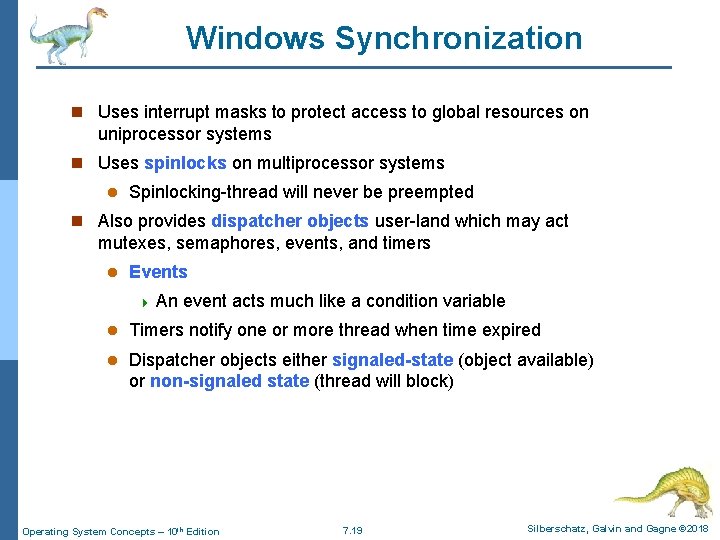
Windows Synchronization n Uses interrupt masks to protect access to global resources on uniprocessor systems n Uses spinlocks on multiprocessor systems l Spinlocking-thread will never be preempted n Also provides dispatcher objects user-land which may act mutexes, semaphores, events, and timers l Events 4 An event acts much like a condition variable l Timers notify one or more thread when time expired l Dispatcher objects either signaled-state (object available) or non-signaled state (thread will block) Operating System Concepts – 10 th Edition 7. 19 Silberschatz, Galvin and Gagne © 2018
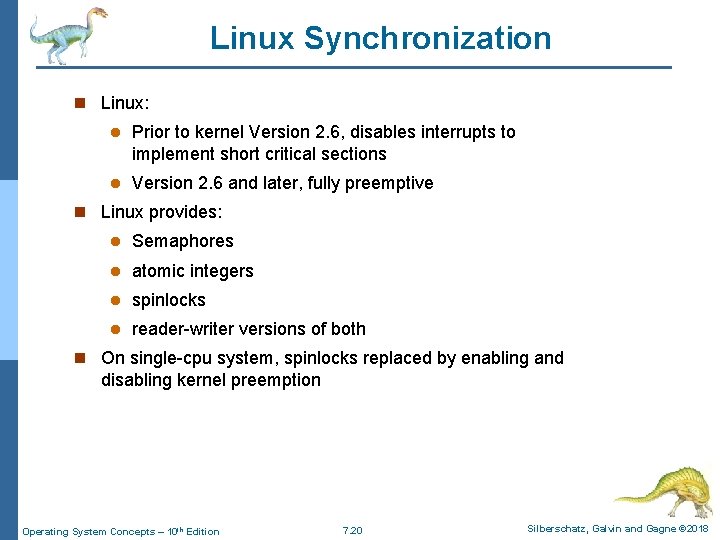
Linux Synchronization n Linux: l Prior to kernel Version 2. 6, disables interrupts to implement short critical sections l Version 2. 6 and later, fully preemptive n Linux provides: l Semaphores l atomic integers l spinlocks l reader-writer versions of both n On single-cpu system, spinlocks replaced by enabling and disabling kernel preemption Operating System Concepts – 10 th Edition 7. 20 Silberschatz, Galvin and Gagne © 2018
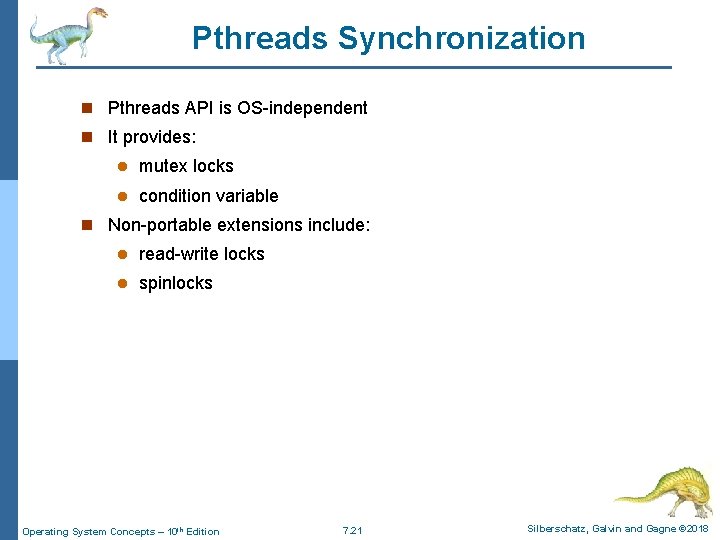
Pthreads Synchronization n Pthreads API is OS-independent n It provides: l mutex locks l condition variable n Non-portable extensions include: l read-write locks l spinlocks Operating System Concepts – 10 th Edition 7. 21 Silberschatz, Galvin and Gagne © 2018
Alternative Approaches n Transactional Memory n Open. MP n Functional Programming Languages Operating System Concepts – 10 th Edition 7. 22 Silberschatz, Galvin and Gagne © 2018
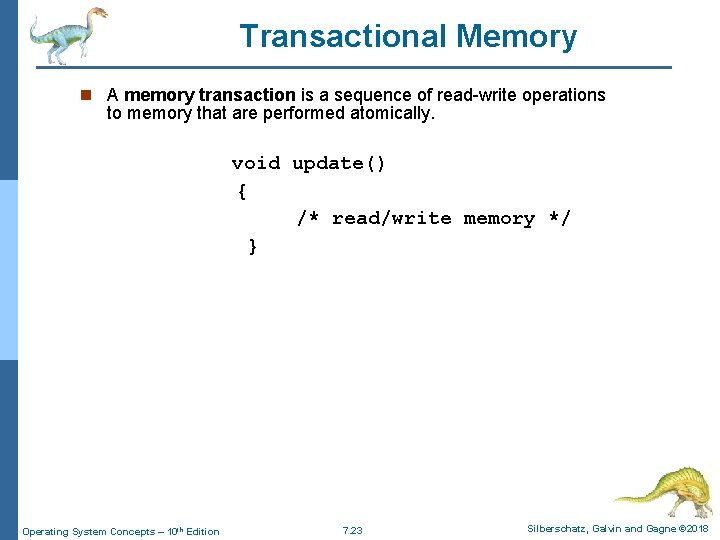
Transactional Memory n A memory transaction is a sequence of read-write operations to memory that are performed atomically. void update() { /* read/write memory */ } Operating System Concepts – 10 th Edition 7. 23 Silberschatz, Galvin and Gagne © 2018
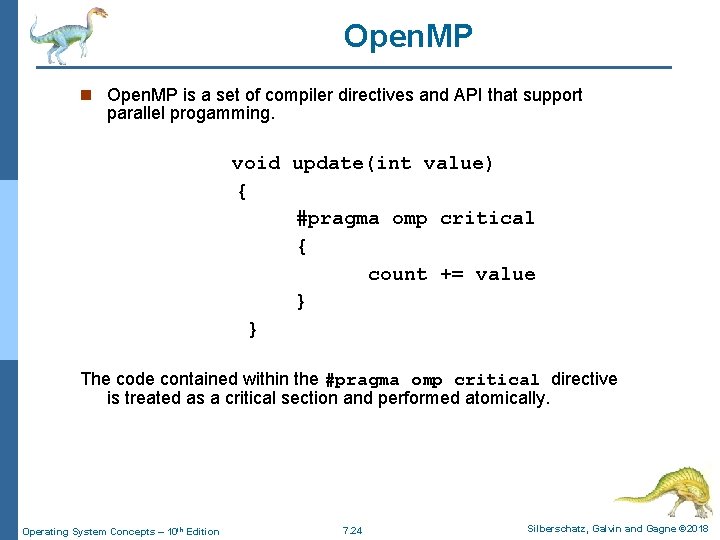
Open. MP n Open. MP is a set of compiler directives and API that support parallel progamming. void update(int value) { #pragma omp critical { count += value } } The code contained within the #pragma omp critical directive is treated as a critical section and performed atomically. Operating System Concepts – 10 th Edition 7. 24 Silberschatz, Galvin and Gagne © 2018
Functional Programming Languages n Functional programming languages offer a different paradigm than procedural languages in that they do not maintain state. n Variables are treated as immutable and cannot change state once they have been assigned a value. n There is increasing interest in functional languages such as Erlang and Scala for their approach in handling data races. Operating System Concepts – 10 th Edition 7. 25 Silberschatz, Galvin and Gagne © 2018
End of Chapter 7 Operating System Concepts – 10 th Edition Silberschatz, Galvin and Gagne © 2018