
Chapter 7 Strategies and Tactics of International Business

Chapter 7 Strategies and Tactics of International Business Negotiation
Learning Objectives By the end of this chapter, you will know: • How to evaluate a situation and decide on what negotiation strategy to use. • What common negotiation strategies are implemented. • How negotiations are approached. • What specific tactics and techniques are adopted.
Lead-in Negotiation Strategy: Seven Common Pitfalls to Avoid 1. Poor Planning 2. Thinking the Pie is Fixed 3. Failing to Pay Attention to Your Opponent 4. Assuming That Cross-Cultural Negotiations are Just Like "Local" Negotiations 5. Paying Too Much Attention to Anchors 6. Caving in Too Quickly 7. Don't Gloat
Contents 7. 1 Strategies of International Business Negotiation 7. 2 Tactics of International Business Negotiation
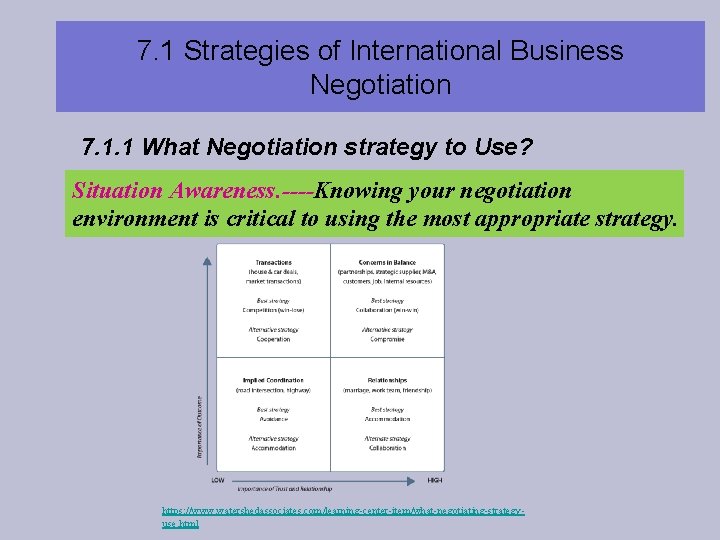
7. 1 Strategies of International Business Negotiation 7. 1. 1 What Negotiation strategy to Use? Situation Awareness. ----Knowing your negotiation environment is critical to using the most appropriate strategy. https: //www. watershedassociates. com/learning-center-item/what-negotiating-strategyuse. html
7. 1 Strategies of International Business Negotiation 7. 1. 1 What Negotiation strategy to Use? Several general elements regarding situation awareness worth considering. 1. recurrence 2. strength of both parties 3. time frame
7. 1 Strategies of International Business Negotiation 7. 1. 1 What Negotiation strategy to Use? Negotiation strategies 1) Five-strategy classification Competitive (win-lose) Avoidance Accommodation Collaboration (win-win) Compromise (win-lose/lose-win)
7. 1 Strategies of International Business Negotiation 7. 1. 1 What Negotiation strategy to Use? Negotiation strategies 2) Four-strategy classification Problem solving Contention Yielding Inaction
7. 1 Strategies of International Business Negotiation 7. 1. 1 What Negotiation strategy to Use? Negotiation strategies 3) Two-strategy classification Competitive Negotiation Strategy Collaborative negotiation strategy
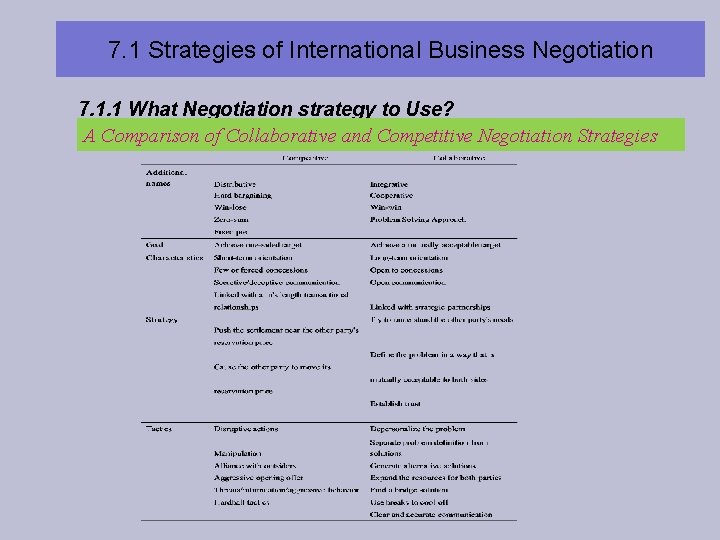
7. 1 Strategies of International Business Negotiation 7. 1. 1 What Negotiation strategy to Use? A Comparison of Collaborative and Competitive Negotiation Strategies
7. 1 Strategies of International Business Negotiation 7. 1. 2 Influencing the Other Party's Strategy • • Encourage the other to develop concern for one's own outcomes. Offer favors to the other and cultivating their dependence, by pointing out a common identity, or by putting them in a good mood. 7. 1. 3 How to approach a negotiation? 1 The hard approach 2 The soft approach 3 Principled negotiation
7. 2 Tactics of International Business Negotiation 1 Highball /Lowball Your counterpart will open with an extremely high or low offer, which they hope will force you to reconsider your resistance points and goal 2 Bogey 3 Snow Job A bogey is a particular issue that the negotiator pretends is vitally important to the deal, though in reality it is unimportant to them. A snow job is a particularly common tactic designed to confuse and distract you. It happens when the other party reveals a lot of information, overwhelming you with facts and figures.
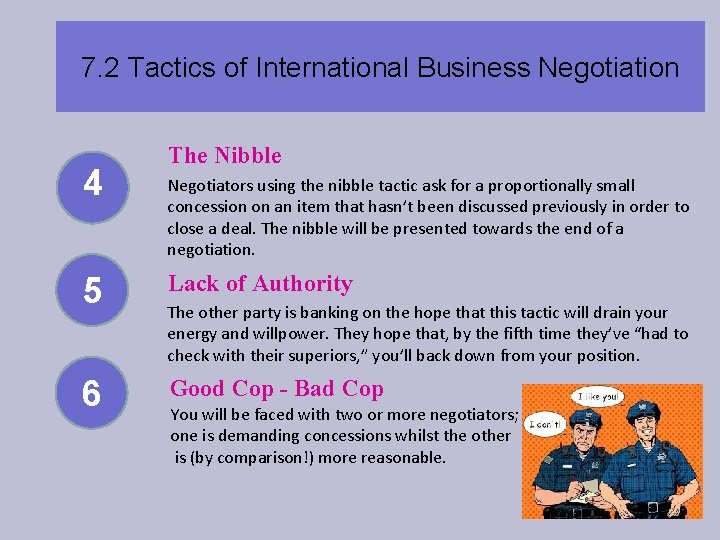
7. 2 Tactics of International Business Negotiation 4 5 6 The Nibble Negotiators using the nibble tactic ask for a proportionally small concession on an item that hasn’t been discussed previously in order to close a deal. The nibble will be presented towards the end of a negotiation. Lack of Authority The other party is banking on the hope that this tactic will drain your energy and willpower. They hope that, by the fifth time they’ve “had to check with their superiors, ” you’ll back down from your position. Good Cop - Bad Cop You will be faced with two or more negotiators; one is demanding concessions whilst the other is (by comparison!) more reasonable.
7. 2 Tactics of International Business Negotiation Deadlines/Ultimatum 7 8 9 Give the other party a deadline forcing them to make a decision. This method uses time to apply pressure to the other party. Deadlines given can be actual or artificial. Auction The bidding process is designed to create competition. When multiple parties want the same thing, pit them against one another. Brink(s)manship One party aggressively pursues a set of terms to the point where the other negotiating party must either agree or walk away.
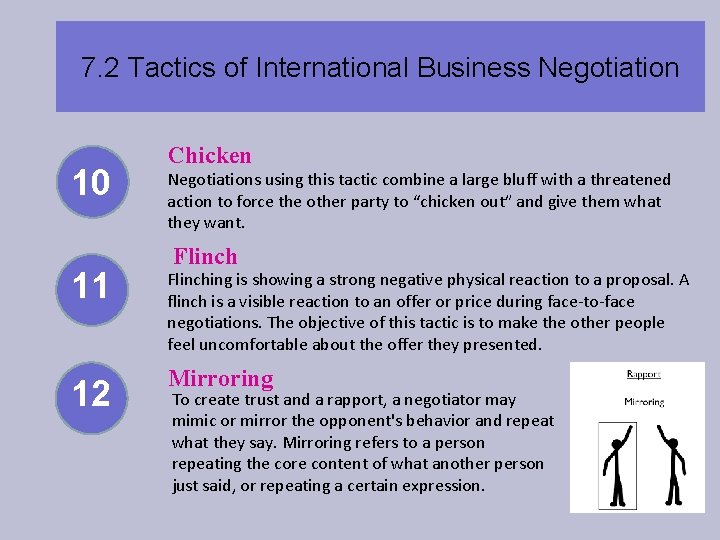
7. 2 Tactics of International Business Negotiation 10 Chicken Negotiations using this tactic combine a large bluff with a threatened action to force the other party to “chicken out” and give them what they want. Flinch 11 Flinching is showing a strong negative physical reaction to a proposal. A flinch is a visible reaction to an offer or price during face-to-face negotiations. The objective of this tactic is to make the other people feel uncomfortable about the offer they presented. 12 Mirroring To create trust and a rapport, a negotiator may mimic or mirror the opponent's behavior and repeat what they say. Mirroring refers to a person repeating the core content of what another person just said, or repeating a certain expression.
7. 2 Tactics of International Business Negotiation Frequently Asked Tactical Questions: Tactics regarding price Should I ever state my acceptable range? Should I ever tell the other side my real bottomline?
7. 2 Tactics of International Business Negotiation Frequently Asked Tactical Questions: Tactics regarding process ü Is it ever acceptable to bid against myself-to make two moves in a row? ü Is it smart or fair to bluff? ü In a complex deal, is it better to reach agreement issue by issue or wait until the end? ü Is it better to deal with difficult or easy Issues? ü What if there is an unexpected turn in the roadbefore or after an agreement?
7. 2 Tactics of International Business Negotiation Frequently Asked Tactical Questions: Tactics regarding people problems ü What happens when you pit a collaborative negotiator against a positional hard bargainer? ü How should I respond if the other side seeks to change something in its offer after a deal has been reached? ü What should I do when the negotiator on the other side has a temper tantrum? ü I don't believe what the other side is saying. What should I do? ü When, if ever, is it appropriate to negotiate over the telephone or by email? Or is it essential to insist on a face-to-face meeting? ü How should I react when the other side challenges my credentials, status, or authority to make a deal?
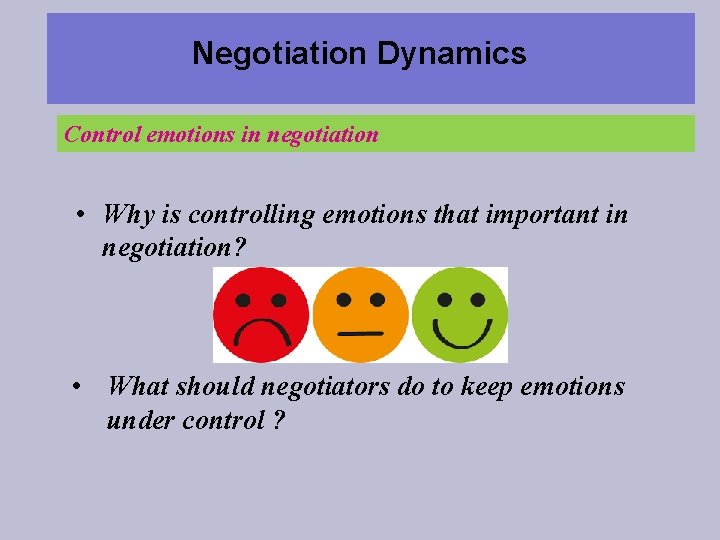
Negotiation Dynamics Control emotions in negotiation • Why is controlling emotions that important in negotiation? • What should negotiators do to keep emotions under control ?
Culture kaleidoscope Tips on negotiating in France • How do French negotiators perceive time concept? • Is logic an important factor in negotiation with French ? How does it affect the negotiation process?
Key Terms Negotiation strategy Negotiation tactics Situation awareness Competitive strategy Collaborative strategy Avoidance Accommodation Compromise Problem-solving Contention Yielding Inaction Highball/lowball Bogey Snow job The nibble Lack of authority Good-cop/Bad-cop Deadlines Auction Brink(s)manship Chicken Flinch Mirroring 谈判战略 谈判策略 态势感知 竞争战略 合作战略 回避战略 顺应战略 折中战略 问题求解战略 竞争战略 让步战略 无为(不作为)战略 高价/低价策略 虚假目标 花言巧语/哄骗术 蚕食策略 缺乏权威性 红脸白脸 最后期限 竞价 边缘策略/冒险策略 胆小鬼博弈 畏缩 模仿
Chapter Summary • What strategy to use largely depends on the specific situation in which negotiators are involved. To assess the situation requires negotiators to develop situation awareness of the strength of both parties, time frame and recurrence. • This chapter examines 5 -strategy, 4 -strategy and 2 -strategy classification of negotiation strategies respectively. • Influencing the other party’s strategy to convince the members to change their minds about their ability to achieve their own goals; and to justify their own objective as desirable, necessary, or even inevitable can be arduous but worthwhile. • Tactic is usually a temporary measure devised to achieve a specific result. An assortment of tactics ranging from bogey, snow job, deadlines, good cop & bad cop, chicken, flinch, mirroring to highball/lowball are employed in different negotiation scenarios.
Exercises I. Review and Critical Thinking Questions II. Case Study III. Suggested Reading

- Slides: 24