
Chapter 7 Some Mathematics The Equations of Motion

- Slides: 25
Chapter 7 Some Mathematics: The Equations of Motion Physical oceanography Instructor: Dr. Cheng-Chien Liu Department of Earth Sciences National Cheng Kung University Last updated: 24 October 2003
Introduction § Response of a fluid to • Internal force • External force § basic equations of ocean dynamics • Chapter 8: viscosity • Chapter 12: vorticity § Table 7. 1 • Conservation laws basic equations
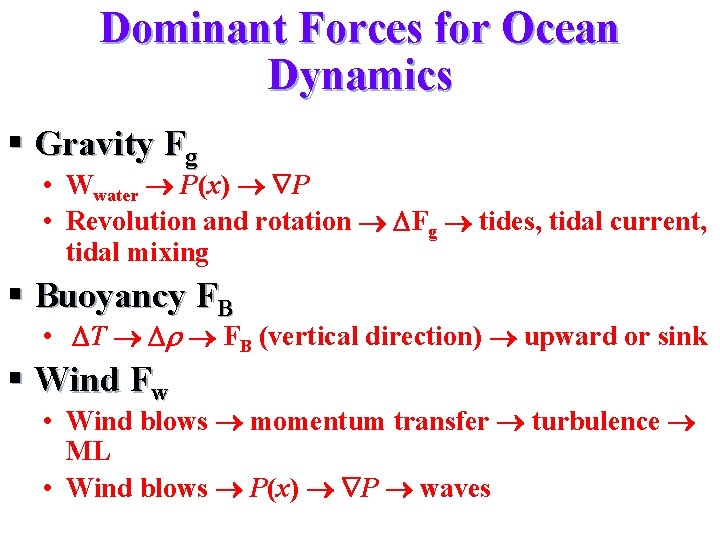
Dominant Forces for Ocean Dynamics § Gravity Fg • Wwater P(x) P • Revolution and rotation DFg tides, tidal current, tidal mixing § Buoyancy FB • DT Dr FB (vertical direction) upward or sink § Wind Fw • Wind blows momentum transfer turbulence ML • Wind blows P(x) P waves
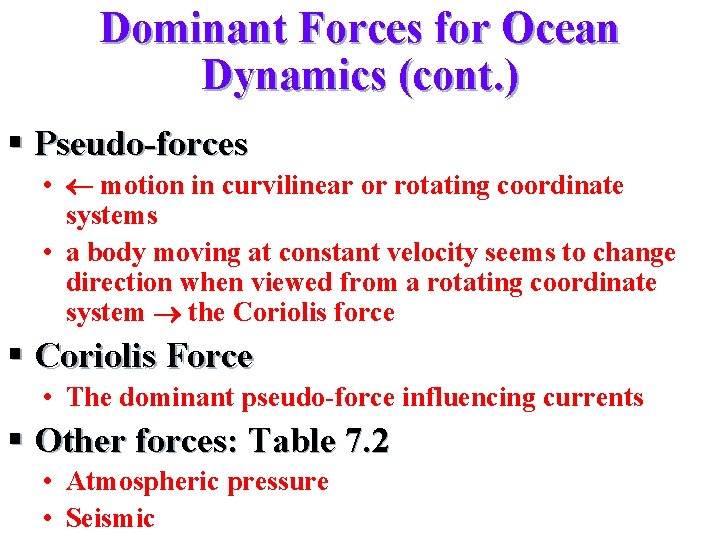
Dominant Forces for Ocean Dynamics (cont. ) § Pseudo-forces • motion in curvilinear or rotating coordinate systems • a body moving at constant velocity seems to change direction when viewed from a rotating coordinate system the Coriolis force § Coriolis Force • The dominant pseudo-force influencing currents § Other forces: Table 7. 2 • Atmospheric pressure • Seismic
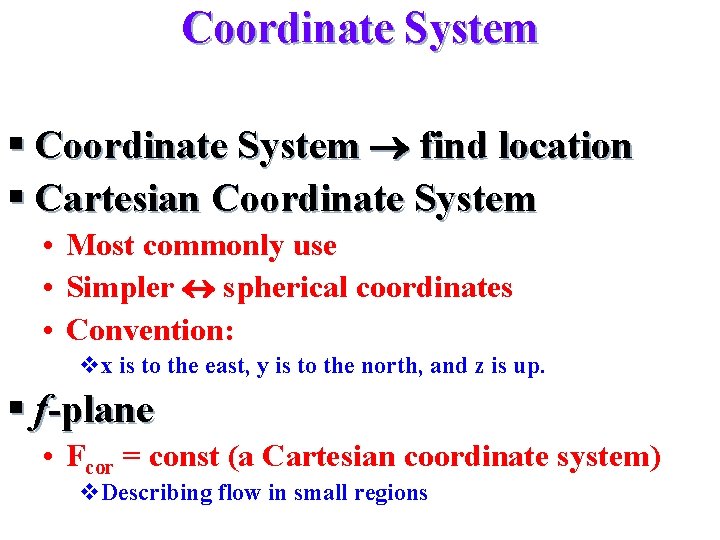
Coordinate System § Coordinate System find location § Cartesian Coordinate System • Most commonly use • Simpler spherical coordinates • Convention: vx is to the east, y is to the north, and z is up. § f-plane • Fcor = const (a Cartesian coordinate system) v. Describing flow in small regions
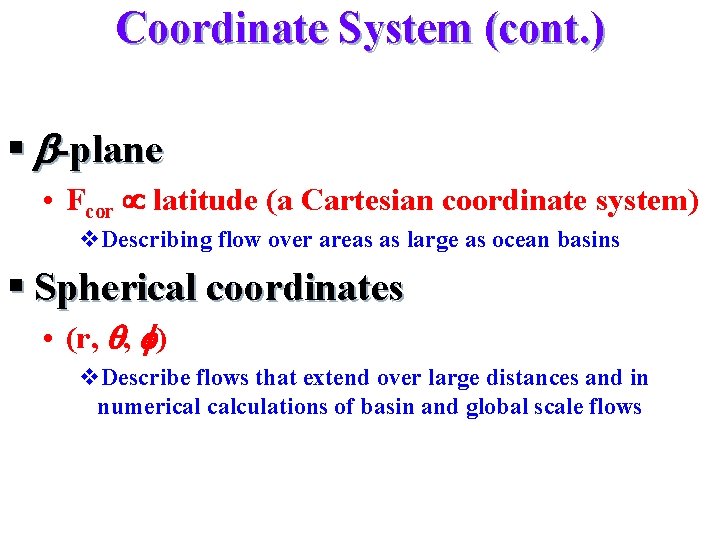
Coordinate System (cont. ) § b-plane • Fcor latitude (a Cartesian coordinate system) v. Describing flow over areas as large as ocean basins § Spherical coordinates • (r, q, f) v. Describe flows that extend over large distances and in numerical calculations of basin and global scale flows
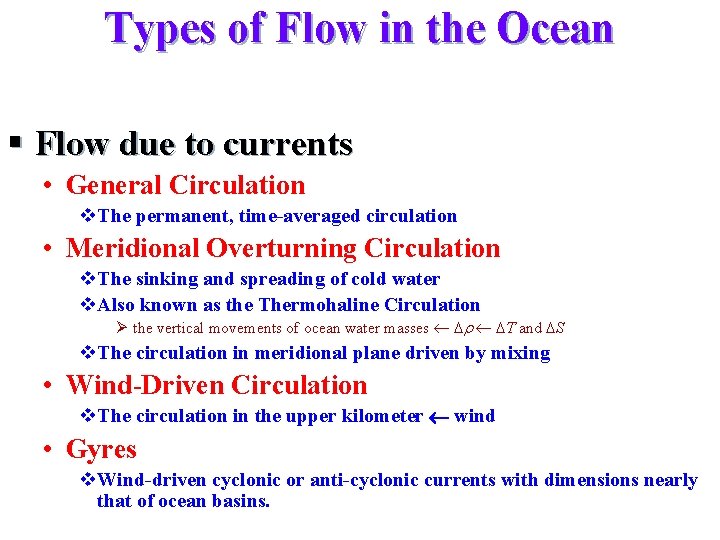
Types of Flow in the Ocean § Flow due to currents • General Circulation v. The permanent, time-averaged circulation • Meridional Overturning Circulation v. The sinking and spreading of cold water v. Also known as the Thermohaline Circulation Ø the vertical movements of ocean water masses Dr DT and DS v. The circulation in meridional plane driven by mixing • Wind-Driven Circulation v. The circulation in the upper kilometer wind • Gyres v. Wind-driven cyclonic or anti-cyclonic currents with dimensions nearly that of ocean basins.
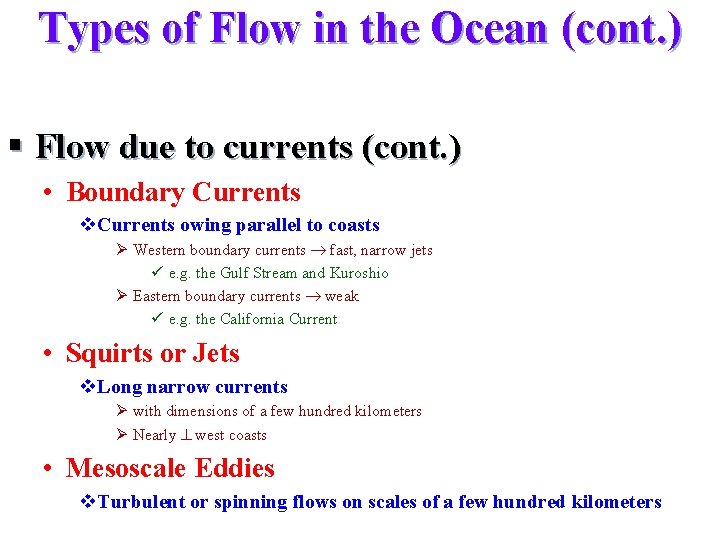
Types of Flow in the Ocean (cont. ) § Flow due to currents (cont. ) • Boundary Currents v. Currents owing parallel to coasts Ø Western boundary currents fast, narrow jets ü e. g. the Gulf Stream and Kuroshio Ø Eastern boundary currents weak ü e. g. the California Current • Squirts or Jets v. Long narrow currents Ø with dimensions of a few hundred kilometers Ø Nearly west coasts • Mesoscale Eddies v. Turbulent or spinning flows on scales of a few hundred kilometers
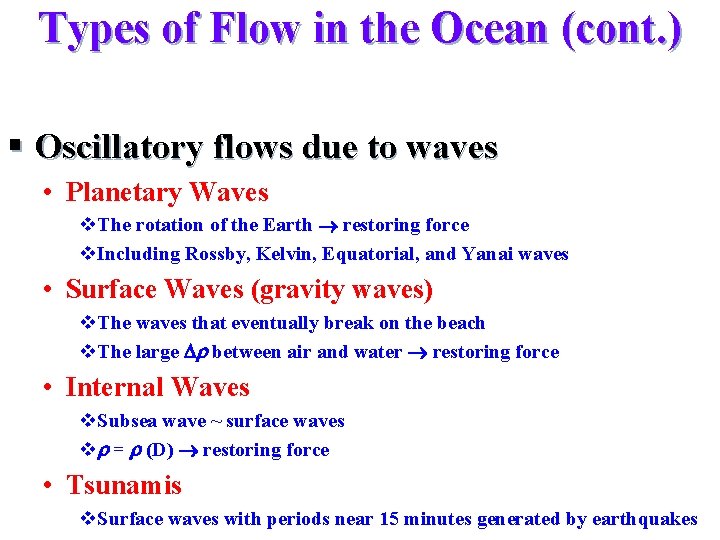
Types of Flow in the Ocean (cont. ) § Oscillatory flows due to waves • Planetary Waves v. The rotation of the Earth restoring force v. Including Rossby, Kelvin, Equatorial, and Yanai waves • Surface Waves (gravity waves) v. The waves that eventually break on the beach v. The large Dr between air and water restoring force • Internal Waves v. Subsea wave ~ surface waves vr = r (D) restoring force • Tsunamis v. Surface waves with periods near 15 minutes generated by earthquakes
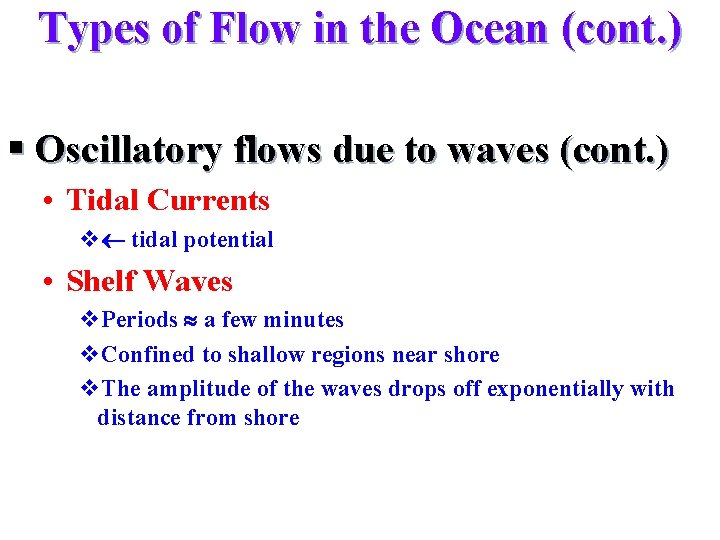
Types of Flow in the Ocean (cont. ) § Oscillatory flows due to waves (cont. ) • Tidal Currents v tidal potential • Shelf Waves v. Periods a few minutes v. Confined to shallow regions near shore v. The amplitude of the waves drops off exponentially with distance from shore
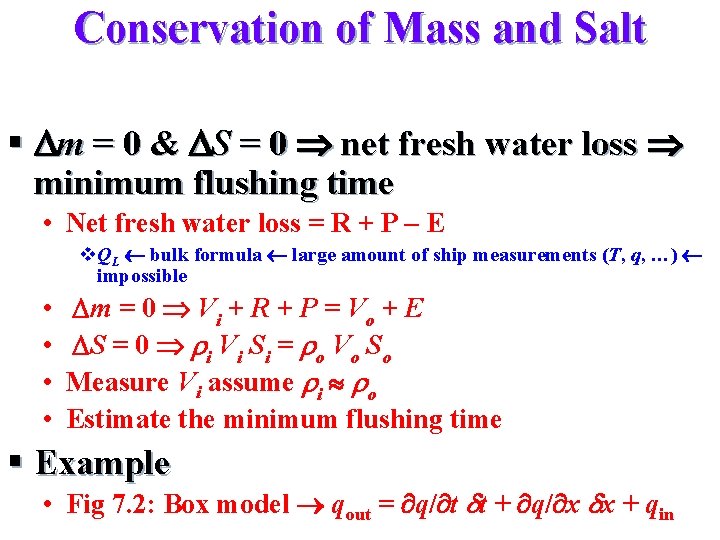
Conservation of Mass and Salt § Dm = 0 & DS = 0 net fresh water loss minimum flushing time • Net fresh water loss = R + P – E v. QL bulk formula large amount of ship measurements (T, q, …) impossible • • Dm = 0 Vi + R + P = Vo + E DS = 0 ri Vi Si = ro Vo So Measure Vi assume ri ro Estimate the minimum flushing time § Example • Fig 7. 2: Box model qout = q/ t dt + q/ x dx + qin
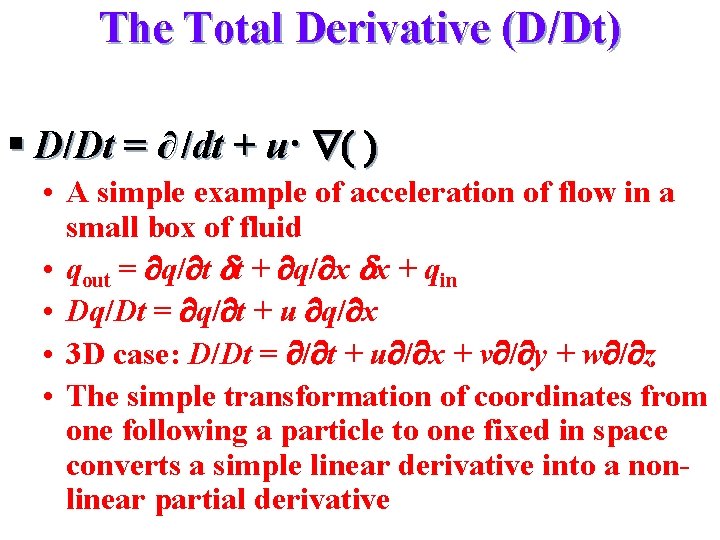
The Total Derivative (D/Dt) § D/Dt = ∂ /dt + u· ( ) • A simple example of acceleration of flow in a small box of fluid • qout = q/ t dt + q/ x dx + qin • Dq/Dt = q/ t + u q/ x • 3 D case: D/Dt = / t + u / x + v / y + w / z • The simple transformation of coordinates from one following a particle to one fixed in space converts a simple linear derivative into a nonlinear partial derivative
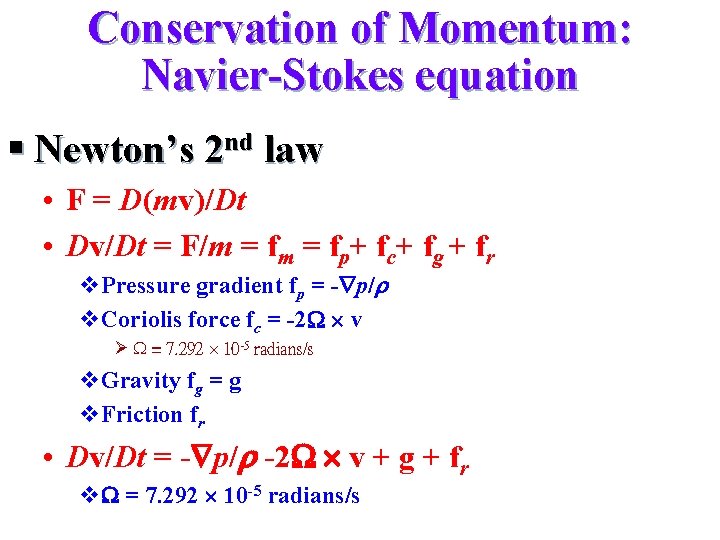
Conservation of Momentum: Navier-Stokes equation § Newton’s 2 nd law • F = D(mv)/Dt • Dv/Dt = F/m = fp+ fc+ fg + fr v. Pressure gradient fp = - p/r v. Coriolis force fc = -2 W v Ø W = 7. 292 10 -5 radians/s v. Gravity fg = g v. Friction fr • Dv/Dt = - p/r -2 W v + g + fr v. W = 7. 292 10 -5 radians/s
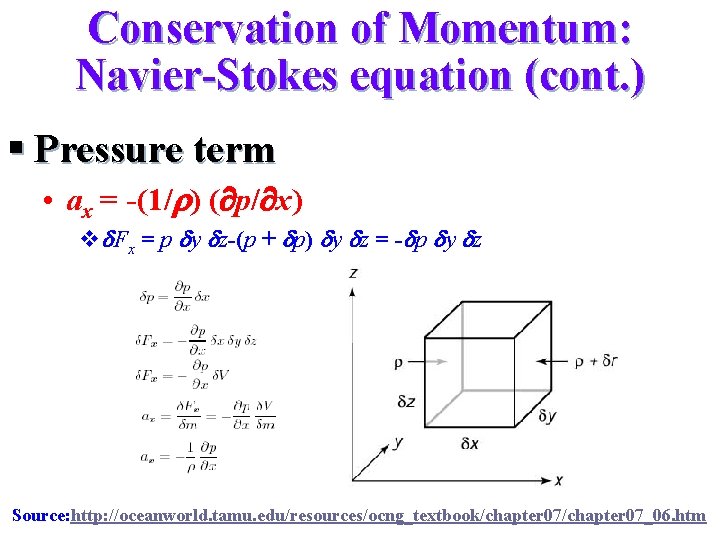
Conservation of Momentum: Navier-Stokes equation (cont. ) § Pressure term • ax = -(1/r) ( p/ x) vd. Fx = p dy dz-(p + dp) dy dz = -dp dy dz Source: http: //oceanworld. tamu. edu/resources/ocng_textbook/chapter 07_06. htm
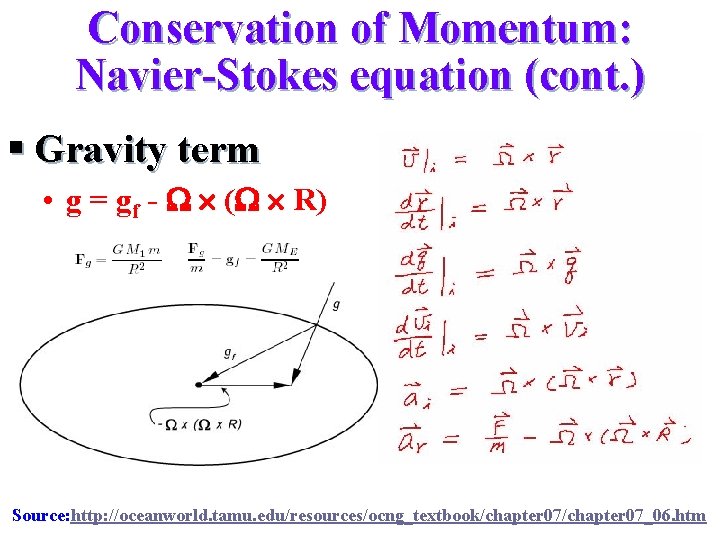
Conservation of Momentum: Navier-Stokes equation (cont. ) § Gravity term • g = gf - W (W R) Source: http: //oceanworld. tamu. edu/resources/ocng_textbook/chapter 07_06. htm
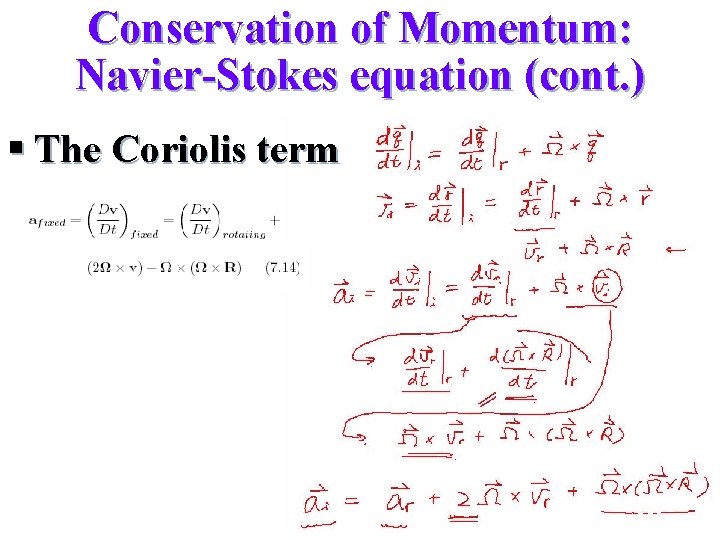
Conservation of Momentum: Navier-Stokes equation (cont. ) § The Coriolis term
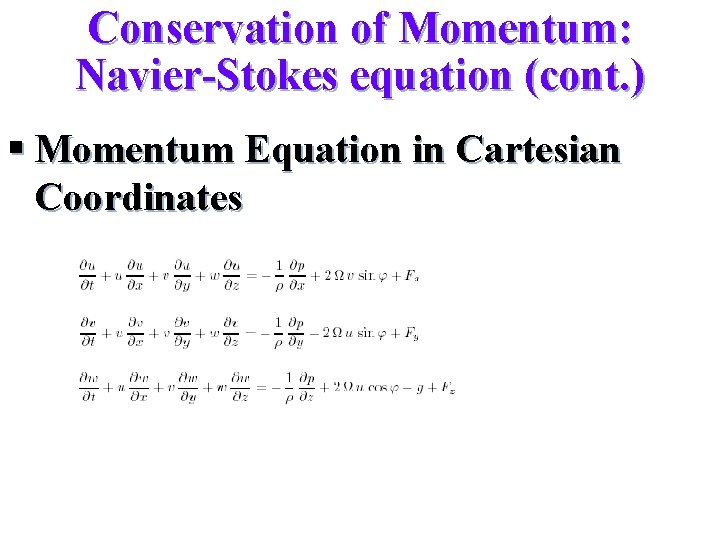
Conservation of Momentum: Navier-Stokes equation (cont. ) § Momentum Equation in Cartesian Coordinates
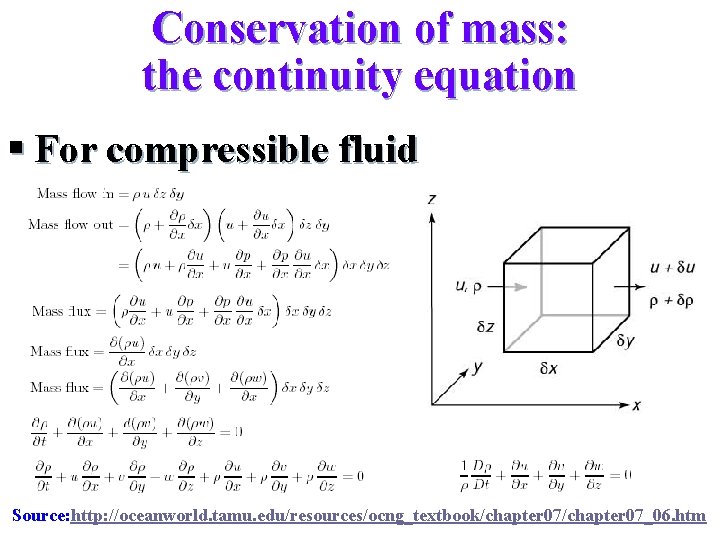
Conservation of mass: the continuity equation § For compressible fluid Source: http: //oceanworld. tamu. edu/resources/ocng_textbook/chapter 07_06. htm
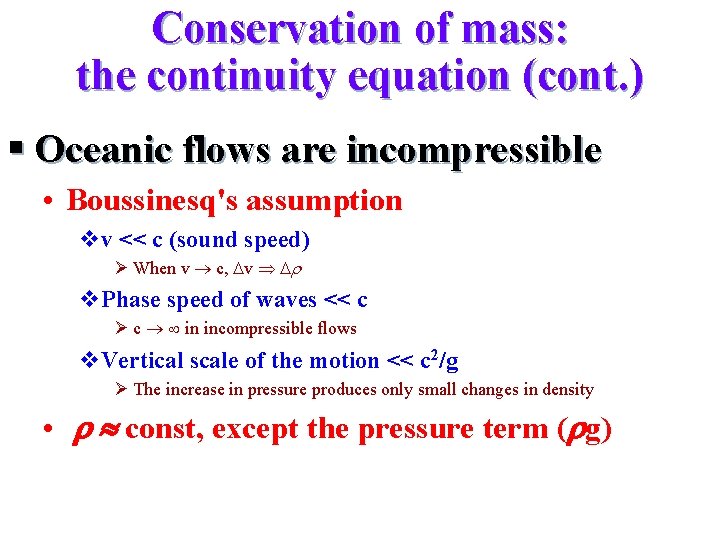
Conservation of mass: the continuity equation (cont. ) § Oceanic flows are incompressible • Boussinesq's assumption vv << c (sound speed) Ø When v c, Dv Dr v. Phase speed of waves << c Ø c in incompressible flows v. Vertical scale of the motion << c 2/g Ø The increase in pressure produces only small changes in density • r const, except the pressure term (rg)
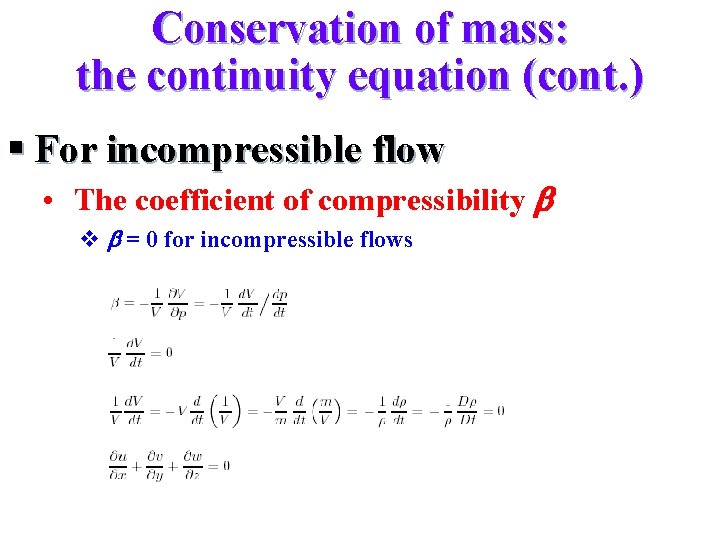
Conservation of mass: the continuity equation (cont. ) § For incompressible flow • The coefficient of compressibility b v b = 0 for incompressible flows
Solutions to the Equations of Motion § Solvable in principle • Four equations v 3 momentum equations v 1 continuity equation • Four unknowns v 3 velocity components: u, v, w v 1 pressure p • Boundary conditions v. No slip condition: v//(boundary) = 0 v. No penetration condition: v (boundary) = 0
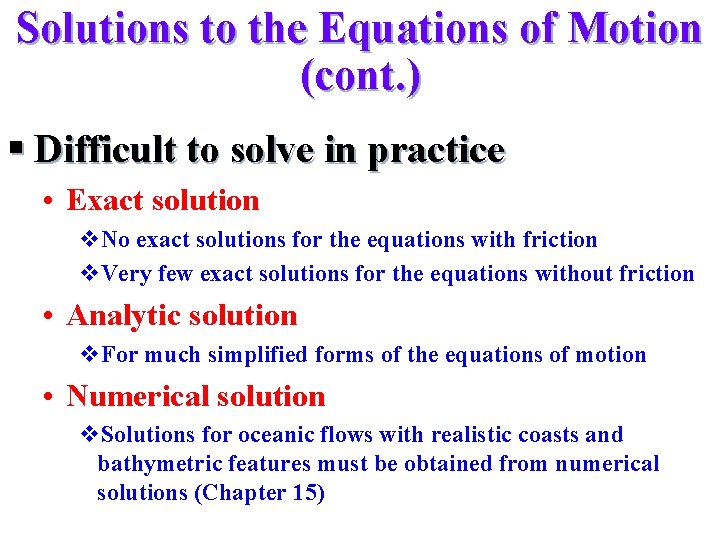
Solutions to the Equations of Motion (cont. ) § Difficult to solve in practice • Exact solution v. No exact solutions for the equations with friction v. Very few exact solutions for the equations without friction • Analytic solution v. For much simplified forms of the equations of motion • Numerical solution v. Solutions for oceanic flows with realistic coasts and bathymetric features must be obtained from numerical solutions (Chapter 15)
Important concepts • Gravity, buoyancy, and wind are the dominant forces acting on the ocean • Earth's rotation produces a pseudo force, the Coriolis force • Conservation laws applied to flow in the ocean lead to equations of motion; conservation of salt, volume and other quantities can lead to deep insights into oceanic flow
Important concepts (cont. ) • The transformation from equations of motion applied to fluid parcels to equations applied at a fixed point in space greatly complicates the equations of motion. The linear, first-order, ordinary differential equations describing Newtonian dynamics of a mass accelerated by a force become nonlinear, partial differential equations of fluid mechanics. • Flow in the ocean can be assumed to be incompressible except when de-scribing sound. Density can be assumed to be constant except when density is multiplied by gravity g. The assumption is called the Boussinesq approximation
Important concepts (cont. ) • Conservation of mass leads to the continuity equation, which has an especially simple form for an incompressible fluid.