
CHAPTER 7 SKELETAL SYSTEM Bone Physiology and Joints
CHAPTER 7: SKELETAL SYSTEM Bone Physiology and Joints
Anatomy A-Day 1/24/20 Bellringer • Hormones that DO NOT require a second messenger system to reach their target cell are: • Which of the following will happen when blood calcium levels are low? Agenda • Bellringer • Skeletal System Notes • Skull Labeling
Anatomy A-Day 1/24/20 Bellringer • Hormones that DO NOT require a second messenger system to reach their target cell are: Agenda • Bellringer • Skeletal System Notes – Steroids • Skull Notes • Which of the following will • Skull Labeling happen when blood calcium levels are low? – Parathyroid hormone will stimulate osteoclasts to break down bone
Anatomy A-Day 1/28/20 Bellringer • Which bone cells aid in bone formation? • What are the ends of long bone called? Agenda • Bellringer • Skull Labeling Practice • Chromebook practice with labeling skulls • Axial Skeleton Notes
Anatomy A-Day 1/28/20 Bellringer • Which bone cells aid in bone formation? – Osteoblasts • What are the ends of long bone called? – Epiphysis Agenda • Bellringer • Skull Labeling Practice • Chromebook practice with labeling skulls • Axial Skeleton Notes

Anatomy A-Day 1/30/20 Bellringer • Which bone makes up the upper mouth? • Which bone doesn’t touch (articulate) any other bone? Agenda • Axial Skeleton Notes • Bone ID-practice • Appendicular Skeleton Notes
Anatomy A-Day 1/30/20 Bellringer • Which bone makes up the upper mouth? – Maxilla • Which bone doesn’t touch (articulate) any other bone? – Hyoid Agenda • Axial Skeleton Notes • Bone ID-practice • Appendicular Skeleton Notes
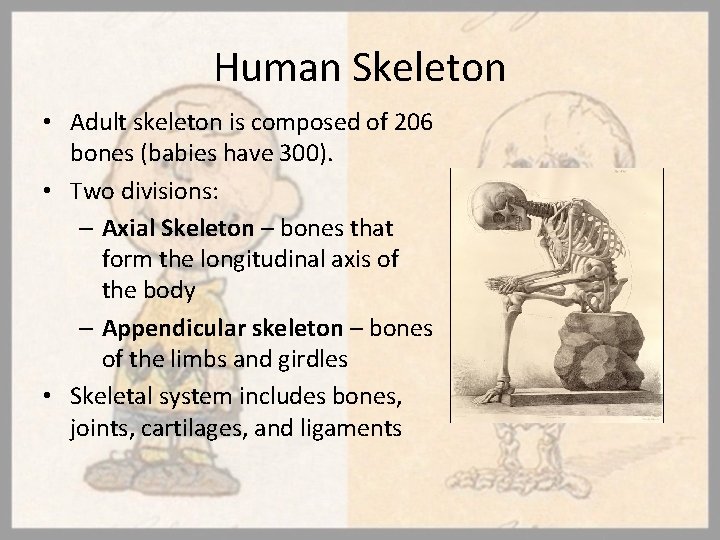
Human Skeleton • Adult skeleton is composed of 206 bones (babies have 300). • Two divisions: – Axial Skeleton – bones that form the longitudinal axis of the body – Appendicular skeleton – bones of the limbs and girdles • Skeletal system includes bones, joints, cartilages, and ligaments
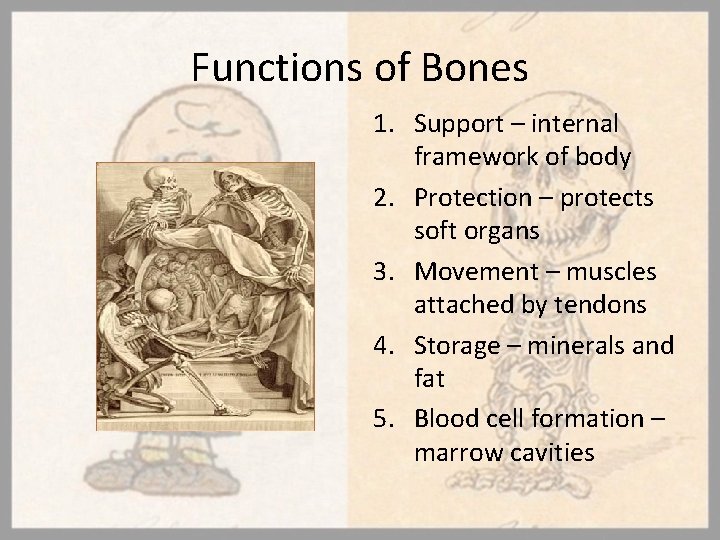
Functions of Bones 1. Support – internal framework of body 2. Protection – protects soft organs 3. Movement – muscles attached by tendons 4. Storage – minerals and fat 5. Blood cell formation – marrow cavities
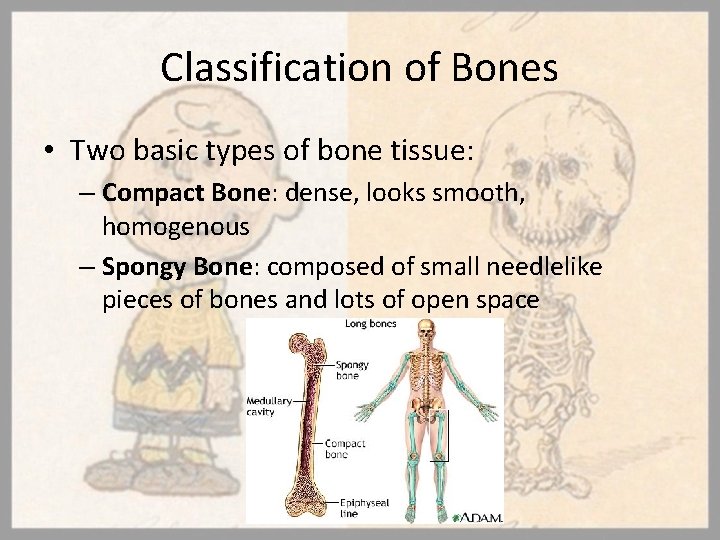
Classification of Bones • Two basic types of bone tissue: – Compact Bone: dense, looks smooth, homogenous – Spongy Bone: composed of small needlelike pieces of bones and lots of open space
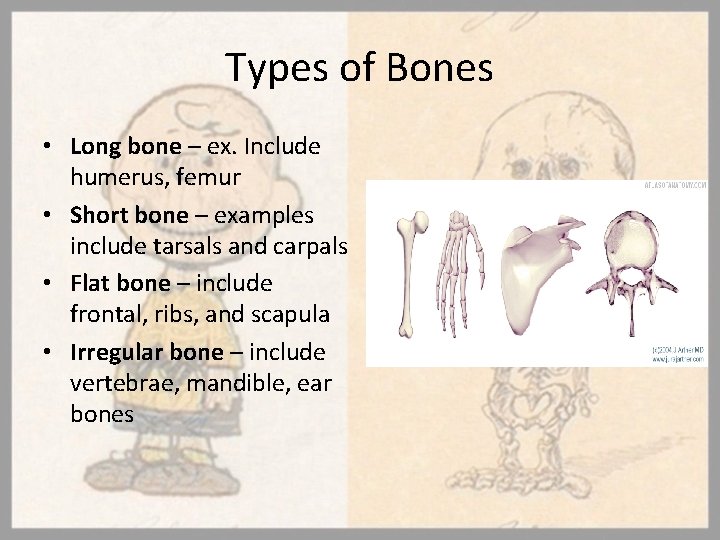
Types of Bones • Long bone – ex. Include humerus, femur • Short bone – examples include tarsals and carpals • Flat bone – include frontal, ribs, and scapula • Irregular bone – include vertebrae, mandible, ear bones
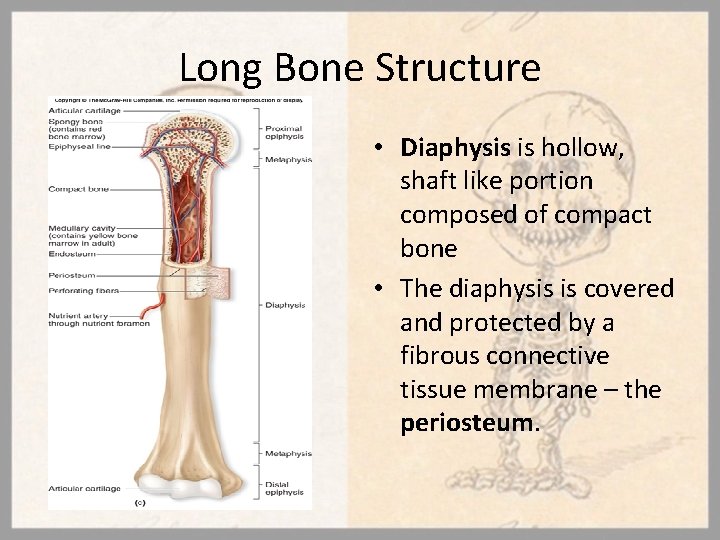
Long Bone Structure • Diaphysis is hollow, shaft like portion composed of compact bone • The diaphysis is covered and protected by a fibrous connective tissue membrane – the periosteum.
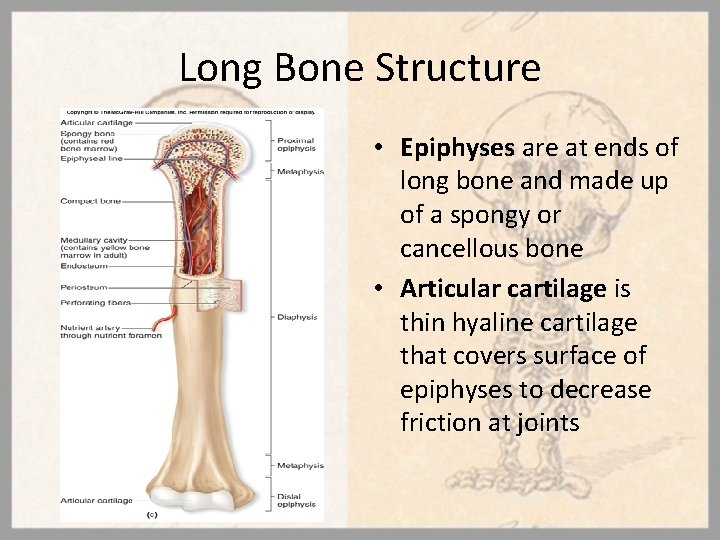
Long Bone Structure • Epiphyses are at ends of long bone and made up of a spongy or cancellous bone • Articular cartilage is thin hyaline cartilage that covers surface of epiphyses to decrease friction at joints
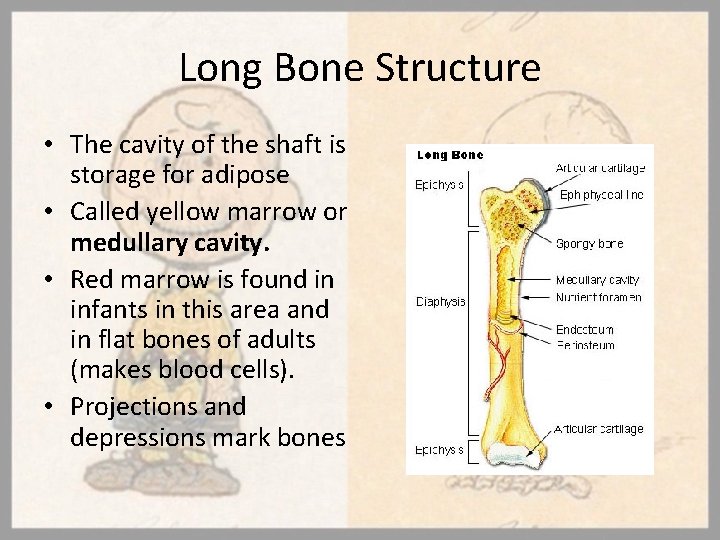
Long Bone Structure • The cavity of the shaft is storage for adipose • Called yellow marrow or medullary cavity. • Red marrow is found in infants in this area and in flat bones of adults (makes blood cells). • Projections and depressions mark bones

Microscopic Structure of Bone • Mainly calcified matrix of calcium salts with collagenous fibers • Matrix of compact bone is made of thousands of structures called haversian systems (osteons)
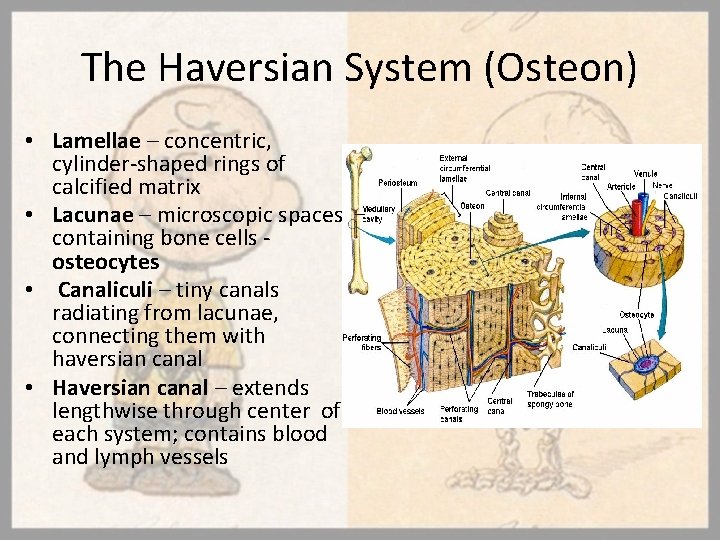
The Haversian System (Osteon) • Lamellae – concentric, cylinder-shaped rings of calcified matrix • Lacunae – microscopic spaces containing bone cells osteocytes • Canaliculi – tiny canals radiating from lacunae, connecting them with haversian canal • Haversian canal – extends lengthwise through center of each system; contains blood and lymph vessels
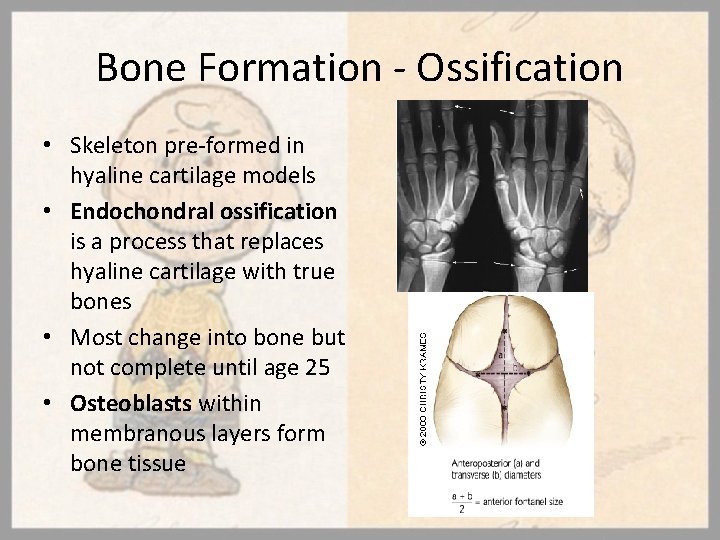
Bone Formation - Ossification • Skeleton pre-formed in hyaline cartilage models • Endochondral ossification is a process that replaces hyaline cartilage with true bones • Most change into bone but not complete until age 25 • Osteoblasts within membranous layers form bone tissue
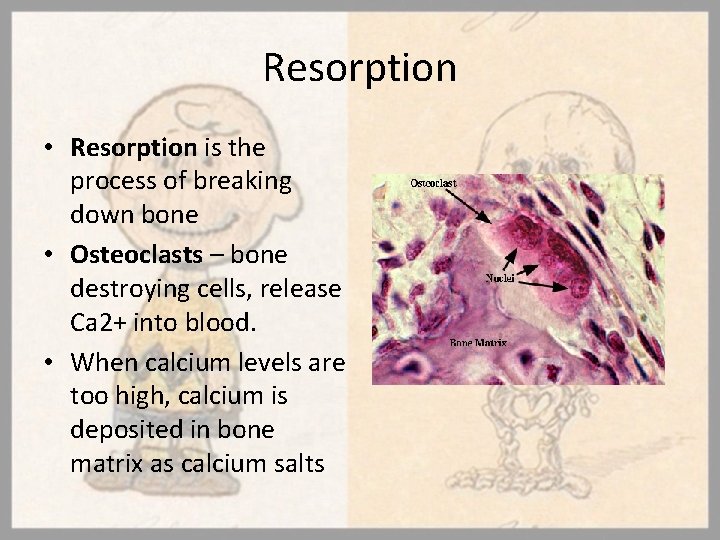
Resorption • Resorption is the process of breaking down bone • Osteoclasts – bone destroying cells, release Ca 2+ into blood. • When calcium levels are too high, calcium is deposited in bone matrix as calcium salts
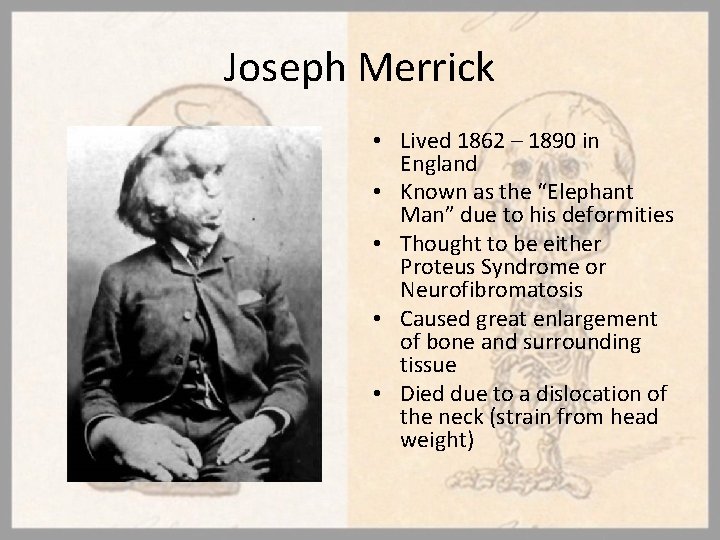
Joseph Merrick • Lived 1862 – 1890 in England • Known as the “Elephant Man” due to his deformities • Thought to be either Proteus Syndrome or Neurofibromatosis • Caused great enlargement of bone and surrounding tissue • Died due to a dislocation of the neck (strain from head weight)
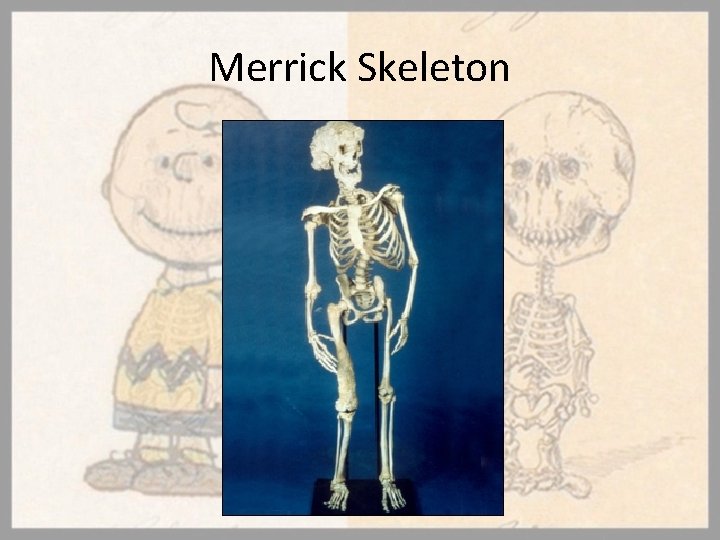
Merrick Skeleton
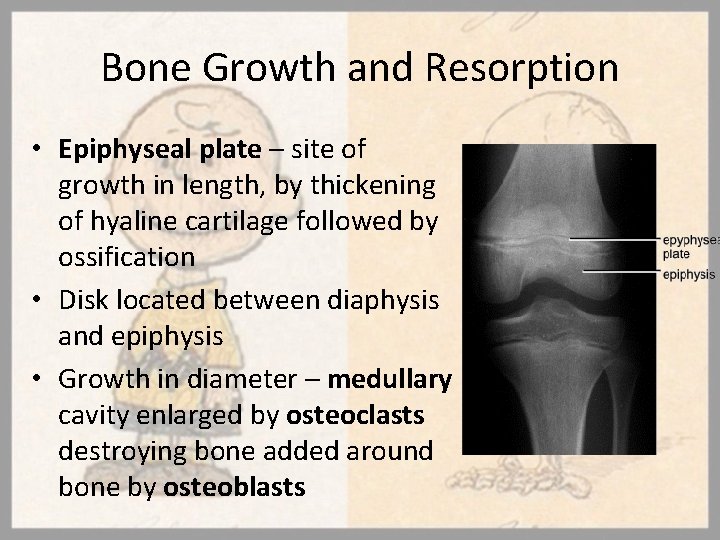
Bone Growth and Resorption • Epiphyseal plate – site of growth in length, by thickening of hyaline cartilage followed by ossification • Disk located between diaphysis and epiphysis • Growth in diameter – medullary cavity enlarged by osteoclasts destroying bone added around bone by osteoblasts
Bone Growth (con’t. ) • Opposing forces of bone formation go on throughout life • Youth: Formation > resorption • Young adult: balance • Age 35 -40+: Resorption greater causing weaker bones • Response to stress includes increasing deposits of calcium and collagen fibers which increases bone strength
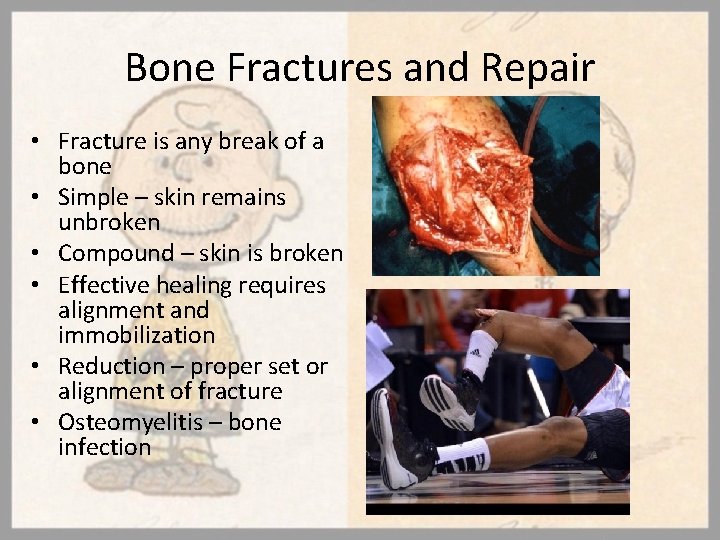
Bone Fractures and Repair • Fracture is any break of a bone • Simple – skin remains unbroken • Compound – skin is broken • Effective healing requires alignment and immobilization • Reduction – proper set or alignment of fracture • Osteomyelitis – bone infection
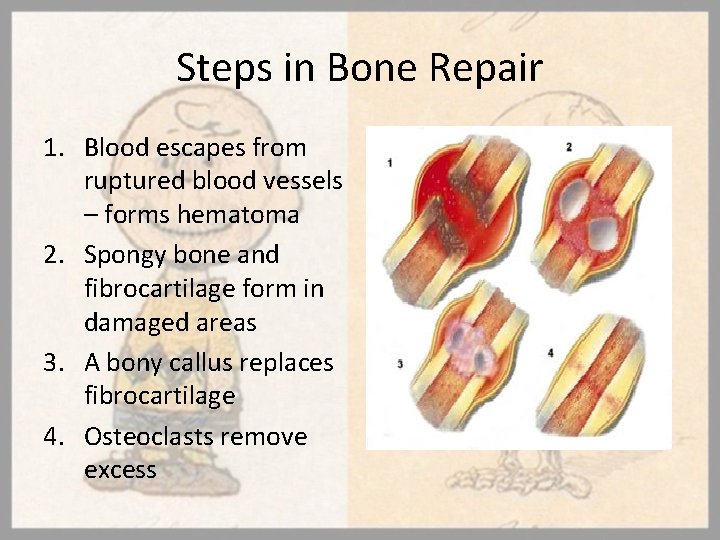
Steps in Bone Repair 1. Blood escapes from ruptured blood vessels – forms hematoma 2. Spongy bone and fibrocartilage form in damaged areas 3. A bony callus replaces fibrocartilage 4. Osteoclasts remove excess
Bone Diseases • Osteoarthritis (OA) – chronic degenerative condition that affects articular cartilage. Aging – Cartilage softens and exposed bones thicken, restricting movement • Rheumatoid Arthritis (RA) – autoimmune disease affecting synovial joints. Cause unknown. – Thicken into pannus which erodes articular cartilage • Osteoporosis – bone-thinning disease – 50% of women, 20% of men
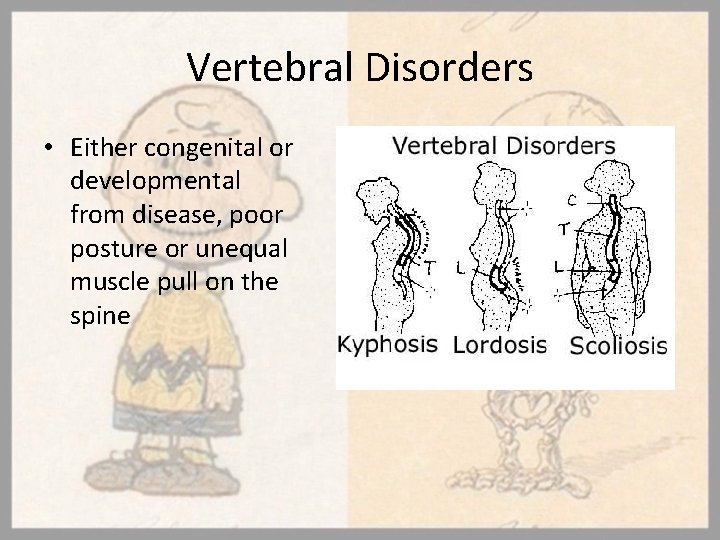
Vertebral Disorders • Either congenital or developmental from disease, poor posture or unequal muscle pull on the spine
Joints of the Skeletal System • Articulations are joints between two bones. • They hold bones together but also permit movement between them. • Can be classified by degree of movement or by type of tissue holding them together
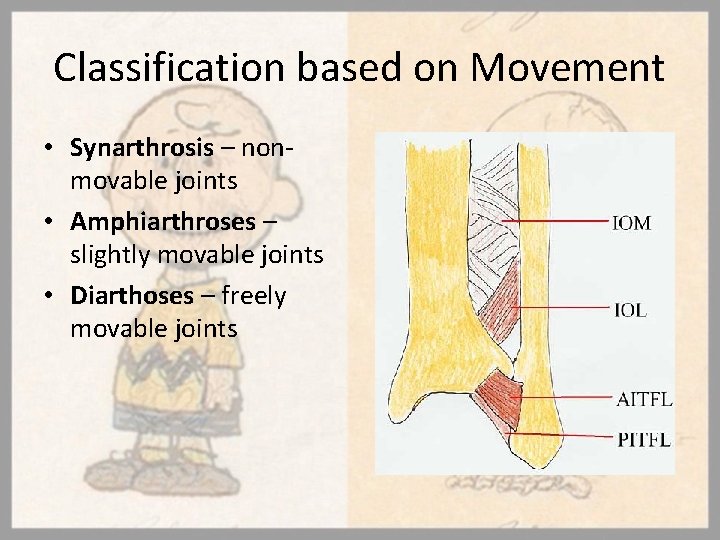
Classification based on Movement • Synarthrosis – nonmovable joints • Amphiarthroses – slightly movable joints • Diarthoses – freely movable joints
Classification based on Tissue • Fibrous joints – united by fibrous tissue. – Syndesmosis – long fibers of conn. Tissue • Includes joints between distal ends of radius and ulna; tibia and fibula • Cartilaginous joints – united by cartilage. – Example: pubic symphysis of pelvis • Synovial joints – joints united by synovial membrane
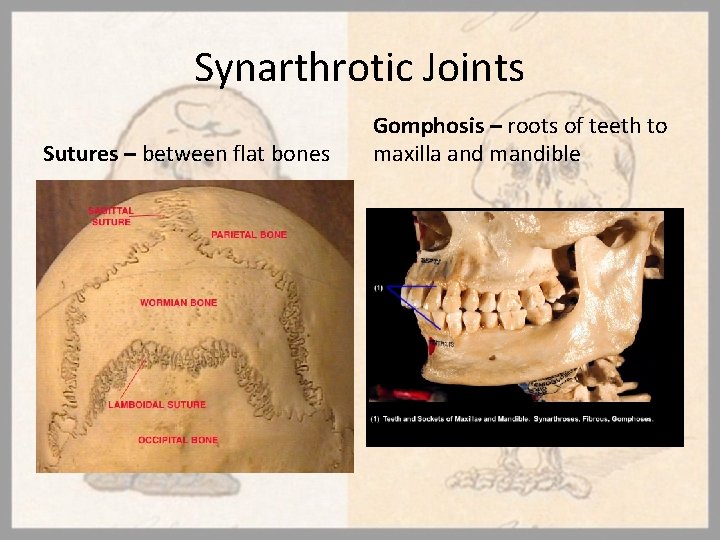
Synarthrotic Joints Sutures – between flat bones Gomphosis – roots of teeth to maxilla and mandible
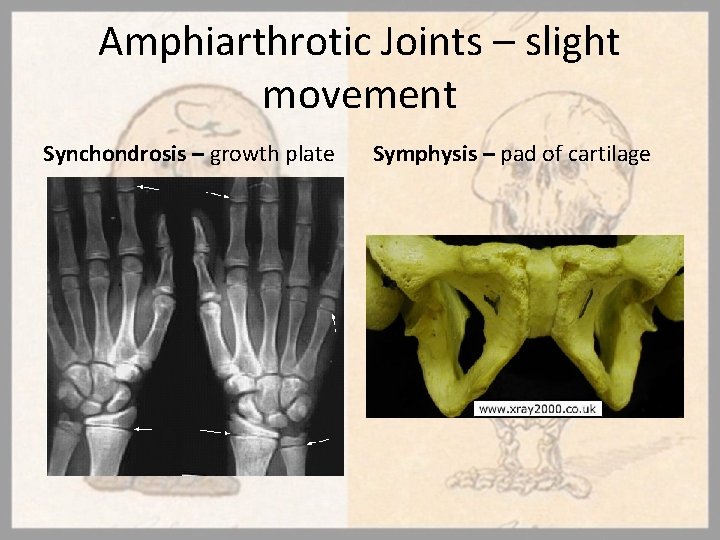
Amphiarthrotic Joints – slight movement Synchondrosis – growth plate Symphysis – pad of cartilage
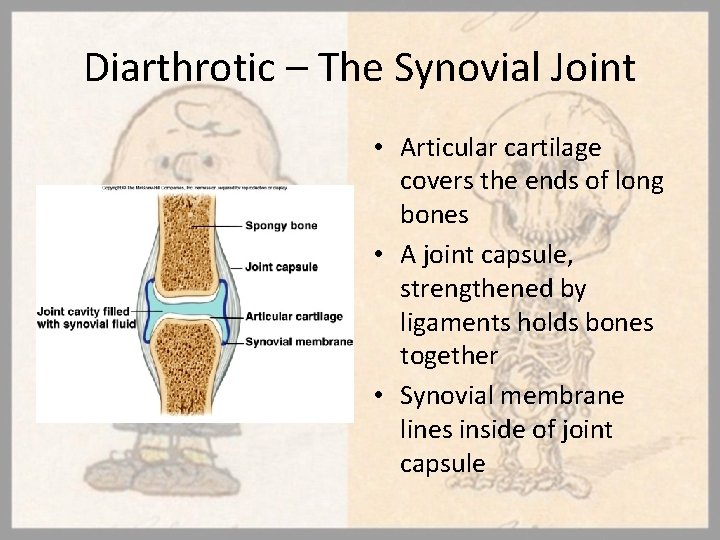
Diarthrotic – The Synovial Joint • Articular cartilage covers the ends of long bones • A joint capsule, strengthened by ligaments holds bones together • Synovial membrane lines inside of joint capsule
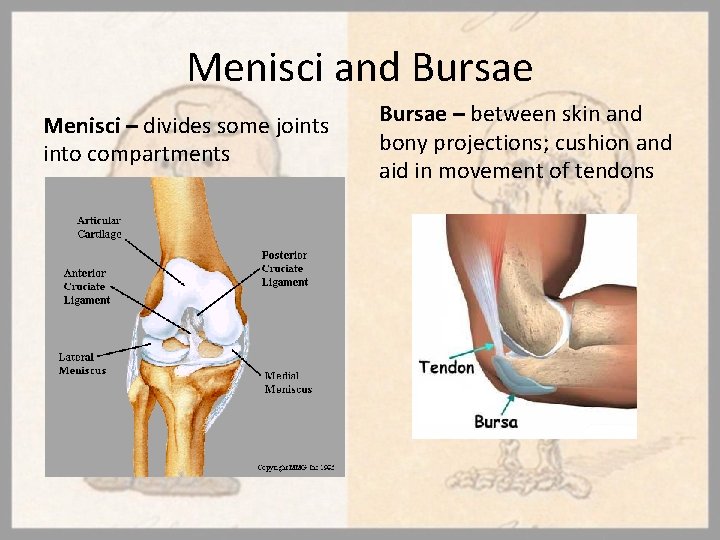
Menisci and Bursae Menisci – divides some joints into compartments Bursae – between skin and bony projections; cushion and aid in movement of tendons
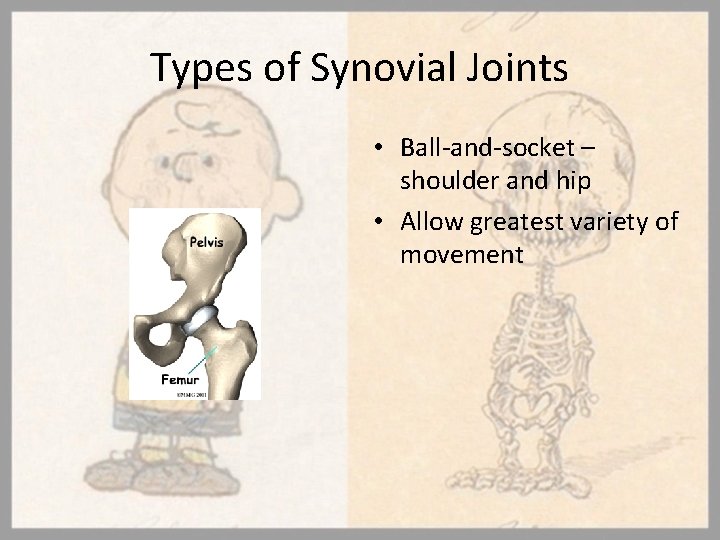
Types of Synovial Joints • Ball-and-socket – shoulder and hip • Allow greatest variety of movement
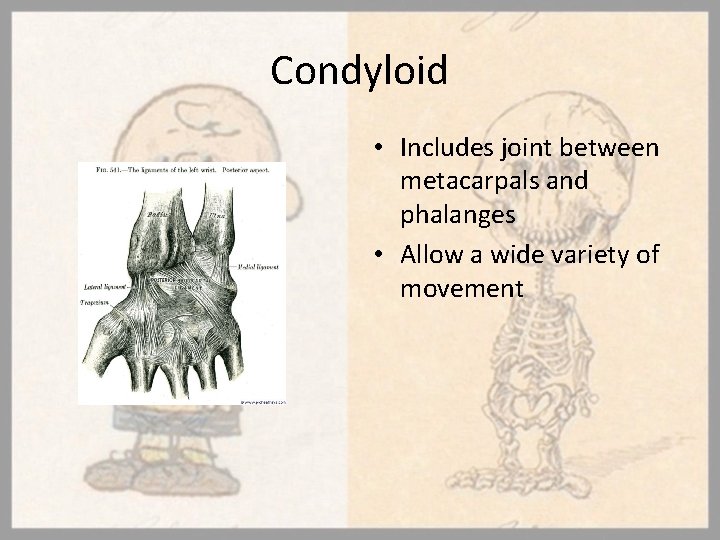
Condyloid • Includes joint between metacarpals and phalanges • Allow a wide variety of movement
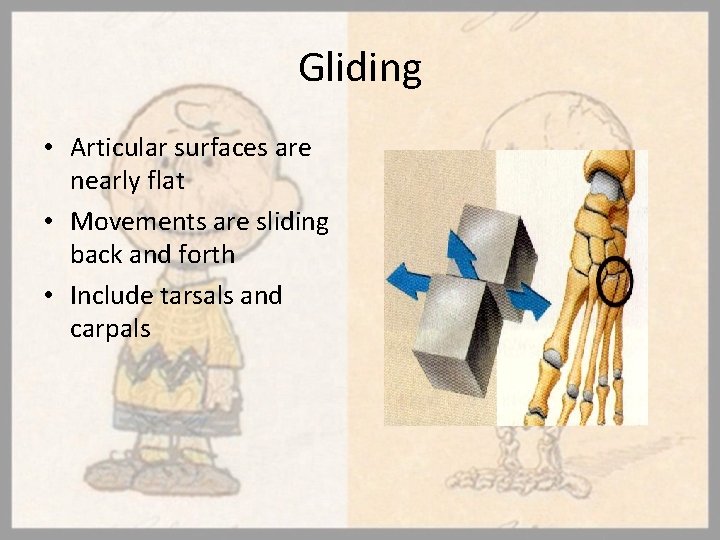
Gliding • Articular surfaces are nearly flat • Movements are sliding back and forth • Include tarsals and carpals
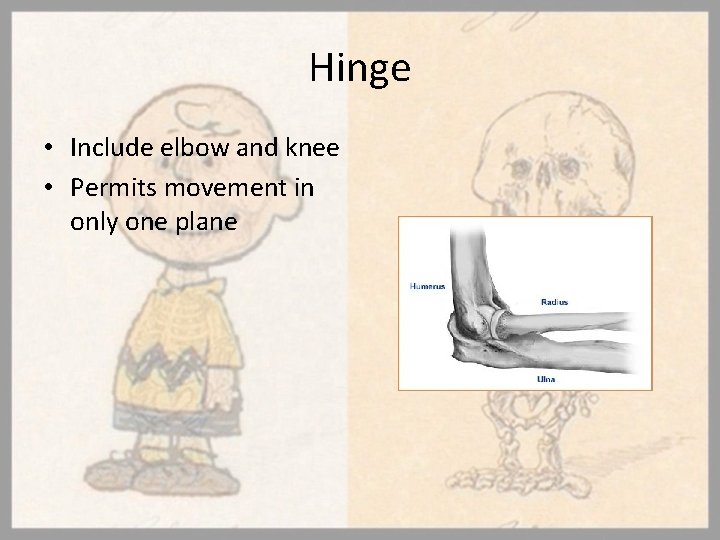
Hinge • Include elbow and knee • Permits movement in only one plane
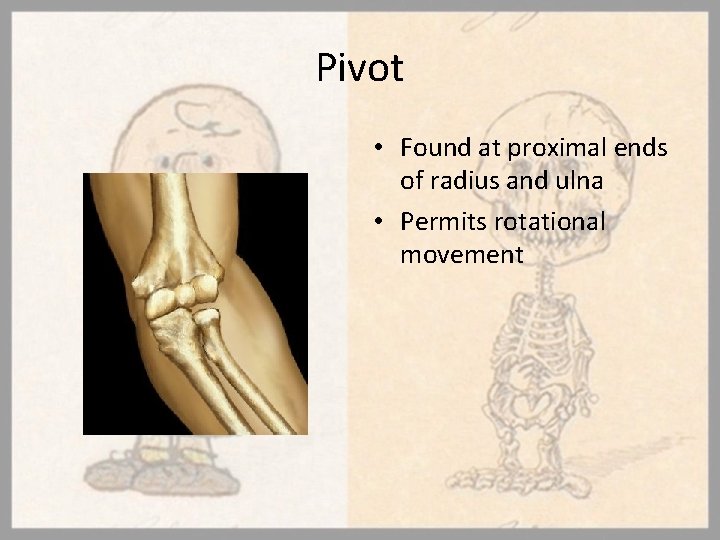
Pivot • Found at proximal ends of radius and ulna • Permits rotational movement
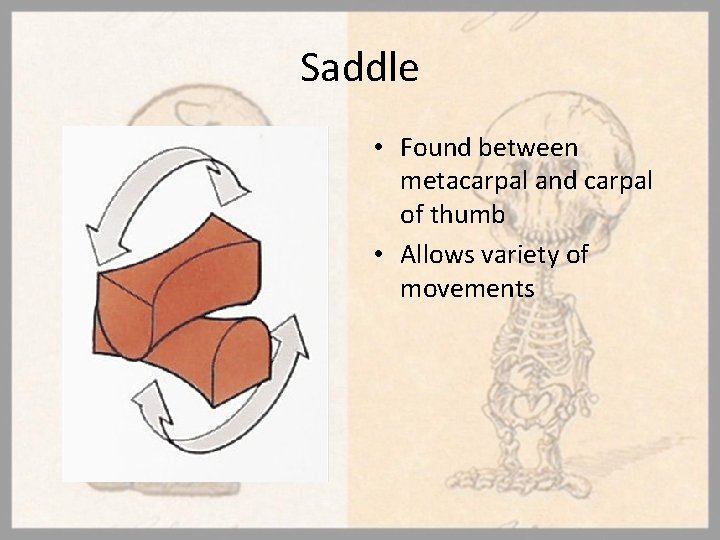
Saddle • Found between metacarpal and carpal of thumb • Allows variety of movements
Movements • Inversion – turning sole inward • Eversion – turning sole outward • Protraction – moving body part forward • Retraction – reverse of protraction • Elevation – moving part upward • Depression – moving part downward • • Flexion – decrease angle Extension – return from flexed position Abduction – move away from midline Adduction – move toward midline Rotation – pivoting bone on central axis Circumduction – moving distal end of bone in a circle causing entire bone to circle Supination – turning palm out Pronation – turning palm in
- Slides: 40